Biliary Atresia
Muhammad Haris Aslam Janjua
Resident, General Surgery
SIMS/Services Hospital, Lahore
Introduction
• Biliary atresia is characterized by obliteration or
discontinuity of the extrahepatic biliary system,
resulting in obstruction to bile flow.
• Most common surgically treatable cause of
Cholestasis in newborns
• If not corrected 
–Secondary biliary cirrhosis
Embryology
• The biliary system originates from the hepatic
diverticulum of the foregut at 4 weeks’
gestation.
• This differentiates into cranial and caudal
components, which give rise to the
intrahepatic and extrahepatic bile ducts,
respectively.
Groups
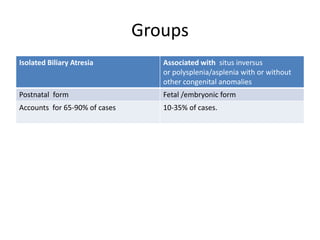
Isolated Biliary Atresia Associated with situs inversus
or polysplenia/asplenia with or without
other congenital anomalies
Postnatal form Fetal /embryonic form
Accounts for 65-90% of cases 10-35% of cases.
Kasai classification system
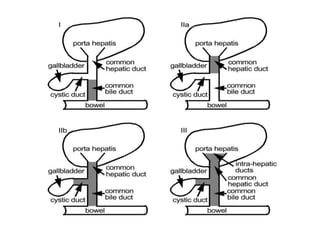
• Type I
– obliteration of the common bile duct
– the proximal ducts are patent
• Type II
– Type IIa is atresia of the hepatic duct, with cystic
bile ducts found at the porta hepatis
– Type IIb is atresia of the cystic duct, common
bile duct, and hepatic ducts
• Type III
– >90% of patients
– atresia occurs at porta hepatis.
• Should not be confused with intrahepatic
biliary hypoplasia,
– Group of distinct and surgically noncorrectable
disorders.
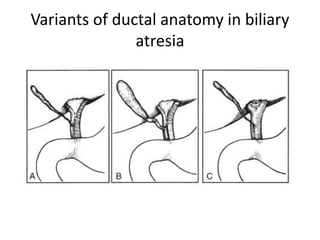
Variants of ductal anatomy in biliary
atresia
Pathophysiology/etiology
• Multifactorial
– Genetic
– Inflammatory
– infectious
• Infectious agents causing bile duct obliteration
(H/P evidence of inflammatory lesion)
– reovirus type 3
– rotavirus and
– cytomegalovirus (CMV)
• Other causes include
– bile duct ischemia,
– abnormal bile acid metabolism,
– pancreaticobiliary maljunction
– environmental toxins
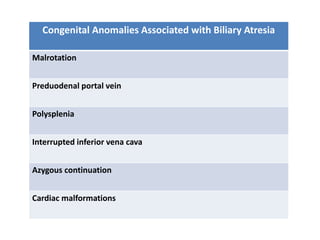
Congenital Anomalies Associated with Biliary Atresia
Malrotation
Preduodenal portal vein
Polysplenia
Interrupted inferior vena cava
Azygous continuation
Cardiac malformations
Epidemiology
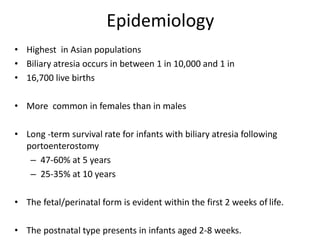
• Highest in Asian populations
• Biliary atresia occurs in between 1 in 10,000 and 1 in
• 16,700 live births
• More common in females than in males
• Long -term survival rate for infants with biliary atresia following
portoenterostomy
– 47-60% at 5 years
– 25-35% at 10 years
• The fetal/perinatal form is evident within the first 2 weeks of life.
• The postnatal type presents in infants aged 2-8 weeks.
Diagnosis
• History
– jaundice, dark urine, and light stools.
– In most cases, acholic stools are not noted at birth
but develop over the first few weeks of life.
– Appetite, growth, and weight gain may be normal
during the first few weeks of life.
Physical findings
• Hepatomegaly may be present early, and the
liver is often firm or hard to palpation.
• Splenomegaly is common,
– Enlarging spleen suggests progressive cirrhosis with
portal hypertension
• In fetal/neonatal form (polysplenia/asplenia
syndrome),
– midline liver may be palpated in the epigastrium .
• Cardiac murmurs  associated cardiac
anomalies
Imp points
• Direct hyperbilirubinemia is always an abnormal
finding and may be present from birth in the
fetal/embryonic form.
• Consider biliary atresia in all neonates with
direct hyperbilirubinemia.
• Physiologic unconjugated hyperbilirubinemia
rarely persists beyond 2 weeks.
– Infants with prolonged physiologic jaundice must be
evaluated for other causes.
• A high index of suspicion is key to making a
diagnosis
– because surgical treatment by age 2 months has
clearly been shown to improve
• the likelihood of establishing bile flow
• prevent the development of irreversible biliary
cirrhosis.
Work Up
• Labs
1. Serum bilirubin (total and direct)
• infants show only moderate elevations in total bilirubin,
which is commonly 6-12 mg/dL, with the direct fraction
comprising 50-60% of total serum bilirubin.
2. Alkaline phosphatase (AP), 5' nucleotidase,
gamma-glutamyl transpeptidase(GGTP), serum
aminotransferases, serum bile acids
• 3. Serum alpha1-antitrypsin with Pi typing:
• Alpha1-antitrypsin deficiency is the most common
inherited liver disease that presents with neonatal
cholestasis.
• 4. Sweat chloride (Cl):
– Biliary tract involvement is a well-recognized complication
of cystic fibrosis (CF)
Imaging studies
• Ultrasonography
– exclude specific anomalies of the extrahepatic
biliary system, particularly choledochal cysts.
– In biliary atresia it may demonstrate absence of
the gallbladder and no dilatation of the biliary
tree.
– sensitivity and specificity do not exceed 80%
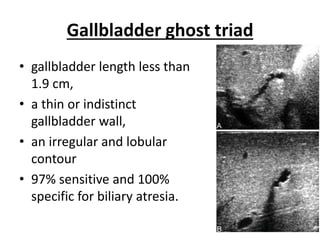
Gallbladder ghost triad
• gallbladder length less than
1.9 cm,
• a thin or indistinct
gallbladder wall,
• an irregular and lobular
contour
• 97% sensitive and 100%
specific for biliary atresia.
• Hepatobiliary scintiscanning
– using technetium-labeled diisopropyl iminodiacetic acid
(DISIDA) nuclear scintiscan,
– intestinal excretion of radiolabel confirms patency of the
extrahepatic biliary system.
• If time allows, all jaundiced infants undergoing
hepatobiliary scintigraphy should be pretreated with
phenobarbital (5 mg/kg/day) for 5 days before the
study.
– sensitivity of hepatobiliary scintigraphy is high (~100%).
– The specificity is 93% specific, and 94.6% accurate in
diagnosing biliary atresia following pretreatment with
phenobarbital
– disadvantages
• reliability of the scintiscan is diminished at very high
conjugated bilirubin levels (>20 mg/dL).
• 10% rate of false-positive or false-negative diagnostic
errors
• MRCP
– incomplete visualization of the extrahepatic
biliary system
– sensitivity and specificity of 90% and 77%,
respectively.
• Endoscopic retrograde cholangiopancreatography
(ERCP)
• Percutaneous liver biopsy
• most accurate nonsurgical diagnostic test
• differentiate between obstructive and
hepatocellular causes of cholestasis,
• with 90% sensitivity and specificity for biliary atresia
– bile ductular proliferation in the liver biopsy is
considered diagnostic for biliary atresia
• Intraoperative cholangiography:
– demonstrates anatomy and patency of the extrahepatic
biliary tract.
Management
• Surgical intervention is the only mechanism for a
– definitive diagnosis (intraoperative cholangiogram)
– therapy (Kasai portoenterostomy).
• Preoperative oral supplementation with fat-soluble
vitamins or an intramuscular injection of vitamin K
(1 mg) should be considered.
• During the operation, the fibrotic biliary tract
remnant is identified, and the patency of the
biliary system is assessed
• In cases in which biliary patency is associated
with ductal hypoplasia, further surgical
intervention is not indicated,
• Bile may be collected to evaluate for disorders
of bile acid metabolism.
• In most cases of atresia, dissection into the
porta hepatis and creation of a Roux-en-Y
anastomosis with a 35-cm to 40-cm retrocolic
jejunal segment is the procedure of choice.
Kasai procedure
• Infant should be placed supine
• Right upper abdominal incision given
• LHQ is searched for spleen
– Absence of the spleen or the finding of polysplenia
can alert the surgeon to the presence of important
associated anomalies
• Next, the liver, biliary structures, and porta are
inspected
– Liver is nodular and fibrotic with greenish colour
• If Rudimentary fibrous gallbladder is noted at
initial exploration and if it clearly has no lumen,
– diagnosis of biliary atresia has been confirmed and
the operation can proceed with dissection of the
portal plate
• If G.B is Normal then fluid in lumen of G.B is aspirated
– If fluid is white proceed for portal plate dissection
– If fluid is dark or there is any doubt intraoperative
cholangiogram is done
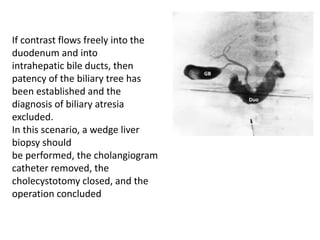
If contrast flows freely into the
duodenum and into
intrahepatic bile ducts, then
patency of the biliary tree has
been established and the
diagnosis of biliary atresia
excluded.
In this scenario, a wedge liver
biopsy should
be performed, the cholangiogram
catheter removed, the
cholecystotomy closed, and the
operation concluded
• The peritoneum overlying the hepatoduodenal
ligament is opened to allow identification of the
structures in this area.
• Fibrous remnant of the distal common bile duct is
often present here.
• As dissection continues proximally, the biliary
remnant develops into a cone of fibrotic tissue that
is located at the bifurcation of the main portal vein
into its left and right branches.
– most important landmark during the dissection of the
portal plate and should be the goal of every dissection
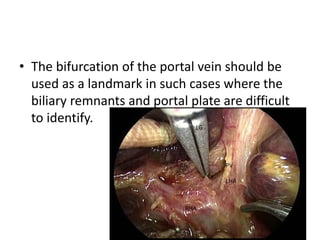
• The bifurcation of the portal vein should be
used as a landmark in such cases where the
biliary remnants and portal plate are difficult
to identify.
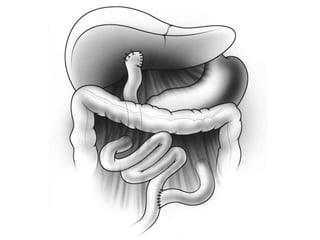
• After portal plate dissection roux limb is
constructed.
• Proximal jejunum is identified and transected about
10 centimeters distal to the ligament of Treitz
• The distal end, destined for the right upper
quadrant, is oversewn and the Roux limb is
measured to 40 to 50 centimeters. At this location,
an end-to-side jejunojejunostomy is created with
interrupted absorbable sutures.
• The oversewn end of the Roux limb is carefully
brought into the right upper quadrant via a small
defect created in the avascular portion of the
transverse mesocolon.
• The side of the Roux limb is opened, and the
portoenterostomy is created.
• Mesenteric defect created by construction of
the Roux limb and to anchor the Roux limb to
the edges of the defect in the transverse
mesocolon.
• Small closed suction drain is placed near the
portoenteric anastomosis, and a wedge liver
biopsy is routinely performed
POSTOPERATIVE CARE
• Drainage of gastric secretions with a
nasogastric tube should continue for the first
48 hours, then removed
• NPO can be broken at 2nd or 3rd day .
• Drain removed at 5th P.O.D
• Antibiotics, a choleretic agent, fat-soluble
vitamin supplements, and an oral steroid
taper is used routinely.
Postoperative Medical Regimen After Hepatic
Portoenterostomy
• Ursodiol (Actigall)—10-15 mg/kg/dose BID day
• Trimethoprim-Sulfamethoxazole—2.5 mg/kg/day based on Trimethoprim
component dosing
• Vitamins ADEK drops—1 mL/day
• Prednisone—2 mg/kg/day and taper over 6 weeks
Tid bits
• Pigmented stools either immediately or within the
first 10 to 14 days after surgery suggest successful
bile flow from the liver to the intestinal tract
• Half will continue to drain bile well, with efficient
clearance of jaundice and normal development. This
is considered a ā€œcure,ā€ and liver transplantation is
not necessary
• In other half liver failure will evetually develop
slowly  Liver transplantation
• In 15 to 30% early liver transplatation is required
When to operate
• Goal is to operate before 70 to 90 days of life.
It is important to note, however, that hepatic
portoenterostomy is not contraindicated after
90 days of age.
• A study of older children (100 days) revealed
acceptable survival rates, supporting the use
of the procedure, if possible, even in older
infants
Complications
• Cholangitis 33 to 60% of patients following
portoenterostomy.
– Treat with I/V fluids, broad spectrumm antibiotics,
choleretic agents and steroids.
• Anastomosis failure to achieve adequate bile
drainage.
• Portal hypertension occur in more than 34-76% of
infants.
– Eventually require liver transplant.
• Progressive liver disease .
• Hepatocellular carcinoma
• Progressive fibrosis and biliary cirrhosis
develop in children who do not drain bile,
– liver transplantation is the only option for long-
term survival.
Available at surgicalpresentations

Biliary Atresia

  • 1.
    Biliary Atresia Muhammad HarisAslam Janjua Resident, General Surgery SIMS/Services Hospital, Lahore
  • 2.
    Introduction • Biliary atresiais characterized by obliteration or discontinuity of the extrahepatic biliary system, resulting in obstruction to bile flow. • Most common surgically treatable cause of Cholestasis in newborns • If not corrected  –Secondary biliary cirrhosis
  • 3.
    Embryology • The biliarysystem originates from the hepatic diverticulum of the foregut at 4 weeks’ gestation. • This differentiates into cranial and caudal components, which give rise to the intrahepatic and extrahepatic bile ducts, respectively.
  • 4.
    Groups Isolated Biliary AtresiaAssociated with situs inversus or polysplenia/asplenia with or without other congenital anomalies Postnatal form Fetal /embryonic form Accounts for 65-90% of cases 10-35% of cases.
  • 5.
    Kasai classification system •Type I – obliteration of the common bile duct – the proximal ducts are patent • Type II – Type IIa is atresia of the hepatic duct, with cystic bile ducts found at the porta hepatis – Type IIb is atresia of the cystic duct, common bile duct, and hepatic ducts
  • 6.
    • Type III –>90% of patients – atresia occurs at porta hepatis. • Should not be confused with intrahepatic biliary hypoplasia, – Group of distinct and surgically noncorrectable disorders.
  • 8.
    Variants of ductalanatomy in biliary atresia
  • 9.
    Pathophysiology/etiology • Multifactorial – Genetic –Inflammatory – infectious • Infectious agents causing bile duct obliteration (H/P evidence of inflammatory lesion) – reovirus type 3 – rotavirus and – cytomegalovirus (CMV)
  • 10.
    • Other causesinclude – bile duct ischemia, – abnormal bile acid metabolism, – pancreaticobiliary maljunction – environmental toxins
  • 11.
    Congenital Anomalies Associatedwith Biliary Atresia Malrotation Preduodenal portal vein Polysplenia Interrupted inferior vena cava Azygous continuation Cardiac malformations
  • 12.
    Epidemiology • Highest inAsian populations • Biliary atresia occurs in between 1 in 10,000 and 1 in • 16,700 live births • More common in females than in males • Long -term survival rate for infants with biliary atresia following portoenterostomy – 47-60% at 5 years – 25-35% at 10 years • The fetal/perinatal form is evident within the first 2 weeks of life. • The postnatal type presents in infants aged 2-8 weeks.
  • 13.
    Diagnosis • History – jaundice,dark urine, and light stools. – In most cases, acholic stools are not noted at birth but develop over the first few weeks of life. – Appetite, growth, and weight gain may be normal during the first few weeks of life.
  • 14.
    Physical findings • Hepatomegalymay be present early, and the liver is often firm or hard to palpation. • Splenomegaly is common, – Enlarging spleen suggests progressive cirrhosis with portal hypertension • In fetal/neonatal form (polysplenia/asplenia syndrome), – midline liver may be palpated in the epigastrium . • Cardiac murmurs  associated cardiac anomalies
  • 15.
    Imp points • Directhyperbilirubinemia is always an abnormal finding and may be present from birth in the fetal/embryonic form. • Consider biliary atresia in all neonates with direct hyperbilirubinemia. • Physiologic unconjugated hyperbilirubinemia rarely persists beyond 2 weeks. – Infants with prolonged physiologic jaundice must be evaluated for other causes.
  • 16.
    • A highindex of suspicion is key to making a diagnosis – because surgical treatment by age 2 months has clearly been shown to improve • the likelihood of establishing bile flow • prevent the development of irreversible biliary cirrhosis.
  • 17.
    Work Up • Labs 1.Serum bilirubin (total and direct) • infants show only moderate elevations in total bilirubin, which is commonly 6-12 mg/dL, with the direct fraction comprising 50-60% of total serum bilirubin. 2. Alkaline phosphatase (AP), 5' nucleotidase, gamma-glutamyl transpeptidase(GGTP), serum aminotransferases, serum bile acids
  • 18.
    • 3. Serumalpha1-antitrypsin with Pi typing: • Alpha1-antitrypsin deficiency is the most common inherited liver disease that presents with neonatal cholestasis. • 4. Sweat chloride (Cl): – Biliary tract involvement is a well-recognized complication of cystic fibrosis (CF)
  • 19.
    Imaging studies • Ultrasonography –exclude specific anomalies of the extrahepatic biliary system, particularly choledochal cysts. – In biliary atresia it may demonstrate absence of the gallbladder and no dilatation of the biliary tree. – sensitivity and specificity do not exceed 80%
  • 20.
    Gallbladder ghost triad •gallbladder length less than 1.9 cm, • a thin or indistinct gallbladder wall, • an irregular and lobular contour • 97% sensitive and 100% specific for biliary atresia.
  • 21.
    • Hepatobiliary scintiscanning –using technetium-labeled diisopropyl iminodiacetic acid (DISIDA) nuclear scintiscan, – intestinal excretion of radiolabel confirms patency of the extrahepatic biliary system. • If time allows, all jaundiced infants undergoing hepatobiliary scintigraphy should be pretreated with phenobarbital (5 mg/kg/day) for 5 days before the study. – sensitivity of hepatobiliary scintigraphy is high (~100%). – The specificity is 93% specific, and 94.6% accurate in diagnosing biliary atresia following pretreatment with phenobarbital
  • 22.
    – disadvantages • reliabilityof the scintiscan is diminished at very high conjugated bilirubin levels (>20 mg/dL). • 10% rate of false-positive or false-negative diagnostic errors
  • 23.
    • MRCP – incompletevisualization of the extrahepatic biliary system – sensitivity and specificity of 90% and 77%, respectively.
  • 24.
    • Endoscopic retrogradecholangiopancreatography (ERCP) • Percutaneous liver biopsy • most accurate nonsurgical diagnostic test • differentiate between obstructive and hepatocellular causes of cholestasis, • with 90% sensitivity and specificity for biliary atresia – bile ductular proliferation in the liver biopsy is considered diagnostic for biliary atresia • Intraoperative cholangiography: – demonstrates anatomy and patency of the extrahepatic biliary tract.
  • 25.
    Management • Surgical interventionis the only mechanism for a – definitive diagnosis (intraoperative cholangiogram) – therapy (Kasai portoenterostomy). • Preoperative oral supplementation with fat-soluble vitamins or an intramuscular injection of vitamin K (1 mg) should be considered. • During the operation, the fibrotic biliary tract remnant is identified, and the patency of the biliary system is assessed
  • 26.
    • In casesin which biliary patency is associated with ductal hypoplasia, further surgical intervention is not indicated, • Bile may be collected to evaluate for disorders of bile acid metabolism. • In most cases of atresia, dissection into the porta hepatis and creation of a Roux-en-Y anastomosis with a 35-cm to 40-cm retrocolic jejunal segment is the procedure of choice.
  • 27.
    Kasai procedure • Infantshould be placed supine • Right upper abdominal incision given • LHQ is searched for spleen – Absence of the spleen or the finding of polysplenia can alert the surgeon to the presence of important associated anomalies • Next, the liver, biliary structures, and porta are inspected – Liver is nodular and fibrotic with greenish colour
  • 28.
    • If Rudimentaryfibrous gallbladder is noted at initial exploration and if it clearly has no lumen, – diagnosis of biliary atresia has been confirmed and the operation can proceed with dissection of the portal plate • If G.B is Normal then fluid in lumen of G.B is aspirated – If fluid is white proceed for portal plate dissection – If fluid is dark or there is any doubt intraoperative cholangiogram is done
  • 29.
    If contrast flowsfreely into the duodenum and into intrahepatic bile ducts, then patency of the biliary tree has been established and the diagnosis of biliary atresia excluded. In this scenario, a wedge liver biopsy should be performed, the cholangiogram catheter removed, the cholecystotomy closed, and the operation concluded
  • 30.
    • The peritoneumoverlying the hepatoduodenal ligament is opened to allow identification of the structures in this area. • Fibrous remnant of the distal common bile duct is often present here. • As dissection continues proximally, the biliary remnant develops into a cone of fibrotic tissue that is located at the bifurcation of the main portal vein into its left and right branches. – most important landmark during the dissection of the portal plate and should be the goal of every dissection
  • 31.
    • The bifurcationof the portal vein should be used as a landmark in such cases where the biliary remnants and portal plate are difficult to identify.
  • 32.
    • After portalplate dissection roux limb is constructed. • Proximal jejunum is identified and transected about 10 centimeters distal to the ligament of Treitz • The distal end, destined for the right upper quadrant, is oversewn and the Roux limb is measured to 40 to 50 centimeters. At this location, an end-to-side jejunojejunostomy is created with interrupted absorbable sutures. • The oversewn end of the Roux limb is carefully brought into the right upper quadrant via a small defect created in the avascular portion of the transverse mesocolon.
  • 33.
    • The sideof the Roux limb is opened, and the portoenterostomy is created. • Mesenteric defect created by construction of the Roux limb and to anchor the Roux limb to the edges of the defect in the transverse mesocolon. • Small closed suction drain is placed near the portoenteric anastomosis, and a wedge liver biopsy is routinely performed
  • 35.
    POSTOPERATIVE CARE • Drainageof gastric secretions with a nasogastric tube should continue for the first 48 hours, then removed • NPO can be broken at 2nd or 3rd day . • Drain removed at 5th P.O.D • Antibiotics, a choleretic agent, fat-soluble vitamin supplements, and an oral steroid taper is used routinely.
  • 36.
    Postoperative Medical RegimenAfter Hepatic Portoenterostomy • Ursodiol (Actigall)—10-15 mg/kg/dose BID day • Trimethoprim-Sulfamethoxazole—2.5 mg/kg/day based on Trimethoprim component dosing • Vitamins ADEK drops—1 mL/day • Prednisone—2 mg/kg/day and taper over 6 weeks
  • 37.
    Tid bits • Pigmentedstools either immediately or within the first 10 to 14 days after surgery suggest successful bile flow from the liver to the intestinal tract • Half will continue to drain bile well, with efficient clearance of jaundice and normal development. This is considered a ā€œcure,ā€ and liver transplantation is not necessary • In other half liver failure will evetually develop slowly  Liver transplantation • In 15 to 30% early liver transplatation is required
  • 38.
    When to operate •Goal is to operate before 70 to 90 days of life. It is important to note, however, that hepatic portoenterostomy is not contraindicated after 90 days of age. • A study of older children (100 days) revealed acceptable survival rates, supporting the use of the procedure, if possible, even in older infants
  • 39.
    Complications • Cholangitis 33to 60% of patients following portoenterostomy. – Treat with I/V fluids, broad spectrumm antibiotics, choleretic agents and steroids. • Anastomosis failure to achieve adequate bile drainage. • Portal hypertension occur in more than 34-76% of infants. – Eventually require liver transplant. • Progressive liver disease .
  • 40.
    • Hepatocellular carcinoma •Progressive fibrosis and biliary cirrhosis develop in children who do not drain bile, – liver transplantation is the only option for long- term survival.
  • 41.