

CanCer : Can beCanCer : Can be
ConqueredConquered
Dr. kundan
Surgical Oncologist
Rajiv Gandhi Cancer Institute & Research Centre,
Niti Bagh Delhi
What is cancer?
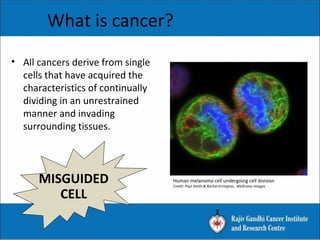
• All cancers derive from single
cells that have acquired the
characteristics of continually
dividing in an unrestrained
manner and invading
surrounding tissues.
Human melanoma cell undergoing cell division
Credit: Paul Smith & Rachel Errington, Wellcome Images
MISGUIDED
CELL
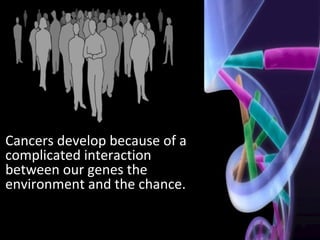
Cancers develop because of a
complicated interaction
between our genes the
environment and the chance.
Cancer can affect people of all
nationalities and age groups
but 60% of cancer
deaths occur in
people older than 60
years
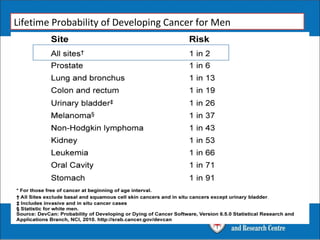
Lifetime Probability of Developing Cancer for Men
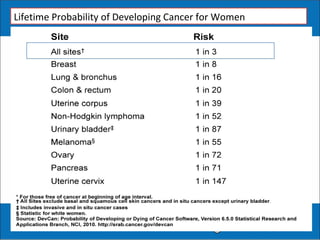
Lifetime Probability of Developing Cancer for Women
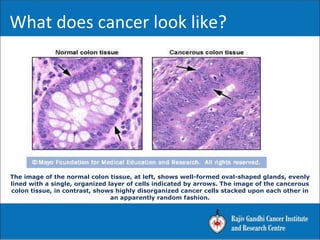
The image of the normal colon tissue, at left, shows well-formed oval-shaped glands, evenly
lined with a single, organized layer of cells indicated by arrows. The image of the cancerous
colon tissue, in contrast, shows highly disorganized cancer cells stacked upon each other in
an apparently random fashion.
What does cancer look like?
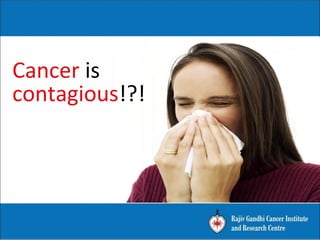
Cancer is
contagious!?!
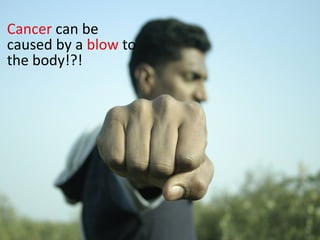
Cancer can be
caused by a blow to
the body!?!
Burden of Cancer
• One in eight deaths worldwide is due to
cancer. Worldwide, cancer causes more
deaths than AIDS, tuberculosis, and malaria
combined
• 12.4 million incidence of cancer was
estimated and 7.6 million deaths estimated
due to cancer in 2008 worldwide
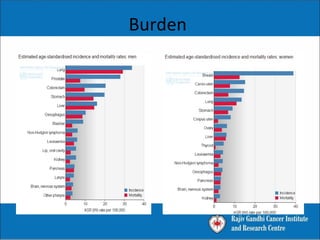
Burden
– Carcinoma
• Arises from the epithelial cells lining the internal
surface of various organs (e.g. mouth, oesophagus,
uterus)
– Sarcoma
• Arises from the mesodermal cells constituting the
various connective tissues (e.g. fibrous tissue, bone)
– Lymphoma, myeloma and leukemia
• Arising from the cells of the bone marrow and immune
system
Major categories of cancer
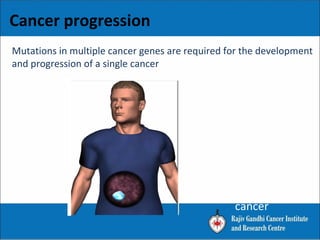
Cancer progression
Benign Tumour
In situ cancer
Invasive cancer
Metastatic
cancer
Mutations in multiple cancer genes are required for the development
and progression of a single cancer
Risk Factors
• Non Modifiable
- Age
- Sex
- Genetic factor
• Modifiable
- Tobacco
- Chronic infection
- Alcohol drinking
- Occupational exposure
- Dietary factors
- Obesity and physical
exercise
- Radiation
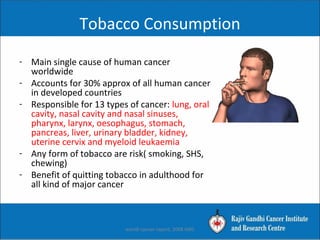
Tobacco Consumption
- Main single cause of human cancer
worldwide
- Accounts for 30% approx of all human cancer
in developed countries
- Responsible for 13 types of cancer: lung, oral
cavity, nasal cavity and nasal sinuses,
pharynx, larynx, oesophagus, stomach,
pancreas, liver, urinary bladder, kidney,
uterine cervix and myeloid leukaemia
- Any form of tobacco are risk( smoking, SHS,
chewing)
- Benefit of quitting tobacco in adulthood for
all kind of major cancer
worldl cancer report, 2008 IARC
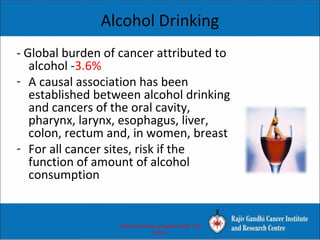
Alcohol Drinking
- Global burden of cancer attributed to
alcohol -3.6%
- A causal association has been
established between alcohol drinking
and cancers of the oral cavity,
pharynx, larynx, esophagus, liver,
colon, rectum and, in women, breast
- For all cancer sites, risk if the
function of amount of alcohol
consumption
oxford text book of public health, 5th
edition
Dietary Factors, Obesity and Physical
activities
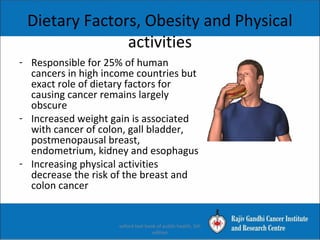
- Responsible for 25% of human
cancers in high income countries but
exact role of dietary factors for
causing cancer remains largely
obscure
- Increased weight gain is associated
with cancer of colon, gall bladder,
postmenopausal breast,
endometrium, kidney and esophagus
- Increasing physical activities
decrease the risk of the breast and
colon cancer
oxford text book of public health, 5th
edition
• Dietary factor
– Smoked fish is related to stomach cancer
– Dietary fiber to intestinal cancer
– Beef consumption to bowel cancer
– High fat diet to breast cancer
– Food additives and contaminants have fallen
under suspicion as causative agents
• Genetic influences have long been suspected
• Retinoblastoma occurs in children of the same
parent
• Mongols are more likely to develop leukemia
• There is probably a complex relationship
between hereditary susceptibility and
environmental carcinogenic stimuli in the
causation of cancer
Genetic factors
Biological factor: virus
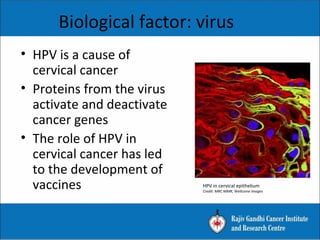
• HPV is a cause of
cervical cancer
• Proteins from the virus
activate and deactivate
cancer genes
• The role of HPV in
cervical cancer has led
to the development of
vaccines HPV in cervical epithelium
Credit: MRC NIMR, Wellcome Images
• Virus
– Hepatitis B & C - hepatocarcinoma
– HIV infection – kaposi’s carcinoma
– AIDS – non Hodgkin’s lymphoma
– Epstein – bar virus – Burkitts lymphoma and naso
– pharyngial carcinoma
– Cytomegalovirus – Kaposi’s Sa
– Pappiloma virus – cervix cancer
– Human T cell leukemia virus – T cell leukemia
• Occupational exposures
– These includes exposure to benzene, cadmium,
arsenic, chromium, vinyl chloride, asbestos,
polycyclic hydrocarbons, etc.
– The risk of occupational exposure is said to be
increased if the individual also smokes cigarette
– Occupational exposure is usually reported 1-5% of
human cancer
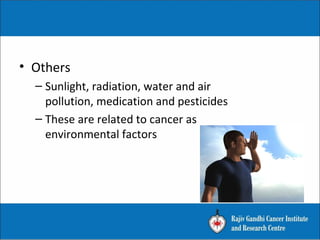
• Others
– Sunlight, radiation, water and air
pollution, medication and pesticides
– These are related to cancer as
environmental factors
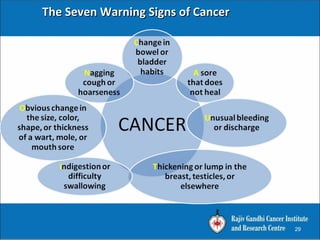
The Seven Warning Signs of CancerThe Seven Warning Signs of Cancer
29
• It consists of prevention, detection, diagnosis,prevention, detection, diagnosis,
treatment,treatment, after care and rehabilitation,
reducing incidence and prevalence
• Primary control
– Reducing the exposure to the risk factors
– Control of Tabaco and alcohol consumption
• Control of these two will reduce the total burden of
cancer by 1 million cases per year
Cancer control
• Personal hygiene
– Improvement in hygiene may decline the incidence of
certain types of cancers
• Radiation
– Effort should be made to reduce the amount of
radiation received by each individuals to a minimum
without reducing the benefits
• Occupational Exposure
– Should protect workers from exposure to industrial
carcinogens
• Food, drugs, and cosmetics
– Should be tested for carcinogens
• Air pollutions
– Control of air pollution is a preventive measure
• Treatment of pre cancerous lesions
– Early detection and prompt treatment of
precanerous lesions
• Legislation
– It comes under primary prevention
• Cancer registration
– Hospital-based registries
– Population based registries
• Early detection of cases
• Treatment
Secondary Prevention
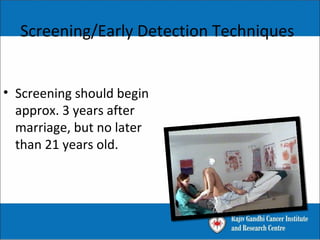
Screening/Early Detection Techniques
• Screening should begin
approx. 3 years after
marriage, but no later
than 21 years old.
• Pelvic Exam
• PAP Test
Treatment
• Multimodality
• Surgery
• Chemotherapy
• Radiotherapy
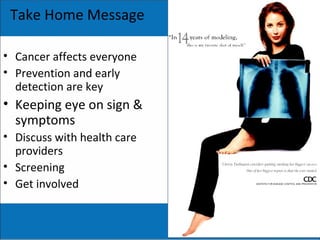
Take Home Message
• Cancer affects everyone
• Prevention and early
detection are key
• Keeping eye on sign &
symptoms
• Discuss with health care
providers
• Screening
• Get involved
Cancer- myths

Cancer- myths

  • 1.
    CanCer : CanbeCanCer : Can be ConqueredConquered Dr. kundan Surgical Oncologist Rajiv Gandhi Cancer Institute & Research Centre, Niti Bagh Delhi
  • 5.
    What is cancer? •All cancers derive from single cells that have acquired the characteristics of continually dividing in an unrestrained manner and invading surrounding tissues. Human melanoma cell undergoing cell division Credit: Paul Smith & Rachel Errington, Wellcome Images MISGUIDED CELL
  • 6.
    Cancers develop becauseof a complicated interaction between our genes the environment and the chance.
  • 7.
    Cancer can affectpeople of all nationalities and age groups but 60% of cancer deaths occur in people older than 60 years
  • 8.
    Lifetime Probability ofDeveloping Cancer for Men
  • 9.
    Lifetime Probability ofDeveloping Cancer for Women
  • 10.
    The image ofthe normal colon tissue, at left, shows well-formed oval-shaped glands, evenly lined with a single, organized layer of cells indicated by arrows. The image of the cancerous colon tissue, in contrast, shows highly disorganized cancer cells stacked upon each other in an apparently random fashion. What does cancer look like?
  • 12.
  • 14.
    Cancer can be causedby a blow to the body!?!
  • 15.
    Burden of Cancer •One in eight deaths worldwide is due to cancer. Worldwide, cancer causes more deaths than AIDS, tuberculosis, and malaria combined • 12.4 million incidence of cancer was estimated and 7.6 million deaths estimated due to cancer in 2008 worldwide
  • 16.
  • 17.
    – Carcinoma • Arisesfrom the epithelial cells lining the internal surface of various organs (e.g. mouth, oesophagus, uterus) – Sarcoma • Arises from the mesodermal cells constituting the various connective tissues (e.g. fibrous tissue, bone) – Lymphoma, myeloma and leukemia • Arising from the cells of the bone marrow and immune system Major categories of cancer
  • 18.
    Cancer progression Benign Tumour Insitu cancer Invasive cancer Metastatic cancer Mutations in multiple cancer genes are required for the development and progression of a single cancer
  • 19.
    Risk Factors • NonModifiable - Age - Sex - Genetic factor • Modifiable - Tobacco - Chronic infection - Alcohol drinking - Occupational exposure - Dietary factors - Obesity and physical exercise - Radiation
  • 20.
    Tobacco Consumption - Mainsingle cause of human cancer worldwide - Accounts for 30% approx of all human cancer in developed countries - Responsible for 13 types of cancer: lung, oral cavity, nasal cavity and nasal sinuses, pharynx, larynx, oesophagus, stomach, pancreas, liver, urinary bladder, kidney, uterine cervix and myeloid leukaemia - Any form of tobacco are risk( smoking, SHS, chewing) - Benefit of quitting tobacco in adulthood for all kind of major cancer worldl cancer report, 2008 IARC
  • 21.
    Alcohol Drinking - Globalburden of cancer attributed to alcohol -3.6% - A causal association has been established between alcohol drinking and cancers of the oral cavity, pharynx, larynx, esophagus, liver, colon, rectum and, in women, breast - For all cancer sites, risk if the function of amount of alcohol consumption oxford text book of public health, 5th edition
  • 22.
    Dietary Factors, Obesityand Physical activities - Responsible for 25% of human cancers in high income countries but exact role of dietary factors for causing cancer remains largely obscure - Increased weight gain is associated with cancer of colon, gall bladder, postmenopausal breast, endometrium, kidney and esophagus - Increasing physical activities decrease the risk of the breast and colon cancer oxford text book of public health, 5th edition
  • 23.
    • Dietary factor –Smoked fish is related to stomach cancer – Dietary fiber to intestinal cancer – Beef consumption to bowel cancer – High fat diet to breast cancer – Food additives and contaminants have fallen under suspicion as causative agents
  • 24.
    • Genetic influenceshave long been suspected • Retinoblastoma occurs in children of the same parent • Mongols are more likely to develop leukemia • There is probably a complex relationship between hereditary susceptibility and environmental carcinogenic stimuli in the causation of cancer Genetic factors
  • 25.
    Biological factor: virus •HPV is a cause of cervical cancer • Proteins from the virus activate and deactivate cancer genes • The role of HPV in cervical cancer has led to the development of vaccines HPV in cervical epithelium Credit: MRC NIMR, Wellcome Images
  • 26.
    • Virus – HepatitisB & C - hepatocarcinoma – HIV infection – kaposi’s carcinoma – AIDS – non Hodgkin’s lymphoma – Epstein – bar virus – Burkitts lymphoma and naso – pharyngial carcinoma – Cytomegalovirus – Kaposi’s Sa – Pappiloma virus – cervix cancer – Human T cell leukemia virus – T cell leukemia
  • 27.
    • Occupational exposures –These includes exposure to benzene, cadmium, arsenic, chromium, vinyl chloride, asbestos, polycyclic hydrocarbons, etc. – The risk of occupational exposure is said to be increased if the individual also smokes cigarette – Occupational exposure is usually reported 1-5% of human cancer
  • 28.
    • Others – Sunlight,radiation, water and air pollution, medication and pesticides – These are related to cancer as environmental factors
  • 29.
    The Seven WarningSigns of CancerThe Seven Warning Signs of Cancer 29
  • 30.
    • It consistsof prevention, detection, diagnosis,prevention, detection, diagnosis, treatment,treatment, after care and rehabilitation, reducing incidence and prevalence • Primary control – Reducing the exposure to the risk factors – Control of Tabaco and alcohol consumption • Control of these two will reduce the total burden of cancer by 1 million cases per year Cancer control
  • 31.
    • Personal hygiene –Improvement in hygiene may decline the incidence of certain types of cancers • Radiation – Effort should be made to reduce the amount of radiation received by each individuals to a minimum without reducing the benefits • Occupational Exposure – Should protect workers from exposure to industrial carcinogens
  • 32.
    • Food, drugs,and cosmetics – Should be tested for carcinogens • Air pollutions – Control of air pollution is a preventive measure • Treatment of pre cancerous lesions – Early detection and prompt treatment of precanerous lesions • Legislation – It comes under primary prevention
  • 33.
    • Cancer registration –Hospital-based registries – Population based registries • Early detection of cases • Treatment Secondary Prevention
  • 34.
    Screening/Early Detection Techniques •Screening should begin approx. 3 years after marriage, but no later than 21 years old. • Pelvic Exam • PAP Test
  • 35.
    Treatment • Multimodality • Surgery •Chemotherapy • Radiotherapy
  • 36.
    Take Home Message •Cancer affects everyone • Prevention and early detection are key • Keeping eye on sign & symptoms • Discuss with health care providers • Screening • Get involved

Editor's Notes

  • #6 All cancers result from changes in the DNA sequence of our genome. These changes occur throughout life because the genome within our cells is exposed to mutagens like UV radiation and accumulates mistakes during replication. These changes result in a progressive, subtle divergence of the DNA sequence from the original copy from the fertilised egg. Occasionally, one of these mutations alters the function of a critical gene, providing a growth advantage to the cell in which it has occurred. This means that this cell and its offspring divide at a faster rate than that of their neighbours. The result is tumour formation, invasion of surrounding tissue and eventually ‘metastasis’, or spread of the cancer to other parts of the body. The image in the slide shows a human melanoma cell undergoing cell division. The chromosomes (blue) have separated and the two daughter cells have almost split apart – only a small bridge of cytoplasm remains. The green staining labels the endoplasmic reticulum and the red labels the mitochondria.
  • #10 The risk of an American woman developing cancer over her lifetime is one in three.
  • #16 Cancer is the second leading cause of death in economically developed countries (following heart diseases) and the third leading cause of death in developing countries (following heart diseases and diarrhoeal diseases)
  • #19 Cancer development is a gradual process where genetic changes are accumulated over a period of time. The different stages of cancer progression are shown: Benign tumour: A cell begins to divide more rapidly than it’s neighbours and a localised mass of cells forms. In situ cancer: A cell begins to divide in an uncontrolled way. Invasive cancer: The tumour gets bigger and cells begin to invade surrounding tissue. In this case the illustration is showing the tumour arising from a cell within a villi of the large intestine, expanding outwards into the surrounding area. Metastatic cancer: Tumour cells travel to other parts of the body through the bloodstream and deposit in other organs leading to secondary tumours, known as metastasis. Before you click to the next slide, you can ask students what kinds of factors can trigger the formation of a cancerous cell.
  • #21 -burden of tobacco related cancer is lower given relatively recent start of the epidemics of smoking, however I will result in greater burden in future
  • #23 Only for alcohol and aflatoxin sufficient evidence has been established for increased risk for cancer. Though high fat diet or other nutrients in determing breast and colorectal cancer has showen associated however risk has not been confirmed. As well limited evidence for protective role of the vegetable and fruits. Which is also indirect benefit thru prevention of obesity that is known risk factor -at least 30 minutes per day of more than moderate level of physical activity might be needed to see the greatest effect in risk reduction-colon cancer - risk reduction begins at levels of 30–60 minutes per day of moderate-intensity to vigorous activity in addition to the usual levels of occupational and household activity of most women”- breast
  • #26 Biological factors can also be linked with cancer. For example, Human papilloma virus (HPV) is recognised as a cause of cervical cancer. HPV is a sexually transmitted virus which has more than 100 different strains. Thirty of these can cause cervical cancer and genital warts. When HPV enters cells of the cervix proteins made by the virus activate and inactivate oncogenes and tumour suppressor genes respectively. It is like a machine for turning on lots of cancer genes. The image shows a lesion in a human cervical epithelium infected with human papilloma virus (HPV16). Early viral proteins (green) bind to and re-organise the keratin filaments (red) towards the edge of the cell. Cell nuclei are stained with Dapi (blue). In 2007, there were more than 550,000 new cases of cervical cancer, and approximately 260,000 deaths from cervical cancer worldwide. The overwhelming majority of these women were in developing countries, where cervical cancer screening programmes are often unavailable and healthcare infrastructure weak. The role of HPV in cervical cancer has led to the development of vaccines against HPV. Vaccination against HPV dramatically reduces cases of cervical cancer. The development of the vaccine is regarded by cancer experts as a stunning advance in the prevention of cancer. A HPV vaccine is available and vaccination and screening programmes are being introduced in the UK. Since 2008, the vaccine has been offered to 12- to 13-year-old girls (school year 8). A three-year catch-up programme was started in 2008 and offers the vaccine to older girls aged 13-18 years old. If time: you could discuss the students’ thoughts on this.