CANCER GENOME
Dr Kundan
Surgical Oncologist
Mahavir Cancer sansthan ,Patna
1. Histologic- to a genetic-based level.
2. Somatic genetic alterations are legitimate targets for therapy.
3. Tumor genotyping is helping clinicians individualize treatments
by matching patients with the best treatment for their
tumors.
4. Tumor-specific DNA alterations represent highly sensitive biomarkers for
disease detection and monitoring.
5. Finally, the ongoing analyses of multiple cancer genomes will
identify additional targets, whose pharmacologic exploitation
will undoubtedly result in new therapeutic approaches.
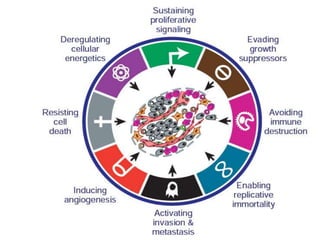
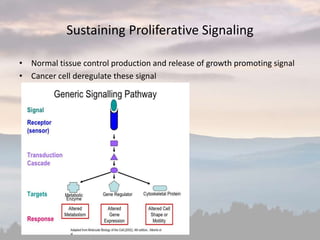
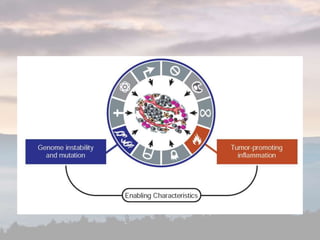
Sustaining Proliferative Signaling
• Normal tissue control production and release of growth promoting signal
• Cancer cell deregulate these signal
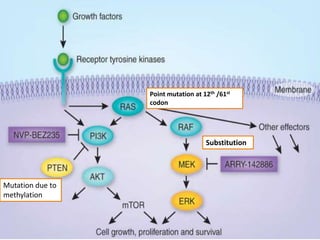
Point mutation at 12th /61st
codon
Mutation due to
methylation
Substitution
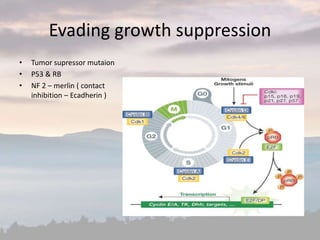
Evading growth suppression
• Tumor supressor mutaion
• P53 & RB
• NF 2 – merlin ( contact
inhibition – Ecadherin )
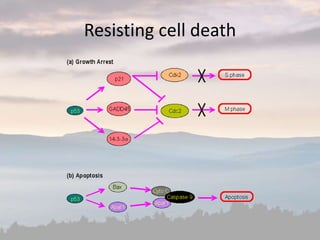
Resisting cell death
Enabling replicative immortality
• Barrier of proliferation
Replicative senescence
Crisis/apoptosis
- Telomerase dysfunction / deficiency
Inducing angiogenesis
• VEGF A- ( three receptors R1-R3)
upregulated by Hypoxia and Oncogenes
• Thrombospondin 1 ( Tsp-1)
• Fibroblast growth factor (FGF)
• It also contribute to microscopic premalignant
phase of neoplastic progression
• Intensity of angiogeneisis is variable
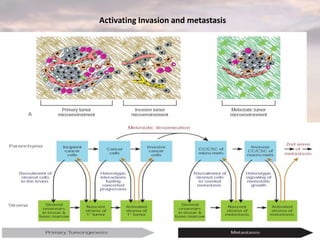
Activating Invasion and metastasis
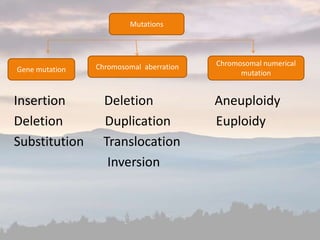
Insertion Deletion Aneuploidy
Deletion Duplication Euploidy
Substitution Translocation
Inversion
Mutations
Gene mutation Chromosomal aberration Chromosomal numerical
mutation
• Driver Mutation : - functional role in
malignant transformation
• Passenger Mutation : - Neutral / No functional
role
- incorporate the signature of previous
exposure
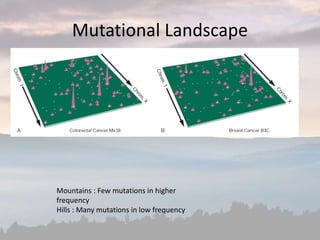
Mutational Landscape
Mountains : Few mutations in higher
frequency
Hills : Many mutations in low frequency
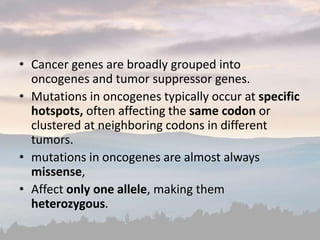
• Cancer genes are broadly grouped into
oncogenes and tumor suppressor genes.
• Mutations in oncogenes typically occur at specific
hotspots, often affecting the same codon or
clustered at neighboring codons in different
tumors.
• mutations in oncogenes are almost always
missense,
• Affect only one allele, making them
heterozygous.
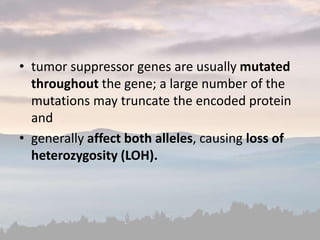
• tumor suppressor genes are usually mutated
throughout the gene; a large number of the
mutations may truncate the encoded protein
and
• generally affect both alleles, causing loss of
heterozygosity (LOH).
Genome Analysis
EARLIER METHODS
• oncovirus analysis,
• Linkage studies,
• LOH,
• cytogenetics.
DNA Sequencing
• DNA sequencing is the process of determining
the precise order of nucleotides within a DNA
molecule.
First Gen Sequence
• Maxam-Gilbert sequencing
.
• Chain-termination methods
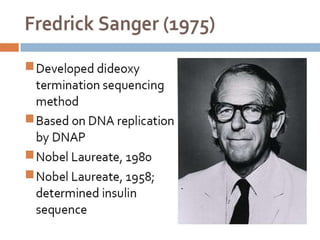
The chain-termination method developed by Frederick
Sanger and coworkers in 1977
.
• The Sanger method, in mass production form, is the
technology which produced the first human genome in
2001, ushering in the age of genomics. However, later
in the decade, radically different approaches reached
the market, bringing the cost per genome down from
$100 million in 2001 to $10,000 in 2011
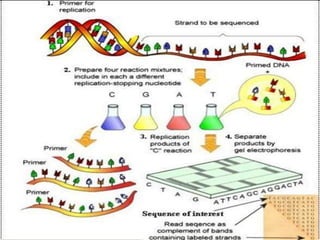
Ingredients for Sanger sequencing
• Sanger sequencing involves making many copies of a target
DNA region.
Its ingredients are similar to those needed for DNA replication
in an organism, or for polymerase chain reaction (PCR),
which copies DNA in vitro. They include:
• A DNA polymerase enzyme
• A primer, which is a short piece of single-stranded DNA
that binds to the template DNA and acts as a "starter" for
the polymerase
• The four DNA nucleotides (dATP, dTTP, dCTP, dGTP)
• The template DNA to be sequenced
Human Genome Project
• The sequencing of the human genome was
completed in 2003, after 13 years of
international collaboration and investment of
USD 3 billion.
• The Human Genome Project used Sanger
sequencing
• Haplotype Map of human Genome
• A single-nucleotide polymorphism (SNP,
pronounced snip) is a DNA sequence variation
occurring when a single nucleotide adenine
(A), thymine (T), cytosine (C), or guanine (G])
in the genome (or other shared sequence)
differs between members of a species or
paired chromosomes in an individual.
• A SNP in which both forms lead to the same
polypeptide sequence is
termed synonymous (sometimes called a
silent mutation) — if a different polypeptide
sequence is produced they
are nonsynonymous. A nonsynonymous
change may either be missense or nonsense,
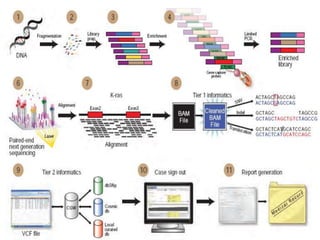
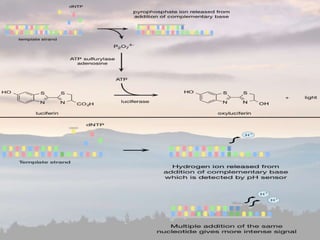
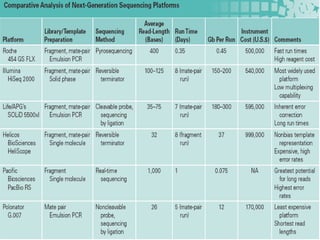
NGS
Next generation methods of DNA sequencing
have three general steps:
• Library preparation: libraries are created
using random fragmentation of DNA, followed
by ligation with custom linkers
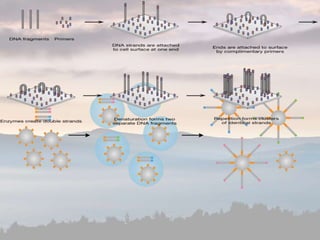
• Amplification: the library is amplified using
clonal amplification methods and PCR
• Sequencing: DNA is sequenced using one of
several different approaches
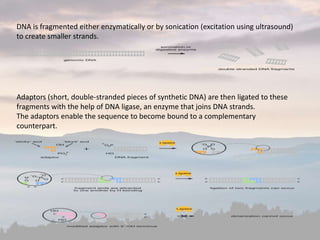
DNA is fragmented either enzymatically or by sonication (excitation using ultrasound)
to create smaller strands.
Adaptors (short, double-stranded pieces of synthetic DNA) are then ligated to these
fragments with the help of DNA ligase, an enzyme that joins DNA strands.
The adaptors enable the sequence to become bound to a complementary
counterpart.
Reversible terminator sequencing
Sequencing by ligation
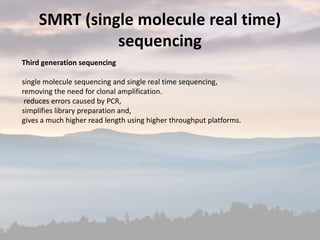
Third generation sequencing
single molecule sequencing and single real time sequencing,
removing the need for clonal amplification.
reduces errors caused by PCR,
simplifies library preparation and,
gives a much higher read length using higher throughput platforms.
SMRT (single molecule real time)
sequencing
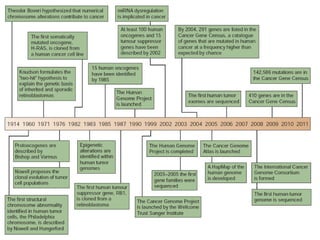
The Cancer Genome Atlas (TCGA)
TCGA is a joint effort of the National Cancer
Institute (NCI) and the National Human
Genome Research Institute (NHGRI), which
are both part of the National Institutes of
Health, U.S. Department of Health and Human
Services.
Started in 2006
• brain (glioblastoma), lung, and ovarian.
international cancer genome
consortium
• To obtain a comprehensive description of
genomic, transcriptomic and epigenomic
changes in 50 different tumor types and/or
subtypes which are of clinical and societal
importance across the globe.
• Multinational Constorium
• More than 90 types of cancers
References
DeVita, Hellman, and Rosenbergs Cancer
Principles and Practice of Oncology -
Cancer genome

Cancer genome

  • 1.
    CANCER GENOME Dr Kundan SurgicalOncologist Mahavir Cancer sansthan ,Patna
  • 2.
    1. Histologic- toa genetic-based level. 2. Somatic genetic alterations are legitimate targets for therapy. 3. Tumor genotyping is helping clinicians individualize treatments by matching patients with the best treatment for their tumors. 4. Tumor-specific DNA alterations represent highly sensitive biomarkers for disease detection and monitoring. 5. Finally, the ongoing analyses of multiple cancer genomes will identify additional targets, whose pharmacologic exploitation will undoubtedly result in new therapeutic approaches.
  • 5.
    Sustaining Proliferative Signaling •Normal tissue control production and release of growth promoting signal • Cancer cell deregulate these signal
  • 6.
    Point mutation at12th /61st codon Mutation due to methylation Substitution
  • 7.
    Evading growth suppression •Tumor supressor mutaion • P53 & RB • NF 2 – merlin ( contact inhibition – Ecadherin )
  • 8.
  • 9.
    Enabling replicative immortality •Barrier of proliferation Replicative senescence Crisis/apoptosis - Telomerase dysfunction / deficiency
  • 10.
    Inducing angiogenesis • VEGFA- ( three receptors R1-R3) upregulated by Hypoxia and Oncogenes • Thrombospondin 1 ( Tsp-1) • Fibroblast growth factor (FGF) • It also contribute to microscopic premalignant phase of neoplastic progression • Intensity of angiogeneisis is variable
  • 12.
  • 15.
    Insertion Deletion Aneuploidy DeletionDuplication Euploidy Substitution Translocation Inversion Mutations Gene mutation Chromosomal aberration Chromosomal numerical mutation
  • 21.
    • Driver Mutation: - functional role in malignant transformation • Passenger Mutation : - Neutral / No functional role - incorporate the signature of previous exposure
  • 24.
    Mutational Landscape Mountains :Few mutations in higher frequency Hills : Many mutations in low frequency
  • 27.
    • Cancer genesare broadly grouped into oncogenes and tumor suppressor genes. • Mutations in oncogenes typically occur at specific hotspots, often affecting the same codon or clustered at neighboring codons in different tumors. • mutations in oncogenes are almost always missense, • Affect only one allele, making them heterozygous.
  • 28.
    • tumor suppressorgenes are usually mutated throughout the gene; a large number of the mutations may truncate the encoded protein and • generally affect both alleles, causing loss of heterozygosity (LOH).
  • 30.
  • 31.
    EARLIER METHODS • oncovirusanalysis, • Linkage studies, • LOH, • cytogenetics.
  • 32.
    DNA Sequencing • DNAsequencing is the process of determining the precise order of nucleotides within a DNA molecule.
  • 33.
    First Gen Sequence •Maxam-Gilbert sequencing . • Chain-termination methods The chain-termination method developed by Frederick Sanger and coworkers in 1977 . • The Sanger method, in mass production form, is the technology which produced the first human genome in 2001, ushering in the age of genomics. However, later in the decade, radically different approaches reached the market, bringing the cost per genome down from $100 million in 2001 to $10,000 in 2011
  • 35.
    Ingredients for Sangersequencing • Sanger sequencing involves making many copies of a target DNA region. Its ingredients are similar to those needed for DNA replication in an organism, or for polymerase chain reaction (PCR), which copies DNA in vitro. They include: • A DNA polymerase enzyme • A primer, which is a short piece of single-stranded DNA that binds to the template DNA and acts as a "starter" for the polymerase • The four DNA nucleotides (dATP, dTTP, dCTP, dGTP) • The template DNA to be sequenced
  • 37.
    Human Genome Project •The sequencing of the human genome was completed in 2003, after 13 years of international collaboration and investment of USD 3 billion. • The Human Genome Project used Sanger sequencing • Haplotype Map of human Genome
  • 38.
    • A single-nucleotidepolymorphism (SNP, pronounced snip) is a DNA sequence variation occurring when a single nucleotide adenine (A), thymine (T), cytosine (C), or guanine (G]) in the genome (or other shared sequence) differs between members of a species or paired chromosomes in an individual.
  • 39.
    • A SNPin which both forms lead to the same polypeptide sequence is termed synonymous (sometimes called a silent mutation) — if a different polypeptide sequence is produced they are nonsynonymous. A nonsynonymous change may either be missense or nonsense,
  • 40.
    NGS Next generation methodsof DNA sequencing have three general steps: • Library preparation: libraries are created using random fragmentation of DNA, followed by ligation with custom linkers • Amplification: the library is amplified using clonal amplification methods and PCR • Sequencing: DNA is sequenced using one of several different approaches
  • 42.
    DNA is fragmentedeither enzymatically or by sonication (excitation using ultrasound) to create smaller strands. Adaptors (short, double-stranded pieces of synthetic DNA) are then ligated to these fragments with the help of DNA ligase, an enzyme that joins DNA strands. The adaptors enable the sequence to become bound to a complementary counterpart.
  • 45.
  • 47.
    Third generation sequencing singlemolecule sequencing and single real time sequencing, removing the need for clonal amplification. reduces errors caused by PCR, simplifies library preparation and, gives a much higher read length using higher throughput platforms. SMRT (single molecule real time) sequencing
  • 49.
    The Cancer GenomeAtlas (TCGA) TCGA is a joint effort of the National Cancer Institute (NCI) and the National Human Genome Research Institute (NHGRI), which are both part of the National Institutes of Health, U.S. Department of Health and Human Services. Started in 2006 • brain (glioblastoma), lung, and ovarian.
  • 50.
    international cancer genome consortium •To obtain a comprehensive description of genomic, transcriptomic and epigenomic changes in 50 different tumor types and/or subtypes which are of clinical and societal importance across the globe. • Multinational Constorium • More than 90 types of cancers
  • 51.
    References DeVita, Hellman, andRosenbergs Cancer Principles and Practice of Oncology -