ANORECTALANORECTAL
MALFORMATIONSMALFORMATIONS
DEFINITIONDEFINITION
Anorectal malformations are developmental
deformities of the lower end of the
alimentary tract i.e. the anorectal canal.
INCIDENCEINCIDENCE
Minor abnormalities of the anus and rectumMinor abnormalities of the anus and rectum
occur in 1 in 500 living newborns whileoccur in 1 in 500 living newborns while
major abnormalities occur in 1 in 5000major abnormalities occur in 1 in 5000
living infants.living infants.
CAUSECAUSE
 The exact cause of these malformations isThe exact cause of these malformations is
not known. It occurs due to the arrest in thenot known. It occurs due to the arrest in the
embryonic development of the anus, lowerembryonic development of the anus, lower
rectum and urogenital tract at the 8th weekrectum and urogenital tract at the 8th week
of embryonic life.of embryonic life.
CAUSECAUSE CONTDCONTD……
 The membrane that separates theThe membrane that separates the
endodermal hindgut from the ectodermalendodermal hindgut from the ectodermal
anal dimple perforates and a continuousanal dimple perforates and a continuous
canal is formed, the outlet of which is thecanal is formed, the outlet of which is the
anus.anus.
CAUSECAUSE CONTDCONTD……
 If the membrane separating the rectumIf the membrane separating the rectum
from the anus is not absorbed, and if thefrom the anus is not absorbed, and if the
union does not take place, an anorectalunion does not take place, an anorectal
anomaly results.anomaly results.
CAUSE CONTDCAUSE CONTD……
 Approximately 40% of the neonates withApproximately 40% of the neonates with
anorectal malformations have associatedanorectal malformations have associated
anomalies like Down’s syndrome,anomalies like Down’s syndrome,
congenital heart disease, undescendedcongenital heart disease, undescended
testes, renal abnormalities, esophagealtestes, renal abnormalities, esophageal
atresia and neural tube defect.atresia and neural tube defect.
TYPESTYPES
 ACCORDING TO THE VISIBILITY OFACCORDING TO THE VISIBILITY OF
THE ANUS:THE ANUS:
a) With a visible abnormal opening ofa) With a visible abnormal opening of
the bowelthe bowel
1)Anal stenosis:1)Anal stenosis: It accounts for 10% of allIt accounts for 10% of all
ARMs. A stricture is at the anus or at levels 1ARMs. A stricture is at the anus or at levels 1
to 4 cm above the anus, or extends the entireto 4 cm above the anus, or extends the entire
length of the anus.length of the anus.
ANALANAL STENOSISSTENOSIS
TYPES CONTDTYPES CONTD……
2) Ano-perineal fistula2) Ano-perineal fistula
TYPES CONTDTYPES CONTD……
3) Ano-vestibular fistula in female3) Ano-vestibular fistula in female..
TYPES CONTDTYPES CONTD……
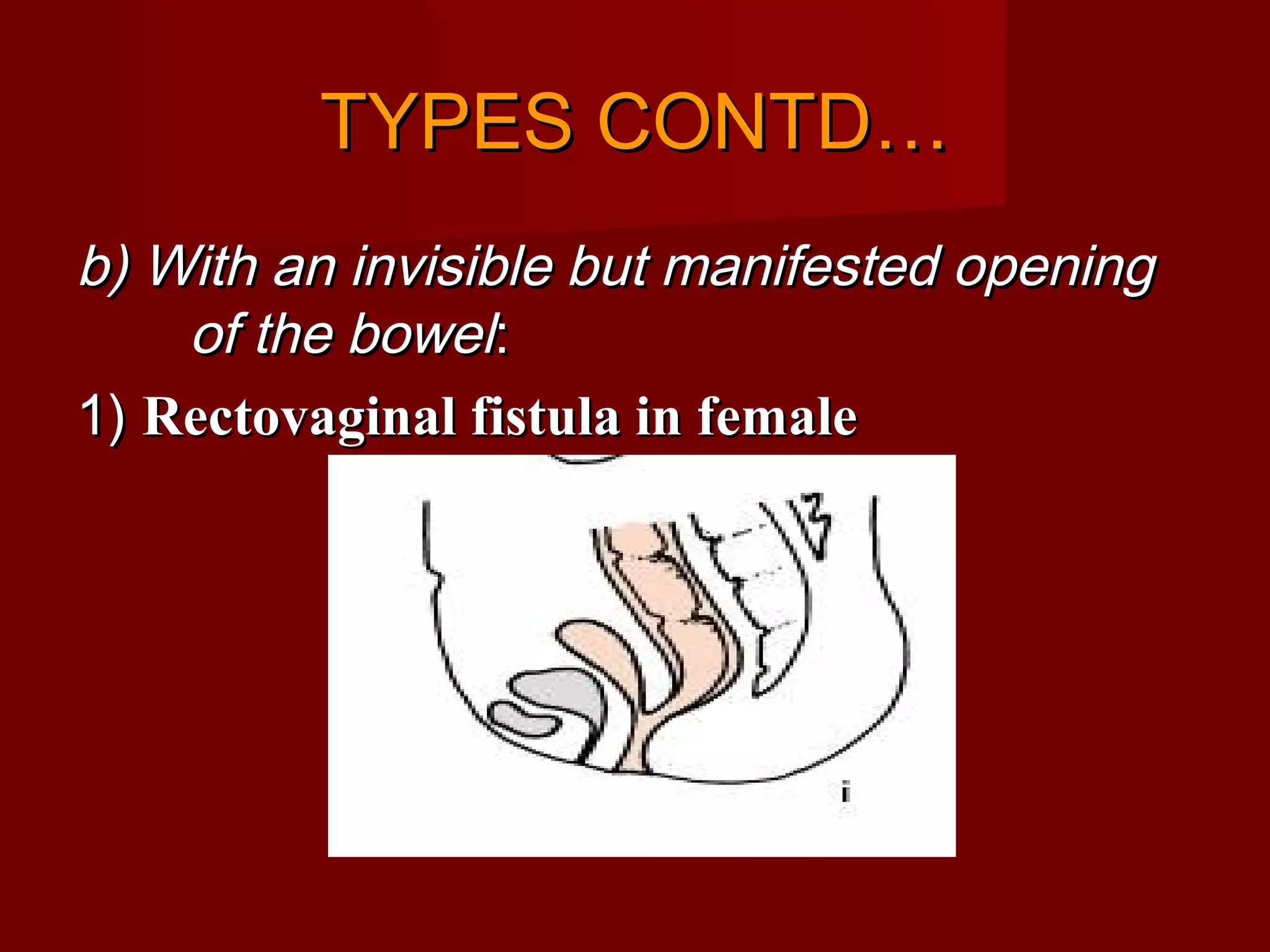
b) With an invisible but manifested openingb) With an invisible but manifested opening
of the bowelof the bowel::
1)1) Rectovaginal fistula in femaleRectovaginal fistula in female
TYPES CONTDTYPES CONTD……
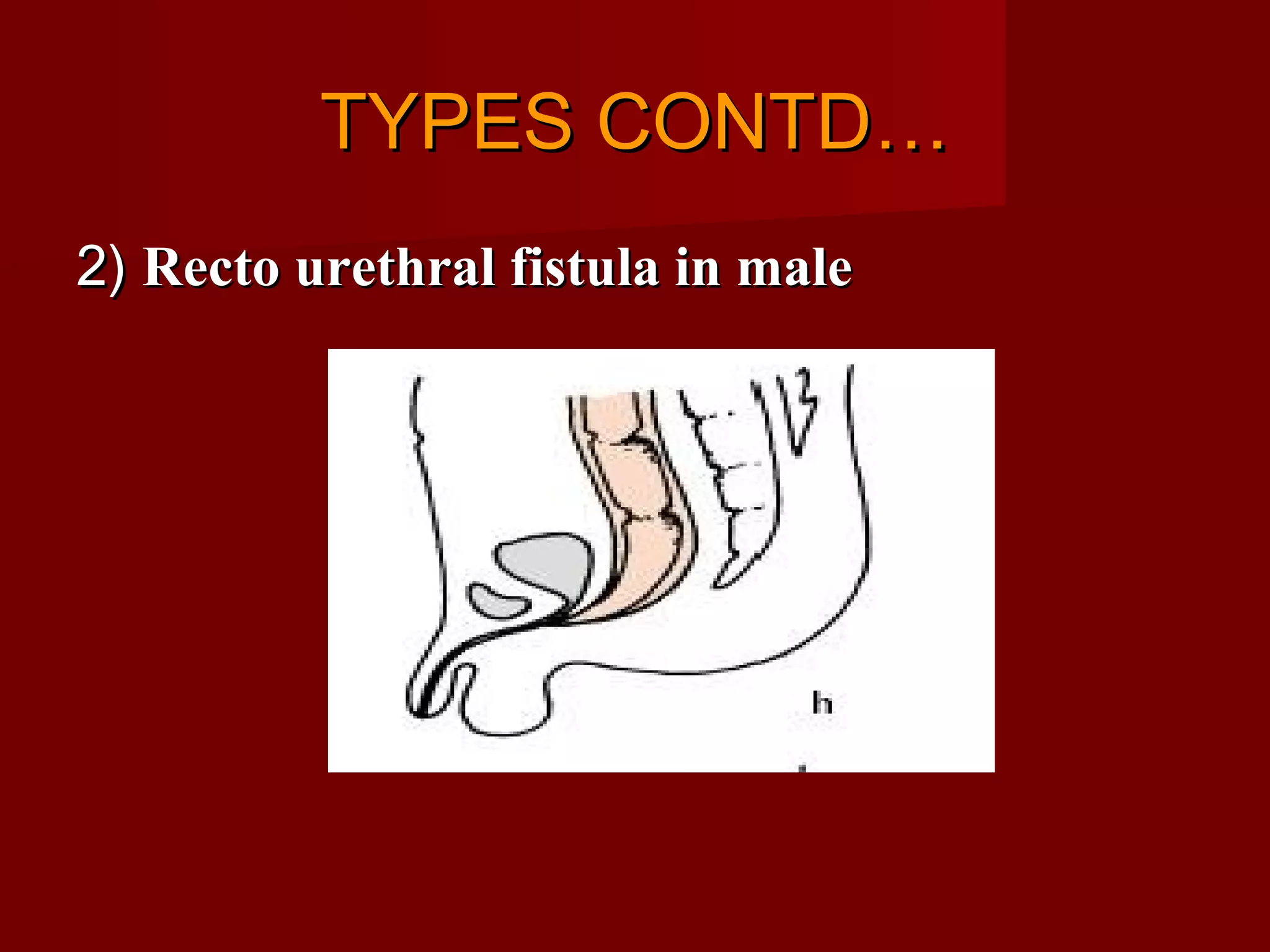
2)2) Recto urethral fistula in maleRecto urethral fistula in male
TYPES CONTD….TYPES CONTD….
3)3) Rectovesicular fistulaRectovesicular fistula
TYPES CONTD…TYPES CONTD…
c)c) No manifested opening of the bowelNo manifested opening of the bowel
1)1) Persistent anal membrane or imperforatePersistent anal membrane or imperforate
anusanus: Here there is an imperforate anal: Here there is an imperforate anal
membrane that produces obstructionmembrane that produces obstruction
behind which the meconium is seen.behind which the meconium is seen.
IMPERFORATE ANUSIMPERFORATE ANUS
TYPES CONTD…TYPES CONTD…
2)2) Rectal atresiaRectal atresia
TYPES CONTD…TYPES CONTD…
a) On the basis of levator ani musclea) On the basis of levator ani muscle
1) Supralevator or high ano-rectal1) Supralevator or high ano-rectal
malformationmalformation:: When rectum terminatesWhen rectum terminates
above the levator ani muscle, which is foundabove the levator ani muscle, which is found
as rectal atresia, rectoprostatic fistula andas rectal atresia, rectoprostatic fistula and
rectovaginal fistula.rectovaginal fistula.
TYPES CONTDTYPES CONTD……
2)2) Translevator or low anoTranslevator or low ano--rectal malformationrectal malformation
: When rectum terminates below the levator: When rectum terminates below the levator
ani muscle found in ano-cutaneous fistulaani muscle found in ano-cutaneous fistula
and anovestibular fistula.and anovestibular fistula.
ANAL AGENESISANAL AGENESIS
 There is an imperforate anus, possibly seenThere is an imperforate anus, possibly seen
as a dimple. The rectal pouch ends blindlyas a dimple. The rectal pouch ends blindly
some distance above the anus or forms asome distance above the anus or forms a
fistula with other organs leading tofistula with other organs leading to
– Rectovaginal fistula- low and high (female)Rectovaginal fistula- low and high (female)
– Rectoperineal fistula (male and female)Rectoperineal fistula (male and female)
– Rectovesical fistula (male)Rectovesical fistula (male)
– Rectourethral fistula (male)Rectourethral fistula (male)
– Rectoprostatic fistula (male)Rectoprostatic fistula (male)
ANAL AGENESIS CONTD…ANAL AGENESIS CONTD…
RECTOVAGINAL LOW FISTULARECTOVAGINAL LOW FISTULA
RECTAL ATRESIARECTAL ATRESIA
There is a normal anus and anal pouch.There is a normal anus and anal pouch.
The rectal pouch ends blindly in the hollowThe rectal pouch ends blindly in the hollow
of the sacrum. The anus might form aof the sacrum. The anus might form a
fistula with other parts leading tofistula with other parts leading to
– Ano vestibular fistula (female)Ano vestibular fistula (female)
– Ano perineal fistula (male and female)Ano perineal fistula (male and female)
– Ano cutaneous fistula (male and female)Ano cutaneous fistula (male and female)
CLOACAL EXSTROPHYCLOACAL EXSTROPHY
It is a rare, severe defect in which there isIt is a rare, severe defect in which there is
externalization of the bladder and bowel throughexternalization of the bladder and bowel through
the abdominal wall. Often the genetalia arethe abdominal wall. Often the genetalia are
indefinite, and the chromosome studies areindefinite, and the chromosome studies are
necessary to determine the child’s sex. Thesenecessary to determine the child’s sex. These
children are mostly femaleschildren are mostly females
CLINICAL MANIFESTATIONSCLINICAL MANIFESTATIONS
– Absence of meconiumAbsence of meconium
– No anal openingNo anal opening
– Unable to insert a gloved finger or a rectalUnable to insert a gloved finger or a rectal
thermometer into the rectumthermometer into the rectum
– Abdominal distentionAbdominal distention
CLINICAL MANIFESTATIONSCLINICAL MANIFESTATIONS
– History of difficult defecation, abdominal distentionHistory of difficult defecation, abdominal distention
and ribbon like stools in an older child in case of analand ribbon like stools in an older child in case of anal
stenosis.stenosis.
– Greenish bulging membrane behind anus in case ofGreenish bulging membrane behind anus in case of
imperforate anal membraneimperforate anal membrane
– Intestinal obstruction if no fistulasIntestinal obstruction if no fistulas
– Passage of meconium through vagina, perineal orificePassage of meconium through vagina, perineal orifice
or with urine in case of fistulaor with urine in case of fistula
DIAGNOSTIC TESTSDIAGNOSTIC TESTS
 Physical examination by passing the glovedPhysical examination by passing the gloved
little finger through the anus and bylittle finger through the anus and by
observing the passage through whichobserving the passage through which
meconium was passed.meconium was passed.
 Ultrasounds scan to locate the rectal pouch.Ultrasounds scan to locate the rectal pouch.
DIAGNOSTIC TESTSDIAGNOSTIC TESTS contd…contd…
 X-ray with inverted infant called asX-ray with inverted infant called as
invertogram or Wangensteen-Rice X-rayinvertogram or Wangensteen-Rice X-ray
when the infant is 24 hrs of age.when the infant is 24 hrs of age.
 Urine examination for presence ofUrine examination for presence of
meconium and epithelial debris.meconium and epithelial debris.
DIAGNOSTIC TESTSDIAGNOSTIC TESTS contd…contd…
 Micturating cystourethrogram (MCU) toMicturating cystourethrogram (MCU) to
detect urinary abnormalities.detect urinary abnormalities.
 Intravenous pyelogram to rule outIntravenous pyelogram to rule out
vesicourethral reflux.vesicourethral reflux.
MANAGEMENTMANAGEMENT
 The reconstructive surgery is done toThe reconstructive surgery is done to
correct or repair the congenitalcorrect or repair the congenital
malformations. It depends upon the type ofmalformations. It depends upon the type of
anomaly and sex of the infant.anomaly and sex of the infant.
MANAGEMENT CONTDMANAGEMENT CONTD……
 In case of low ARMs, where there is lessIn case of low ARMs, where there is less
than 1.5cm distance between the analthan 1.5cm distance between the anal
dimple and the rectal pouch, rectal cutbackdimple and the rectal pouch, rectal cutback
anoplasty or Y-V plasty is done for maleanoplasty or Y-V plasty is done for male
infants and dilation of fistula with definitiveinfants and dilation of fistula with definitive
repair or perineal anoplasty is performedrepair or perineal anoplasty is performed
for female infants.for female infants.
MANAGEMENT CONTDMANAGEMENT CONTD……
 In case of high ARMs, where there is more than 1.5cmIn case of high ARMs, where there is more than 1.5cm
distance between the anal dimple and the rectal pouch,distance between the anal dimple and the rectal pouch,
initial colostomy is done in the neonatal period followed byinitial colostomy is done in the neonatal period followed by
definitive reconstructive surgery as posterior sagittal ano-definitive reconstructive surgery as posterior sagittal ano-
rectoplasty at the age of 10 to 12 months or when therectoplasty at the age of 10 to 12 months or when the
infant is having 7 to 9 kg body weight. Colostomy closure isinfant is having 7 to 9 kg body weight. Colostomy closure is
done after 10 to 12 weeks of successful definitive surgery.done after 10 to 12 weeks of successful definitive surgery.
MANAGEMENT CONTD…MANAGEMENT CONTD…
 In case of imperforate anal membrane, theIn case of imperforate anal membrane, the
membrane is perforated with a bluntmembrane is perforated with a blunt
instrument. Repeated dilatation might beinstrument. Repeated dilatation might be
necessary to prevent scar formation.necessary to prevent scar formation.
MANAGEMENT CONTDMANAGEMENT CONTD……
 In case of anal stenosis, dilatation is done every 4-6In case of anal stenosis, dilatation is done every 4-6
months.months.
 In case of fistulas, the colon can be brought downIn case of fistulas, the colon can be brought down
through the anal dimple by an abdominoperinealthrough the anal dimple by an abdominoperineal
procedure. The anus is positioned in the area ofprocedure. The anus is positioned in the area of
external sphincter and the fistula is removed.external sphincter and the fistula is removed.
PREOPERATIVE CARE:PREOPERATIVE CARE:
– Gastric suction may be doneGastric suction may be done
– Withhold oral feedingsWithhold oral feedings
– Start parenteral hydrationStart parenteral hydration
– Measurement of abdominal girthMeasurement of abdominal girth
– Intake output chartIntake output chart
– Consent from parentsConsent from parents
– Pre-medicationsPre-medications
POST OPERATIVE CAREPOST OPERATIVE CARE
 Scrupulous perineal careScrupulous perineal care
 Change perineal dressings whenever soiledChange perineal dressings whenever soiled
 Apply protective ointments such as zinc oxides toApply protective ointments such as zinc oxides to
decrease skin irritation.decrease skin irritation.
 Position baby in a side-lying or a supine positionPosition baby in a side-lying or a supine position
with the legs suspended at a 90° angle to the trunkwith the legs suspended at a 90° angle to the trunk
to prevent pressure on perineal suturesto prevent pressure on perineal sutures
POST OPERATIVE CAREPOST OPERATIVE CARE contdcontd……
 Intravenous feedings till the wound heals orIntravenous feedings till the wound heals or
until peristalsis appear.until peristalsis appear.
 Prevention of constipation by exclusivePrevention of constipation by exclusive
breastfeeding and proper weaning withbreastfeeding and proper weaning with
stool softeners or fibers.stool softeners or fibers.
 Bowel habit trainingBowel habit training
POST OPERATIVE CARE contdPOST OPERATIVE CARE contd……
 Daily enemas until control are achieved ifDaily enemas until control are achieved if
necessary.necessary.
 Do not use diaper in case of anoplastyDo not use diaper in case of anoplasty
 Colostomy care by changing the collection deviceColostomy care by changing the collection device
and meticulous skin care.and meticulous skin care.
 Family support, discharge planning and homeFamily support, discharge planning and home
carecare
COMPLICATIONSCOMPLICATIONS
 Urinary tract infectionUrinary tract infection
 Intestinal obstructionIntestinal obstruction
 Fecal impactionFecal impaction
 Colostomy related problemsColostomy related problems
 Recurrence of fistulaRecurrence of fistula
 Anal stenosisAnal stenosis
 Poor bowel controlPoor bowel control
 ConstipationConstipation
PROGNOSISPROGNOSIS
– About 30% of children with high ARMs orAbout 30% of children with high ARMs or
associated genitor urinary fistula achieve bowelassociated genitor urinary fistula achieve bowel
continence.continence.
– About 90% of children with low ARMs achieveAbout 90% of children with low ARMs achieve
bowel continence.bowel continence.
NURSING CARENURSING CARE
Preoperative :Preoperative : Impaired bowel elimination related to bowelImpaired bowel elimination related to bowel
malformation as evidenced by lack of patency ormalformation as evidenced by lack of patency or
passage of stool through a different opening.passage of stool through a different opening.
Goal: The child will pass meconium and will not have abdominal distentionGoal: The child will pass meconium and will not have abdominal distention
Interventions:Interventions:
 If there is a fistula, keep the perineum clean until surgery.If there is a fistula, keep the perineum clean until surgery.
 Follow pre-operative orders.Follow pre-operative orders.
 Do gastric decompression with NG tube.Do gastric decompression with NG tube.
 Start IV line.Start IV line.
 Follow strict nil per oral.Follow strict nil per oral.
Nursing care contdNursing care contd……
2) Fluid volume deficit related to nil per oral2) Fluid volume deficit related to nil per oral
Goal: The child will maintain normal fluid balanceGoal: The child will maintain normal fluid balance
Interventions:Interventions:
– Maintain intake output chartMaintain intake output chart
– Administer IV fluids as ordered.Administer IV fluids as ordered.
– Do gastric decompression.Do gastric decompression.
Nursing care contdNursing care contd……
3)3) Risk for infection (UTI) related to passage of meconium throughRisk for infection (UTI) related to passage of meconium through
urethra.urethra.
Goal: The child will have no risk for infection.Goal: The child will have no risk for infection.
Interventions:Interventions:
 If there is a fistula, keep the perineum clean until surgery.If there is a fistula, keep the perineum clean until surgery.
 Follow pre-operative orders.Follow pre-operative orders.
 Start IV line.Start IV line.
 Administer plenty of IV fluids as ordered.Administer plenty of IV fluids as ordered.
 Send urine for examination.Send urine for examination.
Nursing care contdNursing care contd……
 Postoperative:Postoperative:
1) Pain related to surgery1) Pain related to surgery
Goal: The child will have less painGoal: The child will have less pain
Interventions:Interventions:
 Keep the sutured site clean.Keep the sutured site clean.
 Do not spread the legs or place in prone position to avoidDo not spread the legs or place in prone position to avoid
strain on the sutures.strain on the sutures.
 Keep the legs suspended at 90°angle to the trunk.Keep the legs suspended at 90°angle to the trunk.
 Prevent constipation by restarting breastfeeding whenPrevent constipation by restarting breastfeeding when
peristalsis appears.peristalsis appears.
Nursing care contdNursing care contd……
2)Impaired skin integrity related to surgery2)Impaired skin integrity related to surgery
Goal: The wound heals faster.Goal: The wound heals faster.
Interventions:Interventions:
 Keep the sutured site clean.Keep the sutured site clean.
 Do not spread the legs or place in prone position to avoid strain on theDo not spread the legs or place in prone position to avoid strain on the
sutures.sutures.
 Keep the legs suspended at 90°angle to the trunk.Keep the legs suspended at 90°angle to the trunk.
 Prevent constipation by restarting breastfeeding when peristalsis appears.Prevent constipation by restarting breastfeeding when peristalsis appears.
 Apply zinc oxide ointment to prevent skin irritation.Apply zinc oxide ointment to prevent skin irritation.
 Change dressing often.Change dressing often.
 Do not use diaper.Do not use diaper.
 A heat lamp may be used to facilitate healing.A heat lamp may be used to facilitate healing.
Nursing care contdNursing care contd……
3)Risk for infection related to surgical incision in the least3)Risk for infection related to surgical incision in the least
clean area.clean area.
Goal: The child will have no risk for infection Interventions:Goal: The child will have no risk for infection Interventions:
 Keep the sutured site clean.Keep the sutured site clean.
 Change dressing often.Change dressing often.
 Do not use diaper.Do not use diaper.
 Change colostomy bag soon as it is soiled.Change colostomy bag soon as it is soiled.
 Administer antibiotics if prescribed.Administer antibiotics if prescribed.
 Keep the site dry.Keep the site dry.
Nursing care contd..Nursing care contd..
4)Impaired nutrition less than body requirement related to4)Impaired nutrition less than body requirement related to
nil per oral.nil per oral.
Goal: The child will take adequate feeds.Goal: The child will take adequate feeds.
Interventions:Interventions:
 Maintain intake output chartMaintain intake output chart
 Administer IV fluids as ordered.Administer IV fluids as ordered.
 Do gastric decompression immediately after sugery.Do gastric decompression immediately after sugery.
 Start breastfeeding when peristalsis begins.Start breastfeeding when peristalsis begins.
 Monitor abdominal girth.Monitor abdominal girth.
 Give laxative if child is on cow’s milk.Give laxative if child is on cow’s milk.
 Increase fiber content during weaning.Increase fiber content during weaning.
Nursing care contdNursing care contd……
 Risk for complication (constipation, fecalRisk for complication (constipation, fecal
impaction) related to interference withimpaction) related to interference with
neurological control of defecation.neurological control of defecation.
 Impaired family process related to diagnosis of aImpaired family process related to diagnosis of a
congenital conditioncongenital condition
 Anxiety related to surgery and hospitalization.Anxiety related to surgery and hospitalization.
 Knowledge deficit regarding post operative careKnowledge deficit regarding post operative care
THANK YOUTHANK YOU

Anorectal malformation

  • 1.
  • 2.
    DEFINITIONDEFINITION Anorectal malformations aredevelopmental deformities of the lower end of the alimentary tract i.e. the anorectal canal.
  • 3.
    INCIDENCEINCIDENCE Minor abnormalities ofthe anus and rectumMinor abnormalities of the anus and rectum occur in 1 in 500 living newborns whileoccur in 1 in 500 living newborns while major abnormalities occur in 1 in 5000major abnormalities occur in 1 in 5000 living infants.living infants.
  • 4.
    CAUSECAUSE  The exactcause of these malformations isThe exact cause of these malformations is not known. It occurs due to the arrest in thenot known. It occurs due to the arrest in the embryonic development of the anus, lowerembryonic development of the anus, lower rectum and urogenital tract at the 8th weekrectum and urogenital tract at the 8th week of embryonic life.of embryonic life.
  • 5.
    CAUSECAUSE CONTDCONTD……  Themembrane that separates theThe membrane that separates the endodermal hindgut from the ectodermalendodermal hindgut from the ectodermal anal dimple perforates and a continuousanal dimple perforates and a continuous canal is formed, the outlet of which is thecanal is formed, the outlet of which is the anus.anus.
  • 6.
    CAUSECAUSE CONTDCONTD……  Ifthe membrane separating the rectumIf the membrane separating the rectum from the anus is not absorbed, and if thefrom the anus is not absorbed, and if the union does not take place, an anorectalunion does not take place, an anorectal anomaly results.anomaly results.
  • 7.
    CAUSE CONTDCAUSE CONTD…… Approximately 40% of the neonates withApproximately 40% of the neonates with anorectal malformations have associatedanorectal malformations have associated anomalies like Down’s syndrome,anomalies like Down’s syndrome, congenital heart disease, undescendedcongenital heart disease, undescended testes, renal abnormalities, esophagealtestes, renal abnormalities, esophageal atresia and neural tube defect.atresia and neural tube defect.
  • 8.
    TYPESTYPES  ACCORDING TOTHE VISIBILITY OFACCORDING TO THE VISIBILITY OF THE ANUS:THE ANUS: a) With a visible abnormal opening ofa) With a visible abnormal opening of the bowelthe bowel 1)Anal stenosis:1)Anal stenosis: It accounts for 10% of allIt accounts for 10% of all ARMs. A stricture is at the anus or at levels 1ARMs. A stricture is at the anus or at levels 1 to 4 cm above the anus, or extends the entireto 4 cm above the anus, or extends the entire length of the anus.length of the anus.
  • 9.
  • 10.
    TYPES CONTDTYPES CONTD…… 2)Ano-perineal fistula2) Ano-perineal fistula
  • 11.
    TYPES CONTDTYPES CONTD…… 3)Ano-vestibular fistula in female3) Ano-vestibular fistula in female..
  • 12.
    TYPES CONTDTYPES CONTD…… b)With an invisible but manifested openingb) With an invisible but manifested opening of the bowelof the bowel:: 1)1) Rectovaginal fistula in femaleRectovaginal fistula in female
  • 13.
    TYPES CONTDTYPES CONTD…… 2)2)Recto urethral fistula in maleRecto urethral fistula in male
  • 14.
    TYPES CONTD….TYPES CONTD…. 3)3)Rectovesicular fistulaRectovesicular fistula
  • 15.
    TYPES CONTD…TYPES CONTD… c)c)No manifested opening of the bowelNo manifested opening of the bowel 1)1) Persistent anal membrane or imperforatePersistent anal membrane or imperforate anusanus: Here there is an imperforate anal: Here there is an imperforate anal membrane that produces obstructionmembrane that produces obstruction behind which the meconium is seen.behind which the meconium is seen.
  • 16.
  • 17.
    TYPES CONTD…TYPES CONTD… 2)2)Rectal atresiaRectal atresia
  • 18.
    TYPES CONTD…TYPES CONTD… a)On the basis of levator ani musclea) On the basis of levator ani muscle 1) Supralevator or high ano-rectal1) Supralevator or high ano-rectal malformationmalformation:: When rectum terminatesWhen rectum terminates above the levator ani muscle, which is foundabove the levator ani muscle, which is found as rectal atresia, rectoprostatic fistula andas rectal atresia, rectoprostatic fistula and rectovaginal fistula.rectovaginal fistula.
  • 19.
    TYPES CONTDTYPES CONTD…… 2)2)Translevator or low anoTranslevator or low ano--rectal malformationrectal malformation : When rectum terminates below the levator: When rectum terminates below the levator ani muscle found in ano-cutaneous fistulaani muscle found in ano-cutaneous fistula and anovestibular fistula.and anovestibular fistula.
  • 20.
    ANAL AGENESISANAL AGENESIS There is an imperforate anus, possibly seenThere is an imperforate anus, possibly seen as a dimple. The rectal pouch ends blindlyas a dimple. The rectal pouch ends blindly some distance above the anus or forms asome distance above the anus or forms a fistula with other organs leading tofistula with other organs leading to – Rectovaginal fistula- low and high (female)Rectovaginal fistula- low and high (female) – Rectoperineal fistula (male and female)Rectoperineal fistula (male and female) – Rectovesical fistula (male)Rectovesical fistula (male) – Rectourethral fistula (male)Rectourethral fistula (male) – Rectoprostatic fistula (male)Rectoprostatic fistula (male)
  • 21.
    ANAL AGENESIS CONTD…ANALAGENESIS CONTD…
  • 22.
  • 23.
    RECTAL ATRESIARECTAL ATRESIA Thereis a normal anus and anal pouch.There is a normal anus and anal pouch. The rectal pouch ends blindly in the hollowThe rectal pouch ends blindly in the hollow of the sacrum. The anus might form aof the sacrum. The anus might form a fistula with other parts leading tofistula with other parts leading to – Ano vestibular fistula (female)Ano vestibular fistula (female) – Ano perineal fistula (male and female)Ano perineal fistula (male and female) – Ano cutaneous fistula (male and female)Ano cutaneous fistula (male and female)
  • 24.
    CLOACAL EXSTROPHYCLOACAL EXSTROPHY Itis a rare, severe defect in which there isIt is a rare, severe defect in which there is externalization of the bladder and bowel throughexternalization of the bladder and bowel through the abdominal wall. Often the genetalia arethe abdominal wall. Often the genetalia are indefinite, and the chromosome studies areindefinite, and the chromosome studies are necessary to determine the child’s sex. Thesenecessary to determine the child’s sex. These children are mostly femaleschildren are mostly females
  • 25.
    CLINICAL MANIFESTATIONSCLINICAL MANIFESTATIONS –Absence of meconiumAbsence of meconium – No anal openingNo anal opening – Unable to insert a gloved finger or a rectalUnable to insert a gloved finger or a rectal thermometer into the rectumthermometer into the rectum – Abdominal distentionAbdominal distention
  • 26.
    CLINICAL MANIFESTATIONSCLINICAL MANIFESTATIONS –History of difficult defecation, abdominal distentionHistory of difficult defecation, abdominal distention and ribbon like stools in an older child in case of analand ribbon like stools in an older child in case of anal stenosis.stenosis. – Greenish bulging membrane behind anus in case ofGreenish bulging membrane behind anus in case of imperforate anal membraneimperforate anal membrane – Intestinal obstruction if no fistulasIntestinal obstruction if no fistulas – Passage of meconium through vagina, perineal orificePassage of meconium through vagina, perineal orifice or with urine in case of fistulaor with urine in case of fistula
  • 27.
    DIAGNOSTIC TESTSDIAGNOSTIC TESTS Physical examination by passing the glovedPhysical examination by passing the gloved little finger through the anus and bylittle finger through the anus and by observing the passage through whichobserving the passage through which meconium was passed.meconium was passed.  Ultrasounds scan to locate the rectal pouch.Ultrasounds scan to locate the rectal pouch.
  • 28.
    DIAGNOSTIC TESTSDIAGNOSTIC TESTScontd…contd…  X-ray with inverted infant called asX-ray with inverted infant called as invertogram or Wangensteen-Rice X-rayinvertogram or Wangensteen-Rice X-ray when the infant is 24 hrs of age.when the infant is 24 hrs of age.  Urine examination for presence ofUrine examination for presence of meconium and epithelial debris.meconium and epithelial debris.
  • 29.
    DIAGNOSTIC TESTSDIAGNOSTIC TESTScontd…contd…  Micturating cystourethrogram (MCU) toMicturating cystourethrogram (MCU) to detect urinary abnormalities.detect urinary abnormalities.  Intravenous pyelogram to rule outIntravenous pyelogram to rule out vesicourethral reflux.vesicourethral reflux.
  • 30.
    MANAGEMENTMANAGEMENT  The reconstructivesurgery is done toThe reconstructive surgery is done to correct or repair the congenitalcorrect or repair the congenital malformations. It depends upon the type ofmalformations. It depends upon the type of anomaly and sex of the infant.anomaly and sex of the infant.
  • 31.
    MANAGEMENT CONTDMANAGEMENT CONTD…… In case of low ARMs, where there is lessIn case of low ARMs, where there is less than 1.5cm distance between the analthan 1.5cm distance between the anal dimple and the rectal pouch, rectal cutbackdimple and the rectal pouch, rectal cutback anoplasty or Y-V plasty is done for maleanoplasty or Y-V plasty is done for male infants and dilation of fistula with definitiveinfants and dilation of fistula with definitive repair or perineal anoplasty is performedrepair or perineal anoplasty is performed for female infants.for female infants.
  • 32.
    MANAGEMENT CONTDMANAGEMENT CONTD…… In case of high ARMs, where there is more than 1.5cmIn case of high ARMs, where there is more than 1.5cm distance between the anal dimple and the rectal pouch,distance between the anal dimple and the rectal pouch, initial colostomy is done in the neonatal period followed byinitial colostomy is done in the neonatal period followed by definitive reconstructive surgery as posterior sagittal ano-definitive reconstructive surgery as posterior sagittal ano- rectoplasty at the age of 10 to 12 months or when therectoplasty at the age of 10 to 12 months or when the infant is having 7 to 9 kg body weight. Colostomy closure isinfant is having 7 to 9 kg body weight. Colostomy closure is done after 10 to 12 weeks of successful definitive surgery.done after 10 to 12 weeks of successful definitive surgery.
  • 33.
    MANAGEMENT CONTD…MANAGEMENT CONTD… In case of imperforate anal membrane, theIn case of imperforate anal membrane, the membrane is perforated with a bluntmembrane is perforated with a blunt instrument. Repeated dilatation might beinstrument. Repeated dilatation might be necessary to prevent scar formation.necessary to prevent scar formation.
  • 34.
    MANAGEMENT CONTDMANAGEMENT CONTD…… In case of anal stenosis, dilatation is done every 4-6In case of anal stenosis, dilatation is done every 4-6 months.months.  In case of fistulas, the colon can be brought downIn case of fistulas, the colon can be brought down through the anal dimple by an abdominoperinealthrough the anal dimple by an abdominoperineal procedure. The anus is positioned in the area ofprocedure. The anus is positioned in the area of external sphincter and the fistula is removed.external sphincter and the fistula is removed.
  • 35.
    PREOPERATIVE CARE:PREOPERATIVE CARE: –Gastric suction may be doneGastric suction may be done – Withhold oral feedingsWithhold oral feedings – Start parenteral hydrationStart parenteral hydration – Measurement of abdominal girthMeasurement of abdominal girth – Intake output chartIntake output chart – Consent from parentsConsent from parents – Pre-medicationsPre-medications
  • 36.
    POST OPERATIVE CAREPOSTOPERATIVE CARE  Scrupulous perineal careScrupulous perineal care  Change perineal dressings whenever soiledChange perineal dressings whenever soiled  Apply protective ointments such as zinc oxides toApply protective ointments such as zinc oxides to decrease skin irritation.decrease skin irritation.  Position baby in a side-lying or a supine positionPosition baby in a side-lying or a supine position with the legs suspended at a 90° angle to the trunkwith the legs suspended at a 90° angle to the trunk to prevent pressure on perineal suturesto prevent pressure on perineal sutures
  • 37.
    POST OPERATIVE CAREPOSTOPERATIVE CARE contdcontd……  Intravenous feedings till the wound heals orIntravenous feedings till the wound heals or until peristalsis appear.until peristalsis appear.  Prevention of constipation by exclusivePrevention of constipation by exclusive breastfeeding and proper weaning withbreastfeeding and proper weaning with stool softeners or fibers.stool softeners or fibers.  Bowel habit trainingBowel habit training
  • 38.
    POST OPERATIVE CAREcontdPOST OPERATIVE CARE contd……  Daily enemas until control are achieved ifDaily enemas until control are achieved if necessary.necessary.  Do not use diaper in case of anoplastyDo not use diaper in case of anoplasty  Colostomy care by changing the collection deviceColostomy care by changing the collection device and meticulous skin care.and meticulous skin care.  Family support, discharge planning and homeFamily support, discharge planning and home carecare
  • 39.
    COMPLICATIONSCOMPLICATIONS  Urinary tractinfectionUrinary tract infection  Intestinal obstructionIntestinal obstruction  Fecal impactionFecal impaction  Colostomy related problemsColostomy related problems  Recurrence of fistulaRecurrence of fistula  Anal stenosisAnal stenosis  Poor bowel controlPoor bowel control  ConstipationConstipation
  • 40.
    PROGNOSISPROGNOSIS – About 30%of children with high ARMs orAbout 30% of children with high ARMs or associated genitor urinary fistula achieve bowelassociated genitor urinary fistula achieve bowel continence.continence. – About 90% of children with low ARMs achieveAbout 90% of children with low ARMs achieve bowel continence.bowel continence.
  • 41.
    NURSING CARENURSING CARE Preoperative:Preoperative : Impaired bowel elimination related to bowelImpaired bowel elimination related to bowel malformation as evidenced by lack of patency ormalformation as evidenced by lack of patency or passage of stool through a different opening.passage of stool through a different opening. Goal: The child will pass meconium and will not have abdominal distentionGoal: The child will pass meconium and will not have abdominal distention Interventions:Interventions:  If there is a fistula, keep the perineum clean until surgery.If there is a fistula, keep the perineum clean until surgery.  Follow pre-operative orders.Follow pre-operative orders.  Do gastric decompression with NG tube.Do gastric decompression with NG tube.  Start IV line.Start IV line.  Follow strict nil per oral.Follow strict nil per oral.
  • 42.
    Nursing care contdNursingcare contd…… 2) Fluid volume deficit related to nil per oral2) Fluid volume deficit related to nil per oral Goal: The child will maintain normal fluid balanceGoal: The child will maintain normal fluid balance Interventions:Interventions: – Maintain intake output chartMaintain intake output chart – Administer IV fluids as ordered.Administer IV fluids as ordered. – Do gastric decompression.Do gastric decompression.
  • 43.
    Nursing care contdNursingcare contd…… 3)3) Risk for infection (UTI) related to passage of meconium throughRisk for infection (UTI) related to passage of meconium through urethra.urethra. Goal: The child will have no risk for infection.Goal: The child will have no risk for infection. Interventions:Interventions:  If there is a fistula, keep the perineum clean until surgery.If there is a fistula, keep the perineum clean until surgery.  Follow pre-operative orders.Follow pre-operative orders.  Start IV line.Start IV line.  Administer plenty of IV fluids as ordered.Administer plenty of IV fluids as ordered.  Send urine for examination.Send urine for examination.
  • 44.
    Nursing care contdNursingcare contd……  Postoperative:Postoperative: 1) Pain related to surgery1) Pain related to surgery Goal: The child will have less painGoal: The child will have less pain Interventions:Interventions:  Keep the sutured site clean.Keep the sutured site clean.  Do not spread the legs or place in prone position to avoidDo not spread the legs or place in prone position to avoid strain on the sutures.strain on the sutures.  Keep the legs suspended at 90°angle to the trunk.Keep the legs suspended at 90°angle to the trunk.  Prevent constipation by restarting breastfeeding whenPrevent constipation by restarting breastfeeding when peristalsis appears.peristalsis appears.
  • 45.
    Nursing care contdNursingcare contd…… 2)Impaired skin integrity related to surgery2)Impaired skin integrity related to surgery Goal: The wound heals faster.Goal: The wound heals faster. Interventions:Interventions:  Keep the sutured site clean.Keep the sutured site clean.  Do not spread the legs or place in prone position to avoid strain on theDo not spread the legs or place in prone position to avoid strain on the sutures.sutures.  Keep the legs suspended at 90°angle to the trunk.Keep the legs suspended at 90°angle to the trunk.  Prevent constipation by restarting breastfeeding when peristalsis appears.Prevent constipation by restarting breastfeeding when peristalsis appears.  Apply zinc oxide ointment to prevent skin irritation.Apply zinc oxide ointment to prevent skin irritation.  Change dressing often.Change dressing often.  Do not use diaper.Do not use diaper.  A heat lamp may be used to facilitate healing.A heat lamp may be used to facilitate healing.
  • 46.
    Nursing care contdNursingcare contd…… 3)Risk for infection related to surgical incision in the least3)Risk for infection related to surgical incision in the least clean area.clean area. Goal: The child will have no risk for infection Interventions:Goal: The child will have no risk for infection Interventions:  Keep the sutured site clean.Keep the sutured site clean.  Change dressing often.Change dressing often.  Do not use diaper.Do not use diaper.  Change colostomy bag soon as it is soiled.Change colostomy bag soon as it is soiled.  Administer antibiotics if prescribed.Administer antibiotics if prescribed.  Keep the site dry.Keep the site dry.
  • 47.
    Nursing care contd..Nursingcare contd.. 4)Impaired nutrition less than body requirement related to4)Impaired nutrition less than body requirement related to nil per oral.nil per oral. Goal: The child will take adequate feeds.Goal: The child will take adequate feeds. Interventions:Interventions:  Maintain intake output chartMaintain intake output chart  Administer IV fluids as ordered.Administer IV fluids as ordered.  Do gastric decompression immediately after sugery.Do gastric decompression immediately after sugery.  Start breastfeeding when peristalsis begins.Start breastfeeding when peristalsis begins.  Monitor abdominal girth.Monitor abdominal girth.  Give laxative if child is on cow’s milk.Give laxative if child is on cow’s milk.  Increase fiber content during weaning.Increase fiber content during weaning.
  • 48.
    Nursing care contdNursingcare contd……  Risk for complication (constipation, fecalRisk for complication (constipation, fecal impaction) related to interference withimpaction) related to interference with neurological control of defecation.neurological control of defecation.  Impaired family process related to diagnosis of aImpaired family process related to diagnosis of a congenital conditioncongenital condition  Anxiety related to surgery and hospitalization.Anxiety related to surgery and hospitalization.  Knowledge deficit regarding post operative careKnowledge deficit regarding post operative care
  • 49.