TOPIC # X-RAY DIFFRACTION
PRESENTATION BY GROUP NO # 3
Student name RollNo status From
Nazim 18fmt006 Co-prazenter Burewala
MUHAMMAD Adill 18fmt007 Co-prazenter Multan
Muhammad Rashid 18fmt022 Co-prazenter burewala
Muhammad Waqar 18fmt031 Prazenter Narowal
Muneeb-ul-rhaman 18fmt035 Co-prazenter lahore
Muhammad kashif 18fmt040 Co-prazenter Shakohpura
CONTENTS
• INTRODUCTION
• GENERATION OF X-RAYS
• PRINCIPLE
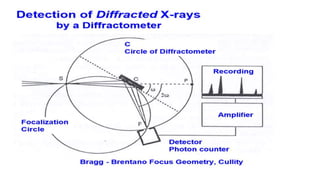
• INSTRUMENTATION
• METHODS
• APPLICATIONS
• CONCLUSIONS
• REFERENCES
•
WHAT IS AN X RAY ?
• INTRODUCTION:
• X-rays were discovered by Wilhelm Roentgen who called them
x-rays because the nature at first was unknown so, x-rays are
also called Roentgen rays. X-ray diffraction in crystals was
discovered by Max von Laue. The wavelength range is 10-7 to
about 10-15 m.
• The penetrating power of x-rays depends on energy also, there
are two types of x-rays. i) Hard x-rays: which have high
frequency and have more energy. ii) soft x-rays: which have
less penetrating and have low energy
• DIFRECTIONS
X-RAYS
• 1.X-rays are short wave length electromagnetic radiations
produced by the deceleration of high energy electrons or by
electronic transitions of electrons in the inner orbital of atoms.
• 2.X-ray region
0.1to100 A˚
3.Analytical purpose 0.7 to 2 A˚
WHY XRD?
• • Measure the average spacings between layers or rows of
atoms
• • Determine the orientation of a single crystal or grain
• • Find the crystal structure of an unknown material
• • Measure the size, shape and internal stress of small
crystalline regions
PRINCIPLE
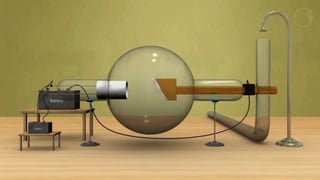
• X-ray diffraction is based on constructive interference of
monochromatic x-rays and a crystalline sample. These x-rays
are generated by a cathode ray tube, filtered to produce
monochromatic radiation ,collimated to concentrate and
directed towards the sample. The interaction of incident rays
with the sample produces constructive int erference when
conditions satisfy Bragg’s law.
APPLICATIONS OF XRD
• • XRD is a nondestructive technique
• • To identify crystalline phases and orientation
• • To determine structural properties: Lattice parameters (10-
4Å), strain, grain size, expitaxy, phase composition, preferred
orientation (Laue) order-disorder transformation, thermal
expansion
• • To measure thickness of thin films and multi-layers*
• • To determine atomic arrangement
• • Detection limits: ~3% in a two phase mixture; can be ~0.1%
with synchrotron radiation Spatial resolution: normally none
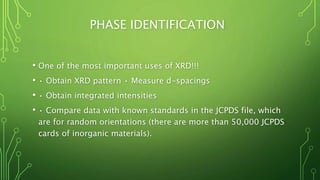
PHASE IDENTIFICATION
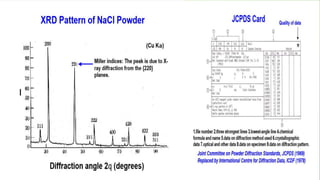
• One of the most important uses of XRD!!!
• • Obtain XRD pattern • Measure d-spacings
• • Obtain integrated intensities
• • Compare data with known standards in the JCPDS file, which
are for random orientations (there are more than 50,000 JCPDS
cards of inorganic materials).
ADVANTAGES
GROUP PIC PLEASE
 XRD

XRD

  • 3.
    TOPIC # X-RAYDIFFRACTION PRESENTATION BY GROUP NO # 3 Student name RollNo status From Nazim 18fmt006 Co-prazenter Burewala MUHAMMAD Adill 18fmt007 Co-prazenter Multan Muhammad Rashid 18fmt022 Co-prazenter burewala Muhammad Waqar 18fmt031 Prazenter Narowal Muneeb-ul-rhaman 18fmt035 Co-prazenter lahore Muhammad kashif 18fmt040 Co-prazenter Shakohpura
  • 4.
    CONTENTS • INTRODUCTION • GENERATIONOF X-RAYS • PRINCIPLE • INSTRUMENTATION • METHODS • APPLICATIONS • CONCLUSIONS • REFERENCES •
  • 6.
    WHAT IS ANX RAY ? • INTRODUCTION: • X-rays were discovered by Wilhelm Roentgen who called them x-rays because the nature at first was unknown so, x-rays are also called Roentgen rays. X-ray diffraction in crystals was discovered by Max von Laue. The wavelength range is 10-7 to about 10-15 m. • The penetrating power of x-rays depends on energy also, there are two types of x-rays. i) Hard x-rays: which have high frequency and have more energy. ii) soft x-rays: which have less penetrating and have low energy • DIFRECTIONS
  • 7.
    X-RAYS • 1.X-rays areshort wave length electromagnetic radiations produced by the deceleration of high energy electrons or by electronic transitions of electrons in the inner orbital of atoms. • 2.X-ray region 0.1to100 A˚ 3.Analytical purpose 0.7 to 2 A˚
  • 10.
    WHY XRD? • •Measure the average spacings between layers or rows of atoms • • Determine the orientation of a single crystal or grain • • Find the crystal structure of an unknown material • • Measure the size, shape and internal stress of small crystalline regions
  • 11.
    PRINCIPLE • X-ray diffractionis based on constructive interference of monochromatic x-rays and a crystalline sample. These x-rays are generated by a cathode ray tube, filtered to produce monochromatic radiation ,collimated to concentrate and directed towards the sample. The interaction of incident rays with the sample produces constructive int erference when conditions satisfy Bragg’s law.
  • 30.
    APPLICATIONS OF XRD •• XRD is a nondestructive technique • • To identify crystalline phases and orientation • • To determine structural properties: Lattice parameters (10- 4Å), strain, grain size, expitaxy, phase composition, preferred orientation (Laue) order-disorder transformation, thermal expansion • • To measure thickness of thin films and multi-layers* • • To determine atomic arrangement • • Detection limits: ~3% in a two phase mixture; can be ~0.1% with synchrotron radiation Spatial resolution: normally none
  • 31.
    PHASE IDENTIFICATION • Oneof the most important uses of XRD!!! • • Obtain XRD pattern • Measure d-spacings • • Obtain integrated intensities • • Compare data with known standards in the JCPDS file, which are for random orientations (there are more than 50,000 JCPDS cards of inorganic materials).
  • 32.
  • 33.