Downloaded 36 times




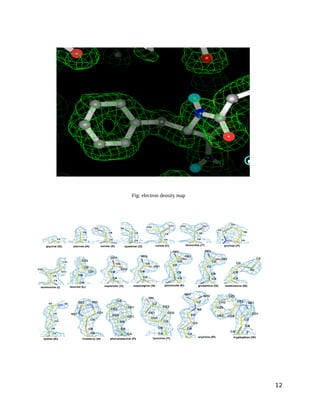
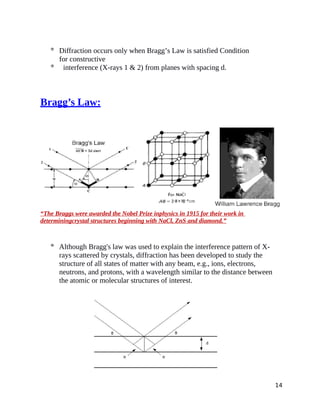
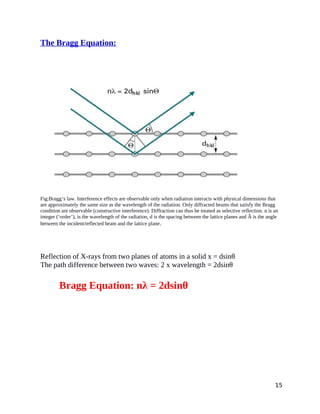


X-ray crystallography is a technique used to determine the three-dimensional atomic structure of crystals. X-rays are diffracted by the crystal and the diffraction pattern is collected on a detector. By analyzing the diffraction pattern using Bragg's law and Fourier transforms, scientists can construct electron density maps and refine protein structures at high resolution. Key aspects of X-ray crystallography include generating X-rays, collecting diffraction data, solving protein structures, and refining models using computational methods. This technique has provided atomic level insights into protein structure and been instrumental in numerous scientific discoveries through applications like determining unknown material structures.


