Co & post-translationmodification
By
KAUSHAL KUMAR SAHU
Assistant Professor (Ad Hoc)
Department of Biotechnology
Govt. Digvijay Autonomous P. G. College
Raj-Nandgaon ( C. G. )
1-Introduction
2-Protein modifications
[A] Folding
1-Chaperon mediated
2-Enzymatic
[B] Cleavage
[C] Glycosylation
[D] Attachment of Lipids
[E] Proteolysis
3-Conclusion
4-Reference
Protein modification can occur at any step in the "life cycle" of a
protein.
For example, many proteins are modified shortly after
translation is completed to mediate proper protein folding or
stability or to direct the nascent protein to distinct cellular
compartments.
Translation completes the flow of genetic information within
the cell. The sequence of nucleotides in DNA has now been
converted to the sequence of amino acids in a polypeptide
chain.
The synthesis of a polypeptide, however, is not equivalent to the
production of a functional protein.
To be useful, polypeptides must fold into distinct three-
dimensional conformations, and in many cases multiple
polypeptide chains must assemble into a functional complex.
 The proper folding of proteins within cells is
mediated by the activities of other proteins.
Proteins that facilitate the folding of other proteins
are called molecular chaperones.
The term "chaperone" was first used by Ron Lackey
and his colleagues.
Chaperone binding stabilizes the amino-terminal
portion in an unfolded conformation until the rest of
the polypeptide chain is synthesized and the
completed protein can fold correctly.
Chaperones
Family Size Location
Hsp 60 ~ 1 MDa
Mitochondria,
Chloroplast
Hsp 70 ~ 70 kDa Cytoplasm, ER ,
Mitochondria,
Chloroplast
Hsp 90 ~ 90 kDa ER, cytosol,
mitochondria
Hsp 100 ~ 100 kDa Mitochondria, ER
chloroplast
Exa- Mitochondria
Cells contain at least two types of enzymes that act as chaperon.
1 Peptidyl prolyl isomerase [PPI]
2 Protein Disulphide Isomerases (PDI) -
Protein disulfide isomerase or PDI is an enzyme in the ER that
catalyzes the formation and breakage of disulfide
bonds between cysteine residues within proteins as they fold.
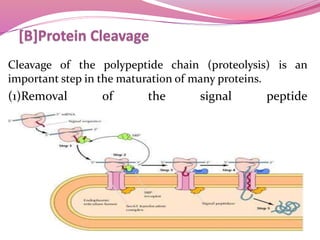
Cleavage of the polypeptide chain (proteolysis) is an
important step in the maturation of many proteins.
(1)Removal of the signal peptide
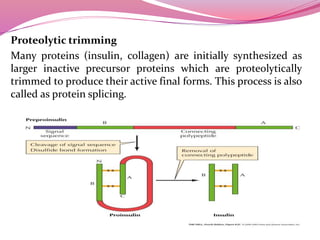
Proteolytic trimming
Many proteins (insulin, collagen) are initially synthesized as
larger inactive precursor proteins which are proteolytically
trimmed to produce their active final forms. This process is also
called as protein splicing.
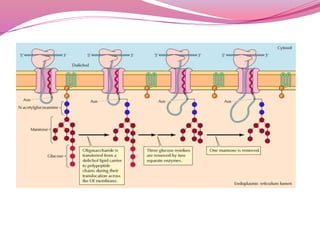
Many proteins, particularly in eukaryotic cells, are
modified by the addition of carbohydrates, a process called
glycosylation.
The proteins to which carbohydrate chains have been
added (called glycoproteins) are usually secreted or
localized to the cell surface, although many nuclear and
cytosolicproteins are also glycosylated.
Some proteins in eukaryotic cells are modified by the attachment
of lipids to the polypeptide chain.
Three general types of lipid additions N- myristoylation,
prenylation, and palmitoylationare common in eukaryotic
proteins associated with the cytosolic face of the plasma
membrane.
A fourth type of modification GPI anchored, the addition of
glycolipids, plays an important role in anchoring some cell surface
proteins to the extracellular face of the plasma membrane.
Fig- Glycosylphosphatidylinositol (GPI)
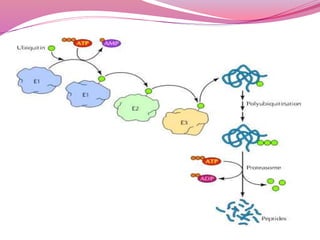
Levels of protein within cells are determined not only by
rates of synthesis but also by rates of degradation.
In eukaryotic cells, two major pathways—the ubiquitin-
proteasome pathway and lysosomal proteolysis—mediate
protein degradation.
Ubiquitin is a 76-amino-acid polypeptide that is highly
conserved in all eukaryotes (yeasts, animals, and
plants).
Proteins are marked for degradation by the attachment
of ubiquitin to the amino group of the side chain of a
lysine residue.
Protein modifications play a key role in functional
proteomics, because they regulate activity, localization
and interaction with other cellular molecules such as
proteins, nucleic acids, lipids, and cofactors.
Cell & Molecular Biology 5
th
edition
Gerald Karp
The Cell A Molecular Approach 4
th
edition
Geoffrey M Cooper
Internet sources- in wikipedia.org

co and post translation modification, by

  • 1.
    Co & post-translationmodification By KAUSHALKUMAR SAHU Assistant Professor (Ad Hoc) Department of Biotechnology Govt. Digvijay Autonomous P. G. College Raj-Nandgaon ( C. G. )
  • 2.
    1-Introduction 2-Protein modifications [A] Folding 1-Chaperonmediated 2-Enzymatic [B] Cleavage [C] Glycosylation [D] Attachment of Lipids [E] Proteolysis 3-Conclusion 4-Reference
  • 3.
    Protein modification canoccur at any step in the "life cycle" of a protein. For example, many proteins are modified shortly after translation is completed to mediate proper protein folding or stability or to direct the nascent protein to distinct cellular compartments.
  • 4.
    Translation completes theflow of genetic information within the cell. The sequence of nucleotides in DNA has now been converted to the sequence of amino acids in a polypeptide chain. The synthesis of a polypeptide, however, is not equivalent to the production of a functional protein. To be useful, polypeptides must fold into distinct three- dimensional conformations, and in many cases multiple polypeptide chains must assemble into a functional complex.
  • 5.
     The properfolding of proteins within cells is mediated by the activities of other proteins. Proteins that facilitate the folding of other proteins are called molecular chaperones. The term "chaperone" was first used by Ron Lackey and his colleagues. Chaperone binding stabilizes the amino-terminal portion in an unfolded conformation until the rest of the polypeptide chain is synthesized and the completed protein can fold correctly.
  • 7.
    Chaperones Family Size Location Hsp60 ~ 1 MDa Mitochondria, Chloroplast Hsp 70 ~ 70 kDa Cytoplasm, ER , Mitochondria, Chloroplast Hsp 90 ~ 90 kDa ER, cytosol, mitochondria Hsp 100 ~ 100 kDa Mitochondria, ER chloroplast
  • 8.
  • 9.
    Cells contain atleast two types of enzymes that act as chaperon. 1 Peptidyl prolyl isomerase [PPI] 2 Protein Disulphide Isomerases (PDI) - Protein disulfide isomerase or PDI is an enzyme in the ER that catalyzes the formation and breakage of disulfide bonds between cysteine residues within proteins as they fold.
  • 11.
    Cleavage of thepolypeptide chain (proteolysis) is an important step in the maturation of many proteins. (1)Removal of the signal peptide
  • 12.
    Proteolytic trimming Many proteins(insulin, collagen) are initially synthesized as larger inactive precursor proteins which are proteolytically trimmed to produce their active final forms. This process is also called as protein splicing.
  • 13.
    Many proteins, particularlyin eukaryotic cells, are modified by the addition of carbohydrates, a process called glycosylation. The proteins to which carbohydrate chains have been added (called glycoproteins) are usually secreted or localized to the cell surface, although many nuclear and cytosolicproteins are also glycosylated.
  • 15.
    Some proteins ineukaryotic cells are modified by the attachment of lipids to the polypeptide chain. Three general types of lipid additions N- myristoylation, prenylation, and palmitoylationare common in eukaryotic proteins associated with the cytosolic face of the plasma membrane. A fourth type of modification GPI anchored, the addition of glycolipids, plays an important role in anchoring some cell surface proteins to the extracellular face of the plasma membrane.
  • 16.
  • 17.
    Levels of proteinwithin cells are determined not only by rates of synthesis but also by rates of degradation. In eukaryotic cells, two major pathways—the ubiquitin- proteasome pathway and lysosomal proteolysis—mediate protein degradation.
  • 18.
    Ubiquitin is a76-amino-acid polypeptide that is highly conserved in all eukaryotes (yeasts, animals, and plants). Proteins are marked for degradation by the attachment of ubiquitin to the amino group of the side chain of a lysine residue.
  • 20.
    Protein modifications playa key role in functional proteomics, because they regulate activity, localization and interaction with other cellular molecules such as proteins, nucleic acids, lipids, and cofactors.
  • 21.
    Cell & MolecularBiology 5 th edition Gerald Karp The Cell A Molecular Approach 4 th edition Geoffrey M Cooper Internet sources- in wikipedia.org