Madelyn HunterMadelyn Hunter
Rebecca HoltRebecca Holt
Cathy RitzesCathy Ritzes
Kathleen WilesKathleen Wiles
Madeline Hunter’s BackgroundMadeline Hunter’s Background
 She did not originally plan out a “7 Step” LessonShe did not originally plan out a “7 Step” Lesson
Plan.Plan.
 Educators who followed created the steps basedEducators who followed created the steps based
on her philosophies.on her philosophies.
 Its misuse is largely responsible to objections toIts misuse is largely responsible to objections to
“Direct Instruction”“Direct Instruction”
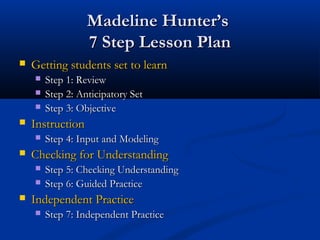
Madeline Hunter’sMadeline Hunter’s
7 Step Lesson Plan7 Step Lesson Plan
 Getting students set to learnGetting students set to learn
 Step 1: ReviewStep 1: Review
 Step 2: Anticipatory SetStep 2: Anticipatory Set
 Step 3: ObjectiveStep 3: Objective
 InstructionInstruction
 Step 4: Input and ModelingStep 4: Input and Modeling
 Checking for UnderstandingChecking for Understanding
 Step 5: Checking UnderstandingStep 5: Checking Understanding
 Step 6: Guided PracticeStep 6: Guided Practice
 Independent PracticeIndependent Practice
 Step 7: Independent PracticeStep 7: Independent Practice
Getting studentsGetting students
set to learnset to learn
Step One: ReviewStep One: Review
 Review previous material that is relevant to thisReview previous material that is relevant to this
lessonlesson
 Typically at the beginning of the lessonTypically at the beginning of the lesson
Step Two: AnticipationStep Two: Anticipation
 A short wake-up activityA short wake-up activity
 Simple questionSimple question
 Example problemExample problem
 Motivational ActivityMotivational Activity
 PromptPrompt
 Visual Stimulation: video clip, audio clip, etc.Visual Stimulation: video clip, audio clip, etc.
Step Three: ObjectiveStep Three: Objective
 Tell students what they will learnTell students what they will learn
 Tell them how they will be assessedTell them how they will be assessed
Click here to return to Hunter’s
InstructionInstruction
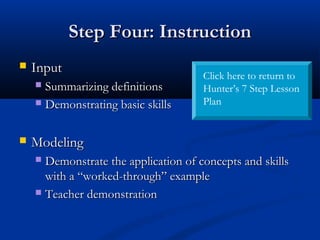
Step Four: InstructionStep Four: Instruction
 InputInput
 Summarizing definitionsSummarizing definitions
 Demonstrating basic skillsDemonstrating basic skills
 ModelingModeling
 Demonstrate the application of concepts and skillsDemonstrate the application of concepts and skills
with a “worked-through” examplewith a “worked-through” example
 Teacher demonstrationTeacher demonstration
Click here to return to
Hunter’s 7 Step Lesson
Plan
Checking ForChecking For
UnderstandingUnderstanding
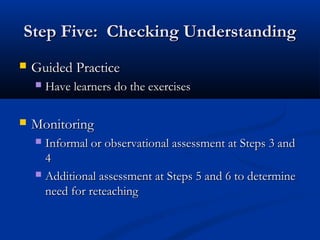
Step Five: Checking UnderstandingStep Five: Checking Understanding
 Guided PracticeGuided Practice
 Have learners do the exercisesHave learners do the exercises
 MonitoringMonitoring
 Informal or observational assessment at Steps 3 andInformal or observational assessment at Steps 3 and
44
 Additional assessment at Steps 5 and 6 to determineAdditional assessment at Steps 5 and 6 to determine
need for reteachingneed for reteaching
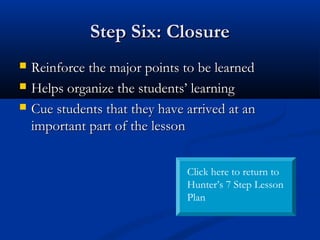
Step Six: ClosureStep Six: Closure
 Reinforce the major points to be learnedReinforce the major points to be learned
 Helps organize the students’ learningHelps organize the students’ learning
 Cue students that they have arrived at anCue students that they have arrived at an
important part of the lessonimportant part of the lesson
Click here to return to
Hunter’s 7 Step Lesson
Plan
Independent PracticeIndependent Practice
Step Seven: Independent PracticeStep Seven: Independent Practice
 Students practice on their ownStudents practice on their own
 Apply the learning to new situationsApply the learning to new situations
 Could be used as:Could be used as:
 HomeworkHomework
 Individual or group work at home or in classIndividual or group work at home or in class
 Element in a subsequent projectElement in a subsequent project
Click here to return to
Hunter’s 7 Step Lesson
Plan
Summary of Hunter’s PhilosophySummary of Hunter’s Philosophy
““Not each of the "seven steps" need beNot each of the "seven steps" need be
in every lesson nor should every lessonin every lesson nor should every lesson
be based on the seven steps; however,be based on the seven steps; however,
the seven steps make a good check listthe seven steps make a good check list
of elements in planning a lesson.of elements in planning a lesson.
The instructional purpose and the bestThe instructional purpose and the best
way to involve the learner are theway to involve the learner are the
guides for what to choose in planning aguides for what to choose in planning a
lesson.”lesson.”
Taken from the website:Taken from the website:
http://www.humboldt.edu/~tha1/hunter-http://www.humboldt.edu/~tha1/hunter-
eei.htmleei.html

Madelyn hunter

  • 1.
    Madelyn HunterMadelyn Hunter RebeccaHoltRebecca Holt Cathy RitzesCathy Ritzes Kathleen WilesKathleen Wiles
  • 2.
    Madeline Hunter’s BackgroundMadelineHunter’s Background  She did not originally plan out a “7 Step” LessonShe did not originally plan out a “7 Step” Lesson Plan.Plan.  Educators who followed created the steps basedEducators who followed created the steps based on her philosophies.on her philosophies.  Its misuse is largely responsible to objections toIts misuse is largely responsible to objections to “Direct Instruction”“Direct Instruction”
  • 3.
    Madeline Hunter’sMadeline Hunter’s 7Step Lesson Plan7 Step Lesson Plan  Getting students set to learnGetting students set to learn  Step 1: ReviewStep 1: Review  Step 2: Anticipatory SetStep 2: Anticipatory Set  Step 3: ObjectiveStep 3: Objective  InstructionInstruction  Step 4: Input and ModelingStep 4: Input and Modeling  Checking for UnderstandingChecking for Understanding  Step 5: Checking UnderstandingStep 5: Checking Understanding  Step 6: Guided PracticeStep 6: Guided Practice  Independent PracticeIndependent Practice  Step 7: Independent PracticeStep 7: Independent Practice
  • 4.
  • 5.
    Step One: ReviewStepOne: Review  Review previous material that is relevant to thisReview previous material that is relevant to this lessonlesson  Typically at the beginning of the lessonTypically at the beginning of the lesson
  • 6.
    Step Two: AnticipationStepTwo: Anticipation  A short wake-up activityA short wake-up activity  Simple questionSimple question  Example problemExample problem  Motivational ActivityMotivational Activity  PromptPrompt  Visual Stimulation: video clip, audio clip, etc.Visual Stimulation: video clip, audio clip, etc.
  • 7.
    Step Three: ObjectiveStepThree: Objective  Tell students what they will learnTell students what they will learn  Tell them how they will be assessedTell them how they will be assessed Click here to return to Hunter’s
  • 8.
  • 9.
    Step Four: InstructionStepFour: Instruction  InputInput  Summarizing definitionsSummarizing definitions  Demonstrating basic skillsDemonstrating basic skills  ModelingModeling  Demonstrate the application of concepts and skillsDemonstrate the application of concepts and skills with a “worked-through” examplewith a “worked-through” example  Teacher demonstrationTeacher demonstration Click here to return to Hunter’s 7 Step Lesson Plan
  • 10.
  • 11.
    Step Five: CheckingUnderstandingStep Five: Checking Understanding  Guided PracticeGuided Practice  Have learners do the exercisesHave learners do the exercises  MonitoringMonitoring  Informal or observational assessment at Steps 3 andInformal or observational assessment at Steps 3 and 44  Additional assessment at Steps 5 and 6 to determineAdditional assessment at Steps 5 and 6 to determine need for reteachingneed for reteaching
  • 12.
    Step Six: ClosureStepSix: Closure  Reinforce the major points to be learnedReinforce the major points to be learned  Helps organize the students’ learningHelps organize the students’ learning  Cue students that they have arrived at anCue students that they have arrived at an important part of the lessonimportant part of the lesson Click here to return to Hunter’s 7 Step Lesson Plan
  • 13.
  • 14.
    Step Seven: IndependentPracticeStep Seven: Independent Practice  Students practice on their ownStudents practice on their own  Apply the learning to new situationsApply the learning to new situations  Could be used as:Could be used as:  HomeworkHomework  Individual or group work at home or in classIndividual or group work at home or in class  Element in a subsequent projectElement in a subsequent project Click here to return to Hunter’s 7 Step Lesson Plan
  • 15.
    Summary of Hunter’sPhilosophySummary of Hunter’s Philosophy ““Not each of the "seven steps" need beNot each of the "seven steps" need be in every lesson nor should every lessonin every lesson nor should every lesson be based on the seven steps; however,be based on the seven steps; however, the seven steps make a good check listthe seven steps make a good check list of elements in planning a lesson.of elements in planning a lesson.
  • 16.
    The instructional purposeand the bestThe instructional purpose and the best way to involve the learner are theway to involve the learner are the guides for what to choose in planning aguides for what to choose in planning a lesson.”lesson.” Taken from the website:Taken from the website: http://www.humboldt.edu/~tha1/hunter-http://www.humboldt.edu/~tha1/hunter- eei.htmleei.html