Chapter 6
CURRICULUM
EVALUATION
Purpose of curriculum evaluation
Print (1993) identified several important purpose and function of
evaluation in school settings:
 Essintial of providing feedback to learners - provides useful
information in hrlping the students improve their performance
and helps teachers identify the strength and weakness of the
learners.
 Helful in determining how well learners have achieve the
objectives of curriculum - describe whether the students learned
or mastered the desire outcomes and objective of curriculum.
 To improve curriculum - the result of evaluation serves as
basis in improving curriculum and for suggesting innovation to
improve learning.
In addition, curriculum evaluation is also useful to administrators
and teachers in many different ways for example.
• Evaluation helps in making decision about improving teaching
and learning process
• it help in shaping academic policies.
• It guide in initiating curricular changes and innovati
• It ensures quality of any curricular program.
• It help schools align their curriculum to different curriculum
sources and influences
Conducting curriculum evaluation is a determinant of an
academic institution or school commitment to quality and
continuous improvement. It show how serious a school can be in
realizing its philosopy, vision and mission.
Curriculum evaluation in the classroom
Doll (1997) asserted that the classroom in fact could be the first site of
gathering important data that will lead curriculum evaluation. With in
the classroom, teachers and administrators can collect data using
several intrument like:
• Test result
• Anecdota record
• Check list
• Interview guide
• Observation guide
• Personality inventuries
• Rating skill
• IQ test and
• Interest inventories
Teacher play a important role in conducting curriculum evaluation
in the classroom level, they must be guided in gathering data from
these intruments and in interpreting the data. The result of
classroom based evaluation may help in improving instruction and
in the effictive implementation of curriculum.
Curriculum evaluation at the school or school system level.
Curriculum evaluation is done mostly at the school or school
system level, this is usually done to evaluate how the curriculum
goals are attained in the macro level. At this level the following
instructions can be used to gathered data for the evaluation of the
curriculum.
• Opinion polls
• Survey
• Focus-group discussion
• Follow up studies (graduate tracer studies)
• Standard evaluation instrument
• Result of district or national test
The school that gathered and anlyze data on the implementation
of the curriculum can also do research activities.
MODEL OF CURRICULUM EVALUATION
Curriculum scholar and curriculum workers have identified various
model that can be used for evaluating curriculum. Each of this model
is a product of endless works of curriculum scholars trying to assess
the vale of a particular curriculum.
A. Provus discrepancy evaluation model
This model of curriculum evaluation are developed by malcolm
provus(1971) to evaluate projects under the elementary, secondary
education act in the united state. Using the taxonomy of program
content developed by robert state
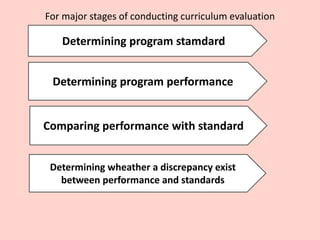
For major stages of conducting curriculum evaluation
Determining program stamdard
Determining program performance
Comparing performance with standard
Determining wheather a discrepancy exist
between performance and standards
Ronald doll (1997) noted that the provus model has been called
the discrepancy model because it compares performance and
standards to determined whether there is a discrepancy between
the two. This model enables the curriculum evaluators and
administrators of the school to collect or gather concrete evidence
on how the curriculum satisfies the set standard .
B.Tyler model of curriculum evaluation
Aligned to his model of curriculum development, ralph
tyler(1950) proposed seven steps in evaluating curriculum
1. Establish of goald and objective.
2. Classification of objectives.
3. Difinition of the objective and behavioral terms.
4. Identification of situation in which achievement of the
objective can be shown.
5. Selection of criterion measurments producers.
6. Collecting of data about pupils performance
7. Comparison of findings with the stated objectives.
C. Stufflebeams CIPP model
The phi delta kappa national study committee evaluation, chaired by
Daniel L. Stufflebeams developed and publish a curriculum evaluation
model know as CIPP ( content, input, process,product) model
(stufflebeams (1971) , stufflebeams (2001) defined evaluation as the
process of delineating,obtaining, and providing useful information for
judging decision atternative
Content Evaluation - according to stufflebeams, is the most basic kind of
evaluation its porpuse is to provide a strong rationale for determining
curriculum objective
Input evaluation - aim to provide information for determining how
resources are utilized to achived curriculum objective.
Process - focuses on providing periodic feedback while the curriculum is
being implemented.
Product - aim to gather, interpret, and apprise curricular attainment not
just the end of an implemention of the curriculum
D. Stakes congruency- contengencyevaluation model
Robert stake (1975) claimed the curriculum evaluation is not
complete unless three categories of data are made available.
1. Antecedets- include data on students and teacher, the curriculum to
be evaluated and community context.
2. Transaction - include time allotment, sequence of steps, social
climate and communication flows
3. Outcomes - encompass student learning in the form of
understanding, skills and value or attitudes, as well as the effects of
the curriculum on the teachers, student at the school.
E. Eisners Educational connoisseurship model
Elliot eisner(1985) provided a qualitative way of evaluating
curriculum. This model does not have methodical producers compared
with other evaluation model. Eisner model calls for a deeper and wider
observation results of evaluation that are express in written form.
Reflection on curriculum evaluation
• The purpose of curriculum evaluation is to make judgment on
the effectiveness of curriculum
• Curriculum evaluation follows a scientific and logical process
the procedures of curriculum evaluation are linked with how the
curriculum was developed.
• Each curriculum evaluation model is based on a set of
principles that embodies a curriculum theory or educational
principle.
• Curriculum evaluation could be done in a national level or
school based depending on the porpuse of the evaluation
• Gathering of data for evaluation and analysis is important in
curriculum evaluation
• The result of curriculum evaluation are essential in making
curricular decision.
The end of
presentation

Curriculum Evaluation.pptx

  • 1.
  • 2.
    Purpose of curriculumevaluation Print (1993) identified several important purpose and function of evaluation in school settings:  Essintial of providing feedback to learners - provides useful information in hrlping the students improve their performance and helps teachers identify the strength and weakness of the learners.  Helful in determining how well learners have achieve the objectives of curriculum - describe whether the students learned or mastered the desire outcomes and objective of curriculum.  To improve curriculum - the result of evaluation serves as basis in improving curriculum and for suggesting innovation to improve learning.
  • 3.
    In addition, curriculumevaluation is also useful to administrators and teachers in many different ways for example. • Evaluation helps in making decision about improving teaching and learning process • it help in shaping academic policies. • It guide in initiating curricular changes and innovati • It ensures quality of any curricular program. • It help schools align their curriculum to different curriculum sources and influences Conducting curriculum evaluation is a determinant of an academic institution or school commitment to quality and continuous improvement. It show how serious a school can be in realizing its philosopy, vision and mission.
  • 4.
    Curriculum evaluation inthe classroom Doll (1997) asserted that the classroom in fact could be the first site of gathering important data that will lead curriculum evaluation. With in the classroom, teachers and administrators can collect data using several intrument like: • Test result • Anecdota record • Check list • Interview guide • Observation guide • Personality inventuries • Rating skill • IQ test and • Interest inventories
  • 5.
    Teacher play aimportant role in conducting curriculum evaluation in the classroom level, they must be guided in gathering data from these intruments and in interpreting the data. The result of classroom based evaluation may help in improving instruction and in the effictive implementation of curriculum.
  • 6.
    Curriculum evaluation atthe school or school system level. Curriculum evaluation is done mostly at the school or school system level, this is usually done to evaluate how the curriculum goals are attained in the macro level. At this level the following instructions can be used to gathered data for the evaluation of the curriculum. • Opinion polls • Survey • Focus-group discussion • Follow up studies (graduate tracer studies) • Standard evaluation instrument • Result of district or national test The school that gathered and anlyze data on the implementation of the curriculum can also do research activities.
  • 7.
    MODEL OF CURRICULUMEVALUATION Curriculum scholar and curriculum workers have identified various model that can be used for evaluating curriculum. Each of this model is a product of endless works of curriculum scholars trying to assess the vale of a particular curriculum. A. Provus discrepancy evaluation model This model of curriculum evaluation are developed by malcolm provus(1971) to evaluate projects under the elementary, secondary education act in the united state. Using the taxonomy of program content developed by robert state
  • 8.
    For major stagesof conducting curriculum evaluation Determining program stamdard Determining program performance Comparing performance with standard Determining wheather a discrepancy exist between performance and standards
  • 9.
    Ronald doll (1997)noted that the provus model has been called the discrepancy model because it compares performance and standards to determined whether there is a discrepancy between the two. This model enables the curriculum evaluators and administrators of the school to collect or gather concrete evidence on how the curriculum satisfies the set standard .
  • 10.
    B.Tyler model ofcurriculum evaluation Aligned to his model of curriculum development, ralph tyler(1950) proposed seven steps in evaluating curriculum 1. Establish of goald and objective. 2. Classification of objectives. 3. Difinition of the objective and behavioral terms. 4. Identification of situation in which achievement of the objective can be shown. 5. Selection of criterion measurments producers. 6. Collecting of data about pupils performance 7. Comparison of findings with the stated objectives.
  • 11.
    C. Stufflebeams CIPPmodel The phi delta kappa national study committee evaluation, chaired by Daniel L. Stufflebeams developed and publish a curriculum evaluation model know as CIPP ( content, input, process,product) model (stufflebeams (1971) , stufflebeams (2001) defined evaluation as the process of delineating,obtaining, and providing useful information for judging decision atternative Content Evaluation - according to stufflebeams, is the most basic kind of evaluation its porpuse is to provide a strong rationale for determining curriculum objective Input evaluation - aim to provide information for determining how resources are utilized to achived curriculum objective. Process - focuses on providing periodic feedback while the curriculum is being implemented. Product - aim to gather, interpret, and apprise curricular attainment not just the end of an implemention of the curriculum
  • 12.
    D. Stakes congruency-contengencyevaluation model Robert stake (1975) claimed the curriculum evaluation is not complete unless three categories of data are made available. 1. Antecedets- include data on students and teacher, the curriculum to be evaluated and community context. 2. Transaction - include time allotment, sequence of steps, social climate and communication flows 3. Outcomes - encompass student learning in the form of understanding, skills and value or attitudes, as well as the effects of the curriculum on the teachers, student at the school. E. Eisners Educational connoisseurship model Elliot eisner(1985) provided a qualitative way of evaluating curriculum. This model does not have methodical producers compared with other evaluation model. Eisner model calls for a deeper and wider observation results of evaluation that are express in written form.
  • 13.
    Reflection on curriculumevaluation • The purpose of curriculum evaluation is to make judgment on the effectiveness of curriculum • Curriculum evaluation follows a scientific and logical process the procedures of curriculum evaluation are linked with how the curriculum was developed. • Each curriculum evaluation model is based on a set of principles that embodies a curriculum theory or educational principle. • Curriculum evaluation could be done in a national level or school based depending on the porpuse of the evaluation • Gathering of data for evaluation and analysis is important in curriculum evaluation • The result of curriculum evaluation are essential in making curricular decision.
  • 14.