Instructional Objectives
A statement of something that students should be
able to
DO
after receiving instruction
Instructional Objectives also have to be “SPECIFIC”
& “MEASURABLE”
• Course description tells you something about the content &
general aims of a course.

• A syllabus provides a “Topic List”.
- Students cannot make out from it the depth /
breadth of coverage of the topics
- The depth / breadth of coverage often varies
from teacher to teacher
- Syllabus does not provide external examiner
with the depth / breadth of coverage
A Course Objective describes the “desired outcome” of a course
Syllabus can be converted to Instructional Objectives.
An example on a course on “Communication Skills”
Course Description:
Principles of written and oral communications for instructional technologists;
development of assertiveness and interpersonal skills; conducting training
programs for employees; creating hard copy materials.
Syllabus: The course covers the following topics :
Topic – 1 Communication and Professionalism
Topic – 2 Communication: Consistency and Change
……….
Topic-wise Instructional Objectives :
In topic – 1 : Communication and Professionalism
At the end of the lesson, the Learner will be able to :
i) identify issues which require consistency in the midst of change
ii) assess basic elements of organizational communication with a
major emphasis on small group and team communication.
In topic - 2 : Communication: Consistency and Change
i) list basic human and organizational communication needs
ii) determine appropriate language use within and outside the organization
iii) profile the audience and their needs within an ethical context
iv) examine and list major attributes of communications media
Basic Characteristics of Instructional Objectives :
• Action Oriented Statements – describing what is to be achieved
by the learner.:
• # Related to “intended Learning Outcomes” -NOT - the process
for achieving those outcomes (bread & baking)
# Specific & measurable – NOT – broad and intangible (understand
algebra / know your enemy / be able to internalize a sense of
confidence)
# Concerned with the “learner” – rather – than the “teacher”
(Lecture on the theory of Relativity / Arrange field trips)
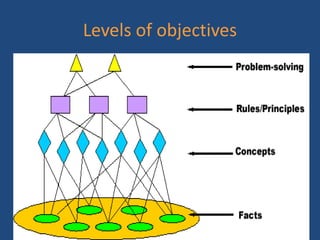
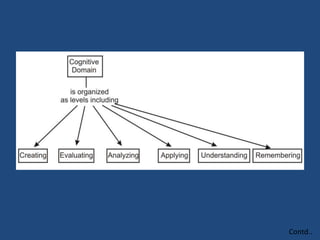
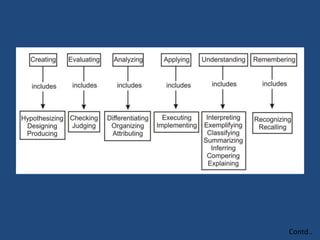
Levels of objectives
Instructional Objectives & ACTION VERBS
Instructional objectives should not be formulated with vague
statements like “ the student would understand / appreciate”
etc
Instructional objectives are to be formulated with the help of
Action verbs”
Action Verbs indicate what the student will be able to actively
do, like – “identify”, “assess”, “list”, “solve”, “analyse”, “design”,
“compare”, etc.
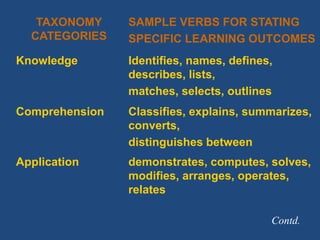
TAXONOMY
CATEGORIES
SAMPLE VERBS FOR STATING
SPECIFIC LEARNING OUTCOMES
Knowledge Identifies, names, defines,
describes, lists,
matches, selects, outlines
Comprehension Classifies, explains, summarizes,
converts,
distinguishes between
Application demonstrates, computes, solves,
modifies, arranges, operates,
relates
Contd.
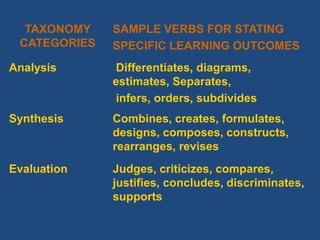
TAXONOMY
CATEGORIES
SAMPLE VERBS FOR STATING
SPECIFIC LEARNING OUTCOMES
Analysis Differentiates, diagrams,
estimates, Separates,
infers, orders, subdivides
Synthesis Combines, creates, formulates,
designs, composes, constructs,
rearranges, revises
Evaluation Judges, criticizes, compares,
justifies, concludes, discriminates,
supports
Factors Affecting the Selection of appropriate objectives :
Entry Behaviour of learners – ie.; - what the learner is able to
do before beginning the lesson / course (prerequisite
knowledge / learner background))
What the learner should be able to do at the end of the lesson
/ course (end objective / goal)
Available teaching resources & constraints, including
availability of hardware / software / teaching aids & teacher
capabilities
Need for Instructional Objectives
In Design : Brings focus, objectivity to instruction –
• It provides the teacher - with clear focus on –
# what he needs to teach & the depth of his teaching
# how to teach it
# how he has to evaluate what he taught
• It provides the student with a clear understanding of what he is
expected to learn and what he will be tested on
• It provides the future employer of such students with clear idea of
exactly what the student has learned from the course.
In Planning :
• It guides selection of “proper tools” for the instruction (
example of surgeons).
• Mode of teaching (lecture / demonstration / hands-on exercises
/ problem solving) will depend on “what the learner needs to
achieve” after the instruction
• It allows instructor ingenuity. Once objectives are fixed,
instructor is free to attain the goal in his own way
• It allows consistent results from learners – across instructors –
across years
In Evaluation :
• It calls for “measurable results” in tests – making tests very
focused and uniform
• It allows “goal posts” for students. They know exactly what
they will be tested on and do not have to second guess
instructors regarding test questions
• It provides benchmark to determine whether the main intent
has been achieved
• It provides criteria to judge whether learners are competent
enough in a particular area
In Instructional efficiency :
• Often a lot of “usually given instruction” can be eliminated
totally – if the objectives are very clear to students – promotes
self-learning
• It clarifies what are critical characteristics that are important to
develop in the lesson
Practical steps towards deriving Instructional Objectives
Questions to be asked while formulating Instructional Objectives
•At the very minimum, what should students leave the course knowing and
being able to do?
•Do you expect students to recall information for a short term (e.g., to apply in a
more advanced-level course next semester) or a long term (e.g., to provide the
liberal arts foundation expected of college graduates and/or to apply in the
professional workplace)?
•Try to choose activities that require the highest possible levels of thinking
Three Important features of a well-written
Instructional Objective
• The performance component
• The condition component
• The criterion component
The performance component --- :
Performance describes what the learner is expected to be able to DO
to demonstrate his mastery over the content. It is the “main
intent” of the objective directly.
Performance may be “overt” – where it can be readily seen / heard
(dance / draft a report).
Performance may be “covert”, ie., is not a visible performance
Such performances often describe something a learner can “BE”
instead of something a learner can “DO”.
To bring objectivity to “covert” performances, add an “indicator
behaviour” - (an act or behaviour that indicates the presence of the
‘covert’ skill – eg., ‘sort ) to show how the covert performance can be
directly detected
Covert performances need to be continuously modified until it
becomes a specific statement of a “doing” word.
( eg., - “be able to develop an appreciation of music” – must be
modified into the things the learner has to become able to DO to
develop such appreciation).
The condition component ----:
All conditions – that make a significant difference to the nature of the
performance” should be stated
Describes actual conditions under which the task will occur or be
observed.
Also identifies :
Tools, procedures, materials, aids, or facilities to be used in performing
the task. (“without reference to a manual" or "by checking a chart".)
Audience - target of objective, and learner's characteristics
(Given a list of chemical elements be able to write valences of each)
Helps avoid :
“Surprises” with objectives, we state the “main intent” of
the objective alongwith the “main conditions” under
which the performance is to occur (“be able to hammer a
nail” – is a quite different objective from “given a brick, be
able to hammer a nail”).
“Miscommunication” between what the teacher expects
the learner to perform – and what the learner thinks he is
expected to do.
To identify “significant conditions” find out :
What the learner is expected to use when achieving the
required performance (tools / forms / software etc.)
What the learner will not be allowed to use while attaining
the desired performance (what is given / not given – chart /
photo / manual / checklists / calculators)
What will be the “real world conditions” / variables - under
which the performance is expected to occur ( under water /
in the cockpit / in a large class)
The Criterion component - help to gauge quality of
performance
A standard against which to judge success of instruction
Students will know if they have met / exceeded expectations
A “criterion of acceptable performance” increases the
communicating power of objectives
This component tells the learner – How often / how well /
how much / how will we know it is OK? His performance –
to be considered competent
Only those criterion should be used that are “Important /
Some common criteria :
Speed / time limit on the performance
Minimum marks for passing / grades
How often something needs to be done
Level of accuracy (within 0.5% accuracy)
Quality of the performance (information is factual / pertinent / treatment is
courteous
Criteria component is derived from :
Job requirements (to determine “how well” the job needs to be
done)
Improvement Requirements (How much “entry-level skill” one
needs to achieve the required improvements)
Academic requirements (prerequisites of the previous course
like algebra I for deciding objectives for algebra II)
Personal experience and experience of competent performers
Distinction between “Condition” & “Criterion” :
Condition is something that influences the SHAPE OF A
PERFORMANCE while Criterion is something that tells HOW
MUCH PERFORMANCE is required.
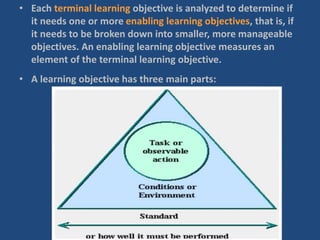
• Each terminal learning objective is analyzed to determine if
it needs one or more enabling learning objectives, that is, if
it needs to be broken down into smaller, more manageable
objectives. An enabling learning objective measures an
element of the terminal learning objective.
• A learning objective has three main parts:
•
Relevance of Objectives
• As you move up the "cognitive ladder," it
becomes increasingly difficult to precisely
specify the degree.
• Affective objectives are the hardest objectives
for most people to write and assess. They deal
almost exclusively with internal feelings and
conditions that can only be artificially observed
externally.
• The verbs you use to describe the overt,
measurable activity can be tricky to write (action
verbs help)
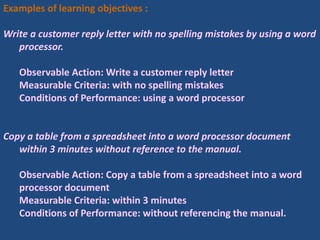
Examples of learning objectives :
Write a customer reply letter with no spelling mistakes by using a word
processor.
Observable Action: Write a customer reply letter
Measurable Criteria: with no spelling mistakes
Conditions of Performance: using a word processor
Copy a table from a spreadsheet into a word processor document
within 3 minutes without reference to the manual.
Observable Action: Copy a table from a spreadsheet into a word
processor document
Measurable Criteria: within 3 minutes
Conditions of Performance: without referencing the manual.
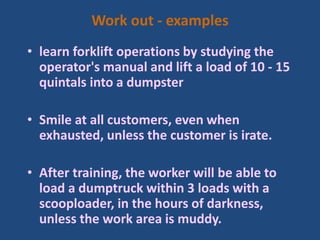
Work out - examples
• learn forklift operations by studying the
operator's manual and lift a load of 10 - 15
quintals into a dumpster
• Smile at all customers, even when
exhausted, unless the customer is irate.
• After training, the worker will be able to
load a dumptruck within 3 loads with a
scooploader, in the hours of darkness,
unless the work area is muddy.
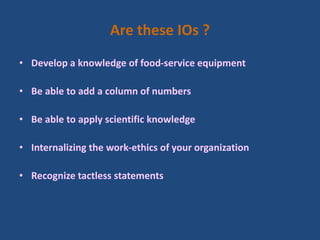
Are these IOs ?
• Develop a knowledge of food-service equipment
• Be able to add a column of numbers
• Be able to apply scientific knowledge
• Internalizing the work-ethics of your organization
• Recognize tactless statements
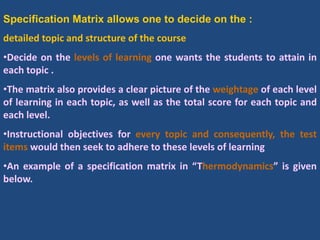
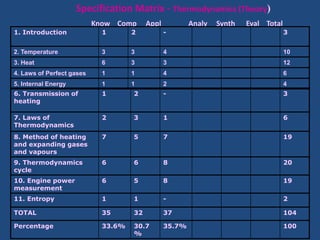
Specification Matrix allows one to decide on the :
detailed topic and structure of the course
•Decide on the levels of learning one wants the students to attain in
each topic .
•The matrix also provides a clear picture of the weightage of each level
of learning in each topic, as well as the total score for each topic and
each level.
•Instructional objectives for every topic and consequently, the test
items would then seek to adhere to these levels of learning
•An example of a specification matrix in “Thermodynamics” is given
below.
Specification Matrix - Thermodynamics (Theory)
Know Comp Appl Analy Synth Eval Total
1. Introduction 1 2 - 3
2. Temperature 3 3 4 10
3. Heat 6 3 3 12
4. Laws of Perfect gases 1 1 4 6
5. Internal Energy 1 1 2 4
6. Transmission of
heating
1 2 - 3
7. Laws of
Thermodynamics
2 3 1 6
8. Method of heating
and expanding gases
and vapours
7 5 7 19
9. Thermodynamics
cycle
6 6 8 20
10. Engine power
measurement
6 5 8 19
11. Entropy 1 1 - 2
TOTAL 35 32 37 104
Percentage 33.6% 30.7
%
35.7% 100
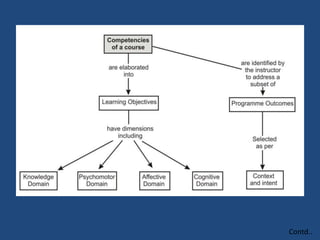
Contd..
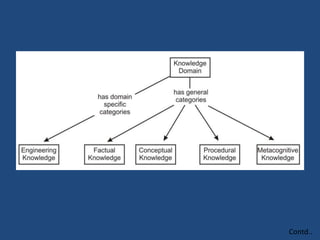
Contd..
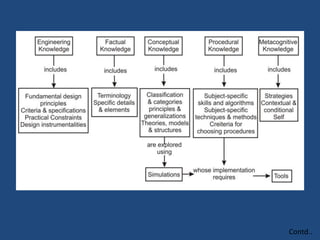
Contd..
Contd..
Contd..
Thank you
(put after slide 39)
Practical steps towards deriving Instructional Objectives
Questions to be asked while formulating Instructional Objectives
•At the very minimum, what should students leave the course knowing and
being able to do?
•Do you expect students to recall information for a short term (e.g., to apply in a
more advanced-level course next semester) or a long term (e.g., to provide the
liberal arts foundation expected of college graduates and/or to apply in the
professional workplace)?
•Try to choose activities that require the highest possible levels of thinking
Systematic Derivation of Instructional Objectives :
When Deriving objectives, first determine – “what is worth teaching” by :
•Task listing - A list of the tasks people do when they carry out their
required job
Task analysis – enumerates the steps that should ideally be taken to
complete the task It provides reasons to take up the task; the steps to be
followed; the decisions made during completion of the task and how to tell when
the task has been completed.
Skill Derivation – enumerates what a person has to know to be
able to practice the task (eg., to interview a job applicant, one
needs the skill to – talk clearly, interact tactfully etc.)
Skill –hierarchy drafting – an organization chart showing which
skill would be necessary before proceeding to master the next
skill.
•Objectives Drafting – describing the “desired performance”, the
“conditions” under which the performance should occur, and the “level of skill
required”.
Objectives should NOT include :
•Instructional Procedure (“given three lectures on the topic of Instructional
Objectives”)
•Target audience (“secondary school students would be able to ….”)
•Format - expecting all objectives to conform to a given format (one sentence /
given space)

Instructional objective

  • 1.
    Instructional Objectives A statementof something that students should be able to DO after receiving instruction Instructional Objectives also have to be “SPECIFIC” & “MEASURABLE”
  • 2.
    • Course descriptiontells you something about the content & general aims of a course. • A syllabus provides a “Topic List”. - Students cannot make out from it the depth / breadth of coverage of the topics - The depth / breadth of coverage often varies from teacher to teacher - Syllabus does not provide external examiner with the depth / breadth of coverage A Course Objective describes the “desired outcome” of a course
  • 3.
    Syllabus can beconverted to Instructional Objectives. An example on a course on “Communication Skills” Course Description: Principles of written and oral communications for instructional technologists; development of assertiveness and interpersonal skills; conducting training programs for employees; creating hard copy materials. Syllabus: The course covers the following topics : Topic – 1 Communication and Professionalism Topic – 2 Communication: Consistency and Change ……….
  • 4.
    Topic-wise Instructional Objectives: In topic – 1 : Communication and Professionalism At the end of the lesson, the Learner will be able to : i) identify issues which require consistency in the midst of change ii) assess basic elements of organizational communication with a major emphasis on small group and team communication. In topic - 2 : Communication: Consistency and Change i) list basic human and organizational communication needs ii) determine appropriate language use within and outside the organization iii) profile the audience and their needs within an ethical context iv) examine and list major attributes of communications media
  • 5.
    Basic Characteristics ofInstructional Objectives : • Action Oriented Statements – describing what is to be achieved by the learner.: • # Related to “intended Learning Outcomes” -NOT - the process for achieving those outcomes (bread & baking) # Specific & measurable – NOT – broad and intangible (understand algebra / know your enemy / be able to internalize a sense of confidence) # Concerned with the “learner” – rather – than the “teacher” (Lecture on the theory of Relativity / Arrange field trips)
  • 7.
  • 8.
    Instructional Objectives &ACTION VERBS Instructional objectives should not be formulated with vague statements like “ the student would understand / appreciate” etc Instructional objectives are to be formulated with the help of Action verbs” Action Verbs indicate what the student will be able to actively do, like – “identify”, “assess”, “list”, “solve”, “analyse”, “design”, “compare”, etc.
  • 9.
    TAXONOMY CATEGORIES SAMPLE VERBS FORSTATING SPECIFIC LEARNING OUTCOMES Knowledge Identifies, names, defines, describes, lists, matches, selects, outlines Comprehension Classifies, explains, summarizes, converts, distinguishes between Application demonstrates, computes, solves, modifies, arranges, operates, relates Contd.
  • 10.
    TAXONOMY CATEGORIES SAMPLE VERBS FORSTATING SPECIFIC LEARNING OUTCOMES Analysis Differentiates, diagrams, estimates, Separates, infers, orders, subdivides Synthesis Combines, creates, formulates, designs, composes, constructs, rearranges, revises Evaluation Judges, criticizes, compares, justifies, concludes, discriminates, supports
  • 11.
    Factors Affecting theSelection of appropriate objectives : Entry Behaviour of learners – ie.; - what the learner is able to do before beginning the lesson / course (prerequisite knowledge / learner background)) What the learner should be able to do at the end of the lesson / course (end objective / goal) Available teaching resources & constraints, including availability of hardware / software / teaching aids & teacher capabilities
  • 12.
    Need for InstructionalObjectives In Design : Brings focus, objectivity to instruction – • It provides the teacher - with clear focus on – # what he needs to teach & the depth of his teaching # how to teach it # how he has to evaluate what he taught • It provides the student with a clear understanding of what he is expected to learn and what he will be tested on • It provides the future employer of such students with clear idea of exactly what the student has learned from the course.
  • 13.
    In Planning : •It guides selection of “proper tools” for the instruction ( example of surgeons). • Mode of teaching (lecture / demonstration / hands-on exercises / problem solving) will depend on “what the learner needs to achieve” after the instruction • It allows instructor ingenuity. Once objectives are fixed, instructor is free to attain the goal in his own way • It allows consistent results from learners – across instructors – across years
  • 14.
    In Evaluation : •It calls for “measurable results” in tests – making tests very focused and uniform • It allows “goal posts” for students. They know exactly what they will be tested on and do not have to second guess instructors regarding test questions • It provides benchmark to determine whether the main intent has been achieved • It provides criteria to judge whether learners are competent enough in a particular area
  • 15.
    In Instructional efficiency: • Often a lot of “usually given instruction” can be eliminated totally – if the objectives are very clear to students – promotes self-learning • It clarifies what are critical characteristics that are important to develop in the lesson
  • 16.
    Practical steps towardsderiving Instructional Objectives Questions to be asked while formulating Instructional Objectives •At the very minimum, what should students leave the course knowing and being able to do? •Do you expect students to recall information for a short term (e.g., to apply in a more advanced-level course next semester) or a long term (e.g., to provide the liberal arts foundation expected of college graduates and/or to apply in the professional workplace)? •Try to choose activities that require the highest possible levels of thinking
  • 17.
    Three Important featuresof a well-written Instructional Objective • The performance component • The condition component • The criterion component
  • 18.
    The performance component--- : Performance describes what the learner is expected to be able to DO to demonstrate his mastery over the content. It is the “main intent” of the objective directly. Performance may be “overt” – where it can be readily seen / heard (dance / draft a report). Performance may be “covert”, ie., is not a visible performance Such performances often describe something a learner can “BE” instead of something a learner can “DO”.
  • 19.
    To bring objectivityto “covert” performances, add an “indicator behaviour” - (an act or behaviour that indicates the presence of the ‘covert’ skill – eg., ‘sort ) to show how the covert performance can be directly detected Covert performances need to be continuously modified until it becomes a specific statement of a “doing” word. ( eg., - “be able to develop an appreciation of music” – must be modified into the things the learner has to become able to DO to develop such appreciation).
  • 20.
    The condition component----: All conditions – that make a significant difference to the nature of the performance” should be stated Describes actual conditions under which the task will occur or be observed. Also identifies : Tools, procedures, materials, aids, or facilities to be used in performing the task. (“without reference to a manual" or "by checking a chart".) Audience - target of objective, and learner's characteristics (Given a list of chemical elements be able to write valences of each)
  • 21.
    Helps avoid : “Surprises”with objectives, we state the “main intent” of the objective alongwith the “main conditions” under which the performance is to occur (“be able to hammer a nail” – is a quite different objective from “given a brick, be able to hammer a nail”). “Miscommunication” between what the teacher expects the learner to perform – and what the learner thinks he is expected to do.
  • 22.
    To identify “significantconditions” find out : What the learner is expected to use when achieving the required performance (tools / forms / software etc.) What the learner will not be allowed to use while attaining the desired performance (what is given / not given – chart / photo / manual / checklists / calculators) What will be the “real world conditions” / variables - under which the performance is expected to occur ( under water / in the cockpit / in a large class)
  • 23.
    The Criterion component- help to gauge quality of performance A standard against which to judge success of instruction Students will know if they have met / exceeded expectations A “criterion of acceptable performance” increases the communicating power of objectives This component tells the learner – How often / how well / how much / how will we know it is OK? His performance – to be considered competent Only those criterion should be used that are “Important /
  • 24.
    Some common criteria: Speed / time limit on the performance Minimum marks for passing / grades How often something needs to be done Level of accuracy (within 0.5% accuracy) Quality of the performance (information is factual / pertinent / treatment is courteous
  • 25.
    Criteria component isderived from : Job requirements (to determine “how well” the job needs to be done) Improvement Requirements (How much “entry-level skill” one needs to achieve the required improvements) Academic requirements (prerequisites of the previous course like algebra I for deciding objectives for algebra II) Personal experience and experience of competent performers Distinction between “Condition” & “Criterion” : Condition is something that influences the SHAPE OF A PERFORMANCE while Criterion is something that tells HOW MUCH PERFORMANCE is required.
  • 26.
    • Each terminallearning objective is analyzed to determine if it needs one or more enabling learning objectives, that is, if it needs to be broken down into smaller, more manageable objectives. An enabling learning objective measures an element of the terminal learning objective. • A learning objective has three main parts: •
  • 27.
    Relevance of Objectives •As you move up the "cognitive ladder," it becomes increasingly difficult to precisely specify the degree. • Affective objectives are the hardest objectives for most people to write and assess. They deal almost exclusively with internal feelings and conditions that can only be artificially observed externally. • The verbs you use to describe the overt, measurable activity can be tricky to write (action verbs help)
  • 28.
    Examples of learningobjectives : Write a customer reply letter with no spelling mistakes by using a word processor. Observable Action: Write a customer reply letter Measurable Criteria: with no spelling mistakes Conditions of Performance: using a word processor Copy a table from a spreadsheet into a word processor document within 3 minutes without reference to the manual. Observable Action: Copy a table from a spreadsheet into a word processor document Measurable Criteria: within 3 minutes Conditions of Performance: without referencing the manual.
  • 29.
    Work out -examples • learn forklift operations by studying the operator's manual and lift a load of 10 - 15 quintals into a dumpster • Smile at all customers, even when exhausted, unless the customer is irate. • After training, the worker will be able to load a dumptruck within 3 loads with a scooploader, in the hours of darkness, unless the work area is muddy.
  • 30.
    Are these IOs? • Develop a knowledge of food-service equipment • Be able to add a column of numbers • Be able to apply scientific knowledge • Internalizing the work-ethics of your organization • Recognize tactless statements
  • 31.
    Specification Matrix allowsone to decide on the : detailed topic and structure of the course •Decide on the levels of learning one wants the students to attain in each topic . •The matrix also provides a clear picture of the weightage of each level of learning in each topic, as well as the total score for each topic and each level. •Instructional objectives for every topic and consequently, the test items would then seek to adhere to these levels of learning •An example of a specification matrix in “Thermodynamics” is given below.
  • 32.
    Specification Matrix -Thermodynamics (Theory) Know Comp Appl Analy Synth Eval Total 1. Introduction 1 2 - 3 2. Temperature 3 3 4 10 3. Heat 6 3 3 12 4. Laws of Perfect gases 1 1 4 6 5. Internal Energy 1 1 2 4 6. Transmission of heating 1 2 - 3 7. Laws of Thermodynamics 2 3 1 6 8. Method of heating and expanding gases and vapours 7 5 7 19 9. Thermodynamics cycle 6 6 8 20 10. Engine power measurement 6 5 8 19 11. Entropy 1 1 - 2 TOTAL 35 32 37 104 Percentage 33.6% 30.7 % 35.7% 100
  • 33.
  • 34.
  • 35.
  • 36.
  • 37.
  • 38.
  • 39.
    (put after slide39) Practical steps towards deriving Instructional Objectives Questions to be asked while formulating Instructional Objectives •At the very minimum, what should students leave the course knowing and being able to do? •Do you expect students to recall information for a short term (e.g., to apply in a more advanced-level course next semester) or a long term (e.g., to provide the liberal arts foundation expected of college graduates and/or to apply in the professional workplace)? •Try to choose activities that require the highest possible levels of thinking
  • 40.
    Systematic Derivation ofInstructional Objectives : When Deriving objectives, first determine – “what is worth teaching” by : •Task listing - A list of the tasks people do when they carry out their required job Task analysis – enumerates the steps that should ideally be taken to complete the task It provides reasons to take up the task; the steps to be followed; the decisions made during completion of the task and how to tell when the task has been completed.
  • 41.
    Skill Derivation –enumerates what a person has to know to be able to practice the task (eg., to interview a job applicant, one needs the skill to – talk clearly, interact tactfully etc.) Skill –hierarchy drafting – an organization chart showing which skill would be necessary before proceeding to master the next skill.
  • 42.
    •Objectives Drafting –describing the “desired performance”, the “conditions” under which the performance should occur, and the “level of skill required”. Objectives should NOT include : •Instructional Procedure (“given three lectures on the topic of Instructional Objectives”) •Target audience (“secondary school students would be able to ….”) •Format - expecting all objectives to conform to a given format (one sentence / given space)