HEALTH EDUCATION PROCESS
DEVELOPING A HEALTH EDUCATION PLAN
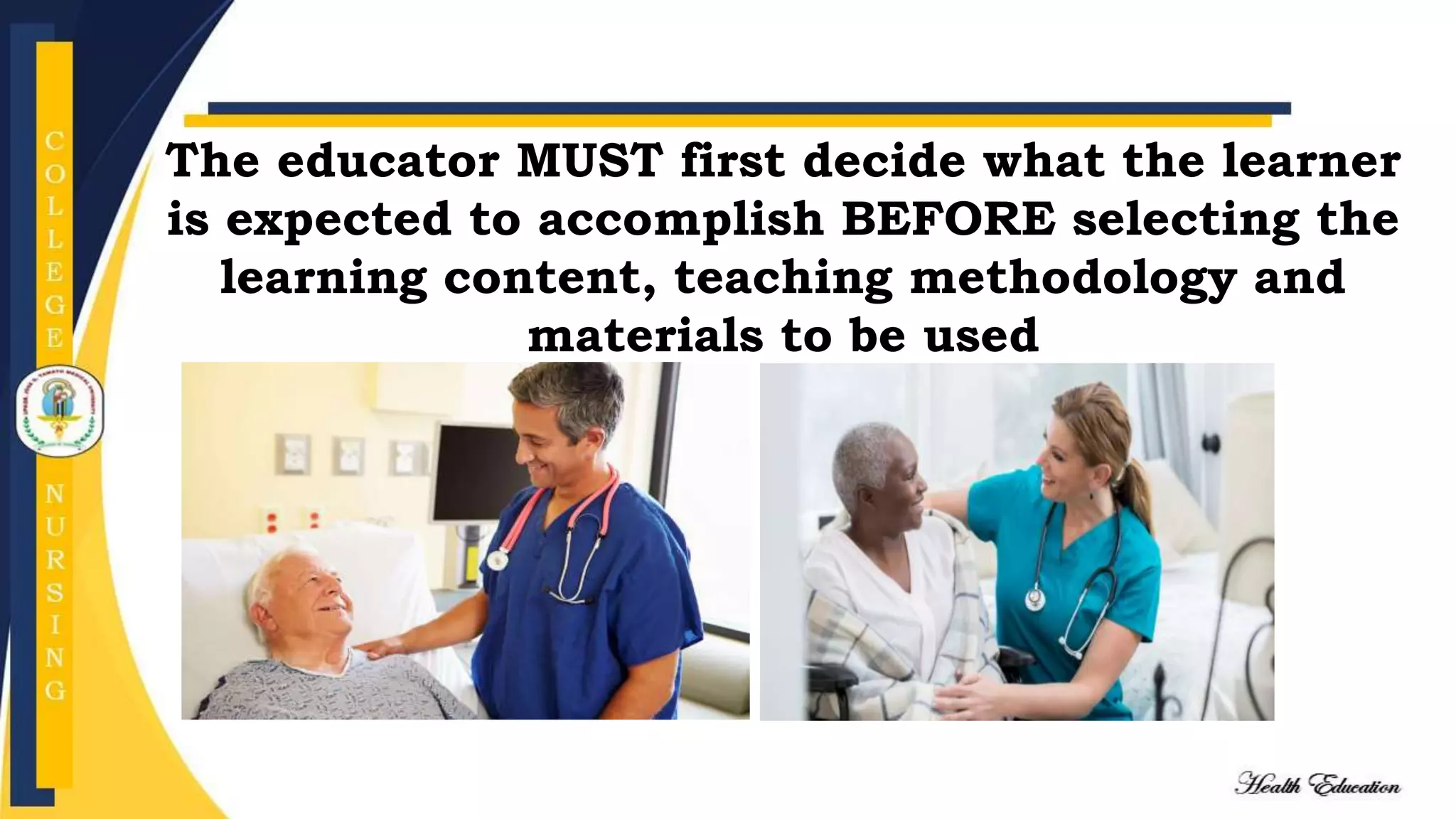
The educator MUST first decide what the learner
is expected to accomplish BEFORE selecting the
learning content, teaching methodology and
materials to be used
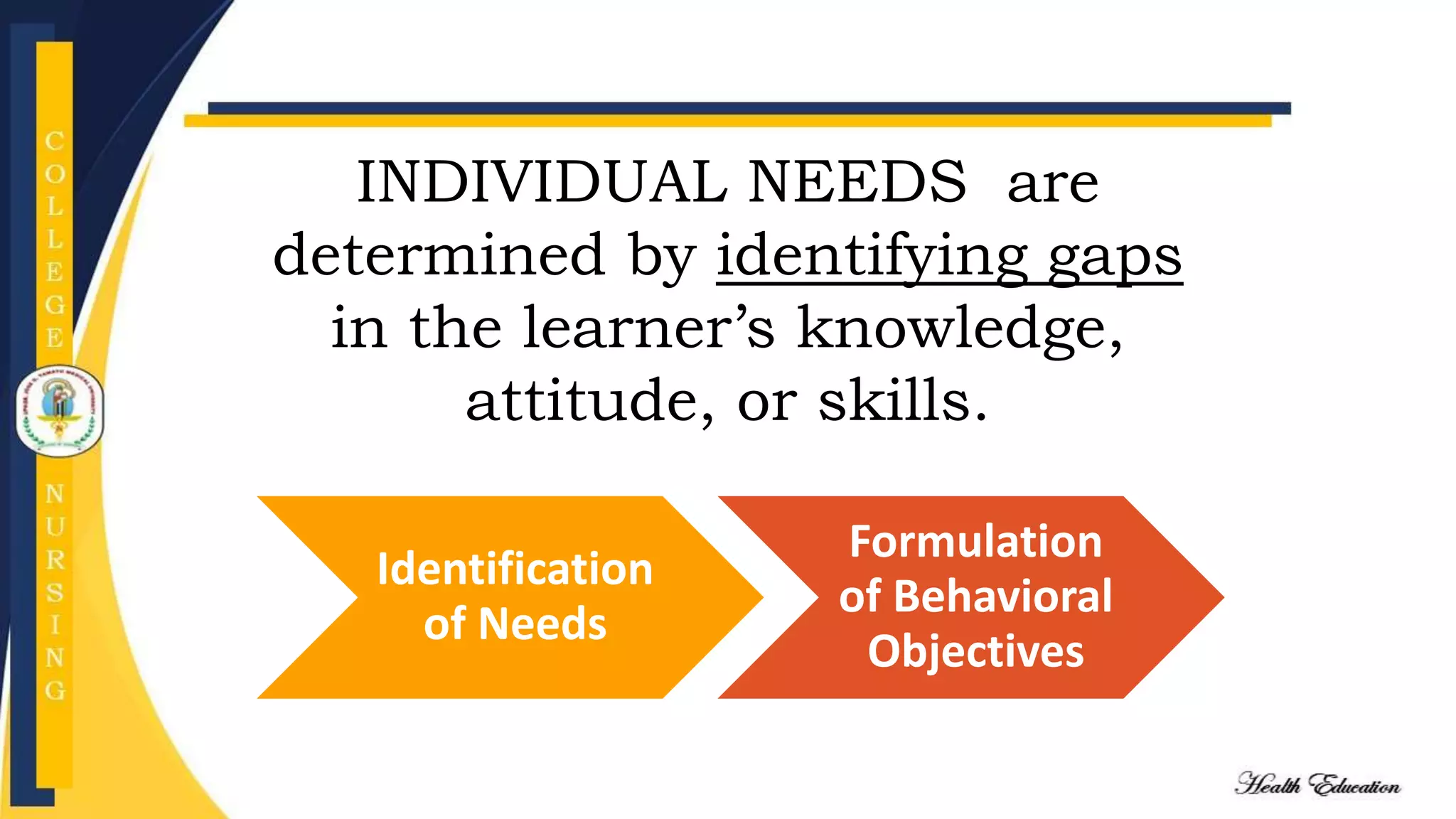
INDIVIDUAL NEEDS are
determined by identifying gaps
in the learner’s knowledge,
attitude, or skills.
Identification
of Needs
Formulation
of Behavioral
Objectives
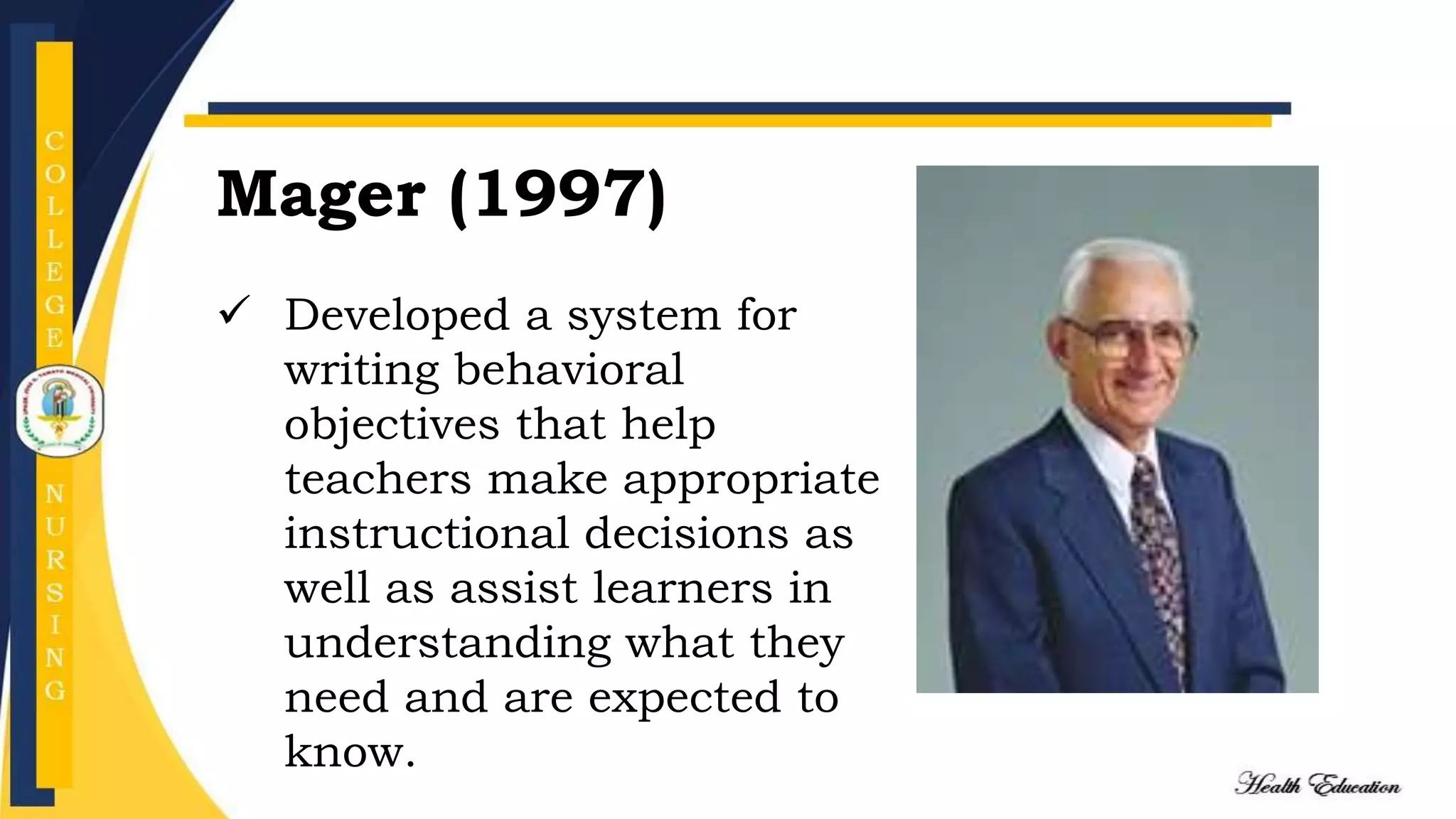
Mager (1997)
 Developed a system for
writing behavioral
objectives that help
teachers make appropriate
instructional decisions as
well as assist learners in
understanding what they
need and are expected to
know.
The study of the general principles of scientific
classification (https://www.merriam-webster.com/dictionary/taxonomy)
What does taxonomy mean in education?
Bloom’s taxonomy is a classification system used to define
and distinguish different levels of human cognition—i.e.,
thinking, learning, and understanding.
Taxonomy
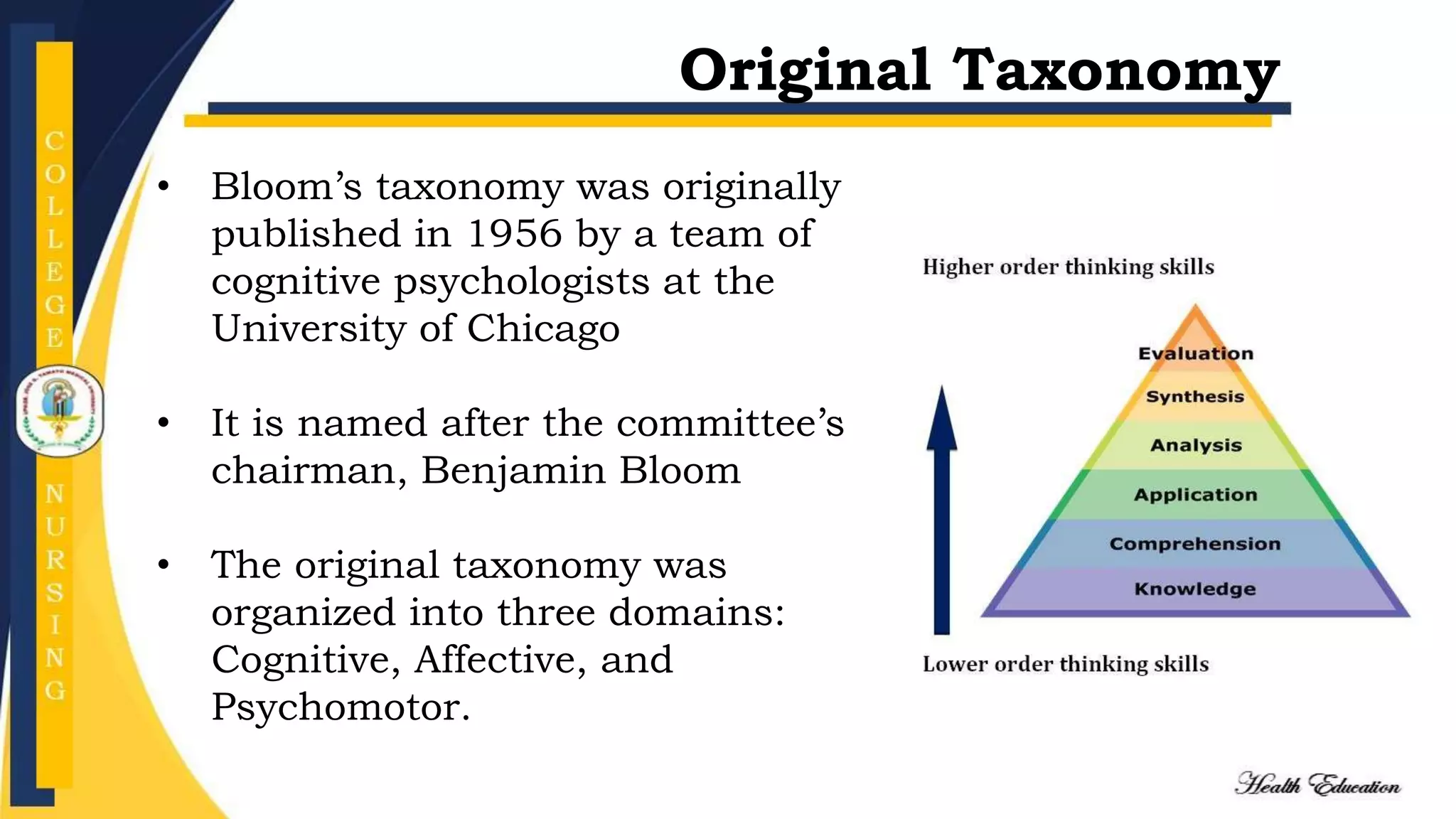
• Bloom’s taxonomy was originally
published in 1956 by a team of
cognitive psychologists at the
University of Chicago
• It is named after the committee’s
chairman, Benjamin Bloom
• The original taxonomy was
organized into three domains:
Cognitive, Affective, and
Psychomotor.
Original Taxonomy
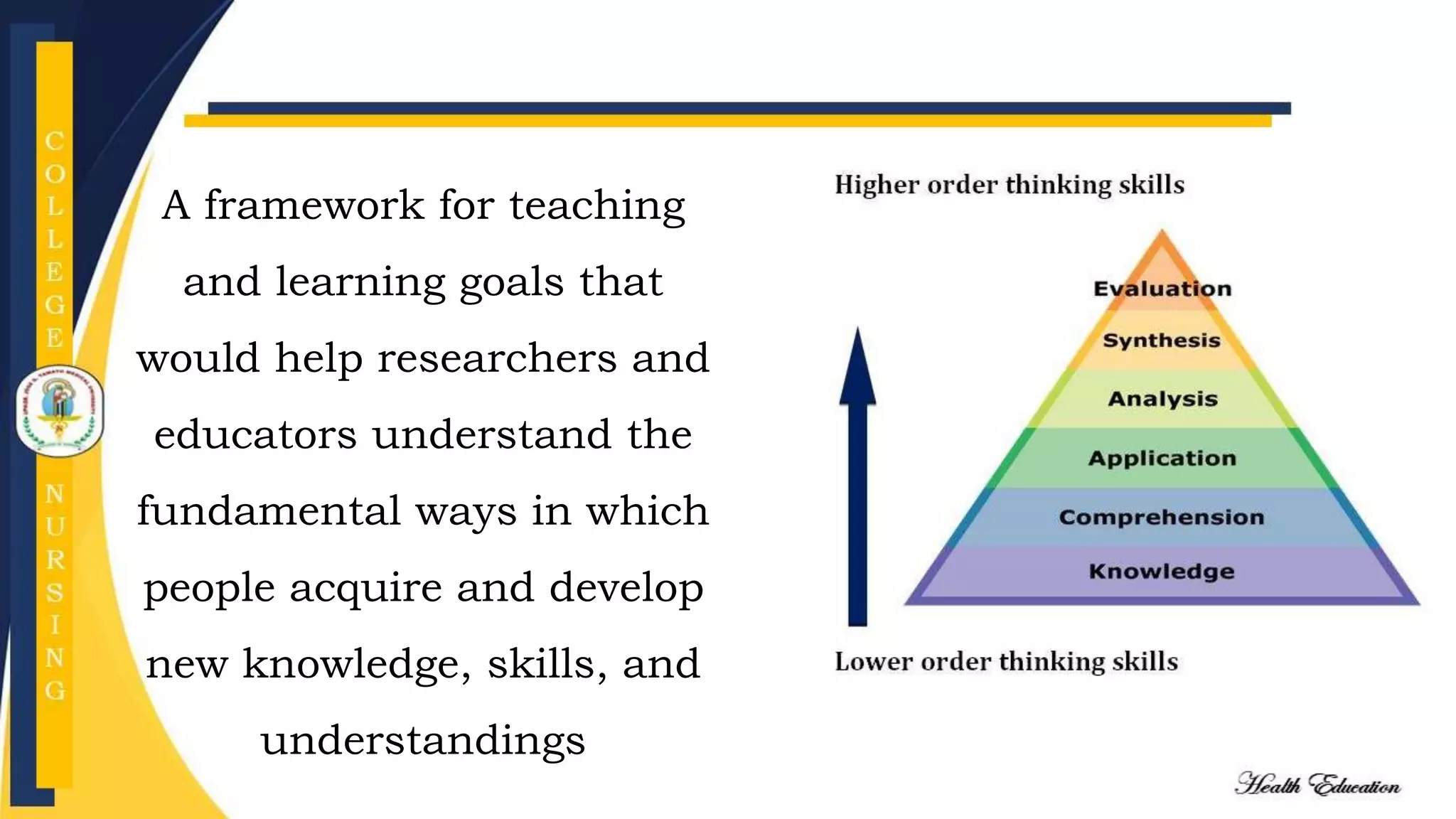
A framework for teaching
and learning goals that
would help researchers and
educators understand the
fundamental ways in which
people acquire and develop
new knowledge, skills, and
understandings
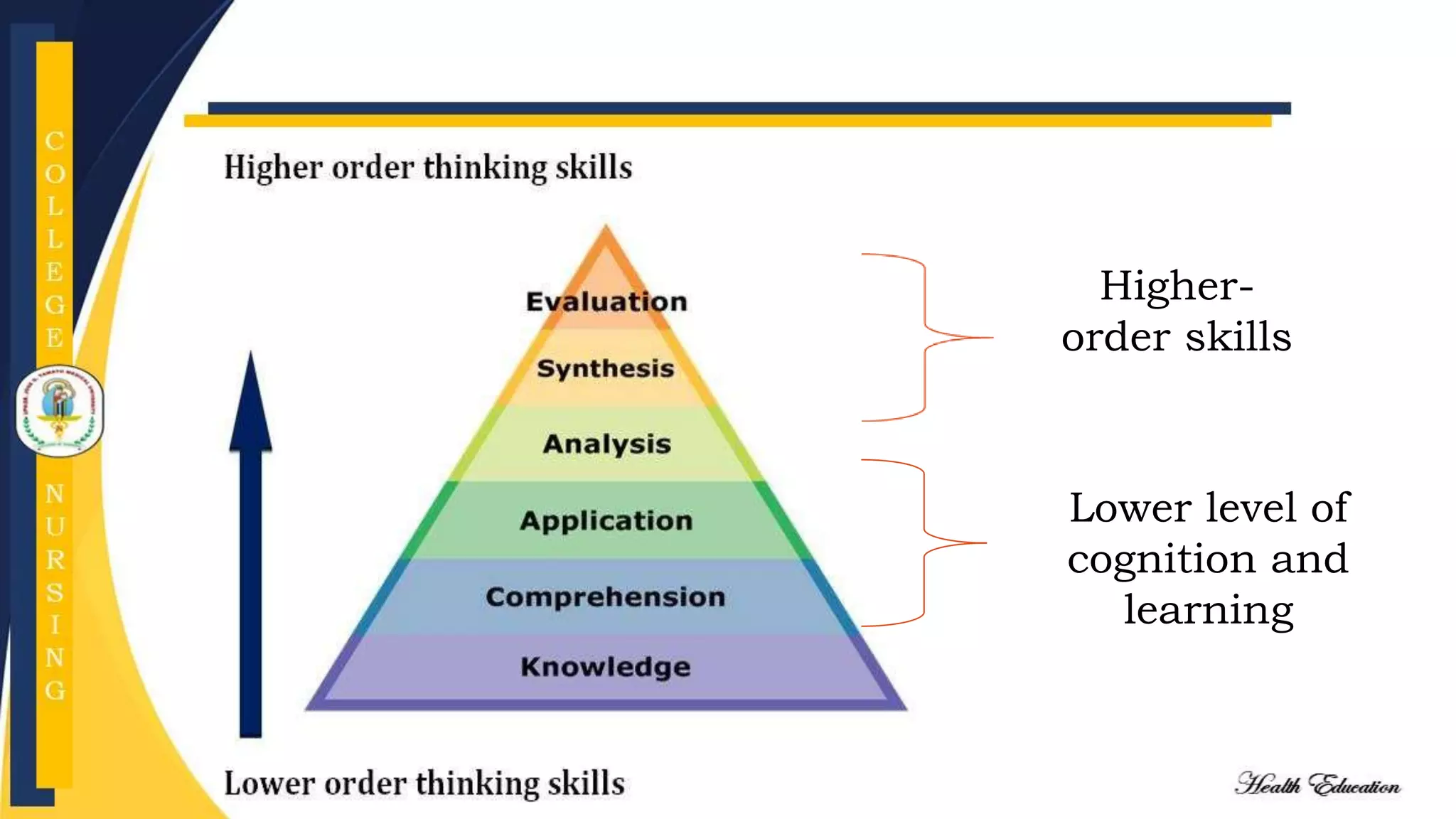
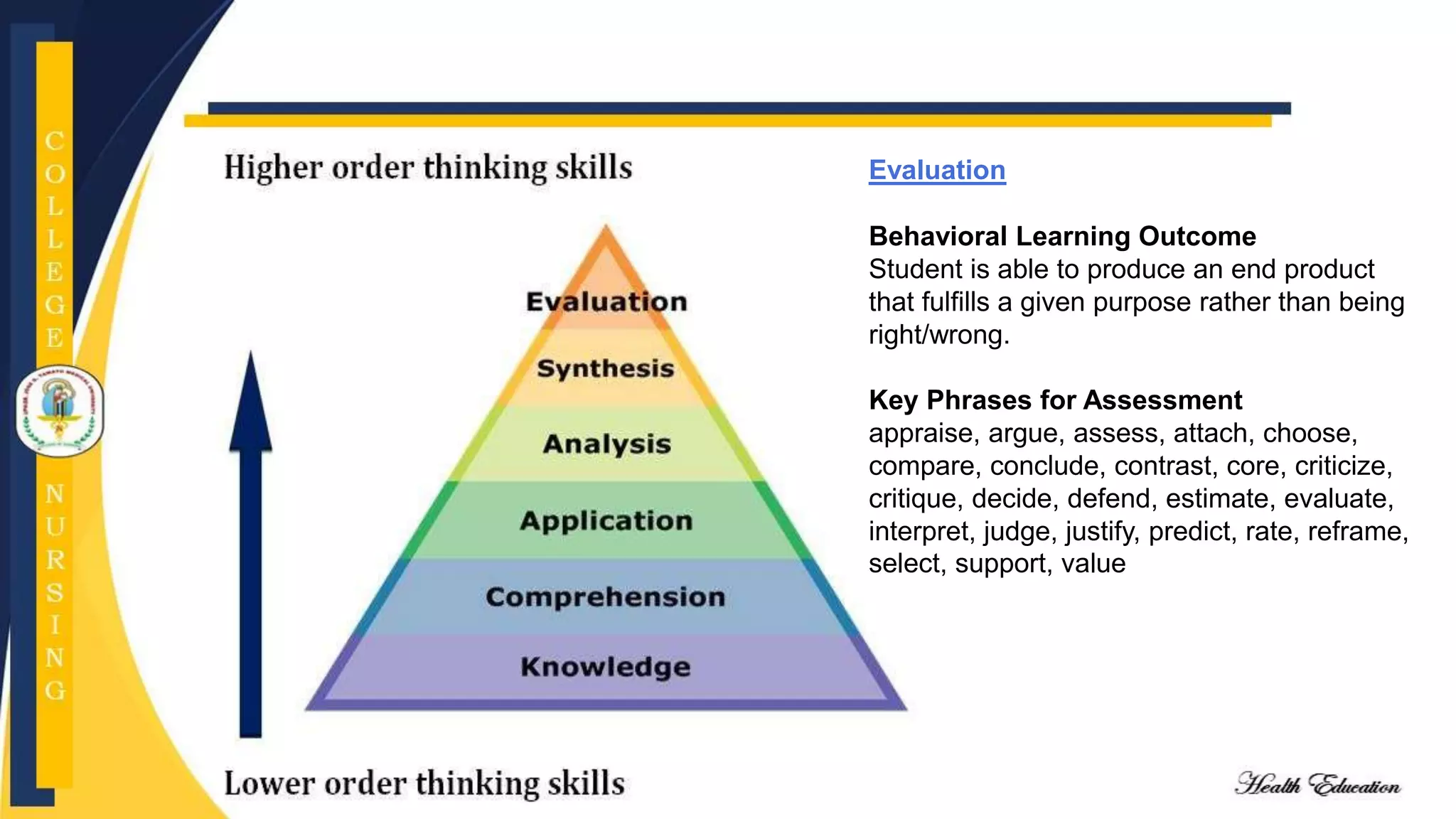
Higher-
order skills
Lower level of
cognition and
learning
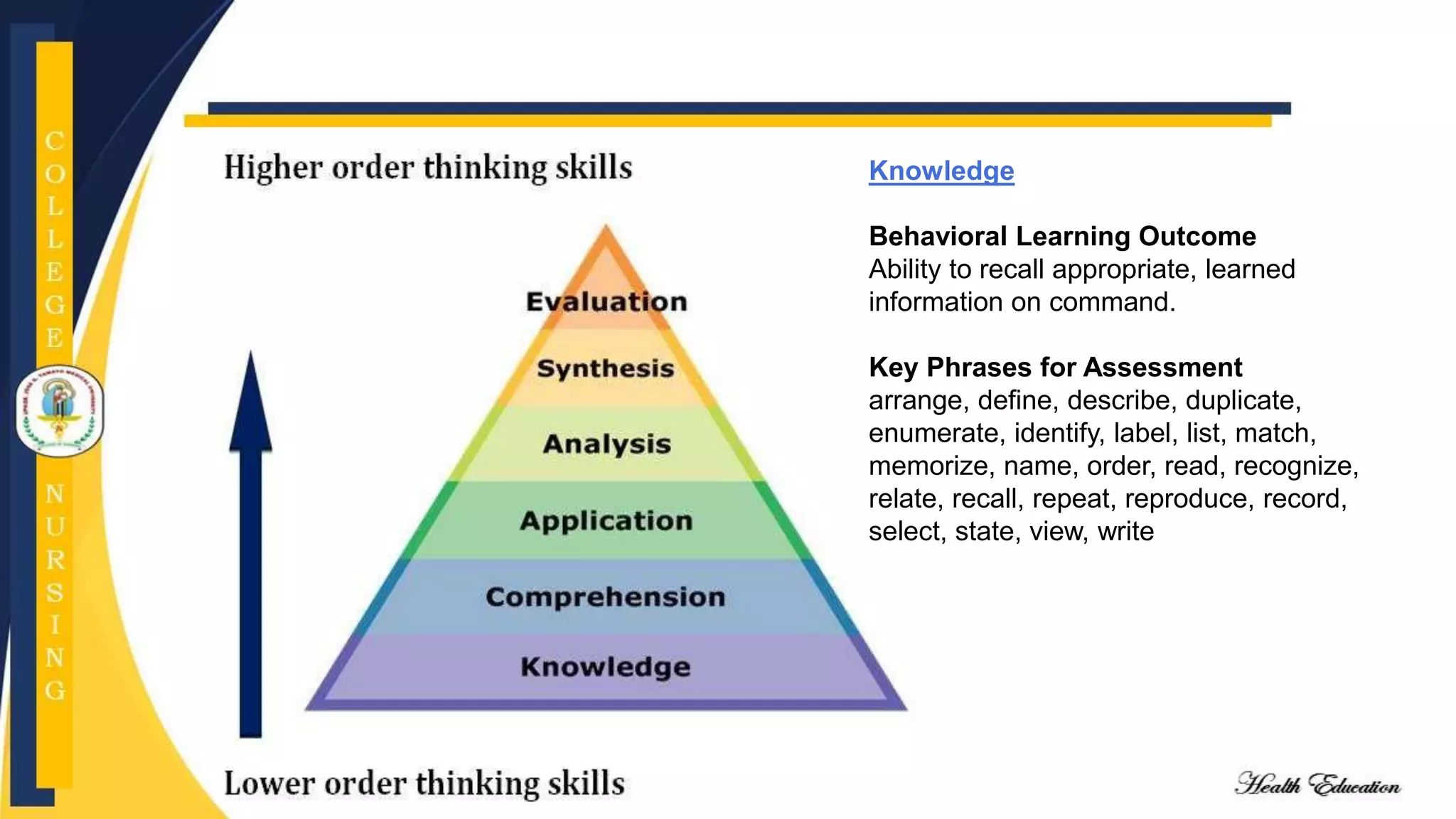
Knowledge
Behavioral Learning Outcome
Ability to recall appropriate, learned
information on command.
Key Phrases for Assessment
arrange, define, describe, duplicate,
enumerate, identify, label, list, match,
memorize, name, order, read, recognize,
relate, recall, repeat, reproduce, record,
select, state, view, write
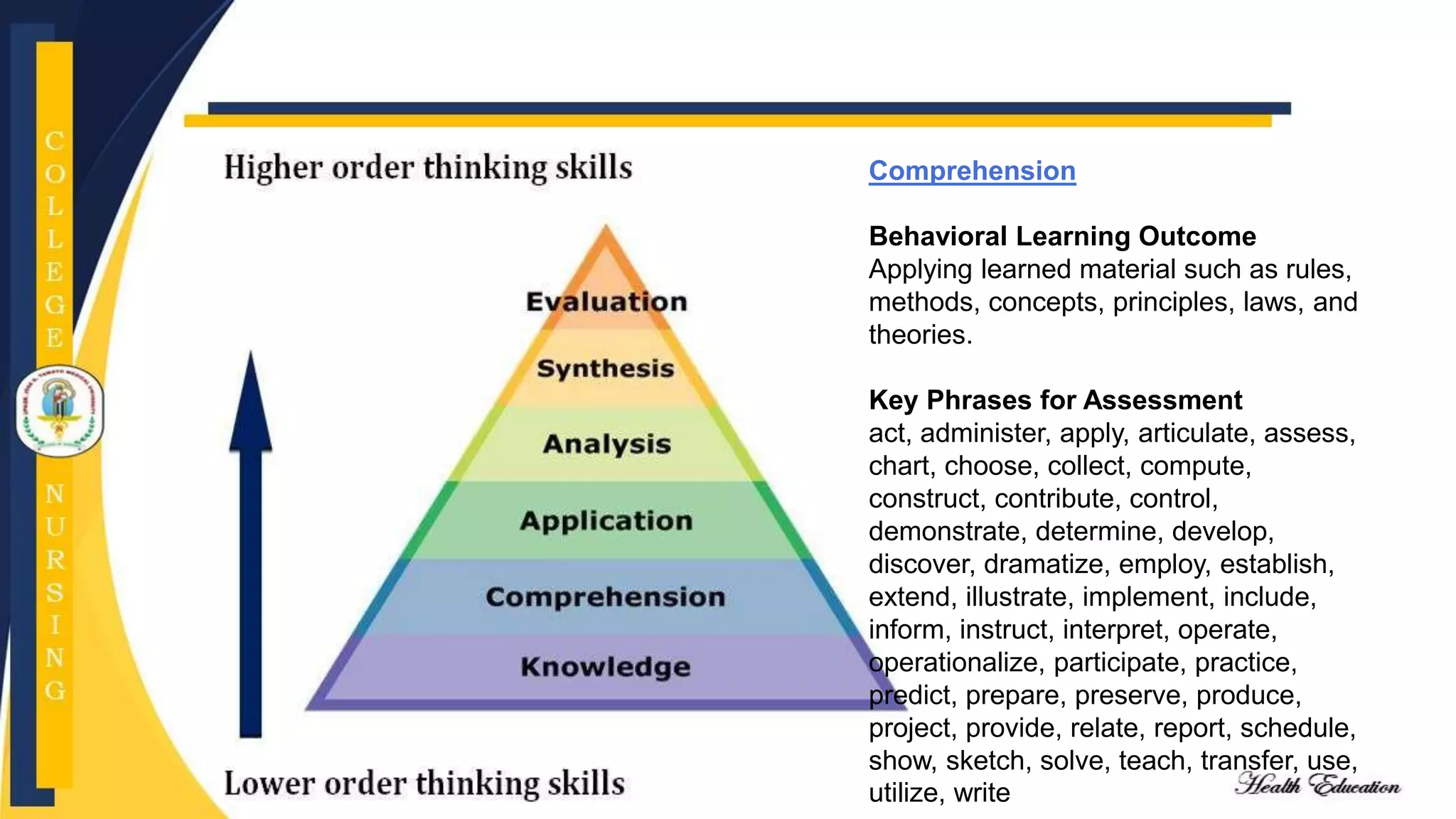
Comprehension
Behavioral Learning Outcome
Applying learned material such as rules,
methods, concepts, principles, laws, and
theories.
Key Phrases for Assessment
act, administer, apply, articulate, assess,
chart, choose, collect, compute,
construct, contribute, control,
demonstrate, determine, develop,
discover, dramatize, employ, establish,
extend, illustrate, implement, include,
inform, instruct, interpret, operate,
operationalize, participate, practice,
predict, prepare, preserve, produce,
project, provide, relate, report, schedule,
show, sketch, solve, teach, transfer, use,
utilize, write
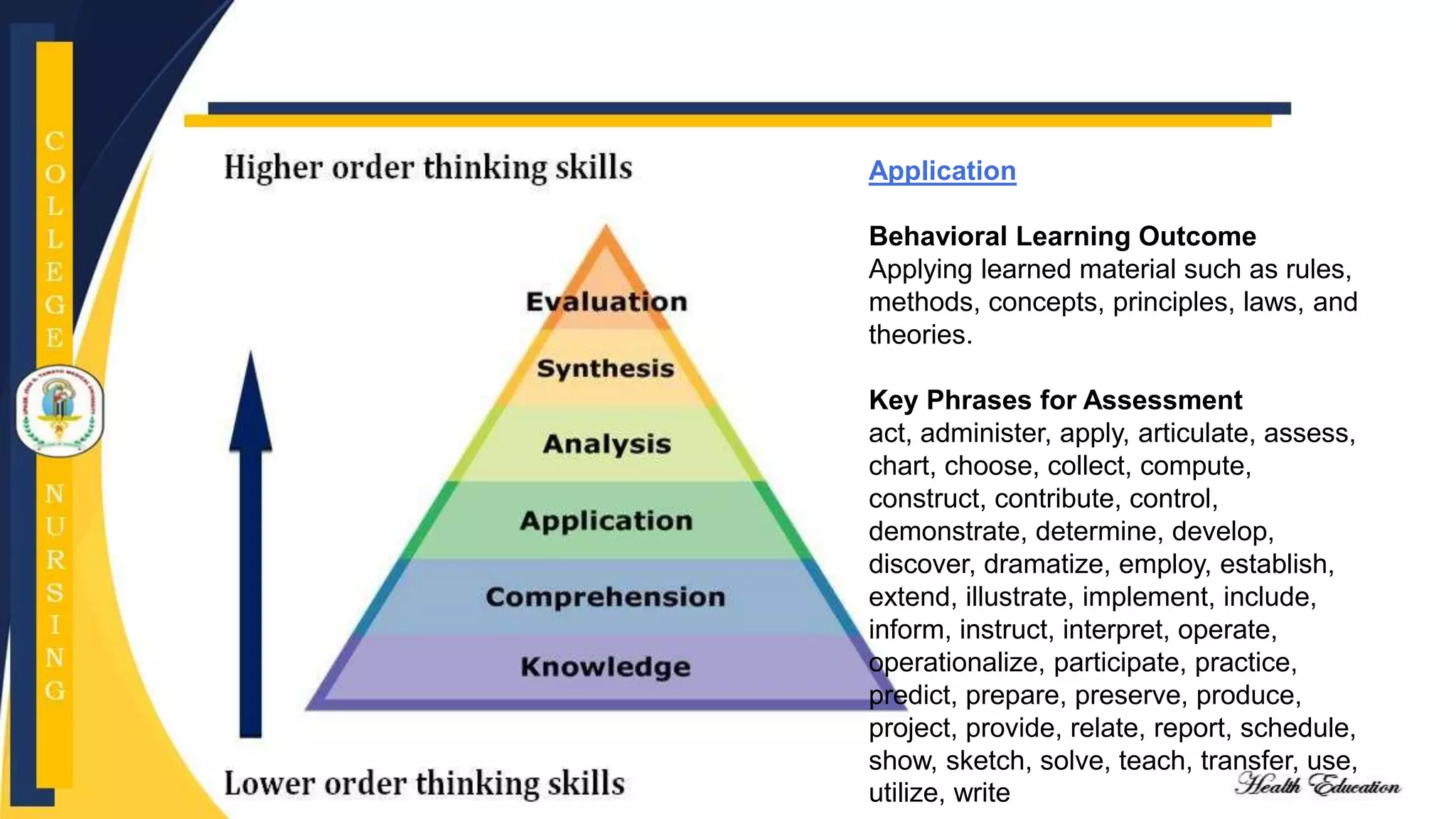
Application
Behavioral Learning Outcome
Applying learned material such as rules,
methods, concepts, principles, laws, and
theories.
Key Phrases for Assessment
act, administer, apply, articulate, assess,
chart, choose, collect, compute,
construct, contribute, control,
demonstrate, determine, develop,
discover, dramatize, employ, establish,
extend, illustrate, implement, include,
inform, instruct, interpret, operate,
operationalize, participate, practice,
predict, prepare, preserve, produce,
project, provide, relate, report, schedule,
show, sketch, solve, teach, transfer, use,
utilize, write
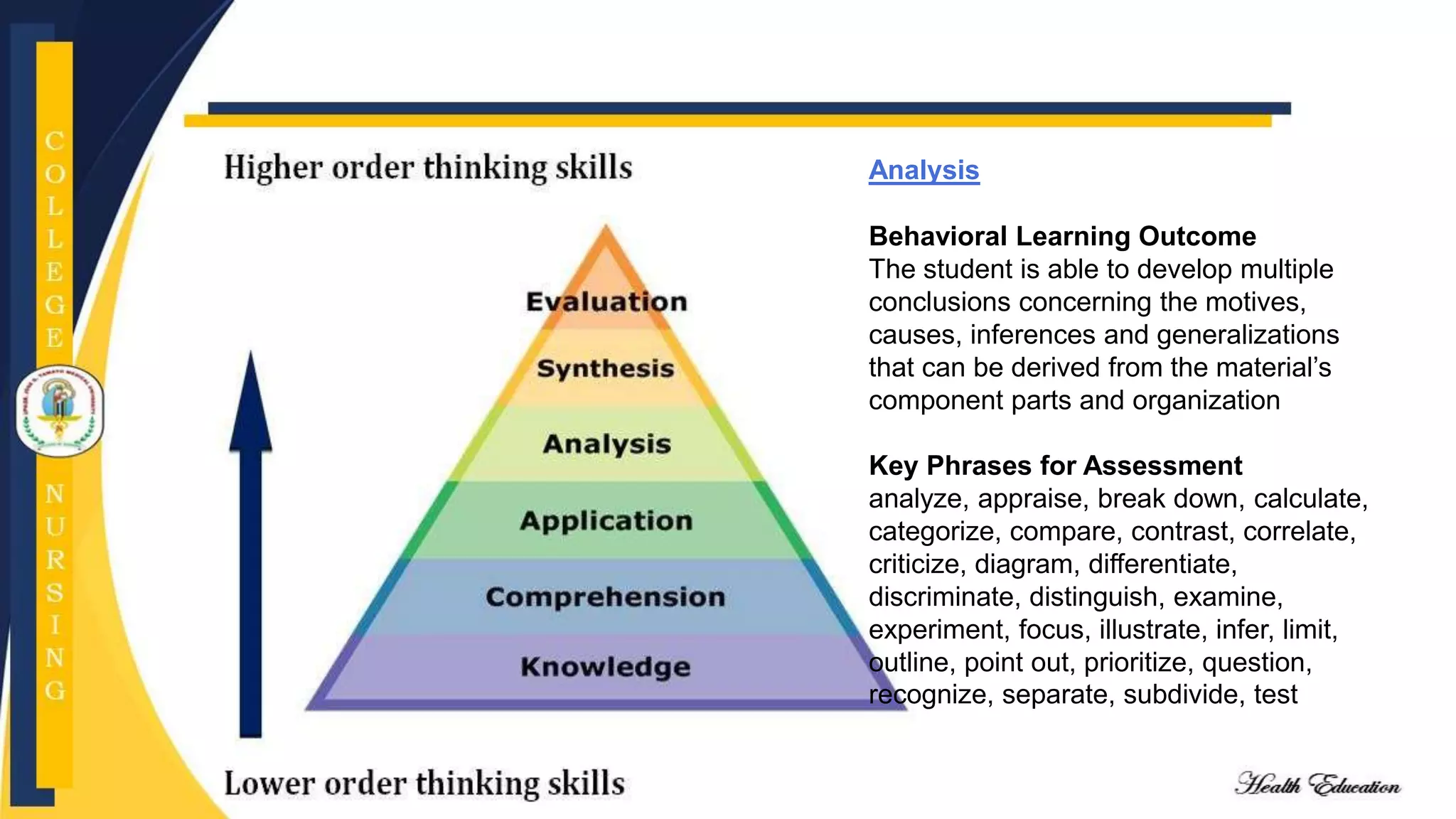
Analysis
Behavioral Learning Outcome
The student is able to develop multiple
conclusions concerning the motives,
causes, inferences and generalizations
that can be derived from the material’s
component parts and organization
Key Phrases for Assessment
analyze, appraise, break down, calculate,
categorize, compare, contrast, correlate,
criticize, diagram, differentiate,
discriminate, distinguish, examine,
experiment, focus, illustrate, infer, limit,
outline, point out, prioritize, question,
recognize, separate, subdivide, test
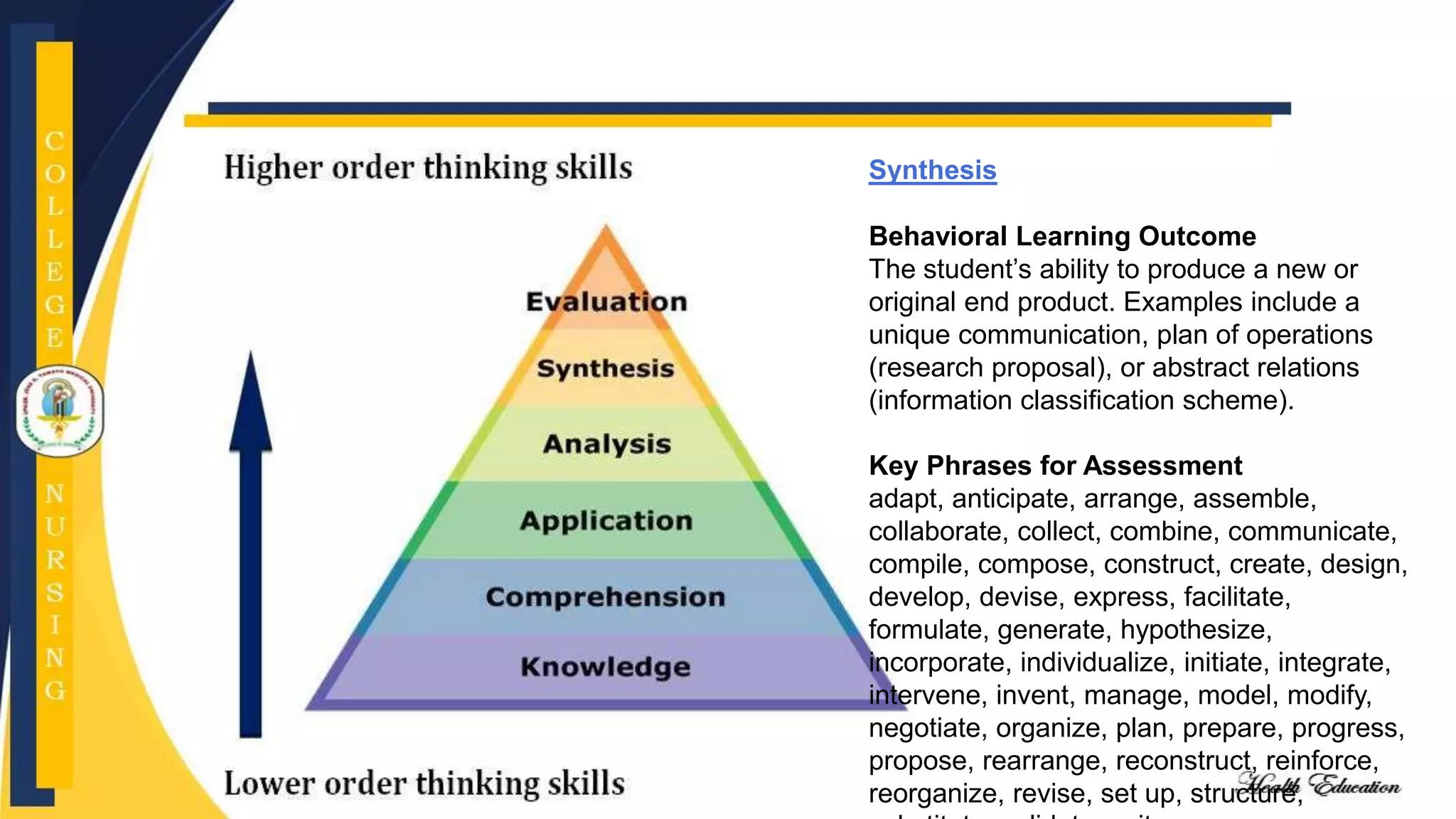
Synthesis
Behavioral Learning Outcome
The student’s ability to produce a new or
original end product. Examples include a
unique communication, plan of operations
(research proposal), or abstract relations
(information classification scheme).
Key Phrases for Assessment
adapt, anticipate, arrange, assemble,
collaborate, collect, combine, communicate,
compile, compose, construct, create, design,
develop, devise, express, facilitate,
formulate, generate, hypothesize,
incorporate, individualize, initiate, integrate,
intervene, invent, manage, model, modify,
negotiate, organize, plan, prepare, progress,
propose, rearrange, reconstruct, reinforce,
reorganize, revise, set up, structure,
Evaluation
Behavioral Learning Outcome
Student is able to produce an end product
that fulfills a given purpose rather than being
right/wrong.
Key Phrases for Assessment
appraise, argue, assess, attach, choose,
compare, conclude, contrast, core, criticize,
critique, decide, defend, estimate, evaluate,
interpret, judge, justify, predict, rate, reframe,
select, support, value
 In 2001, another team of scholars—led by Lorin
Anderson and David Krathwohl released a revised
version of Bloom’s taxonomy called A Taxonomy for
Learning, Teaching, and Assessing: A Revision of
Bloom’s Taxonomy of Educational Objectives
 The “Revised Bloom’s Taxonomy,” as it is commonly
called, was intentionally designed to be more useful to
educators and to reflect the common ways in which it
had come to be used in schools.
Revised Taxonomy
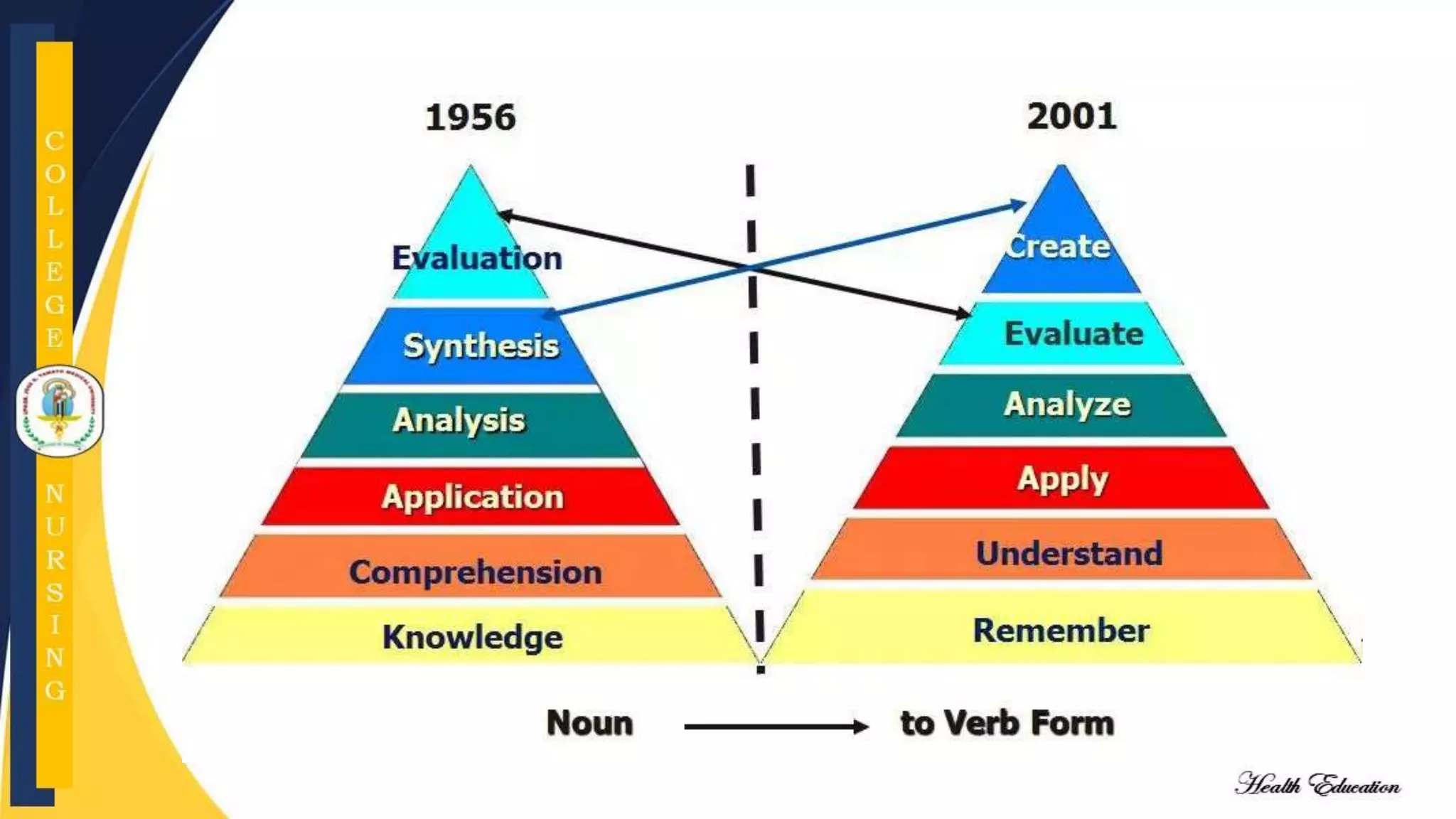
• 3 categories were renamed and all the categories
were expressed as verbs rather than nouns:
Knowledge was changed to Remembering
Comprehension became Understanding
Synthesis was renamed Creating
• Creating became the highest level in the
classification system, switching places with
Evaluating
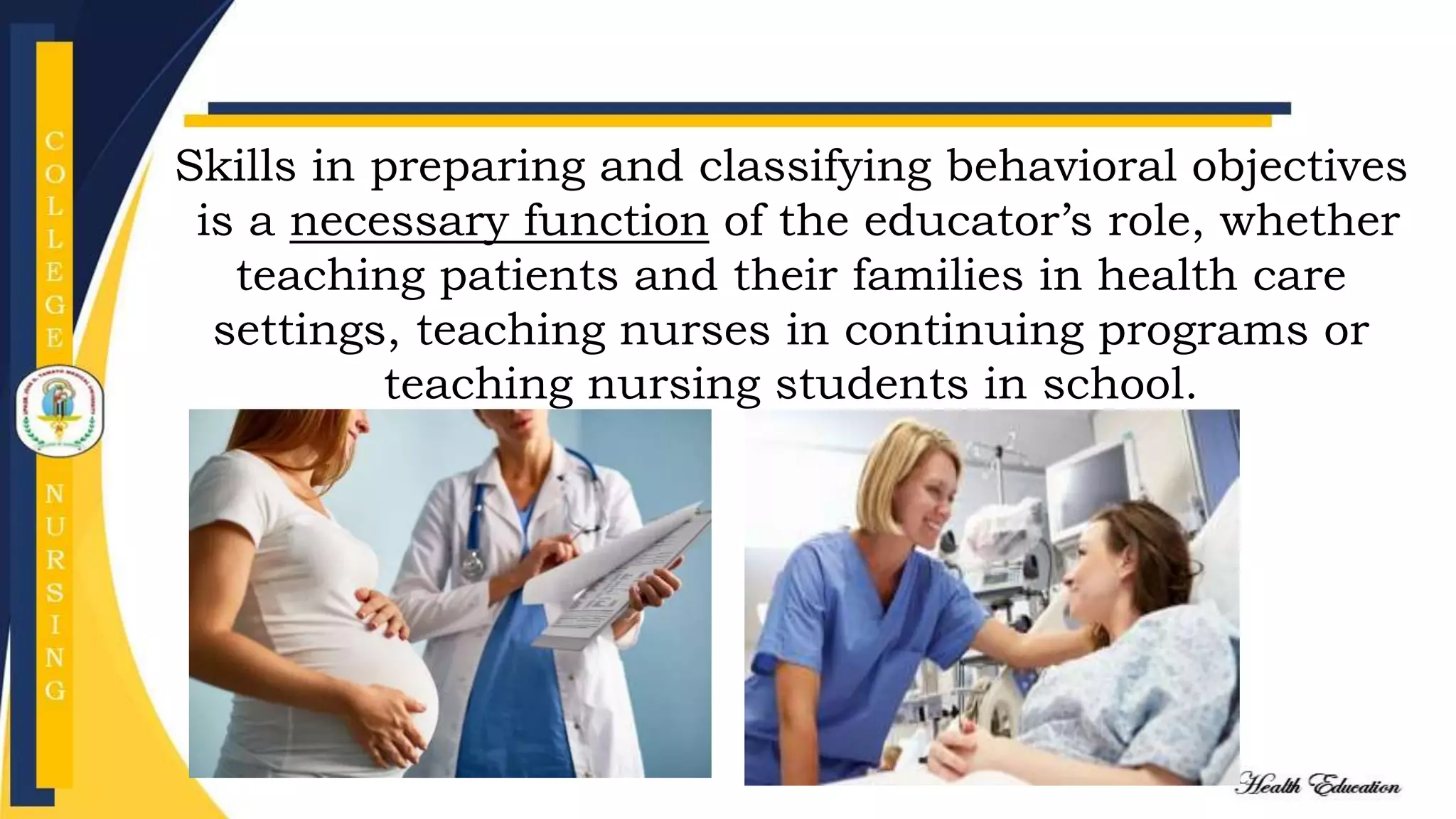
Skills in preparing and classifying behavioral objectives
is a necessary function of the educator’s role, whether
teaching patients and their families in health care
settings, teaching nurses in continuing programs or
teaching nursing students in school.
1. Educational - used to identify the intended
outcomes of the education process.
2. Instructional – describe the teaching activities,
specific content areas, and resources used to
facilitate effective instruction.
3. Behavioral/learning – describe precisely what the
learner will be able to do following a learning
situation.
Types of Objectives
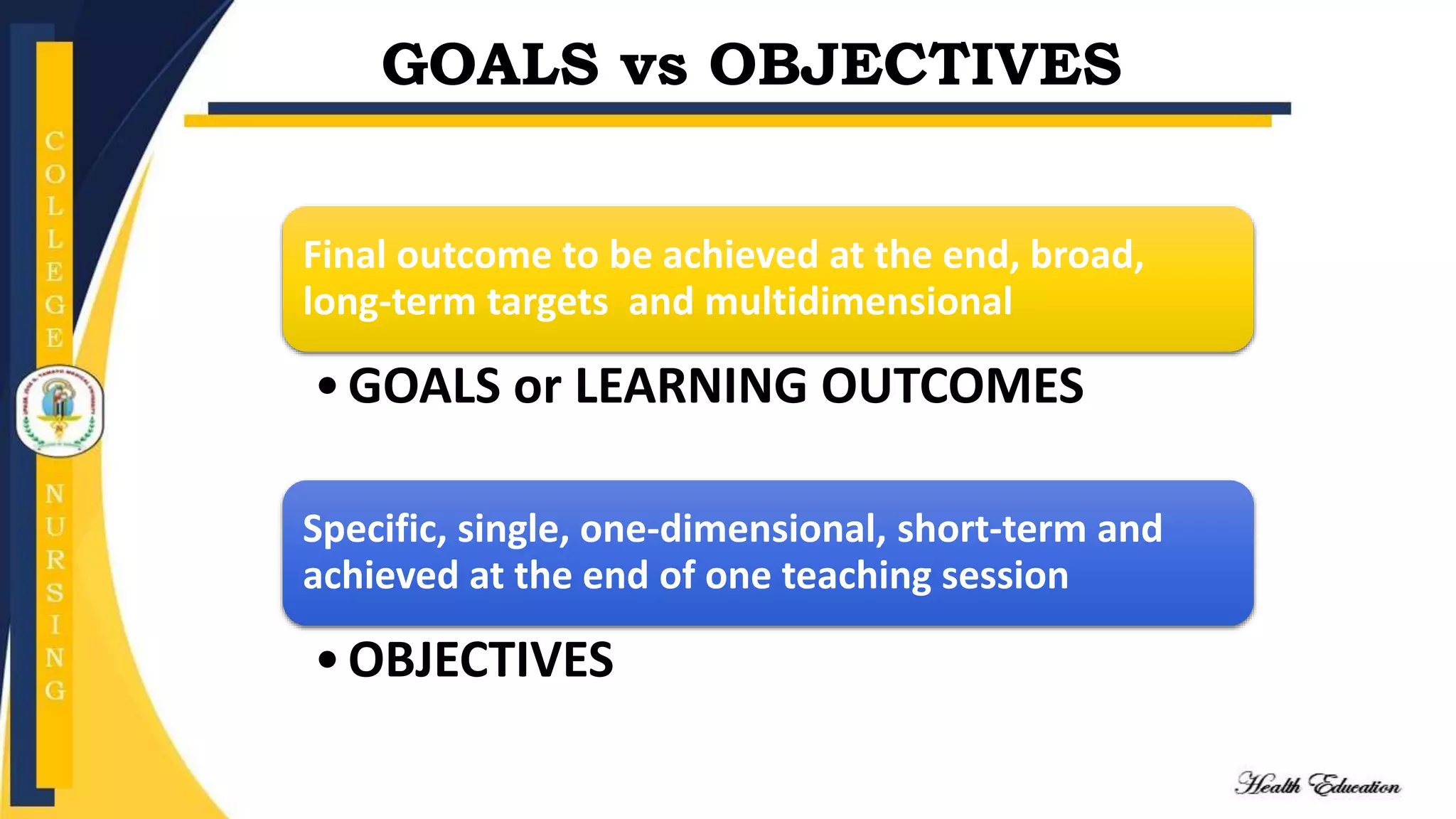
GOALS vs OBJECTIVES
Final outcome to be achieved at the end, broad,
long-term targets and multidimensional
•GOALS or LEARNING OUTCOMES
Specific, single, one-dimensional, short-term and
achieved at the end of one teaching session
•OBJECTIVES
BEHAVIORAL OBJECTIVE
Describes a performance that learners
should be able to exhibit before they are
considered COMPETENT (Mager, 1997)
The intended result of instruction
“If you don’t know where you’re going, how will
you know which road to take to get there?”
- Mager 1997
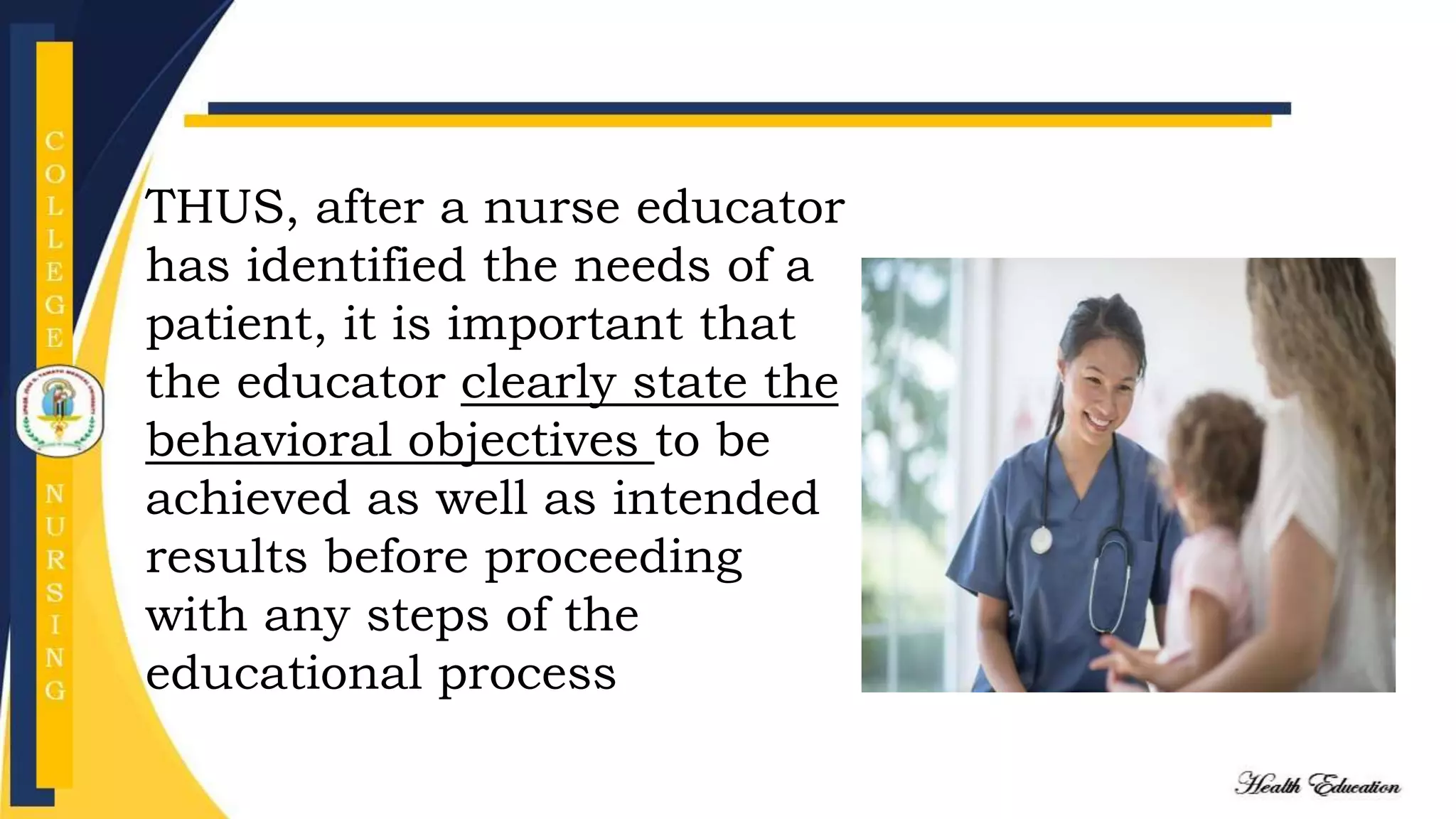
THUS, after a nurse educator
has identified the needs of a
patient, it is important that
the educator clearly state the
behavioral objectives to be
achieved as well as intended
results before proceeding
with any steps of the
educational process
Writing Behavioral Objectives and Goals
Three important characteristics according to
Mager:
1. Performance
– What should the learner be able to do?
2. Condition
– Under which conditions should the learner
be able to do it?
3. Criterion
– How well must the learner be able to do it?
Writing Behavioral Objectives and Goals
Three important characteristics according to
Mager:
1. Performance
– What should the learner be able to do?
Writing Behavioral Objectives and Goals
Three important characteristics according to
Mager:
1. Performance
– What should the learner be able to do?
The most important and indispensable characteristic of a useful
objective is that it describes the kind of performance that will be
accepted as evidence that the learner has mastered the
objective.
Writing Behavioral Objectives and Goals
Three important characteristics according to
Mager:
1. Performance
– What should the learner be able to do?
Which of the two following learning objectives do you think is
better?
1.Be able to write a news article.
2.Be able to develop an appreciation of music.
Writing Behavioral Objectives and Goals
Three important characteristics according to
Mager:
1.
2. Condition
– Under which conditions should the learner
be able to do it?
Writing Behavioral Objectives and Goals
Three important characteristics according to
Mager:
1.
2. Condition
– Under which conditions should the learner
be able to do it?
Writing Behavioral Objectives and Goals
Three important characteristics according to
Mager:
3. Criterion
– How well must the learner be able to do it?
Four-part Method of Objective Writing:
A – audience (who)
B – behavior (what)
C – condition (under which circumstance)
D – degree (how well, to what extent,
within what time frame)
ABCD rule by Smaldino,
Lowther and Russel (2012)
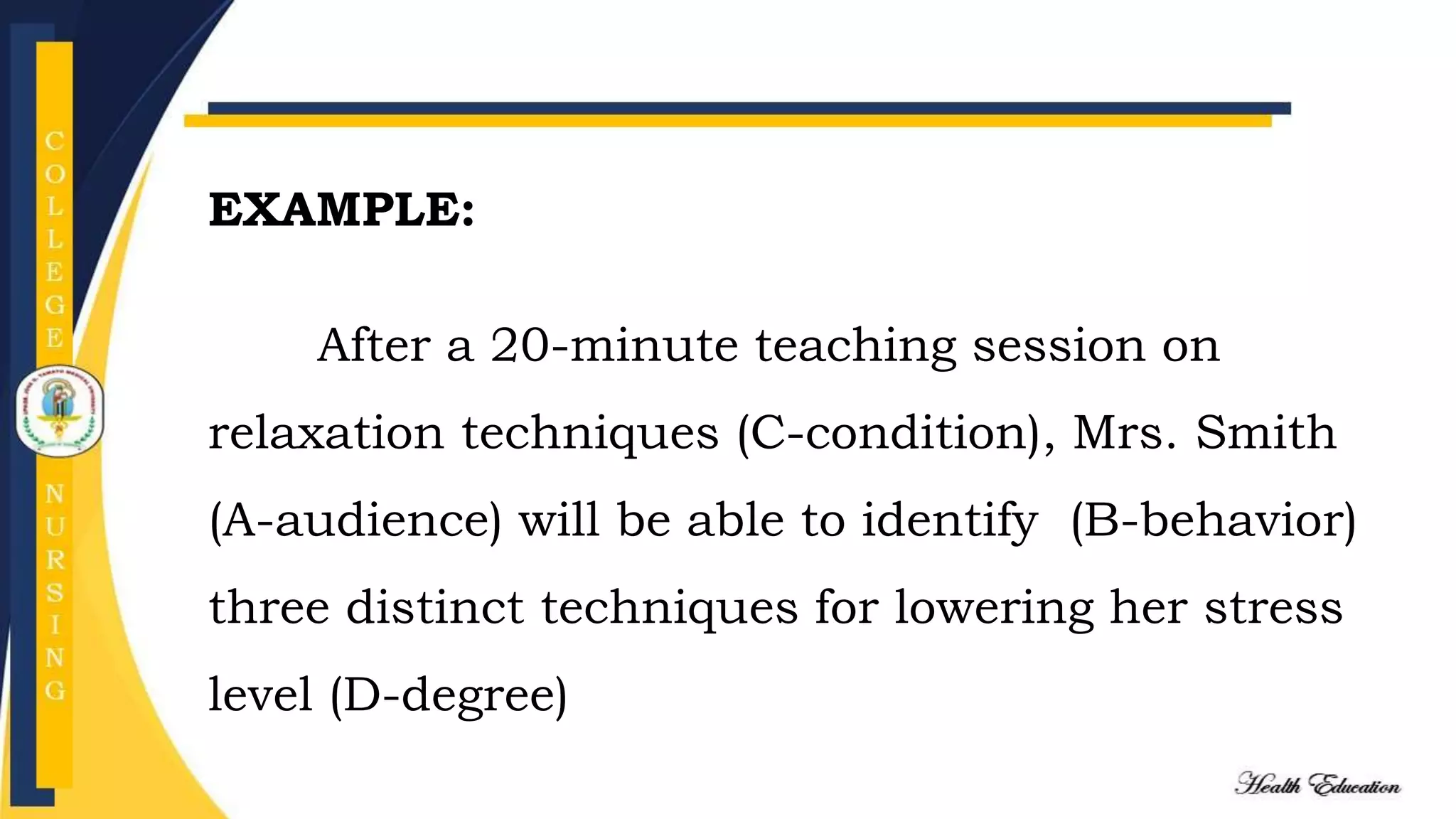
EXAMPLE:
After a 20-minute teaching session on
relaxation techniques (C-condition), Mrs. Smith
(A-audience) will be able to identify (B-behavior)
three distinct techniques for lowering her stress
level (D-degree)
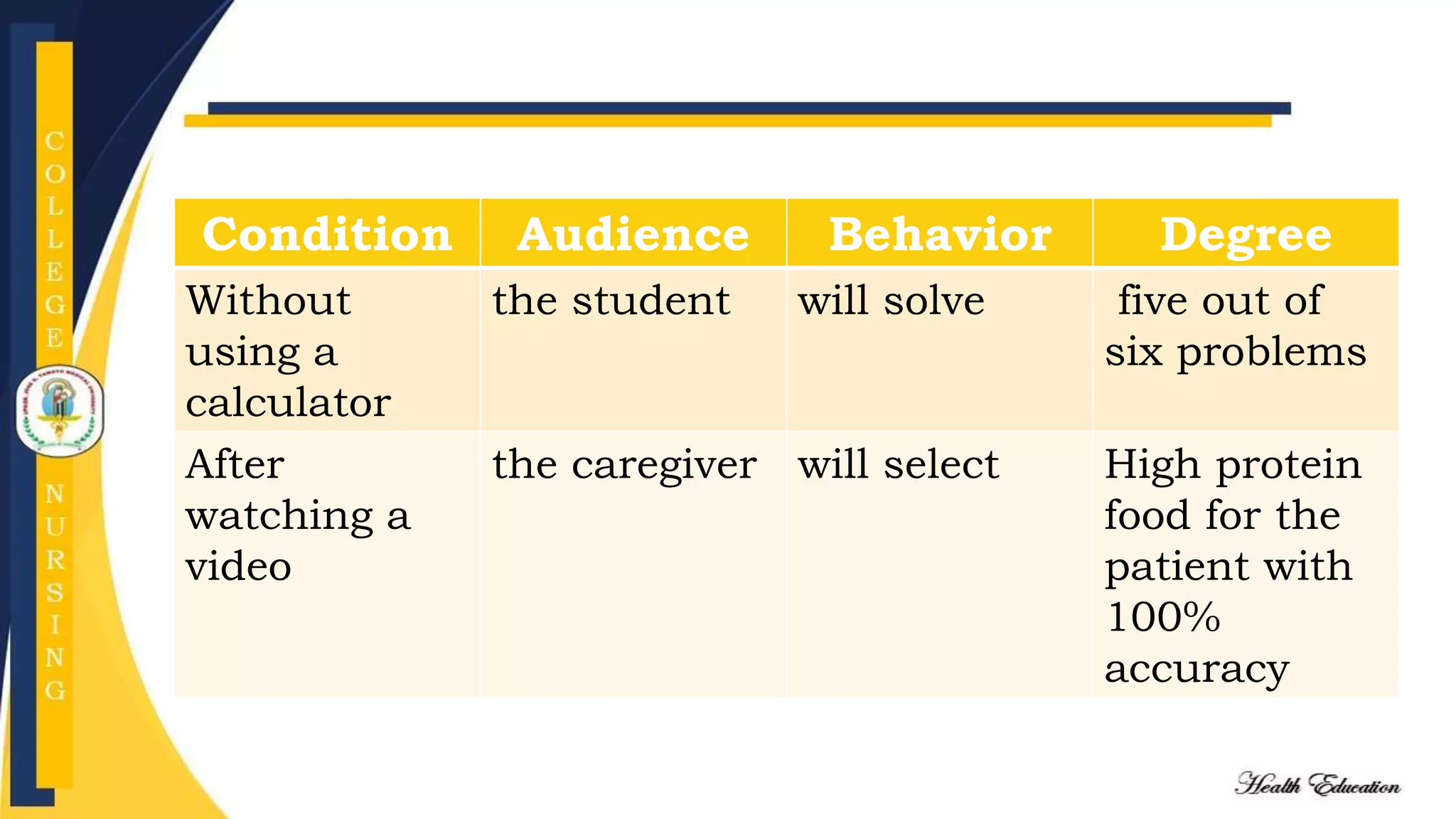
Condition Audience Behavior Degree
Without
using a
calculator
the student will solve five out of
six problems
After
watching a
video
the caregiver will select High protein
food for the
patient with
100%
accuracy
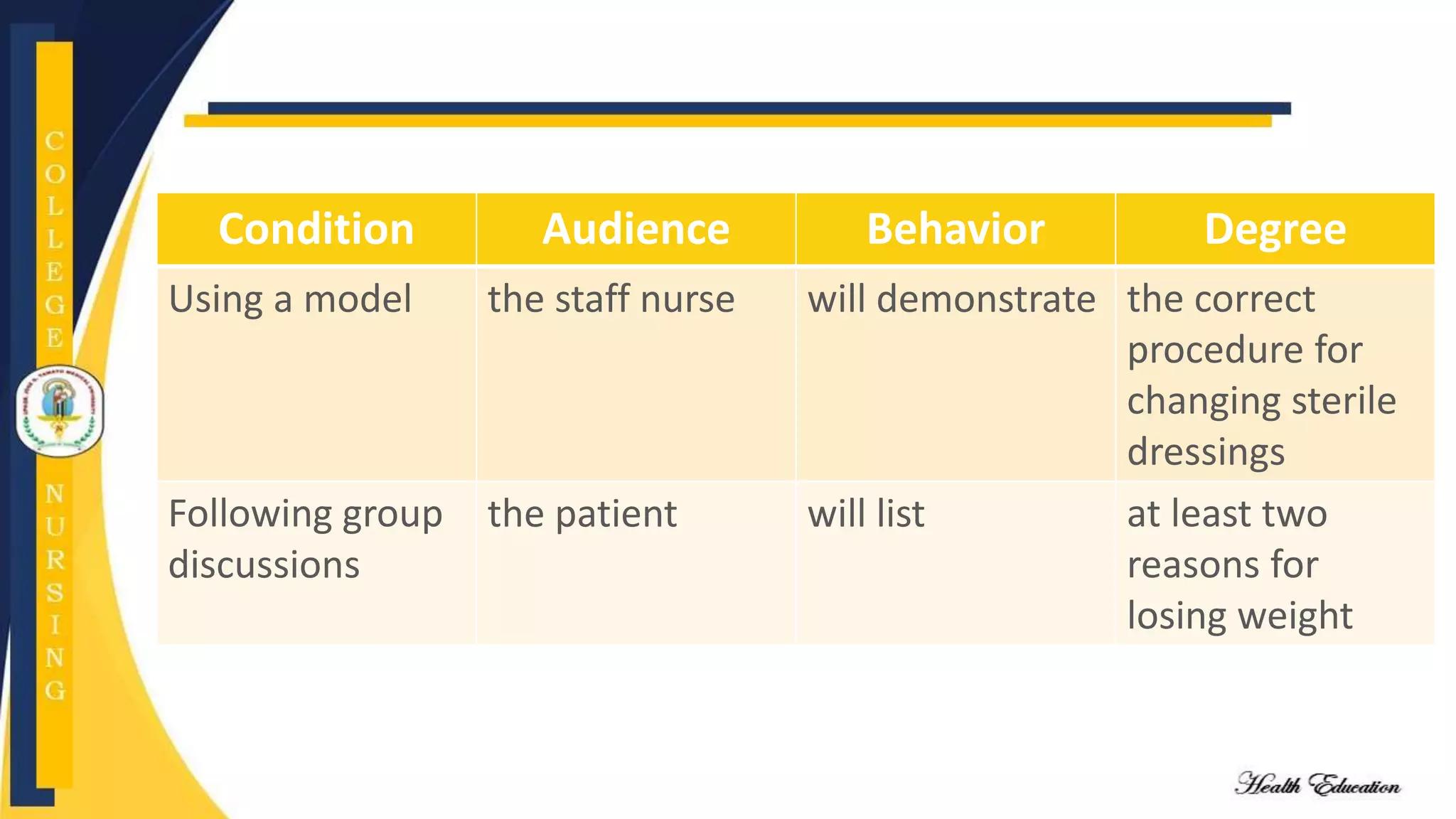
Condition Audience Behavior Degree
Using a model the staff nurse will demonstrate the correct
procedure for
changing sterile
dressings
Following group
discussions
the patient will list at least two
reasons for
losing weight
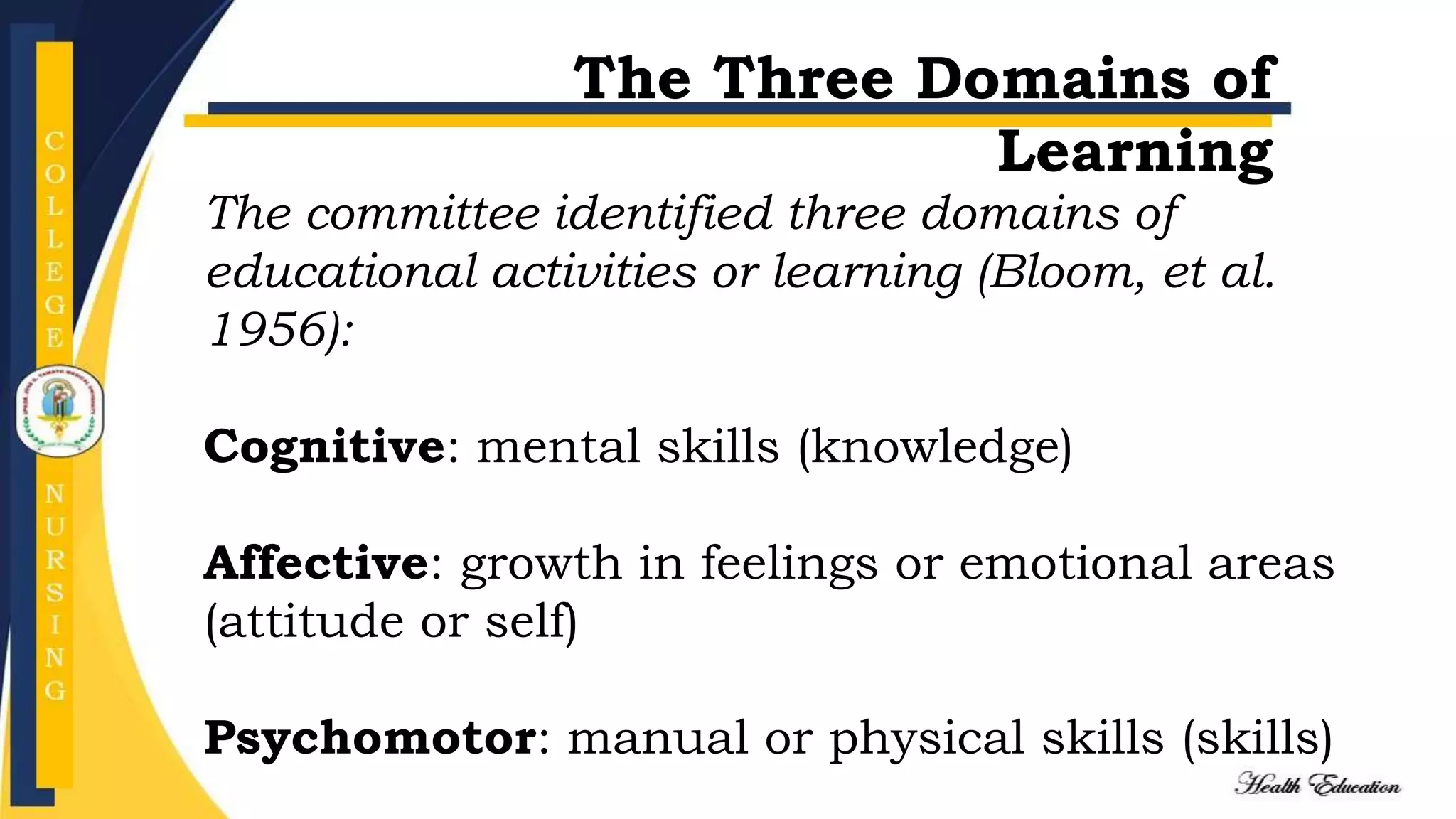
The committee identified three domains of
educational activities or learning (Bloom, et al.
1956):
Cognitive: mental skills (knowledge)
Affective: growth in feelings or emotional areas
(attitude or self)
Psychomotor: manual or physical skills (skills)
The Three Domains of
Learning
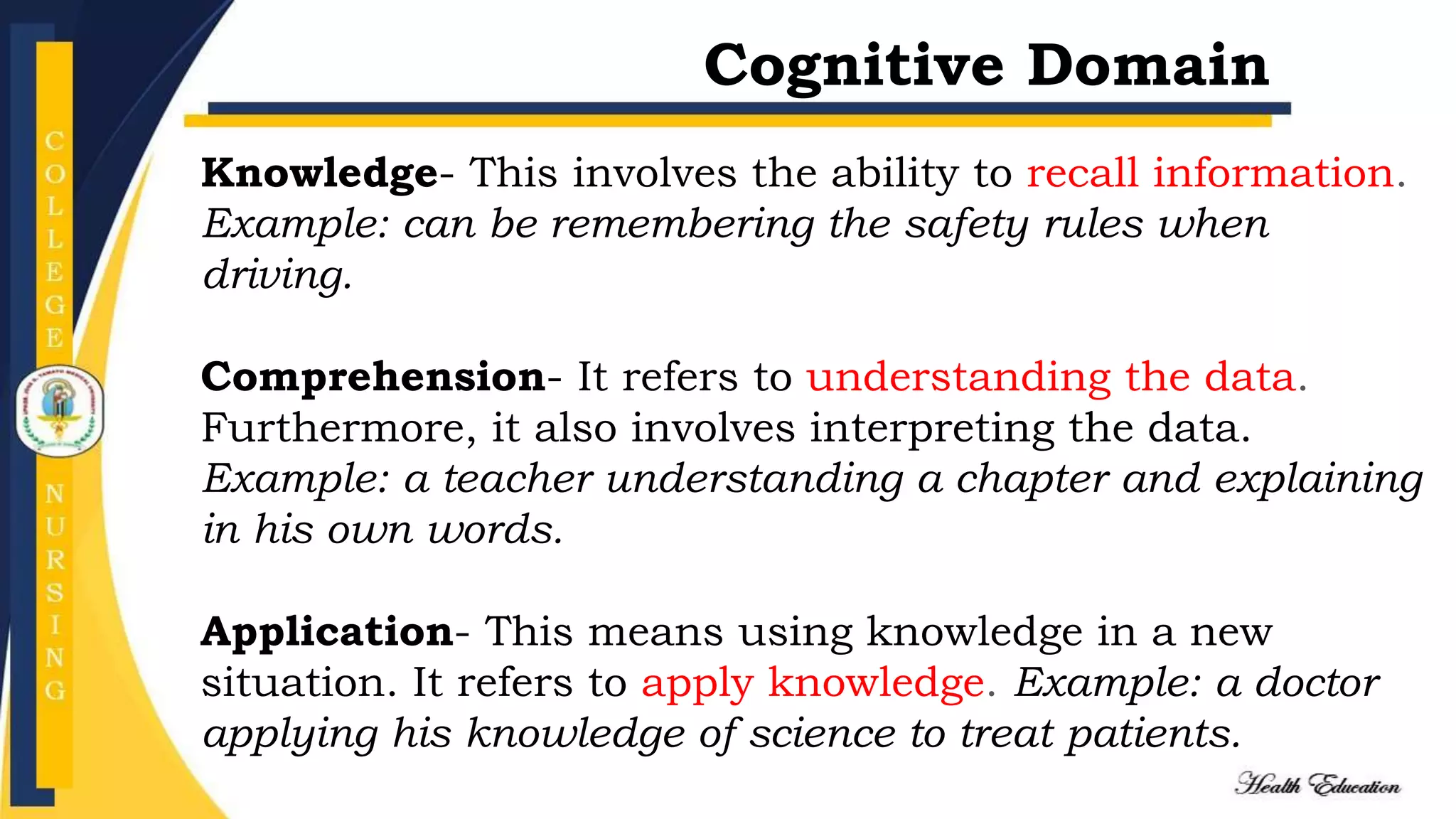
Knowledge- This involves the ability to recall information.
Example: can be remembering the safety rules when
driving.
Comprehension- It refers to understanding the data.
Furthermore, it also involves interpreting the data.
Example: a teacher understanding a chapter and explaining
in his own words.
Application- This means using knowledge in a new
situation. It refers to apply knowledge. Example: a doctor
applying his knowledge of science to treat patients.
Cognitive Domain
Analysis- Helps students to understand the difference
between facts and opinions. Example: a lawyer knows how
to separate facts from opinions in court.
Synthesis- To combine different parts of information to
form a pattern. Hence, synthesis gives new meaning.
Example: a sports coach makes new plans to win matches.
Evaluation- The ability to form judgments about a
situation. Example: a painter decides which colors to use
for a painting.
Cognitive Domain
Receiving information- Here a person becomes aware of the
feelings and emotions. Furthermore, it also involves the ability
to use emotion. Example: a person listening to a friend with
feeling.
Responding to the situation- This means people responding to
phenomena. It involves the active participation of the people.
Example: a student participating in group discussions.
Valuing- A person places value on something which he finds
important. Hence valuing is the ability to see the worth of
something. The person expresses this worth. Example: parents
love their children more than anything else.
Affective Domain
Organization- This means to organize values into matters
of great importance. A person gives more importance to
some values over another. Example: An army man wants
to stay in the gym rather than anywhere else.
Characterization- Here internalized valued control a
person’s behavior. Hence characterization refers to the
ability to internalize values. Example: a person having self-
confidence when working alone.
Affective Domain
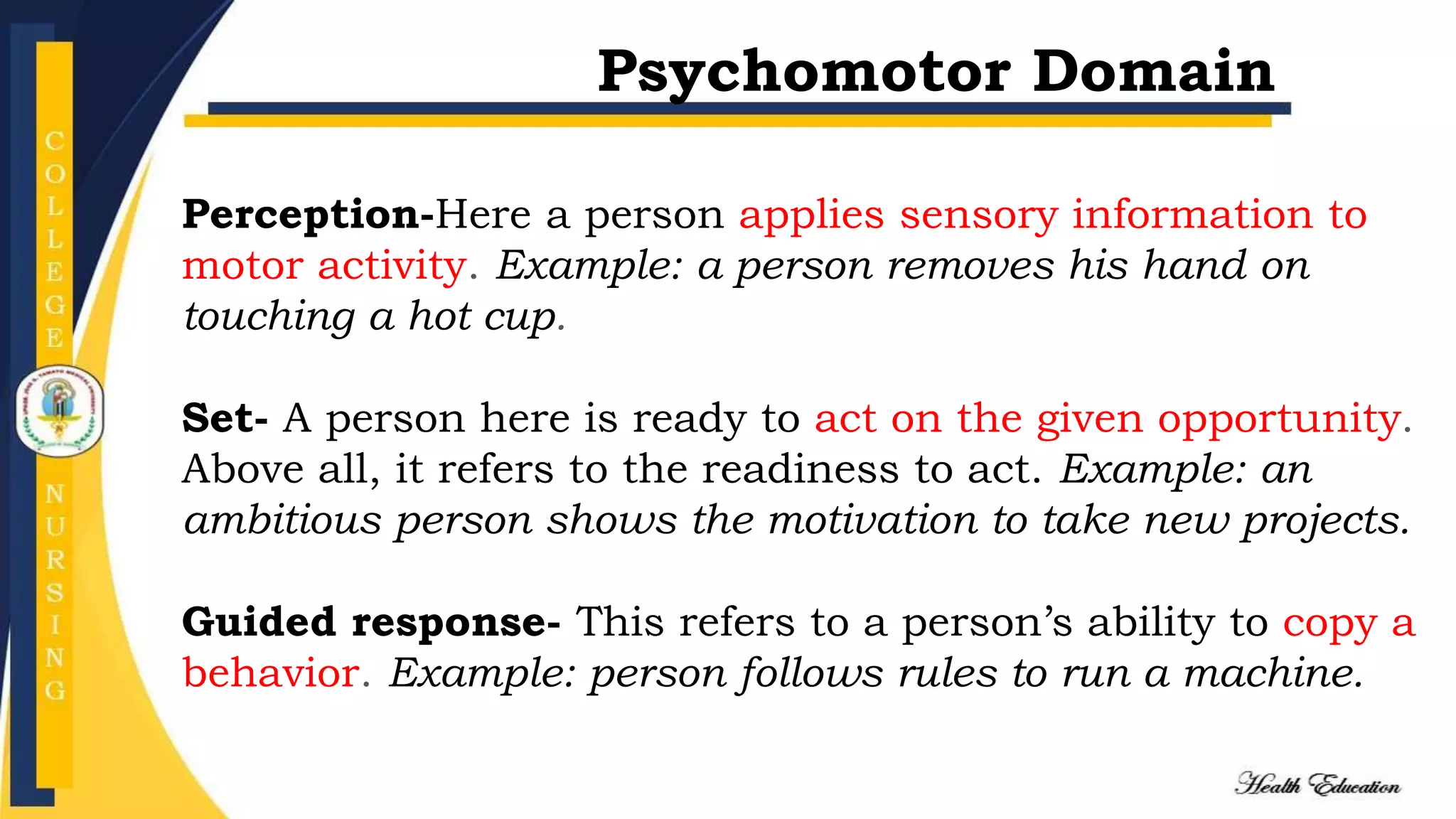
Perception-Here a person applies sensory information to
motor activity. Example: a person removes his hand on
touching a hot cup.
Set- A person here is ready to act on the given opportunity.
Above all, it refers to the readiness to act. Example: an
ambitious person shows the motivation to take new projects.
Guided response- This refers to a person’s ability to copy a
behavior. Example: person follows rules to run a machine.
Psychomotor Domain
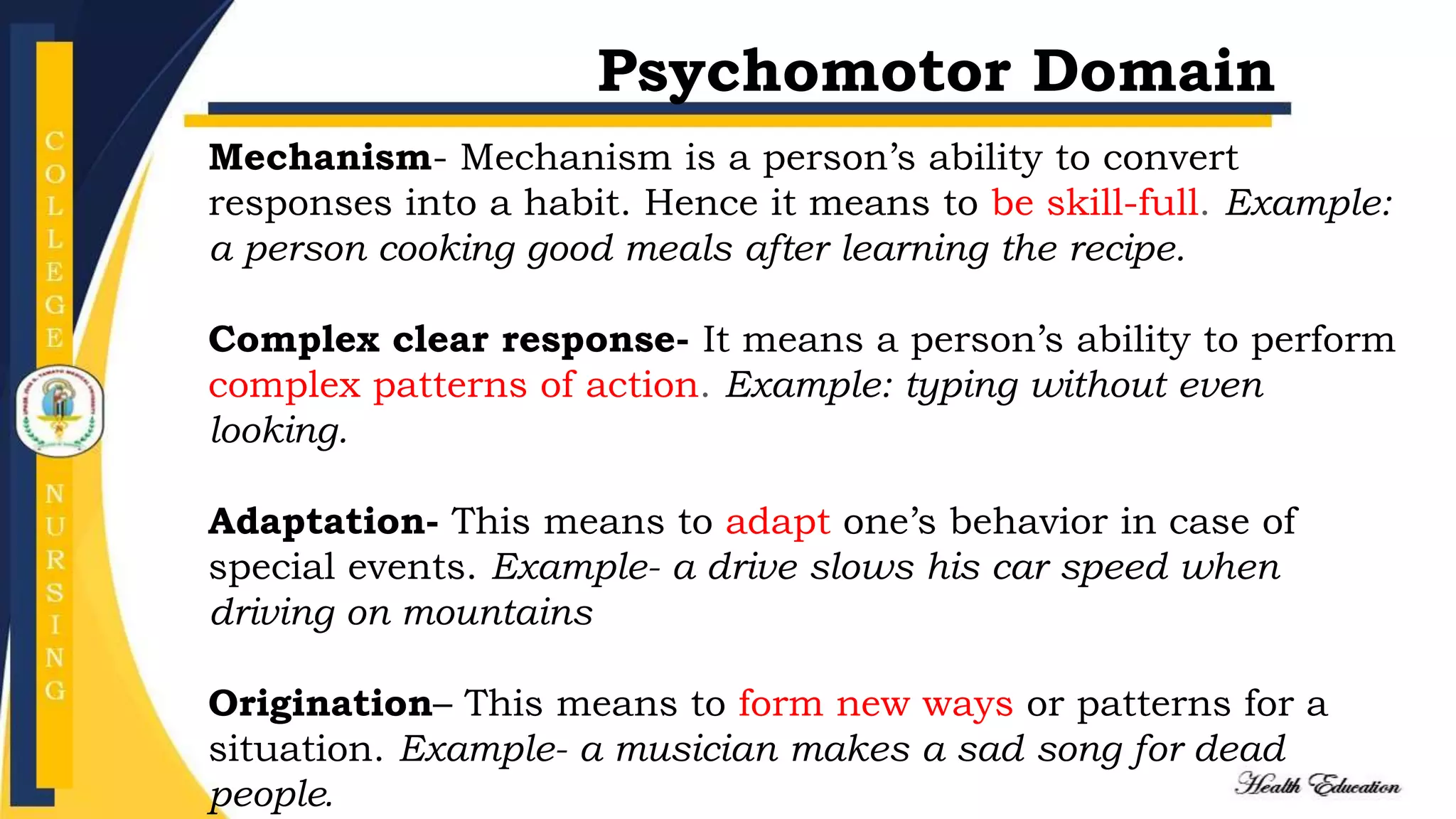
Mechanism- Mechanism is a person’s ability to convert
responses into a habit. Hence it means to be skill-full. Example:
a person cooking good meals after learning the recipe.
Complex clear response- It means a person’s ability to perform
complex patterns of action. Example: typing without even
looking.
Adaptation- This means to adapt one’s behavior in case of
special events. Example- a drive slows his car speed when
driving on mountains
Origination– This means to form new ways or patterns for a
situation. Example- a musician makes a sad song for dead
people.
Psychomotor Domain
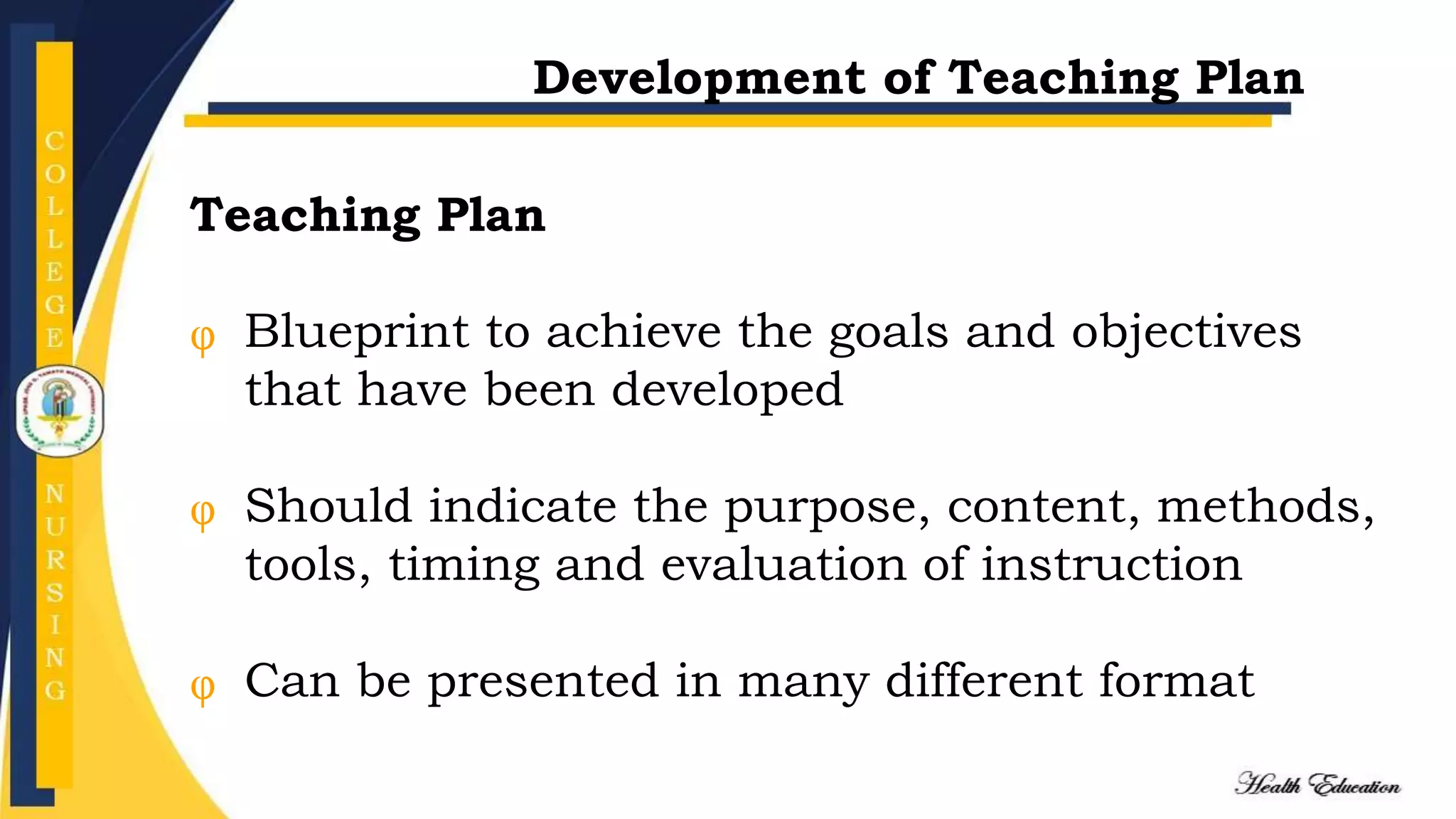
Development of Teaching Plan
Teaching Plan
Blueprint to achieve the goals and objectives
that have been developed
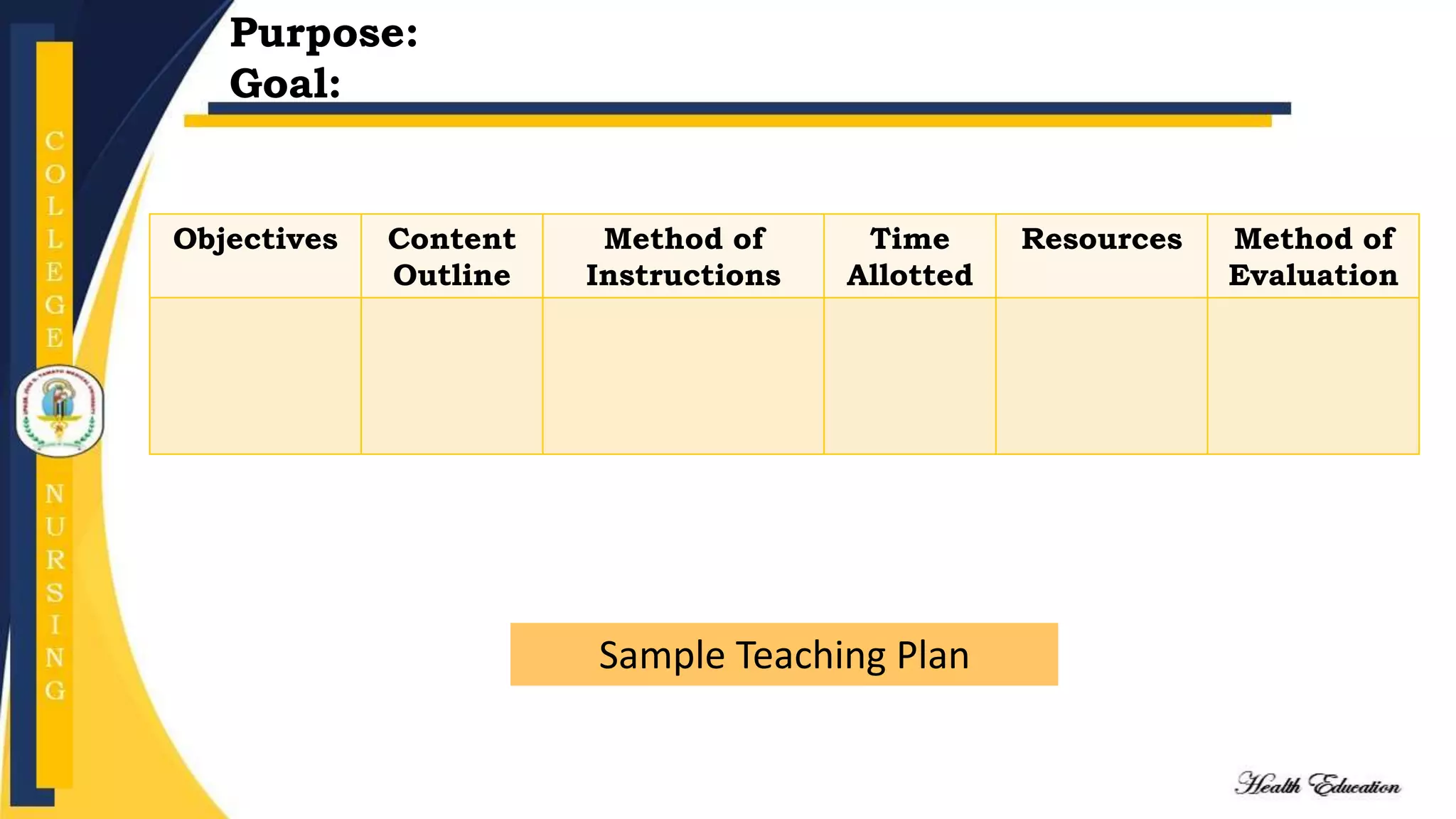
Should indicate the purpose, content, methods,
tools, timing and evaluation of instruction
Can be presented in many different format
Objectives Content
Outline
Method of
Instructions
Time
Allotted
Resources Method of
Evaluation
Purpose:
Goal:
Sample Teaching Plan
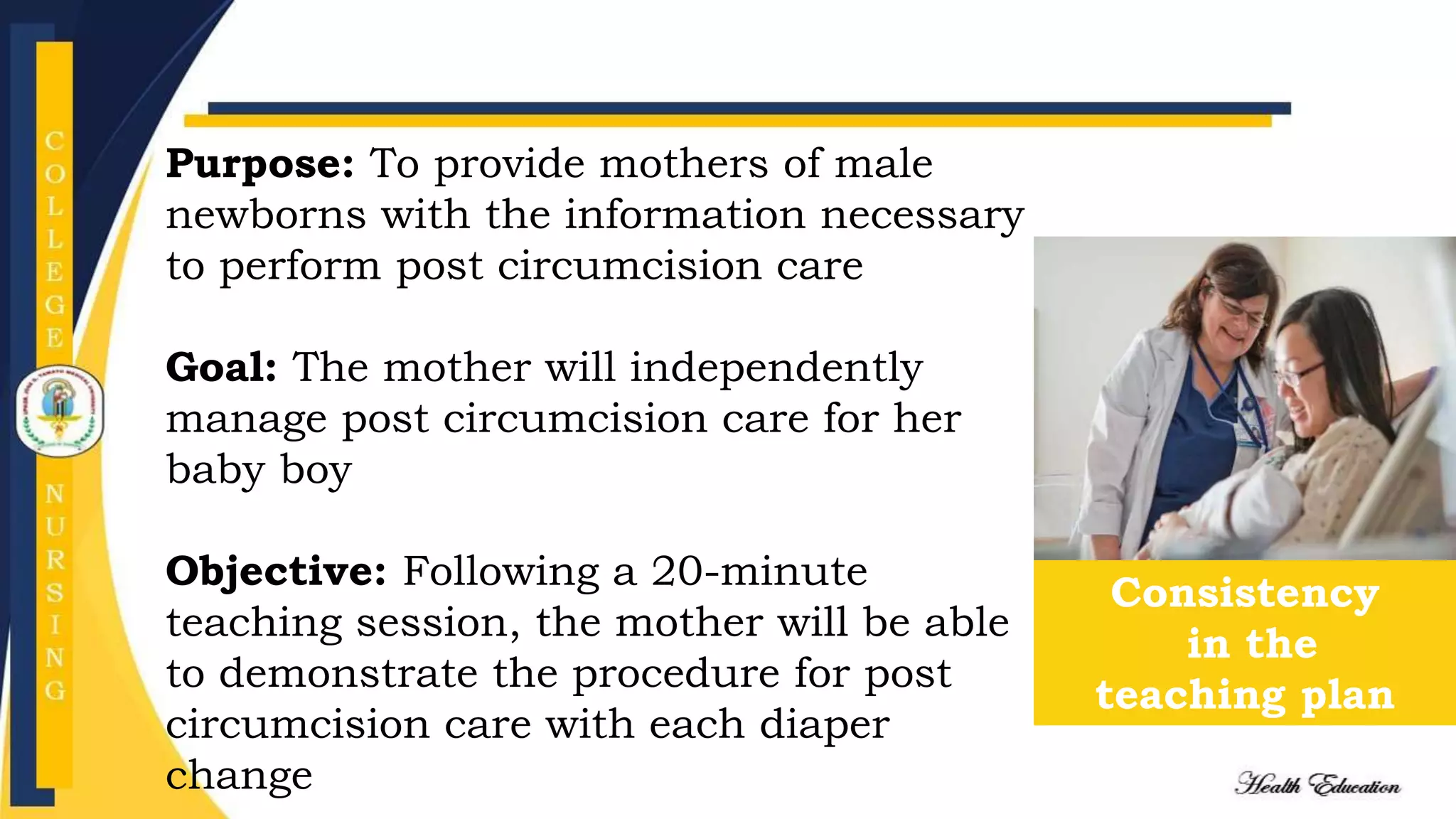
Consistency
in the
teaching plan
Purpose: To provide mothers of male
newborns with the information necessary
to perform post circumcision care
Goal: The mother will independently
manage post circumcision care for her
baby boy
Objective: Following a 20-minute
teaching session, the mother will be able
to demonstrate the procedure for post
circumcision care with each diaper
change
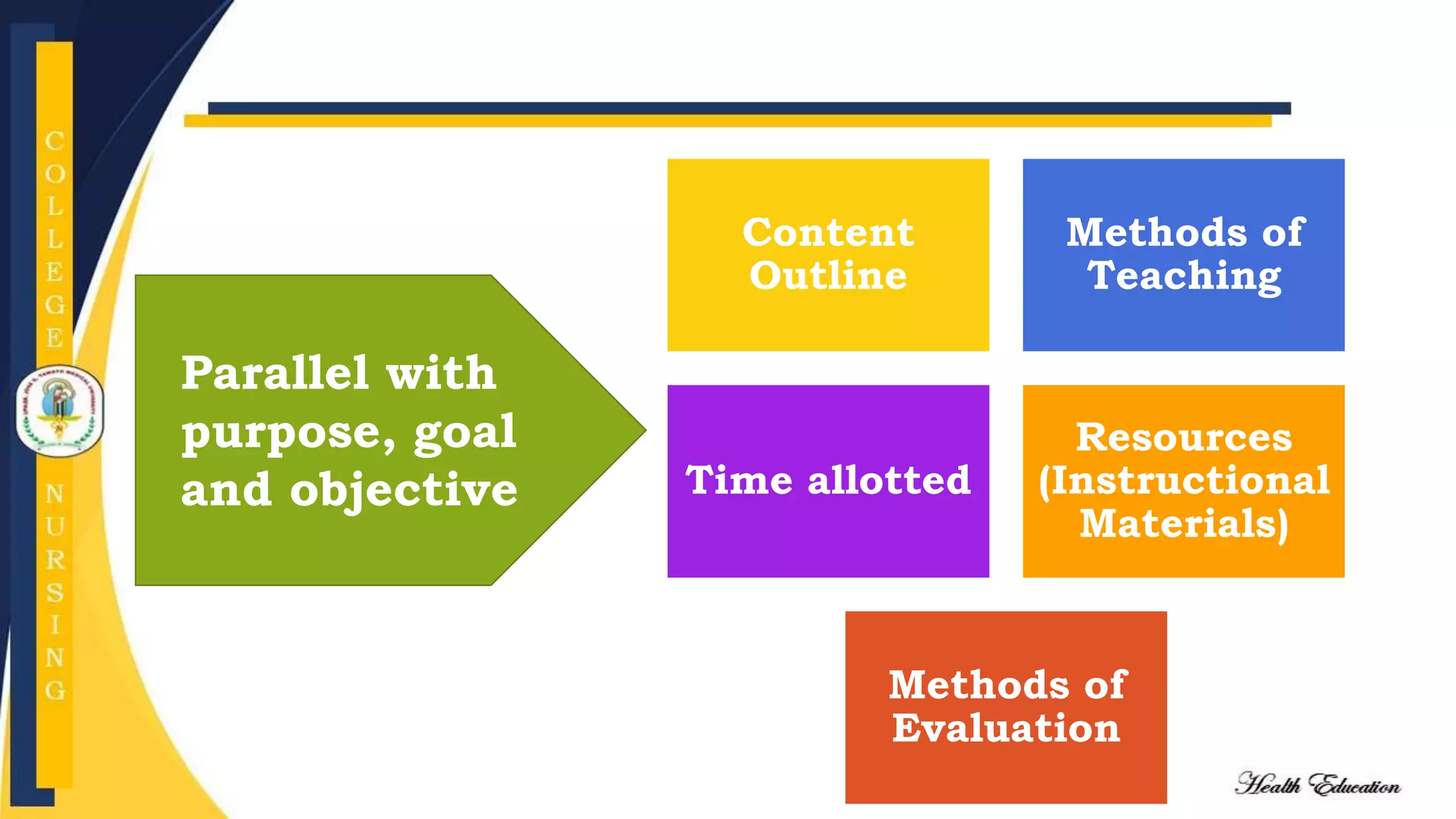
Content
Outline
Methods of
Teaching
Time allotted
Resources
(Instructional
Materials)
Methods of
Evaluation
Parallel with
purpose, goal
and objective
CONTENT OUTLINE
Depends on the assessment of the learner’s need,
readiness to learn and learning style
METHODS OF TEACHING
Should be appropriate for the information being
taught, the learners and the setting.
EXAMPLE
Purpose: To teach a patient to self-administer medication
from an asthma inhaler (Psychomotor)
Methods of Teaching: Demonstration and Return
Demonstration
METHODS OF TEACHING
Should be appropriate for the information being
taught, the learners and the setting.
EXAMPLE
Purpose: To provide knowledge of what is a low-fat
diet to a group of individuals with high cholesterol
(Cognitive)
Methods of Teaching: Lecture-Discussion
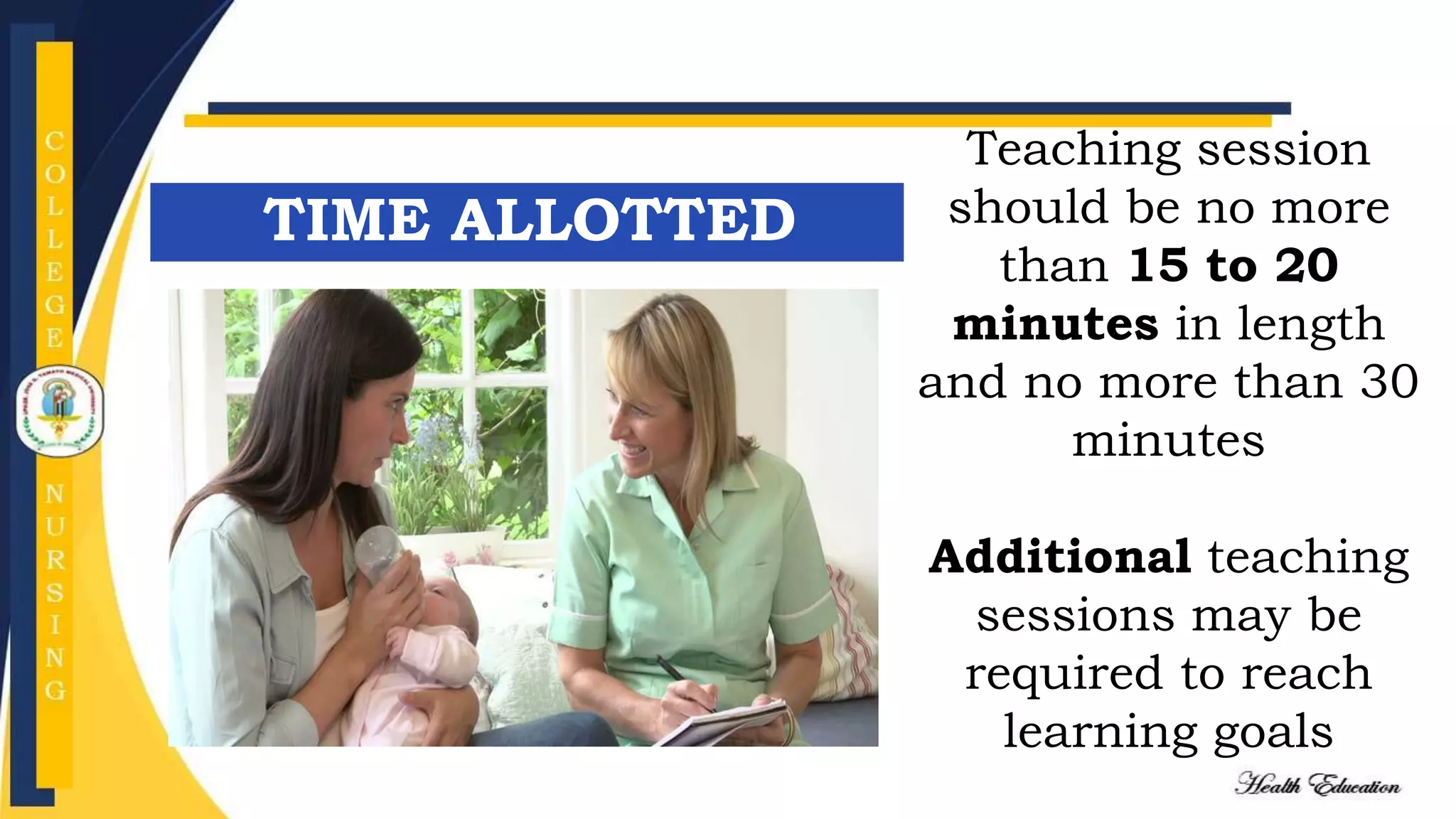
Teaching session
should be no more
than 15 to 20
minutes in length
and no more than 30
minutes
Additional teaching
sessions may be
required to reach
learning goals
TIME ALLOTTED
RESOURCES
Should match the content and support the teaching method
EXAMPLE
When teaching breast self-examination, an anatomic
model of the breast plus written and audiovisual
materials would be useful instructional tools
METHODS OF EVALUATION
– Should match the domains of each objective
and validate whether the goal has been met.
– Must measure the desired learning outcomes to
determine if and to what extent the learner
achieved the goal
EXAMPLE
A learner diagnosed with CAD may have an
objective to be able to state and list the 3 most
important symptoms of a heart attack.
Evaluation Method:
Written post-test or oral question and answer
approach (to test the knowledge)
 Nurses need to be
able to develop
teaching plan as part
of their professional
practice
 All elements of
teaching plan need to
relate to each other to
be TRULY
EFFECTIVE
Bastable (2019). Nurse as Educator. Principles of
Teaching and Learning for Nursing Practice. Jones &
Bartlett Learning.
Reference:
QUIZ No. 1
1
2
3
4
5
6
7
8
9
10
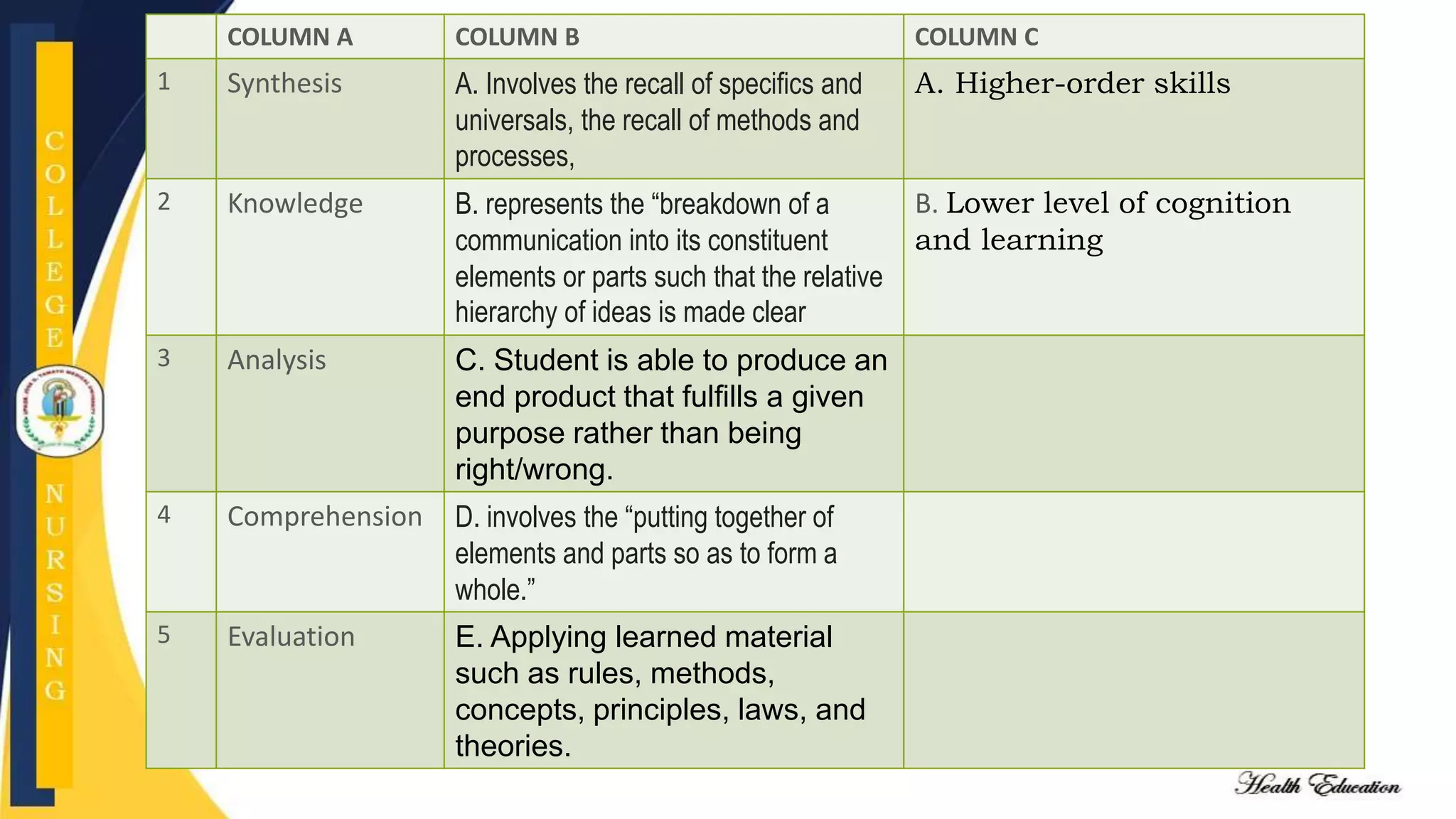
COLUMN A COLUMN B COLUMN C
1 Synthesis A. Involves the recall of specifics and
universals, the recall of methods and
processes,
A. Higher-order skills
2 Knowledge B. represents the “breakdown of a
communication into its constituent
elements or parts such that the relative
hierarchy of ideas is made clear
B. Lower level of cognition
and learning
3 Analysis C. Student is able to produce an
end product that fulfills a given
purpose rather than being
right/wrong.
4 Comprehension D. involves the “putting together of
elements and parts so as to form a
whole.”
5 Evaluation E. Applying learned material
such as rules, methods,
concepts, principles, laws, and
theories.
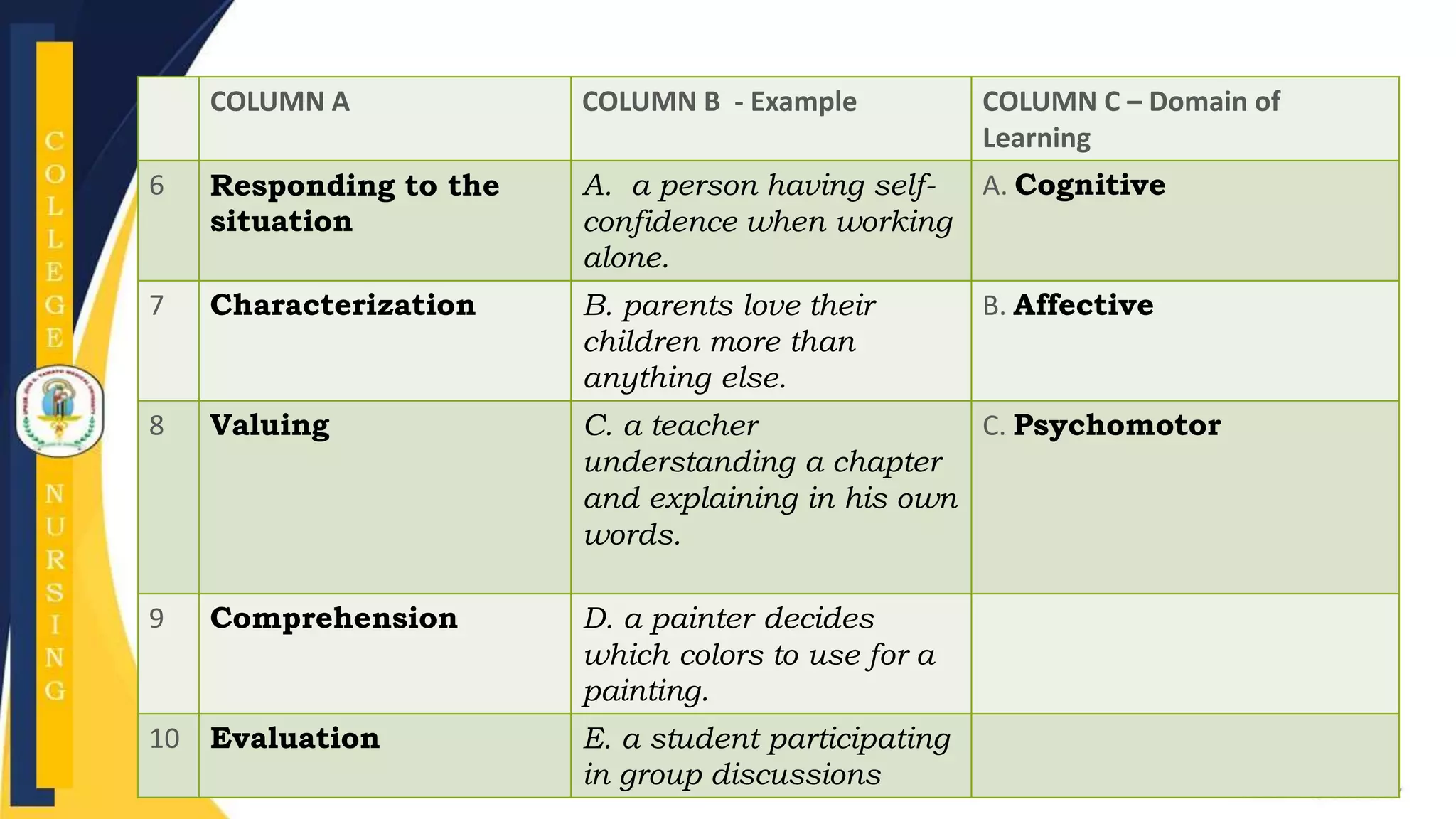
COLUMN A COLUMN B - Example COLUMN C – Domain of
Learning
6 Responding to the
situation
A. a person having self-
confidence when working
alone.
A. Cognitive
7 Characterization B. parents love their
children more than
anything else.
B. Affective
8 Valuing C. a teacher
understanding a chapter
and explaining in his own
words.
C. Psychomotor
9 Comprehension D. a painter decides
which colors to use for a
painting.
10 Evaluation E. a student participating
in group discussions
MIDTERM LECTURE 1.pptx

MIDTERM LECTURE 1.pptx

  • 1.
    HEALTH EDUCATION PROCESS DEVELOPINGA HEALTH EDUCATION PLAN
  • 2.
    The educator MUSTfirst decide what the learner is expected to accomplish BEFORE selecting the learning content, teaching methodology and materials to be used
  • 3.
    INDIVIDUAL NEEDS are determinedby identifying gaps in the learner’s knowledge, attitude, or skills. Identification of Needs Formulation of Behavioral Objectives
  • 4.
    Mager (1997)  Developeda system for writing behavioral objectives that help teachers make appropriate instructional decisions as well as assist learners in understanding what they need and are expected to know.
  • 5.
    The study ofthe general principles of scientific classification (https://www.merriam-webster.com/dictionary/taxonomy) What does taxonomy mean in education? Bloom’s taxonomy is a classification system used to define and distinguish different levels of human cognition—i.e., thinking, learning, and understanding. Taxonomy
  • 6.
    • Bloom’s taxonomywas originally published in 1956 by a team of cognitive psychologists at the University of Chicago • It is named after the committee’s chairman, Benjamin Bloom • The original taxonomy was organized into three domains: Cognitive, Affective, and Psychomotor. Original Taxonomy
  • 7.
    A framework forteaching and learning goals that would help researchers and educators understand the fundamental ways in which people acquire and develop new knowledge, skills, and understandings
  • 8.
    Higher- order skills Lower levelof cognition and learning
  • 9.
    Knowledge Behavioral Learning Outcome Abilityto recall appropriate, learned information on command. Key Phrases for Assessment arrange, define, describe, duplicate, enumerate, identify, label, list, match, memorize, name, order, read, recognize, relate, recall, repeat, reproduce, record, select, state, view, write
  • 10.
    Comprehension Behavioral Learning Outcome Applyinglearned material such as rules, methods, concepts, principles, laws, and theories. Key Phrases for Assessment act, administer, apply, articulate, assess, chart, choose, collect, compute, construct, contribute, control, demonstrate, determine, develop, discover, dramatize, employ, establish, extend, illustrate, implement, include, inform, instruct, interpret, operate, operationalize, participate, practice, predict, prepare, preserve, produce, project, provide, relate, report, schedule, show, sketch, solve, teach, transfer, use, utilize, write
  • 11.
    Application Behavioral Learning Outcome Applyinglearned material such as rules, methods, concepts, principles, laws, and theories. Key Phrases for Assessment act, administer, apply, articulate, assess, chart, choose, collect, compute, construct, contribute, control, demonstrate, determine, develop, discover, dramatize, employ, establish, extend, illustrate, implement, include, inform, instruct, interpret, operate, operationalize, participate, practice, predict, prepare, preserve, produce, project, provide, relate, report, schedule, show, sketch, solve, teach, transfer, use, utilize, write
  • 12.
    Analysis Behavioral Learning Outcome Thestudent is able to develop multiple conclusions concerning the motives, causes, inferences and generalizations that can be derived from the material’s component parts and organization Key Phrases for Assessment analyze, appraise, break down, calculate, categorize, compare, contrast, correlate, criticize, diagram, differentiate, discriminate, distinguish, examine, experiment, focus, illustrate, infer, limit, outline, point out, prioritize, question, recognize, separate, subdivide, test
  • 13.
    Synthesis Behavioral Learning Outcome Thestudent’s ability to produce a new or original end product. Examples include a unique communication, plan of operations (research proposal), or abstract relations (information classification scheme). Key Phrases for Assessment adapt, anticipate, arrange, assemble, collaborate, collect, combine, communicate, compile, compose, construct, create, design, develop, devise, express, facilitate, formulate, generate, hypothesize, incorporate, individualize, initiate, integrate, intervene, invent, manage, model, modify, negotiate, organize, plan, prepare, progress, propose, rearrange, reconstruct, reinforce, reorganize, revise, set up, structure,
  • 14.
    Evaluation Behavioral Learning Outcome Studentis able to produce an end product that fulfills a given purpose rather than being right/wrong. Key Phrases for Assessment appraise, argue, assess, attach, choose, compare, conclude, contrast, core, criticize, critique, decide, defend, estimate, evaluate, interpret, judge, justify, predict, rate, reframe, select, support, value
  • 15.
     In 2001,another team of scholars—led by Lorin Anderson and David Krathwohl released a revised version of Bloom’s taxonomy called A Taxonomy for Learning, Teaching, and Assessing: A Revision of Bloom’s Taxonomy of Educational Objectives  The “Revised Bloom’s Taxonomy,” as it is commonly called, was intentionally designed to be more useful to educators and to reflect the common ways in which it had come to be used in schools. Revised Taxonomy
  • 16.
    • 3 categorieswere renamed and all the categories were expressed as verbs rather than nouns: Knowledge was changed to Remembering Comprehension became Understanding Synthesis was renamed Creating • Creating became the highest level in the classification system, switching places with Evaluating
  • 18.
    Skills in preparingand classifying behavioral objectives is a necessary function of the educator’s role, whether teaching patients and their families in health care settings, teaching nurses in continuing programs or teaching nursing students in school.
  • 19.
    1. Educational -used to identify the intended outcomes of the education process. 2. Instructional – describe the teaching activities, specific content areas, and resources used to facilitate effective instruction. 3. Behavioral/learning – describe precisely what the learner will be able to do following a learning situation. Types of Objectives
  • 20.
    GOALS vs OBJECTIVES Finaloutcome to be achieved at the end, broad, long-term targets and multidimensional •GOALS or LEARNING OUTCOMES Specific, single, one-dimensional, short-term and achieved at the end of one teaching session •OBJECTIVES
  • 21.
    BEHAVIORAL OBJECTIVE Describes aperformance that learners should be able to exhibit before they are considered COMPETENT (Mager, 1997) The intended result of instruction
  • 22.
    “If you don’tknow where you’re going, how will you know which road to take to get there?” - Mager 1997
  • 23.
    THUS, after anurse educator has identified the needs of a patient, it is important that the educator clearly state the behavioral objectives to be achieved as well as intended results before proceeding with any steps of the educational process
  • 24.
    Writing Behavioral Objectivesand Goals Three important characteristics according to Mager: 1. Performance – What should the learner be able to do? 2. Condition – Under which conditions should the learner be able to do it? 3. Criterion – How well must the learner be able to do it?
  • 25.
    Writing Behavioral Objectivesand Goals Three important characteristics according to Mager: 1. Performance – What should the learner be able to do?
  • 26.
    Writing Behavioral Objectivesand Goals Three important characteristics according to Mager: 1. Performance – What should the learner be able to do? The most important and indispensable characteristic of a useful objective is that it describes the kind of performance that will be accepted as evidence that the learner has mastered the objective.
  • 27.
    Writing Behavioral Objectivesand Goals Three important characteristics according to Mager: 1. Performance – What should the learner be able to do? Which of the two following learning objectives do you think is better? 1.Be able to write a news article. 2.Be able to develop an appreciation of music.
  • 28.
    Writing Behavioral Objectivesand Goals Three important characteristics according to Mager: 1. 2. Condition – Under which conditions should the learner be able to do it?
  • 29.
    Writing Behavioral Objectivesand Goals Three important characteristics according to Mager: 1. 2. Condition – Under which conditions should the learner be able to do it?
  • 30.
    Writing Behavioral Objectivesand Goals Three important characteristics according to Mager: 3. Criterion – How well must the learner be able to do it?
  • 31.
    Four-part Method ofObjective Writing: A – audience (who) B – behavior (what) C – condition (under which circumstance) D – degree (how well, to what extent, within what time frame) ABCD rule by Smaldino, Lowther and Russel (2012)
  • 32.
    EXAMPLE: After a 20-minuteteaching session on relaxation techniques (C-condition), Mrs. Smith (A-audience) will be able to identify (B-behavior) three distinct techniques for lowering her stress level (D-degree)
  • 33.
    Condition Audience BehaviorDegree Without using a calculator the student will solve five out of six problems After watching a video the caregiver will select High protein food for the patient with 100% accuracy
  • 34.
    Condition Audience BehaviorDegree Using a model the staff nurse will demonstrate the correct procedure for changing sterile dressings Following group discussions the patient will list at least two reasons for losing weight
  • 35.
    The committee identifiedthree domains of educational activities or learning (Bloom, et al. 1956): Cognitive: mental skills (knowledge) Affective: growth in feelings or emotional areas (attitude or self) Psychomotor: manual or physical skills (skills) The Three Domains of Learning
  • 36.
    Knowledge- This involvesthe ability to recall information. Example: can be remembering the safety rules when driving. Comprehension- It refers to understanding the data. Furthermore, it also involves interpreting the data. Example: a teacher understanding a chapter and explaining in his own words. Application- This means using knowledge in a new situation. It refers to apply knowledge. Example: a doctor applying his knowledge of science to treat patients. Cognitive Domain
  • 37.
    Analysis- Helps studentsto understand the difference between facts and opinions. Example: a lawyer knows how to separate facts from opinions in court. Synthesis- To combine different parts of information to form a pattern. Hence, synthesis gives new meaning. Example: a sports coach makes new plans to win matches. Evaluation- The ability to form judgments about a situation. Example: a painter decides which colors to use for a painting. Cognitive Domain
  • 38.
    Receiving information- Herea person becomes aware of the feelings and emotions. Furthermore, it also involves the ability to use emotion. Example: a person listening to a friend with feeling. Responding to the situation- This means people responding to phenomena. It involves the active participation of the people. Example: a student participating in group discussions. Valuing- A person places value on something which he finds important. Hence valuing is the ability to see the worth of something. The person expresses this worth. Example: parents love their children more than anything else. Affective Domain
  • 39.
    Organization- This meansto organize values into matters of great importance. A person gives more importance to some values over another. Example: An army man wants to stay in the gym rather than anywhere else. Characterization- Here internalized valued control a person’s behavior. Hence characterization refers to the ability to internalize values. Example: a person having self- confidence when working alone. Affective Domain
  • 40.
    Perception-Here a personapplies sensory information to motor activity. Example: a person removes his hand on touching a hot cup. Set- A person here is ready to act on the given opportunity. Above all, it refers to the readiness to act. Example: an ambitious person shows the motivation to take new projects. Guided response- This refers to a person’s ability to copy a behavior. Example: person follows rules to run a machine. Psychomotor Domain
  • 41.
    Mechanism- Mechanism isa person’s ability to convert responses into a habit. Hence it means to be skill-full. Example: a person cooking good meals after learning the recipe. Complex clear response- It means a person’s ability to perform complex patterns of action. Example: typing without even looking. Adaptation- This means to adapt one’s behavior in case of special events. Example- a drive slows his car speed when driving on mountains Origination– This means to form new ways or patterns for a situation. Example- a musician makes a sad song for dead people. Psychomotor Domain
  • 42.
    Development of TeachingPlan Teaching Plan Blueprint to achieve the goals and objectives that have been developed Should indicate the purpose, content, methods, tools, timing and evaluation of instruction Can be presented in many different format
  • 43.
    Objectives Content Outline Method of Instructions Time Allotted ResourcesMethod of Evaluation Purpose: Goal: Sample Teaching Plan
  • 44.
    Consistency in the teaching plan Purpose:To provide mothers of male newborns with the information necessary to perform post circumcision care Goal: The mother will independently manage post circumcision care for her baby boy Objective: Following a 20-minute teaching session, the mother will be able to demonstrate the procedure for post circumcision care with each diaper change
  • 45.
  • 46.
    CONTENT OUTLINE Depends onthe assessment of the learner’s need, readiness to learn and learning style METHODS OF TEACHING Should be appropriate for the information being taught, the learners and the setting. EXAMPLE Purpose: To teach a patient to self-administer medication from an asthma inhaler (Psychomotor) Methods of Teaching: Demonstration and Return Demonstration
  • 47.
    METHODS OF TEACHING Shouldbe appropriate for the information being taught, the learners and the setting. EXAMPLE Purpose: To provide knowledge of what is a low-fat diet to a group of individuals with high cholesterol (Cognitive) Methods of Teaching: Lecture-Discussion
  • 48.
    Teaching session should beno more than 15 to 20 minutes in length and no more than 30 minutes Additional teaching sessions may be required to reach learning goals TIME ALLOTTED
  • 49.
    RESOURCES Should match thecontent and support the teaching method EXAMPLE When teaching breast self-examination, an anatomic model of the breast plus written and audiovisual materials would be useful instructional tools
  • 50.
    METHODS OF EVALUATION –Should match the domains of each objective and validate whether the goal has been met. – Must measure the desired learning outcomes to determine if and to what extent the learner achieved the goal
  • 51.
    EXAMPLE A learner diagnosedwith CAD may have an objective to be able to state and list the 3 most important symptoms of a heart attack. Evaluation Method: Written post-test or oral question and answer approach (to test the knowledge)
  • 52.
     Nurses needto be able to develop teaching plan as part of their professional practice  All elements of teaching plan need to relate to each other to be TRULY EFFECTIVE
  • 53.
    Bastable (2019). Nurseas Educator. Principles of Teaching and Learning for Nursing Practice. Jones & Bartlett Learning. Reference:
  • 54.
  • 55.
  • 56.
    COLUMN A COLUMNB COLUMN C 1 Synthesis A. Involves the recall of specifics and universals, the recall of methods and processes, A. Higher-order skills 2 Knowledge B. represents the “breakdown of a communication into its constituent elements or parts such that the relative hierarchy of ideas is made clear B. Lower level of cognition and learning 3 Analysis C. Student is able to produce an end product that fulfills a given purpose rather than being right/wrong. 4 Comprehension D. involves the “putting together of elements and parts so as to form a whole.” 5 Evaluation E. Applying learned material such as rules, methods, concepts, principles, laws, and theories.
  • 57.
    COLUMN A COLUMNB - Example COLUMN C – Domain of Learning 6 Responding to the situation A. a person having self- confidence when working alone. A. Cognitive 7 Characterization B. parents love their children more than anything else. B. Affective 8 Valuing C. a teacher understanding a chapter and explaining in his own words. C. Psychomotor 9 Comprehension D. a painter decides which colors to use for a painting. 10 Evaluation E. a student participating in group discussions

Editor's Notes

  • #4 IN a prereq to formulating BO that serve as a road map to guide subsequent planning, implementation and eval of teaching and learning A gap analysis measures where you are currently versus where you want or need to be in the future. Therefore, a skills gap analysis is a survey of what skills an individual or company currently possess and those that they will need in the future to meet their business goals
  • #5 Robert Mager's Performance-Based Learning Objectives 20th century- educators and psychologists developed approaches to writing and classifying BO that offers teachers assistance in organizing instructional content for learners Graduate Univ. of Iowa PhD – Psychology Became Interested Instructional Design after serving in the Army seeing soldiers trained Wrote a book called“Preparing Instructional Objectives”First lets look at Robert Mager a Graduate of Ohio University with a Bachelor's and Masters degree. He also has a PhD in Psychology from the University of Iowa. He became interested in designing instruction after being drafted in the Army and seeing the way soldiers were trained. And he wrote a book called Preparing Instructional Objectives.
  • #6 .In Science, Taxonomy is the science of naming, describing and classifying organisms and includes all plants, animals and microorganisms of the world Educators have typically used Bloom’s taxonomy to inform or guide the development of assessments (tests and other evaluations of student learning), curriculum (units, lessons, projects, and other learning activities), and instructional methods such as questioning strategies. Bloom's taxonomy was developed to provide a common language for teachers to discuss and exchange learning and assessment methods. Specific learning outcomes can be derived from the taxonomy, though it is most commonly used to assess learning on a variety of cognitive levels. Bloom's taxonomy is a classification system used to define and distinguish different levels of human cognition—i.e., thinking, learning, and understanding
  • #7 Educators have primarily focused on the Cognitive model, which includes six different classification levels: Knowledge, Comprehension, Application, Analysis, Synthesis, and Evaluation. Knowledge “involves the recall of specifics and universals, the recall of methods and processes, or the recall of a pattern, structure, or setting.” Comprehension “refers to a type of understanding or apprehension such that the individual knows what is being communicated and can make use of the material or idea being communicated without necessarily relating it to other material or seeing its fullest implications.” Application refers to the “use of abstractions in particular and concrete situations.” Analysis represents the “breakdown of a communication into its constituent elements or parts such that the relative hierarchy of ideas is made clear and/or the relations between ideas expressed are made explicit.” Synthesis involves the “putting together of elements and parts so as to form a whole.” Evaluation engenders “judgments about the value of material and methods for given purposes.”
  • #9  the first three elements—Knowledge, Comprehension, and Application—represent lower levels of cognition and learning, while Analysis, Synthesis, and Evaluation are considered higher-order skills. For this reason, the taxonomy is often graphically represented as a pyramid with higher-order cognition at the top.
  • #10 involves the recall of specifics and universals, the recall of methods and processes, or the recall of a pattern, structure, or setting.” Teaching/Learning Methods: Lecture Memorization Readings Podcast Video Web information Summative Assessments Exam items of the form: define, label, list, reproduce. Items are convergent, limited answers. Example Assessment Label the parts of the human eye.
  • #11 refers to a type of understanding or apprehension such that the individual knows what is being communicated and can make use of the material or idea being communicated without necessarily relating it to other material or seeing its fullest implications.” Teaching/Learning Methods: Demonstrate problem-solving (Case Studies, text problems, scenarios) Demonstrate application of rules, laws, or theories (Case Studies, text problems, scenarios) Demonstrate methods or procedures Practice in multiple contexts Summative Assessments Student presentation for instructor or evaluator. (Live, video, podcast) Exam items of the form: apply, use, solve, demonstrate, employ Problem set Example Assessment Apply the Opponent Processes color theory to predict how the world appears to the major varieties of color blindness and color vision anomaly.
  • #12 refers to the “use of abstractions in particular and concrete situations.” Using information and materials to solve new problems or respond to concrete situations that have a single or best answer. Teaching/Learning Methods: Demonstrate problem-solving (Case Studies, text problems, scenarios) Demonstrate application of rules, laws, or theories (Case Studies, text problems, scenarios) Demonstrate methods or procedures Practice in multiple contexts Summative Assessments Student presentation for instructor or evaluator. (Live, video, podcast) Exam items of the form: apply, use, solve, demonstrate, employ Problem set Example Assessment Apply the Opponent Processes color theory to predict how the world appears to the major varieties of color blindness and color vision anomaly.
  • #13  represents the “breakdown of a communication into its constituent elements or parts such that the relative hierarchy of ideas is made clear and/or the relations between ideas expressed are made explicit.” Teaching/Learning Methods Case Studies Simulations (Computer-based, mannequins, part task trainers, role plays) Discussion Labs Graphic Organizers Exam items of the form: analyze, compare, distinguish, examine, test (Take home, online, or face to face) Portfolio entries focused on analyzing case studies or clinical experiences. Essays Student presentations Example Assessment Compare and contrast Helmholtz’s (1865) “Place Theory” to Rutherford’s (1886) “Frequency Theory”.
  • #14 involves the “putting together of elements and parts so as to form a whole.” Teaching/Learning Methods Research/Labs Plan development Multiple Case Studies – Class or small group discussions assembling relevant information to produce a hypothesis, plan to address recurring problems Interviews with experts Summative Assessments Exam items of the form: develop, plan, prepare, propose, construct, design, formulate, create, assemble Portfolio Design and build a model Create a work of art Develop a unique plan to serve some purpose Student presentations Example Assessment Choose a perceptual disorder and create a device that would mitigate its effects.
  • #15 engenders “judgments about the value of material and methods for given purposes.” Teaching/Learning Methods Demonstrate process for evaluating research reports based on criteria Case Studies – Small group discussions of appropriateness of procedures, results Debates Summative Assessments Exam items of the form: evaluate, argue, assess, defend, judge, predict, rate, support Student presentations Example Assessment Evaluate the ADA guidelines in light of what you have learned about blindness and critique its strengths and weaknesses. Do you believe the guidelines are effective? Why or why not?
  • #16 Lorin Anderson, a former student of Bloom’s, and David Krathwohl, a Bloom colleague who served on the academic team that developed the original taxonomy A group of cognitive psychologists, curriculum theorists and instructional researchers, and testing and assessment specialists published in 2001 a revision of Bloom’s Taxonomy with the title A Taxonomy for Teaching, Learning, and Assessment. This title draws attention away from the somewhat static notion of “educational objectives” (in Bloom’s original title) and points to a more dynamic conception of classification. The authors of the revised taxonomy underscore this dynamism, using verbs and gerunds to label their categories and subcategories (rather than the nouns of the original taxonomy). These “action words” describe the cognitive processes by which thinkers encounter and work with knowledge: The current updated version developed by Anderson and Krathwohl (2001) reorganizes, and highlights the interactions between, two dimensions: cognitive processes and knowledge content. Anderson and Krathwohl identify two reasons for updating the original handbook. They emphasize a refocusing of educational outcomes back to the original handbook, which was ahead of its time and can still offer assistance to modern educators and to incorporate new findings in psychology and education into the framework
  • #17 . In their revision, cognitive processes are presented as verbs and the knowledge content are presented as nouns.
  • #18 Along with exchanging the levels of Evaluation and Synthesis (which they rename to Creation), Anderson and Krathwohl redefine the knowledge dimension to include four types: Factual Knowledge: Basic elements of a discipline that a student must know and be able to work with to solve problems including basic terminology and specific details and elements. Conceptual Knowledge: Interrelationships between basic factual knowledge that demonstrate how elements work together, for example, classifications and categories, principles and generalizations, and theories, models, and structures. Procedural Knowledge: How something is done including the methods of inquiry, skills, algorithms, techniques, and methods needed to investigate, apply, or analyze information. Metacognitive Knowledge: Awareness and knowledge of one’s own cognition including strategies for learning, contextual and conditional knowledge about cognitive tasks, and self-knowledge.
  • #21 The main difference between goals and objectives is that goals are broader in scope and help create vision and direction, while objectives are more specific targets and describe tangible actions to achieve an end result. objectives are the individual actions you need to take to achieve a goal. When working toward accomplishing a goal, often you'll have objectives you must complete along the way. By completing objectives, you're making progress towards completing your goal.  For example, the goal to “provide excellent customer service” is intangible, but the objective to “reduce customer wait time to one minute” is tangible and helps in achieving the main goal
  • #22 A behavioral objective is a learning outcome stated in measurable terms, that guides the learner's experience and serves as the foundation for student evaluation.  A clear and unambiguous statement of a planned educational expectation (s) for the learner is an educational behavioral objective, it states what behavior a student must execute or display in order for a teacher to infer that learning occurred. If appropriately developed, behavioral objectives can be used to draw those conclusions. Behavioral Objectives are about Curriculum, not instruction. A behavioral objective serves as the main point of the learning plan, as well as providing criteria for generating an assessment of the learning experience and the instructional approaches used by the educator to achieve it. It is difficult, if not impossible, to establish exactly what a learning experience's consequences are designed to achieve without a behavioral target.
  • #23 Surgeons do not choose intruments unitl they know which operation is to be performed, teachers should never prepare instructional materials or content until they know the knowledge and skills students are expected to learn
  • #25 Well written BO gives learners clear statement about what is expected of them. Assist teachers to measure learners progress . According to Mager, a learning objective should include the following three components: A performance (performed by the learner, remember--we just covered that) Conditions (under which the learner must perform the performance) Criteria (by which the performance is evaluated by another; or, in other words, how well the learner must perform the performance Mager admits that in some cases, “it is not always necessary to include the second characteristic, and not always practical to include the third,” but he goes on to say that the more you say about them, the better your objective will communicate. (That point about communicating effectively is one that Mager comes back to again and again in his book, and we’ll come back to it again later in this article as well).
  • #26  the objective must specify "what learners must be able to DO or PERFORM when they demonstrate mastery of an objective." So, as we've said before, the key is that the learner must do something. But you've got to be careful when you're writing a learning objective so that you write a performance that you or someone else can somehow observe, and you must tell the learner how their performance will be evaluated. Or, as Mager puts it:
  • #27 Because there's an emphasis on having the learner do something that someone else can observe as evidence, it's important to avoid learning objectives that include words like "know" and "understand." Why? Because how can you tell if someone "knows" or "understands" something? Instead, focus on things people really do on their job.
  • #28 If you selected "Be able to write a news article," you picked the right one. That's an action that someone can later evaluate and clearly tell if it's been performed or hasn't been performed. And it's clearly something that an employee would have to a on the job--if the employee is a journalist, that is. On the other hand, how would you know if someone has developed an appreciation of music? What are the clear signs of that--or is that too abstract? Mager would say there's no clear way to know if someone has developed an appreciation of music.
  • #29 The next thing to do is to state the conditions, if any, in which the learner must complete the performance. The conditions will tell the leaner things like the following (look for the italicized parts of the objectives below): What can I use while doing the performance? (For example: Given 100 toothpicks and some glue, construct a suspension bridge.) What will be denied to me? (For example: Perform the multiplication tables up to 20 without the of a calculator.) In which conditions will the performance have to occur? (For example: Run a 100-yard dash on a muddy field.)
  • #30 Remember that Mager said you may not always need to add conditions. As always with Mager, he suggests using them if they make things more clear and remove ambiguity. Mager's big on being clear and he's down on ambiguity, and that seems reasonable.
  • #31 Finally, the third part of a Mager three-part, performance-based learning objective is the criterion or criteria. Or, as Mager puts it: "Having described what you want your students to do, you can increase the communication power of an objective by telling them HOW WELL you want them to be able to do it." Note again Mager's focus on "the communication power of an objective." Here are some examples (again, look for the italicized parts of the objectives below): Identify four out out five product defects on a moving manufacturing line. Close ten boxes in a minute. Mager notes that it may not always be practical to include criteria in a learning objective. When that's true, don't include them.
  • #43 A predetermined goal and objectives serve as a basis for developing a teaching plan
  • #44 All part of the TP need to relate to each other, with the overall intention of meeting the goal Nurses need to know how to organize and present information in an internally consistent teaching plan
  • #47  Example of Method of teaching Art-based projects; Audio tutorials; Author's chair; Book reports; Bulletin boards; Brainstorming; Case studies; Chalkboard