The fund of human knowledge represents
the repository of accumulated discoveries
and inventions of man down the centuries,
due to man’s exploration of the world.
1. Subject-centered view
Gerome Bruner: “Knowledge is
a model we construct to give
meaning and structure to
regularities in experience.”
2. Learner- centered view
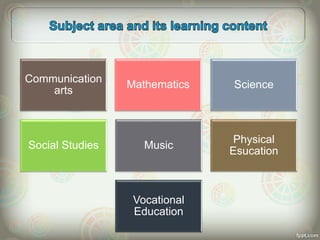
Communication
arts
Mathematics Science
Social Studies Music
Physical
Esucation
Vocational
Education
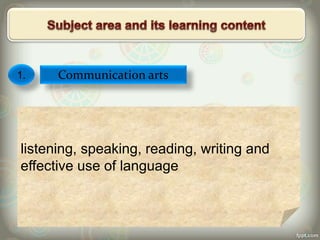
1. Communication arts
listening, speaking, reading, writing and
effective use of language
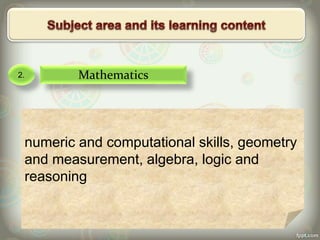
2. Mathematics
numeric and computational skills, geometry
and measurement, algebra, logic and
reasoning
3. Science
all branches of natural sciences,
exploration and discovery dealing with
natural phenomena and scientific
investigation
4. Social Studies
basic elememts of Geography, History,
Sociology, Anthropology, Economics,
Civics, Political Science, and Psychology
5. Music
basic music theory, practice in listening,
singing, playing musical instrument, and
music preparation
6. Physical Education
health and physical fitness, individual team
sports, spectatorship and wise use of
leisure
7. Vocational Education
psychomotor and manipulative skills in
basic crafts and trades, design, work ethic
and appreciation of manual productive work
Criteria in selection of
subject matter
1. Self- sufficiency – attaining
self- sufficiency in most
economical manner;
- less teaching and
learner’s effort but more results
and effective learning outcomes
Criteria in selection of
subject matter
2. Significance – content will contribute
to basic ideas, concepts and principles,
and generalizations to achieve the aim of
the curriculum;
- it will develop the cognitive,
affective and psychomotor skills of the
learners; and cultural aspects will be
considered
Criteria in selection of
subject matter
3. Validity – authenticity of the
subject matter
4. Interest - a key criterion in
learner-centered curriculum; content
should be based on the interest of the
learner
Criteria in selection of
subject matter
5. Utility – usefulness of the content
to the learner either for the present or
the future
6. Learnability – subject matter
should be within the range of the
experiences of the learners
Criteria in selection of
subject matter
7. Feasibility – content should be
learned within the time allowed,
resources available, expertise of the
teacher and nature of the learner.
Other considerations in
selection of learning content:
a. Frequently and commonly used in daily
life;
b. Suited to the maturity levels and the
abilities of the students;
c. Valuable in meeting the needs and the
competencies of a future career;
d. Related with other subject areas; and
e. Important in the transfer of learning
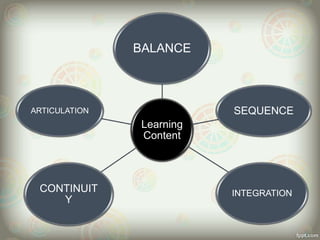
Learning
Content
BALANCE
SEQUENCE
INTEGRATIONCONTINUIT
Y
ARTICULATION
• Balance – Content curriculum
should be fairly distributed in
depth and breadth of the
particular learning or discipline.
• Articulation – Each level of subject matter
should be smoothly connected to the next,
glaring gaps or wasteful overlaps in the
subject matter will be avoided.
• Sequence –It refers to the deepening and
broadening of content as it is taken up in
the higher level.
• The horizontal connections are needed in
subject areas that are similar so that
learning will be related to one another.
This is INTEGRATION.
• The constant repetition, review and
reinforcement of learning is what is
referred to as CONTINUITY.

Curriculum Content or Subject Matter

  • 5.
    The fund ofhuman knowledge represents the repository of accumulated discoveries and inventions of man down the centuries, due to man’s exploration of the world. 1. Subject-centered view
  • 6.
    Gerome Bruner: “Knowledgeis a model we construct to give meaning and structure to regularities in experience.” 2. Learner- centered view
  • 8.
    Communication arts Mathematics Science Social StudiesMusic Physical Esucation Vocational Education
  • 9.
    1. Communication arts listening,speaking, reading, writing and effective use of language
  • 10.
    2. Mathematics numeric andcomputational skills, geometry and measurement, algebra, logic and reasoning
  • 11.
    3. Science all branchesof natural sciences, exploration and discovery dealing with natural phenomena and scientific investigation
  • 12.
    4. Social Studies basicelememts of Geography, History, Sociology, Anthropology, Economics, Civics, Political Science, and Psychology
  • 13.
    5. Music basic musictheory, practice in listening, singing, playing musical instrument, and music preparation
  • 14.
    6. Physical Education healthand physical fitness, individual team sports, spectatorship and wise use of leisure
  • 15.
    7. Vocational Education psychomotorand manipulative skills in basic crafts and trades, design, work ethic and appreciation of manual productive work
  • 17.
    Criteria in selectionof subject matter 1. Self- sufficiency – attaining self- sufficiency in most economical manner; - less teaching and learner’s effort but more results and effective learning outcomes
  • 18.
    Criteria in selectionof subject matter 2. Significance – content will contribute to basic ideas, concepts and principles, and generalizations to achieve the aim of the curriculum; - it will develop the cognitive, affective and psychomotor skills of the learners; and cultural aspects will be considered
  • 19.
    Criteria in selectionof subject matter 3. Validity – authenticity of the subject matter 4. Interest - a key criterion in learner-centered curriculum; content should be based on the interest of the learner
  • 20.
    Criteria in selectionof subject matter 5. Utility – usefulness of the content to the learner either for the present or the future 6. Learnability – subject matter should be within the range of the experiences of the learners
  • 21.
    Criteria in selectionof subject matter 7. Feasibility – content should be learned within the time allowed, resources available, expertise of the teacher and nature of the learner.
  • 22.
    Other considerations in selectionof learning content: a. Frequently and commonly used in daily life; b. Suited to the maturity levels and the abilities of the students; c. Valuable in meeting the needs and the competencies of a future career; d. Related with other subject areas; and e. Important in the transfer of learning
  • 24.
  • 25.
    • Balance –Content curriculum should be fairly distributed in depth and breadth of the particular learning or discipline.
  • 26.
    • Articulation –Each level of subject matter should be smoothly connected to the next, glaring gaps or wasteful overlaps in the subject matter will be avoided. • Sequence –It refers to the deepening and broadening of content as it is taken up in the higher level.
  • 27.
    • The horizontalconnections are needed in subject areas that are similar so that learning will be related to one another. This is INTEGRATION. • The constant repetition, review and reinforcement of learning is what is referred to as CONTINUITY.