By: Mrs. Asma Hassan
     Subject Specialist English
                           PTB
 In the current scenario, English is the language
  of international communication, higher
  learning and better career options. It should,
  therefore, reach the masses so that there is no
  discrimination amongst the rich and the poor in
  Pakistan in terms of opportunities for personal,
  professional and economic development.
 The new curriculum aims to provide holistic
  opportunities to the students for language
  development and to equip them with
  competencies in using the English language for
  communication in different academic and
  social contexts than on acquiring knowledge
  about the language for its own sake.
 It acknowledges, on one hand, the
  importance of teaching the knowledge
  about the language system ; on the
  other , it moves a step forward to
  emphasize the appropriate use of that
  knowledge so that students’ ability to
  communicate in real life situations is
  improved and made effective for
  various purposes.
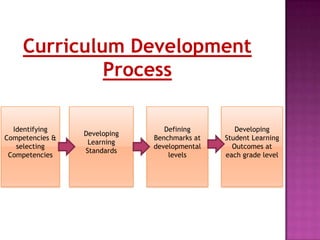
Curriculum Development
             Process

  Identifying                    Defining        Developing
                 Developing
Competencies &                Benchmarks at   Student Learning
                  Learning
   selecting                  developmental     Outcomes at
                 Standards
 Competencies                     levels      each grade level
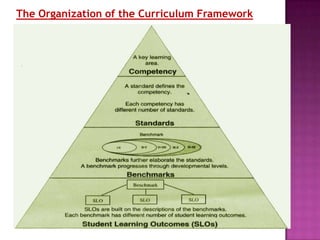
The Organization of the Curriculum Framework
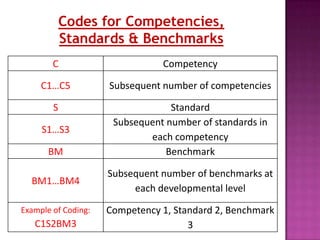
Codes for Competencies,
            Standards & Benchmarks
        C                       Competency

     C1…C5           Subsequent number of competencies

        S                         Standard
                      Subsequent number of standards in
     S1…S3
                             each competency
       BM                        Benchmark

                     Subsequent number of benchmarks at
  BM1…BM4
                          each developmental level

Example of Coding:   Competency 1, Standard 2, Benchmark
   C1S2BM3                            3
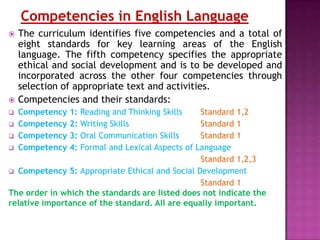
Competencies in English Language
   The curriculum identifies five competencies and a total of
    eight standards for key learning areas of the English
    language. The fifth competency specifies the appropriate
    ethical and social development and is to be developed and
    incorporated across the other four competencies through
    selection of appropriate text and activities.
   Competencies and their standards:
   Competency   1:   Reading and Thinking SkillsStandard 1,2
   Competency   2:   Writing Skills             Standard 1
   Competency   3:   Oral Communication Skills  Standard 1
   Competency   4:   Formal and Lexical Aspects of
                                                Language
                                                 Standard 1,2,3
 Competency 5: Appropriate Ethical and Social Development
                                                 Standard 1
The order in which the standards are listed does not indicate the
relative importance of the standard. All are equally important.
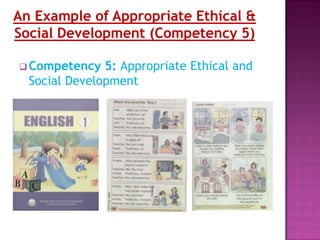
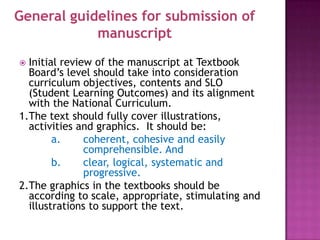
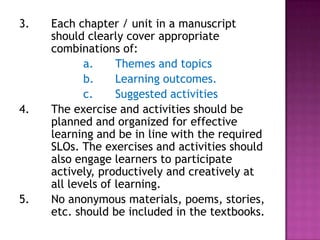
An Example of Appropriate Ethical &
Social Development (Competency 5)

 Competency   5: Appropriate Ethical and
  Social Development
General guidelines for submission of
            manuscript
 Initial review of the manuscript at Textbook
  Board’s level should take into consideration
  curriculum objectives, contents and SLO
  (Student Learning Outcomes) and its alignment
  with the National Curriculum.
1.The text should fully cover illustrations,
  activities and graphics. It should be:
        a.     coherent, cohesive and easily
               comprehensible. And
        b.     clear, logical, systematic and
               progressive.
2.The graphics in the textbooks should be
  according to scale, appropriate, stimulating and
  illustrations to support the text.
3.   Each chapter / unit in a manuscript
     should clearly cover appropriate
     combinations of:
            a.     Themes and topics
            b.     Learning outcomes.
            c.     Suggested activities
4.   The exercise and activities should be
     planned and organized for effective
     learning and be in line with the required
     SLOs. The exercises and activities should
     also engage learners to participate
     actively, productively and creatively at
     all levels of learning.
5.   No anonymous materials, poems, stories,
     etc. should be included in the textbooks.
6.   There should be no controversial topics /
     materials in the manuscripts, especially
     in languages, Islamiyat and Ethics.
7.   There should be no materials repugnant
     to Islam as well as the ideology of
     Pakistan.
8.   The materials in the language
     manuscripts should lead students to
     learn and master the language skills
     outlined in SLOs/ learning outcomes. The
     approach chosen in presenting the
     materials must be clear and age
     appropriate.
9.   The materials in the manuscripts should
     be dynamic, challenging, stimulating and
     user friendly.
11.   Manuscripts should have glossary of
      terms and an index at the end of
      manuscript.
12.   Reference to textbooks, materials, other
      resource material, etc. should be
      acknowledged and mentioned in the
      manuscript.
13.   Instructions to authors as included in the
      subject curriculum should be strictly
      adhered to.
14.    At the end of the textbook a small
      paragraph about the author should be
      given.
Specific guidelines for English
         Language Authors
In the material writing stage:
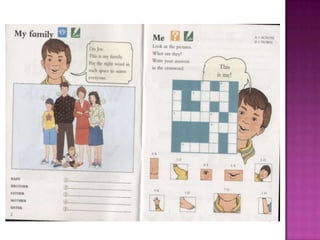
 Select a range of authentic reading texts in a
  variety of styles. If required, adapt these texts
  to match the age and grade level of the
  students. Give complete reference details for
  the selected texts.
 Write the texts, where necessary, to match the
  age and grade level of the students.
 Develop activities on selected skills, sub-skills,
  vocabulary, grammar, etc. Make sure the
  activities a) are in line with the SLOs for a
  particular    grade;    b)    provide    sufficient
  independent and integrated language practice of
  listening, speaking, reading and writing.
 Include sufficient review exercises.
 Write a summary of the knowledge and skills
  focused on in the unit, and grammar and
  spelling rules(if any) at end of each unit.
 Provide a progress test after two or three
  units to assess the SLOs focused upon in
  these units
 Decide which illustrations are to be used and
  prepare an art brief with instructions for the
  illustrator and designer.
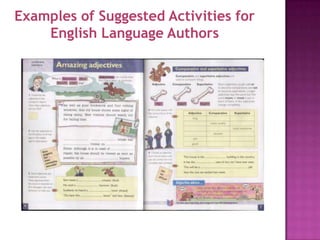
Examples of Suggested Activities for
    English Language Authors
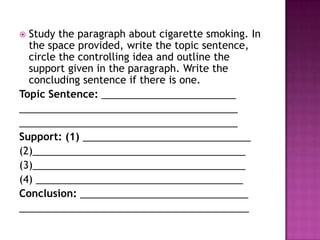
 Study the paragraph about cigarette smoking. In
  the space provided, write the topic sentence,
  circle the controlling idea and outline the
  support given in the paragraph. Write the
  concluding sentence if there is one.
Topic Sentence: ________________________
_______________________________________
_______________________________________
Support: (1) ______________________________
(2)______________________________________
(3)______________________________________
(4) _____________________________________
Conclusion: ______________________________
_________________________________________

Guidelines for development of textbook

  • 1.
    By: Mrs. AsmaHassan Subject Specialist English PTB
  • 2.
     In thecurrent scenario, English is the language of international communication, higher learning and better career options. It should, therefore, reach the masses so that there is no discrimination amongst the rich and the poor in Pakistan in terms of opportunities for personal, professional and economic development.  The new curriculum aims to provide holistic opportunities to the students for language development and to equip them with competencies in using the English language for communication in different academic and social contexts than on acquiring knowledge about the language for its own sake.
  • 3.
     It acknowledges,on one hand, the importance of teaching the knowledge about the language system ; on the other , it moves a step forward to emphasize the appropriate use of that knowledge so that students’ ability to communicate in real life situations is improved and made effective for various purposes.
  • 4.
    Curriculum Development Process Identifying Defining Developing Developing Competencies & Benchmarks at Student Learning Learning selecting developmental Outcomes at Standards Competencies levels each grade level
  • 5.
    The Organization ofthe Curriculum Framework
  • 6.
    Codes for Competencies, Standards & Benchmarks C Competency C1…C5 Subsequent number of competencies S Standard Subsequent number of standards in S1…S3 each competency BM Benchmark Subsequent number of benchmarks at BM1…BM4 each developmental level Example of Coding: Competency 1, Standard 2, Benchmark C1S2BM3 3
  • 7.
    Competencies in EnglishLanguage  The curriculum identifies five competencies and a total of eight standards for key learning areas of the English language. The fifth competency specifies the appropriate ethical and social development and is to be developed and incorporated across the other four competencies through selection of appropriate text and activities.  Competencies and their standards:  Competency 1: Reading and Thinking SkillsStandard 1,2  Competency 2: Writing Skills Standard 1  Competency 3: Oral Communication Skills Standard 1  Competency 4: Formal and Lexical Aspects of Language Standard 1,2,3  Competency 5: Appropriate Ethical and Social Development Standard 1 The order in which the standards are listed does not indicate the relative importance of the standard. All are equally important.
  • 8.
    An Example ofAppropriate Ethical & Social Development (Competency 5)  Competency 5: Appropriate Ethical and Social Development
  • 9.
    General guidelines forsubmission of manuscript  Initial review of the manuscript at Textbook Board’s level should take into consideration curriculum objectives, contents and SLO (Student Learning Outcomes) and its alignment with the National Curriculum. 1.The text should fully cover illustrations, activities and graphics. It should be: a. coherent, cohesive and easily comprehensible. And b. clear, logical, systematic and progressive. 2.The graphics in the textbooks should be according to scale, appropriate, stimulating and illustrations to support the text.
  • 10.
    3. Each chapter / unit in a manuscript should clearly cover appropriate combinations of: a. Themes and topics b. Learning outcomes. c. Suggested activities 4. The exercise and activities should be planned and organized for effective learning and be in line with the required SLOs. The exercises and activities should also engage learners to participate actively, productively and creatively at all levels of learning. 5. No anonymous materials, poems, stories, etc. should be included in the textbooks.
  • 11.
    6. There should be no controversial topics / materials in the manuscripts, especially in languages, Islamiyat and Ethics. 7. There should be no materials repugnant to Islam as well as the ideology of Pakistan. 8. The materials in the language manuscripts should lead students to learn and master the language skills outlined in SLOs/ learning outcomes. The approach chosen in presenting the materials must be clear and age appropriate. 9. The materials in the manuscripts should be dynamic, challenging, stimulating and user friendly.
  • 12.
    11. Manuscripts should have glossary of terms and an index at the end of manuscript. 12. Reference to textbooks, materials, other resource material, etc. should be acknowledged and mentioned in the manuscript. 13. Instructions to authors as included in the subject curriculum should be strictly adhered to. 14. At the end of the textbook a small paragraph about the author should be given.
  • 13.
    Specific guidelines forEnglish Language Authors In the material writing stage:  Select a range of authentic reading texts in a variety of styles. If required, adapt these texts to match the age and grade level of the students. Give complete reference details for the selected texts.  Write the texts, where necessary, to match the age and grade level of the students.  Develop activities on selected skills, sub-skills, vocabulary, grammar, etc. Make sure the activities a) are in line with the SLOs for a particular grade; b) provide sufficient independent and integrated language practice of listening, speaking, reading and writing.
  • 14.
     Include sufficientreview exercises.  Write a summary of the knowledge and skills focused on in the unit, and grammar and spelling rules(if any) at end of each unit.  Provide a progress test after two or three units to assess the SLOs focused upon in these units  Decide which illustrations are to be used and prepare an art brief with instructions for the illustrator and designer.
  • 15.
    Examples of SuggestedActivities for English Language Authors
  • 19.
     Study theparagraph about cigarette smoking. In the space provided, write the topic sentence, circle the controlling idea and outline the support given in the paragraph. Write the concluding sentence if there is one. Topic Sentence: ________________________ _______________________________________ _______________________________________ Support: (1) ______________________________ (2)______________________________________ (3)______________________________________ (4) _____________________________________ Conclusion: ______________________________ _________________________________________