TEST DEVELOPMENT AND
EVALUATION (6462)
Evaluating Students Progress: Need and Significance
Department of Secondary Teacher Education
ALLAMA IQBAL OPEN UNIVERSITY, ISLAMABAD
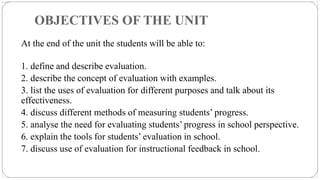
OBJECTIVES OF THE UNIT
At the end of the unit the students will be able to:
1. define and describe evaluation.
2. describe the concept of evaluation with examples.
3. list the uses of evaluation for different purposes and talk about its
effectiveness.
4. discuss different methods of measuring students’ progress.
5. analyse the need for evaluating students’ progress in school perspective.
6. explain the tools for students’ evaluation in school.
7. discuss use of evaluation for instructional feedback in school.
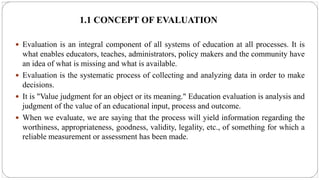
1.1 CONCEPT OF EVALUATION
 Evaluation is an integral component of all systems of education at all processes. It is
what enables educators, teaches, administrators, policy makers and the community have
an idea of what is missing and what is available.
 Evaluation is the systematic process of collecting and analyzing data in order to make
decisions.
 It is "Value judgment for an object or its meaning." Education evaluation is analysis and
judgment of the value of an educational input, process and outcome.
 When we evaluate, we are saying that the process will yield information regarding the
worthiness, appropriateness, goodness, validity, legality, etc., of something for which a
reliable measurement or assessment has been made.
1.2 USE OF EVALUATION FOR DIFFERENT PURPOSES: STUDENTS &
TEACHERS EVALUATION
 The main reason teachers evaluate is to find out what students have learned the outcome of
the instruction, in two ways: first to inform the teachers about their teaching and what
needs to be taught next and second, to make a judgment about how well students have
learned the knowledge or skill being taught.
 Informal evaluation is used by the teacher to provide feedback to students and to check for
understanding in the teaching and learning process. Informal evaluation activities include
observation of students as they work in groups, pre-tests, short classroom assignments,
practice tasks, oral questioning and discussion.
 Formal evaluation is used to judge student achievement; that is, how well the student has
learned the knowledge and/or skills. Students are marked on formal evaluation tasks and
this mark is usually part of their report card grade. These evaluation tasks can include
projects, writing assignments, performances, tests, reports and research.
1.2 USE OF EVALUATION FOR DIFFERENT PURPOSES: STUDENTS &
TEACHERS EVALUATION
 Planning, Structuring and Conducting Instruction
 Diagnosing Pupil’s Problems
 Grading Academic Learning and progress
 Evaluation Stimulates Students to Study
 Evaluation Helps Parents to Understand Pupil-growth, Interest and Potentialities
 Evaluation Aids in Devising more Effective Instructional Materials and Procedures
of Instruction
 Evaluation Sets up Standards of Performance for the Pupils
1.3 MEASURING STUDENTS PROGRESS: BASIC ASSUMPTION
 Planning for student evaluation is an integral part of teaching, not just the final step of the instructional
process. Formative evaluation can communicate to both teachers and students whether or not course
content is effectively being communicated and learned, information that can lead to refinement of
instruction on the part of the teacher and refinement of studying techniques on the part of the students.
 Meaningful evaluation includes consideration of all activities that have occurred during the particular
evaluation period. Such activities should include homework, projects, reports, class participation, portfolio
preparation and tests, including unit tests.
 One standout trait of teachers who make major progress with their students is frequent assessment. The
focus becomes not “what I taught” but rather “what my students learned.” In this sense, assessment is vital
to our mission as an organization. In order to close the achievement gap, we need to make dramatic,
measurable gains with our students.
1.4 NEED FOR EVALUATING STUDENT’S PROGRESS
 How Student Progress Evaluation Improves Instruction?
Through student’s progress evaluation, the teacher determines a student's current performance level on skills that the
student will be learning that school year, identifies achievement goals that the student needs to reach by the end of the
year, and establishes the rate of progress the student must make to meet those goals.
 Why test? A Rationale for Evaluating Learning and Instruction
Assessment can help determine, if objectives were achieved and assist in the development and implementation of
individualized education programs (IEPs). In addition, through evaluation, teachers can determine the direction of future
instruction and develop a basis for extra help where needed.
 How Can I Integrate Instruction and Assessment?
Teaching in an inclusive learning environment has made our teacher contributors attentive to the relationship of instruction
and assessment. Assessment is seen as part of the learning process (Margaret Jenkins) and is in itself a learning experience
(Karen Willig).
 Student’s Progress Monitoring
If the child is meeting or exceeding the expectation, the teacher continues to teach the child in the same way. If the child's
performance on the measurement does not meet the expectation, then the teacher changes the teaching.
1.4 NEED FOR EVALUATING STUDENT’S PROGRESS
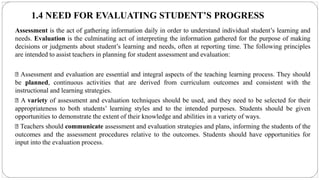
Assessment is the act of gathering information daily in order to understand individual student’s learning and
needs. Evaluation is the culminating act of interpreting the information gathered for the purpose of making
decisions or judgments about student’s learning and needs, often at reporting time. The following principles
are intended to assist teachers in planning for student assessment and evaluation:
Assessment and evaluation are essential and integral aspects of the teaching learning process. They should
be planned, continuous activities that are derived from curriculum outcomes and consistent with the
instructional and learning strategies.
A variety of assessment and evaluation techniques should be used, and they need to be selected for their
appropriateness to both students’ learning styles and to the intended purposes. Students should be given
opportunities to demonstrate the extent of their knowledge and abilities in a variety of ways.
Teachers should communicate assessment and evaluation strategies and plans, informing the students of the
outcomes and the assessment procedures relative to the outcomes. Students should have opportunities for
input into the evaluation process.
1.5 ACCOUNTABILITY AND EVALUATION
 Students, teachers and administrators have always been held accountable, primarily at a
local school level or district level and sometimes at the state level. Teacher accountability
has to do with knowing best practices (and using them); it entails intimate knowledge of
the curriculum, state standards, and having the skills to deliver superior instruction.
 Like evaluation accountability is also a process. But unlike evaluation, accountability is
largely a public information process specifically targeted towards those inside and outside
the organization that are in position to influence the decision made about extension
program, budgets, staffing, facilities and related matters. And it is important to be aware
of internal and external purposes that accountability deserves.
Internal accountability influences program management decisions.
External accountability provides concrete evidence of our accomplishments to
administrators.
1.6 SELECTION OF APPROPRIATE TOOLS FOR STUDENTS’
EVALUATION
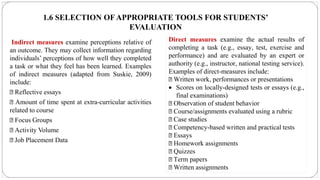
Indirect measures examine perceptions relative of
an outcome. They may collect information regarding
individuals’ perceptions of how well they completed
a task or what they feel has been learned. Examples
of indirect measures (adapted from Suskie, 2009)
include:
Reflective essays
Amount of time spent at extra-curricular activities
related to course
Focus Groups
Activity Volume
Job Placement Data
Direct measures examine the actual results of
completing a task (e.g., essay, test, exercise and
performance) and are evaluated by an expert or
authority (e.g., instructor, national testing service).
Examples of direct-measures include:
Written work, performances or presentations
• Scores on locally-designed tests or essays (e.g.,
final examinations)
Observation of student behavior
Course/assignments evaluated using a rubric
Case studies
Competency-based written and practical tests
Essays
Homework assignments
Quizzes
Term papers
Written assignments
1.7 USE OF EVALUATION FOR INSTRUCTIONAL FEEDBACK
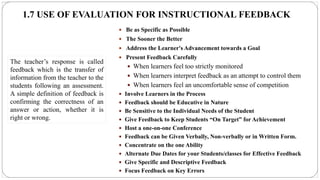
 Be as Specific as Possible
 The Sooner the Better
 Address the Learner's Advancement towards a Goal
 Present Feedback Carefully
 When learners feel too strictly monitored
 When learners interpret feedback as an attempt to control them
 When learners feel an uncomfortable sense of competition
 Involve Learners in the Process
 Feedback should be Educative in Nature
 Be Sensitive to the Individual Needs of the Student
 Give Feedback to Keep Students “On Target” for Achievement
 Host a one-on-one Conference
 Feedback can be Given Verbally, Non-verbally or in Written Form.
 Concentrate on the one Ability
 Alternate Due Dates for your Students/classes for Effective Feedback
 Give Specific and Descriptive Feedback
 Focus Feedback on Key Errors
The teacher’s response is called
feedback which is the transfer of
information from the teacher to the
students following an assessment.
A simple definition of feedback is
confirming the correctness of an
answer or action, whether it is
right or wrong.
Department of Secondary Teacher Education
ALLAMA IQBAL OPEN UNIVERSITY, ISLAMABAD
Dr. Hina Jalal
hinansari23@gmail.com

Test Development and Evaluation

  • 1.
    TEST DEVELOPMENT AND EVALUATION(6462) Evaluating Students Progress: Need and Significance Department of Secondary Teacher Education ALLAMA IQBAL OPEN UNIVERSITY, ISLAMABAD
  • 2.
    OBJECTIVES OF THEUNIT At the end of the unit the students will be able to: 1. define and describe evaluation. 2. describe the concept of evaluation with examples. 3. list the uses of evaluation for different purposes and talk about its effectiveness. 4. discuss different methods of measuring students’ progress. 5. analyse the need for evaluating students’ progress in school perspective. 6. explain the tools for students’ evaluation in school. 7. discuss use of evaluation for instructional feedback in school.
  • 3.
    1.1 CONCEPT OFEVALUATION  Evaluation is an integral component of all systems of education at all processes. It is what enables educators, teaches, administrators, policy makers and the community have an idea of what is missing and what is available.  Evaluation is the systematic process of collecting and analyzing data in order to make decisions.  It is "Value judgment for an object or its meaning." Education evaluation is analysis and judgment of the value of an educational input, process and outcome.  When we evaluate, we are saying that the process will yield information regarding the worthiness, appropriateness, goodness, validity, legality, etc., of something for which a reliable measurement or assessment has been made.
  • 4.
    1.2 USE OFEVALUATION FOR DIFFERENT PURPOSES: STUDENTS & TEACHERS EVALUATION  The main reason teachers evaluate is to find out what students have learned the outcome of the instruction, in two ways: first to inform the teachers about their teaching and what needs to be taught next and second, to make a judgment about how well students have learned the knowledge or skill being taught.  Informal evaluation is used by the teacher to provide feedback to students and to check for understanding in the teaching and learning process. Informal evaluation activities include observation of students as they work in groups, pre-tests, short classroom assignments, practice tasks, oral questioning and discussion.  Formal evaluation is used to judge student achievement; that is, how well the student has learned the knowledge and/or skills. Students are marked on formal evaluation tasks and this mark is usually part of their report card grade. These evaluation tasks can include projects, writing assignments, performances, tests, reports and research.
  • 5.
    1.2 USE OFEVALUATION FOR DIFFERENT PURPOSES: STUDENTS & TEACHERS EVALUATION  Planning, Structuring and Conducting Instruction  Diagnosing Pupil’s Problems  Grading Academic Learning and progress  Evaluation Stimulates Students to Study  Evaluation Helps Parents to Understand Pupil-growth, Interest and Potentialities  Evaluation Aids in Devising more Effective Instructional Materials and Procedures of Instruction  Evaluation Sets up Standards of Performance for the Pupils
  • 6.
    1.3 MEASURING STUDENTSPROGRESS: BASIC ASSUMPTION  Planning for student evaluation is an integral part of teaching, not just the final step of the instructional process. Formative evaluation can communicate to both teachers and students whether or not course content is effectively being communicated and learned, information that can lead to refinement of instruction on the part of the teacher and refinement of studying techniques on the part of the students.  Meaningful evaluation includes consideration of all activities that have occurred during the particular evaluation period. Such activities should include homework, projects, reports, class participation, portfolio preparation and tests, including unit tests.  One standout trait of teachers who make major progress with their students is frequent assessment. The focus becomes not “what I taught” but rather “what my students learned.” In this sense, assessment is vital to our mission as an organization. In order to close the achievement gap, we need to make dramatic, measurable gains with our students.
  • 7.
    1.4 NEED FOREVALUATING STUDENT’S PROGRESS  How Student Progress Evaluation Improves Instruction? Through student’s progress evaluation, the teacher determines a student's current performance level on skills that the student will be learning that school year, identifies achievement goals that the student needs to reach by the end of the year, and establishes the rate of progress the student must make to meet those goals.  Why test? A Rationale for Evaluating Learning and Instruction Assessment can help determine, if objectives were achieved and assist in the development and implementation of individualized education programs (IEPs). In addition, through evaluation, teachers can determine the direction of future instruction and develop a basis for extra help where needed.  How Can I Integrate Instruction and Assessment? Teaching in an inclusive learning environment has made our teacher contributors attentive to the relationship of instruction and assessment. Assessment is seen as part of the learning process (Margaret Jenkins) and is in itself a learning experience (Karen Willig).  Student’s Progress Monitoring If the child is meeting or exceeding the expectation, the teacher continues to teach the child in the same way. If the child's performance on the measurement does not meet the expectation, then the teacher changes the teaching.
  • 8.
    1.4 NEED FOREVALUATING STUDENT’S PROGRESS Assessment is the act of gathering information daily in order to understand individual student’s learning and needs. Evaluation is the culminating act of interpreting the information gathered for the purpose of making decisions or judgments about student’s learning and needs, often at reporting time. The following principles are intended to assist teachers in planning for student assessment and evaluation: Assessment and evaluation are essential and integral aspects of the teaching learning process. They should be planned, continuous activities that are derived from curriculum outcomes and consistent with the instructional and learning strategies. A variety of assessment and evaluation techniques should be used, and they need to be selected for their appropriateness to both students’ learning styles and to the intended purposes. Students should be given opportunities to demonstrate the extent of their knowledge and abilities in a variety of ways. Teachers should communicate assessment and evaluation strategies and plans, informing the students of the outcomes and the assessment procedures relative to the outcomes. Students should have opportunities for input into the evaluation process.
  • 9.
    1.5 ACCOUNTABILITY ANDEVALUATION  Students, teachers and administrators have always been held accountable, primarily at a local school level or district level and sometimes at the state level. Teacher accountability has to do with knowing best practices (and using them); it entails intimate knowledge of the curriculum, state standards, and having the skills to deliver superior instruction.  Like evaluation accountability is also a process. But unlike evaluation, accountability is largely a public information process specifically targeted towards those inside and outside the organization that are in position to influence the decision made about extension program, budgets, staffing, facilities and related matters. And it is important to be aware of internal and external purposes that accountability deserves. Internal accountability influences program management decisions. External accountability provides concrete evidence of our accomplishments to administrators.
  • 10.
    1.6 SELECTION OFAPPROPRIATE TOOLS FOR STUDENTS’ EVALUATION Indirect measures examine perceptions relative of an outcome. They may collect information regarding individuals’ perceptions of how well they completed a task or what they feel has been learned. Examples of indirect measures (adapted from Suskie, 2009) include: Reflective essays Amount of time spent at extra-curricular activities related to course Focus Groups Activity Volume Job Placement Data Direct measures examine the actual results of completing a task (e.g., essay, test, exercise and performance) and are evaluated by an expert or authority (e.g., instructor, national testing service). Examples of direct-measures include: Written work, performances or presentations • Scores on locally-designed tests or essays (e.g., final examinations) Observation of student behavior Course/assignments evaluated using a rubric Case studies Competency-based written and practical tests Essays Homework assignments Quizzes Term papers Written assignments
  • 11.
    1.7 USE OFEVALUATION FOR INSTRUCTIONAL FEEDBACK  Be as Specific as Possible  The Sooner the Better  Address the Learner's Advancement towards a Goal  Present Feedback Carefully  When learners feel too strictly monitored  When learners interpret feedback as an attempt to control them  When learners feel an uncomfortable sense of competition  Involve Learners in the Process  Feedback should be Educative in Nature  Be Sensitive to the Individual Needs of the Student  Give Feedback to Keep Students “On Target” for Achievement  Host a one-on-one Conference  Feedback can be Given Verbally, Non-verbally or in Written Form.  Concentrate on the one Ability  Alternate Due Dates for your Students/classes for Effective Feedback  Give Specific and Descriptive Feedback  Focus Feedback on Key Errors The teacher’s response is called feedback which is the transfer of information from the teacher to the students following an assessment. A simple definition of feedback is confirming the correctness of an answer or action, whether it is right or wrong.
  • 12.
    Department of SecondaryTeacher Education ALLAMA IQBAL OPEN UNIVERSITY, ISLAMABAD Dr. Hina Jalal hinansari23@gmail.com