Reporter: Joan Marie V. Geraldo
Define Curriculum Development.
Trace the Curriculum Continuum.
Understand the Levels of Curriculum Development.
CURRICULUM DEVELOPMENT
Is the idea of cooperative planning by any
number of interested individuals.
Is a collective and intentional process or
activity directed at beneficial curriculum
change.
CURRICULUM
DEVELOPERS- are persons charged with the responsibility of
planning, designing, and producing a curriculum,
whether it be in the form of a brief document or
an elaborate curriculum package.
is a generic term that subsumes a whole family of
concepts such as innovation, development, and
adoption.
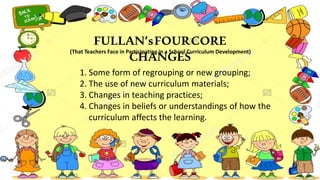
FULLAN’sFOURCORE
CHANGES
(That Teachers Face in Participating in a School Curriculum Development)
1. Some form of regrouping or new grouping;
2. The use of new curriculum materials;
3. Changes in teaching practices;
4. Changes in beliefs or understandings of how the
curriculum affects the learning.
- means either a new object, idea, or practice or the
process by which a new object, idea, or practice
comes to be adopted by an individual group or
organization.
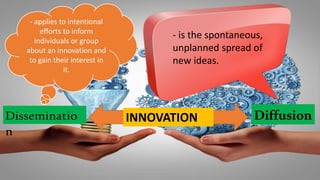
INNOVATION DiffusionDisseminatio
n
- applies to intentional
efforts to inform
individuals or group
about an innovation and
to gain their interest in
it.
- is the spontaneous,
unplanned spread of
new ideas.
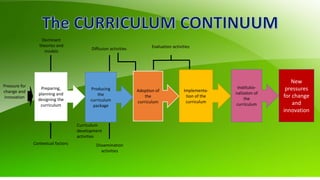
Preparing,
planning and
designing the
curriculum
Producing
the
curriculum
package
Adoption of
the
curriculum
Implementa-
tion of the
curriculum
Institutio-
nalizaton of
the
curriculum
New
pressures
for change
and
innovation
Pressure for
change and
innovation
Dominant
theories and
models
Contextual factors
Diffusion activities
Dissemination
activities
Curriculum
development
activities
Evaluation activities
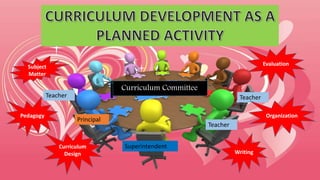
Superintendent
Principal
Teacher
TeacherTeacher
Curriculum Committee
Subject
Matter
Pedagogy
Curriculum
Design
Evaluation
Organization
Writing
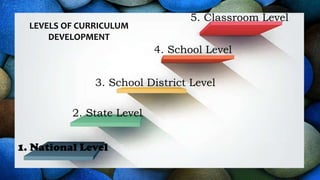
2. State Level
3. School District Level
4. School Level
5. Classroom Level
LEVELS OF CURRICULUM
DEVELOPMENT
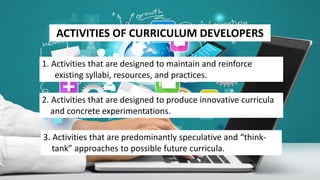
ACTIVITIES OF CURRICULUM DEVELOPERS
1. Activities that are designed to maintain and reinforce
existing syllabi, resources, and practices.
2. Activities that are designed to produce innovative curricula
and concrete experimentations.
3. Activities that are predominantly speculative and “think-
tank” approaches to possible future curricula.
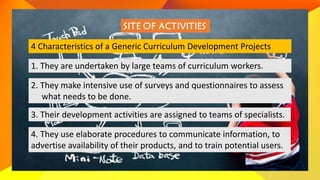
4 Characteristics of a Generic Curriculum Development Projects
1. They are undertaken by large teams of curriculum workers.
2. They make intensive use of surveys and questionnaires to assess
what needs to be done.
3. Their development activities are assigned to teams of specialists.
4. They use elaborate procedures to communicate information, to
advertise availability of their products, and to train potential users.
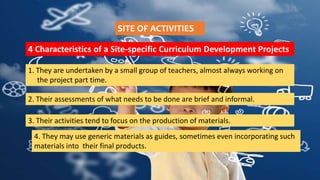
SITE OF ACTIVITIES
4 Characteristics of a Site-specific Curriculum Development Projects
1. They are undertaken by a small group of teachers, almost always working on
the project part time.
2. Their assessments of what needs to be done are brief and informal.
3. Their activities tend to focus on the production of materials.
4. They may use generic materials as guides, sometimes even incorporating such
materials into their final products.
Curriculum Development and Change

Curriculum Development and Change

  • 1.
  • 2.
    Define Curriculum Development. Tracethe Curriculum Continuum. Understand the Levels of Curriculum Development.
  • 3.
    CURRICULUM DEVELOPMENT Is theidea of cooperative planning by any number of interested individuals. Is a collective and intentional process or activity directed at beneficial curriculum change.
  • 4.
    CURRICULUM DEVELOPERS- are personscharged with the responsibility of planning, designing, and producing a curriculum, whether it be in the form of a brief document or an elaborate curriculum package.
  • 5.
    is a genericterm that subsumes a whole family of concepts such as innovation, development, and adoption.
  • 6.
    FULLAN’sFOURCORE CHANGES (That Teachers Facein Participating in a School Curriculum Development) 1. Some form of regrouping or new grouping; 2. The use of new curriculum materials; 3. Changes in teaching practices; 4. Changes in beliefs or understandings of how the curriculum affects the learning.
  • 7.
    - means eithera new object, idea, or practice or the process by which a new object, idea, or practice comes to be adopted by an individual group or organization.
  • 8.
    INNOVATION DiffusionDisseminatio n - appliesto intentional efforts to inform individuals or group about an innovation and to gain their interest in it. - is the spontaneous, unplanned spread of new ideas.
  • 9.
    Preparing, planning and designing the curriculum Producing the curriculum package Adoptionof the curriculum Implementa- tion of the curriculum Institutio- nalizaton of the curriculum New pressures for change and innovation Pressure for change and innovation Dominant theories and models Contextual factors Diffusion activities Dissemination activities Curriculum development activities Evaluation activities
  • 10.
  • 11.
    2. State Level 3.School District Level 4. School Level 5. Classroom Level LEVELS OF CURRICULUM DEVELOPMENT
  • 12.
    ACTIVITIES OF CURRICULUMDEVELOPERS 1. Activities that are designed to maintain and reinforce existing syllabi, resources, and practices. 2. Activities that are designed to produce innovative curricula and concrete experimentations. 3. Activities that are predominantly speculative and “think- tank” approaches to possible future curricula.
  • 13.
    4 Characteristics ofa Generic Curriculum Development Projects 1. They are undertaken by large teams of curriculum workers. 2. They make intensive use of surveys and questionnaires to assess what needs to be done. 3. Their development activities are assigned to teams of specialists. 4. They use elaborate procedures to communicate information, to advertise availability of their products, and to train potential users.
  • 14.
    SITE OF ACTIVITIES 4Characteristics of a Site-specific Curriculum Development Projects 1. They are undertaken by a small group of teachers, almost always working on the project part time. 2. Their assessments of what needs to be done are brief and informal. 3. Their activities tend to focus on the production of materials. 4. They may use generic materials as guides, sometimes even incorporating such materials into their final products.