1
Learning Objectives
2
Why Use Learning Objectives?
 By defining where you intend to go, you increase the
likelihood the learner ends up in the intended
destination.
 Guides the learner, helps his/her focus on what needs to
be learned, and sets priorities.
 Shows the learner what behaviors are valued.
 Focuses and organizes the instructor.
 Creates the learner’s basis for
self-assessment.
 Sets the stage for what the “mastered”
skill looks like.
3
Effective learning objectives …
 Are learner-focused (not instructor or content focused)
 Focused on the intended learning that results from an
activity, course, or program
 Reflective of the institution’s mission and the values for
which it represents
 Reflects important, non-trivial aspects of learning that are
credible to the learner
 Focuses on skills and abilities central to the discipline
and based on professional standards
 Captures general concepts, but with enough detail to be
clear, specific, and measurable or observable
 Focuses on aspects of learning that will develop and
endure but that can be assessed in some form now
4
Goals versus Learning Objectives
 Goals are statements that describe in broad
terms what the leaner will gain from instruction.
 Example:
- Learners will gain appreciation of the role of a
family medicine physician in the health care
system.
5
Goals versus Learning Objectives
 Objectives are statements which describe specifically
what the learner is expected to achieve as a result of
instruction.
 Objectives direct attention to the learner and the types
of behaviors they should exhibit. Sometimes these
statements are called behavioral objectives.
 Example:
- Learners will list three characteristics
that make the family medicine physician
distinctive from other specialists in the
health care system.
6
Learning Objectives
(Mager,1975)
Ideal learning objectives include:
1. A measurable verb
 One task or behavior per verb
 Choose the verb that best describes the type of behavior or
task the learner must display after training
2. The condition
 How the task or behavior will be performed
 Under what conditions will the task be performed
3. The standard for acceptable performance
 How well the task or behavior must be performed to meet the
standard
7
Exercise: Evaluating Learning Objectives
 Use the criteria on the previous slides to
evaluate the learning objectives that follow.
 Identify the objectives that meet
most of the criteria presented.
 Discuss your selections with
your colleagues and determine
which objectives best meet the
criteria.
8
Writing Learning
Objectives
9
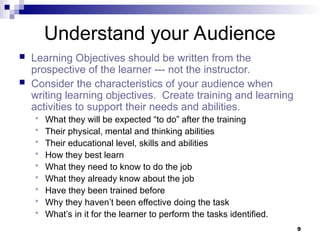
Understand your Audience
 Learning Objectives should be written from the
prospective of the learner --- not the instructor.
 Consider the characteristics of your audience when
writing learning objectives. Create training and learning
activities to support their needs and abilities.
 What they will be expected “to do” after the training
 Their physical, mental and thinking abilities
 Their educational level, skills and abilities
 How they best learn
 What they need to know to do the job
 What they already know about the job
 Have they been trained before
 Why they haven’t been effective doing the task
 What’s in it for the learner to perform the tasks identified.
10
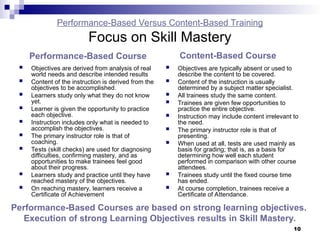
Performance-Based Versus Content-Based Training
Focus on Skill Mastery
 Objectives are derived from analysis of real
world needs and describe intended results
 Content of the instruction is derived from the
objectives to be accomplished.
 Learners study only what they do not know
yet.
 Learner is given the opportunity to practice
each objective.
 Instruction includes only what is needed to
accomplish the objectives.
 The primary instructor role is that of
coaching.
 Tests (skill checks) are used for diagnosing
difficulties, confirming mastery, and as
opportunities to make trainees feel good
about their progress.
 Learners study and practice until they have
reached mastery of the objectives.
 On reaching mastery, learners receive a
Certificate of Achievement
 Objectives are typically absent or used to
describe the content to be covered.
 Content of the instruction is usually
determined by a subject matter specialist.
 All trainees study the same content.
 Trainees are given few opportunities to
practice the entire objective.
 Instruction may include content irrelevant to
the need.
 The primary instructor role is that of
presenting.
 When used at all, tests are used mainly as
basis for grading; that is, as a basis for
determining how well each student
performed in comparison with other course
attendees.
 Trainees study until the fixed course time
has ended.
 At course completion, trainees receive a
Certificate of Attendance.
Performance-Based Course Content-Based Course
Performance-Based Courses are based on strong learning objectives.
Execution of strong Learning Objectives results in Skill Mastery.
11
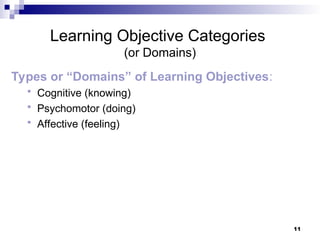
Learning Objective Categories
(or Domains)
Types or “Domains” of Learning Objectives:
 Cognitive (knowing)
 Psychomotor (doing)
 Affective (feeling)
12
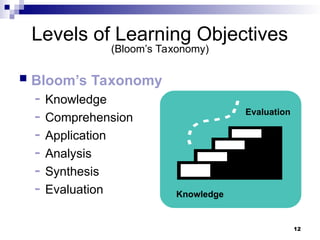
Levels of Learning Objectives
(Bloom’s Taxonomy)
 Bloom’s Taxonomy
- Knowledge
- Comprehension
- Application
- Analysis
- Synthesis
- Evaluation
Evaluation
Knowledge
13
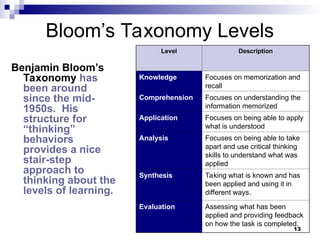
Bloom’s Taxonomy Levels
Benjamin Bloom’s
Taxonomy has
been around
since the mid-
1950s. His
structure for
“thinking”
behaviors
provides a nice
stair-step
approach to
thinking about the
levels of learning.
Level Description
Knowledge Focuses on memorization and
recall
Comprehension Focuses on understanding the
information memorized
Application Focuses on being able to apply
what is understood
Analysis Focuses on being able to take
apart and use critical thinking
skills to understand what was
applied
Synthesis Taking what is known and has
been applied and using it in
different ways.
Evaluation Assessing what has been
applied and providing feedback
on how the task is completed.
14
Exercise: Evaluating Levels of Objectives
 Review Levels of Learning Objectives slide.
 Review the learning objectives on the following
slides and answer the following questions.
 Which level of Bloom’s
taxonomy is the first
objective listed?
 What level is the second
one listed?
15
Exercise: Evaluating Levels of Objectives
 Name five causes of dizziness.
 Give a patient case description and
determine the three most likely causes of
dizziness.
16
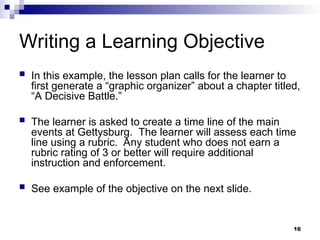
Writing a Learning Objective
 In this example, the lesson plan calls for the learner to
first generate a “graphic organizer” about a chapter titled,
“A Decisive Battle.”
 The learner is asked to create a time line of the main
events at Gettysburg. The learner will assess each time
line using a rubric. Any student who does not earn a
rubric rating of 3 or better will require additional
instruction and enforcement.
 See example of the objective on the next slide.
17
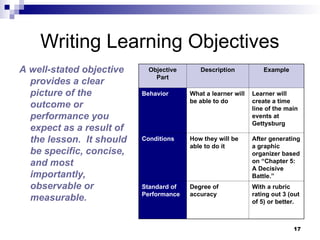
Writing Learning Objectives
A well-stated objective
provides a clear
picture of the
outcome or
performance you
expect as a result of
the lesson. It should
be specific, concise,
and most
importantly,
observable or
measurable.
Objective
Part
Description Example
Behavior What a learner will
be able to do
Learner will
create a time
line of the main
events at
Gettysburg
Conditions How they will be
able to do it
After generating
a graphic
organizer based
on “Chapter 5:
A Decisive
Battle.”
Standard of
Performance
Degree of
accuracy
With a rubric
rating out 3 (out
of 5) or better.
18
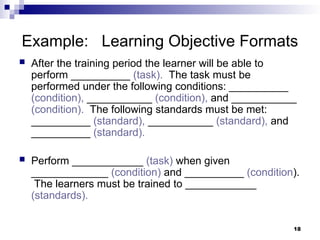
Example: Learning Objective Formats
 After the training period the learner will be able to
perform __________ (task). The task must be
performed under the following conditions: __________
(condition), ___________ (condition), and ___________
(condition). The following standards must be met:
__________ (standard), ___________ (standard), and
__________ (standard).
 Perform ____________ (task) when given
_____________ (condition) and __________ (condition).
The learners must be trained to ____________
(standards).
19
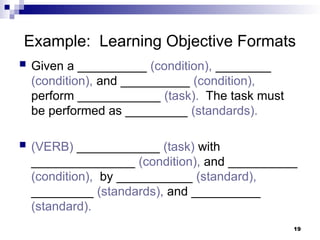
Example: Learning Objective Formats
 Given a __________ (condition), ________
(condition), and __________ (condition),
perform ____________ (task). The task must
be performed as _________ (standards).
 (VERB) ____________ (task) with
_______________ (condition), and __________
(condition), by ___________ (standard),
_________ (standards), and __________
(standard).
20
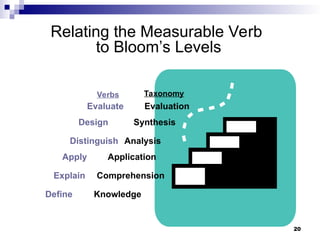
Relating the Measurable Verb
to Bloom’s Levels
Evaluation
Synthesis
Analysis
Application
Comprehension
Knowledge
Define
Explain
Apply
Distinguish
Design
Evaluate
Verbs Taxonomy
21
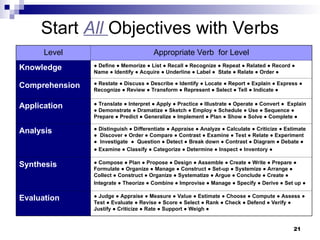
Start All Objectives with Verbs
Level Appropriate Verb for Level
Knowledge ● Define ● Memorize ● List ● Recall ● Recognize ● Repeat ● Related ● Record ●
Name ● Identify ● Acquire ● Underline ● Label ● State ● Relate ● Order ●
Comprehension ● Restate ● Discuss ● Describe ● Identify ● Locate ● Report ● Explain ● Express ●
Recognize ● Review ● Transform ● Represent ● Select ● Tell ● Indicate ●
Application ● Translate ● Interpret ● Apply ● Practice ● Illustrate ● Operate ● Convert ● Explain
● Demonstrate ● Dramatize ● Sketch ● Employ ● Schedule ● Use ● Sequence ●
Prepare ● Predict ● Generalize ● Implement ● Plan ● Show ● Solve ● Complete ●
Analysis ● Distinguish ● Differentiate ● Appraise ● Analyze ● Calculate ● Criticize ● Estimate
● Discover ● Order ● Compare ● Contrast ● Examine ● Test ● Relate ● Experiment
● Investigate ● Question ● Detect ● Break down ● Contrast ● Diagram ● Debate ●
● Examine ● Classify ● Categorize ● Determine ● Inspect ● Inventory ●
Synthesis ● Compose ● Plan ● Propose ● Design ● Assemble ● Create ● Write ● Prepare ●
Formulate ● Organize ● Manage ● Construct ● Set-up ● Systemize ● Arrange ●
Collect ● Construct ● Organize ● Systematize ● Argue ● Conclude ● Create ●
Integrate ● Theorize ● Combine ● Improvise ● Manage ● Specify ● Derive ● Set up ●
Evaluation ● Judge ● Appraise ● Measure ● Value ● Estimate ● Choose ● Compute ● Assess ●
Test ● Evaluate ● Revise ● Score ● Select ● Rank ● Check ● Defend ● Verify ●
Justify ● Criticize ● Rate ● Support ● Weigh ●
22
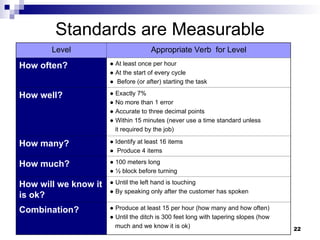
Standards are Measurable
Level Appropriate Verb for Level
How often? ● At least once per hour
● At the start of every cycle
● Before (or after) starting the task
How well? ● Exactly 7%
● No more than 1 error
● Accurate to three decimal points
● Within 15 minutes (never use a time standard unless
it required by the job)
How many? ● Identify at least 16 items
● Produce 4 items
How much? ● 100 meters long
● ½ block before turning
How will we know it
is ok?
● Until the left hand is touching
● By speaking only after the customer has spoken
Combination? ● Produce at least 15 per hour (how many and how often)
● Until the ditch is 300 feet long with tapering slopes (how
much and we know it is ok)
23
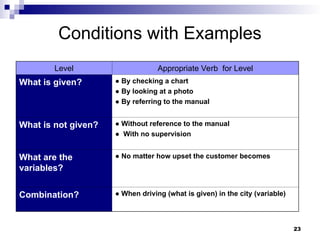
Conditions with Examples
Level Appropriate Verb for Level
What is given? ● By checking a chart
● By looking at a photo
● By referring to the manual
What is not given? ● Without reference to the manual
● With no supervision
What are the
variables?
● No matter how upset the customer becomes
Combination? ● When driving (what is given) in the city (variable)
24
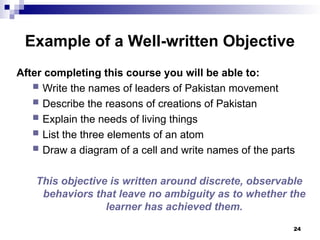
Example of a Well-written Objective
After completing this course you will be able to:
 Write the names of leaders of Pakistan movement
 Describe the reasons of creations of Pakistan
 Explain the needs of living things
 List the three elements of an atom
 Draw a diagram of a cell and write names of the parts
This objective is written around discrete, observable
behaviors that leave no ambiguity as to whether the
learner has achieved them.
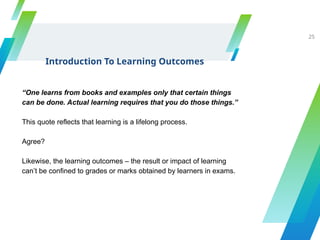
Introduction To Learning Outcomes
25
“One learns from books and examples only that certain things
can be done. Actual learning requires that you do those things.”
This quote reflects that learning is a lifelong process.
Agree?
Likewise, the learning outcomes – the result or impact of learning
can’t be confined to grades or marks obtained by learners in exams.
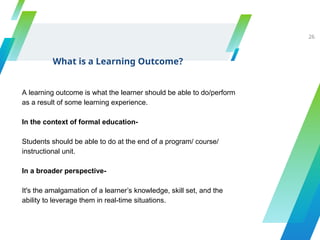
What is a Learning Outcome?
26
A learning outcome is what the learner should be able to do/perform
as a result of some learning experience.
In the context of formal education-
Students should be able to do at the end of a program/ course/
instructional unit.
In a broader perspective-
It's the amalgamation of a learner’s knowledge, skill set, and the
ability to leverage them in real-time situations.
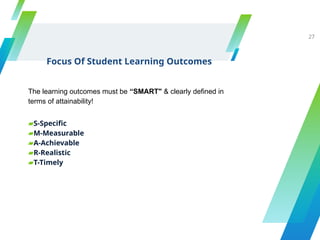
Focus Of Student Learning Outcomes
The learning outcomes must be “SMART" & clearly defined in
terms of attainability!
▰S-Specific
▰M-Measurable
▰A-Achievable
▰R-Realistic
▰T-Timely
27
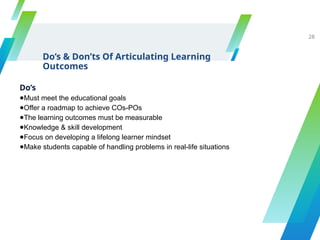
Do’s
●Must meet the educational goals
●Offer a roadmap to achieve COs-POs
●The learning outcomes must be measurable
●Knowledge & skill development
●Focus on developing a lifelong learner mindset
●Make students capable of handling problems in real-life situations
Do’s & Don’ts Of Articulating Learning
Outcomes
28

Learning Objectives & Learning Outcomes .

  • 1.
  • 2.
    2 Why Use LearningObjectives?  By defining where you intend to go, you increase the likelihood the learner ends up in the intended destination.  Guides the learner, helps his/her focus on what needs to be learned, and sets priorities.  Shows the learner what behaviors are valued.  Focuses and organizes the instructor.  Creates the learner’s basis for self-assessment.  Sets the stage for what the “mastered” skill looks like.
  • 3.
    3 Effective learning objectives…  Are learner-focused (not instructor or content focused)  Focused on the intended learning that results from an activity, course, or program  Reflective of the institution’s mission and the values for which it represents  Reflects important, non-trivial aspects of learning that are credible to the learner  Focuses on skills and abilities central to the discipline and based on professional standards  Captures general concepts, but with enough detail to be clear, specific, and measurable or observable  Focuses on aspects of learning that will develop and endure but that can be assessed in some form now
  • 4.
    4 Goals versus LearningObjectives  Goals are statements that describe in broad terms what the leaner will gain from instruction.  Example: - Learners will gain appreciation of the role of a family medicine physician in the health care system.
  • 5.
    5 Goals versus LearningObjectives  Objectives are statements which describe specifically what the learner is expected to achieve as a result of instruction.  Objectives direct attention to the learner and the types of behaviors they should exhibit. Sometimes these statements are called behavioral objectives.  Example: - Learners will list three characteristics that make the family medicine physician distinctive from other specialists in the health care system.
  • 6.
    6 Learning Objectives (Mager,1975) Ideal learningobjectives include: 1. A measurable verb  One task or behavior per verb  Choose the verb that best describes the type of behavior or task the learner must display after training 2. The condition  How the task or behavior will be performed  Under what conditions will the task be performed 3. The standard for acceptable performance  How well the task or behavior must be performed to meet the standard
  • 7.
    7 Exercise: Evaluating LearningObjectives  Use the criteria on the previous slides to evaluate the learning objectives that follow.  Identify the objectives that meet most of the criteria presented.  Discuss your selections with your colleagues and determine which objectives best meet the criteria.
  • 8.
  • 9.
    9 Understand your Audience Learning Objectives should be written from the prospective of the learner --- not the instructor.  Consider the characteristics of your audience when writing learning objectives. Create training and learning activities to support their needs and abilities.  What they will be expected “to do” after the training  Their physical, mental and thinking abilities  Their educational level, skills and abilities  How they best learn  What they need to know to do the job  What they already know about the job  Have they been trained before  Why they haven’t been effective doing the task  What’s in it for the learner to perform the tasks identified.
  • 10.
    10 Performance-Based Versus Content-BasedTraining Focus on Skill Mastery  Objectives are derived from analysis of real world needs and describe intended results  Content of the instruction is derived from the objectives to be accomplished.  Learners study only what they do not know yet.  Learner is given the opportunity to practice each objective.  Instruction includes only what is needed to accomplish the objectives.  The primary instructor role is that of coaching.  Tests (skill checks) are used for diagnosing difficulties, confirming mastery, and as opportunities to make trainees feel good about their progress.  Learners study and practice until they have reached mastery of the objectives.  On reaching mastery, learners receive a Certificate of Achievement  Objectives are typically absent or used to describe the content to be covered.  Content of the instruction is usually determined by a subject matter specialist.  All trainees study the same content.  Trainees are given few opportunities to practice the entire objective.  Instruction may include content irrelevant to the need.  The primary instructor role is that of presenting.  When used at all, tests are used mainly as basis for grading; that is, as a basis for determining how well each student performed in comparison with other course attendees.  Trainees study until the fixed course time has ended.  At course completion, trainees receive a Certificate of Attendance. Performance-Based Course Content-Based Course Performance-Based Courses are based on strong learning objectives. Execution of strong Learning Objectives results in Skill Mastery.
  • 11.
    11 Learning Objective Categories (orDomains) Types or “Domains” of Learning Objectives:  Cognitive (knowing)  Psychomotor (doing)  Affective (feeling)
  • 12.
    12 Levels of LearningObjectives (Bloom’s Taxonomy)  Bloom’s Taxonomy - Knowledge - Comprehension - Application - Analysis - Synthesis - Evaluation Evaluation Knowledge
  • 13.
    13 Bloom’s Taxonomy Levels BenjaminBloom’s Taxonomy has been around since the mid- 1950s. His structure for “thinking” behaviors provides a nice stair-step approach to thinking about the levels of learning. Level Description Knowledge Focuses on memorization and recall Comprehension Focuses on understanding the information memorized Application Focuses on being able to apply what is understood Analysis Focuses on being able to take apart and use critical thinking skills to understand what was applied Synthesis Taking what is known and has been applied and using it in different ways. Evaluation Assessing what has been applied and providing feedback on how the task is completed.
  • 14.
    14 Exercise: Evaluating Levelsof Objectives  Review Levels of Learning Objectives slide.  Review the learning objectives on the following slides and answer the following questions.  Which level of Bloom’s taxonomy is the first objective listed?  What level is the second one listed?
  • 15.
    15 Exercise: Evaluating Levelsof Objectives  Name five causes of dizziness.  Give a patient case description and determine the three most likely causes of dizziness.
  • 16.
    16 Writing a LearningObjective  In this example, the lesson plan calls for the learner to first generate a “graphic organizer” about a chapter titled, “A Decisive Battle.”  The learner is asked to create a time line of the main events at Gettysburg. The learner will assess each time line using a rubric. Any student who does not earn a rubric rating of 3 or better will require additional instruction and enforcement.  See example of the objective on the next slide.
  • 17.
    17 Writing Learning Objectives Awell-stated objective provides a clear picture of the outcome or performance you expect as a result of the lesson. It should be specific, concise, and most importantly, observable or measurable. Objective Part Description Example Behavior What a learner will be able to do Learner will create a time line of the main events at Gettysburg Conditions How they will be able to do it After generating a graphic organizer based on “Chapter 5: A Decisive Battle.” Standard of Performance Degree of accuracy With a rubric rating out 3 (out of 5) or better.
  • 18.
    18 Example: Learning ObjectiveFormats  After the training period the learner will be able to perform __________ (task). The task must be performed under the following conditions: __________ (condition), ___________ (condition), and ___________ (condition). The following standards must be met: __________ (standard), ___________ (standard), and __________ (standard).  Perform ____________ (task) when given _____________ (condition) and __________ (condition). The learners must be trained to ____________ (standards).
  • 19.
    19 Example: Learning ObjectiveFormats  Given a __________ (condition), ________ (condition), and __________ (condition), perform ____________ (task). The task must be performed as _________ (standards).  (VERB) ____________ (task) with _______________ (condition), and __________ (condition), by ___________ (standard), _________ (standards), and __________ (standard).
  • 20.
    20 Relating the MeasurableVerb to Bloom’s Levels Evaluation Synthesis Analysis Application Comprehension Knowledge Define Explain Apply Distinguish Design Evaluate Verbs Taxonomy
  • 21.
    21 Start All Objectiveswith Verbs Level Appropriate Verb for Level Knowledge ● Define ● Memorize ● List ● Recall ● Recognize ● Repeat ● Related ● Record ● Name ● Identify ● Acquire ● Underline ● Label ● State ● Relate ● Order ● Comprehension ● Restate ● Discuss ● Describe ● Identify ● Locate ● Report ● Explain ● Express ● Recognize ● Review ● Transform ● Represent ● Select ● Tell ● Indicate ● Application ● Translate ● Interpret ● Apply ● Practice ● Illustrate ● Operate ● Convert ● Explain ● Demonstrate ● Dramatize ● Sketch ● Employ ● Schedule ● Use ● Sequence ● Prepare ● Predict ● Generalize ● Implement ● Plan ● Show ● Solve ● Complete ● Analysis ● Distinguish ● Differentiate ● Appraise ● Analyze ● Calculate ● Criticize ● Estimate ● Discover ● Order ● Compare ● Contrast ● Examine ● Test ● Relate ● Experiment ● Investigate ● Question ● Detect ● Break down ● Contrast ● Diagram ● Debate ● ● Examine ● Classify ● Categorize ● Determine ● Inspect ● Inventory ● Synthesis ● Compose ● Plan ● Propose ● Design ● Assemble ● Create ● Write ● Prepare ● Formulate ● Organize ● Manage ● Construct ● Set-up ● Systemize ● Arrange ● Collect ● Construct ● Organize ● Systematize ● Argue ● Conclude ● Create ● Integrate ● Theorize ● Combine ● Improvise ● Manage ● Specify ● Derive ● Set up ● Evaluation ● Judge ● Appraise ● Measure ● Value ● Estimate ● Choose ● Compute ● Assess ● Test ● Evaluate ● Revise ● Score ● Select ● Rank ● Check ● Defend ● Verify ● Justify ● Criticize ● Rate ● Support ● Weigh ●
  • 22.
    22 Standards are Measurable LevelAppropriate Verb for Level How often? ● At least once per hour ● At the start of every cycle ● Before (or after) starting the task How well? ● Exactly 7% ● No more than 1 error ● Accurate to three decimal points ● Within 15 minutes (never use a time standard unless it required by the job) How many? ● Identify at least 16 items ● Produce 4 items How much? ● 100 meters long ● ½ block before turning How will we know it is ok? ● Until the left hand is touching ● By speaking only after the customer has spoken Combination? ● Produce at least 15 per hour (how many and how often) ● Until the ditch is 300 feet long with tapering slopes (how much and we know it is ok)
  • 23.
    23 Conditions with Examples LevelAppropriate Verb for Level What is given? ● By checking a chart ● By looking at a photo ● By referring to the manual What is not given? ● Without reference to the manual ● With no supervision What are the variables? ● No matter how upset the customer becomes Combination? ● When driving (what is given) in the city (variable)
  • 24.
    24 Example of aWell-written Objective After completing this course you will be able to:  Write the names of leaders of Pakistan movement  Describe the reasons of creations of Pakistan  Explain the needs of living things  List the three elements of an atom  Draw a diagram of a cell and write names of the parts This objective is written around discrete, observable behaviors that leave no ambiguity as to whether the learner has achieved them.
  • 25.
    Introduction To LearningOutcomes 25 “One learns from books and examples only that certain things can be done. Actual learning requires that you do those things.” This quote reflects that learning is a lifelong process. Agree? Likewise, the learning outcomes – the result or impact of learning can’t be confined to grades or marks obtained by learners in exams.
  • 26.
    What is aLearning Outcome? 26 A learning outcome is what the learner should be able to do/perform as a result of some learning experience. In the context of formal education- Students should be able to do at the end of a program/ course/ instructional unit. In a broader perspective- It's the amalgamation of a learner’s knowledge, skill set, and the ability to leverage them in real-time situations.
  • 27.
    Focus Of StudentLearning Outcomes The learning outcomes must be “SMART" & clearly defined in terms of attainability! ▰S-Specific ▰M-Measurable ▰A-Achievable ▰R-Realistic ▰T-Timely 27
  • 28.
    Do’s ●Must meet theeducational goals ●Offer a roadmap to achieve COs-POs ●The learning outcomes must be measurable ●Knowledge & skill development ●Focus on developing a lifelong learner mindset ●Make students capable of handling problems in real-life situations Do’s & Don’ts Of Articulating Learning Outcomes 28

Editor's Notes

  • #4 The terms “goals” and “objectives” are sometimes used interchangeably. This is wrong. They are different. Goals are broad and sometimes difficult to measure. The important thing about goals is that they help us focus on the big and important picture. I am sure that everyone in family medicine would agree that the goals stated on the slide above is important and something we want the learner to gain. From this one could write a set of related, specific, and measurable learning objectives.
  • #5 Some other names you will see for learning objectives include: Behavioral objectives Learning outcomes Outcomes Enabling objectives Terminal Objectives Educational objectives Performance objectives Instructional objectives Aims Competencies
  • #11 Cognitive objectives are the ones we normally think about. Psychomotor objectives are also stated but many times they are stated in vague terms and they could be made much clearer if the criterion were included as part of the objective. We rarely see learning objectives in the affective domain. Statements of affective outcomes usually include phrases like: Show sensitivity to Accept responsibility for Be willing to Demonstrate commitment to. Affective domain or objectives can be hard to write, but are really hard to measure since the measurement of these involves a lot of subjectivity.
  • #15 Here are two examples of learning objectives at different levels. Which level of Blooms taxonomy is the first one? What level is the second one?
  • #17 In this example, the lesson plan would call for the learner to first generate a graphic organizer about a chapter titled, “A Decisive Battle.” Then, the learner will create a time line of the main events at Gettysburg. The learner will assess each time line using a rubric. Any student who does not earn a rubric rating of 3 or better will require additional instruction and enforcement.
  • #20 Benjamin Bloom’s taxonomy has been around since the mid-1950s. His structure for cognitive behavior provides a nice stair-step approach to thinking about levels of learning. Knowledge – focuses on memorization Comprehension – focuses on understanding the information memorized Application – focuses on being able to apply what is understood Analysis – focus on being apply to take apart and use critical thinking skills to understand what was applied. Synthesis – is taking what is known and has been applied and using it in different ways. Evaluation – is being able to assess what has been applied and provide feedback on how the task is completed.