By
Dr.Shazia Zamir
Contents
Curriculum Bodies at Primary, Elementary ,Secondary
and Higher Secondary Level
Why Curriculum?
Education plays a vital role in nation building.
Ministry of (provisional) Education, is responsible
for the cohesion, integration and preservation of
the ideological foundation of the states.
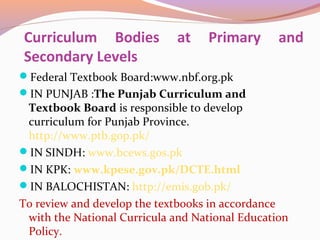
Curriculum Bodies at Primary and
Secondary Levels
Federal Textbook Board:www.nbf.org.pk
IN PUNJAB :The Punjab Curriculum and
Textbook Board is responsible to develop
curriculum for Punjab Province.
http://www.ptb.gop.pk/
IN SINDH: www.bcews.gos.pk
IN KPK: www.kpese.gov.pk/DCTE.html
IN BALOCHISTAN: http://emis.gob.pk/
To review and develop the textbooks in accordance
with the National Curricula and National Education
Policy.
Main Functions of these bodies
prepare schemes of studies,
curricula,manuscripts of textbooks, standards
of education and schedules or strategy for
their introduction in various classes of an
institution in connection with the
implementation of the education policy of the
Government.
Main Responsibilities
Ministry of Education (Curriculum Development
Body) is responsible in making of:
1. Curriculum
2.Syllabus
3. Planning
4.Policy and
5.Development of Educational Standards.
Curriculum Design and Development
Process in Pakistan
1. Evolution of Curriculum Objectives.
2. Development of Scheme of Studies.
3. Development of Syllabus of each subject.
4. Development of Textbook, Instructional material.
5. Approval of Textual Material.
6. Teacher Training.
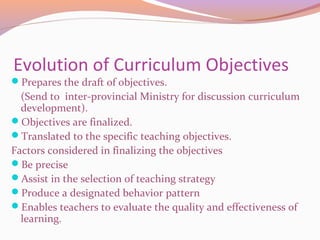
Evolution of Curriculum Objectives
Prepares the draft of objectives.
(Send to inter-provincial Ministry for discussion curriculum
development).
Objectives are finalized.
Translated to the specific teaching objectives.
Factors considered in finalizing the objectives
Be precise
Assist in the selection of teaching strategy
Produce a designated behavior pattern
Enables teachers to evaluate the quality and effectiveness of
learning.
The studies Scheme (Scheme of
Studies)
It is based on three key factors:
The Education policy
Market Demand
Global Issues
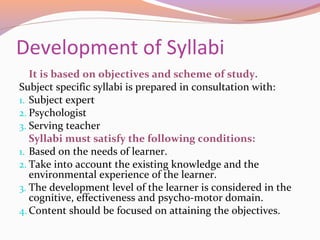
Development of Syllabi
It is based on objectives and scheme of study.
Subject specific syllabi is prepared in consultation with:
1. Subject expert
2. Psychologist
3. Serving teacher
Syllabi must satisfy the following conditions:
1. Based on the needs of learner.
2. Take into account the existing knowledge and the
environmental experience of the learner.
3. The development level of the learner is considered in the
cognitive, effectiveness and psycho-motor domain.
4. Content should be focused on attaining the objectives.
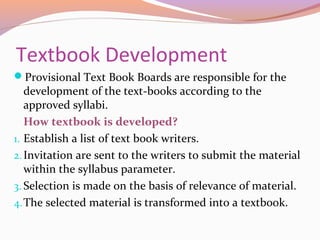
Textbook Development
Provisional Text Book Boards are responsible for the
development of the text-books according to the
approved syllabi.
How textbook is developed?
1. Establish a list of text book writers.
2.Invitation are sent to the writers to submit the material
within the syllabus parameter.
3. Selection is made on the basis of relevance of material.
4.The selected material is transformed into a textbook.
Review the Approval
Review committee comprises on five or six members:
At least one expert form the syllabus Formulation Committee.
Two subject experts.
Two school teachers
Textbooks Review Parameter
The books truly reflects the curriculum.
It meets the objectives stated in the curriculum.
Book does not contain any material repugnant to Islamic and
Pakistani ideology.
In case of approval, textbook is sent for publishing and
distribution.
In case of objection, complaints are relayed with revision
recommendations.
Teacher Training
Teacher training for curriculum implementation is
the responsibility of the provincial government.
It is now stressed that each textbook must have a
teacher's guide or included in textbook.
In some cases assistance in the training of the masters
trainers is arranged by the provincial government.
http://www.ibe.unesco.org
Curriculum Development at
Higher Education Level
curriculum development at higher
education level
Higher Education Commission
In December, 1976 Federal Government
appointed University Grant commission (now
HEC ) as the competent authority to look after the
curriculum revision work at bachelor level and
onwards
It also looks after the degrees, certificates and
diplomas awarded by degree colleges, universities
and other institutions of HEC.

Curriculum development process in pakistan lecture 2

  • 1.
  • 2.
    Contents Curriculum Bodies atPrimary, Elementary ,Secondary and Higher Secondary Level
  • 3.
    Why Curriculum? Education playsa vital role in nation building. Ministry of (provisional) Education, is responsible for the cohesion, integration and preservation of the ideological foundation of the states.
  • 4.
    Curriculum Bodies atPrimary and Secondary Levels Federal Textbook Board:www.nbf.org.pk IN PUNJAB :The Punjab Curriculum and Textbook Board is responsible to develop curriculum for Punjab Province. http://www.ptb.gop.pk/ IN SINDH: www.bcews.gos.pk IN KPK: www.kpese.gov.pk/DCTE.html IN BALOCHISTAN: http://emis.gob.pk/ To review and develop the textbooks in accordance with the National Curricula and National Education Policy.
  • 5.
    Main Functions ofthese bodies prepare schemes of studies, curricula,manuscripts of textbooks, standards of education and schedules or strategy for their introduction in various classes of an institution in connection with the implementation of the education policy of the Government.
  • 6.
    Main Responsibilities Ministry ofEducation (Curriculum Development Body) is responsible in making of: 1. Curriculum 2.Syllabus 3. Planning 4.Policy and 5.Development of Educational Standards.
  • 7.
    Curriculum Design andDevelopment Process in Pakistan 1. Evolution of Curriculum Objectives. 2. Development of Scheme of Studies. 3. Development of Syllabus of each subject. 4. Development of Textbook, Instructional material. 5. Approval of Textual Material. 6. Teacher Training.
  • 8.
    Evolution of CurriculumObjectives Prepares the draft of objectives. (Send to inter-provincial Ministry for discussion curriculum development). Objectives are finalized. Translated to the specific teaching objectives. Factors considered in finalizing the objectives Be precise Assist in the selection of teaching strategy Produce a designated behavior pattern Enables teachers to evaluate the quality and effectiveness of learning.
  • 9.
    The studies Scheme(Scheme of Studies) It is based on three key factors: The Education policy Market Demand Global Issues
  • 10.
    Development of Syllabi Itis based on objectives and scheme of study. Subject specific syllabi is prepared in consultation with: 1. Subject expert 2. Psychologist 3. Serving teacher Syllabi must satisfy the following conditions: 1. Based on the needs of learner. 2. Take into account the existing knowledge and the environmental experience of the learner. 3. The development level of the learner is considered in the cognitive, effectiveness and psycho-motor domain. 4. Content should be focused on attaining the objectives.
  • 11.
    Textbook Development Provisional TextBook Boards are responsible for the development of the text-books according to the approved syllabi. How textbook is developed? 1. Establish a list of text book writers. 2.Invitation are sent to the writers to submit the material within the syllabus parameter. 3. Selection is made on the basis of relevance of material. 4.The selected material is transformed into a textbook.
  • 12.
    Review the Approval Reviewcommittee comprises on five or six members: At least one expert form the syllabus Formulation Committee. Two subject experts. Two school teachers Textbooks Review Parameter The books truly reflects the curriculum. It meets the objectives stated in the curriculum. Book does not contain any material repugnant to Islamic and Pakistani ideology. In case of approval, textbook is sent for publishing and distribution. In case of objection, complaints are relayed with revision recommendations.
  • 13.
    Teacher Training Teacher trainingfor curriculum implementation is the responsibility of the provincial government. It is now stressed that each textbook must have a teacher's guide or included in textbook. In some cases assistance in the training of the masters trainers is arranged by the provincial government. http://www.ibe.unesco.org
  • 14.
    Curriculum Development at HigherEducation Level curriculum development at higher education level
  • 15.
    Higher Education Commission InDecember, 1976 Federal Government appointed University Grant commission (now HEC ) as the competent authority to look after the curriculum revision work at bachelor level and onwards It also looks after the degrees, certificates and diplomas awarded by degree colleges, universities and other institutions of HEC.