WAVES
WHERE DO WAVES COME FROM?
Why learn about waves?
• What experiences do we
already have about
waves?
OBJECTIVES:
• Understand what wave is
• Define the following terms:
Amplitude, wavelength, frequency, period, crest
and trough.
• Differentiate electromagnetic wave from mechanical
wave and give examples for each
• Differentiate longitudinal waves from transverse
waves and give examples for each
• Determine the wave velocity in a medium
• Name and explain the common properties of waves:
reflection, refraction, diffraction, and interference.
Waves
 A wave is an
oscillation that
travels.
Waves
• When you drop a ball into water, some of
the water is pushed aside and raised by the
ball.
WAVES
• A wave is a disturbance traveling through a
medium or in a vacuum.
Energy Transmission by Wave
• Water waves move to the shore but water
does not file up in the shore.
Energy Transmission by Wave
• Useful in transmission
of information.
• Different
communication
systems use
electromagnetic waves,
particularly microwave
and radiowave, to
transmit information.
CLASSIFICATION OF WAVES
According to nature and direction of vibration
Mechanical Waves
• Require a material medium to propagate
• Example: Sound waves. Sound cannot travel in
a vacuum.
Why Does Inhaling Helium Make
Your Voice Sound Funny?
• Because helium is lighter than air, sound
waves travel through it faster.
• In a room where the temperature is 68
degrees Fahrenheit, sound travels at 344
meters a second through air, but 927 meters a
second through helium.
MORE FUN WITH GASES
CAUTION:
• Breathing helium continuously can cause
asphyxiation within a few minutes.
• don't ever inhale helium directly from one of
those pressurized tanks. The high flow rate
can rupture your lung tissue or send a
concentrated mass of gas into your
bloodstream, after which it can lodge in the
brain and cause a stroke, seizures and death.
Electromagnetic Waves
• Can travel in a vacuum and in material media
• Propagate through a vacuum (or air) with the
same speed, the speed of light :
3 x 10⁸
m/s
• Examples: light, heat waves, radio waves and
microwaves.
CHECK YOUR UNDERSTANDING:
• A science fiction film depicts inhabitants of
one spaceship (in outer space) hearing the
sound of a nearby spaceship as it zooms past
at high speeds. Critique the physics of this
film.
Transverse Waves
• The particles of the medium are vibrating
perpendicularly to the direction of wave
propagation.
• Are made up of alternating hills (crests) and
valleys (troughs).
Longitudinal Waves
• The particles of the medium vibrate parallel
to the direction of wave propagation.
• Composed of:
– COMPRESSIONS where particles are closer
together
– RAREFACTIONS where they are farther apart
ANATOMY OF A WAVE
Parts of a TRANSVERSE wave
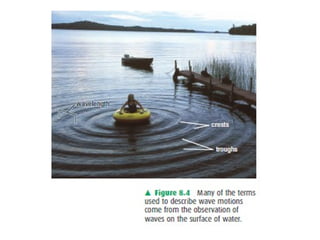
• A crest is the high point of the wave.
• A trough is the low point.
Parts of a TRANSVERSE wave
• A crest is the high point of the wave.
• A trough is the low point.
Parts of a TRANSVERSE wave
• The amplitude of a water wave is the
maximum height the wave rises above the
level surface.
Parts of a TRANSVERSE wave
• Wavelength is the distance between one crest and
the next crest.
Parts of a LONGITUDINAL wave
• COMPRESSION - A region where the coils are
pressed together in a small amount of space
• RAREFACTION - A region where the coils are
spread apart, thus maximizing the distance
between coils
CHECK YOUR UNDERSTANDING:
• The wavelength of the wave in the diagram is
________.
• The amplitude of the wave in the diagram is
_______.
FREQUENCY AND PERIOD
FREQUENCY
• of a wave refers to how often the
particles of the medium vibrate when a
wave passes through the medium.
• UNIT: Hertz
PERIOD
• of a wave is the time for a particle on a
medium to make one complete
vibrational cycle.
The speed of waves
• The speed is the distance traveled (one wavelength)
divided by the time it takes (one period).
• We usually calculate the speed of a wave by
multiplying wavelength by frequency.
BASIC WAVE EQUATION
PROBLEM SOLVING
• Calculate the velocity of a water wave if
the frequency is 400 Hz, the wavelength
is 6 m, and the amplitude of the wave is
3.76 cm.
SPEED OF A TRANSVERSE WAVE:
• Where:
v = speed
F = stretching force or tension
m = mass per unit length
SEATWORK
½ c.w. Show the complete solution. DO NOT COPY the problems.
1. The linear density of a clothesline is
0.250 kg/m. How much tension does
Throcky have to apply to produce the
observed wave speed of 12.0 m/s?
2. A sound wave is travelling with a speed
of 343 m/s
a. calculate its frequency if the
wavelength of the wave is 500m.
b. Calculate its period
WAVE PROPERTIES
WAVE PROPERTIES
• Reflection
• Refraction
• Diffraction
• Interference
• Doppler Effect
• Polarization
REFLECTION
• When a wave travels through a medium, part
of it may be transmitted and the rest
reflected as it reaches the boundary of the
medium.
REFRACTION
• Waves that strike the medium boundary are
partly absorbed by the boundary.
• The remaining waves continue to move
through the boundary until they reach
another medium.
• The wave velocity on the other side of the
boundary will differ from that on the other
side.
INTERFERENCE
• is the phenomenon that occurs when two
waves meet while traveling along the same
medium
Constructive Interference
• two interfering waves have a displacement in
the same direction
Destructive Interference
• where the two interfering waves have a
displacement in the opposite direction
DIFFRACTION
• change in direction of waves as they pass
through an opening or around a barrier in
their path
DOPPLER EFFECT
• The frequency of a wave is perceived to
increase as the source of the wave moves
toward a stationary observer.
The stealth fighter
• The stealth fighter that
attacked the most
heavily fortified targets in
Iraq during Desert Storm
(1991) had been
engineered to avoid
detection of radar. It has
microwave absorbing
materials, angled shapes
that reduce its cross
sectional area, and
electronic jamming.
POLARIZATION
• Only transverse waves can be polarized
• To decrease the intensity of a wave
SYNTHESIS OF THE LESSON
• Waves
• Classification of Waves according to its nature
• Mechanical Waves
• Electromagnetic Waves
• Classification of Waves according to its
direction of vibration
• Transverse
• Longitudinal waves
• Crest
• Trough
• Amplitude
• Wavelength
• frequency
• Wave Speed Equation
What type of Electromagnetic Wave?
What Wave Property?
STANDING WAVES
STANDING WAVE PATTERN
• is a vibrational pattern
created within a medium
when the vibrational
frequency of the source
causes reflected waves
from one end of the
medium to interfere with
incident waves from the
source.
• NODES – points that
appear to be
standing still. These
points, sometimes
described as points
of no displacement.
• ANTI-NODES –
These are the points
that undergo the
maximum
displacement during
each vibrational
cycle of the standing
wave.
Harmonic # of Nodes # of Antinodes Pattern
1st 2 1
2nd 3 2
3rd 4 3
4th 5 4
5th 6 5
6th 7 6
nth n + 1 n --
• The number of nodes in the standing wave
shown in the diagram is ____.
• The number of antinodes in the standing wave
shown in the diagram is ____.
SAMPLE PROBLEM
In a physics demonstration, Mr. H establishes a
standing wave pattern in a snakey by vibrating
it up and down with 32 vibrations in 10
seconds. Gerald is holding the opposite end of
the snakey and is standing 6.2 m from Mr. H's
end. There are four equal length sections in
the snakey, each occupied by an antinode.
Determine the frequency, wavelength and
speed of the wave.

Waves

  • 1.
  • 2.
    WHERE DO WAVESCOME FROM?
  • 3.
    Why learn aboutwaves? • What experiences do we already have about waves?
  • 4.
    OBJECTIVES: • Understand whatwave is • Define the following terms: Amplitude, wavelength, frequency, period, crest and trough. • Differentiate electromagnetic wave from mechanical wave and give examples for each • Differentiate longitudinal waves from transverse waves and give examples for each • Determine the wave velocity in a medium • Name and explain the common properties of waves: reflection, refraction, diffraction, and interference.
  • 5.
    Waves  A waveis an oscillation that travels.
  • 6.
    Waves • When youdrop a ball into water, some of the water is pushed aside and raised by the ball.
  • 7.
    WAVES • A waveis a disturbance traveling through a medium or in a vacuum.
  • 8.
    Energy Transmission byWave • Water waves move to the shore but water does not file up in the shore.
  • 9.
    Energy Transmission byWave • Useful in transmission of information. • Different communication systems use electromagnetic waves, particularly microwave and radiowave, to transmit information.
  • 10.
    CLASSIFICATION OF WAVES Accordingto nature and direction of vibration
  • 12.
    Mechanical Waves • Requirea material medium to propagate • Example: Sound waves. Sound cannot travel in a vacuum.
  • 13.
    Why Does InhalingHelium Make Your Voice Sound Funny?
  • 14.
    • Because heliumis lighter than air, sound waves travel through it faster. • In a room where the temperature is 68 degrees Fahrenheit, sound travels at 344 meters a second through air, but 927 meters a second through helium.
  • 15.
  • 16.
    CAUTION: • Breathing heliumcontinuously can cause asphyxiation within a few minutes. • don't ever inhale helium directly from one of those pressurized tanks. The high flow rate can rupture your lung tissue or send a concentrated mass of gas into your bloodstream, after which it can lodge in the brain and cause a stroke, seizures and death.
  • 17.
    Electromagnetic Waves • Cantravel in a vacuum and in material media • Propagate through a vacuum (or air) with the same speed, the speed of light : 3 x 10⁸ m/s • Examples: light, heat waves, radio waves and microwaves.
  • 20.
    CHECK YOUR UNDERSTANDING: •A science fiction film depicts inhabitants of one spaceship (in outer space) hearing the sound of a nearby spaceship as it zooms past at high speeds. Critique the physics of this film.
  • 22.
    Transverse Waves • Theparticles of the medium are vibrating perpendicularly to the direction of wave propagation. • Are made up of alternating hills (crests) and valleys (troughs).
  • 23.
    Longitudinal Waves • Theparticles of the medium vibrate parallel to the direction of wave propagation. • Composed of: – COMPRESSIONS where particles are closer together – RAREFACTIONS where they are farther apart
  • 25.
  • 26.
    Parts of aTRANSVERSE wave • A crest is the high point of the wave. • A trough is the low point.
  • 28.
    Parts of aTRANSVERSE wave • A crest is the high point of the wave. • A trough is the low point.
  • 29.
    Parts of aTRANSVERSE wave • The amplitude of a water wave is the maximum height the wave rises above the level surface.
  • 30.
    Parts of aTRANSVERSE wave • Wavelength is the distance between one crest and the next crest.
  • 31.
    Parts of aLONGITUDINAL wave • COMPRESSION - A region where the coils are pressed together in a small amount of space • RAREFACTION - A region where the coils are spread apart, thus maximizing the distance between coils
  • 32.
    CHECK YOUR UNDERSTANDING: •The wavelength of the wave in the diagram is ________. • The amplitude of the wave in the diagram is _______.
  • 33.
  • 34.
    FREQUENCY • of awave refers to how often the particles of the medium vibrate when a wave passes through the medium. • UNIT: Hertz
  • 35.
    PERIOD • of awave is the time for a particle on a medium to make one complete vibrational cycle.
  • 38.
    The speed ofwaves • The speed is the distance traveled (one wavelength) divided by the time it takes (one period). • We usually calculate the speed of a wave by multiplying wavelength by frequency.
  • 39.
  • 41.
  • 42.
    • Calculate thevelocity of a water wave if the frequency is 400 Hz, the wavelength is 6 m, and the amplitude of the wave is 3.76 cm.
  • 43.
    SPEED OF ATRANSVERSE WAVE: • Where: v = speed F = stretching force or tension m = mass per unit length
  • 44.
    SEATWORK ½ c.w. Showthe complete solution. DO NOT COPY the problems.
  • 45.
    1. The lineardensity of a clothesline is 0.250 kg/m. How much tension does Throcky have to apply to produce the observed wave speed of 12.0 m/s?
  • 46.
    2. A soundwave is travelling with a speed of 343 m/s a. calculate its frequency if the wavelength of the wave is 500m. b. Calculate its period
  • 47.
  • 48.
    WAVE PROPERTIES • Reflection •Refraction • Diffraction • Interference • Doppler Effect • Polarization
  • 49.
    REFLECTION • When awave travels through a medium, part of it may be transmitted and the rest reflected as it reaches the boundary of the medium.
  • 51.
    REFRACTION • Waves thatstrike the medium boundary are partly absorbed by the boundary. • The remaining waves continue to move through the boundary until they reach another medium. • The wave velocity on the other side of the boundary will differ from that on the other side.
  • 55.
    INTERFERENCE • is thephenomenon that occurs when two waves meet while traveling along the same medium
  • 57.
    Constructive Interference • twointerfering waves have a displacement in the same direction
  • 58.
    Destructive Interference • wherethe two interfering waves have a displacement in the opposite direction
  • 59.
    DIFFRACTION • change indirection of waves as they pass through an opening or around a barrier in their path
  • 62.
    DOPPLER EFFECT • Thefrequency of a wave is perceived to increase as the source of the wave moves toward a stationary observer.
  • 64.
    The stealth fighter •The stealth fighter that attacked the most heavily fortified targets in Iraq during Desert Storm (1991) had been engineered to avoid detection of radar. It has microwave absorbing materials, angled shapes that reduce its cross sectional area, and electronic jamming.
  • 65.
    POLARIZATION • Only transversewaves can be polarized • To decrease the intensity of a wave
  • 66.
  • 67.
    • Waves • Classificationof Waves according to its nature • Mechanical Waves • Electromagnetic Waves • Classification of Waves according to its direction of vibration • Transverse • Longitudinal waves
  • 68.
    • Crest • Trough •Amplitude • Wavelength • frequency • Wave Speed Equation
  • 69.
    What type ofElectromagnetic Wave?
  • 70.
  • 71.
  • 72.
    STANDING WAVE PATTERN •is a vibrational pattern created within a medium when the vibrational frequency of the source causes reflected waves from one end of the medium to interfere with incident waves from the source.
  • 73.
    • NODES –points that appear to be standing still. These points, sometimes described as points of no displacement.
  • 74.
    • ANTI-NODES – Theseare the points that undergo the maximum displacement during each vibrational cycle of the standing wave.
  • 76.
    Harmonic # ofNodes # of Antinodes Pattern 1st 2 1 2nd 3 2 3rd 4 3 4th 5 4 5th 6 5 6th 7 6 nth n + 1 n --
  • 77.
    • The numberof nodes in the standing wave shown in the diagram is ____. • The number of antinodes in the standing wave shown in the diagram is ____.
  • 80.
    SAMPLE PROBLEM In aphysics demonstration, Mr. H establishes a standing wave pattern in a snakey by vibrating it up and down with 32 vibrations in 10 seconds. Gerald is holding the opposite end of the snakey and is standing 6.2 m from Mr. H's end. There are four equal length sections in the snakey, each occupied by an antinode. Determine the frequency, wavelength and speed of the wave.