What is light? (baby don’t hurt me, don’t hurt me…no more!)
L i g h t   a n d   C o lo r We see light as color and brightness It’s actually electromagnetic radiation: Partly electric, partly magnetic Flows in straight line (radiates)
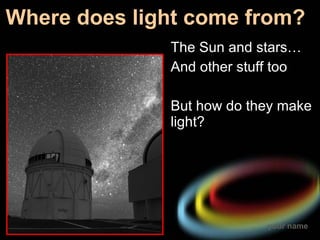
Where does light come from? The Sun and stars… And other stuff too But how do they make light?
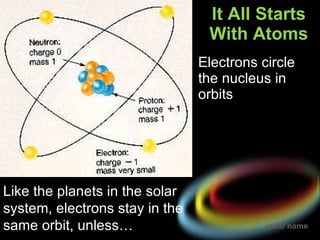
It All Starts With Atoms Electrons circle the nucleus in orbits Like the planets in the solar system, electrons stay in the same orbit, unless…
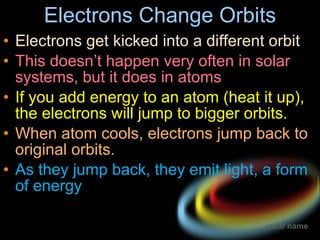
Electrons Change Orbits Electrons get kicked into a different orbit This doesn’t happen very often in solar systems, but it does in atoms If you add energy to an atom (heat it up), the electrons will jump to bigger orbits. When atom cools, electrons jump back to original orbits.  As they jump back, they emit light, a form of energy
Color of light Each electron that jumps back emits one photon of light The color of this light depends on how big the jump was between orbits The bigger the jump, the higher the energy. The energy determines color; a blue photon has more energy than a red
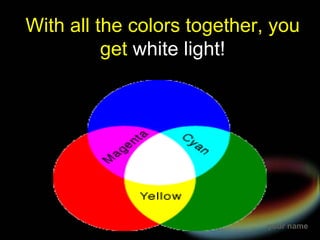
With all the colors together, you get  white light!
PHOTONS What makes up light?
Light is Weird It has a dual personality… Sometimes, it acts like a particle Sometimes, it acts like a wave
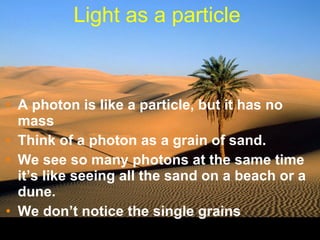
Light as a particle  A photon is like a particle, but it has no mass Think of a photon as a grain of sand. We see so many photons at the same time it’s like seeing all the sand on a beach or a dune. We don’t notice the single grains
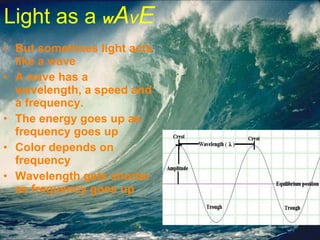
Light as a  w A v E But sometimes light acts like a wave A wave has a wavelength, a speed and a frequency. The energy goes up as frequency goes up Color depends on frequency Wavelength gets shorter as frequency goes up
Duality of Light Light as a Wave Beams of light seem to flow like waves through the air Light has a measurable wavelength, amplitude and frequency, just like a regular wave Light as a Particle Light comes in certain bundled amounts, called photons We know this because of the way excited electrons give off light in fixed quantities when they fall down to ground state
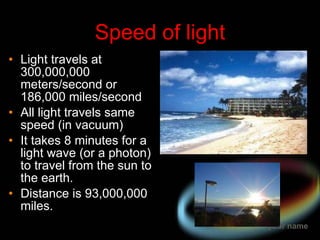
Speed of light Light travels at 300,000,000 meters/second or 186,000 miles/second All light travels same speed (in vacuum) It takes 8 minutes for a light wave (or a photon) to travel from the sun to the earth. Distance is 93,000,000 miles.
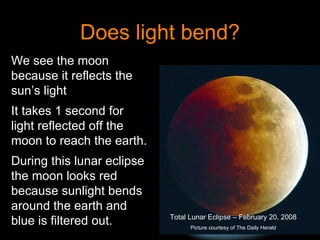
Does light bend? Total Lunar Eclipse – February 20, 2008 Picture courtesy of The Daily Herald We see the moon because it reflects the sun’s light It takes 1 second for light reflected off the moon to reach the earth. During this lunar eclipse the moon looks red because sunlight bends around the earth and blue is filtered out.
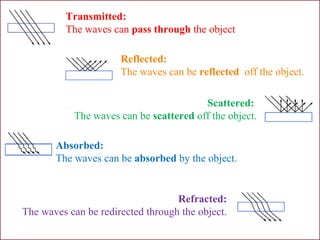
Light interacting with matter When light hits something (air, glass, a green wall, Quiznos), it may be: Transmitted  (if the thing is transparent) Reflected  (off a mirror) Scattered  (raindrops or a prism) Absorbed  (off a black velvet dress) Refracted  (bent around something) OR So me combination of these
            Transmitted: The waves can  pass through  the object Absorbed: The waves can be  absorbed  by the object. Reflected:  The waves can be  reflected   off the object. Scattered:  The waves can be  scattered  off the object. Refracted: The waves can be redirected through the object.
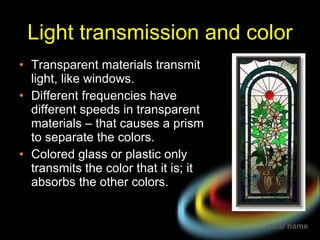
Light transmission and color Transparent materials transmit light, like windows. Different frequencies have different speeds in transparent materials – that causes a prism to separate the colors. Colored glass or plastic only transmits the color that it is; it absorbs the other colors.
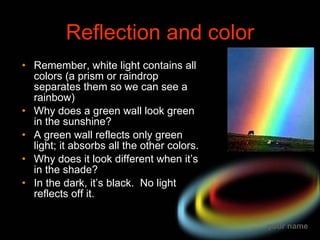
Reflection and color Remember, white light contains all colors (a prism or raindrop separates them so we can see a rainbow) Why does a green wall look green in the sunshine? A green wall reflects only green light; it absorbs all the other colors. Why does it look different when it’s in the shade? In the dark, it’s black.  No light reflects off it.
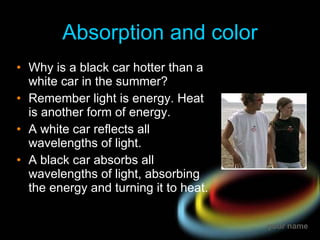
Absorption and color Why is a black car hotter than a white car in the summer? Remember light is energy. Heat is another form of energy. A white car reflects all wavelengths of light. A black car absorbs all wavelengths of light, absorbing the energy and turning it to heat.
Using Light to Study the Stars Astronomers collect energy from the stars with a telescope Visible light Infrared light Radio waves, etc. Each atom has a special pattern of light frequencies like a fingerprint The fingerprint of frequencies will be shifted if the star is moving away or toward us  (like the sound of a freight train) The temperature of the Star can be determined from the color of the star
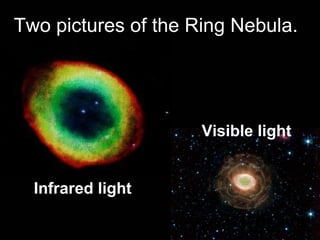
Two pictures of the Ring Nebula.  Infrared light Visible light

Light and Color

  • 1.
    What is light?(baby don’t hurt me, don’t hurt me…no more!)
  • 2.
    L i gh t a n d C o lo r We see light as color and brightness It’s actually electromagnetic radiation: Partly electric, partly magnetic Flows in straight line (radiates)
  • 3.
    Where does lightcome from? The Sun and stars… And other stuff too But how do they make light?
  • 4.
    It All StartsWith Atoms Electrons circle the nucleus in orbits Like the planets in the solar system, electrons stay in the same orbit, unless…
  • 5.
    Electrons Change OrbitsElectrons get kicked into a different orbit This doesn’t happen very often in solar systems, but it does in atoms If you add energy to an atom (heat it up), the electrons will jump to bigger orbits. When atom cools, electrons jump back to original orbits. As they jump back, they emit light, a form of energy
  • 6.
    Color of lightEach electron that jumps back emits one photon of light The color of this light depends on how big the jump was between orbits The bigger the jump, the higher the energy. The energy determines color; a blue photon has more energy than a red
  • 7.
    With all thecolors together, you get white light!
  • 8.
  • 9.
    Light is WeirdIt has a dual personality… Sometimes, it acts like a particle Sometimes, it acts like a wave
  • 10.
    Light as aparticle A photon is like a particle, but it has no mass Think of a photon as a grain of sand. We see so many photons at the same time it’s like seeing all the sand on a beach or a dune. We don’t notice the single grains
  • 11.
    Light as a w A v E But sometimes light acts like a wave A wave has a wavelength, a speed and a frequency. The energy goes up as frequency goes up Color depends on frequency Wavelength gets shorter as frequency goes up
  • 12.
    Duality of LightLight as a Wave Beams of light seem to flow like waves through the air Light has a measurable wavelength, amplitude and frequency, just like a regular wave Light as a Particle Light comes in certain bundled amounts, called photons We know this because of the way excited electrons give off light in fixed quantities when they fall down to ground state
  • 13.
    Speed of lightLight travels at 300,000,000 meters/second or 186,000 miles/second All light travels same speed (in vacuum) It takes 8 minutes for a light wave (or a photon) to travel from the sun to the earth. Distance is 93,000,000 miles.
  • 14.
    Does light bend?Total Lunar Eclipse – February 20, 2008 Picture courtesy of The Daily Herald We see the moon because it reflects the sun’s light It takes 1 second for light reflected off the moon to reach the earth. During this lunar eclipse the moon looks red because sunlight bends around the earth and blue is filtered out.
  • 15.
    Light interacting withmatter When light hits something (air, glass, a green wall, Quiznos), it may be: Transmitted (if the thing is transparent) Reflected (off a mirror) Scattered (raindrops or a prism) Absorbed (off a black velvet dress) Refracted (bent around something) OR So me combination of these
  • 16.
               Transmitted: The waves can pass through the object Absorbed: The waves can be absorbed by the object. Reflected: The waves can be reflected off the object. Scattered: The waves can be scattered off the object. Refracted: The waves can be redirected through the object.
  • 17.
    Light transmission andcolor Transparent materials transmit light, like windows. Different frequencies have different speeds in transparent materials – that causes a prism to separate the colors. Colored glass or plastic only transmits the color that it is; it absorbs the other colors.
  • 18.
    Reflection and colorRemember, white light contains all colors (a prism or raindrop separates them so we can see a rainbow) Why does a green wall look green in the sunshine? A green wall reflects only green light; it absorbs all the other colors. Why does it look different when it’s in the shade? In the dark, it’s black. No light reflects off it.
  • 19.
    Absorption and colorWhy is a black car hotter than a white car in the summer? Remember light is energy. Heat is another form of energy. A white car reflects all wavelengths of light. A black car absorbs all wavelengths of light, absorbing the energy and turning it to heat.
  • 20.
    Using Light toStudy the Stars Astronomers collect energy from the stars with a telescope Visible light Infrared light Radio waves, etc. Each atom has a special pattern of light frequencies like a fingerprint The fingerprint of frequencies will be shifted if the star is moving away or toward us (like the sound of a freight train) The temperature of the Star can be determined from the color of the star
  • 21.
    Two pictures ofthe Ring Nebula. Infrared light Visible light