By iTutor.com
T- 1-855-694-8886
Email- info@iTutor.com
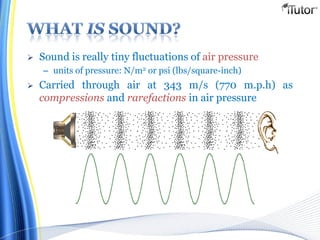
 Sound is really tiny fluctuations of air pressure
– units of pressure: N/m2 or psi (lbs/square-inch)
 Carried through air at 343 m/s (770 m.p.h) as
compressions and rarefactions in air pressure
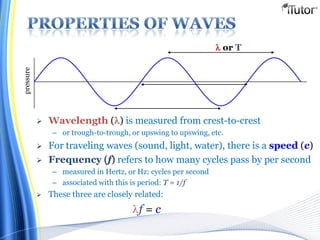
 Wavelength () is measured from crest-to-crest
– or trough-to-trough, or upswing to upswing, etc.
 For traveling waves (sound, light, water), there is a speed (c)
 Frequency (f) refers to how many cycles pass by per second
– measured in Hertz, or Hz: cycles per second
– associated with this is period: T = 1/f
 These three are closely related:
f = c
 or T
pressure
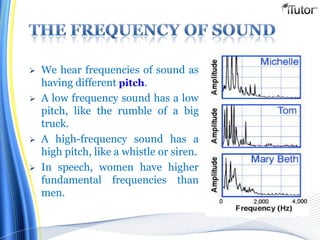
 We hear frequencies of sound as
having different pitch.
 A low frequency sound has a low
pitch, like the rumble of a big
truck.
 A high-frequency sound has a
high pitch, like a whistle or siren.
 In speech, women have higher
fundamental frequencies than
men.
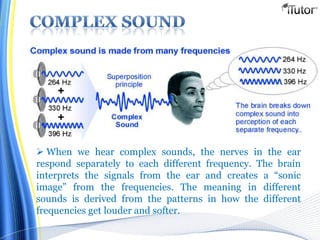
 When we hear complex sounds, the nerves in the ear
respond separately to each different frequency. The brain
interprets the signals from the ear and creates a “sonic
image” from the frequencies. The meaning in different
sounds is derived from the patterns in how the different
frequencies get louder and softer.
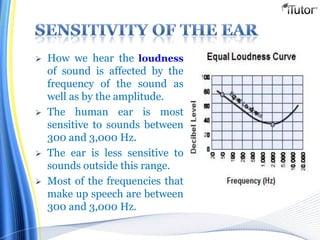
 How we hear the loudness
of sound is affected by the
frequency of the sound as
well as by the amplitude.
 The human ear is most
sensitive to sounds between
300 and 3,000 Hz.
 The ear is less sensitive to
sounds outside this range.
 Most of the frequencies that
make up speech are between
300 and 3,000 Hz.
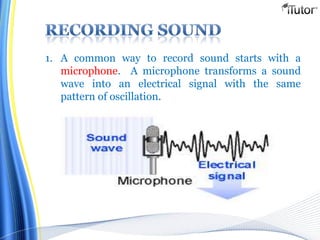
1. A common way to record sound starts with a
microphone. A microphone transforms a sound
wave into an electrical signal with the same
pattern of oscillation.
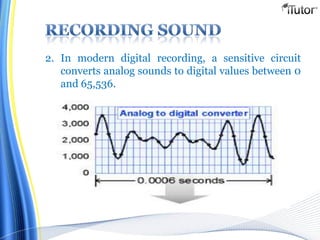
2. In modern digital recording, a sensitive circuit
converts analog sounds to digital values between 0
and 65,536.
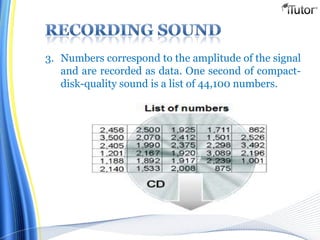
3. Numbers correspond to the amplitude of the signal
and are recorded as data. One second of compact-
disk-quality sound is a list of 44,100 numbers.
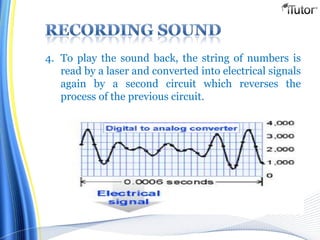
4. To play the sound back, the string of numbers is
read by a laser and converted into electrical signals
again by a second circuit which reverses the
process of the previous circuit.
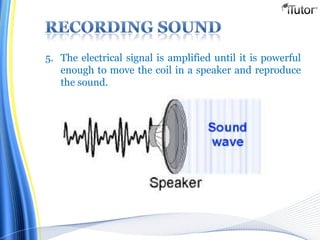
5. The electrical signal is amplified until it is powerful
enough to move the coil in a speaker and reproduce
the sound.
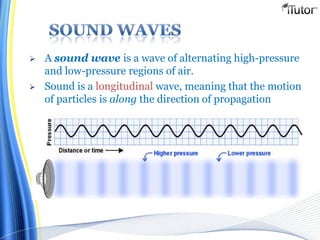
 A sound wave is a wave of alternating high-pressure
and low-pressure regions of air.
 Sound is a longitudinal wave, meaning that the motion
of particles is along the direction of propagation
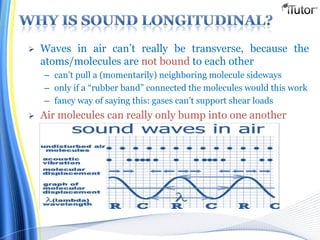
 Waves in air can’t really be transverse, because the
atoms/molecules are not bound to each other
– can’t pull a (momentarily) neighboring molecule sideways
– only if a “rubber band” connected the molecules would this work
– fancy way of saying this: gases can’t support shear loads
 Air molecules can really only bump into one another
 The pitch of a sound depends on the frequency of
the tone that the ear receives. High notes are
produced by an object that is vibrating a greater
number of times per second than for a low note
 The intensity of a sound is the amount of energy
crossing a unit area in unit time or the power
flowing through the unit area. The SI unit is watts
per square meter.
 The loudness of the sound depends upon the
subjective effect of intensity of sound waves on the
human ear.
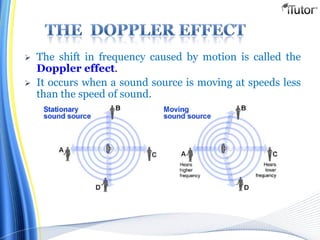
 The shift in frequency caused by motion is called the
Doppler effect.
 It occurs when a sound source is moving at speeds less
than the speed of sound.
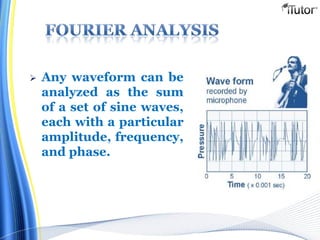
 Any waveform can be
analyzed as the sum
of a set of sine waves,
each with a particular
amplitude, frequency,
and phase.
 The speed of sound in air is 343 meters per second
(660 miles per hour) at one atmosphere of pressure
and room temperature (21°C).
 An object is subsonic when it is moving slower than
sound.
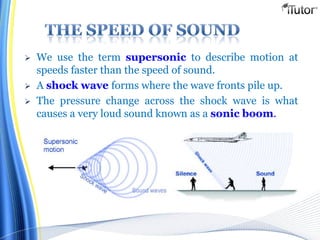
 We use the term supersonic to describe motion at
speeds faster than the speed of sound.
 A shock wave forms where the wave fronts pile up.
 The pressure change across the shock wave is what
causes a very loud sound known as a sonic boom.
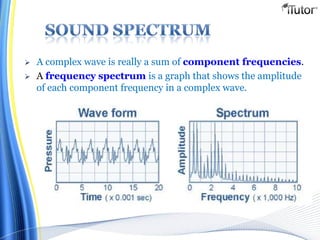
 A complex wave is really a sum of component frequencies.
 A frequency spectrum is a graph that shows the amplitude
of each component frequency in a complex wave.
 A single frequency by itself does not have much meaning.
 The meaning comes from patterns in many frequencies
together.
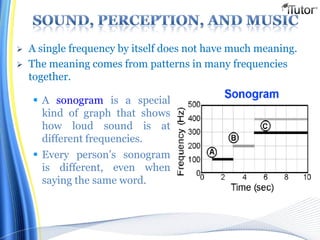
 A sonogram is a special
kind of graph that shows
how loud sound is at
different frequencies.
 Every person’s sonogram
is different, even when
saying the same word.
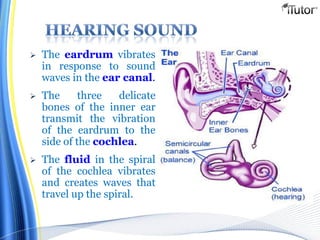
 The eardrum vibrates
in response to sound
waves in the ear canal.
 The three delicate
bones of the inner ear
transmit the vibration
of the eardrum to the
side of the cochlea.
 The fluid in the spiral
of the cochlea vibrates
and creates waves that
travel up the spiral.
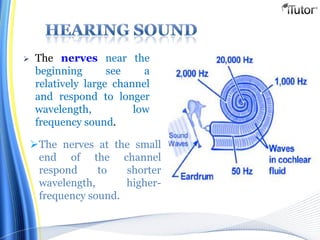
 The nerves near the
beginning see a
relatively large channel
and respond to longer
wavelength, low
frequency sound.
The nerves at the small
end of the channel
respond to shorter
wavelength, higher-
frequency sound.
 The pitch of a sound is how high or low we hear its
frequency. Though pitch and frequency usually mean
the same thing, the way we hear a pitch can be
affected by the sounds we heard before and after.
 Rhythm is a regular time pattern in a sound.
 Music is a combination of sound and rhythm that we
find pleasant.
 Most of the music you listen to is created from a
pattern of frequencies called a musical scale.
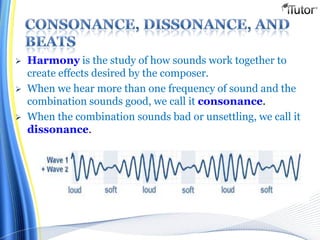
 Harmony is the study of how sounds work together to
create effects desired by the composer.
 When we hear more than one frequency of sound and the
combination sounds good, we call it consonance.
 When the combination sounds bad or unsettling, we call it
dissonance.
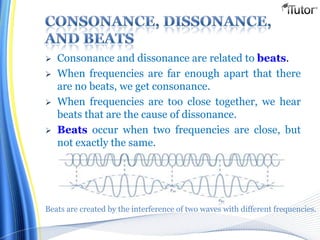
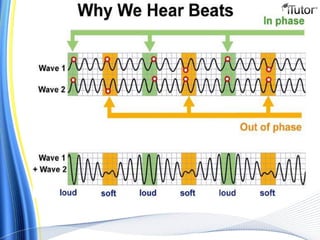
 Consonance and dissonance are related to beats.
 When frequencies are far enough apart that there
are no beats, we get consonance.
 When frequencies are too close together, we hear
beats that are the cause of dissonance.
 Beats occur when two frequencies are close, but
not exactly the same.
Beats are created by the interference of two waves with different frequencies.
 A listener will hear the alternating loudness, known
as beats.
 The number of beats per second, called the beat
frequency, equals the difference between the
frequencies of the two individual waves.
 To tune an instrument accurately, a musician
listens carefully and adjusts her instrument to
eliminate beats between the instrument and a given
pitch.
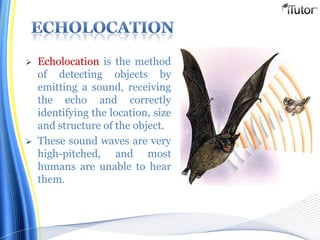
 Echolocation is the method
of detecting objects by
emitting a sound, receiving
the echo and correctly
identifying the location, size
and structure of the object.
 These sound waves are very
high-pitched, and most
humans are unable to hear
them.
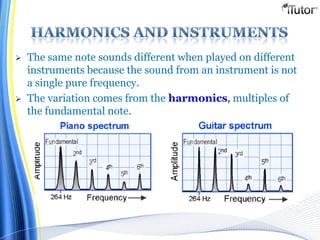
 The same note sounds different when played on different
instruments because the sound from an instrument is not
a single pure frequency.
 The variation comes from the harmonics, multiples of
the fundamental note.
The End
Call us for more information
www.iTutor.com
Visit
1-855-694-8886

Sound Waves

  • 1.
  • 2.
     Sound isreally tiny fluctuations of air pressure – units of pressure: N/m2 or psi (lbs/square-inch)  Carried through air at 343 m/s (770 m.p.h) as compressions and rarefactions in air pressure
  • 3.
     Wavelength ()is measured from crest-to-crest – or trough-to-trough, or upswing to upswing, etc.  For traveling waves (sound, light, water), there is a speed (c)  Frequency (f) refers to how many cycles pass by per second – measured in Hertz, or Hz: cycles per second – associated with this is period: T = 1/f  These three are closely related: f = c  or T pressure
  • 4.
     We hearfrequencies of sound as having different pitch.  A low frequency sound has a low pitch, like the rumble of a big truck.  A high-frequency sound has a high pitch, like a whistle or siren.  In speech, women have higher fundamental frequencies than men.
  • 5.
     When wehear complex sounds, the nerves in the ear respond separately to each different frequency. The brain interprets the signals from the ear and creates a “sonic image” from the frequencies. The meaning in different sounds is derived from the patterns in how the different frequencies get louder and softer.
  • 6.
     How wehear the loudness of sound is affected by the frequency of the sound as well as by the amplitude.  The human ear is most sensitive to sounds between 300 and 3,000 Hz.  The ear is less sensitive to sounds outside this range.  Most of the frequencies that make up speech are between 300 and 3,000 Hz.
  • 7.
    1. A commonway to record sound starts with a microphone. A microphone transforms a sound wave into an electrical signal with the same pattern of oscillation.
  • 8.
    2. In moderndigital recording, a sensitive circuit converts analog sounds to digital values between 0 and 65,536.
  • 9.
    3. Numbers correspondto the amplitude of the signal and are recorded as data. One second of compact- disk-quality sound is a list of 44,100 numbers.
  • 10.
    4. To playthe sound back, the string of numbers is read by a laser and converted into electrical signals again by a second circuit which reverses the process of the previous circuit.
  • 11.
    5. The electricalsignal is amplified until it is powerful enough to move the coil in a speaker and reproduce the sound.
  • 12.
     A soundwave is a wave of alternating high-pressure and low-pressure regions of air.  Sound is a longitudinal wave, meaning that the motion of particles is along the direction of propagation
  • 13.
     Waves inair can’t really be transverse, because the atoms/molecules are not bound to each other – can’t pull a (momentarily) neighboring molecule sideways – only if a “rubber band” connected the molecules would this work – fancy way of saying this: gases can’t support shear loads  Air molecules can really only bump into one another
  • 14.
     The pitchof a sound depends on the frequency of the tone that the ear receives. High notes are produced by an object that is vibrating a greater number of times per second than for a low note  The intensity of a sound is the amount of energy crossing a unit area in unit time or the power flowing through the unit area. The SI unit is watts per square meter.  The loudness of the sound depends upon the subjective effect of intensity of sound waves on the human ear.
  • 15.
     The shiftin frequency caused by motion is called the Doppler effect.  It occurs when a sound source is moving at speeds less than the speed of sound.
  • 16.
     Any waveformcan be analyzed as the sum of a set of sine waves, each with a particular amplitude, frequency, and phase.
  • 17.
     The speedof sound in air is 343 meters per second (660 miles per hour) at one atmosphere of pressure and room temperature (21°C).  An object is subsonic when it is moving slower than sound.
  • 18.
     We usethe term supersonic to describe motion at speeds faster than the speed of sound.  A shock wave forms where the wave fronts pile up.  The pressure change across the shock wave is what causes a very loud sound known as a sonic boom.
  • 19.
     A complexwave is really a sum of component frequencies.  A frequency spectrum is a graph that shows the amplitude of each component frequency in a complex wave.
  • 20.
     A singlefrequency by itself does not have much meaning.  The meaning comes from patterns in many frequencies together.  A sonogram is a special kind of graph that shows how loud sound is at different frequencies.  Every person’s sonogram is different, even when saying the same word.
  • 21.
     The eardrumvibrates in response to sound waves in the ear canal.  The three delicate bones of the inner ear transmit the vibration of the eardrum to the side of the cochlea.  The fluid in the spiral of the cochlea vibrates and creates waves that travel up the spiral.
  • 22.
     The nervesnear the beginning see a relatively large channel and respond to longer wavelength, low frequency sound. The nerves at the small end of the channel respond to shorter wavelength, higher- frequency sound.
  • 23.
     The pitchof a sound is how high or low we hear its frequency. Though pitch and frequency usually mean the same thing, the way we hear a pitch can be affected by the sounds we heard before and after.  Rhythm is a regular time pattern in a sound.  Music is a combination of sound and rhythm that we find pleasant.  Most of the music you listen to is created from a pattern of frequencies called a musical scale.
  • 24.
     Harmony isthe study of how sounds work together to create effects desired by the composer.  When we hear more than one frequency of sound and the combination sounds good, we call it consonance.  When the combination sounds bad or unsettling, we call it dissonance.
  • 25.
     Consonance anddissonance are related to beats.  When frequencies are far enough apart that there are no beats, we get consonance.  When frequencies are too close together, we hear beats that are the cause of dissonance.  Beats occur when two frequencies are close, but not exactly the same. Beats are created by the interference of two waves with different frequencies.
  • 26.
     A listenerwill hear the alternating loudness, known as beats.  The number of beats per second, called the beat frequency, equals the difference between the frequencies of the two individual waves.  To tune an instrument accurately, a musician listens carefully and adjusts her instrument to eliminate beats between the instrument and a given pitch.
  • 28.
     Echolocation isthe method of detecting objects by emitting a sound, receiving the echo and correctly identifying the location, size and structure of the object.  These sound waves are very high-pitched, and most humans are unable to hear them.
  • 29.
     The samenote sounds different when played on different instruments because the sound from an instrument is not a single pure frequency.  The variation comes from the harmonics, multiples of the fundamental note.
  • 30.
    The End Call usfor more information www.iTutor.com Visit 1-855-694-8886