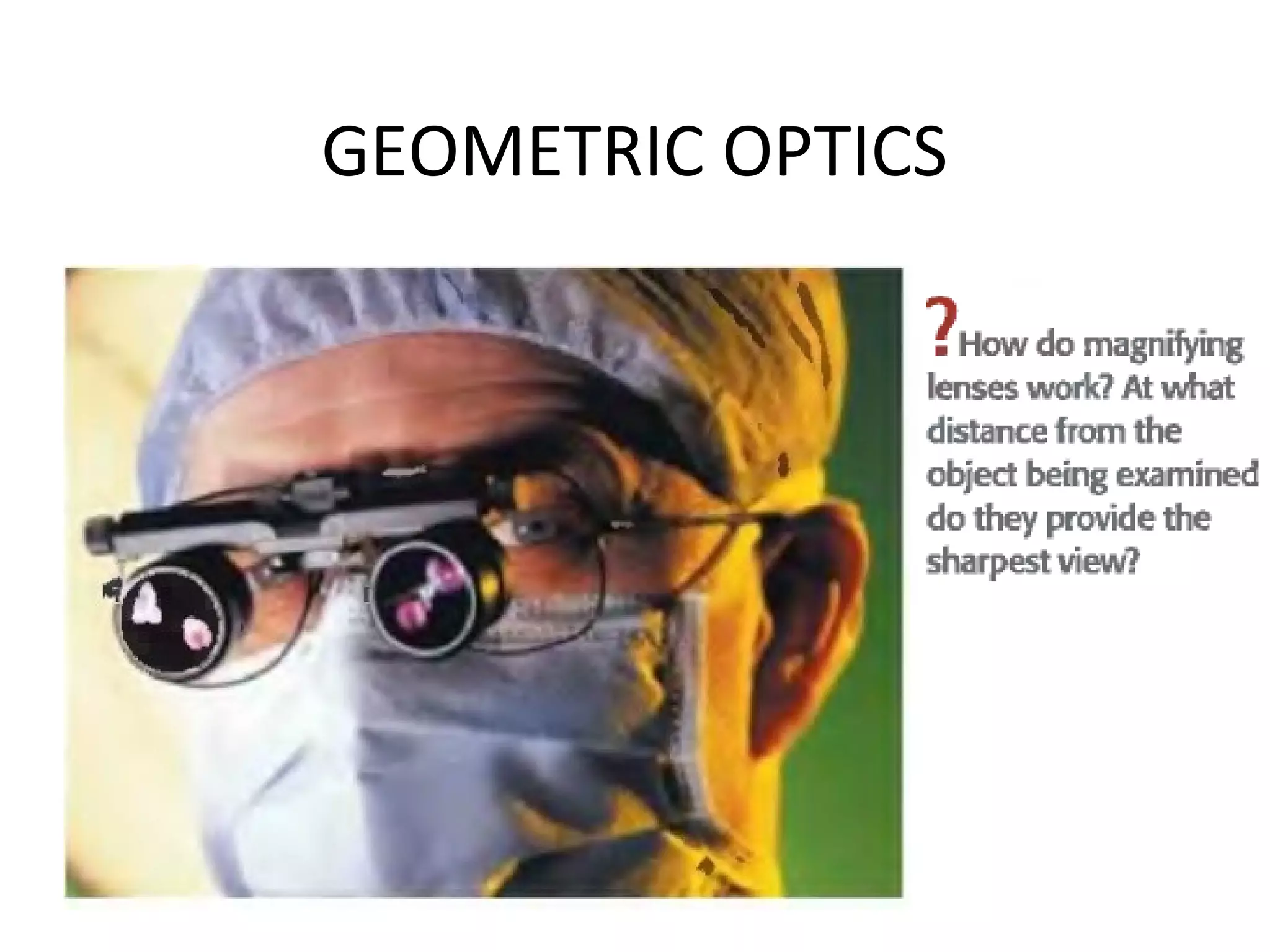
GEOMETRIC OPTICS
To understand images and image
formation, all we need are the RAY
MODEL OF LIGHT, the LAWS OF
REFLECTION and REFRACTION, and some
simple geometry and trigonometry.
GEOMETRIC OPTICS
• The study of how light rays form images
REFLECTION AND REFRACTION AT A
PLANE SURFACE
OBJECT
• Anything from which light rays radiate
• Could be:
–Light emitted by the object itself (self-
luminous)
–Light emitted by another source and then
reflected from the object
• POINT OBJECT has no
physical extent.
• EXTENDED OBJECT has
length, width and
height.
• Point P an object
point
• Point P’ an image
point
“The reflecting surface
forms an image of
point P.”
TYPES OF IMAGES
• Virtual image  if the outgoing rays
don’t actually pass through the image
point
• Real image  the outgoing rays do pass
through an image point.
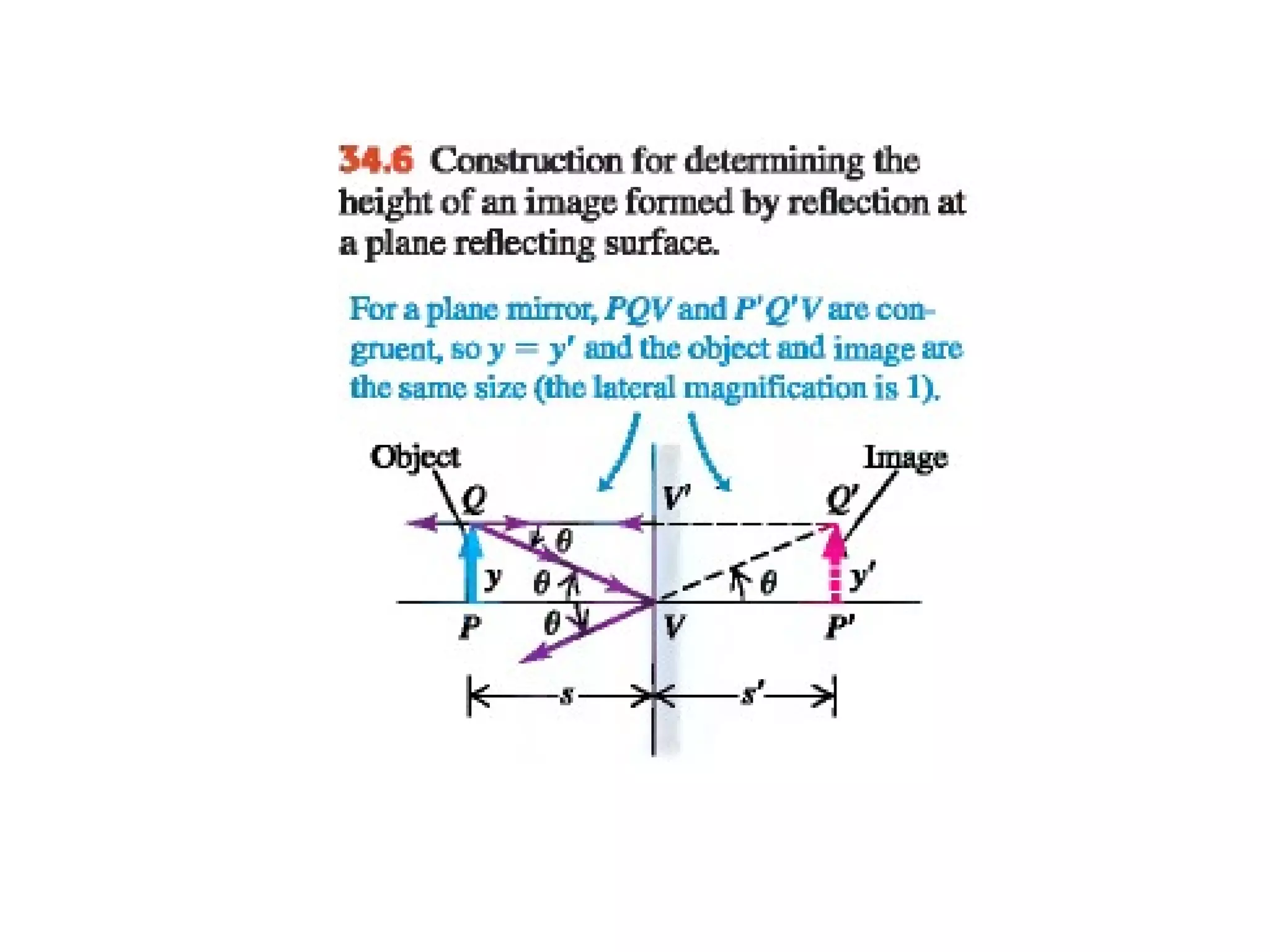
Image formation by a Plane Mirror
SIGN RULES
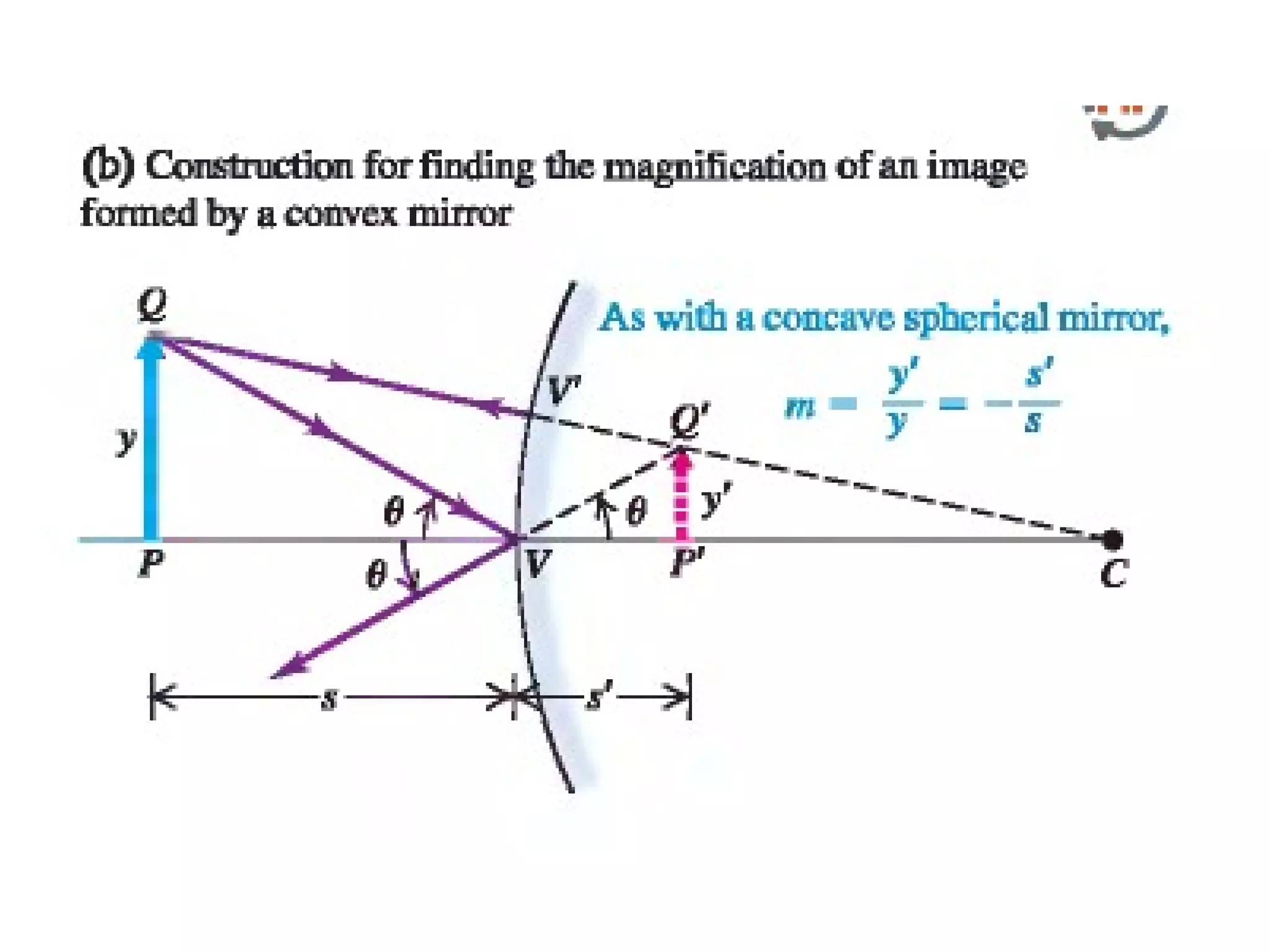
Lateral Magnification
• The ratio of image height to object
height
• If the image is erect, m is positive
• If the image is inverted, m is negative
REFLECTION AT A SPHERICAL
SURFACE
Concave and Convex Mirrors
CONCAVE MIRRORS
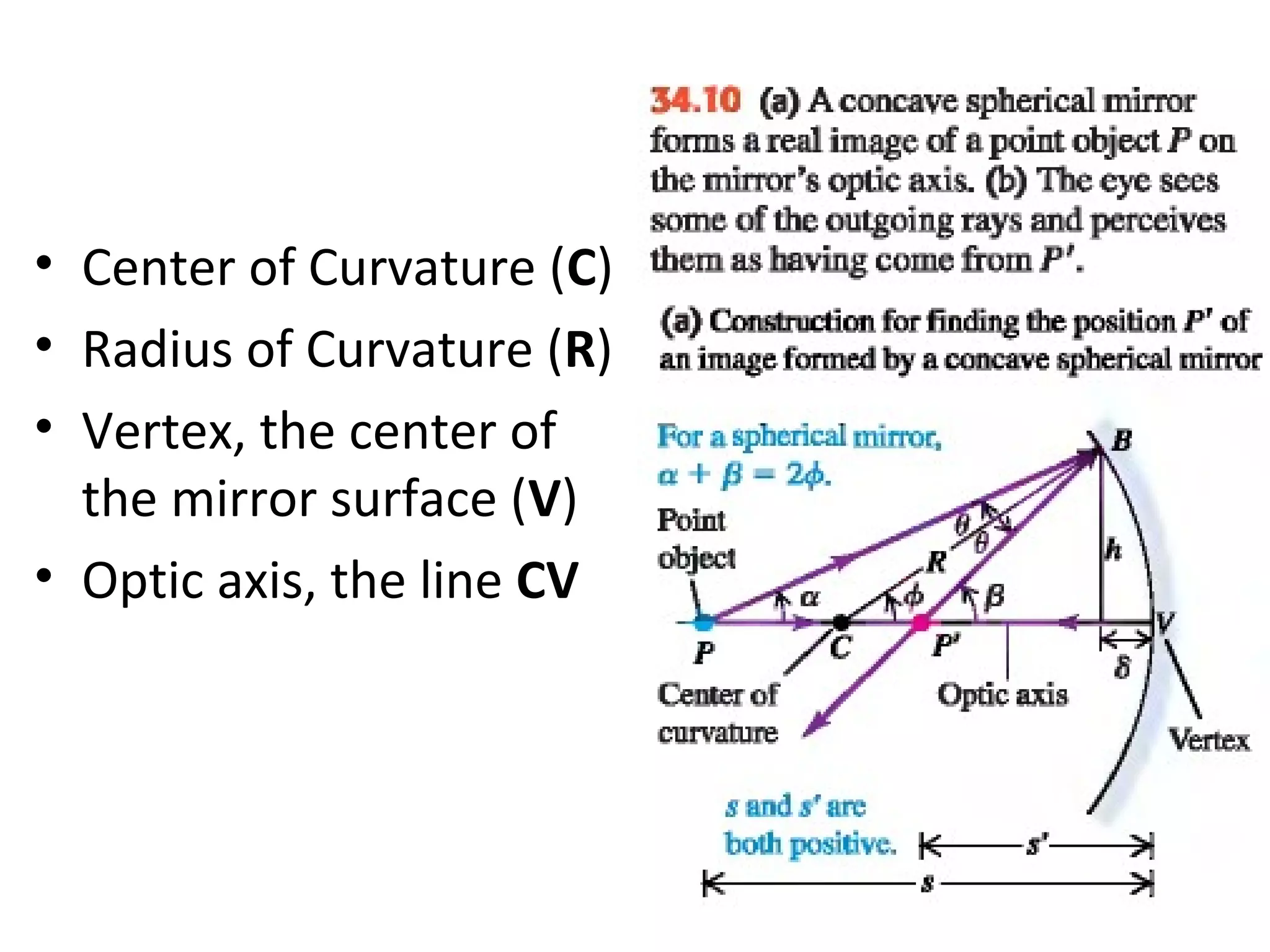
• Center of Curvature (C)
• Radius of Curvature (R)
• Vertex, the center of
the mirror surface (V)
• Optic axis, the line CV
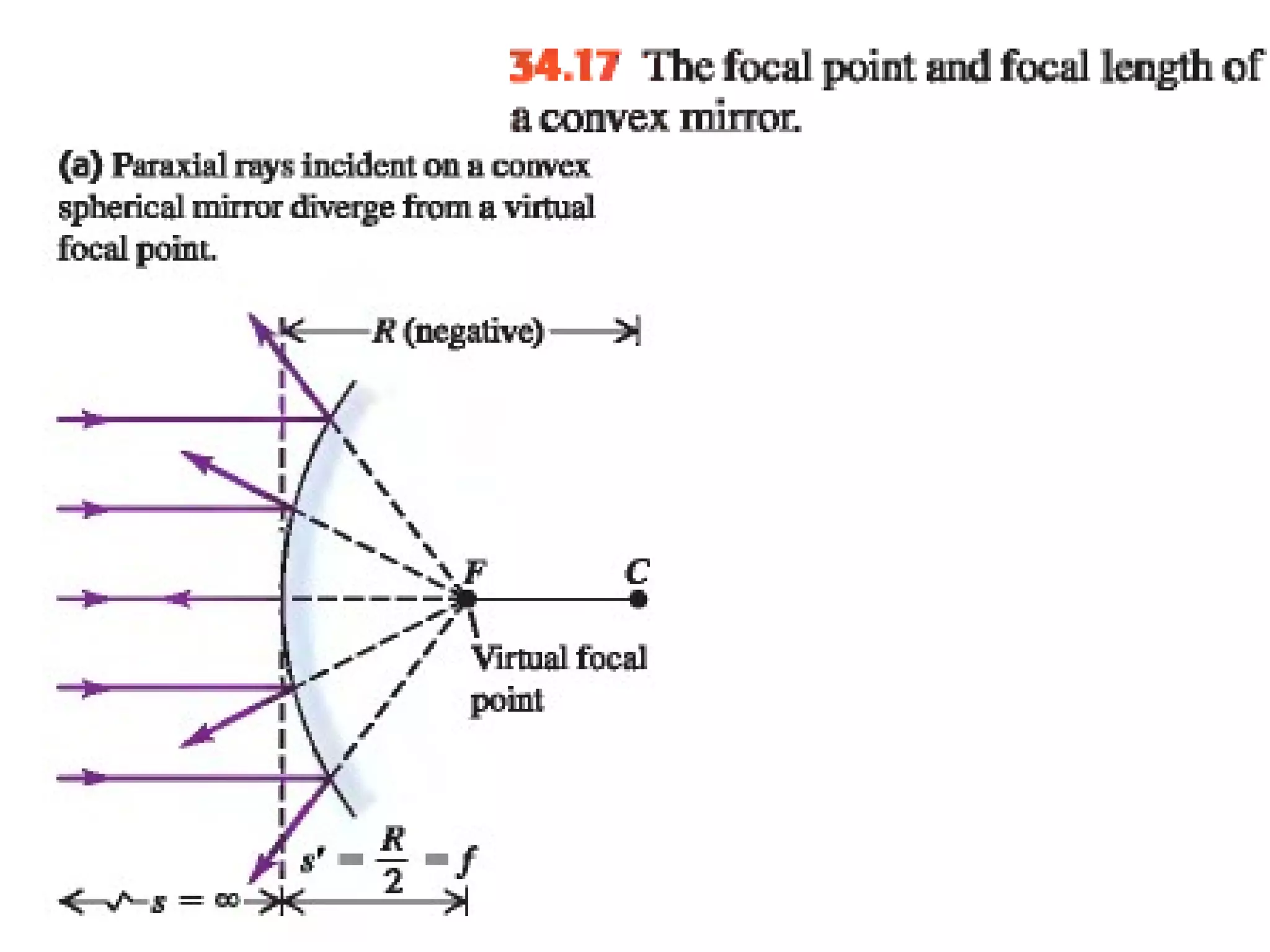
Focal Point and Focal Length
• Where:
f = focal length
R = radius of curvature
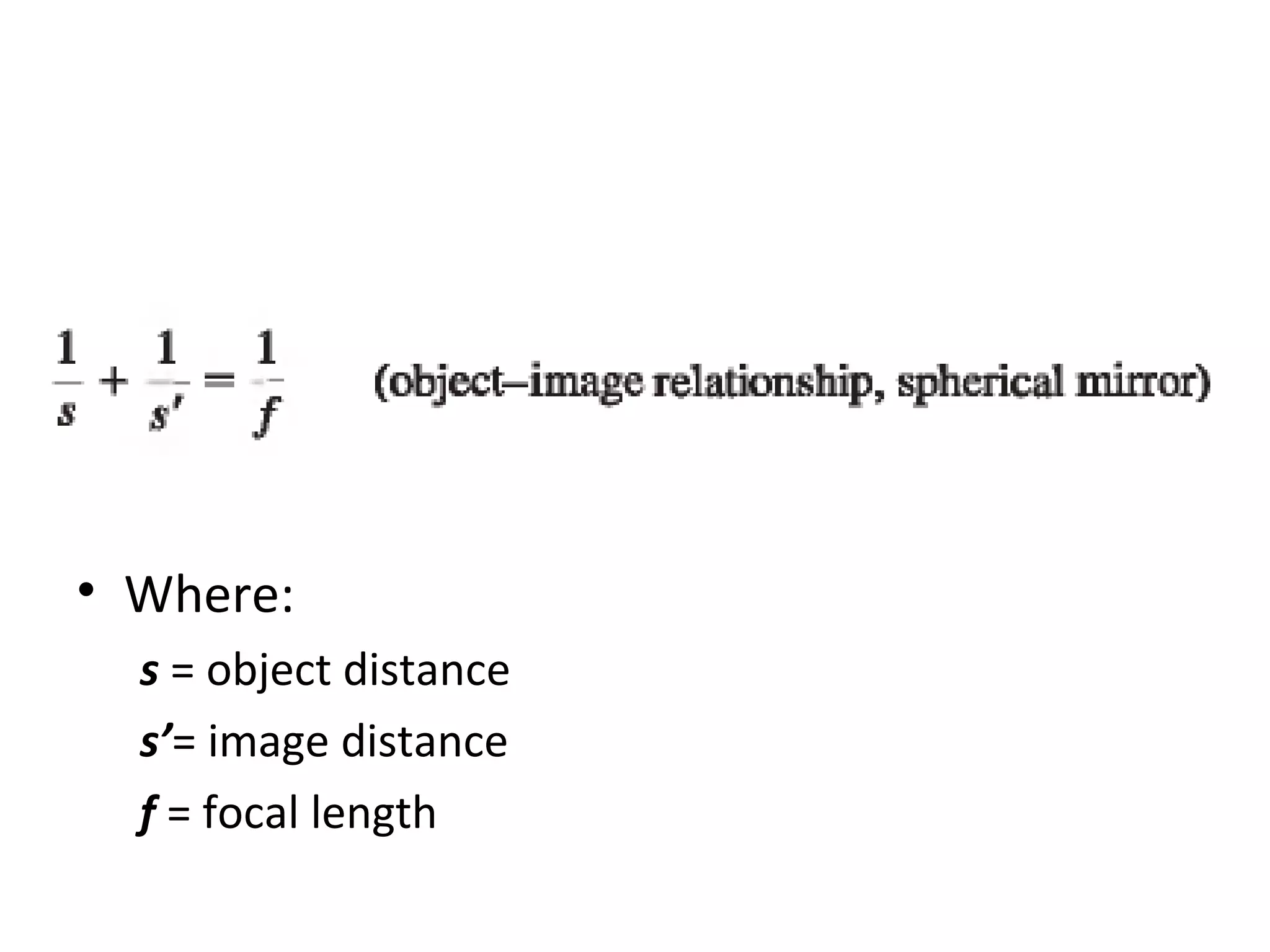
• Where:
s = object distance
s’= image distance
f = focal length
Lateral Magnification (m)
SAMPLE PROBLEM
• A 4.00-cm tall light bulb is placed a
distance of 45.7 cm from a concave
mirror having a focal length of 15.2
cm. Determine the image distance
and the image size.
SAMPLE PROBLEM
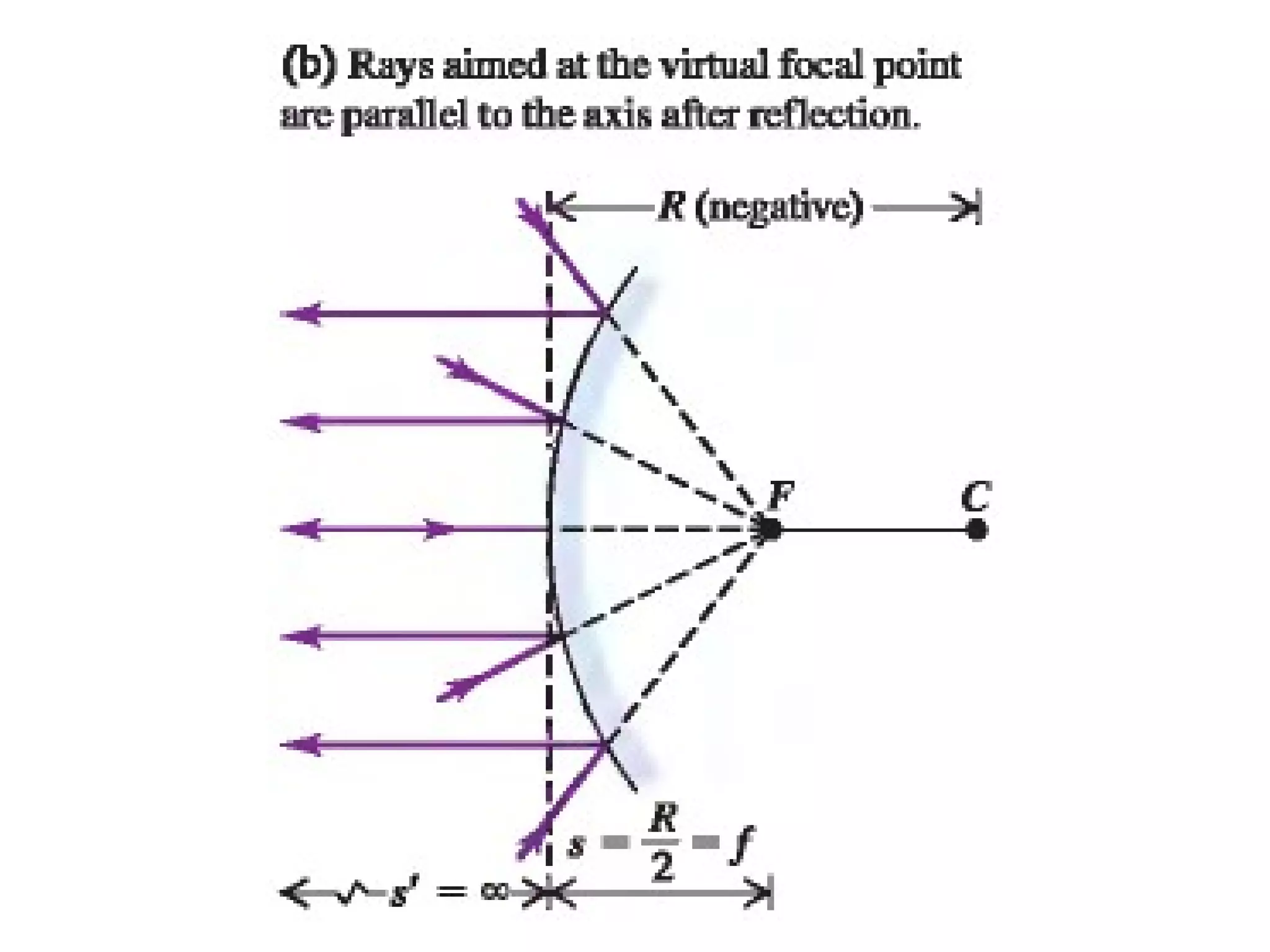
CONVEX MIRRORS
• The center of curvature (C) is on the opposite
side to the outgoing rays
Sample Problem
CONCAVE AND CONVEX MIRROR
CONCAVE MIRROR
• has the capability of
forming images that can
be smaller or larger in
size and virtual or erect,
depending on the
position of the object.
CONVEX MIRROR
• always produces a
smaller, virtual, and
erect image of an
object.
• In convex mirror, the
length of the image is
shorter than that of the
object.
CONCAVE MIRROR
• doctors use this mirror for obtaining a
relatively larger image of teeth, ear, skin etc.
CONVEX MIRROR
SW : REFLECTION ON SPHERICAL
SURFACE
½ c.w. DO NOT COPY THE PROBLEM. SHOW COMPLETE SOLUTION
1. A luminous object is 4.00 m from a wall.
You are to use a concave mirror to
project an image of the object on the
wall, with the image 2.25 times the size
of the object. How far should the mirror
be from the wall? What should the
radius of curvature be?
1. Determine the image distance and
image height for a 5.00-cm tall object
placed 20.0 cm from a concave mirror
having a focal length of 15.0 cm.
2. Find the focal length of a convex
mirror of an object 0.30 m from the
mirror forms an image of 0.10 m
behind the mirror.
GRAPHICAL METHOD FOR MIRRORS
Concave Mirror
• The center C of a concave mirror is outside the
mirror.
• Focal point F is also outside the mirror, half way
between the center and the surface of the mirror.
• The focal length f is half of the radius.
case 1:case 1: The object is placed at a distanceThe object is placed at a distance
greater than the C. The image formed isgreater than the C. The image formed is
real, inverted and smaller in size.real, inverted and smaller in size.
Step 1 Step 2
Step 3 Step 4
case 2: The object is placed at a distance
equal to C. The image formed is real,
inverted and the same size as the object.
Case 3: The object is placed between C
and f. The image formed is real, inverted
and magnified in size.
Case 4: The object is located at f.
No image is formed.
Case 5: The object is placed between
the principal focus and the mirror. The
image formed is virtual, upright and
magnified.
CONVEX MIRRORS
PRINCIPAL RAYS:
PRINCIPAL RAYS:
PRINCIPAL RAYS:
PRINCIPAL RAYS:
PRINCIPAL RAYS:
THIN LENSES
THIN LENS
• A lens is an optical system with two
refracting surfaces
• The simplest lens has two spherical
surfaces close enough together that we
can neglect the distance between them
(the thickness of the lens)
CONVERGING LENS
• Has the property that when a beam of
rays parallel to the axis passes through
the lens, the rays converge to a point F2
and form a real image at that point.
• Similarly, rays passing through point F1
emerge from the lens as a beam of
parallel rays.
• A positive lens (F1 and F2 are both
positive)
DIVERGING LENS
• The beam of parallel rays incident on
this lens diverges after refraction.
• Is called a negative lens
• The focal length of a diverging lens is
a negative quantity
GRAPHICAL METHOD FOR LENSES
Sample Problem
• An object 5.0 cm high is placed 24
cm away from a lens of focal length
8.0 cm.
a.Calculate the location of the image
b.Calculate the height of the image
SHORT QUIZ
OPEN NOTES (1/2 CW) DO NOT COPY THE PROBLEM…
SHOW GIVEN AND COMPLETE SOLUTION
1. An object 5.0 cm high is placed 24.0 cm away

Geometric optics

  • 1.
  • 2.
    To understand imagesand image formation, all we need are the RAY MODEL OF LIGHT, the LAWS OF REFLECTION and REFRACTION, and some simple geometry and trigonometry.
  • 3.
    GEOMETRIC OPTICS • Thestudy of how light rays form images
  • 4.
    REFLECTION AND REFRACTIONAT A PLANE SURFACE
  • 5.
    OBJECT • Anything fromwhich light rays radiate • Could be: –Light emitted by the object itself (self- luminous) –Light emitted by another source and then reflected from the object
  • 6.
    • POINT OBJECThas no physical extent. • EXTENDED OBJECT has length, width and height.
  • 7.
    • Point Pan object point • Point P’ an image point “The reflecting surface forms an image of point P.”
  • 8.
    TYPES OF IMAGES •Virtual image  if the outgoing rays don’t actually pass through the image point • Real image  the outgoing rays do pass through an image point.
  • 9.
    Image formation bya Plane Mirror
  • 10.
  • 15.
    Lateral Magnification • Theratio of image height to object height • If the image is erect, m is positive • If the image is inverted, m is negative
  • 16.
    REFLECTION AT ASPHERICAL SURFACE Concave and Convex Mirrors
  • 17.
  • 18.
    • Center ofCurvature (C) • Radius of Curvature (R) • Vertex, the center of the mirror surface (V) • Optic axis, the line CV
  • 21.
    Focal Point andFocal Length
  • 22.
    • Where: f =focal length R = radius of curvature
  • 23.
    • Where: s =object distance s’= image distance f = focal length
  • 24.
  • 25.
    SAMPLE PROBLEM • A4.00-cm tall light bulb is placed a distance of 45.7 cm from a concave mirror having a focal length of 15.2 cm. Determine the image distance and the image size.
  • 26.
  • 28.
    CONVEX MIRRORS • Thecenter of curvature (C) is on the opposite side to the outgoing rays
  • 33.
  • 35.
  • 36.
    CONCAVE MIRROR • hasthe capability of forming images that can be smaller or larger in size and virtual or erect, depending on the position of the object. CONVEX MIRROR • always produces a smaller, virtual, and erect image of an object. • In convex mirror, the length of the image is shorter than that of the object.
  • 37.
    CONCAVE MIRROR • doctorsuse this mirror for obtaining a relatively larger image of teeth, ear, skin etc.
  • 38.
  • 39.
    SW : REFLECTIONON SPHERICAL SURFACE ½ c.w. DO NOT COPY THE PROBLEM. SHOW COMPLETE SOLUTION
  • 40.
    1. A luminousobject is 4.00 m from a wall. You are to use a concave mirror to project an image of the object on the wall, with the image 2.25 times the size of the object. How far should the mirror be from the wall? What should the radius of curvature be?
  • 41.
    1. Determine theimage distance and image height for a 5.00-cm tall object placed 20.0 cm from a concave mirror having a focal length of 15.0 cm.
  • 42.
    2. Find thefocal length of a convex mirror of an object 0.30 m from the mirror forms an image of 0.10 m behind the mirror.
  • 43.
  • 44.
    Concave Mirror • Thecenter C of a concave mirror is outside the mirror. • Focal point F is also outside the mirror, half way between the center and the surface of the mirror. • The focal length f is half of the radius.
  • 45.
    case 1:case 1:The object is placed at a distanceThe object is placed at a distance greater than the C. The image formed isgreater than the C. The image formed is real, inverted and smaller in size.real, inverted and smaller in size. Step 1 Step 2 Step 3 Step 4
  • 46.
    case 2: Theobject is placed at a distance equal to C. The image formed is real, inverted and the same size as the object.
  • 47.
    Case 3: Theobject is placed between C and f. The image formed is real, inverted and magnified in size.
  • 48.
    Case 4: Theobject is located at f. No image is formed.
  • 49.
    Case 5: Theobject is placed between the principal focus and the mirror. The image formed is virtual, upright and magnified.
  • 50.
  • 51.
  • 52.
  • 53.
  • 54.
  • 55.
  • 63.
  • 64.
    THIN LENS • Alens is an optical system with two refracting surfaces • The simplest lens has two spherical surfaces close enough together that we can neglect the distance between them (the thickness of the lens)
  • 66.
    CONVERGING LENS • Hasthe property that when a beam of rays parallel to the axis passes through the lens, the rays converge to a point F2 and form a real image at that point. • Similarly, rays passing through point F1 emerge from the lens as a beam of parallel rays. • A positive lens (F1 and F2 are both positive)
  • 68.
    DIVERGING LENS • Thebeam of parallel rays incident on this lens diverges after refraction. • Is called a negative lens • The focal length of a diverging lens is a negative quantity
  • 72.
  • 73.
  • 74.
  • 80.
    Sample Problem • Anobject 5.0 cm high is placed 24 cm away from a lens of focal length 8.0 cm. a.Calculate the location of the image b.Calculate the height of the image
  • 81.
    SHORT QUIZ OPEN NOTES(1/2 CW) DO NOT COPY THE PROBLEM… SHOW GIVEN AND COMPLETE SOLUTION
  • 82.
    1. An object5.0 cm high is placed 24.0 cm away