

The Wave
WAVES
Nature, Properties and Characteristics
Wave, Pulse Wave and Periodic Wave
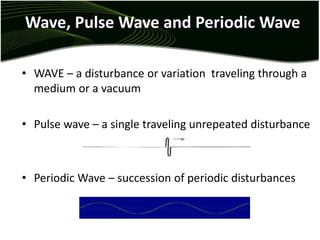
• WAVE – a disturbance or variation traveling through a
medium or a vacuum
• Pulse wave – a single traveling unrepeated disturbance
• Periodic Wave – succession of periodic disturbances
IMPORTANT
Waves are simply energy carriers. As the wave
travels through a medium, the energy it
carries is transmitted as vibrational energy
from one particle to another. The particles of
the medium do not move or go with wave.
WAVE Types:
1. MECHANICAL WAVES – waves that
requires a medium for propagation
Examples: sound waves, water waves
2. ELECTROMAGNETIC WAVES (EM) – waves
that can travel through a medium or
through vacuum
Examples: light, radio waves, gamma rays
Group Activity: Human Simulation
Discuss the following questions:
• What is a transverse/longitudinal wave?
• What is frequency? wavelength? amplitude?
Then, simulate your assigned wave using your own
bodies to show the following:
• wave with low frequency and low amplitude
• wave with high frequency and low amplitude
• wave with low frequency and high amplitude
• wave with high frequency and high amplitude
Group Activity: Human Simulation
Transverse:
• wave with low frequency
and low amplitude
• wave with high frequency
and low amplitude
• wave with low frequency
and high amplitude
• wave with high frequency
and high amplitude
Longitudinal:
• Wave with low frequency
• Wave with high frequency
• Wave with short
wavelength
• Wave with long wavelength
Then, simulate your assigned wave using
your own bodies to show the following:
Types of Mechanical Waves:
a. Transverse Waves – the particles of the
medium vibrates perpendicular to the
direction of the wave motion
b. Longitudinal Waves – the particles of
the medium vibrates parallel to the
direction of the wave motion
c. Surface Waves – combination of
transverse and longitudinal motion
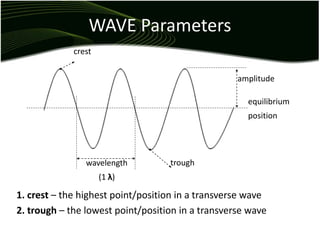
WAVE Parameters
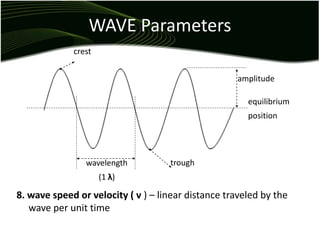
crest
wavelength
(1 λ)
equilibrium
position
amplitude
trough
1. crest – the highest point/position in a transverse wave
2. trough – the lowest point/position in a transverse wave
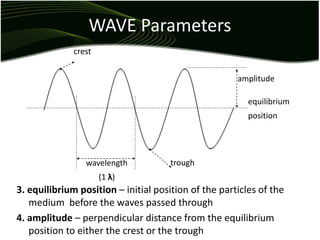
WAVE Parameters
crest
wavelength
(1 λ)
equilibrium
position
amplitude
trough
3. equilibrium position – initial position of the particles of the
medium before the waves passed through
4. amplitude – perpendicular distance from the equilibrium
position to either the crest or the trough
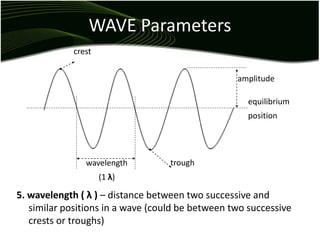
WAVE Parameters
crest
wavelength
(1 λ)
equilibrium
position
amplitude
trough
5. wavelength ( λ ) – distance between two successive and
similar positions in a wave (could be between two successive
crests or troughs)
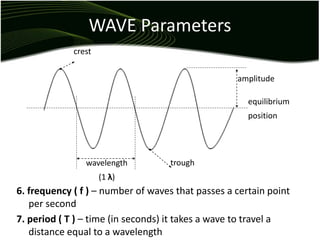
WAVE Parameters
crest
wavelength
(1 λ)
equilibrium
position
amplitude
trough
6. frequency ( f ) – number of waves that passes a certain point
per second
7. period ( T ) – time (in seconds) it takes a wave to travel a
distance equal to a wavelength
WAVE Parameters
crest
wavelength
(1 λ)
equilibrium
position
amplitude
trough
8. wave speed or velocity ( v ) – linear distance traveled by the
wave per unit time
WAVE Parameters
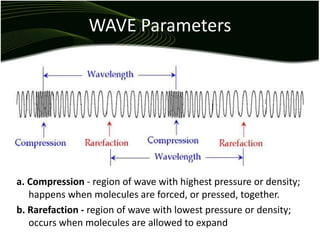
a. Compression - region of wave with highest pressure or density;
happens when molecules are forced, or pressed, together.
b. Rarefaction - region of wave with lowest pressure or density;
occurs when molecules are allowed to expand
fin
General Properties
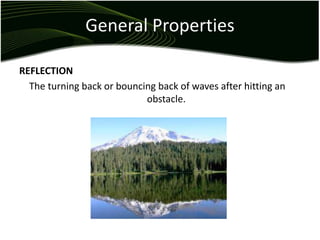
REFLECTION
The turning back or bouncing back of waves after hitting an
obstacle.
General Properties
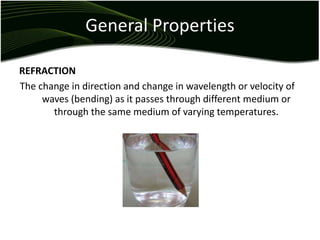
REFRACTION
The change in direction and change in wavelength or velocity of
waves (bending) as it passes through different medium or
through the same medium of varying temperatures.
General Properties
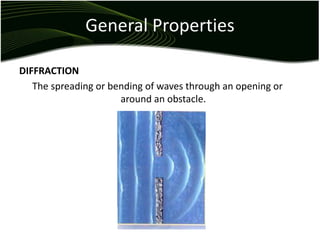
DIFFRACTION
The spreading or bending of waves through an opening or
around an obstacle.
General Properties
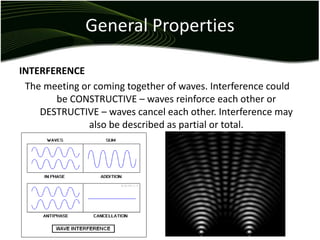
INTERFERENCE
The meeting or coming together of waves. Interference could
be CONSTRUCTIVE – waves reinforce each other or
DESTRUCTIVE – waves cancel each other. Interference may
also be described as partial or total.
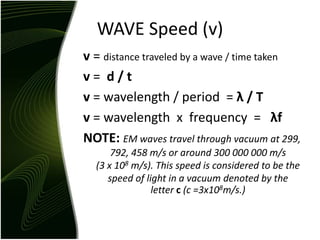
WAVE Speed (v)
v = distance traveled by a wave / time taken
v = d / t
v = wavelength / period = λ / T
v = wavelength x frequency = λf
NOTE: EM waves travel through vacuum at 299,
792, 458 m/s or around 300 000 000 m/s
(3 x 10⁸ m/s). This speed is considered to be the
speed of light in a vacuum denoted by the
letter c (c =3x10⁸m/s.)
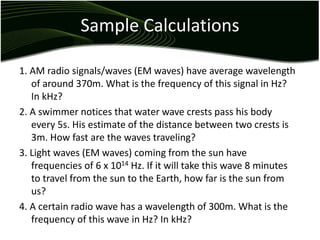
Sample Calculations
1. AM radio signals/waves (EM waves) have average wavelength
of around 370m. What is the frequency of this signal in Hz?
In kHz?
2. A swimmer notices that water wave crests pass his body
every 5s. His estimate of the distance between two crests is
3m. How fast are the waves traveling?
3. Light waves (EM waves) coming from the sun have
frequencies of 6 x 10¹⁴ Hz. If it will take this wave 8 minutes
to travel from the sun to the Earth, how far is the sun from
us?
4. A certain radio wave has a wavelength of 300m. What is the
frequency of this wave in Hz? In kHz?

07 waves

  • 2.
  • 3.
  • 4.
    Wave, Pulse Waveand Periodic Wave • WAVE – a disturbance or variation traveling through a medium or a vacuum • Pulse wave – a single traveling unrepeated disturbance • Periodic Wave – succession of periodic disturbances
  • 5.
    IMPORTANT Waves are simplyenergy carriers. As the wave travels through a medium, the energy it carries is transmitted as vibrational energy from one particle to another. The particles of the medium do not move or go with wave.
  • 6.
    WAVE Types: 1. MECHANICALWAVES – waves that requires a medium for propagation Examples: sound waves, water waves 2. ELECTROMAGNETIC WAVES (EM) – waves that can travel through a medium or through vacuum Examples: light, radio waves, gamma rays
  • 7.
    Group Activity: HumanSimulation Discuss the following questions: • What is a transverse/longitudinal wave? • What is frequency? wavelength? amplitude? Then, simulate your assigned wave using your own bodies to show the following: • wave with low frequency and low amplitude • wave with high frequency and low amplitude • wave with low frequency and high amplitude • wave with high frequency and high amplitude
  • 8.
    Group Activity: HumanSimulation Transverse: • wave with low frequency and low amplitude • wave with high frequency and low amplitude • wave with low frequency and high amplitude • wave with high frequency and high amplitude Longitudinal: • Wave with low frequency • Wave with high frequency • Wave with short wavelength • Wave with long wavelength Then, simulate your assigned wave using your own bodies to show the following:
  • 9.
    Types of MechanicalWaves: a. Transverse Waves – the particles of the medium vibrates perpendicular to the direction of the wave motion b. Longitudinal Waves – the particles of the medium vibrates parallel to the direction of the wave motion c. Surface Waves – combination of transverse and longitudinal motion
  • 10.
    WAVE Parameters crest wavelength (1 λ) equilibrium position amplitude trough 1.crest – the highest point/position in a transverse wave 2. trough – the lowest point/position in a transverse wave
  • 11.
    WAVE Parameters crest wavelength (1 λ) equilibrium position amplitude trough 3.equilibrium position – initial position of the particles of the medium before the waves passed through 4. amplitude – perpendicular distance from the equilibrium position to either the crest or the trough
  • 12.
    WAVE Parameters crest wavelength (1 λ) equilibrium position amplitude trough 5.wavelength ( λ ) – distance between two successive and similar positions in a wave (could be between two successive crests or troughs)
  • 13.
    WAVE Parameters crest wavelength (1 λ) equilibrium position amplitude trough 6.frequency ( f ) – number of waves that passes a certain point per second 7. period ( T ) – time (in seconds) it takes a wave to travel a distance equal to a wavelength
  • 14.
    WAVE Parameters crest wavelength (1 λ) equilibrium position amplitude trough 8.wave speed or velocity ( v ) – linear distance traveled by the wave per unit time
  • 15.
    WAVE Parameters a. Compression- region of wave with highest pressure or density; happens when molecules are forced, or pressed, together. b. Rarefaction - region of wave with lowest pressure or density; occurs when molecules are allowed to expand
  • 17.
  • 18.
    General Properties REFLECTION The turningback or bouncing back of waves after hitting an obstacle.
  • 19.
    General Properties REFRACTION The changein direction and change in wavelength or velocity of waves (bending) as it passes through different medium or through the same medium of varying temperatures.
  • 20.
    General Properties DIFFRACTION The spreadingor bending of waves through an opening or around an obstacle.
  • 21.
    General Properties INTERFERENCE The meetingor coming together of waves. Interference could be CONSTRUCTIVE – waves reinforce each other or DESTRUCTIVE – waves cancel each other. Interference may also be described as partial or total.
  • 22.
    WAVE Speed (v) v= distance traveled by a wave / time taken v = d / t v = wavelength / period = λ / T v = wavelength x frequency = λf NOTE: EM waves travel through vacuum at 299, 792, 458 m/s or around 300 000 000 m/s (3 x 10⁸ m/s). This speed is considered to be the speed of light in a vacuum denoted by the letter c (c =3x10⁸m/s.)
  • 23.
    Sample Calculations 1. AMradio signals/waves (EM waves) have average wavelength of around 370m. What is the frequency of this signal in Hz? In kHz? 2. A swimmer notices that water wave crests pass his body every 5s. His estimate of the distance between two crests is 3m. How fast are the waves traveling? 3. Light waves (EM waves) coming from the sun have frequencies of 6 x 10¹⁴ Hz. If it will take this wave 8 minutes to travel from the sun to the Earth, how far is the sun from us? 4. A certain radio wave has a wavelength of 300m. What is the frequency of this wave in Hz? In kHz?