Waves and Vibrations
Objectives describe the difference between a longitudinal wave and a transverse wave identify the parts of a wave calculate wave speed when frequency and wavelength are given
Key Terms
Waves are everywhere in nature Sound waves  light waves radio waves  microwaves  water waves  telephone cord waves stadium waves  earthquake waves waves on a string  slinky waves
What is a wave? a wave  is a disturbance that travels through a medium from one location to another. the wave is the motion of a disturbance
Slinky Wave Let’s use a slinky wave as an example. When the slinky is stretched from end to end and is held at rest, it assumes a natural position known as the  equilibrium  or  rest  position To create a wave here we must first create a disturbance.
Slinky Wave One way to do this is to quickly push the slinky forward the disturbance moves down the slinky this disturbance that moves down the slinky is called a  pulse .
Slinky Wave
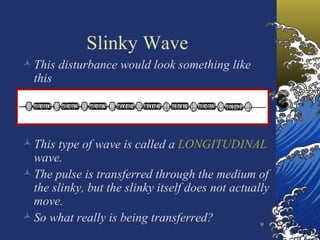
Slinky Wave This disturbance would look something like this This type of wave is called a  LONGITUDINAL  wave. The pulse is transferred through the medium of the slinky, but the slinky itself does not actually move. So what really is being transferred?
Slinky Wave Energy   is being transferred. The metal of the slinky is the MEDIUM in that transfers the energy pulse of the wave. The medium ends up in the same place as it started … it just gets disturbed and then returns to it rest position. The same can be seen with a  stadium wave .
Longitudinal Wave In a longitudinal wave, the medium particles vibrate  parallel  to the motion of the pulse. This is the type of wave that transfers sound.
Transverse waves A second type of wave is a transverse wave. Remember, in a  longitudinal  wave the pulse travels in a direction  parallel  to the disturbance. In a  transverse  wave the pulse travels  perpendicular  to the disturbance.
Transverse Waves The differences between the two can be seen
Transverse Waves Transverse waves occur when we wiggle the slinky back and forth.
Transverse v. Longitudinal
Anatomy of a Wave Now we can begin to describe the anatomy of our waves. We will use a  transverse  wave to describe this since it is easier to see the pieces.
Anatomy of a Wave In our wave here the blue line is the wave and the solid grey line is the equilibrium position Once the medium is disturbed, the medium moves away from equilibrium and then returns to it equilibrium
Anatomy of a Wave The points A and B are called the  CRESTS  of the wave. This is the point where the wave exhibits the maximum amount of positive or upwards displacement A B crest
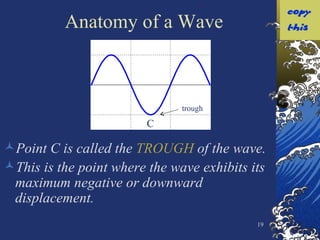
Anatomy of a Wave Point C is called the  TROUGH  of the wave. This is the point where the wave exhibits its maximum negative or downward displacement. C trough
Anatomy of a Wave The height of the wave – as measured from equilibrium to crest is called the  amplitude This is the maximum displacement that the wave moves away from its equilibrium. Amplitude A crest
Anatomy of a Wave The distance between two consecutive similar points (in this case two crests) is called the  wavelength . Between what other points is can a wavelength be measured? wavelength
Wave frequency We know that frequency measures how often something happens over a certain amount of time. A wave’s  frequency  is measured by how many complete waves pass a fixed point in a certain amount of time
Wave frequency Suppose I wiggle a slinky back and forth, and count that 6 waves pass a point in 2 seconds.  What would the frequency be? 3 waves / second 3 Hertz Hertz = Hz.
Wave frequency Suppose I wiggle a slinky back and forth, and count that 27 waves pass a point in 1 second.  What would the frequency be? 27 waves / second 27 Hertz
Wave frequency Can you create a formula for frequency? frequency = # of waves that pass by / time Frequency is measured in Hertz (Hz)
Wave Speed Think back to what you know about motion: what is the formula for speed? speed = distance / time so to calculate speed, we need to know two things: 1. distance 2. time
Wave Speed Let’s apply what we know about speed to waves: A set of waves passes a point 5 times in one second (5 Hz) Each wave is 4 cm long What is the total distance traveled? How long does it take the waves to travel this distance?
Wave Speed 5 waves that are 4 cm long each = 20 cm it takes these five waves one second to pass by speed = distance/time what’s the wave’s speed? Answer = 20 cm/s
Wave Speed Here’s another problem: 10 waves pass by in two seconds (5 Hz) each wave is 3 m in length
Wave Speed Total distance = 30m time = 2s Speed? Answer: 15m/s
Wave Speed The problems I’m giving you can be reasoned out… but what if you wanted (or needed)  a formula?
Wave Speed Formula Let’s look at another problem with easy numbers: 5 waves pass by in a second; each wave is 2 cm long the total distance traveled by all waves is 10 cm, the time it takes them to pass by is 1 second, so the speed is 10 cm/s
Wave Speed Formula 5 waves pass by in a second (frequency); each wave is 2 cm long (wavelength) the speed is 10 cm/s what is the relationship between the speed, frequency, and wavelength in the problem?
Wave Speed Formula If given frequency (Hz or waves/s), and wavelength, the formula for wave speed is: frequency  x  wavelength = wave speed
Exit Slip Describe the differences between a longitudinal and transverse wave. Draw a transverse wave and label the wavelength, amplitude, crest, and trough. If the wavelength is 20 cm and frequency is 5Hz, what is the wave’s speed? SHOW YOUR WORK!

Waves

  • 1.
  • 2.
    Objectives describe thedifference between a longitudinal wave and a transverse wave identify the parts of a wave calculate wave speed when frequency and wavelength are given
  • 3.
  • 4.
    Waves are everywherein nature Sound waves light waves radio waves microwaves water waves telephone cord waves stadium waves earthquake waves waves on a string slinky waves
  • 5.
    What is awave? a wave is a disturbance that travels through a medium from one location to another. the wave is the motion of a disturbance
  • 6.
    Slinky Wave Let’suse a slinky wave as an example. When the slinky is stretched from end to end and is held at rest, it assumes a natural position known as the equilibrium or rest position To create a wave here we must first create a disturbance.
  • 7.
    Slinky Wave Oneway to do this is to quickly push the slinky forward the disturbance moves down the slinky this disturbance that moves down the slinky is called a pulse .
  • 8.
  • 9.
    Slinky Wave Thisdisturbance would look something like this This type of wave is called a LONGITUDINAL wave. The pulse is transferred through the medium of the slinky, but the slinky itself does not actually move. So what really is being transferred?
  • 10.
    Slinky Wave Energy is being transferred. The metal of the slinky is the MEDIUM in that transfers the energy pulse of the wave. The medium ends up in the same place as it started … it just gets disturbed and then returns to it rest position. The same can be seen with a stadium wave .
  • 11.
    Longitudinal Wave Ina longitudinal wave, the medium particles vibrate parallel to the motion of the pulse. This is the type of wave that transfers sound.
  • 12.
    Transverse waves Asecond type of wave is a transverse wave. Remember, in a longitudinal wave the pulse travels in a direction parallel to the disturbance. In a transverse wave the pulse travels perpendicular to the disturbance.
  • 13.
    Transverse Waves Thedifferences between the two can be seen
  • 14.
    Transverse Waves Transversewaves occur when we wiggle the slinky back and forth.
  • 15.
  • 16.
    Anatomy of aWave Now we can begin to describe the anatomy of our waves. We will use a transverse wave to describe this since it is easier to see the pieces.
  • 17.
    Anatomy of aWave In our wave here the blue line is the wave and the solid grey line is the equilibrium position Once the medium is disturbed, the medium moves away from equilibrium and then returns to it equilibrium
  • 18.
    Anatomy of aWave The points A and B are called the CRESTS of the wave. This is the point where the wave exhibits the maximum amount of positive or upwards displacement A B crest
  • 19.
    Anatomy of aWave Point C is called the TROUGH of the wave. This is the point where the wave exhibits its maximum negative or downward displacement. C trough
  • 20.
    Anatomy of aWave The height of the wave – as measured from equilibrium to crest is called the amplitude This is the maximum displacement that the wave moves away from its equilibrium. Amplitude A crest
  • 21.
    Anatomy of aWave The distance between two consecutive similar points (in this case two crests) is called the wavelength . Between what other points is can a wavelength be measured? wavelength
  • 22.
    Wave frequency Weknow that frequency measures how often something happens over a certain amount of time. A wave’s frequency is measured by how many complete waves pass a fixed point in a certain amount of time
  • 23.
    Wave frequency SupposeI wiggle a slinky back and forth, and count that 6 waves pass a point in 2 seconds. What would the frequency be? 3 waves / second 3 Hertz Hertz = Hz.
  • 24.
    Wave frequency SupposeI wiggle a slinky back and forth, and count that 27 waves pass a point in 1 second. What would the frequency be? 27 waves / second 27 Hertz
  • 25.
    Wave frequency Canyou create a formula for frequency? frequency = # of waves that pass by / time Frequency is measured in Hertz (Hz)
  • 26.
    Wave Speed Thinkback to what you know about motion: what is the formula for speed? speed = distance / time so to calculate speed, we need to know two things: 1. distance 2. time
  • 27.
    Wave Speed Let’sapply what we know about speed to waves: A set of waves passes a point 5 times in one second (5 Hz) Each wave is 4 cm long What is the total distance traveled? How long does it take the waves to travel this distance?
  • 28.
    Wave Speed 5waves that are 4 cm long each = 20 cm it takes these five waves one second to pass by speed = distance/time what’s the wave’s speed? Answer = 20 cm/s
  • 29.
    Wave Speed Here’sanother problem: 10 waves pass by in two seconds (5 Hz) each wave is 3 m in length
  • 30.
    Wave Speed Totaldistance = 30m time = 2s Speed? Answer: 15m/s
  • 31.
    Wave Speed Theproblems I’m giving you can be reasoned out… but what if you wanted (or needed) a formula?
  • 32.
    Wave Speed FormulaLet’s look at another problem with easy numbers: 5 waves pass by in a second; each wave is 2 cm long the total distance traveled by all waves is 10 cm, the time it takes them to pass by is 1 second, so the speed is 10 cm/s
  • 33.
    Wave Speed Formula5 waves pass by in a second (frequency); each wave is 2 cm long (wavelength) the speed is 10 cm/s what is the relationship between the speed, frequency, and wavelength in the problem?
  • 34.
    Wave Speed FormulaIf given frequency (Hz or waves/s), and wavelength, the formula for wave speed is: frequency x wavelength = wave speed
  • 35.
    Exit Slip Describethe differences between a longitudinal and transverse wave. Draw a transverse wave and label the wavelength, amplitude, crest, and trough. If the wavelength is 20 cm and frequency is 5Hz, what is the wave’s speed? SHOW YOUR WORK!