INTRODUCTI
ON
TO
LIGHT WAVES
Jade Kristine M. Comia
Crystal Mary Vinas
Catherine Florendo
In this module, you will be able to:
Describe
what happens
when light is
refracted,
reflected,
transmitted,
and
absorbed;
Cite the
contributions
of Newton
and
Descartes in
the study of
the colors of
light;
Compare
and contrast
the particle
theory and
the wave
theory of
light
Cite
examples
of
waves;
and
WAVES
• Disturbances in space and time
• They cannot travel in a vacuum or
empty space
• They require a medium for propagation
LIGHT WAVES
• Form of an EM wave that is
propagated perpendicular to the source
of energy.
• They travel in straight path.
PROPERTIES OF LIGHT
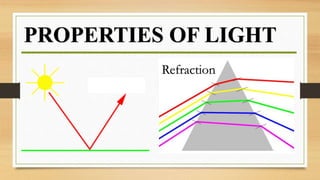
Refraction
PROPERTIES OF LIGHT
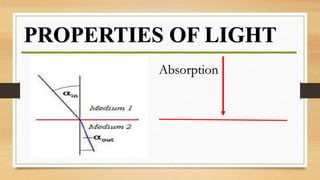
Absorption
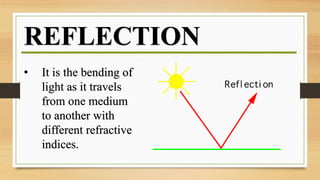
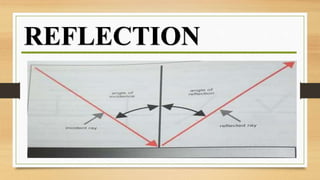
REFLECTION
• It is the bending of
light as it travels
from one medium
to another with
different refractive
indices.
REFLECTION
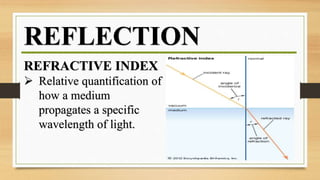
REFRACTIVE INDEX
 Relative quantification of
how a medium
propagates a specific
wavelength of light.
REFLECTION
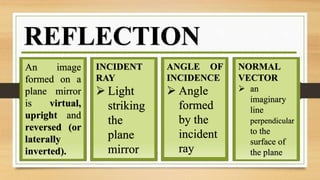
REFLECTION
An image
formed on a
plane mirror
is virtual,
upright and
reversed (or
laterally
inverted).
INCIDENT
RAY
 Light
striking
the
plane
mirror
ANGLE OF
INCIDENCE
 Angle
formed
by the
incident
ray
NORMAL
VECTOR
 an
imaginary
line
perpendicular
to the
surface of
the plane
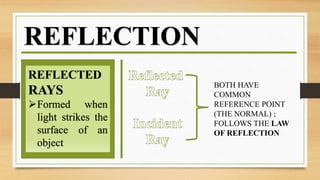
REFLECTION
REFLECTED
RAYS
Formed when
light strikes the
surface of an
object
BOTH HAVE
COMMON
REFERENCE POINT
(THE NORMAL) ;
FOLLOWS THE LAW
OF REFLECTION
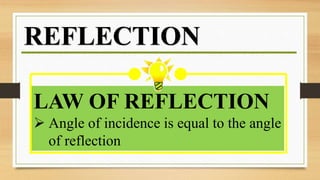
LAW OF REFLECTION
 Angle of incidence is equal to the angle
of reflection
REFLECTION
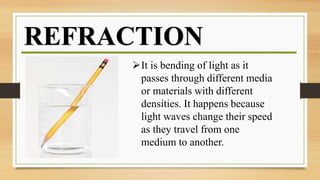
REFRACTION
It is bending of light as it
passes through different media
or materials with different
densities. It happens because
light waves change their speed
as they travel from one
medium to another.
VIRTUAL/APPEARANCE IMAGE
 image that appears in a different
location than its actual location
REFRACTION
REFRACTION
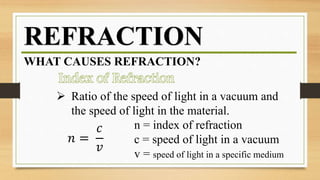
WHAT CAUSES REFRACTION?
 Ratio of the speed of light in a vacuum and
the speed of light in the material.
𝑛 =
𝑐
𝑣
n = index of refraction
c = speed of light in a vacuum
v = speed of light in a specific medium
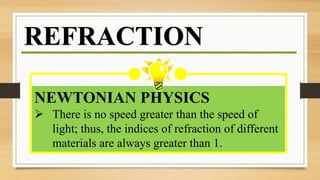
NEWTONIAN PHYSICS
 There is no speed greater than the speed of
light; thus, the indices of refraction of different
materials are always greater than 1.
REFRACTION
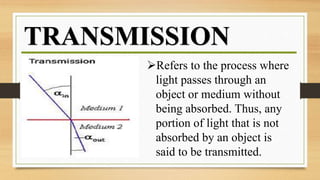
TRANSMISSION
Refers to the process where
light passes through an
object or medium without
being absorbed. Thus, any
portion of light that is not
absorbed by an object is
said to be transmitted.
TRANSMISSION
TRANSMITTANCE (T)
 Ratio between the absorbed light (I) and
the incident light (Io)
 It is unitless and is used as a relative
comparison of how efficient a medium is
in transmitting light.
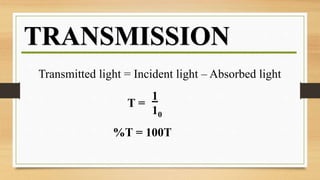
Transmitted light = Incident light – Absorbed light
TRANSMISSION
1
10
T =
%T = 100T
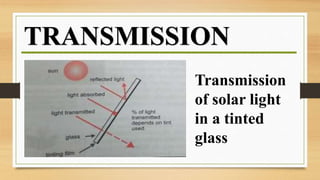
Transmission
of solar light
in a tinted
glass
TRANSMISSION
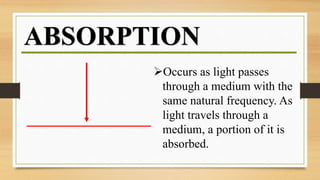
ABSORPTION
Occurs as light passes
through a medium with the
same natural frequency. As
light travels through a
medium, a portion of it is
absorbed.
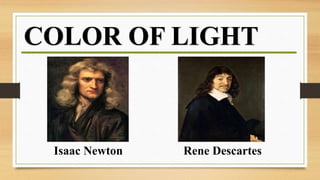
COLOR OF LIGHT
Isaac Newton Rene Descartes
COLOR OF LIGHT
PRISM
Medium that diffracts life
SEVEN COLORS
ROYGBIV
COLOR OF LIGHT
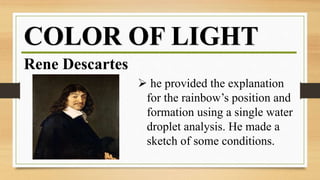
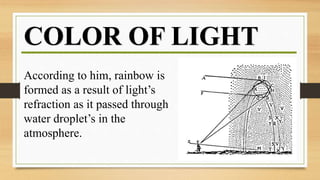
Rene Descartes
 he provided the explanation
for the rainbow’s position and
formation using a single water
droplet analysis. He made a
sketch of some conditions.
RAINBOW
 A manifestation that indeed light is composed
of seven colors (red, orange, yellow, green,
blue, indigo and violet)
COLOR OF LIGHT
COLOR OF LIGHT
According to him, rainbow is
formed as a result of light’s
refraction as it passed through
water droplet’s in the
atmosphere.
COLOR OF LIGHT
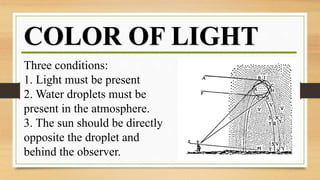
Three conditions:
1. Light must be present
2. Water droplets must be
present in the atmosphere.
3. The sun should be directly
opposite the droplet and
behind the observer.
COLOR OF LIGHT
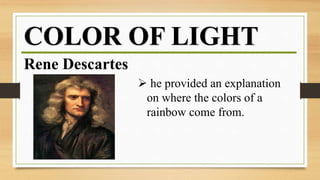
Rene Descartes
 he provided an explanation
on where the colors of a
rainbow come from.
SPECTRUM
 Components of light with
varying wavelengths
COLOR OF LIGHT
DUAL NATURE OF LIGHT
The wave-particle duality of light is a paradigm
wherein light is viewed as both a wave and a
particle.
Light has both the properties of a wave (form of
energy) and a particle.
Introduction to Light Waves

Introduction to Light Waves

  • 1.
    INTRODUCTI ON TO LIGHT WAVES Jade KristineM. Comia Crystal Mary Vinas Catherine Florendo
  • 2.
    In this module,you will be able to: Describe what happens when light is refracted, reflected, transmitted, and absorbed; Cite the contributions of Newton and Descartes in the study of the colors of light; Compare and contrast the particle theory and the wave theory of light Cite examples of waves; and
  • 3.
    WAVES • Disturbances inspace and time • They cannot travel in a vacuum or empty space • They require a medium for propagation
  • 4.
    LIGHT WAVES • Formof an EM wave that is propagated perpendicular to the source of energy. • They travel in straight path.
  • 5.
  • 6.
  • 7.
    REFLECTION • It isthe bending of light as it travels from one medium to another with different refractive indices.
  • 8.
    REFLECTION REFRACTIVE INDEX  Relativequantification of how a medium propagates a specific wavelength of light.
  • 9.
  • 10.
    REFLECTION An image formed ona plane mirror is virtual, upright and reversed (or laterally inverted). INCIDENT RAY  Light striking the plane mirror ANGLE OF INCIDENCE  Angle formed by the incident ray NORMAL VECTOR  an imaginary line perpendicular to the surface of the plane
  • 11.
    REFLECTION REFLECTED RAYS Formed when light strikesthe surface of an object BOTH HAVE COMMON REFERENCE POINT (THE NORMAL) ; FOLLOWS THE LAW OF REFLECTION
  • 12.
    LAW OF REFLECTION Angle of incidence is equal to the angle of reflection REFLECTION
  • 13.
    REFRACTION It is bendingof light as it passes through different media or materials with different densities. It happens because light waves change their speed as they travel from one medium to another.
  • 14.
    VIRTUAL/APPEARANCE IMAGE  imagethat appears in a different location than its actual location REFRACTION
  • 15.
    REFRACTION WHAT CAUSES REFRACTION? Ratio of the speed of light in a vacuum and the speed of light in the material. 𝑛 = 𝑐 𝑣 n = index of refraction c = speed of light in a vacuum v = speed of light in a specific medium
  • 16.
    NEWTONIAN PHYSICS  Thereis no speed greater than the speed of light; thus, the indices of refraction of different materials are always greater than 1. REFRACTION
  • 17.
    TRANSMISSION Refers to theprocess where light passes through an object or medium without being absorbed. Thus, any portion of light that is not absorbed by an object is said to be transmitted.
  • 18.
    TRANSMISSION TRANSMITTANCE (T)  Ratiobetween the absorbed light (I) and the incident light (Io)  It is unitless and is used as a relative comparison of how efficient a medium is in transmitting light.
  • 19.
    Transmitted light =Incident light – Absorbed light TRANSMISSION 1 10 T = %T = 100T
  • 20.
    Transmission of solar light ina tinted glass TRANSMISSION
  • 21.
    ABSORPTION Occurs as lightpasses through a medium with the same natural frequency. As light travels through a medium, a portion of it is absorbed.
  • 22.
    COLOR OF LIGHT IsaacNewton Rene Descartes
  • 23.
    COLOR OF LIGHT PRISM Mediumthat diffracts life SEVEN COLORS ROYGBIV
  • 24.
    COLOR OF LIGHT ReneDescartes  he provided the explanation for the rainbow’s position and formation using a single water droplet analysis. He made a sketch of some conditions.
  • 25.
    RAINBOW  A manifestationthat indeed light is composed of seven colors (red, orange, yellow, green, blue, indigo and violet) COLOR OF LIGHT
  • 26.
    COLOR OF LIGHT Accordingto him, rainbow is formed as a result of light’s refraction as it passed through water droplet’s in the atmosphere.
  • 27.
    COLOR OF LIGHT Threeconditions: 1. Light must be present 2. Water droplets must be present in the atmosphere. 3. The sun should be directly opposite the droplet and behind the observer.
  • 28.
    COLOR OF LIGHT ReneDescartes  he provided an explanation on where the colors of a rainbow come from.
  • 29.
    SPECTRUM  Components oflight with varying wavelengths COLOR OF LIGHT
  • 30.
    DUAL NATURE OFLIGHT The wave-particle duality of light is a paradigm wherein light is viewed as both a wave and a particle. Light has both the properties of a wave (form of energy) and a particle.

Editor's Notes

  • #4 Waves are everywhere. You are able to see the text on this module because of electromagnetic waves (EM). A marine vessel uses water waves. An ambulance transmits sound waves through its siren.
  • #5 EM waves do not require a medium to travel. This is why sunlight can reach Earth even if the outer space is basically a vacuum. EM waves is the EM Spectrum includes radio waves (longest wave), microwaves, infrared, visible light, ultraviolet ray, X-Ray, and gamma ray. All waves travel at a constant speed of 3 x 10⁸ m/s in vacuum. That is why if you put an obstruction (opaque object) in front of a light, a shadow will be formed. The area where the shadow is formed is the part where light cannot pass through.
  • #9 Others have different refractive indices, that is why certain objects can reflect light while others cannot. Reflection does not affect the wavelength of light or the distance between two successive identical points that is measured in nanometers. The wavelength of light reflected determines the color you see. For example, you see leaves as green because the leaves reflect the 510 nm portion of the visible light which corresponds to the green color. When you look at yourself in the mirror, the image you see will have the same color –from the clothes you are wearing to the color of your skin. This is because when light strikes you, a portion of it is reflected toward the mirror. The mirror reflects the light without changing its wavelength. Thus, you or the object will have the same color as the image.
  • #14 What do you see? Why does the pencil appear to be broken? Because it shows refraction of light. What do you think are the medias used in the picture? 1.) air 2.) glass 3.) water There are also three distinct portions of the pencil’s images: a.) portion of the pencil extending from the top of the glass; b.) portion of the pencil just above the surface of the water; and c.) portion of the pencil submerged under water Why does this happen? a.) Light is reflected by the pencil and travels through air towards the eye. b.) Light travels through three media (Light is reflected by the straw and then refracted by the glass. Since the glass layer is thin, it provides distortion to the path of the light as compared to the last portion of the straw. c.) There is an evident distortion of its image. Not only does the pencil appear wider, it also does not appear on its true location as seen in the discontinuity of the broken image.
  • #15 * Why does an image do not appear in its actual location? When there are great distortions in the light’s path, the brain bases the location of the image from the source of the light. The location of the image is actually the point of refraction of light. The picture also tells you that refraction does not affect the frequency of light. The pencil is still red in the water.
  • #16 Each material has an index of refraction. Light refracts whenever light travels from one medium to another that have different indices of refraction. Mathematically, the index of refraction can be calculated using this: The equation tells you two things: 1.) it does not have any unit 2.) the n is the ration between the c and v
  • #19 Transmission of light is expressed in terms of transmittance.
  • #21 Tinting or coating of car windows and windshields is an application of the concept of light transmission. Some types of tinted/coated glass are used to filter the harmful UV light from the sun. The layer produced after tinting the glass reflects the harmful UV light.
  • #22 A system does not always perfectly reflect or refract light. As light strikes or passes through an object,
  • #24 Rainbow occurs when there is sunlight and water droplets present in the atmosphere. Thousands of tiny waters act as a prism. When light passes through the water droplets, the components of light spectrum separate based on their wavelengths. The seven colors emerge. This is the explanation how rainbows are formed.
  • #29 During the late 1660s people thought that colors are just about light and darkness. They believed that colors result from the different combination of light and darkness. White existed in the absence of darkness and black existed in the absence of light. Newton wanted to disprove this and Robert Hooke’s claim that prisms provide the color of light.
  • #30 He conducted an experiment in a dark room where there was a small hole in the windows where light passed through. He placed two prisms opposite with each other and in line with the path of light. When he let the light passed through the prism, the white light separated into seven colored bands (spectrum). He let it strike the other prism and was surprised that the colors combined again to form white light. He concluded that a prism does not color light, rather, it separates the components of white light into seven different colors.