Copyright © 2006 Pearson Education, Inc., publishing as Benjamin Cummings
Microorganisms found in Food
 Food safety is a global issue
 Soil microbes can spoil food
 Contamination by unsanitary handling of food
 Improper storage and preparation procedures can lead
to contamination by pathogens
 Imports of fruits and vegetables from 3rd World
countries can bring in diseases and parasites
 *Hands washed properly??
Copyright © 2006 Pearson Education, Inc., publishing as Benjamin Cummings
Bread Production - Sour Dough Bread
 Sourdough culture- yeast Candida milleri and
Lactobacillus sanfrancisco 1:100 ratio
 German sour rye bread has 4 different yeast species
and 13 species of Lactobacilli
 Yeast feed on the sugars except maltose, Lactobacilli
need maltose, then produce ethyl alcohol and CO2
 Lactobacilli produce lactic and acetic acids giving the
sour flavor, pH 3.6 - 4.0 inhibits microbial growth
Copyright © 2006 Pearson Education, Inc., publishing as Benjamin Cummings
GRAINS
 Rye and wheat are harvested dry
 If they get wet, molds and other microbes will grow
 Insect, birds and rodent vectors also transmit microbes
 Raw grain with mold Claviceps purpurea cause
ergotism, mold is halucinogenic and deadly
 Aspergillus produce aflatoxins
 Rhizopus nigricans is most common bread mold, also
Aspergillus, Penicillium and Monila (pink mold)
 Rye bread likely infected by Bacillus sp (w/spores)
Copyright © 2006 Pearson Education, Inc., publishing as Benjamin Cummings
FRUITS AND VEGETABLES
 Pseudomonas fluorescens are found on surface of
fruits and vegetables
 Pathogens: Salmonella, Shigella, Entameoba, Ascaris
can be transmitted on surfaces
 Leafy vegetables more susceptible to rot by Erwinia
carotovora, Penicillium mold on citrus fruits and apples
 Fungus Phytophthora infestans caused potato blight
 Now using GMO to make plants resistant
 Tomato rot- Fusarium fungus, Rhizopus injected by
insects. Peach rot - Monilia fruiticola
Copyright © 2006 Pearson Education, Inc., publishing as Benjamin Cummings
MEATS AND POULTRY
70 pathogens found at slaughterhouses, inspected by vet
Dec 2003 -1st case of Mad Cow in US, stricter laws
Carcasses are hung in refrigerated rooms to age, some
mold: Rhizopus and Mucor , Pseudomonas release
H2S and green coloration
Clostridium cause bone stink deep in carcass
Ground meat- may have helminths-Trichinella, lactobacilli
Should be cooked to kill pathogens
Copyright © 2006 Pearson Education, Inc., publishing as Benjamin Cummings
MEATS AND POULTRY
 20 bacteria found on Poultry- 1/2 of all infections
caused by Salmonella, ¼ by Clostridium perfringens,
¼ Staphylococcus aureus,
 Gram – Pseudomonas cause slime and odors
 Eggs have a hard porous shell, and microbes can get
through
 Chickens laying eggs can have Salmonella,1/10000
eggs has this bacteria in side shell, it does not have to
be cracked so always cook eggs; don’t eat raw eggs!
Copyright © 2006 Pearson Education, Inc., publishing as Benjamin Cummings
FISH AND SHELLFISH
 Fresh fish have microbes: enteric bacteria, worms, &
viruses which survive even shipped in ice
 Shellfish- oysters & clams –Salmonella and Vibrio
 Clams filter feeder can pick up red tides toxins, sewage
 Shrimp (breaded) have high bacterial counts
 Lobster and crabs - enteric pathogens
 Crabs carry Clostridium, Cryptococcus and Candida
Copyright © 2006 Pearson Education, Inc., publishing as Benjamin Cummings
MILK
 Breeding cattle for high milk production have large
udders and easily admit bacteria- get rid of 1st few
squirts which can have 15,000 bacteria /ml
 Mostly Staphylococcus, Micrococcus, Pseudomonas
 Hand milking- E. coli, Acinetobacter
 Diseased cattle can transmit Mycobacterium bovis
Brucella, TB
 Milk is Soured by Streptococcus lactis, Lactobacillus
Copyright © 2006 Pearson Education, Inc., publishing as Benjamin Cummings
OTHER EDIBLE SUBSTANCES
 Sugar- raw cane supports fungi: Aspergillus,
Saccharomyces, Candida. Bacteria: Bacillus and
Micrococcus
 Clostridium causes the bulge in cans
 High sugar concentration acys as preservative
 Maple trees are tapped in spring -Leuconostoc , and
Enterobacter
 Honey toxins for Clostridium spores-floppy baby
syndrome botulism
Copyright © 2006 Pearson Education, Inc., publishing as Benjamin Cummings
OTHER EDIBLE SUBSTANCES
 Spices- mask odors rather than preserve
 Condiments, ketchup mustard have acids
 Harvested coffee subject to molds and coffee rust
 Tea leaves mold by Aspergillus and Penicillium
 Microbes needed to make coffee: Erwinia needed to
digest pectin on coffee bean,
 Yeasts turn bean pulp into alcohol also create flavor of
chocolate
Copyright © 2006 Pearson Education, Inc., publishing as Benjamin Cummings
PREVENTING DISEASE TRANSMISSION
AND FOOD SPOILAGE
 More contamination in large processing plants
 Klebsiella found in human digestive tract is also a
respiratory pathogen, but can cause diarrhea
 TB can be transmitted from unpasteurized milk/cheese
 Virus are transferred through food
 Milk is ideal medium for growth of pathogens/microbes
 Crucial factor to prevent spoilage and disease is
cleanliness in handling, use fresh foods, refrigerate,
 Process quickly and store properly
Copyright © 2006 Pearson Education, Inc., publishing as Benjamin Cummings
Food Are Preserved By
 Drying of grain
 Osmotic pressure (salt or sugar)- Dried and salted
meats and other foods
 Fermentation - milk allowed to sour was made into
cheese
 Canning - use of moist heat under pressure, used to
preserve fruits, vegetables, meats in glass jars and
metal cans.
Destroys microbes, endospores, prevents spoilage
Copyright © 2006 Pearson Education, Inc., publishing as Benjamin Cummings
CANNING
 Some thermophiles (Bacillus stearothermophilus) may
remain alive even after canning, spores can germinate
and grow, can will bulge in heat (thermophilic anaerobic
spoilage)
 Flat sour spoilage
 Mesophilic spoilage- improper canning at room temp
 Sugars
Copyright © 2006 Pearson Education, Inc., publishing as Benjamin Cummings
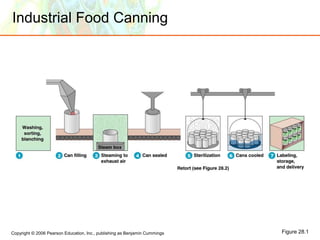
Industrial Food Canning
Figure 28.1
Copyright © 2006 Pearson Education, Inc., publishing as Benjamin Cummings
Commercial Sterilization to Destroy
C. botulinum Endospores
 12D treatment kills 1012 endospores
 Surviving endospores of thermophilic anaerobes cause
spoilage with gas
 Or flat-sour spoilage
Copyright © 2006 Pearson Education, Inc., publishing as Benjamin Cummings
DRYING AND LYOPHILIZATION
 Drying- desication or dehydration is oldest method
 Remove 90% of water
 Stops growth but does not kill microbes
 Can be sun dried, heated in ovens etc
 Addition of slat, sugar or chemicals also used
 Lyophilization- freeze drying is used for instant coffee
and dry yeast for bread making
Copyright © 2006 Pearson Education, Inc., publishing as Benjamin Cummings
Food Preservation- Irradiation
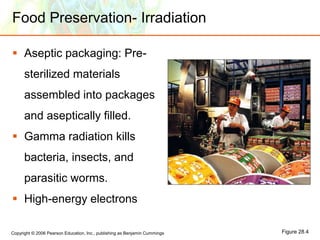
 Aseptic packaging: Pre-
sterilized materials
assembled into packages
and aseptically filled.
 Gamma radiation kills
bacteria, insects, and
parasitic worms.
 High-energy electrons
Figure 28.4
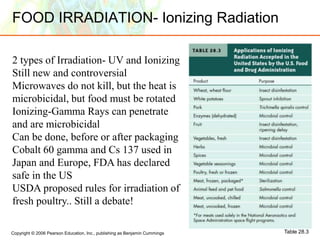
Copyright © 2006 Pearson Education, Inc., publishing as Benjamin Cummings Table 28.3
FOOD IRRADIATION- Ionizing Radiation
2 types of Irradiation- UV and Ionizing
Still new and controversial
Microwaves do not kill, but the heat is
microbicidal, but food must be rotated
Ionizing-Gamma Rays can penetrate
and are microbicidal
Can be done, before or after packaging
Cobalt 60 gamma and Cs 137 used in
Japan and Europe, FDA has declared
safe in the US
USDA proposed rules for irradiation of
fresh poultry.. Still a debate!
Copyright © 2006 Pearson Education, Inc., publishing as Benjamin Cummings
CHEMICAL ADDITIVES
 Benzoic, sorbic and propionic acids used in margarine,
juice, bread, other baked goods
 Alkylating agents- ethylene oxide used on nuts/spices
 Ozone used on shellfish
 NaCl- salt to cure meats, dehydrates bacteria
 Halogen, chloride for processing equipment
 Nitrates on sausage, hot dogs
 QUATS- sanitize udders, fresh vegetables, eggshell
surfaces
Copyright © 2006 Pearson Education, Inc., publishing as Benjamin Cummings
ANTIBIOTICS
 In US only nisin - bacteriocin produced by milk
fermentation by Streptococcus lactis
 Antibiotics are prohibited because: (p 790)
Copyright © 2006 Pearson Education, Inc., publishing as Benjamin Cummings
PASTUERIZATION OF MILK - STANDARDS
 2 methods : High temp short time
 Low temp long time
 Ultra high temperature- UHT treatment
 Some chemical additives
 Milk and Food in US carefully regulated by FDA
 Animals inspected and soon stricter methods by
microscope
 Quality control has many tests for purity and
guarantees high quality milk to consumers
Copyright © 2006 Pearson Education, Inc., publishing as Benjamin Cummings
MICROORGANISMS AS FOOD AND IN
FOOD PRODUCTION
 Algae, Fungi, and Bacteria as Food:
 Yeasts are good source of protein
 1 kg yeast = 100 kg protein, but human digestive tract
can only handle small amounts of it
 Algal cultures: Cyanobacteria- Spirulina and red algae
grown in aquaculture (in Kona)
 Algae- ingredient of ice cream
 Yeast, algae and bacteria could increase World Food
Supply!
Copyright © 2006 Pearson Education, Inc., publishing as Benjamin Cummings
FOOD PRODUCTION: BREAD & DAIRY
 BREAD- previous slide on sour dough
 Yeast Saccharomyces is a leavening agent, produce
gas ato make bread rise and alcohol by fermentation
 Alcohol and CO2 driven off during baking- holes
 DAIRY- cultured buttermilk- Streptococcus cremoris is
added to skim milk and allowed to ferment, also
Leuconostoc sp
 Sour cream- add one of above microbes to cream
 Yogurt- Streptococcus and Lactobacillus added to milk
Copyright © 2006 Pearson Education, Inc., publishing as Benjamin Cummings
FOOD PRODUCTION: DAIRY
 Fermented Milk beverages- Mongolia- Arak drink from
Mare’s milk produces alcohol
 Acidophilus milk- add Lactibacillus acidophilus
 Bulgarian milk- add L. bulgaricus, makes it more acidic
 Kefir- Balkan goats milk stored in goatskin bags
 Koumiss- Russian drink from Mare’s milk
 Streptococcus lactis, L. bulgaricus, and yeasts are
responsible for lactic acid, alcohol and other products
Copyright © 2006 Pearson Education, Inc., publishing as Benjamin Cummings
Cheese
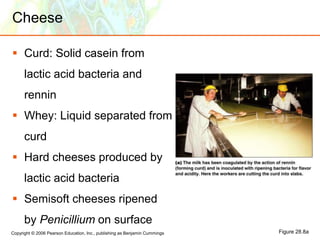
 Curd: Solid casein from
lactic acid bacteria and
rennin
 Whey: Liquid separated from
curd
 Hard cheeses produced by
lactic acid bacteria
 Semisoft cheeses ripened
by Penicillium on surface
Figure 28.8a
Copyright © 2006 Pearson Education, Inc., publishing as Benjamin Cummings
OTHER PRODUCTS
 Vinegar: ethyl alcohol by Acetobacter aceti
 Sauerkraut: cabbage with salt and microbes
Lactobacillus and Leuconostoc ferment under
anaerobic conditions
 Pickles: add brine to cucumbers and ferment
 Olives: ferment in Salt and Leuconostoc
 Poi: ferment taro paste, yeast adds alcohol
 Soy Sauce: soybeans, salt and Aspergillus-ferment
 Soy Products: Miso, Tofu soft curd
 Fermented Meats: salami, bologna, summer sausage
Copyright © 2006 Pearson Education, Inc., publishing as Benjamin Cummings
Alcoholic Beverages-Beer, Wine and Spirits
 Distillation-
 Beer and ale are fermented starch.
 Malting: Germinating barley converts starch to maltose
and glucose.
 Yeast ferment sugars to ethyl alcohol + CO2
Copyright © 2006 Pearson Education, Inc., publishing as Benjamin Cummings
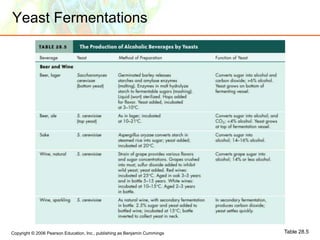
Yeast Fermentations
Table 28.5
Copyright © 2006 Pearson Education, Inc., publishing as Benjamin Cummings
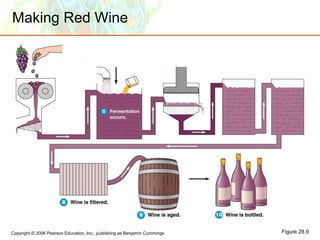
Making Red Wine
Figure 28.9

Food microbiology

  • 1.
    Copyright © 2006Pearson Education, Inc., publishing as Benjamin Cummings Microorganisms found in Food  Food safety is a global issue  Soil microbes can spoil food  Contamination by unsanitary handling of food  Improper storage and preparation procedures can lead to contamination by pathogens  Imports of fruits and vegetables from 3rd World countries can bring in diseases and parasites  *Hands washed properly??
  • 2.
    Copyright © 2006Pearson Education, Inc., publishing as Benjamin Cummings Bread Production - Sour Dough Bread  Sourdough culture- yeast Candida milleri and Lactobacillus sanfrancisco 1:100 ratio  German sour rye bread has 4 different yeast species and 13 species of Lactobacilli  Yeast feed on the sugars except maltose, Lactobacilli need maltose, then produce ethyl alcohol and CO2  Lactobacilli produce lactic and acetic acids giving the sour flavor, pH 3.6 - 4.0 inhibits microbial growth
  • 3.
    Copyright © 2006Pearson Education, Inc., publishing as Benjamin Cummings GRAINS  Rye and wheat are harvested dry  If they get wet, molds and other microbes will grow  Insect, birds and rodent vectors also transmit microbes  Raw grain with mold Claviceps purpurea cause ergotism, mold is halucinogenic and deadly  Aspergillus produce aflatoxins  Rhizopus nigricans is most common bread mold, also Aspergillus, Penicillium and Monila (pink mold)  Rye bread likely infected by Bacillus sp (w/spores)
  • 4.
    Copyright © 2006Pearson Education, Inc., publishing as Benjamin Cummings FRUITS AND VEGETABLES  Pseudomonas fluorescens are found on surface of fruits and vegetables  Pathogens: Salmonella, Shigella, Entameoba, Ascaris can be transmitted on surfaces  Leafy vegetables more susceptible to rot by Erwinia carotovora, Penicillium mold on citrus fruits and apples  Fungus Phytophthora infestans caused potato blight  Now using GMO to make plants resistant  Tomato rot- Fusarium fungus, Rhizopus injected by insects. Peach rot - Monilia fruiticola
  • 5.
    Copyright © 2006Pearson Education, Inc., publishing as Benjamin Cummings MEATS AND POULTRY 70 pathogens found at slaughterhouses, inspected by vet Dec 2003 -1st case of Mad Cow in US, stricter laws Carcasses are hung in refrigerated rooms to age, some mold: Rhizopus and Mucor , Pseudomonas release H2S and green coloration Clostridium cause bone stink deep in carcass Ground meat- may have helminths-Trichinella, lactobacilli Should be cooked to kill pathogens
  • 6.
    Copyright © 2006Pearson Education, Inc., publishing as Benjamin Cummings MEATS AND POULTRY  20 bacteria found on Poultry- 1/2 of all infections caused by Salmonella, ¼ by Clostridium perfringens, ¼ Staphylococcus aureus,  Gram – Pseudomonas cause slime and odors  Eggs have a hard porous shell, and microbes can get through  Chickens laying eggs can have Salmonella,1/10000 eggs has this bacteria in side shell, it does not have to be cracked so always cook eggs; don’t eat raw eggs!
  • 7.
    Copyright © 2006Pearson Education, Inc., publishing as Benjamin Cummings FISH AND SHELLFISH  Fresh fish have microbes: enteric bacteria, worms, & viruses which survive even shipped in ice  Shellfish- oysters & clams –Salmonella and Vibrio  Clams filter feeder can pick up red tides toxins, sewage  Shrimp (breaded) have high bacterial counts  Lobster and crabs - enteric pathogens  Crabs carry Clostridium, Cryptococcus and Candida
  • 8.
    Copyright © 2006Pearson Education, Inc., publishing as Benjamin Cummings MILK  Breeding cattle for high milk production have large udders and easily admit bacteria- get rid of 1st few squirts which can have 15,000 bacteria /ml  Mostly Staphylococcus, Micrococcus, Pseudomonas  Hand milking- E. coli, Acinetobacter  Diseased cattle can transmit Mycobacterium bovis Brucella, TB  Milk is Soured by Streptococcus lactis, Lactobacillus
  • 9.
    Copyright © 2006Pearson Education, Inc., publishing as Benjamin Cummings OTHER EDIBLE SUBSTANCES  Sugar- raw cane supports fungi: Aspergillus, Saccharomyces, Candida. Bacteria: Bacillus and Micrococcus  Clostridium causes the bulge in cans  High sugar concentration acys as preservative  Maple trees are tapped in spring -Leuconostoc , and Enterobacter  Honey toxins for Clostridium spores-floppy baby syndrome botulism
  • 10.
    Copyright © 2006Pearson Education, Inc., publishing as Benjamin Cummings OTHER EDIBLE SUBSTANCES  Spices- mask odors rather than preserve  Condiments, ketchup mustard have acids  Harvested coffee subject to molds and coffee rust  Tea leaves mold by Aspergillus and Penicillium  Microbes needed to make coffee: Erwinia needed to digest pectin on coffee bean,  Yeasts turn bean pulp into alcohol also create flavor of chocolate
  • 11.
    Copyright © 2006Pearson Education, Inc., publishing as Benjamin Cummings PREVENTING DISEASE TRANSMISSION AND FOOD SPOILAGE  More contamination in large processing plants  Klebsiella found in human digestive tract is also a respiratory pathogen, but can cause diarrhea  TB can be transmitted from unpasteurized milk/cheese  Virus are transferred through food  Milk is ideal medium for growth of pathogens/microbes  Crucial factor to prevent spoilage and disease is cleanliness in handling, use fresh foods, refrigerate,  Process quickly and store properly
  • 12.
    Copyright © 2006Pearson Education, Inc., publishing as Benjamin Cummings Food Are Preserved By  Drying of grain  Osmotic pressure (salt or sugar)- Dried and salted meats and other foods  Fermentation - milk allowed to sour was made into cheese  Canning - use of moist heat under pressure, used to preserve fruits, vegetables, meats in glass jars and metal cans. Destroys microbes, endospores, prevents spoilage
  • 13.
    Copyright © 2006Pearson Education, Inc., publishing as Benjamin Cummings CANNING  Some thermophiles (Bacillus stearothermophilus) may remain alive even after canning, spores can germinate and grow, can will bulge in heat (thermophilic anaerobic spoilage)  Flat sour spoilage  Mesophilic spoilage- improper canning at room temp  Sugars
  • 14.
    Copyright © 2006Pearson Education, Inc., publishing as Benjamin Cummings Industrial Food Canning Figure 28.1
  • 15.
    Copyright © 2006Pearson Education, Inc., publishing as Benjamin Cummings Commercial Sterilization to Destroy C. botulinum Endospores  12D treatment kills 1012 endospores  Surviving endospores of thermophilic anaerobes cause spoilage with gas  Or flat-sour spoilage
  • 16.
    Copyright © 2006Pearson Education, Inc., publishing as Benjamin Cummings DRYING AND LYOPHILIZATION  Drying- desication or dehydration is oldest method  Remove 90% of water  Stops growth but does not kill microbes  Can be sun dried, heated in ovens etc  Addition of slat, sugar or chemicals also used  Lyophilization- freeze drying is used for instant coffee and dry yeast for bread making
  • 17.
    Copyright © 2006Pearson Education, Inc., publishing as Benjamin Cummings Food Preservation- Irradiation  Aseptic packaging: Pre- sterilized materials assembled into packages and aseptically filled.  Gamma radiation kills bacteria, insects, and parasitic worms.  High-energy electrons Figure 28.4
  • 18.
    Copyright © 2006Pearson Education, Inc., publishing as Benjamin Cummings Table 28.3 FOOD IRRADIATION- Ionizing Radiation 2 types of Irradiation- UV and Ionizing Still new and controversial Microwaves do not kill, but the heat is microbicidal, but food must be rotated Ionizing-Gamma Rays can penetrate and are microbicidal Can be done, before or after packaging Cobalt 60 gamma and Cs 137 used in Japan and Europe, FDA has declared safe in the US USDA proposed rules for irradiation of fresh poultry.. Still a debate!
  • 19.
    Copyright © 2006Pearson Education, Inc., publishing as Benjamin Cummings CHEMICAL ADDITIVES  Benzoic, sorbic and propionic acids used in margarine, juice, bread, other baked goods  Alkylating agents- ethylene oxide used on nuts/spices  Ozone used on shellfish  NaCl- salt to cure meats, dehydrates bacteria  Halogen, chloride for processing equipment  Nitrates on sausage, hot dogs  QUATS- sanitize udders, fresh vegetables, eggshell surfaces
  • 20.
    Copyright © 2006Pearson Education, Inc., publishing as Benjamin Cummings ANTIBIOTICS  In US only nisin - bacteriocin produced by milk fermentation by Streptococcus lactis  Antibiotics are prohibited because: (p 790)
  • 21.
    Copyright © 2006Pearson Education, Inc., publishing as Benjamin Cummings PASTUERIZATION OF MILK - STANDARDS  2 methods : High temp short time  Low temp long time  Ultra high temperature- UHT treatment  Some chemical additives  Milk and Food in US carefully regulated by FDA  Animals inspected and soon stricter methods by microscope  Quality control has many tests for purity and guarantees high quality milk to consumers
  • 22.
    Copyright © 2006Pearson Education, Inc., publishing as Benjamin Cummings MICROORGANISMS AS FOOD AND IN FOOD PRODUCTION  Algae, Fungi, and Bacteria as Food:  Yeasts are good source of protein  1 kg yeast = 100 kg protein, but human digestive tract can only handle small amounts of it  Algal cultures: Cyanobacteria- Spirulina and red algae grown in aquaculture (in Kona)  Algae- ingredient of ice cream  Yeast, algae and bacteria could increase World Food Supply!
  • 23.
    Copyright © 2006Pearson Education, Inc., publishing as Benjamin Cummings FOOD PRODUCTION: BREAD & DAIRY  BREAD- previous slide on sour dough  Yeast Saccharomyces is a leavening agent, produce gas ato make bread rise and alcohol by fermentation  Alcohol and CO2 driven off during baking- holes  DAIRY- cultured buttermilk- Streptococcus cremoris is added to skim milk and allowed to ferment, also Leuconostoc sp  Sour cream- add one of above microbes to cream  Yogurt- Streptococcus and Lactobacillus added to milk
  • 24.
    Copyright © 2006Pearson Education, Inc., publishing as Benjamin Cummings FOOD PRODUCTION: DAIRY  Fermented Milk beverages- Mongolia- Arak drink from Mare’s milk produces alcohol  Acidophilus milk- add Lactibacillus acidophilus  Bulgarian milk- add L. bulgaricus, makes it more acidic  Kefir- Balkan goats milk stored in goatskin bags  Koumiss- Russian drink from Mare’s milk  Streptococcus lactis, L. bulgaricus, and yeasts are responsible for lactic acid, alcohol and other products
  • 25.
    Copyright © 2006Pearson Education, Inc., publishing as Benjamin Cummings Cheese  Curd: Solid casein from lactic acid bacteria and rennin  Whey: Liquid separated from curd  Hard cheeses produced by lactic acid bacteria  Semisoft cheeses ripened by Penicillium on surface Figure 28.8a
  • 26.
    Copyright © 2006Pearson Education, Inc., publishing as Benjamin Cummings OTHER PRODUCTS  Vinegar: ethyl alcohol by Acetobacter aceti  Sauerkraut: cabbage with salt and microbes Lactobacillus and Leuconostoc ferment under anaerobic conditions  Pickles: add brine to cucumbers and ferment  Olives: ferment in Salt and Leuconostoc  Poi: ferment taro paste, yeast adds alcohol  Soy Sauce: soybeans, salt and Aspergillus-ferment  Soy Products: Miso, Tofu soft curd  Fermented Meats: salami, bologna, summer sausage
  • 27.
    Copyright © 2006Pearson Education, Inc., publishing as Benjamin Cummings Alcoholic Beverages-Beer, Wine and Spirits  Distillation-  Beer and ale are fermented starch.  Malting: Germinating barley converts starch to maltose and glucose.  Yeast ferment sugars to ethyl alcohol + CO2
  • 28.
    Copyright © 2006Pearson Education, Inc., publishing as Benjamin Cummings Yeast Fermentations Table 28.5
  • 29.
    Copyright © 2006Pearson Education, Inc., publishing as Benjamin Cummings Making Red Wine Figure 28.9