Light Waves
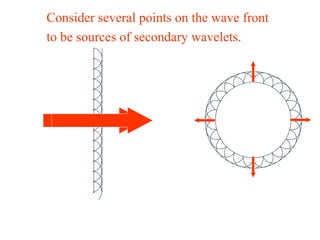
1. HUYGENS' PRINCIPLE Every point on a wave front can be regarded as a new source of wavelets, which combine to produce the next wave front, whose points are sources of further wavelets, and so on.  Huygen’s Principle can be used to explain the propagation of wave fronts involved in reflection, refraction, and  diffraction .
. . . . . . . Consider several points on the wave front to be sources of secondary wavelets. . . . . . . .
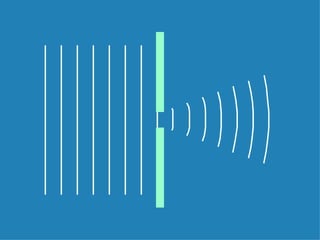
2. DIFFRACTION The bending of light that passes around an obstacle or through a narrow slit, causing the light to spread and to produce light and dark fringes. Demo - Laser, diffraction accessories, and    rainbow disks
 
If the wavelength of water waves are small compared to the size of an ocean vessel, the vessel will cast a “shadow.”  For the same waves a stick will not cast a “shadow.”
Long wavelengths bend a great deal around small objects. Because of diffraction AM radio waves travel farther than FM radio waves. Microscopy diffraction limit - One cannot see details of objects that are approximately the same size as or smaller than the wavelength of the illuminating light.
AM band radio waves travel farther than FM band radio waves because (a) AM waves travel faster than FM waves (b) AM wavelengths are shorter than FM wavelengths (c) AM waves are scattered more than FM waves (d) AM waves are diffracted more than FM waves  (d) AM waves are diffracted more than FM waves
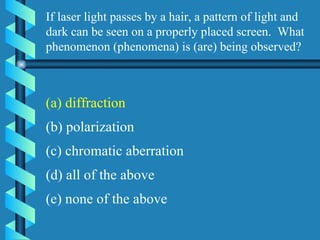
If laser light passes by a hair, a pattern of light and dark can be seen on a properly placed screen.  What phenomenon (phenomena) is (are) being observed? (a) diffraction (b) polarization (c) chromatic aberration (d) all of the above (e) none of the above (a) diffraction
 
 
Back

Light Waves

  • 1.
  • 2.
    1. HUYGENS' PRINCIPLEEvery point on a wave front can be regarded as a new source of wavelets, which combine to produce the next wave front, whose points are sources of further wavelets, and so on. Huygen’s Principle can be used to explain the propagation of wave fronts involved in reflection, refraction, and diffraction .
  • 3.
    . . .. . . . Consider several points on the wave front to be sources of secondary wavelets. . . . . . . .
  • 4.
    2. DIFFRACTION Thebending of light that passes around an obstacle or through a narrow slit, causing the light to spread and to produce light and dark fringes. Demo - Laser, diffraction accessories, and rainbow disks
  • 5.
  • 6.
    If the wavelengthof water waves are small compared to the size of an ocean vessel, the vessel will cast a “shadow.” For the same waves a stick will not cast a “shadow.”
  • 7.
    Long wavelengths benda great deal around small objects. Because of diffraction AM radio waves travel farther than FM radio waves. Microscopy diffraction limit - One cannot see details of objects that are approximately the same size as or smaller than the wavelength of the illuminating light.
  • 8.
    AM band radiowaves travel farther than FM band radio waves because (a) AM waves travel faster than FM waves (b) AM wavelengths are shorter than FM wavelengths (c) AM waves are scattered more than FM waves (d) AM waves are diffracted more than FM waves (d) AM waves are diffracted more than FM waves
  • 9.
    If laser lightpasses by a hair, a pattern of light and dark can be seen on a properly placed screen. What phenomenon (phenomena) is (are) being observed? (a) diffraction (b) polarization (c) chromatic aberration (d) all of the above (e) none of the above (a) diffraction
  • 10.
  • 11.
  • 12.