CELL STRUCTURE
Prof. Redem C. Deligero, MATMRS;MSES
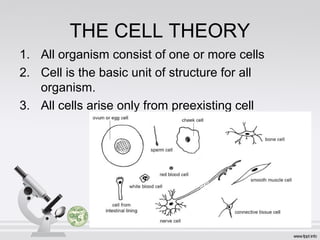
THE CELL THEORY
1. All organism consist of one or more cells
2. Cell is the basic unit of structure for all
organism.
3. All cells arise only from preexisting cell
BASIC PARTS OF A CELL
1. Cell Membrane – This is the structure that separates
the cell from it external environment which defines its
boundary and serves as a limiting membrane that
regulates the entrance and exit of substances from cell
and its environment.
2. Nucleus – This is the rounded structure usually at the
center of the cell enclosed by another membrane
called nuclear envelope. This structure is considered
as the control center of the cell for most of it metabolic
activities.
3. Protoplasm – This is known as the living substance
within the cell because it contains the functional
structure making the cell an independent structure.
THEORY OF CELL MEMBRANE
ARRANGEMENT
1. Fluid-Mosaic Model – This model of cell
membrane arrangement were proposed by S.
Jonathan Singer and Garth Nicholson (1972)
which states that the cell membrane is like an
ocean or sea in which there are many
substances that floats like an icebergs.
2. Tripartite Arrangement – This is proposed by
Danielle and Dawson (1935) which states that
the cell membrane is like a railroad truck with
two outer dark bands and a lighter middle core
or layer.
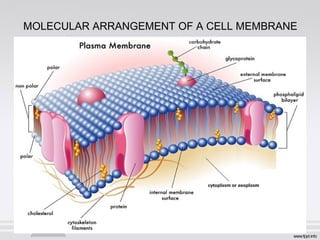
MOLECULAR ARRANGEMENT OF A CELL MEMBRANE
CELL MEMBRANE FUNCTION
1. Maintain structural integrity of the cell.
2. Control movement of substances in and out of the cell.
3. Regulating cell-cell reactions.
4. Recognition, via receptors, antigens and foreign cells
as well as altered cells.
5. Acting as an interface between the cytoplasm and the
external milieu.
6. Establishing transport systems for specific molecules.
7. Transducing extracellular physical or chemical signals
into intracellular events.
CELL MEMBRANE COMPONENT
1. Phospholipids – Third class of lipids
similar to triacylglycerols.
2. Cholesterol – A subclass of lipids in
animals.
3. Proteins – Linear polymer of amino acids.
4. Charbohydrates – Sugar group.
GLYCOCALYX
1. Protection of cell from interaction with
inappropriate proteins.
2. Protection from chemical physical injury.
3. Cell-cell recognition and adhesion.
4. In blood clotting and inflammatory
reaction.
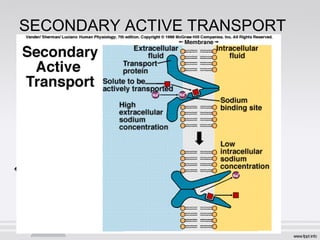
MEMBRANE TRANSPORT PROTIENS
1. Channel Proteins – Gated or ungated
and incapable of transporting substances
against concentration gradient.
2. Carrier Proteins – utilize ATP-driven
transport mechanism to ferry specific
substances across the plasmalemma
against the concentration gradient.
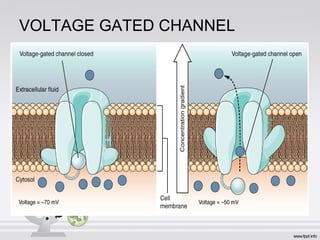
VOLTAGE GATED CHANNEL
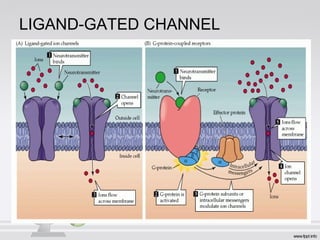
LIGAND-GATED CHANNEL
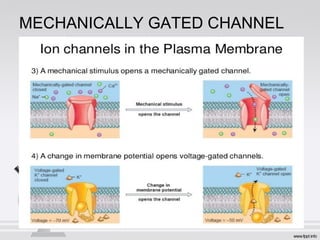
MECHANICALLY GATED CHANNEL
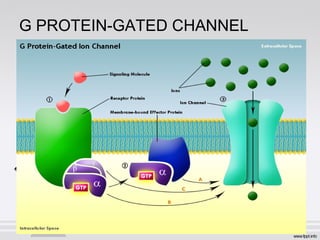
G PROTEIN-GATED CHANNEL
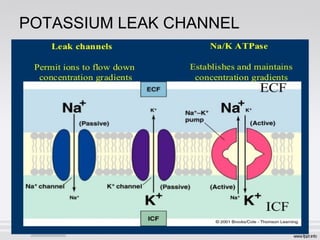
POTASSIUM LEAK CHANNEL
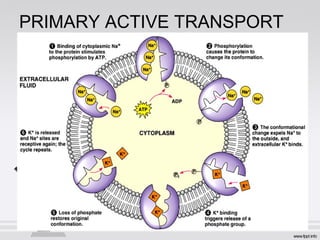
PRIMARY ACTIVE TRANSPORT
SECONDARY ACTIVE TRANSPORT

Cell Membrane

  • 1.
    CELL STRUCTURE Prof. RedemC. Deligero, MATMRS;MSES
  • 2.
    THE CELL THEORY 1.All organism consist of one or more cells 2. Cell is the basic unit of structure for all organism. 3. All cells arise only from preexisting cell
  • 3.
    BASIC PARTS OFA CELL 1. Cell Membrane – This is the structure that separates the cell from it external environment which defines its boundary and serves as a limiting membrane that regulates the entrance and exit of substances from cell and its environment. 2. Nucleus – This is the rounded structure usually at the center of the cell enclosed by another membrane called nuclear envelope. This structure is considered as the control center of the cell for most of it metabolic activities. 3. Protoplasm – This is known as the living substance within the cell because it contains the functional structure making the cell an independent structure.
  • 4.
    THEORY OF CELLMEMBRANE ARRANGEMENT 1. Fluid-Mosaic Model – This model of cell membrane arrangement were proposed by S. Jonathan Singer and Garth Nicholson (1972) which states that the cell membrane is like an ocean or sea in which there are many substances that floats like an icebergs. 2. Tripartite Arrangement – This is proposed by Danielle and Dawson (1935) which states that the cell membrane is like a railroad truck with two outer dark bands and a lighter middle core or layer.
  • 5.
    MOLECULAR ARRANGEMENT OFA CELL MEMBRANE
  • 6.
    CELL MEMBRANE FUNCTION 1.Maintain structural integrity of the cell. 2. Control movement of substances in and out of the cell. 3. Regulating cell-cell reactions. 4. Recognition, via receptors, antigens and foreign cells as well as altered cells. 5. Acting as an interface between the cytoplasm and the external milieu. 6. Establishing transport systems for specific molecules. 7. Transducing extracellular physical or chemical signals into intracellular events.
  • 7.
    CELL MEMBRANE COMPONENT 1.Phospholipids – Third class of lipids similar to triacylglycerols. 2. Cholesterol – A subclass of lipids in animals. 3. Proteins – Linear polymer of amino acids. 4. Charbohydrates – Sugar group.
  • 8.
    GLYCOCALYX 1. Protection ofcell from interaction with inappropriate proteins. 2. Protection from chemical physical injury. 3. Cell-cell recognition and adhesion. 4. In blood clotting and inflammatory reaction.
  • 9.
    MEMBRANE TRANSPORT PROTIENS 1.Channel Proteins – Gated or ungated and incapable of transporting substances against concentration gradient. 2. Carrier Proteins – utilize ATP-driven transport mechanism to ferry specific substances across the plasmalemma against the concentration gradient.
  • 10.
  • 11.
  • 12.
  • 13.
  • 14.
  • 15.
  • 16.