WAREHOUSING
BY SUMIT MALHOTRA
CONCEPT
 Need  for storage arises both for raw
  material as well as finished products
 STORAGE involves proper management
  for preserving goods from the time of their
  production or purchase till actual use.
 When this storage is done on a large scale
  and in a specified manner it is called
  WAREHOUSING.
MEANING AND DEFINITION
 Place where goods are kept is called
  WAREHOUSE
 The person in-charge of warehouse is
  called WAREHOUSE-KEEPER
 A commercial building for storage of
  goods
 Used by manufacturers, importers,
  exporters, wholesalers, transport
  business, customers etc.
DEFINITION
 Warehousing refers to the activities involving
  storage of goods on a large-scale in a systematic
  and orderly manner and making them available
  conveniently when needed.
 Means holding or preserving goods in huge
  quantities from the time of their purchase or
  production till their actual use or sale.
 Creates time utility by bridging the time gap
  between production and consumption of goods
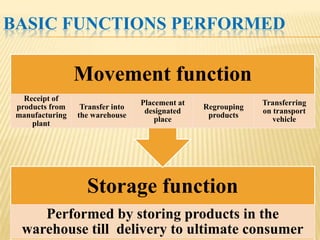
BASIC FUNCTIONS PERFORMED

                 Movement function
   Receipt of
                                  Placement at                Transferring
 products from    Transfer into                  Regrouping
                                   designated                 on transport
 manufacturing   the warehouse                    products
                                      place                      vehicle
     plant


                   Storage function
     Performed by storing products in the
  warehouse till delivery to ultimate consumer
NEED AND IMPORTANCE
 REGULAR   SUPPLY
 QUALITY

 STOCK  OF TRADE
 PRICE STABILISATION

 SEASONAL PRODUCTS

 PERISHABLE GOODS

 CONTINUOUS PRODUCTION

 SEASONAL DEMAND
 LARGE-SCALE   PRODUCTION
 QUICK SUPPLY
 PROTECTION AND PRESERVATION
  OF GOODS
 EASY HANDLING

 USEFUL FOR SMALL BUSINESSES

 CREATION OF EMPLOYMENT

 FACILITATES SALE OF GOODS

 AVAILABILITY OF FINANCE
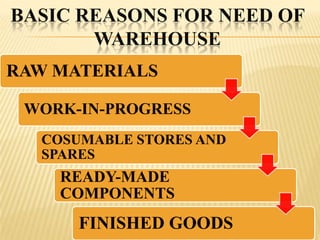
BASIC REASONS FOR NEED OF
       WAREHOUSE
RAW MATERIALS

 WORK-IN-PROGRESS
   COSUMABLE STORES AND
   SPARES
     READY-MADE
     COMPONENTS
       FINISHED GOODS
CHARACTERISTICS OF IDEAL
         WAREHOUSES
   CONVENIENT LOCATION
   AVAILABILITY OF MECHANICAL APPLIANCES
    TO LOAD AND UNLOAD GOODS
   ADEQUATE SPACE
   COLD STORAGE FACILITIES
   PROPER ARRANGEMENT FOR PROTECTION
   SUFFICIENT PARKING SPACE
   ROUND THE CLOCK SECURITY ARRANGEMENT
   LATEST FIRE FIGHTING EUIPMENTS
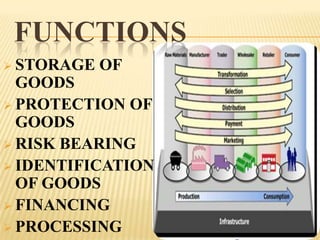
FUNCTIONS
 STORAGE   OF
  GOODS
 PROTECTION OF
  GOODS
 RISK BEARING
 IDENTIFICATION
  OF GOODS
 FINANCING
 PROCESSING
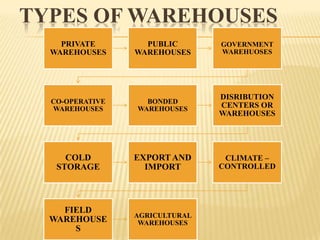
TYPES OF WAREHOUSES
    PRIVATE        PUBLIC       GOVERNMENT
  WAREHOUSES     WAREHOUSES     WAREHUOSES


                                DISRIBUTION
  CO-OPERATIVE     BONDED
  WAREHOUSES     WAREHOUSES     CENTERS OR
                                WAREHOUSES


     COLD        EXPORT AND      CLIMATE –
   STORAGE         IMPORT       CONTROLLED


    FIELD
                 AGRICULTURAL
  WAREHOUSE       WAREHOUSES
      S
1. PRIVATE HOUSES
   OPERATED by a company for shipping and storing its
    own products
   OWNED AND MANAGED- manufacturers or traders
   CONSTRUCTION- Farmers near their fields,
    Wholesalers and Retailers near their business centre's
    and Manufacturers near their factories
   COMPANIES – Stable inventory levels and long run
    expectations
    SUITABILITY- Firms that require special handling and
    storage features and want to control design and
    operation of the warehouse
ADVANTAGES OF PRIVATE WAREHOUSES

 Bettercontrol over movement and storage
 Chances of errors and mistakes are less as
  products are handled by its own employees
  who have full knowledge
 Designing is done according to suitability of
  owner
 Greater flexibility with respect to storage
  and material handling needs
2. PUBLIC WAREHOUSES
   Provide storage and physical distribution services on
    rental basis
   Used by SMALL FIRMS and LARGE FIRMS
    Organizes to provide storage facilities to
    traders, manufacturers, agriculturists in return for a
    storage charge
   Licensed by Govt.
   In India OWNED and OPERATED – Central
    Warehousing Corporation and State Warehousing
    Corporation
   SUITABILTY – seasonal production or low volume storage
    needs, companies with inventories maintained in many
    locations, firms entering new markets
   OWNER –stands as an agent of goods
ADVANTAGES OF PUBLIC WAREHOUSING

 More efficient and less expensive
 Cost easily and exactly ascertained

 Fixed cost distributed among many users

 Strategically located and immediately available

 Flexible to meet space requirements of different
  users
 Companies have a wide choice of locations and
  warehouse types
3. GOVERNMENT WAREHOUSES
 OWNED, MANAGED AND CONTROLLED -
  Central or State Governments or public
  corporations or local authorities
 EXAMPLES- Central Warehousing Corporation of
  India, State Warehousing Corporation and Food
  Corporation of India
 If customer cannot pay rent within specified time
  authority can recover rent disposing of goods
4. CO-OPERATIVE WAREHOUSES
•   Owned, Managed and Controlled – Co-operative
    societies
•   Facilities at most economical rates to members
•   Located-Punjab, Karnataka, Maharashtra and
    Andhra
5. BONDED WAREHOUSES
   Licensed to accept imported goods for storage before payment of
    customs duty
   Imported merchandise is stored and released only after payment
    of appropriate taxes
   Cigarettes, Liquor, Other products are stored
   Owned and Operated – PORT TRUSTS
   Acts in two capacities viz LANDLORD and BAILEE OF GOODS
   As landlord provides storage facilities on rent
   As bailee of goods take reasonable care to handle and store goods
    as it has lien on goods under care for charges of its services
   Owner can sell goods wholly or in part by endorsing a warrant
   Facilitate enterpot trade- importer need not pay the import duty
6. DISTRIBUTION CENTERS / WAREHOUSES

   Designed to move goods
   Large and highly automated
   Receive goods from various plants and suppliers,
    take orders, fill them efficiently deliver to customers
    quickly
   Located near the market owned or leased by
    manufacturers
   Access to transport networks
7. COLD STORAGE
 Preserve perishability of goods against payment of a
  storage charge
 Temperature variation is controlled to degree
  necessary for certain sensitive items
8. EXPORT AND IMPORT WAREHOUSES
 LOCATION –near ports where international
  trade is undertaken
 Storage facilities for goods awaiting onward
  movements
 Facilities- packaging , inspection, marking etc

9. CLIMATE-CONTROLLED WAREHOUSE
 Handle storage of many products including
  need special handling conditions
 Freezers for frozen products, humidity
  controlled environment for delicate products,
  produce or flowers, etc
10. FIELD WAREHOUSES
 MANAGED- Public Warehousing Agency in the
  premises of a factory or company which needs
  facility for borrowing from a bank against
  certification of goods in storage or in process by
  an independent professional warehouse man.
11. AGRICULTURAL WAREHOUSES
 Store agricultural produce grown in a certain
  area
 Location – Assembling or regulated markets
 Receive agricultural commodities either directly
  from farmers or through their commission
  agents or from wholesalers
 Encourage speculative trading
WAREHOUSING STRATEGY
 Depends  on the Company’s
  objectives in general and Logistics
  objectives in particular like :-
a) Availability of goods to consumers

b) Degree of customer service offered

c) Minimum total distribution cost
INTEGRATED WAREHOUSE STRATEGY

  Focuses    on two questions
 i.    How many warehouses should be
       employed ?
 ii.   Which warehouse types should be used
       to meet market requirements ?
      Firms utilize a combination of public
       private contract facilities
 PRIVATE OR CONTRACT FACILITIES used to
  cover basic year round requirements
 PUBLIC FACILITIES used to handle peak seasons

 FULL WAREHOUSE UTILIZATION throughout
  the year is a remote possibility.
 It will be fully utilized between 75% to 85% of the
  time
 15% to 25% of time to meet peak requirements is
  not utilized
 In such situations, more efficient to build PRIVATE
  FACILITIES to convert 75% requirements and
  PUBLIC WAREHOUSES to accommodate peak
  demand
 After Defining Corporate Logistical Objectives
  Then Following Factors To Be Considered
  Buying Behavior of Customers
  Demand Pattern
  Warehousing Strategies of Competitors
  In case of stock out situation- reaction of
  customers
  OTHER FACTORS
 PRESENCE SYNERGY
 INDUSTRY SYNERGY
 OPERATING FLEXIBILTY
 LOCATION FLEXIBILTY
 SCALE ECONOMIES
 PRESENCE SYNERGY
 Inventory located in a nearby building that is
  clearly affiliated with enterprise .
 INDUSTRY SYNERGY
 Operating benefits of coordinating with other
  firms serving the same industry.
 OPERATING FLEXIBILTY
  Ability to adjust internal policies and procedures
  to meet product and customer needs.
 LOCATION FLEXIBILITY
  Ability to quickly adjust warehouse location with
  seasonal and permanent demand changes
 SCALE ECONOMIES
  Ability to reduce material handling and storage
  through application of advanced technologies
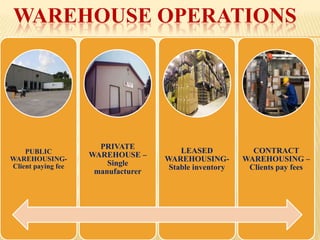
WAREHOUSE OPERATIONS


                      PRIVATE
    PUBLIC                              LEASED            CONTRACT
                    WAREHOUSE –
WAREHOUSING-                        WAREHOUSING-        WAREHOUSING –
Client paying fee       Single
                                     Stable inventory    Clients pay fees
                     manufacturer
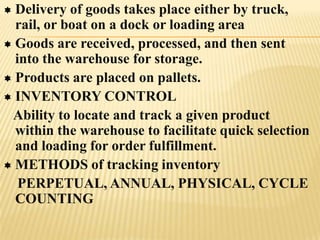
 Delivery of goods takes place either by truck,
  rail, or boat on a dock or loading area
 Goods are received, processed, and then sent
  into the warehouse for storage.
 Products are placed on pallets.
 INVENTORY CONTROL
 Ability to locate and track a given product
  within the warehouse to facilitate quick selection
  and loading for order fulfillment.
 METHODS of tracking inventory
   PERPETUAL, ANNUAL, PHYSICAL, CYCLE
  COUNTING
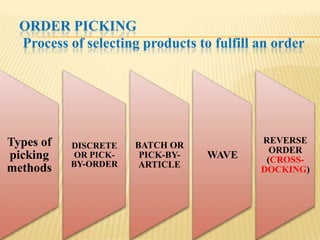
ORDER PICKING
  Process of selecting products to fulfill an order


Types of                                   REVERSE
           DISCRETE    BATCH OR
                                             ORDER
picking     OR PICK-    PICK-BY-   WAVE     (CROSS-
           BY-ORDER     ARTICLE
methods                                    DOCKING)
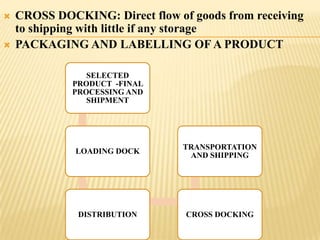
   CROSS DOCKING: Direct flow of goods from receiving
    to shipping with little if any storage
   PACKAGING AND LABELLING OF A PRODUCT

                SELECTED
             PRODUCT -FINAL
             PROCESSING AND
                SHIPMENT


                                 TRANSPORTATION
              LOADING DOCK
                                  AND SHIPPING


              DISTRIBUTION       CROSS DOCKING
AUTOMATION IN WAREHOUSES

 System where goods are placed into and
  removed from store by remote control with
  assistance of electronic data processing
  equipment.
 Reasons due to which company opts are:

 Reduce total cost of distribution

 Raise customer service by prompt delivery and
  accurate order filling
 More control distribution operations as a
  whole
MODERN TRENDS
   JUST IN TIME (JIT) system promotes product delivery
    directly from suppliers to consumers without the use of
    warehouse
   Retailing trends led to development of WAREHOUSE-
    STYLE RETAIL STORES
   INTERNET BASED STORES do not require physical
    retail space but still require warehouse to store goods
   Warehousing Companies are transforming into third-
    party logistics providers or 3PLs .
   RADIO FREQUENCY IDENTIFICATION (RFID)
   TRANSPORTATION MANAGEMENT SYSTEMS
   PICK-TO-LIGHT TECHNOLOGY
   VOICE-ACTIVATED RECEIVING ANG PACKAGING
BENEFITS
   Maximum usage of available floor space and building
    height
   Increase storage capacity by up to 400%
   Less land and smaller building
   High productivity
   Operate faster -24 hours a day, 7-days a week
   No delays
   Efficient flow of materials
   Provide buffer storage functions
   Need for drivers/operators eliminated
   Risk of injury minimized by safety fences
   Reduce stockholdings
   Inventory accurately tracked at all stages
   Ongoing operating costs eliminated
MERITS                AND                  DEMERITS
   Meet demand fluctuations         Poor market coverage
    at short notice                  Distant market demand
   No dangers of stock out           not met in short notice
   Transport facilities             Transport cost maximum
    optimally used                    unless in bulk quantity
   Bulk transportation              Increased material
    cheaper                           handling cost
   Less warehousing costs           Possibility of bottlenecks
   Reduction in requirement          and resultant delays
    of personnel                     Greater danger of loss by
   Reduction in administrative       fire
    cost                             Delay in customer service
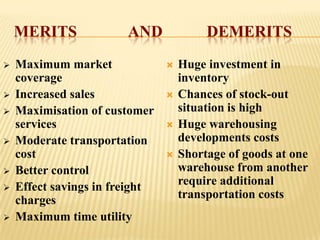
MERITS              AND              DEMERITS
   Maximum market                 Huge investment in
    coverage                        inventory
   Increased sales                Chances of stock-out
   Maximisation of customer        situation is high
    services                       Huge warehousing
   Moderate transportation         developments costs
    cost                           Shortage of goods at one
   Better control                  warehouse from another
   Effect savings in freight       require additional
    charges                         transportation costs
   Maximum time utility
Warehousing

Warehousing

  • 1.
  • 2.
    CONCEPT  Need for storage arises both for raw material as well as finished products  STORAGE involves proper management for preserving goods from the time of their production or purchase till actual use.  When this storage is done on a large scale and in a specified manner it is called WAREHOUSING.
  • 3.
    MEANING AND DEFINITION Place where goods are kept is called WAREHOUSE  The person in-charge of warehouse is called WAREHOUSE-KEEPER  A commercial building for storage of goods  Used by manufacturers, importers, exporters, wholesalers, transport business, customers etc.
  • 4.
    DEFINITION  Warehousing refersto the activities involving storage of goods on a large-scale in a systematic and orderly manner and making them available conveniently when needed.  Means holding or preserving goods in huge quantities from the time of their purchase or production till their actual use or sale.  Creates time utility by bridging the time gap between production and consumption of goods
  • 5.
    BASIC FUNCTIONS PERFORMED Movement function Receipt of Placement at Transferring products from Transfer into Regrouping designated on transport manufacturing the warehouse products place vehicle plant Storage function Performed by storing products in the warehouse till delivery to ultimate consumer
  • 6.
    NEED AND IMPORTANCE REGULAR SUPPLY  QUALITY  STOCK OF TRADE  PRICE STABILISATION  SEASONAL PRODUCTS  PERISHABLE GOODS  CONTINUOUS PRODUCTION  SEASONAL DEMAND
  • 7.
     LARGE-SCALE PRODUCTION  QUICK SUPPLY  PROTECTION AND PRESERVATION OF GOODS  EASY HANDLING  USEFUL FOR SMALL BUSINESSES  CREATION OF EMPLOYMENT  FACILITATES SALE OF GOODS  AVAILABILITY OF FINANCE
  • 8.
    BASIC REASONS FORNEED OF WAREHOUSE RAW MATERIALS WORK-IN-PROGRESS COSUMABLE STORES AND SPARES READY-MADE COMPONENTS FINISHED GOODS
  • 9.
    CHARACTERISTICS OF IDEAL WAREHOUSES  CONVENIENT LOCATION  AVAILABILITY OF MECHANICAL APPLIANCES TO LOAD AND UNLOAD GOODS  ADEQUATE SPACE  COLD STORAGE FACILITIES  PROPER ARRANGEMENT FOR PROTECTION  SUFFICIENT PARKING SPACE  ROUND THE CLOCK SECURITY ARRANGEMENT  LATEST FIRE FIGHTING EUIPMENTS
  • 10.
    FUNCTIONS  STORAGE OF GOODS  PROTECTION OF GOODS  RISK BEARING  IDENTIFICATION OF GOODS  FINANCING  PROCESSING
  • 11.
    TYPES OF WAREHOUSES PRIVATE PUBLIC GOVERNMENT WAREHOUSES WAREHOUSES WAREHUOSES DISRIBUTION CO-OPERATIVE BONDED WAREHOUSES WAREHOUSES CENTERS OR WAREHOUSES COLD EXPORT AND CLIMATE – STORAGE IMPORT CONTROLLED FIELD AGRICULTURAL WAREHOUSE WAREHOUSES S
  • 12.
    1. PRIVATE HOUSES  OPERATED by a company for shipping and storing its own products  OWNED AND MANAGED- manufacturers or traders  CONSTRUCTION- Farmers near their fields, Wholesalers and Retailers near their business centre's and Manufacturers near their factories  COMPANIES – Stable inventory levels and long run expectations  SUITABILITY- Firms that require special handling and storage features and want to control design and operation of the warehouse
  • 13.
    ADVANTAGES OF PRIVATEWAREHOUSES  Bettercontrol over movement and storage  Chances of errors and mistakes are less as products are handled by its own employees who have full knowledge  Designing is done according to suitability of owner  Greater flexibility with respect to storage and material handling needs
  • 14.
    2. PUBLIC WAREHOUSES  Provide storage and physical distribution services on rental basis  Used by SMALL FIRMS and LARGE FIRMS  Organizes to provide storage facilities to traders, manufacturers, agriculturists in return for a storage charge  Licensed by Govt.  In India OWNED and OPERATED – Central Warehousing Corporation and State Warehousing Corporation  SUITABILTY – seasonal production or low volume storage needs, companies with inventories maintained in many locations, firms entering new markets  OWNER –stands as an agent of goods
  • 15.
    ADVANTAGES OF PUBLICWAREHOUSING  More efficient and less expensive  Cost easily and exactly ascertained  Fixed cost distributed among many users  Strategically located and immediately available  Flexible to meet space requirements of different users  Companies have a wide choice of locations and warehouse types
  • 16.
    3. GOVERNMENT WAREHOUSES OWNED, MANAGED AND CONTROLLED - Central or State Governments or public corporations or local authorities  EXAMPLES- Central Warehousing Corporation of India, State Warehousing Corporation and Food Corporation of India  If customer cannot pay rent within specified time authority can recover rent disposing of goods 4. CO-OPERATIVE WAREHOUSES • Owned, Managed and Controlled – Co-operative societies • Facilities at most economical rates to members • Located-Punjab, Karnataka, Maharashtra and Andhra
  • 17.
    5. BONDED WAREHOUSES  Licensed to accept imported goods for storage before payment of customs duty  Imported merchandise is stored and released only after payment of appropriate taxes  Cigarettes, Liquor, Other products are stored  Owned and Operated – PORT TRUSTS  Acts in two capacities viz LANDLORD and BAILEE OF GOODS  As landlord provides storage facilities on rent  As bailee of goods take reasonable care to handle and store goods as it has lien on goods under care for charges of its services  Owner can sell goods wholly or in part by endorsing a warrant  Facilitate enterpot trade- importer need not pay the import duty
  • 18.
    6. DISTRIBUTION CENTERS/ WAREHOUSES  Designed to move goods  Large and highly automated  Receive goods from various plants and suppliers, take orders, fill them efficiently deliver to customers quickly  Located near the market owned or leased by manufacturers  Access to transport networks 7. COLD STORAGE  Preserve perishability of goods against payment of a storage charge  Temperature variation is controlled to degree necessary for certain sensitive items
  • 19.
    8. EXPORT ANDIMPORT WAREHOUSES  LOCATION –near ports where international trade is undertaken  Storage facilities for goods awaiting onward movements  Facilities- packaging , inspection, marking etc 9. CLIMATE-CONTROLLED WAREHOUSE  Handle storage of many products including need special handling conditions  Freezers for frozen products, humidity controlled environment for delicate products, produce or flowers, etc
  • 20.
    10. FIELD WAREHOUSES MANAGED- Public Warehousing Agency in the premises of a factory or company which needs facility for borrowing from a bank against certification of goods in storage or in process by an independent professional warehouse man. 11. AGRICULTURAL WAREHOUSES  Store agricultural produce grown in a certain area  Location – Assembling or regulated markets  Receive agricultural commodities either directly from farmers or through their commission agents or from wholesalers  Encourage speculative trading
  • 21.
    WAREHOUSING STRATEGY  Depends on the Company’s objectives in general and Logistics objectives in particular like :- a) Availability of goods to consumers b) Degree of customer service offered c) Minimum total distribution cost
  • 22.
    INTEGRATED WAREHOUSE STRATEGY  Focuses on two questions i. How many warehouses should be employed ? ii. Which warehouse types should be used to meet market requirements ?  Firms utilize a combination of public private contract facilities
  • 23.
     PRIVATE ORCONTRACT FACILITIES used to cover basic year round requirements  PUBLIC FACILITIES used to handle peak seasons  FULL WAREHOUSE UTILIZATION throughout the year is a remote possibility.  It will be fully utilized between 75% to 85% of the time  15% to 25% of time to meet peak requirements is not utilized  In such situations, more efficient to build PRIVATE FACILITIES to convert 75% requirements and PUBLIC WAREHOUSES to accommodate peak demand
  • 24.
     After DefiningCorporate Logistical Objectives Then Following Factors To Be Considered Buying Behavior of Customers Demand Pattern Warehousing Strategies of Competitors In case of stock out situation- reaction of customers OTHER FACTORS  PRESENCE SYNERGY  INDUSTRY SYNERGY  OPERATING FLEXIBILTY  LOCATION FLEXIBILTY  SCALE ECONOMIES
  • 25.
     PRESENCE SYNERGY Inventory located in a nearby building that is clearly affiliated with enterprise .  INDUSTRY SYNERGY Operating benefits of coordinating with other firms serving the same industry.  OPERATING FLEXIBILTY Ability to adjust internal policies and procedures to meet product and customer needs.  LOCATION FLEXIBILITY Ability to quickly adjust warehouse location with seasonal and permanent demand changes  SCALE ECONOMIES Ability to reduce material handling and storage through application of advanced technologies
  • 26.
    WAREHOUSE OPERATIONS PRIVATE PUBLIC LEASED CONTRACT WAREHOUSE – WAREHOUSING- WAREHOUSING- WAREHOUSING – Client paying fee Single Stable inventory Clients pay fees manufacturer
  • 27.
     Delivery ofgoods takes place either by truck, rail, or boat on a dock or loading area  Goods are received, processed, and then sent into the warehouse for storage.  Products are placed on pallets.  INVENTORY CONTROL Ability to locate and track a given product within the warehouse to facilitate quick selection and loading for order fulfillment.  METHODS of tracking inventory PERPETUAL, ANNUAL, PHYSICAL, CYCLE COUNTING
  • 28.
    ORDER PICKING Process of selecting products to fulfill an order Types of REVERSE DISCRETE BATCH OR ORDER picking OR PICK- PICK-BY- WAVE (CROSS- BY-ORDER ARTICLE methods DOCKING)
  • 29.
    CROSS DOCKING: Direct flow of goods from receiving to shipping with little if any storage  PACKAGING AND LABELLING OF A PRODUCT SELECTED PRODUCT -FINAL PROCESSING AND SHIPMENT TRANSPORTATION LOADING DOCK AND SHIPPING DISTRIBUTION CROSS DOCKING
  • 30.
    AUTOMATION IN WAREHOUSES System where goods are placed into and removed from store by remote control with assistance of electronic data processing equipment.  Reasons due to which company opts are:  Reduce total cost of distribution  Raise customer service by prompt delivery and accurate order filling  More control distribution operations as a whole
  • 31.
    MODERN TRENDS  JUST IN TIME (JIT) system promotes product delivery directly from suppliers to consumers without the use of warehouse  Retailing trends led to development of WAREHOUSE- STYLE RETAIL STORES  INTERNET BASED STORES do not require physical retail space but still require warehouse to store goods  Warehousing Companies are transforming into third- party logistics providers or 3PLs .  RADIO FREQUENCY IDENTIFICATION (RFID)  TRANSPORTATION MANAGEMENT SYSTEMS  PICK-TO-LIGHT TECHNOLOGY  VOICE-ACTIVATED RECEIVING ANG PACKAGING
  • 32.
    BENEFITS  Maximum usage of available floor space and building height  Increase storage capacity by up to 400%  Less land and smaller building  High productivity  Operate faster -24 hours a day, 7-days a week  No delays  Efficient flow of materials  Provide buffer storage functions  Need for drivers/operators eliminated  Risk of injury minimized by safety fences  Reduce stockholdings  Inventory accurately tracked at all stages  Ongoing operating costs eliminated
  • 33.
    MERITS AND DEMERITS  Meet demand fluctuations  Poor market coverage at short notice  Distant market demand  No dangers of stock out not met in short notice  Transport facilities  Transport cost maximum optimally used unless in bulk quantity  Bulk transportation  Increased material cheaper handling cost  Less warehousing costs  Possibility of bottlenecks  Reduction in requirement and resultant delays of personnel  Greater danger of loss by  Reduction in administrative fire cost  Delay in customer service
  • 34.
    MERITS AND DEMERITS  Maximum market  Huge investment in coverage inventory  Increased sales  Chances of stock-out  Maximisation of customer situation is high services  Huge warehousing  Moderate transportation developments costs cost  Shortage of goods at one  Better control warehouse from another  Effect savings in freight require additional charges transportation costs  Maximum time utility