Inventory Management

Winter 2014

ADM – eSupply Chain Management
Outline
• What is inventory
• Myths in inventory management
• Reasons for having inventory
• Rolls of Inventory in SCM
• Types of Demands
• Benefits/Drawbacks
• Methods for inventories
• Inventory Techniques
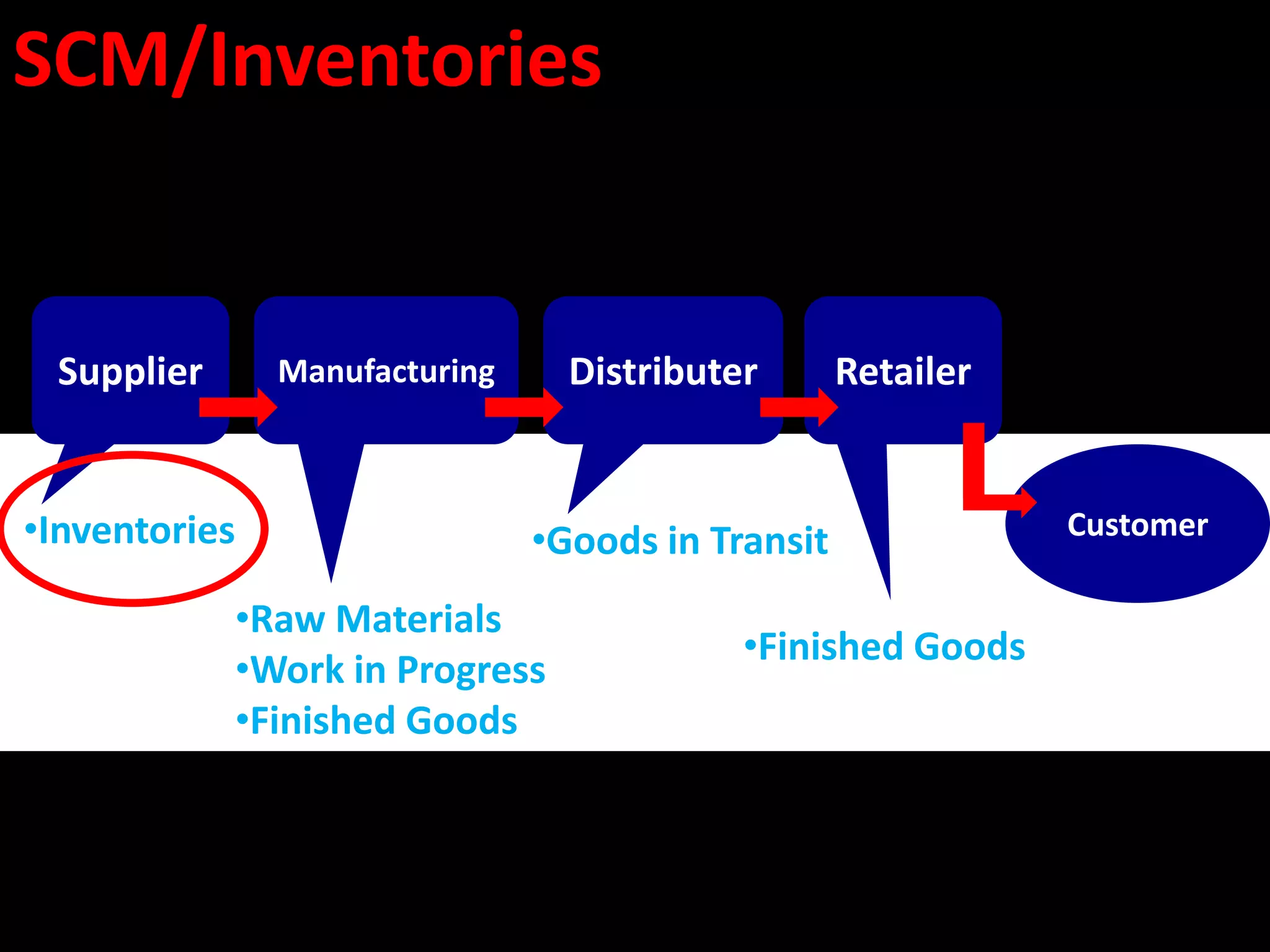
SCM/Inventories

Supplier

Manufacturing

•Inventories

Distributer

Retailer

•Goods in Transit

Customer

•Raw Materials
•Finished Goods
•Work in Progress
•Finished Goods
Traditional Supply Chain Management
(SCM)
G.Trites, J.Boritz, “e-business strategies, a Canadian perspective for a networked world” ,Pearson-Prentice Hall, 2009
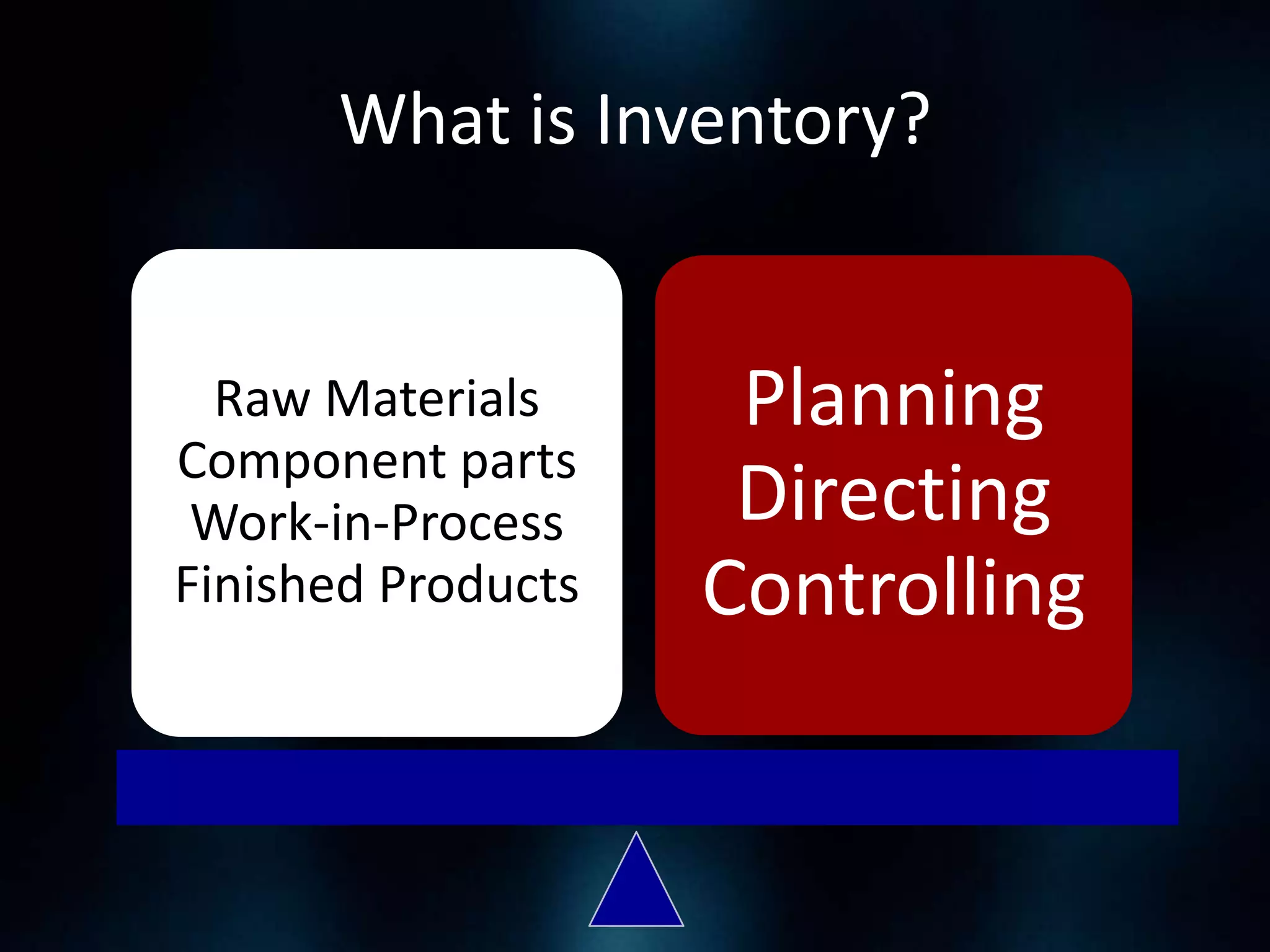
What is Inventory?

Raw Materials
Component parts
Work-in-Process
Finished Products

Planning
Directing
Controlling
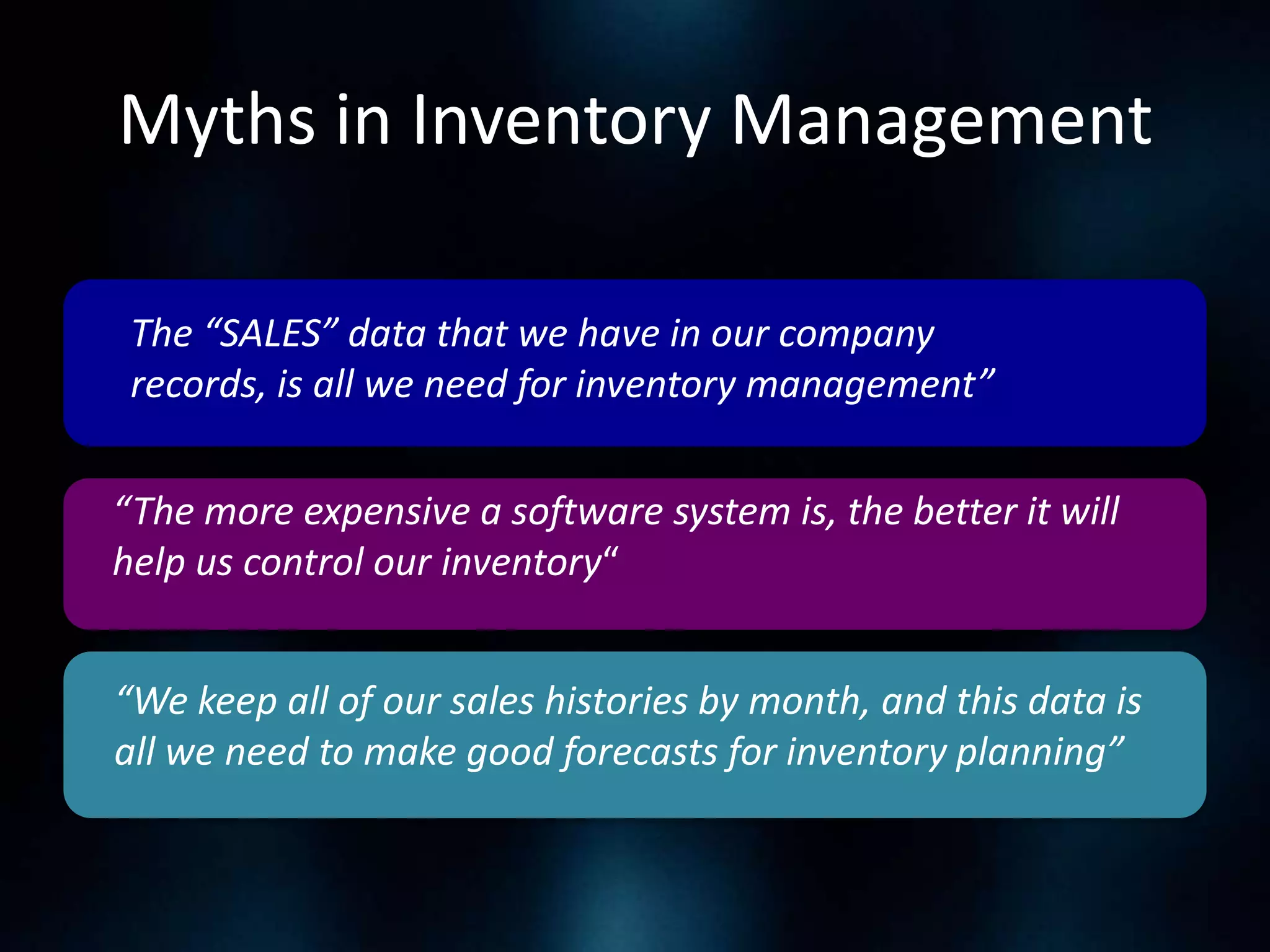
Myths in Inventory Management
The “SALES” data that we have in our company
records, is all we need for inventory management”

“The more expensive a software system is, the better it will
help us control our inventory“
“We keep all of our sales histories by month, and this data is
all we need to make good forecasts for inventory planning”
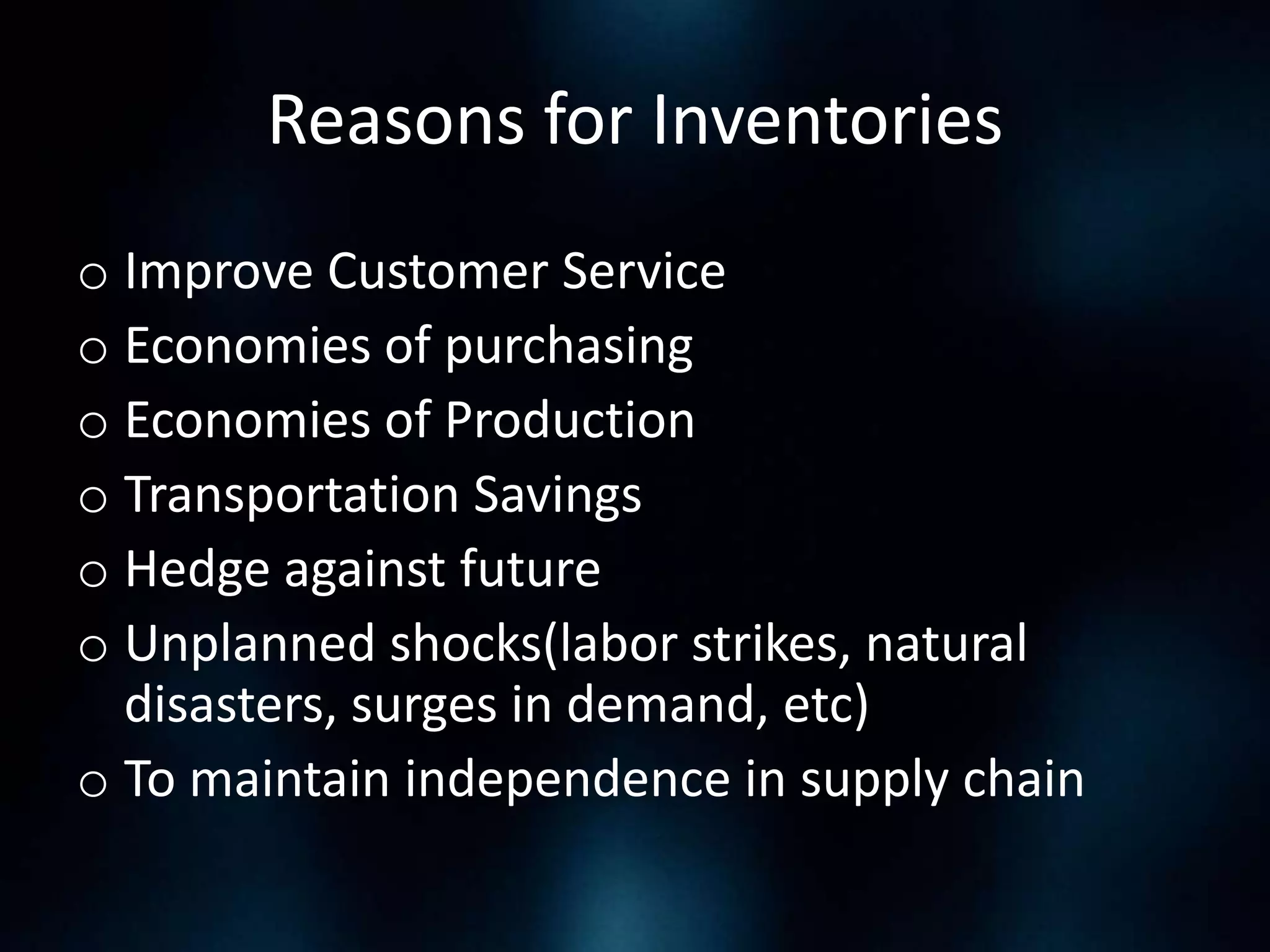
Reasons for Inventories
o Improve Customer Service
o Economies of purchasing
o Economies of Production
o Transportation Savings
o Hedge against future
o Unplanned shocks(labor strikes, natural
disasters, surges in demand, etc)
o To maintain independence in supply chain
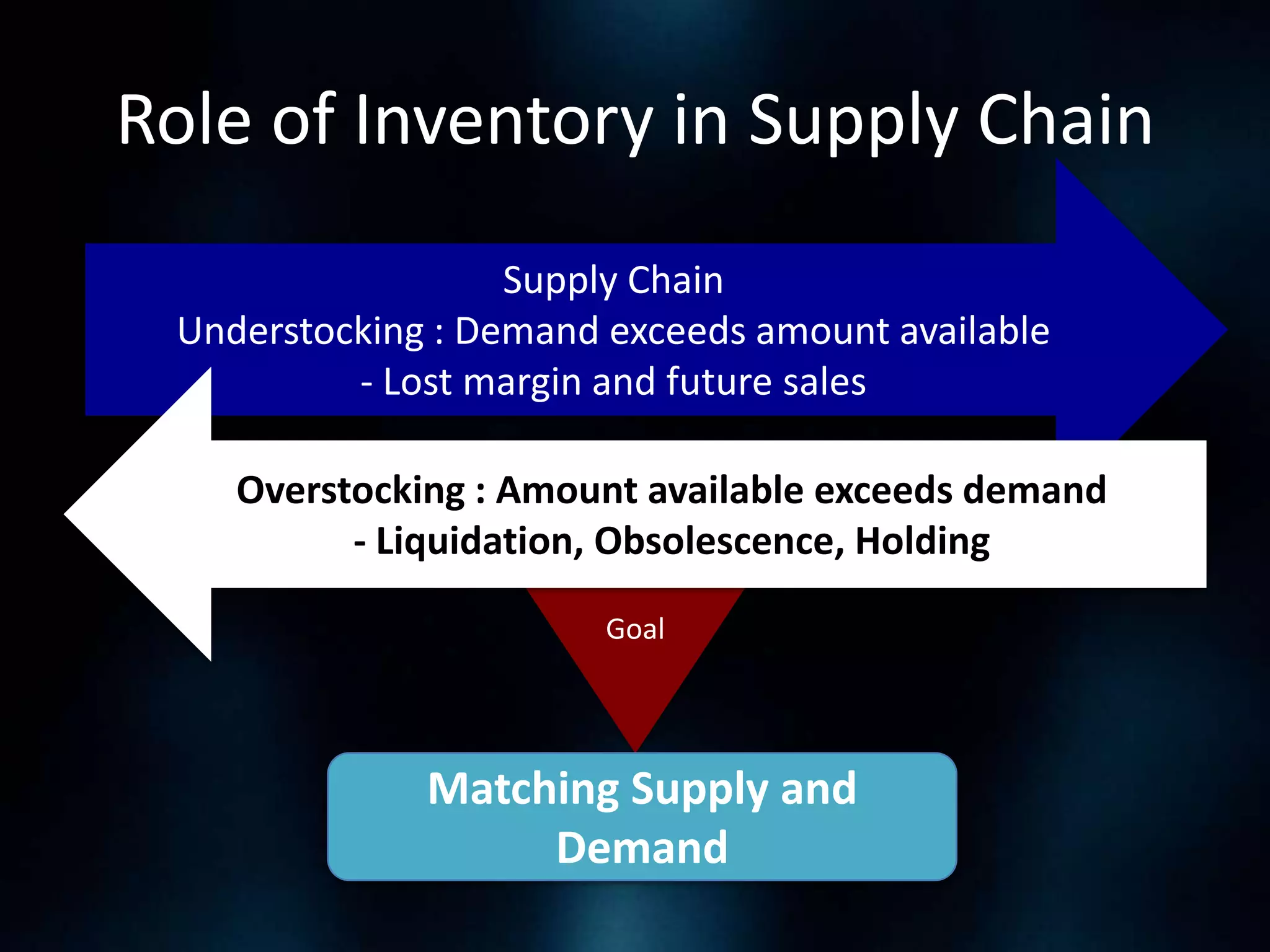
Role of Inventory in Supply Chain
Supply Chain
Understocking : Demand exceeds amount available
- Lost margin and future sales

Overstocking : Amount available exceeds demand
- Liquidation, Obsolescence, Holding
Goal

Matching Supply and
Demand
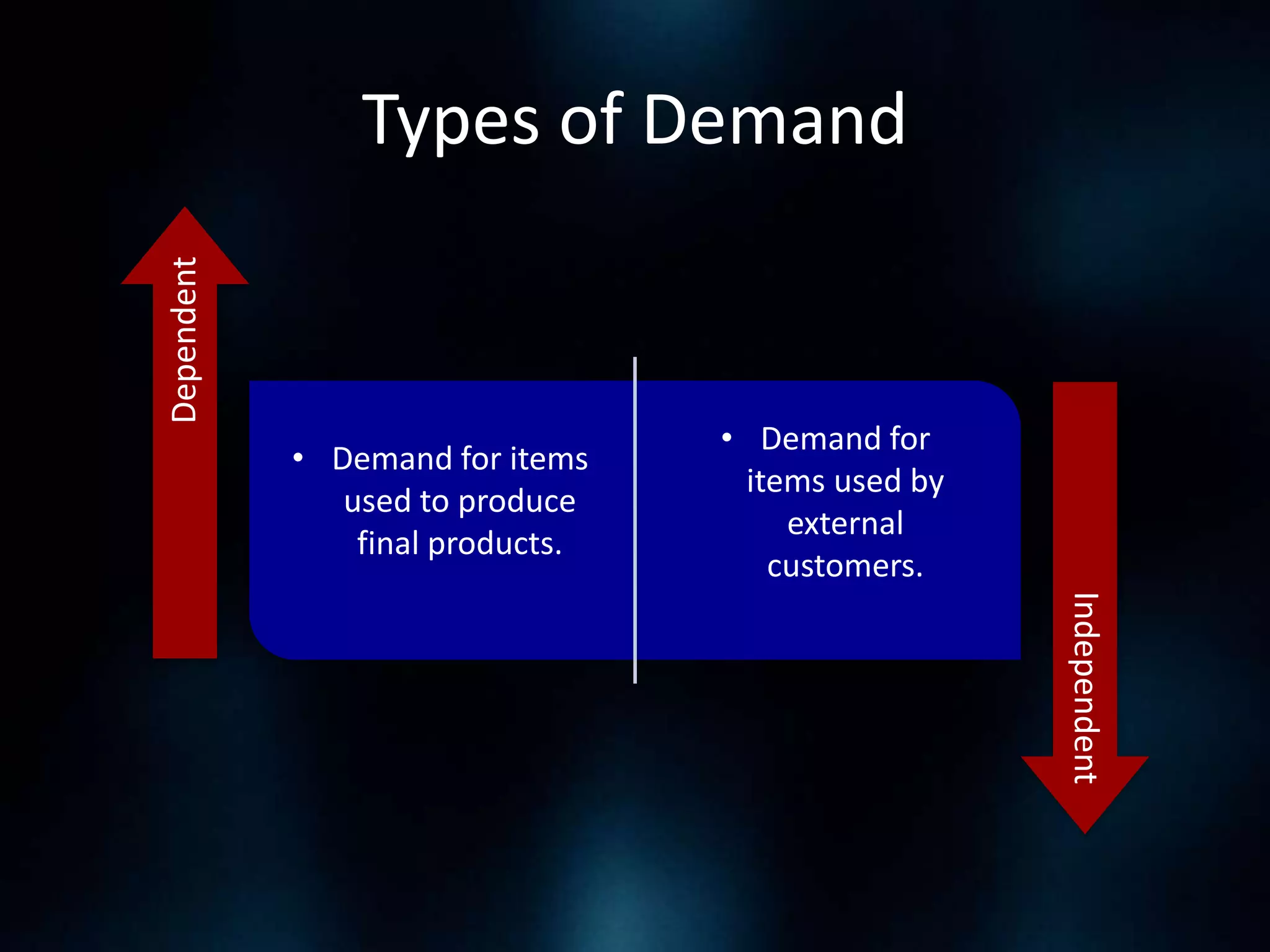
Dependent

Types of Demand

• Demand for items
used to produce
final products.

• Demand for
items used by
external
customers.

Independent
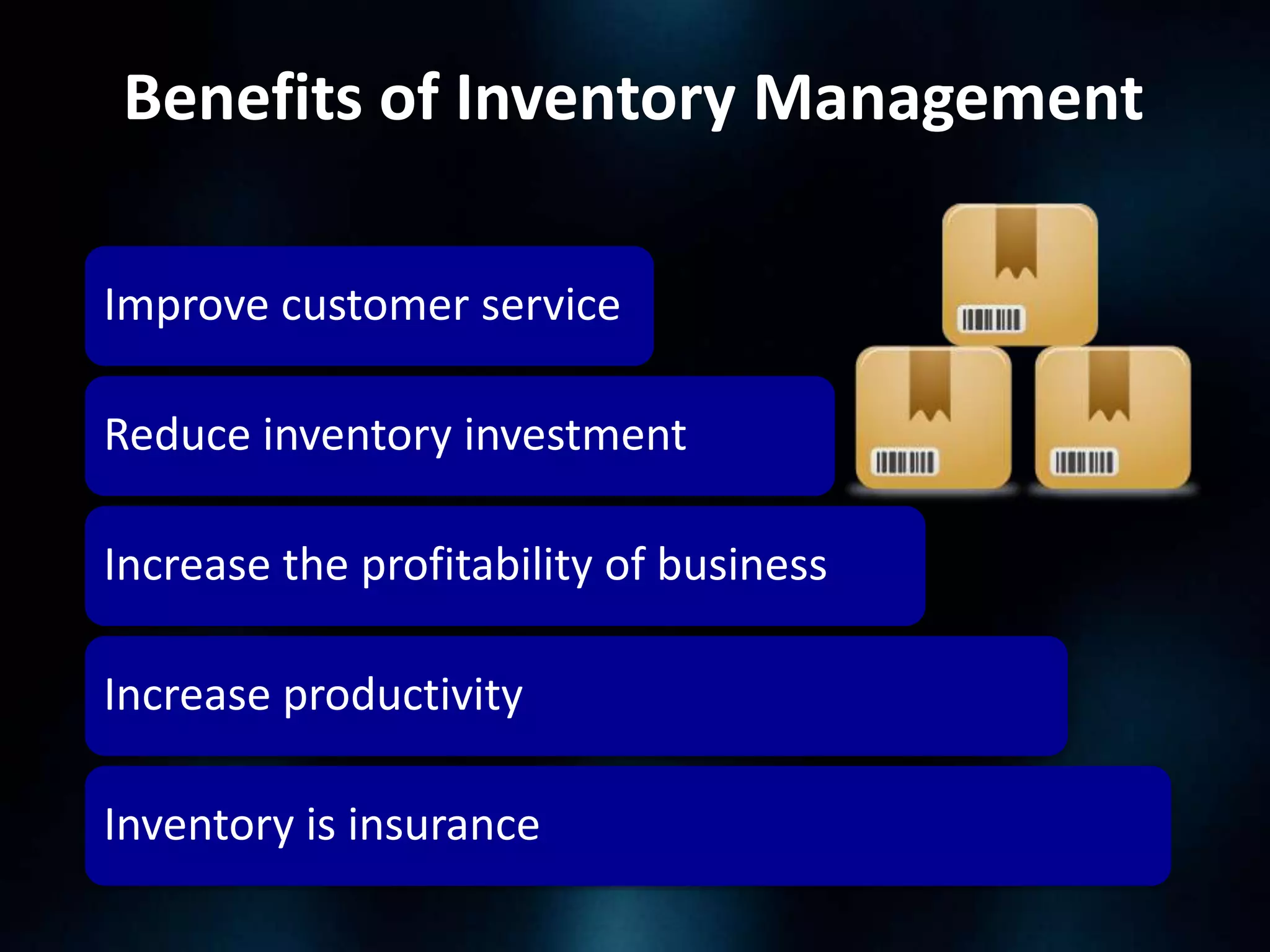
Benefits of Inventory Management
Improve customer service
Reduce inventory investment
Increase the profitability of business
Increase productivity

Inventory is insurance
Drawbacks of Keeping Inventory

• Inventory is expensive
• Items deterioration
• Products obsolescence
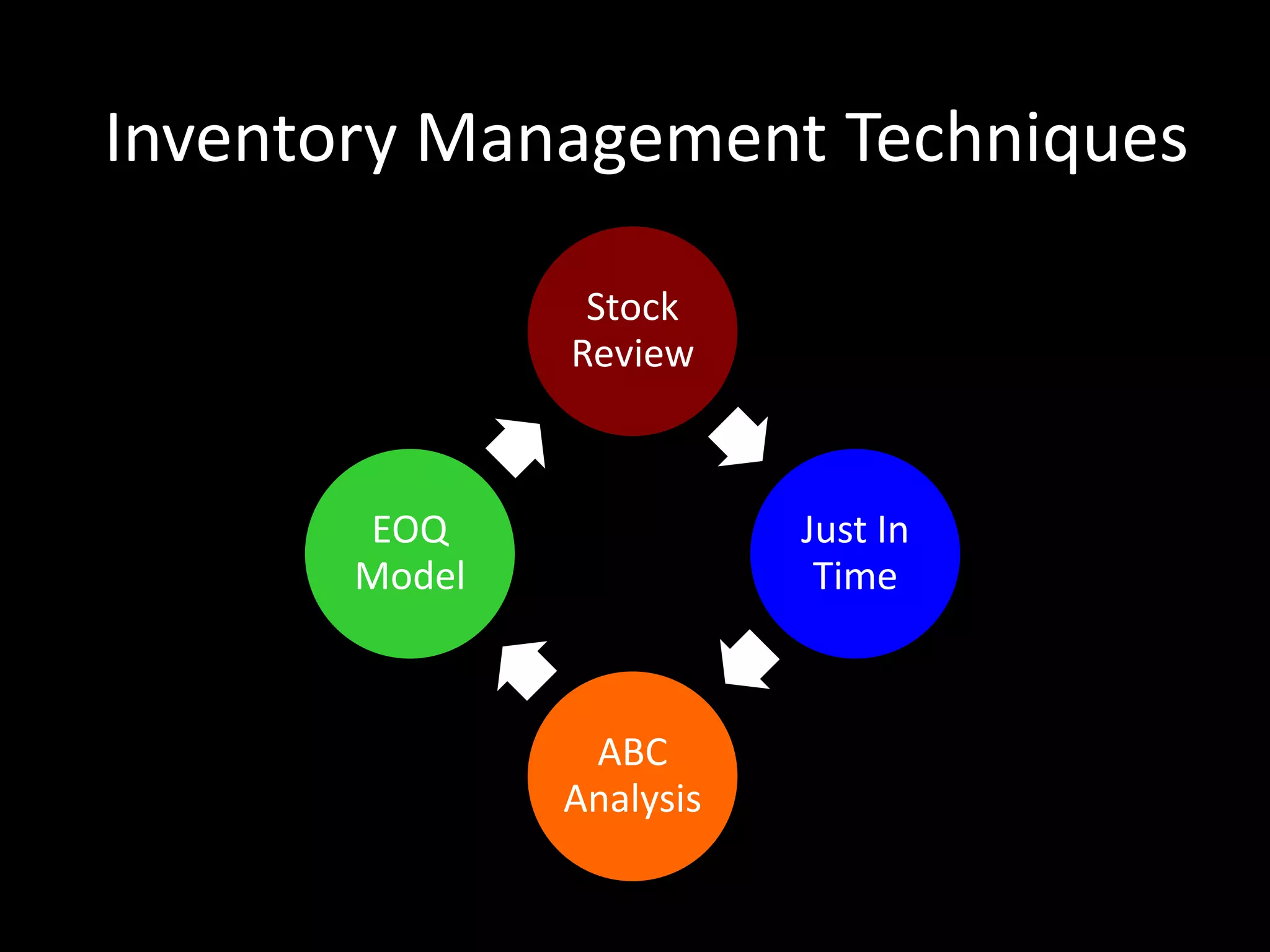
Inventory Management Techniques
Stock
Review

EOQ
Model

Just In
Time

ABC
Analysis
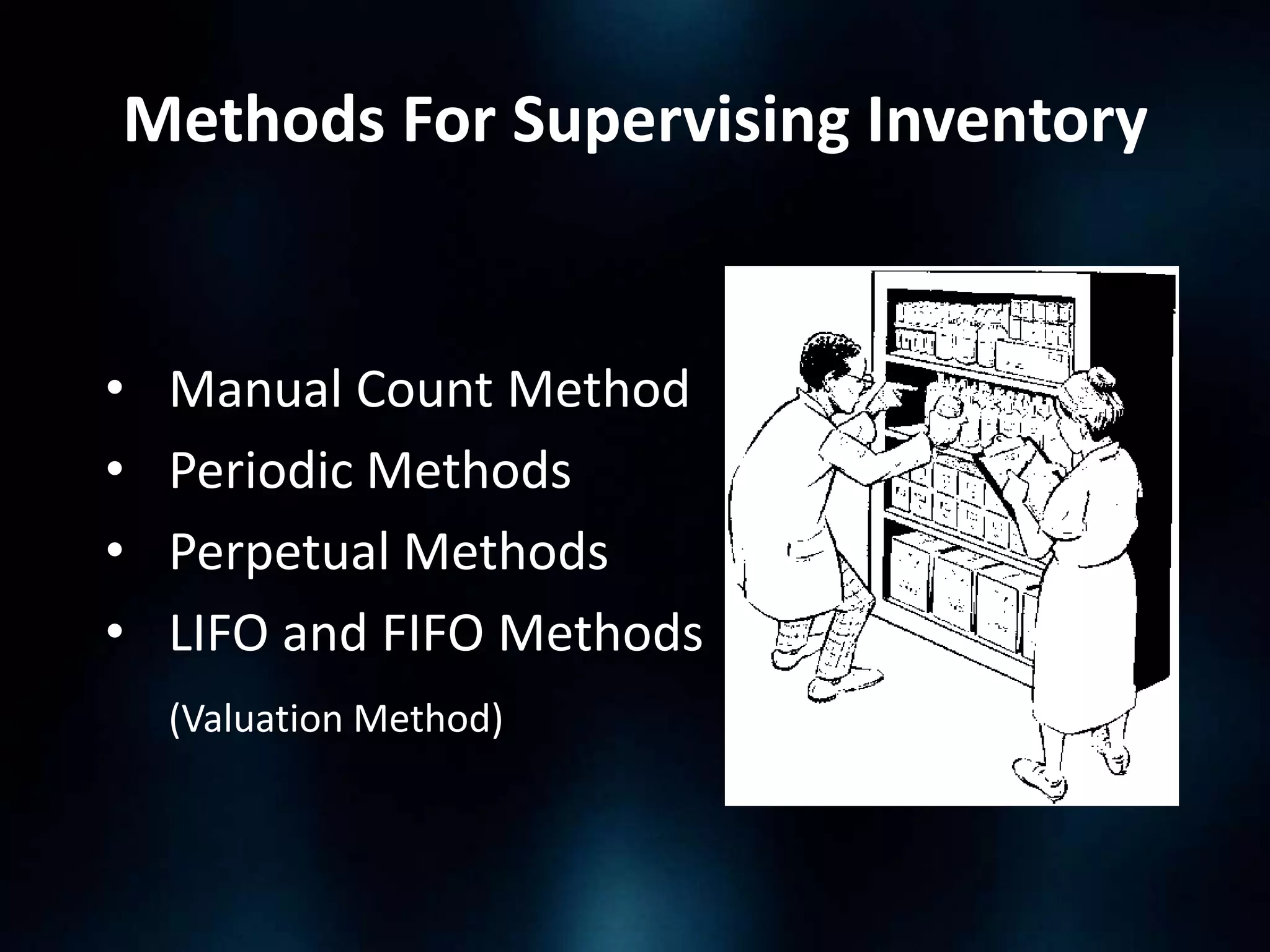
Methods For Supervising Inventory

•
•
•
•

Manual Count Method
Periodic Methods
Perpetual Methods
LIFO and FIFO Methods
(Valuation Method)
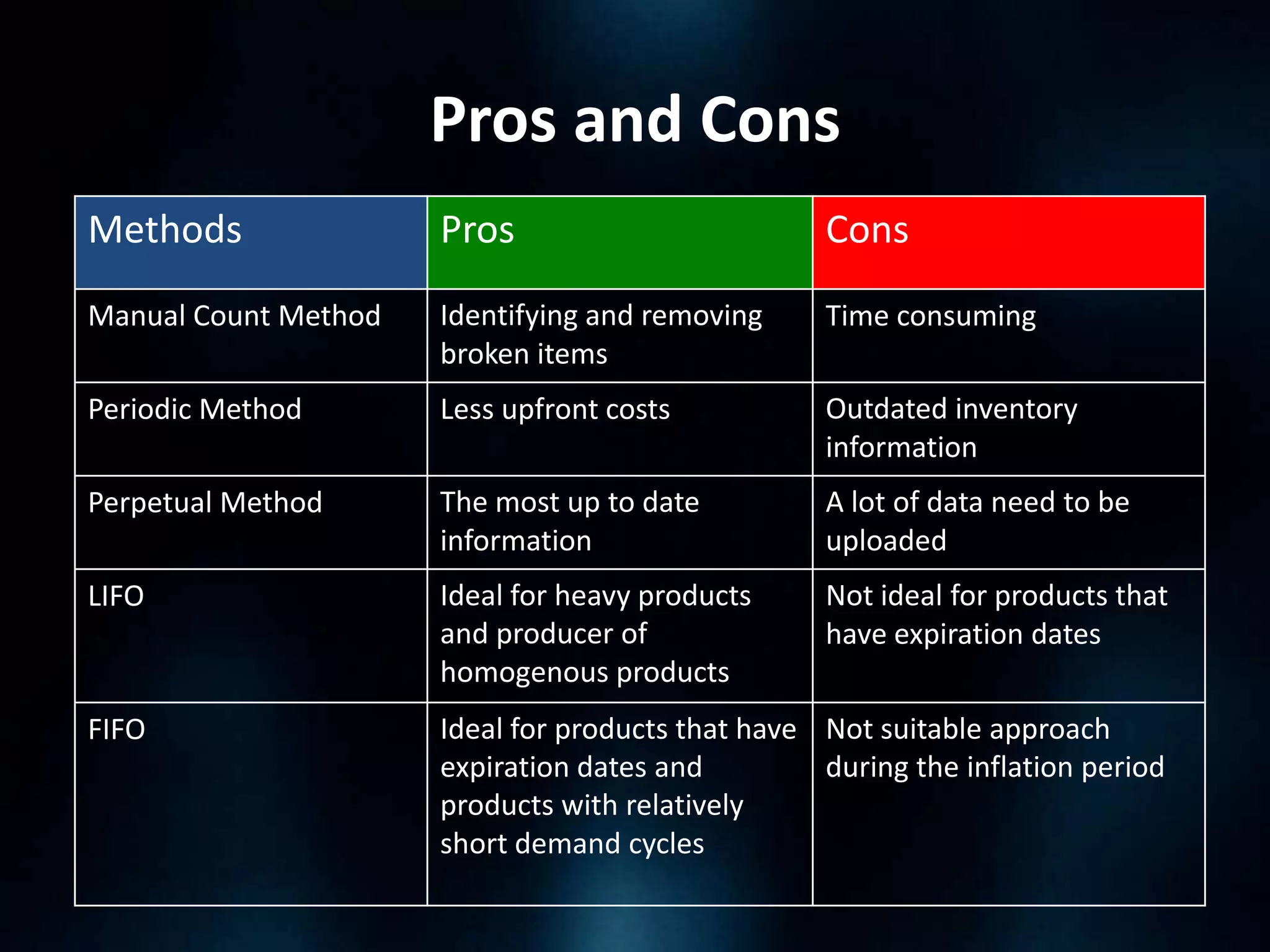
Pros and Cons
Methods

Pros

Cons

Manual Count Method

Identifying and removing
broken items

Time consuming

Periodic Method

Less upfront costs

Outdated inventory
information

Perpetual Method

The most up to date
information

A lot of data need to be
uploaded

LIFO

Ideal for heavy products
and producer of
homogenous products

Not ideal for products that
have expiration dates

FIFO

Ideal for products that have Not suitable approach
expiration dates and
during the inflation period
products with relatively
short demand cycles
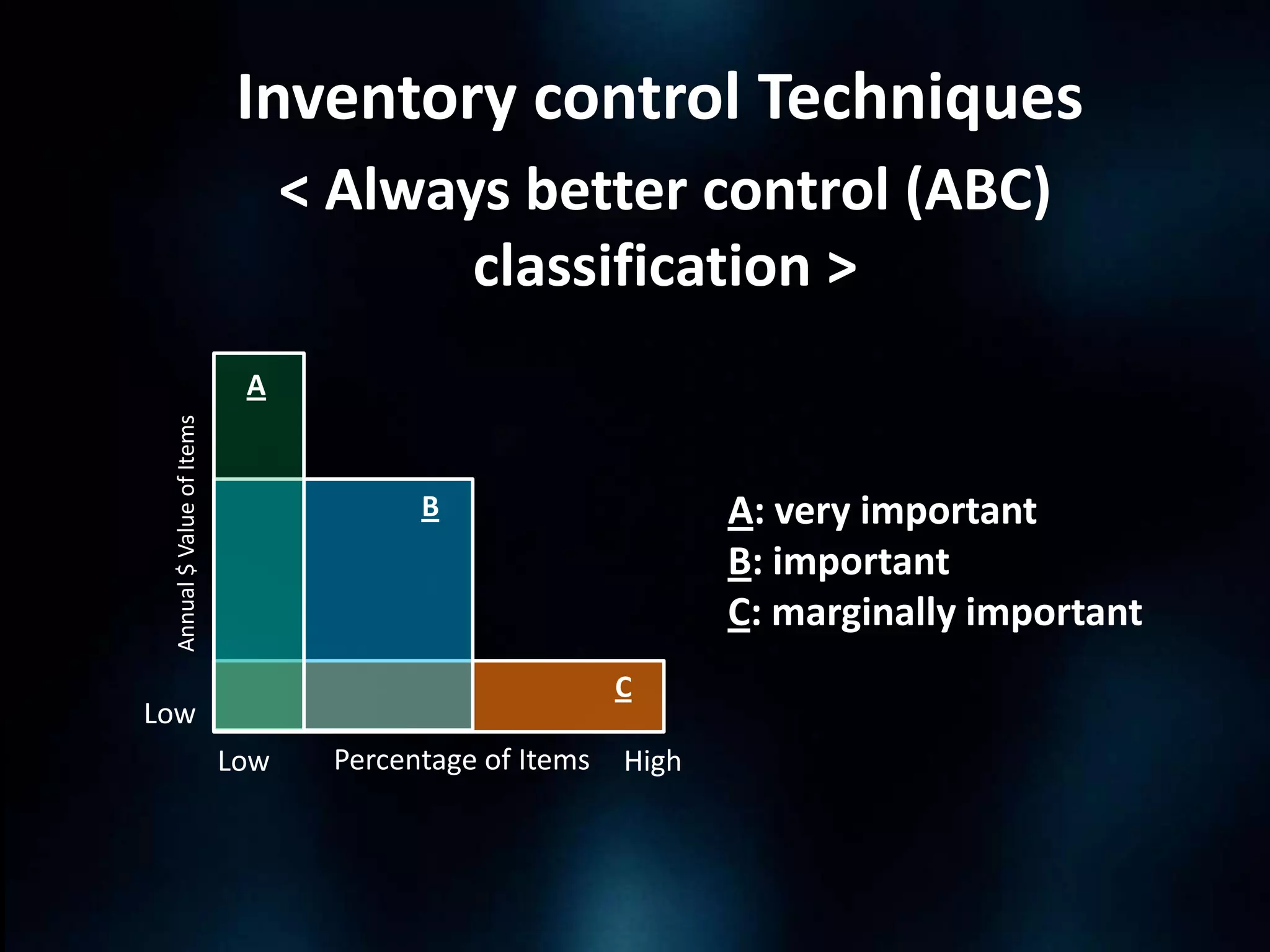
Inventory control Techniques
< Always better control (ABC)
classification >
Annual $ Value of Items

A

A: very important
B: important
C: marginally important

B

C

Low

Low

Percentage of Items

High
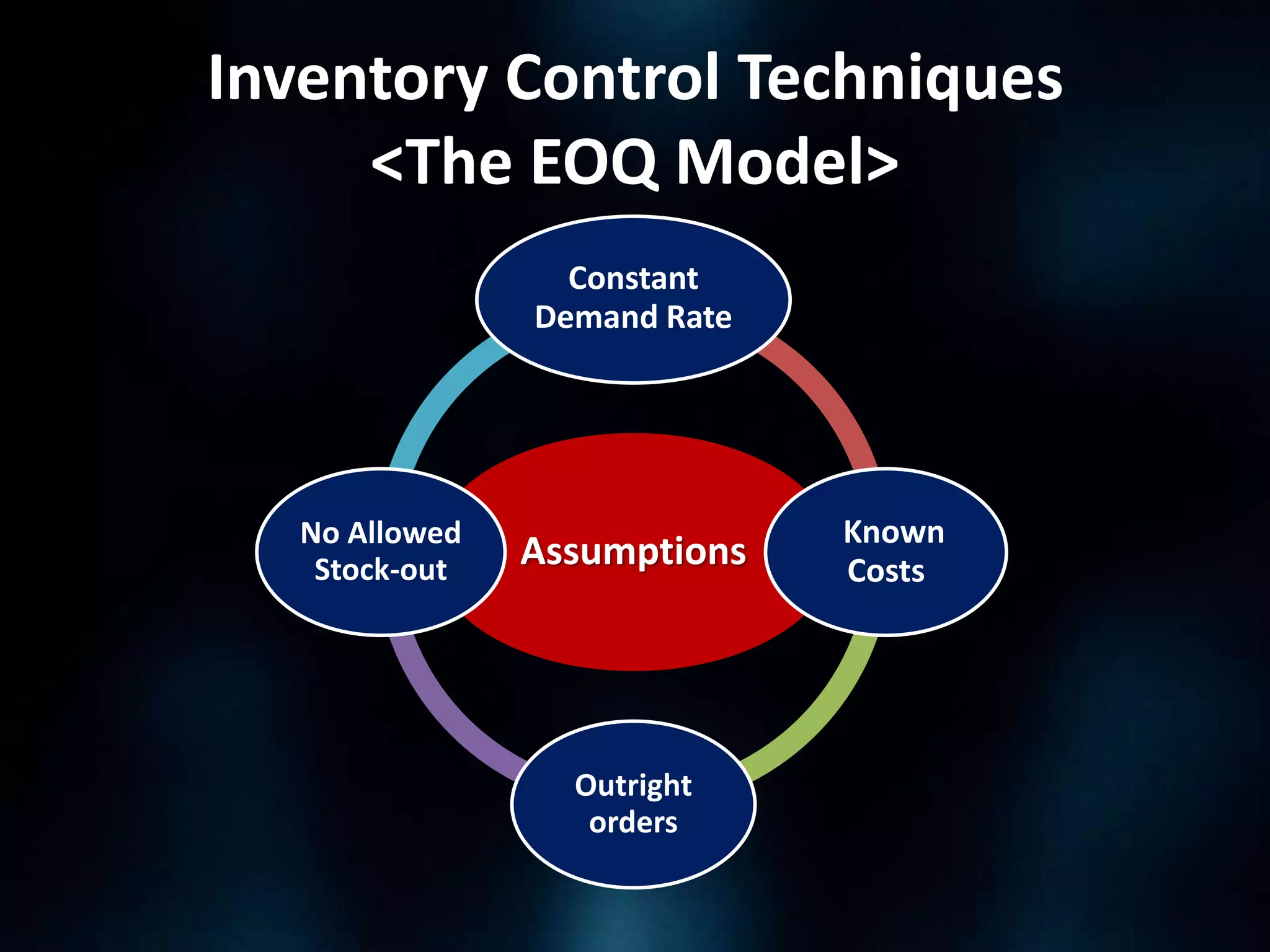
Inventory Control Techniques
<The EOQ Model>
Constant
Demand Rate

No Allowed
Stock-out

Assumptions

Outright
orders

Known
Costs
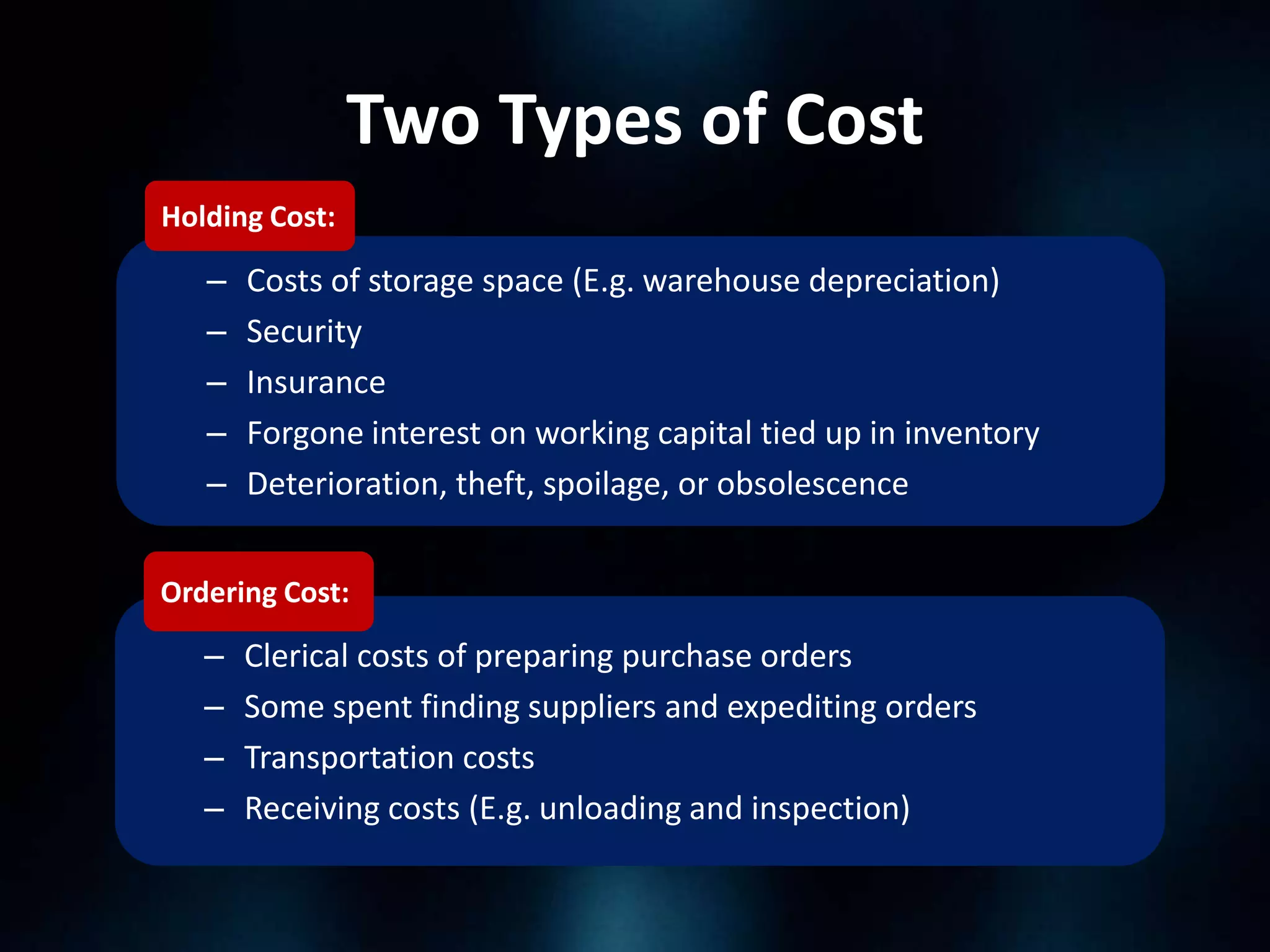
Two Types of Cost
Holding Cost:

–
–
–
–
–

Costs of storage space (E.g. warehouse depreciation)
Security
Insurance
Forgone interest on working capital tied up in inventory
Deterioration, theft, spoilage, or obsolescence

Ordering Cost:

–
–
–
–

Clerical costs of preparing purchase orders
Some spent finding suppliers and expediting orders
Transportation costs
Receiving costs (E.g. unloading and inspection)
Development of EOQ Model
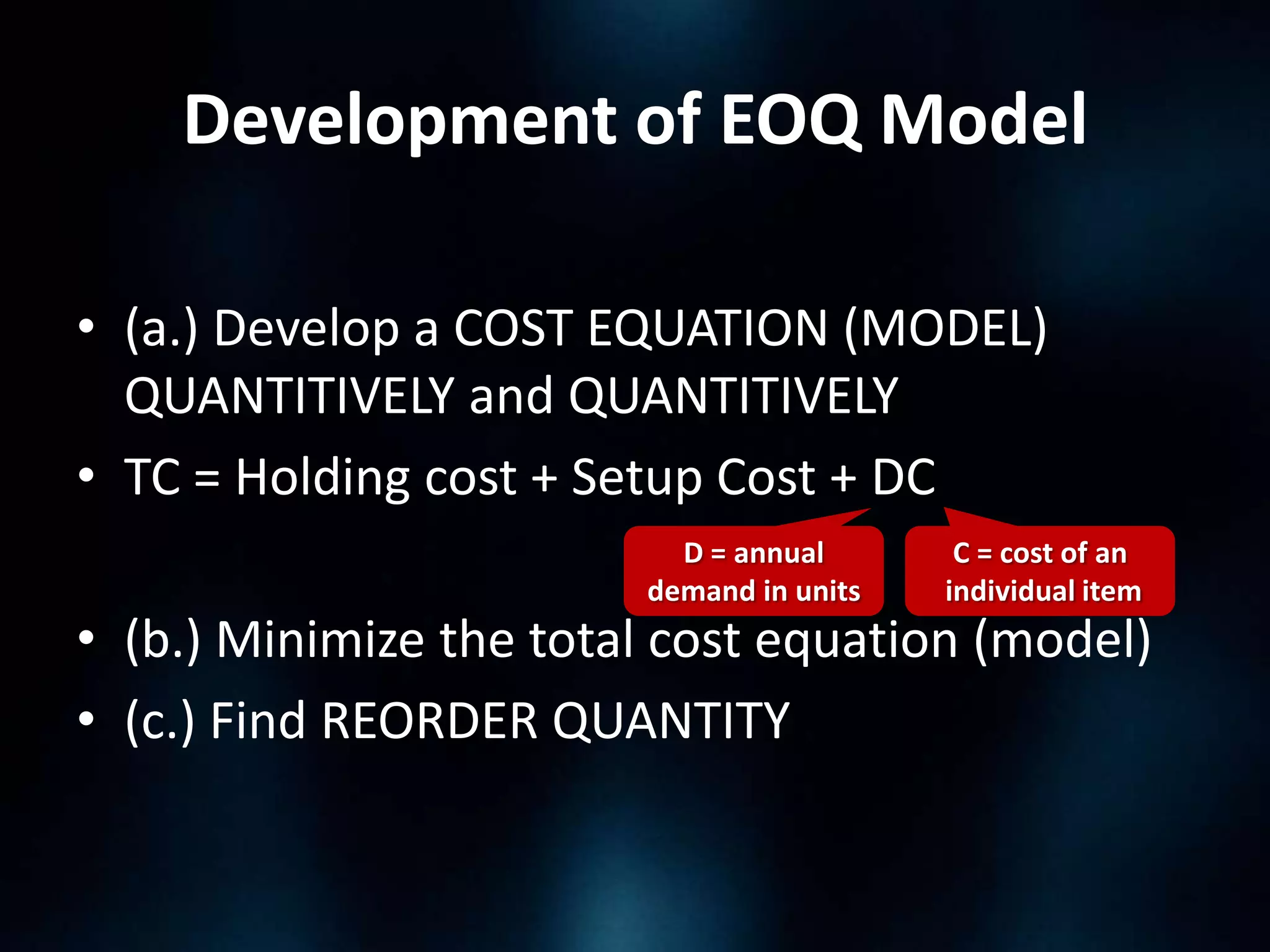
• (a.) Develop a COST EQUATION (MODEL)
QUANTITIVELY and QUANTITIVELY
• TC = Holding cost + Setup Cost + DC
D = annual
demand in units

C = cost of an
individual item

• (b.) Minimize the total cost equation (model)
• (c.) Find REORDER QUANTITY
Inventory Usage Over Time
Order Quantity

Usage
Rate

[maximum inventory level]

Q
Inventory Control

Average inventory
on hand
Q/2

0
Minimum
Inventory

Lead time

Time
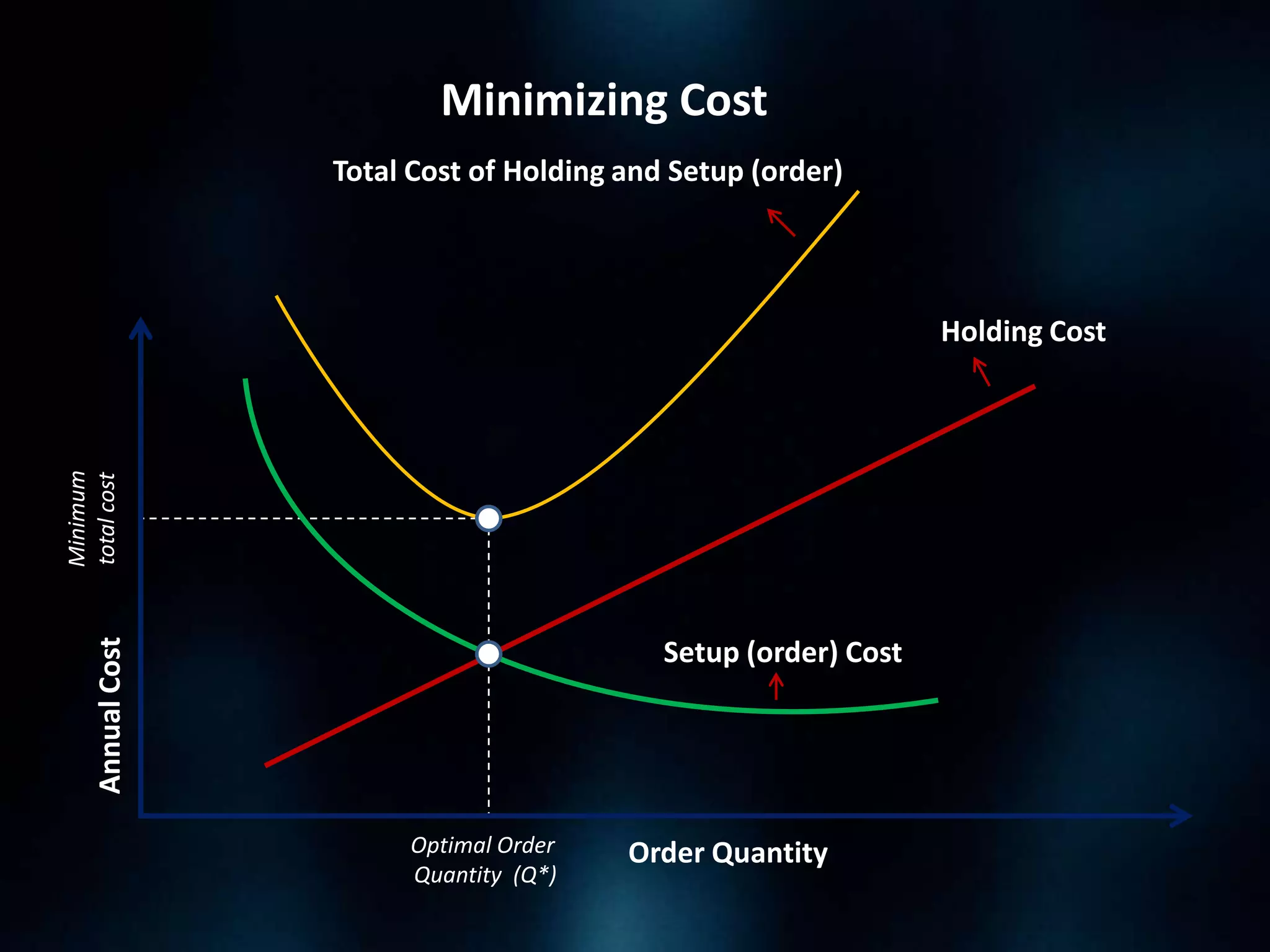
Minimizing Cost
Total Cost of Holding and Setup (order)

Annual Cost

Minimum
total cost

Holding Cost

Setup (order) Cost

Optimal Order
Quantity (Q*)

Order Quantity
Inventory control Techniques
<The EOQ Model>
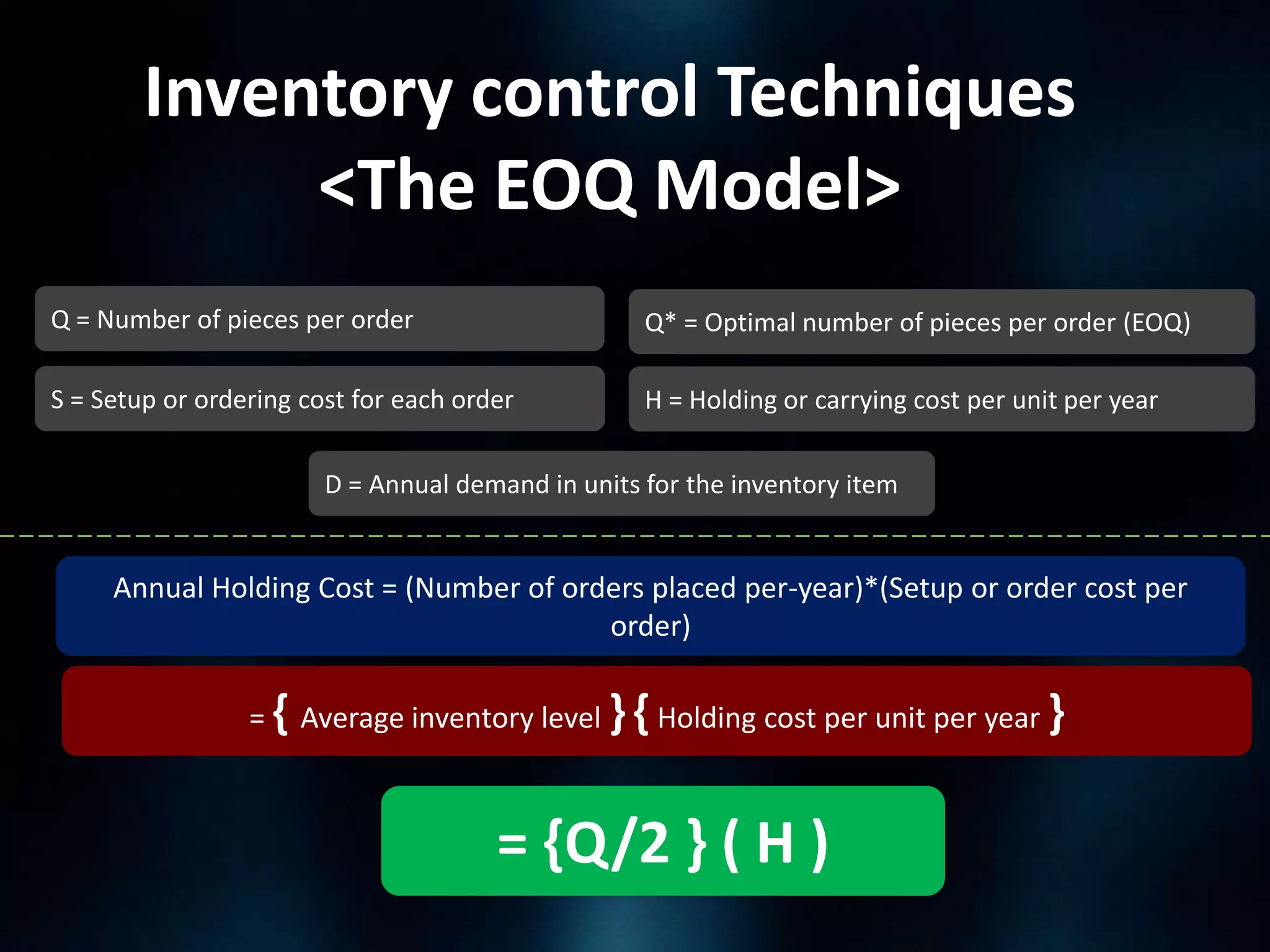
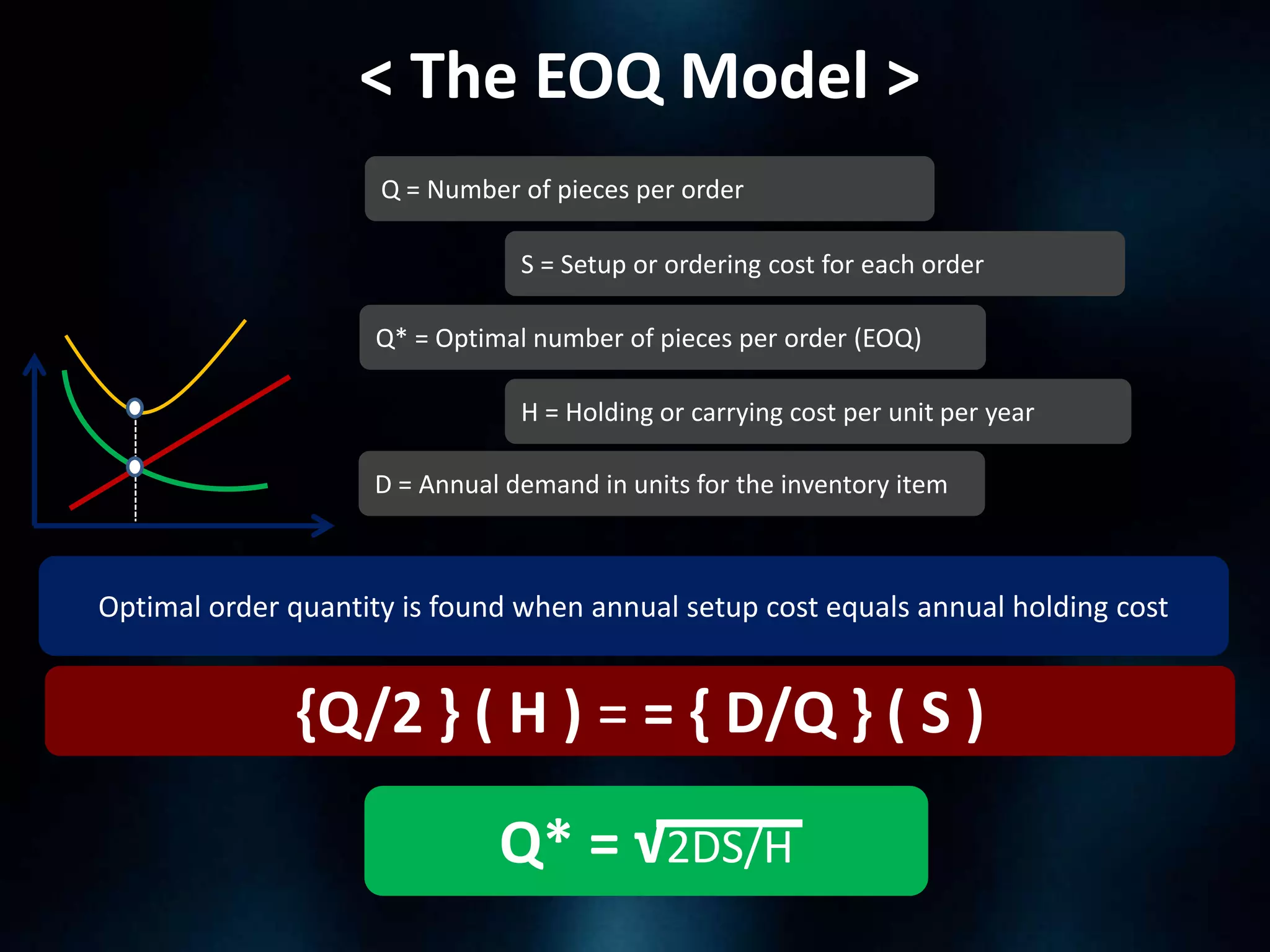
Q = Number of pieces per order

Q* = Optimal number of pieces per order (EOQ)

S = Setup or ordering cost for each order

H = Holding or carrying cost per unit per year

D = Annual demand in units for the inventory item

Annual Holding Cost = (Number of orders placed per-year)*(Setup or order cost per
order)
= { Average inventory level } { Holding cost per unit per year }

= {Q/2 } ( H )
Inventory control Techniques
< The EOQ Model >
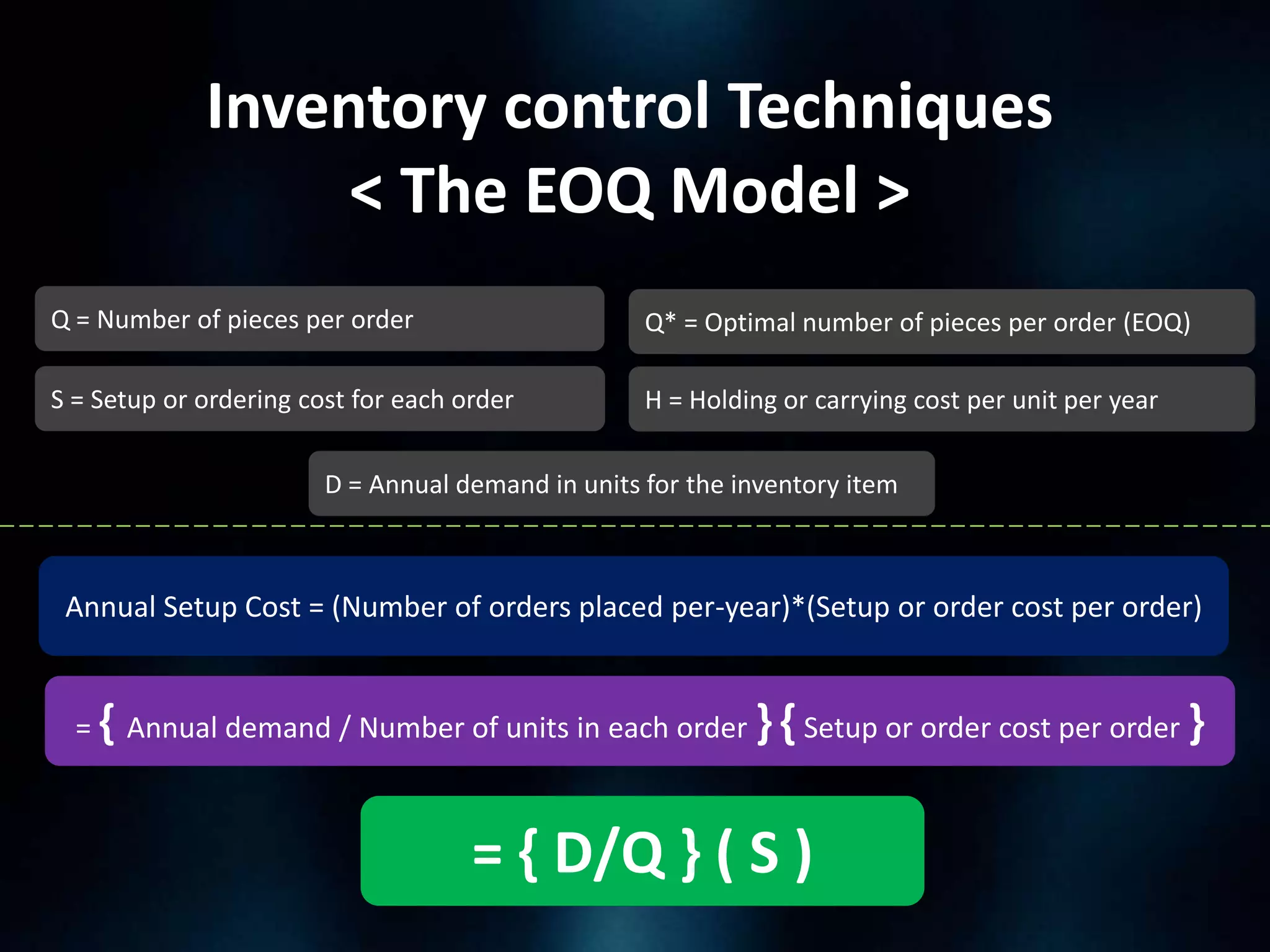
Q = Number of pieces per order

Q* = Optimal number of pieces per order (EOQ)

S = Setup or ordering cost for each order

H = Holding or carrying cost per unit per year

D = Annual demand in units for the inventory item

Annual Setup Cost = (Number of orders placed per-year)*(Setup or order cost per order)
= { Annual demand / Number of units in each order } { Setup or order cost per order }

= { D/Q } ( S )
< The EOQ Model >
Q = Number of pieces per order
S = Setup or ordering cost for each order
Q* = Optimal number of pieces per order (EOQ)
H = Holding or carrying cost per unit per year
D = Annual demand in units for the inventory item

Optimal order quantity is found when annual setup cost equals annual holding cost

{Q/2 } ( H ) = = { D/Q } ( S )
Q* = √2DS/H
Ahmad Saymil,,“Operations Management:Toyota Production System (TPS), Just-inTime (JIT), and Lean Manufacturing Handout”, http://www.clt.astate.edu/asyamil/

Lowering Inventory /Reduces Waste
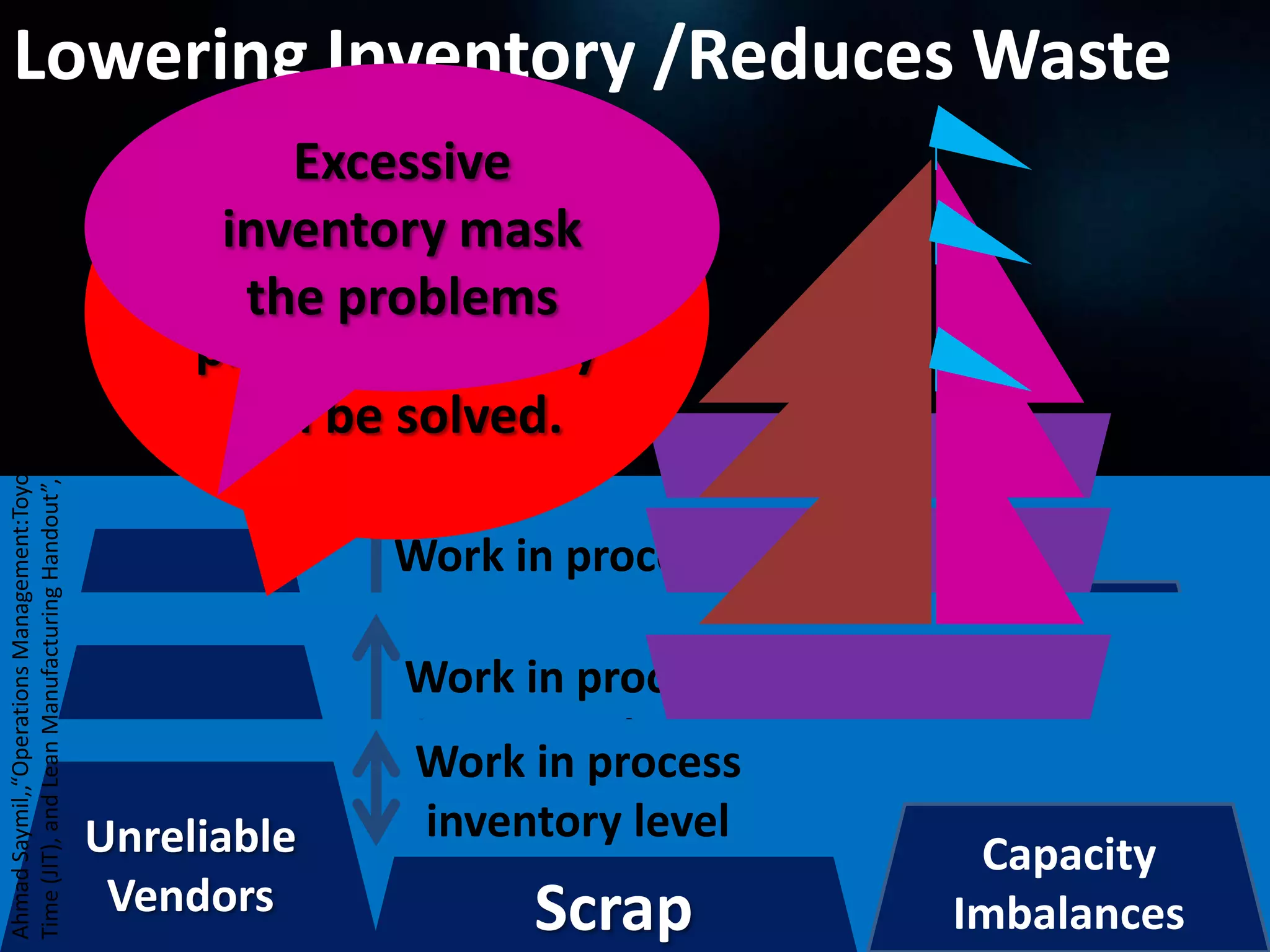
Excessive
Reducing
inventory mask
inventory reveals
the problems
problems so they
can be solved.

Unreliable
Unreliable
Vendors
Unreliable
Vendors
Vendors

Work in process inventory level
(hides problems)
Work in process
inventory level
Work in process
Capacity
inventory level
Capacity
Imbalances
Scrap
Capacity
Imbalances
Scrap
Imbalances
Scrap
Video
http://www.youtube.com/watch?v=1d0O8MAMyAM
“One of the great responsibilities that I
have is to manage my assets wisely, so
that they create value.”

Alice Walton
Thank You!

Inventory management in supply chain

  • 1.
    Inventory Management Winter 2014 ADM– eSupply Chain Management
  • 2.
    Outline • What isinventory • Myths in inventory management • Reasons for having inventory • Rolls of Inventory in SCM • Types of Demands • Benefits/Drawbacks • Methods for inventories • Inventory Techniques
  • 3.
    SCM/Inventories Supplier Manufacturing •Inventories Distributer Retailer •Goods in Transit Customer •RawMaterials •Finished Goods •Work in Progress •Finished Goods Traditional Supply Chain Management (SCM) G.Trites, J.Boritz, “e-business strategies, a Canadian perspective for a networked world” ,Pearson-Prentice Hall, 2009
  • 4.
    What is Inventory? RawMaterials Component parts Work-in-Process Finished Products Planning Directing Controlling
  • 5.
    Myths in InventoryManagement The “SALES” data that we have in our company records, is all we need for inventory management” “The more expensive a software system is, the better it will help us control our inventory“ “We keep all of our sales histories by month, and this data is all we need to make good forecasts for inventory planning”
  • 6.
    Reasons for Inventories oImprove Customer Service o Economies of purchasing o Economies of Production o Transportation Savings o Hedge against future o Unplanned shocks(labor strikes, natural disasters, surges in demand, etc) o To maintain independence in supply chain
  • 7.
    Role of Inventoryin Supply Chain Supply Chain Understocking : Demand exceeds amount available - Lost margin and future sales Overstocking : Amount available exceeds demand - Liquidation, Obsolescence, Holding Goal Matching Supply and Demand
  • 8.
    Dependent Types of Demand •Demand for items used to produce final products. • Demand for items used by external customers. Independent
  • 9.
    Benefits of InventoryManagement Improve customer service Reduce inventory investment Increase the profitability of business Increase productivity Inventory is insurance
  • 10.
    Drawbacks of KeepingInventory • Inventory is expensive • Items deterioration • Products obsolescence
  • 11.
  • 12.
    Methods For SupervisingInventory • • • • Manual Count Method Periodic Methods Perpetual Methods LIFO and FIFO Methods (Valuation Method)
  • 13.
    Pros and Cons Methods Pros Cons ManualCount Method Identifying and removing broken items Time consuming Periodic Method Less upfront costs Outdated inventory information Perpetual Method The most up to date information A lot of data need to be uploaded LIFO Ideal for heavy products and producer of homogenous products Not ideal for products that have expiration dates FIFO Ideal for products that have Not suitable approach expiration dates and during the inflation period products with relatively short demand cycles
  • 14.
    Inventory control Techniques <Always better control (ABC) classification > Annual $ Value of Items A A: very important B: important C: marginally important B C Low Low Percentage of Items High
  • 15.
    Inventory Control Techniques <TheEOQ Model> Constant Demand Rate No Allowed Stock-out Assumptions Outright orders Known Costs
  • 16.
    Two Types ofCost Holding Cost: – – – – – Costs of storage space (E.g. warehouse depreciation) Security Insurance Forgone interest on working capital tied up in inventory Deterioration, theft, spoilage, or obsolescence Ordering Cost: – – – – Clerical costs of preparing purchase orders Some spent finding suppliers and expediting orders Transportation costs Receiving costs (E.g. unloading and inspection)
  • 17.
    Development of EOQModel • (a.) Develop a COST EQUATION (MODEL) QUANTITIVELY and QUANTITIVELY • TC = Holding cost + Setup Cost + DC D = annual demand in units C = cost of an individual item • (b.) Minimize the total cost equation (model) • (c.) Find REORDER QUANTITY
  • 18.
    Inventory Usage OverTime Order Quantity Usage Rate [maximum inventory level] Q Inventory Control Average inventory on hand Q/2 0 Minimum Inventory Lead time Time
  • 19.
    Minimizing Cost Total Costof Holding and Setup (order) Annual Cost Minimum total cost Holding Cost Setup (order) Cost Optimal Order Quantity (Q*) Order Quantity
  • 20.
    Inventory control Techniques <TheEOQ Model> Q = Number of pieces per order Q* = Optimal number of pieces per order (EOQ) S = Setup or ordering cost for each order H = Holding or carrying cost per unit per year D = Annual demand in units for the inventory item Annual Holding Cost = (Number of orders placed per-year)*(Setup or order cost per order) = { Average inventory level } { Holding cost per unit per year } = {Q/2 } ( H )
  • 21.
    Inventory control Techniques <The EOQ Model > Q = Number of pieces per order Q* = Optimal number of pieces per order (EOQ) S = Setup or ordering cost for each order H = Holding or carrying cost per unit per year D = Annual demand in units for the inventory item Annual Setup Cost = (Number of orders placed per-year)*(Setup or order cost per order) = { Annual demand / Number of units in each order } { Setup or order cost per order } = { D/Q } ( S )
  • 22.
    < The EOQModel > Q = Number of pieces per order S = Setup or ordering cost for each order Q* = Optimal number of pieces per order (EOQ) H = Holding or carrying cost per unit per year D = Annual demand in units for the inventory item Optimal order quantity is found when annual setup cost equals annual holding cost {Q/2 } ( H ) = = { D/Q } ( S ) Q* = √2DS/H
  • 23.
    Ahmad Saymil,,“Operations Management:ToyotaProduction System (TPS), Just-inTime (JIT), and Lean Manufacturing Handout”, http://www.clt.astate.edu/asyamil/ Lowering Inventory /Reduces Waste Excessive Reducing inventory mask inventory reveals the problems problems so they can be solved. Unreliable Unreliable Vendors Unreliable Vendors Vendors Work in process inventory level (hides problems) Work in process inventory level Work in process Capacity inventory level Capacity Imbalances Scrap Capacity Imbalances Scrap Imbalances Scrap
  • 24.
  • 25.
    “One of thegreat responsibilities that I have is to manage my assets wisely, so that they create value.” Alice Walton
  • 26.

Editor's Notes

  • #15 Classifying inventory according to some measure of importance and allocating control effects accordingly
  • #16 Demand rate is constant, recurring and known No stock-out are allowed Orders are delivered at once All costs are assumed to be known and constant All orders are placed independently (no joint orders)