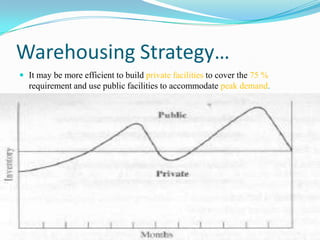
Warehouse Management
Contents:-Reasons for warehousingBenefitsWarehouse operating principlesTypes of WarehouseWarehousing strategiesWarehouse location strategiesSite selectionTransport
Warehousing:-	“Storage or warehousing provides the place utility as part of logistics for any business and along with Transportation is a critical component of customer service standards”.
Customer  AnalysisPurchasing/Supplier  PartneringOrder FulfillmentIntegrated Supply Chain ManagementInventory Management & ControlWarehouse &  TransportationManufacturing/ Re-manufacturing / AssemblyDemand &  Lead Time  ManagementMaterials  Management
Reasons for warehousing:-To support the company’s customer policy.To maintain a source of supply without interruptions.To achieve transportation economies.To support changing market conditions and sudden changes in demand.To support any JIT programs.To provide customers with the right mix of products at all times and all locations.To ensure least logistics cost for a desired level of customer service.
Benefits of warehousing:-Consolidation.
Consolidation Warehouses:-                                                 CustomersPlant  AConsolidation  WarehousesACBPlant  BPlant  C
Benefits of warehousing:-Consolidation.Break bulk warehouse.
Break bulk Warehouses:-                                                  CustomersABreak bulk  WarehousesBPlant  AC
Benefits of warehousing:-Consolidation.Break bulk warehouse.Processing / Postponement.Stockpiling.Service benefits.
Warehouse Operating Principles:-Three Principles are:Design criteria:a) Number of stories in the facility,b) Height utilization,c) Product flow
Warehouse Operating Principles:-2) Handling technologyMovement continuity,Movement scale economies.3) Storage plan
Types of warehouses:-It includes:1) Private warehouses,2) Public warehouses, 3) Contract warehouses
Warehousing Strategy…An integrated warehouse strategy focuses on two questions. 1) The 1st concerns how many warehouses should be employed. 2) The 2nd question concerns which warehouse types should be used to meet market requirements.
Warehousing Strategy:-Many firms utilize a combination of private, public, and contract facilities. A private or contract facility may be used to cover basic year round requirements, while public facilities are used to handle peak seasons. In other situations, central warehouses may be private, while market area or field warehouses are public facilities.
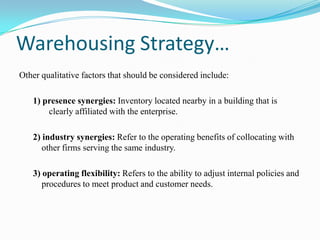
Warehousing Strategy…Full warehouse utilization throughout a year is a remote possibility. As a planning rule, a warehouse designed for full-capacity utilization will in fact be fully utilized between 75 to 85 % of the time. Thus from 15 to 25 % of the time, the space needed to meet peak requirements is not utilized. In such situations, it may be more efficient to build private facilities to cover the 75% requirement and use public facilities to accommodate peak demand.
Warehousing Strategy…It may be more efficient to build private facilities to cover the 75 % requirement and use public facilities to accommodatepeak demand.
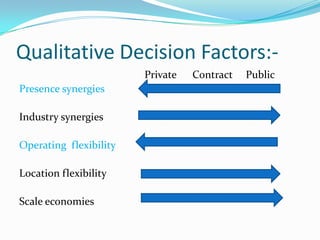
Warehousing Strategy…Other qualitative factors that should be considered include: 1) presence synergies: Inventory located nearby in a building that is clearly affiliated with the enterprise.2) industry synergies: Refer to the operating benefits of collocating with other firms serving the same industry. 3) operating flexibility: Refers to the ability to adjust internal policies and procedures to meet product and customer needs.
Contd…   4) location flexibility: Refers to the ability to quickly adjust warehouse location and number in accordance with seasonal or permanent demand changes.5) scale economies: Refer to the ability to reduce material-handling and storage through application of advanced technologies.
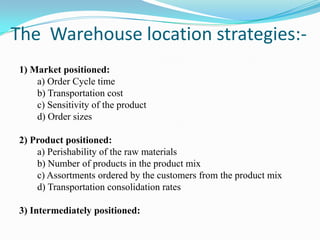
Qualitative Decision Factors:-                                               Private      Contract     PublicPresence synergiesIndustry synergiesOperating  flexibilityLocation flexibilityScale economies
The  Warehouse location strategies:-1) Market positioned:	a) Order Cycle timeb) Transportation costc) Sensitivity of the productd) Order sizes2) Product positioned:	a) Perishability of the raw materialsb) Number of products in the product mixc) Assortments ordered by the customers from the product mixd) Transportation consolidation rates3) Intermediately positioned:
Site Selection:-Location of the major markets.Nature of the products being distributed.Quality & Variety of carriers serving the proposed site.Quality & Quantity of labour  available.Cost of industrial land.
Contd…Potential for expansion.Local tax structures.Cost of construction. Cost & availability of utilities .Any local govt. tax concessions or incentives.
Product-Mix Coiderations:-Each product should be analyzed in terms of annual sales, stability of demand, weight, and packaging. It is also desirable to determine the total size and weight of the average order processed through the warehouse. Expansion:-Well-managed organizations often establish five- to ten-year expansion plans. Such expansion considerations may require purchase or option of a site three to five times the size of the initial structure.
Warehouse Layout:-Layout of a warehouse depends on the proposed material handling system and requires development of a floor plan to facilitate product flow.If pallets are to be utilized, the first step is to determine the pallet size. Pilferage Protection:-Protection against theft of merchandise has become a major factor in warehouse operationAs standard procedure, only authorized personnel should be permitted into the facility and surrounding grounds.
Product Deterioration:-The most obvious form of product deterioration is damage from careless transfer or storage. Another major form of deterioration is non-compatibility of products stored in the same facility.Product deterioration from careless handling within the warehouse is a form of loss that cannot be insured against and constitutes a 100 percent cost with no compensating revenue.
TRANSPORT
Transport Fundamentals:-Transport involves Equipment People Decisions When deciding the transport mode for a given product  there are several things to consider:Mode priceTransit time and variability (reliability)Potential for loss or damage.
Single-mode Service Choices and Issues:-Air
Rapidly growing segment of transportation industry
Lightweight, small items
Quick, reliable, expensive
Rail
Low cost, high-volume
Improving flexibility
intermodal serviceContd…Road :Company has flexibility of deciding the drop points .
The operation can be 24 x 7

Warehouse

  • 1.
  • 2.
    Contents:-Reasons for warehousingBenefitsWarehouseoperating principlesTypes of WarehouseWarehousing strategiesWarehouse location strategiesSite selectionTransport
  • 3.
    Warehousing:- “Storage or warehousingprovides the place utility as part of logistics for any business and along with Transportation is a critical component of customer service standards”.
  • 4.
    Customer AnalysisPurchasing/Supplier PartneringOrder FulfillmentIntegrated Supply Chain ManagementInventory Management & ControlWarehouse & TransportationManufacturing/ Re-manufacturing / AssemblyDemand & Lead Time ManagementMaterials Management
  • 5.
    Reasons for warehousing:-Tosupport the company’s customer policy.To maintain a source of supply without interruptions.To achieve transportation economies.To support changing market conditions and sudden changes in demand.To support any JIT programs.To provide customers with the right mix of products at all times and all locations.To ensure least logistics cost for a desired level of customer service.
  • 6.
  • 7.
    Consolidation Warehouses:- CustomersPlant AConsolidation WarehousesACBPlant BPlant C
  • 8.
  • 9.
    Break bulk Warehouses:- CustomersABreak bulk WarehousesBPlant AC
  • 10.
    Benefits of warehousing:-Consolidation.Breakbulk warehouse.Processing / Postponement.Stockpiling.Service benefits.
  • 11.
    Warehouse Operating Principles:-ThreePrinciples are:Design criteria:a) Number of stories in the facility,b) Height utilization,c) Product flow
  • 12.
    Warehouse Operating Principles:-2)Handling technologyMovement continuity,Movement scale economies.3) Storage plan
  • 13.
    Types of warehouses:-Itincludes:1) Private warehouses,2) Public warehouses, 3) Contract warehouses
  • 14.
    Warehousing Strategy…An integratedwarehouse strategy focuses on two questions. 1) The 1st concerns how many warehouses should be employed. 2) The 2nd question concerns which warehouse types should be used to meet market requirements.
  • 15.
    Warehousing Strategy:-Many firmsutilize a combination of private, public, and contract facilities. A private or contract facility may be used to cover basic year round requirements, while public facilities are used to handle peak seasons. In other situations, central warehouses may be private, while market area or field warehouses are public facilities.
  • 16.
    Warehousing Strategy…Full warehouseutilization throughout a year is a remote possibility. As a planning rule, a warehouse designed for full-capacity utilization will in fact be fully utilized between 75 to 85 % of the time. Thus from 15 to 25 % of the time, the space needed to meet peak requirements is not utilized. In such situations, it may be more efficient to build private facilities to cover the 75% requirement and use public facilities to accommodate peak demand.
  • 17.
    Warehousing Strategy…It maybe more efficient to build private facilities to cover the 75 % requirement and use public facilities to accommodatepeak demand.
  • 18.
    Warehousing Strategy…Other qualitativefactors that should be considered include: 1) presence synergies: Inventory located nearby in a building that is clearly affiliated with the enterprise.2) industry synergies: Refer to the operating benefits of collocating with other firms serving the same industry. 3) operating flexibility: Refers to the ability to adjust internal policies and procedures to meet product and customer needs.
  • 19.
    Contd… 4) location flexibility: Refers to the ability to quickly adjust warehouse location and number in accordance with seasonal or permanent demand changes.5) scale economies: Refer to the ability to reduce material-handling and storage through application of advanced technologies.
  • 20.
    Qualitative Decision Factors:- Private Contract PublicPresence synergiesIndustry synergiesOperating flexibilityLocation flexibilityScale economies
  • 21.
    The Warehouselocation strategies:-1) Market positioned: a) Order Cycle timeb) Transportation costc) Sensitivity of the productd) Order sizes2) Product positioned: a) Perishability of the raw materialsb) Number of products in the product mixc) Assortments ordered by the customers from the product mixd) Transportation consolidation rates3) Intermediately positioned:
  • 22.
    Site Selection:-Location ofthe major markets.Nature of the products being distributed.Quality & Variety of carriers serving the proposed site.Quality & Quantity of labour available.Cost of industrial land.
  • 23.
    Contd…Potential for expansion.Localtax structures.Cost of construction. Cost & availability of utilities .Any local govt. tax concessions or incentives.
  • 24.
    Product-Mix Coiderations:-Each productshould be analyzed in terms of annual sales, stability of demand, weight, and packaging. It is also desirable to determine the total size and weight of the average order processed through the warehouse. Expansion:-Well-managed organizations often establish five- to ten-year expansion plans. Such expansion considerations may require purchase or option of a site three to five times the size of the initial structure.
  • 25.
    Warehouse Layout:-Layout ofa warehouse depends on the proposed material handling system and requires development of a floor plan to facilitate product flow.If pallets are to be utilized, the first step is to determine the pallet size. Pilferage Protection:-Protection against theft of merchandise has become a major factor in warehouse operationAs standard procedure, only authorized personnel should be permitted into the facility and surrounding grounds.
  • 26.
    Product Deterioration:-The mostobvious form of product deterioration is damage from careless transfer or storage. Another major form of deterioration is non-compatibility of products stored in the same facility.Product deterioration from careless handling within the warehouse is a form of loss that cannot be insured against and constitutes a 100 percent cost with no compensating revenue.
  • 27.
  • 28.
    Transport Fundamentals:-Transport involvesEquipment People Decisions When deciding the transport mode for a given product there are several things to consider:Mode priceTransit time and variability (reliability)Potential for loss or damage.
  • 29.
  • 30.
    Rapidly growing segmentof transportation industry
  • 31.
  • 32.
  • 33.
  • 34.
  • 35.
  • 36.
    intermodal serviceContd…Road :Companyhas flexibility of deciding the drop points .
  • 37.