Retail Merchandising 1
Objectives
 To demonstrate the importance of a sound merchandising

philosophy
 To outline the considerations in devising merchandise
plans: forecasts, innovativeness, assortment, brands,
timing, and allocation
 To discuss category management
• To study various buying organization formats and the
processes they use
Retail Merchandising







Definition & the Concept of Retail
Merchandising
Role & Responsibilities of a Merchandiser
Fashion Merchandising
Merchandise Characteristics
Merchandise Management- Merchandise Mix &
Merchandise Budget
Basics of Merchandise Accounting
RM - DEFINITION



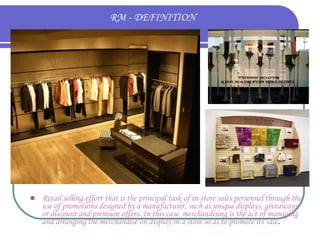
Retail selling effort that is the principal task of in-store sales personnel through the
use of promotions designed by a manufacturer, such as unique displays, giveaways,
or discount and premium offers. In this case, merchandising is the act of managing
and arranging the merchandise on display in a store so as to promote its sale.
Role & Responsibility of Merchandiser
 Planning
 Directing
 Co-ordinating
 Controlling
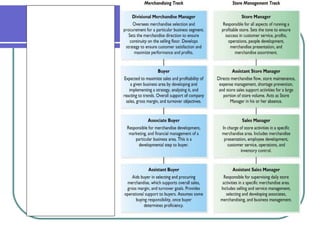
Merchandising
Versus Store
Management Career
Tracks
Functions of Merchandisers at Shopper’s stop










Inventory-turn Management
Achieving Sales & Margins
Plans Merchandise
Availability Management, as per range plan
Merchandising strategy & planning
Processing of purchase orders
Analysis of Data & Sales Budgeting
Profitability Targets & Expense Control
Vendor/Supplier relations for both, in-house products as well as for
brands.
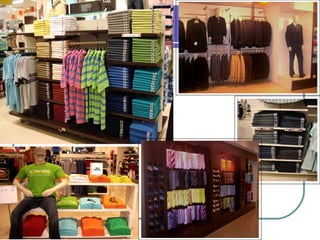
ARRANGING -MERCHANDISE
Merchandising arrangement














MERCHANDISING ARR
ANGMENT………
Why making effective use of your space is so important.
How to position your departments and products.
How to improve store lighting.
The importance of atmosphere and cleanliness in your store.
How to create great displays and signage.
W
HAT W W
E ILL ACHIEVE AS A BUSINESS……….
The consistently best Display standards against Competition in India
A great environment that will attract & satisfy Customers
Showcase to best advantage our product offer
Dramatically enhance Customer Service
Managing the Merchandise
 Developing a sales forecast
 Determining the merchandise requirements
 Merchandise control
 Assortment planning
Developing Sales forecast
 Reviewing Past sales
 Analyzing the changes in Economic Conditions
 Analyzing the changes in the sales potential
 Analyzing the changes in the marketing strategies

of the retail organization and the competition
 Creating the sales forecast
Forecasts


These are projections of expected retail sales for
given periods
 Components:
 Overall

company projections
 Product category projections
 Item-by-item projections
 Store-by-store projections (if a chain)
Determining the merchandise requirements
 Merchandise Mix
 Retail communication Mix
Basics of Merchandise Accounting
Merchandising Accounting
 Cash Flow
 The Balance sheet
 Financial Ratios
 Income statements
 Gross- Margin-Return on Investment
Cash Flow
 Cash In
 Cash Out
 Negative Cash flow = Cash In < Cash Out
 Positive Cash flow = Cash out > Cash In
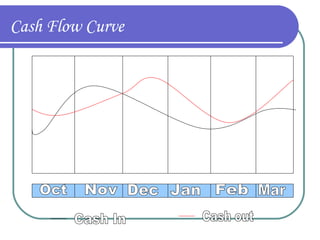
Cash Flow Curve
The Balance Sheet
 The Balance Sheet is a statement of an

organization's Assets, Liabilities and Owners’
Equity at a Particular Point in time.
Assets
Liabilities
Owner's Equity
Assets
 Assets – Owned by an organization

a. Short term (or) Current Assets
b. Long term
Liability
 Liability: Debts owed by an organization

Payment on Short term
Ex: Payment to supplier
Payment on Long term
Ex: Mortgage on Land &
Building
Investment on Extension,
Expansion &
renovation

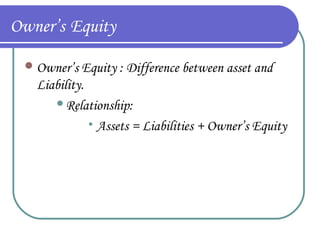
Owner’s Equity
 Owner’s Equity : Difference between asset and

Liability.
Relationship:
Assets = Liabilities + Owner’s Equity

Income statement
Income statement




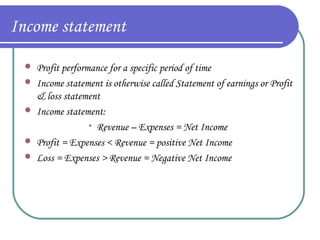
Profit performance for a specific period of time
Income statement is otherwise called Statement of earnings or Profit
& loss statement
Income statement:
Revenue – Expenses = Net Income
Profit = Expenses < Revenue = positive Net Income
Loss = Expenses > Revenue = Negative Net Income




Income statement


Income statement can be computed for an entire organization






contd…

Individual Store
A Group of Store
Department

Profit and loss is based on the revenue & expenses directly associated
with each unit of business.
Income statement

contd…

 Components : 5 major components










Revenue
Cost of goods sold
Gross margin
Expenses
Net Profit

 Relationship among the components


Net revenue

–

Cost of goods sold - Expenses
Gross margin
Net Profit
Income statement

contd…



Relationship among the components



Net revenue

–

Cost of goods sold - Expenses
Gross margin
Net Profit



Net revenue : composed of sales, Leasing or renting property or
interest on accounts
 Net sales = Gross sales – Customer return
 Gross sales are used to determine the customer return rates


Customer return rate = Customer returns x100
Gross sales
Income statement

contd…

 High customer return rate is often indicates of issue related

a. Customer service
b. Quality
c. Fit of merchandise
 High sales attest to the ability of an organization buyer to
select assortments of goods that are appealing to the store’s
target customers.
Income statement

contd…

 Cost of goods sold (or) Cost of Merchandise sold (or)

cost of sales
 Cost of goods sold = Billed cost of Merchandise +
work room costs +shipping cost – cash Discount Returns to vendors
Income statement

contd…

 Shipping cost : Delivery cost for transporting goods

from supplier
 Workroom costs: activities that prepare
merchandise for sale ( steaming & pressing apparel)
 Return to vendors : defective or slow selling goods
returned to suppliers for credit
 Cash discounts : Invoice concessions from suppliers
for prompt payment
Income statement

contd…

 Expenses: Payroll, rent, Utilities, advertising and

interest on debt.
 Direct Expense: attributable to a specific unit
( store rent )
 Indirect Expense: is not attributable to a specific
unit. ( news paper advertisement )
Income statement

contd…

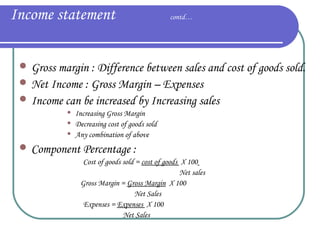
 Gross margin : Difference between sales and cost of goods sold.
 Net Income : Gross Margin – Expenses
 Income can be increased by Increasing sales




Increasing Gross Margin
Decreasing cost of goods sold
Any combination of above

 Component Percentage :
Cost of goods sold = cost of goods X 100
Net sales
Gross Margin = Gross Margin X 100
Net Sales
Expenses = Expenses X 100
Net Sales
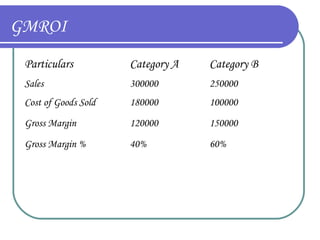
GMROI
Particulars

Category A

Category B

Sales

300000

250000

Cost of Goods Sold

180000

100000

Gross Margin

120000

150000

Gross Margin %

40%

60%
GMROI
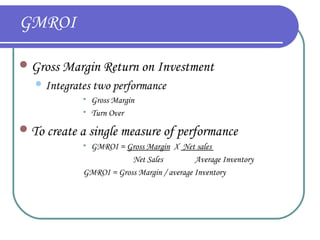
 Gross Margin Return on Investment
 Integrates




two performance
Gross Margin
Turn Over

 To create a single measure of performance
GMROI = Gross Margin X Net sales
Net Sales
Average Inventory
GMROI = Gross Margin / average Inventory

Key terms
Assets
Balance sheet
Cash discount
Cash Flow
Component Percentage
Cost of goods sold
Current ratio
Expenses
Factor
GMROI
Gross sales

Income statement
Liability
Net Income
Net Loss
Net Sales
Return to Vendor
Owner’s Equity
Time Series Comparison
Workroom cost

Merchandising

  • 1.
  • 2.
    Objectives  To demonstratethe importance of a sound merchandising philosophy  To outline the considerations in devising merchandise plans: forecasts, innovativeness, assortment, brands, timing, and allocation  To discuss category management • To study various buying organization formats and the processes they use
  • 3.
    Retail Merchandising       Definition &the Concept of Retail Merchandising Role & Responsibilities of a Merchandiser Fashion Merchandising Merchandise Characteristics Merchandise Management- Merchandise Mix & Merchandise Budget Basics of Merchandise Accounting
  • 4.
    RM - DEFINITION  Retailselling effort that is the principal task of in-store sales personnel through the use of promotions designed by a manufacturer, such as unique displays, giveaways, or discount and premium offers. In this case, merchandising is the act of managing and arranging the merchandise on display in a store so as to promote its sale.
  • 5.
    Role & Responsibilityof Merchandiser  Planning  Directing  Co-ordinating  Controlling
  • 6.
  • 7.
    Functions of Merchandisersat Shopper’s stop          Inventory-turn Management Achieving Sales & Margins Plans Merchandise Availability Management, as per range plan Merchandising strategy & planning Processing of purchase orders Analysis of Data & Sales Budgeting Profitability Targets & Expense Control Vendor/Supplier relations for both, in-house products as well as for brands.
  • 8.
  • 10.
    Merchandising arrangement             MERCHANDISING ARR ANGMENT……… Whymaking effective use of your space is so important. How to position your departments and products. How to improve store lighting. The importance of atmosphere and cleanliness in your store. How to create great displays and signage. W HAT W W E ILL ACHIEVE AS A BUSINESS………. The consistently best Display standards against Competition in India A great environment that will attract & satisfy Customers Showcase to best advantage our product offer Dramatically enhance Customer Service
  • 11.
    Managing the Merchandise Developing a sales forecast  Determining the merchandise requirements  Merchandise control  Assortment planning
  • 12.
    Developing Sales forecast Reviewing Past sales  Analyzing the changes in Economic Conditions  Analyzing the changes in the sales potential  Analyzing the changes in the marketing strategies of the retail organization and the competition  Creating the sales forecast
  • 13.
    Forecasts  These are projectionsof expected retail sales for given periods  Components:  Overall company projections  Product category projections  Item-by-item projections  Store-by-store projections (if a chain)
  • 14.
    Determining the merchandiserequirements  Merchandise Mix  Retail communication Mix
  • 15.
  • 16.
    Merchandising Accounting  CashFlow  The Balance sheet  Financial Ratios  Income statements  Gross- Margin-Return on Investment
  • 17.
    Cash Flow  CashIn  Cash Out  Negative Cash flow = Cash In < Cash Out  Positive Cash flow = Cash out > Cash In
  • 18.
  • 19.
    The Balance Sheet The Balance Sheet is a statement of an organization's Assets, Liabilities and Owners’ Equity at a Particular Point in time. Assets Liabilities Owner's Equity
  • 20.
    Assets  Assets –Owned by an organization a. Short term (or) Current Assets b. Long term
  • 21.
    Liability  Liability: Debtsowed by an organization Payment on Short term Ex: Payment to supplier Payment on Long term Ex: Mortgage on Land & Building Investment on Extension, Expansion & renovation 
  • 22.
    Owner’s Equity  Owner’sEquity : Difference between asset and Liability. Relationship: Assets = Liabilities + Owner’s Equity 
  • 23.
  • 24.
    Income statement    Profit performancefor a specific period of time Income statement is otherwise called Statement of earnings or Profit & loss statement Income statement: Revenue – Expenses = Net Income Profit = Expenses < Revenue = positive Net Income Loss = Expenses > Revenue = Negative Net Income   
  • 25.
    Income statement  Income statementcan be computed for an entire organization     contd… Individual Store A Group of Store Department Profit and loss is based on the revenue & expenses directly associated with each unit of business.
  • 26.
    Income statement contd…  Components: 5 major components      Revenue Cost of goods sold Gross margin Expenses Net Profit  Relationship among the components  Net revenue – Cost of goods sold - Expenses Gross margin Net Profit
  • 27.
    Income statement contd…  Relationship amongthe components  Net revenue – Cost of goods sold - Expenses Gross margin Net Profit  Net revenue : composed of sales, Leasing or renting property or interest on accounts  Net sales = Gross sales – Customer return  Gross sales are used to determine the customer return rates  Customer return rate = Customer returns x100 Gross sales
  • 28.
    Income statement contd…  Highcustomer return rate is often indicates of issue related a. Customer service b. Quality c. Fit of merchandise  High sales attest to the ability of an organization buyer to select assortments of goods that are appealing to the store’s target customers.
  • 29.
    Income statement contd…  Costof goods sold (or) Cost of Merchandise sold (or) cost of sales  Cost of goods sold = Billed cost of Merchandise + work room costs +shipping cost – cash Discount Returns to vendors
  • 30.
    Income statement contd…  Shippingcost : Delivery cost for transporting goods from supplier  Workroom costs: activities that prepare merchandise for sale ( steaming & pressing apparel)  Return to vendors : defective or slow selling goods returned to suppliers for credit  Cash discounts : Invoice concessions from suppliers for prompt payment
  • 31.
    Income statement contd…  Expenses:Payroll, rent, Utilities, advertising and interest on debt.  Direct Expense: attributable to a specific unit ( store rent )  Indirect Expense: is not attributable to a specific unit. ( news paper advertisement )
  • 32.
    Income statement contd…  Grossmargin : Difference between sales and cost of goods sold.  Net Income : Gross Margin – Expenses  Income can be increased by Increasing sales    Increasing Gross Margin Decreasing cost of goods sold Any combination of above  Component Percentage : Cost of goods sold = cost of goods X 100 Net sales Gross Margin = Gross Margin X 100 Net Sales Expenses = Expenses X 100 Net Sales
  • 33.
    GMROI Particulars Category A Category B Sales 300000 250000 Costof Goods Sold 180000 100000 Gross Margin 120000 150000 Gross Margin % 40% 60%
  • 34.
    GMROI  Gross MarginReturn on Investment  Integrates   two performance Gross Margin Turn Over  To create a single measure of performance GMROI = Gross Margin X Net sales Net Sales Average Inventory GMROI = Gross Margin / average Inventory 
  • 35.
    Key terms Assets Balance sheet Cashdiscount Cash Flow Component Percentage Cost of goods sold Current ratio Expenses Factor GMROI Gross sales Income statement Liability Net Income Net Loss Net Sales Return to Vendor Owner’s Equity Time Series Comparison Workroom cost