WAREHOUSING
V.BALAMURUGAN
BBA
Ayya Nadar Janaki Ammal College
Sivakasi
What is warehouse?
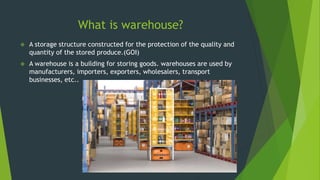
 A storage structure constructed for the protection of the quality and
quantity of the stored produce.(GOI)
 A warehouse is a building for storing goods. warehouses are used by
manufacturers, importers, exporters, wholesalers, transport
businesses, etc..
Warehouse
Ware House
Manufactured articles of a
specified type
A building in which people
meet for a particular activity.
Definition
 Means holding or preserving goods in huge quantities from the
time of their purchase or production till their actual use or sale.
 Creates time utility by bridging the time gap between production
and consumption of goods
Importance Of Warehouse
 1. Economic Benefit: Warehouses are indispensable especially when the product in
question is high in demand. Instead of supplying from various nodes, warehouses
provide the benefit of accumulation and consolidation. By accumulating the inventory
at one place, it is easier to sustain stock as well as merge shipments together. This
approach results in sizeable savings from the economies of scale point of view.
 2. Assembly Point: Final products consisting of multiple parts from different facilities
require being assembled before final distribution to the customer. Warehouses act as a
central point for production assembly. Modern warehouses even allow logistic
companies to pack and grade their products according to the consumer needs.
 3. Reverse Logistics: Warehouses serve as a single point for returns on shipments. This
way companies can administer their returns more efficiently. The focal point of supply
when turns into the focal point for reverse logistics, helps maintain the correct levels of
inventory and a seamless supply chain.
Importance Of Warehouse
 4. Storage: Warehouses cut down the time between production and consumption of
goods by enabling storage of a buffer stock of the products. It particularly helps with
seasonal products which even though produced only during a few months, need to
uphold a stable supply throughout the year.
 5. Value Addition: Warehouses add considerable value to the entire logistics process by
reducing the cycle time. Storing goods in a warehouse facilitates proper management of
inventory and businesses can make better replenishment and other decisions.
Location of warehouse
 Service area.
 Transportation facility.
 Availability of power , water , gas , wastes , etc.
 Labour supply & cost.
 Existing facilities of company.
 Climate & labour productivity.
 Local residents & government.
 Cost of land & other costs.
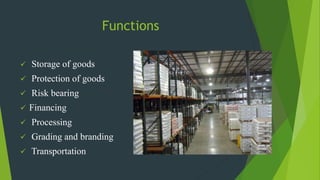
Functions
 Storage of goods
 Protection of goods
 Risk bearing
 Financing
 Processing
 Grading and branding
 Transportation
Functions
 Storage of goods
The basic function of warehouses is to store large stock of goods.
These goods are stored from the time of their production or purchase till their
consumption or use.
 Protection of goods
A warehouse provides protection of goods from loss or damage
due to heat, dust, wind and moisture, etc. It makes special arrangements for different
products according to their nature. It cuts down losses due to spoilage and wastage
during storage.
 Risk bearing
Warehouses take over the risks incidental to storage of goods. Once
goods are handed over to the warehouse-keeper for storage, the responsibility of
these goods passes on to the warehouse-keeper. Thus, the risk of loss or damage to
goods in storage is borne by the warehouse keeper. Since it is bound to return the
goods in good condition, the warehouse becomes responsible for any loss, theft or
damage, etc. Thus, it takes all precautions to prevent any mishap.
Functions
 Financing
When goods are deposited in any warehouse, the depositor gets a receipt,
which acts as a proof about the deposit of goods. The warehouses can also issue a
document in favour of the owner of the goods, which is called warehouse-keeper’s
warrant. This warrant is a document of title and can be transferred by simple
endorsement and delivery.
 Processing
Certain commodities are not consumed in the form they are produced.
Processing is required to make them consumable. For example, paddy is polished,
timber is seasoned, and fruits are ripened, etc. Sometimes warehouses also undertake
these activities on behalf of the owners.
 Grading and branding
On request warehouses also perform the functions of grading
and branding of goods on behalf of the manufacturer, wholesaler or the importer of
goods. It also provides facilities for mixing, blending and packaging of goods for the
convenience of handling and sale.
 Transportation
In some cases warehouses provide transport arrangement to the
bulk depositors. It collects goods from the place of production and also sends goods
to the place of delivery on request of the depositors.
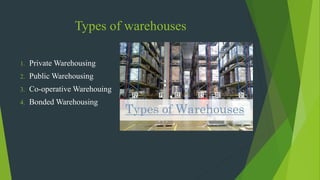
Types of warehouses
1. Private Warehousing
2. Public Warehousing
3. Co-operative Warehouing
4. Bonded Warehousing
PRIVATE WAREHOUSING
 Public warehousing facilities are owned and operated by a third party. In this
model, pricing is based on the level of service utilized by the customer. Public
warehousing facilities are used for short-term or long-term storage, with some
locations offering additional services and amenities.
 Private warehousing facilities are owned and operated by a company division.
Also known as proprietary warehousing, these facilities often require a
significant front-end investment for building, facilities management, and
regular maintenance.
Benefits of Private Warehousing
 Private warehousing facilities typically offer abundant benefits to fewer customers,
which public warehouses simply can’t offer because of their size and scale. There are a
few reasons private warehousing might be a more attractive option.
 One of the biggest benefits of private warehousing is the high degree of control for
clients. If you want to determine how best to utilize the space on your own, carefully
track the internal flow of material or inventory, or keep a team working around the
clock, a private warehouse offers unlimited control of the facilities. That unlimited
control also means having to cover the cost of design, operation, and
maintenance. Depending on the items being stored, the warehouse may also require
special certifications and insurances. The high cost of private warehousing keeps it out
of reach for most businesses.
Public Warehousing
 A public warehouse is a stand-alone company that specializes in warehousing and
distribution. Most companies that sell large quantities of a product can benefit from the
services of a public warehouse. These services almost always include various ways of
storing goods based on environmental needs (cold storage, humidity control,
refrigeration, etc.), but some may only offer traditional dry warehousing.
 Many public warehousing companies offer multiple options as far as shipping methods
and techniques. A full-service logistics provider will offer cross docking, pick-pack and
contract packaging service to augment the transportation process. This allows the
clients to customize their own warehousing experience to meet their own specific needs
as well as the needs of their customers.
Benefits of Public Warehousing
 Public warehouses require no long-term commitment, which makes it easy for
businesses to change to a different warehouse if they don’t like the one they’re using.
This also means there are many additional offerings to customers because of high
competition in the sector.Some of these include:
 Specialty Storage – Temperature sensitive goods, hazardous materials, and perishable
items all require special storage. While not every public warehouse can accommodate,
many are certified to do so.
 Rail Siding – Clients utilizing rail or intermodal transport will require a public
warehouse near a rail line. The best public warehouses will be situated very near the
rail, while others will offer indoor rail line access right at the warehouse itself.
 Packing and Assembly Services – Great public warehouses will offer add-on services to
help clients pack, assemble, and often ship their stored goods.
Co-operative Warehouing
 These warehouses are owned, managed and controlled by co-operative societies. They
provide warehousing facilities at the most economical rates to the members of their
society
Bonded Warehousing
 A bonded warehouse is a secure place to store items intended for export while you wait
for a buyer, allowing you to delay the payment of customs duties and taxes. However,
for some businesses, it is easier and more profitable to use free ports like Hong Kong
for warehousing and fulfillment purposes.
WAREHOUSE LAYOUT
Advantages of Warehousing
 Protection and Preservation of goods - Warehouse provides necessary facilities to
the businessmen for storing their goods when they are not required for sale. It provides
protection to the stocks, ensures their safety and prevents wastage. It minimises losses
from breakage, deterioration in quality, spoilage etc. Warehouses usually adopt latest
technologies to avoid losses, as far as possible.
 Regular flow of goods - Many commodities like rice, wheat etc. are produced during
a particular season but are consumed throughout the year. Warehousing ensures regular
supply of such seasonal commodities throughout the year.
 Continuity in production - Warehouse enables the manufacturers to carry on
production continuously without bothering about the storage of raw materials. It helps
to provide seasonal raw material without any break, for production of finished goods.
 Convenient location - Warehouses are generally located at convenient places near
road, rail or waterways to facilitate movement of goods. Convenient location reduces
the cost of transportation.
 Easy handling - Modern warehouses are generally fitted with mechanical appliances
to handle the goods. Heavy and bulky goods can be loaded and unloaded by using
modern machines, which reduces cost of handling such goods. Mechanical handling
also minimizes wastage during loading and unloading.
Disadvantages
 Increased master data maintenance.
 Additional process step for receipt and picking.
 Requires expert knowledge to configure for maximum benefit.
 More complex to resolve problems caused by incorrect processing.
 High Setup Costs. The biggest disadvantage of having a warehouse is that the initial
setup cost for setting a warehouse.
 Additional Administrative Costs. Another limitation of warehouses is that apart from
initial setup costs the company.
 Not Helpful in increasing Sales. Warehouses can only help in maintaining the constant
supply of goods for meeting demand.
THANK YOU

Warehousing

  • 1.
  • 2.
    What is warehouse? A storage structure constructed for the protection of the quality and quantity of the stored produce.(GOI)  A warehouse is a building for storing goods. warehouses are used by manufacturers, importers, exporters, wholesalers, transport businesses, etc..
  • 3.
    Warehouse Ware House Manufactured articlesof a specified type A building in which people meet for a particular activity.
  • 4.
    Definition  Means holdingor preserving goods in huge quantities from the time of their purchase or production till their actual use or sale.  Creates time utility by bridging the time gap between production and consumption of goods
  • 5.
    Importance Of Warehouse 1. Economic Benefit: Warehouses are indispensable especially when the product in question is high in demand. Instead of supplying from various nodes, warehouses provide the benefit of accumulation and consolidation. By accumulating the inventory at one place, it is easier to sustain stock as well as merge shipments together. This approach results in sizeable savings from the economies of scale point of view.  2. Assembly Point: Final products consisting of multiple parts from different facilities require being assembled before final distribution to the customer. Warehouses act as a central point for production assembly. Modern warehouses even allow logistic companies to pack and grade their products according to the consumer needs.  3. Reverse Logistics: Warehouses serve as a single point for returns on shipments. This way companies can administer their returns more efficiently. The focal point of supply when turns into the focal point for reverse logistics, helps maintain the correct levels of inventory and a seamless supply chain.
  • 6.
    Importance Of Warehouse 4. Storage: Warehouses cut down the time between production and consumption of goods by enabling storage of a buffer stock of the products. It particularly helps with seasonal products which even though produced only during a few months, need to uphold a stable supply throughout the year.  5. Value Addition: Warehouses add considerable value to the entire logistics process by reducing the cycle time. Storing goods in a warehouse facilitates proper management of inventory and businesses can make better replenishment and other decisions.
  • 7.
    Location of warehouse Service area.  Transportation facility.  Availability of power , water , gas , wastes , etc.  Labour supply & cost.  Existing facilities of company.  Climate & labour productivity.  Local residents & government.  Cost of land & other costs.
  • 8.
    Functions  Storage ofgoods  Protection of goods  Risk bearing  Financing  Processing  Grading and branding  Transportation
  • 9.
    Functions  Storage ofgoods The basic function of warehouses is to store large stock of goods. These goods are stored from the time of their production or purchase till their consumption or use.  Protection of goods A warehouse provides protection of goods from loss or damage due to heat, dust, wind and moisture, etc. It makes special arrangements for different products according to their nature. It cuts down losses due to spoilage and wastage during storage.  Risk bearing Warehouses take over the risks incidental to storage of goods. Once goods are handed over to the warehouse-keeper for storage, the responsibility of these goods passes on to the warehouse-keeper. Thus, the risk of loss or damage to goods in storage is borne by the warehouse keeper. Since it is bound to return the goods in good condition, the warehouse becomes responsible for any loss, theft or damage, etc. Thus, it takes all precautions to prevent any mishap.
  • 10.
    Functions  Financing When goodsare deposited in any warehouse, the depositor gets a receipt, which acts as a proof about the deposit of goods. The warehouses can also issue a document in favour of the owner of the goods, which is called warehouse-keeper’s warrant. This warrant is a document of title and can be transferred by simple endorsement and delivery.  Processing Certain commodities are not consumed in the form they are produced. Processing is required to make them consumable. For example, paddy is polished, timber is seasoned, and fruits are ripened, etc. Sometimes warehouses also undertake these activities on behalf of the owners.  Grading and branding On request warehouses also perform the functions of grading and branding of goods on behalf of the manufacturer, wholesaler or the importer of goods. It also provides facilities for mixing, blending and packaging of goods for the convenience of handling and sale.  Transportation In some cases warehouses provide transport arrangement to the bulk depositors. It collects goods from the place of production and also sends goods to the place of delivery on request of the depositors.
  • 11.
    Types of warehouses 1.Private Warehousing 2. Public Warehousing 3. Co-operative Warehouing 4. Bonded Warehousing
  • 12.
    PRIVATE WAREHOUSING  Publicwarehousing facilities are owned and operated by a third party. In this model, pricing is based on the level of service utilized by the customer. Public warehousing facilities are used for short-term or long-term storage, with some locations offering additional services and amenities.  Private warehousing facilities are owned and operated by a company division. Also known as proprietary warehousing, these facilities often require a significant front-end investment for building, facilities management, and regular maintenance.
  • 13.
    Benefits of PrivateWarehousing  Private warehousing facilities typically offer abundant benefits to fewer customers, which public warehouses simply can’t offer because of their size and scale. There are a few reasons private warehousing might be a more attractive option.  One of the biggest benefits of private warehousing is the high degree of control for clients. If you want to determine how best to utilize the space on your own, carefully track the internal flow of material or inventory, or keep a team working around the clock, a private warehouse offers unlimited control of the facilities. That unlimited control also means having to cover the cost of design, operation, and maintenance. Depending on the items being stored, the warehouse may also require special certifications and insurances. The high cost of private warehousing keeps it out of reach for most businesses.
  • 14.
    Public Warehousing  Apublic warehouse is a stand-alone company that specializes in warehousing and distribution. Most companies that sell large quantities of a product can benefit from the services of a public warehouse. These services almost always include various ways of storing goods based on environmental needs (cold storage, humidity control, refrigeration, etc.), but some may only offer traditional dry warehousing.  Many public warehousing companies offer multiple options as far as shipping methods and techniques. A full-service logistics provider will offer cross docking, pick-pack and contract packaging service to augment the transportation process. This allows the clients to customize their own warehousing experience to meet their own specific needs as well as the needs of their customers.
  • 15.
    Benefits of PublicWarehousing  Public warehouses require no long-term commitment, which makes it easy for businesses to change to a different warehouse if they don’t like the one they’re using. This also means there are many additional offerings to customers because of high competition in the sector.Some of these include:  Specialty Storage – Temperature sensitive goods, hazardous materials, and perishable items all require special storage. While not every public warehouse can accommodate, many are certified to do so.  Rail Siding – Clients utilizing rail or intermodal transport will require a public warehouse near a rail line. The best public warehouses will be situated very near the rail, while others will offer indoor rail line access right at the warehouse itself.  Packing and Assembly Services – Great public warehouses will offer add-on services to help clients pack, assemble, and often ship their stored goods.
  • 16.
    Co-operative Warehouing  Thesewarehouses are owned, managed and controlled by co-operative societies. They provide warehousing facilities at the most economical rates to the members of their society
  • 17.
    Bonded Warehousing  Abonded warehouse is a secure place to store items intended for export while you wait for a buyer, allowing you to delay the payment of customs duties and taxes. However, for some businesses, it is easier and more profitable to use free ports like Hong Kong for warehousing and fulfillment purposes.
  • 18.
  • 19.
    Advantages of Warehousing Protection and Preservation of goods - Warehouse provides necessary facilities to the businessmen for storing their goods when they are not required for sale. It provides protection to the stocks, ensures their safety and prevents wastage. It minimises losses from breakage, deterioration in quality, spoilage etc. Warehouses usually adopt latest technologies to avoid losses, as far as possible.  Regular flow of goods - Many commodities like rice, wheat etc. are produced during a particular season but are consumed throughout the year. Warehousing ensures regular supply of such seasonal commodities throughout the year.  Continuity in production - Warehouse enables the manufacturers to carry on production continuously without bothering about the storage of raw materials. It helps to provide seasonal raw material without any break, for production of finished goods.  Convenient location - Warehouses are generally located at convenient places near road, rail or waterways to facilitate movement of goods. Convenient location reduces the cost of transportation.  Easy handling - Modern warehouses are generally fitted with mechanical appliances to handle the goods. Heavy and bulky goods can be loaded and unloaded by using modern machines, which reduces cost of handling such goods. Mechanical handling also minimizes wastage during loading and unloading.
  • 20.
    Disadvantages  Increased masterdata maintenance.  Additional process step for receipt and picking.  Requires expert knowledge to configure for maximum benefit.  More complex to resolve problems caused by incorrect processing.  High Setup Costs. The biggest disadvantage of having a warehouse is that the initial setup cost for setting a warehouse.  Additional Administrative Costs. Another limitation of warehouses is that apart from initial setup costs the company.  Not Helpful in increasing Sales. Warehouses can only help in maintaining the constant supply of goods for meeting demand.
  • 21.