PRODUCTION MANAGEMENT & MATERIAL 
MANAGEMENT 
2014-2015
GROUP MEMBERS ROLL NO. 
TEPILLA GERSHAM 26 
PAVITHRA MUDALIYAR 29 
SIDDHI PATANKAR 31 
JYOTI PATIL 32 
RITU YADAV 50
INTRODUCTION 
Storage is an unavoidable activity. It increase 
the value of the material by the simply carrying it. 
No transformation of any type is to be done. 
Stores, has the vital role to play In a majority of 
manufacturing organization material constitutes 

the major fraction of cost, like 60 to 80% of total 
cost. This cost in inventories substantial. Material 
has to be provided quickly to right person and at 
right time and right place when ever required.
MEANING 
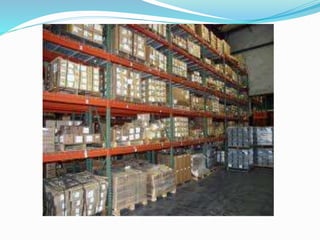
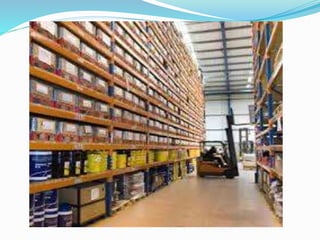
A warehouse is a point in a material 
management where a firm stores or holds raw 
materials, semi finished goods, or finished goods 
for varying periods of time. In the macro 
economics system, warehousing performs a vital 
functions. It creates time utility for raw material, 
industrial goods and finished goods. This 
warehousing function continuous to be 
increasingly important as companies and the 
industries use customer services as a dynamic, 
value-adding competitive tool.
DEFINITION 
Warehousing is that part of firms logistics 
system that stores products at and between point 
of origin and point of consumption and provides 
information to management of the status, 
condition, and disposition of items being stored.
TYPES OF WAREHOUSING 
PRIVATE WAREHOUSE : 
Private warehousing facility is owned 
and managed by same enterprise that owns the 
merchandise handled and stored at the facility. 
This facility may be owned or leased as per the 
decisions about strategy, which best fits the 
financial aspect to the firm.
ADVANTAGES OF PRIVATE WAREHOUSING 
: 
 Flexibility to design to specifications. 
 Greater direct control on warehousing activities. 
 Housing of other offices. 
 As companies trained employees handle the 
goods, there is no error or handling damages. 
 If the volume is sufficient, this may workout 
cheaper. 
 For some force private warehouse may not be 
available in some strategic locations.
DISADVANTAGES OF PRIVATE 
WAREHOUSE : 
 Lack of geographical flexibility. 
 Prohibitive costs may preclude some firms generating 
enough capital to build or buy a warehouse. 
Permanent liability. 
Cost of material handling, machinery and equipment. 
• Cost of manpower. 
• Office and other facilities expenses. 
• Insurance premium
•Public warehouse 
It is operated as an independent business 
offering arrange of services such as storage, handling 
and transportation. On the basis of fixed and variable 
free. They generally offer relatively standardized 
services to all clients. 
Cost involved- 
• rent of the space hired, 
• Payment of charges towards use of other facilities.
 Advantages of public warehousing 
1) Less expensive and fixed cost are distributed among 
many distributors. 
2) Offer greater operating and management expertise. 
3) Public warehousing have lower variable cost as 
compare to the private sector. 
4) The are more flexible as the offer different plans to 
different customers. 
5) Facilities can be given up when not required. 
6) It is easy to ascertain the storage cost
 Disadvantages of public warehousing 
1) Effective communication may be a problem. 
2) Socialized services may not always be available in 
the desired location. 
3) Space may not be available were and when needed.
Contract warehousing 
There is a long term contract singed Between the 
company and the party providing warehousing 
services. The long terms contract could help in lower 
the cost. it is flexible. It also provides the additional 
services such as transportation, order processes 
customer services , etc.
Co-operative warehouse 
These warehouse are owned, by managed and 
controlled by cooperative societies. They provide 
warehousing facilities at the most economical rates to 
the members of their society.
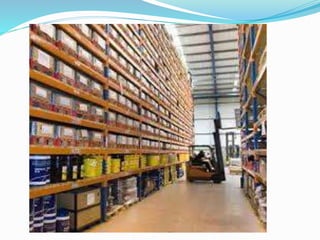
Basic components of a warehouse 
1) Space-space allows for the storage of goods when 
demand and supply are unequal. 
2) equipments- warehouse equipments helps in product, 
movement, storage and tracking. 
3) people- the most critical components of warehousing. 
Space and equipments are nothing without people.
Functions of stores 
1) Receive the material 
2) Store the material properly 
3) Remove the material when required 
4) Deliver the material to right place 
5) Keep the records perfectly in disciplines 
6) Maintain good housekeeping 
7) Keep proper control 
8) Manage the people in perfect discipline 
9) Avoid keeping surplus materials 
10) Verification of stocks at regular intervals 
11) Co-ordination and corporation. 
12) Mixing of material 
13) Maintaining good housekeeping,- 
14) Arranging transport
Objectives of warehouse material 
1) To facilitate smooth and balanced flow of raw material. 
2) To maintain optimum stock of material. 
3) To achieve optimum utilization of storage space. 
4) To reduce usage of handling materials. 
5) To provide codification of stores items for easy 
recognition. 
6) To enable flexibility. 
7) To facilitate quantity purchase at discount prices. 
8) To keep the accounts of all goods kept it stores. 
9) To prevent theft, damage, wastage etc 
10) To maintain the income of all materials.
Types of material stored 
1) Raw material stores 
2) Component stores 
3) Consumable material stores 
4) Semi finished goods stores 
5) Finished goods stores 
6) Inward goods stores and transit stores 
7) Holding stores 
8) Spare parts stores 
9) Inflammable material stores 
10) Tools stores 
11) Stationery stores
Warehouse organization 
 The warehouse organization is very important in the 
work place. With the organized warehousing the 
material is able to control. Hence the well organized 
warehousing helps in the well considered work. It also 
saves the and the expenses required.
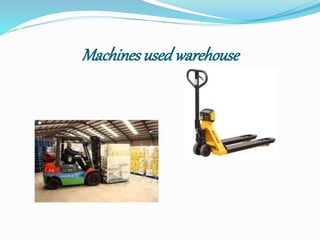
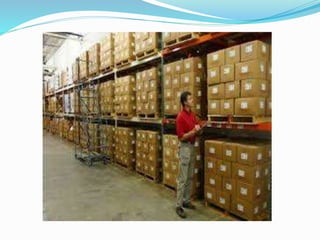
Machines used warehouse
Centralization of warehousing 
1) Effective and better supervision and control are 
exercise. 
2) Personnel requirement is less. So there is cost 
reduction in manpower. 
3) Better and efficient layout of stores. 
4) Inventory checks are better. 
5) Stores maintenance is better. 
6) Fewer redundant and obsolete. 
7) This gives better security arrangements.
Decentralization of warehousing 
1) Reduced material handling and associated work. 
2) Convenient for every department to draw material. 
3) Less risk for loss by fire etc. 
4) There is less chance of production stoppage. This is 
due to near by, easy and prompt availability of 
materials to material shops.
Rationale for warehousing 
1) Achieve transportation economies. 
2) Achieves production economies. 
3) Take advantages of quality discounts. 
4) Accomplish least total logistic cost. 
5) Maintain steady source of suppliers. 
6) Support customers service policies. 
7) Meet changing demand condition. 
8) Reduce time and space distance.
Need for warehousing 
1) Conventional approach 
a) protection against delay and uncertainty against 
transportation. 
b) Availability of products on desired time and on desired 
place. 
c) Provide adjustment between the time of production 
and use of the products. 
d) Serve as reservoirs of goods.
Modern approach 
1) Movement of production. 
2) Relation between warehousing and 
producer/consumers etc. 
3) Reduction of time and cost
Principles of warehousing 
1) Provision for easy receipts, storage and distribution of 
materials. 
2) Minimum handling and transportation of materials. 
3) Good handling of equipments and tools. 
4) Optimum utilization of space 
5) Flexibility to suit the changing stores. 
6) Protection against waste, damage, etc. 
7) Clear identification of materials and location of items in 
a specific manner. 
8) Scrap or disposal stores. 
9) Stationery items stores 
10) Packing of material stores.
Quality Decisions 
1) Presence synergies 
2) Inventory synergies 
3) Location flexibility 
4) Scale economies
Problems due to inefficient warehousing 
1) Failure to locate store rooms properly and inefficient 
available storerooms space which increase the store 
cost. 
2) Difficulty to locating materials. 
3) Overstocking and the resulting cost. 
4) Inventory carrying cost due to waste, damage, etc. 
5) Problem in material control and time involved in 
supply materials when needed.
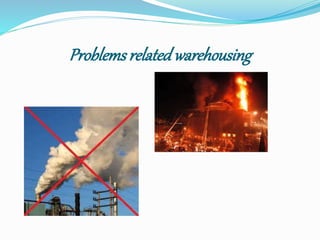
Problems related warehousing
Importance of warehousing 
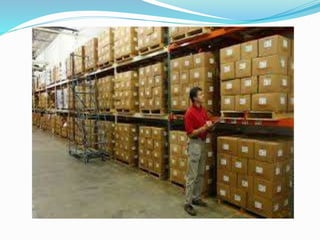
1) Ready associability of important materials which 
provides efficient service to the users. 
2) Efficient utilization of cubic space in the store area. 
3) Flexibility in arranging the storage of goods in the 
warehouse. 
4) Minimization of the risk, damage, wastage, etc 
5) Easy of physical counting at the time of the manual 
stock checking.
conclusion 
 We conclude here with the view that warehousing 
is very important at all the work place. 
which reduces the time and required expenses. It 
also protect the goods and services by wastage, 
damage, etc 
warehousing results in the low risks and the low 
accidents. Hence warehousing is the important factor 
of all the work place.
warehousing

warehousing

  • 2.
    PRODUCTION MANAGEMENT &MATERIAL MANAGEMENT 2014-2015
  • 3.
    GROUP MEMBERS ROLLNO. TEPILLA GERSHAM 26 PAVITHRA MUDALIYAR 29 SIDDHI PATANKAR 31 JYOTI PATIL 32 RITU YADAV 50
  • 4.
    INTRODUCTION Storage isan unavoidable activity. It increase the value of the material by the simply carrying it. No transformation of any type is to be done. Stores, has the vital role to play In a majority of manufacturing organization material constitutes the major fraction of cost, like 60 to 80% of total cost. This cost in inventories substantial. Material has to be provided quickly to right person and at right time and right place when ever required.
  • 6.
    MEANING A warehouseis a point in a material management where a firm stores or holds raw materials, semi finished goods, or finished goods for varying periods of time. In the macro economics system, warehousing performs a vital functions. It creates time utility for raw material, industrial goods and finished goods. This warehousing function continuous to be increasingly important as companies and the industries use customer services as a dynamic, value-adding competitive tool.
  • 8.
    DEFINITION Warehousing isthat part of firms logistics system that stores products at and between point of origin and point of consumption and provides information to management of the status, condition, and disposition of items being stored.
  • 9.
    TYPES OF WAREHOUSING PRIVATE WAREHOUSE : Private warehousing facility is owned and managed by same enterprise that owns the merchandise handled and stored at the facility. This facility may be owned or leased as per the decisions about strategy, which best fits the financial aspect to the firm.
  • 10.
    ADVANTAGES OF PRIVATEWAREHOUSING :  Flexibility to design to specifications.  Greater direct control on warehousing activities.  Housing of other offices.  As companies trained employees handle the goods, there is no error or handling damages.  If the volume is sufficient, this may workout cheaper.  For some force private warehouse may not be available in some strategic locations.
  • 11.
    DISADVANTAGES OF PRIVATE WAREHOUSE :  Lack of geographical flexibility.  Prohibitive costs may preclude some firms generating enough capital to build or buy a warehouse. Permanent liability. Cost of material handling, machinery and equipment. • Cost of manpower. • Office and other facilities expenses. • Insurance premium
  • 12.
    •Public warehouse Itis operated as an independent business offering arrange of services such as storage, handling and transportation. On the basis of fixed and variable free. They generally offer relatively standardized services to all clients. Cost involved- • rent of the space hired, • Payment of charges towards use of other facilities.
  • 13.
     Advantages ofpublic warehousing 1) Less expensive and fixed cost are distributed among many distributors. 2) Offer greater operating and management expertise. 3) Public warehousing have lower variable cost as compare to the private sector. 4) The are more flexible as the offer different plans to different customers. 5) Facilities can be given up when not required. 6) It is easy to ascertain the storage cost
  • 14.
     Disadvantages ofpublic warehousing 1) Effective communication may be a problem. 2) Socialized services may not always be available in the desired location. 3) Space may not be available were and when needed.
  • 15.
    Contract warehousing Thereis a long term contract singed Between the company and the party providing warehousing services. The long terms contract could help in lower the cost. it is flexible. It also provides the additional services such as transportation, order processes customer services , etc.
  • 16.
    Co-operative warehouse Thesewarehouse are owned, by managed and controlled by cooperative societies. They provide warehousing facilities at the most economical rates to the members of their society.
  • 17.
    Basic components ofa warehouse 1) Space-space allows for the storage of goods when demand and supply are unequal. 2) equipments- warehouse equipments helps in product, movement, storage and tracking. 3) people- the most critical components of warehousing. Space and equipments are nothing without people.
  • 19.
    Functions of stores 1) Receive the material 2) Store the material properly 3) Remove the material when required 4) Deliver the material to right place 5) Keep the records perfectly in disciplines 6) Maintain good housekeeping 7) Keep proper control 8) Manage the people in perfect discipline 9) Avoid keeping surplus materials 10) Verification of stocks at regular intervals 11) Co-ordination and corporation. 12) Mixing of material 13) Maintaining good housekeeping,- 14) Arranging transport
  • 20.
    Objectives of warehousematerial 1) To facilitate smooth and balanced flow of raw material. 2) To maintain optimum stock of material. 3) To achieve optimum utilization of storage space. 4) To reduce usage of handling materials. 5) To provide codification of stores items for easy recognition. 6) To enable flexibility. 7) To facilitate quantity purchase at discount prices. 8) To keep the accounts of all goods kept it stores. 9) To prevent theft, damage, wastage etc 10) To maintain the income of all materials.
  • 21.
    Types of materialstored 1) Raw material stores 2) Component stores 3) Consumable material stores 4) Semi finished goods stores 5) Finished goods stores 6) Inward goods stores and transit stores 7) Holding stores 8) Spare parts stores 9) Inflammable material stores 10) Tools stores 11) Stationery stores
  • 22.
    Warehouse organization The warehouse organization is very important in the work place. With the organized warehousing the material is able to control. Hence the well organized warehousing helps in the well considered work. It also saves the and the expenses required.
  • 23.
  • 24.
    Centralization of warehousing 1) Effective and better supervision and control are exercise. 2) Personnel requirement is less. So there is cost reduction in manpower. 3) Better and efficient layout of stores. 4) Inventory checks are better. 5) Stores maintenance is better. 6) Fewer redundant and obsolete. 7) This gives better security arrangements.
  • 25.
    Decentralization of warehousing 1) Reduced material handling and associated work. 2) Convenient for every department to draw material. 3) Less risk for loss by fire etc. 4) There is less chance of production stoppage. This is due to near by, easy and prompt availability of materials to material shops.
  • 26.
    Rationale for warehousing 1) Achieve transportation economies. 2) Achieves production economies. 3) Take advantages of quality discounts. 4) Accomplish least total logistic cost. 5) Maintain steady source of suppliers. 6) Support customers service policies. 7) Meet changing demand condition. 8) Reduce time and space distance.
  • 27.
    Need for warehousing 1) Conventional approach a) protection against delay and uncertainty against transportation. b) Availability of products on desired time and on desired place. c) Provide adjustment between the time of production and use of the products. d) Serve as reservoirs of goods.
  • 28.
    Modern approach 1)Movement of production. 2) Relation between warehousing and producer/consumers etc. 3) Reduction of time and cost
  • 29.
    Principles of warehousing 1) Provision for easy receipts, storage and distribution of materials. 2) Minimum handling and transportation of materials. 3) Good handling of equipments and tools. 4) Optimum utilization of space 5) Flexibility to suit the changing stores. 6) Protection against waste, damage, etc. 7) Clear identification of materials and location of items in a specific manner. 8) Scrap or disposal stores. 9) Stationery items stores 10) Packing of material stores.
  • 31.
    Quality Decisions 1)Presence synergies 2) Inventory synergies 3) Location flexibility 4) Scale economies
  • 32.
    Problems due toinefficient warehousing 1) Failure to locate store rooms properly and inefficient available storerooms space which increase the store cost. 2) Difficulty to locating materials. 3) Overstocking and the resulting cost. 4) Inventory carrying cost due to waste, damage, etc. 5) Problem in material control and time involved in supply materials when needed.
  • 33.
  • 34.
    Importance of warehousing 1) Ready associability of important materials which provides efficient service to the users. 2) Efficient utilization of cubic space in the store area. 3) Flexibility in arranging the storage of goods in the warehouse. 4) Minimization of the risk, damage, wastage, etc 5) Easy of physical counting at the time of the manual stock checking.
  • 36.
    conclusion  Weconclude here with the view that warehousing is very important at all the work place. which reduces the time and required expenses. It also protect the goods and services by wastage, damage, etc warehousing results in the low risks and the low accidents. Hence warehousing is the important factor of all the work place.