Definition
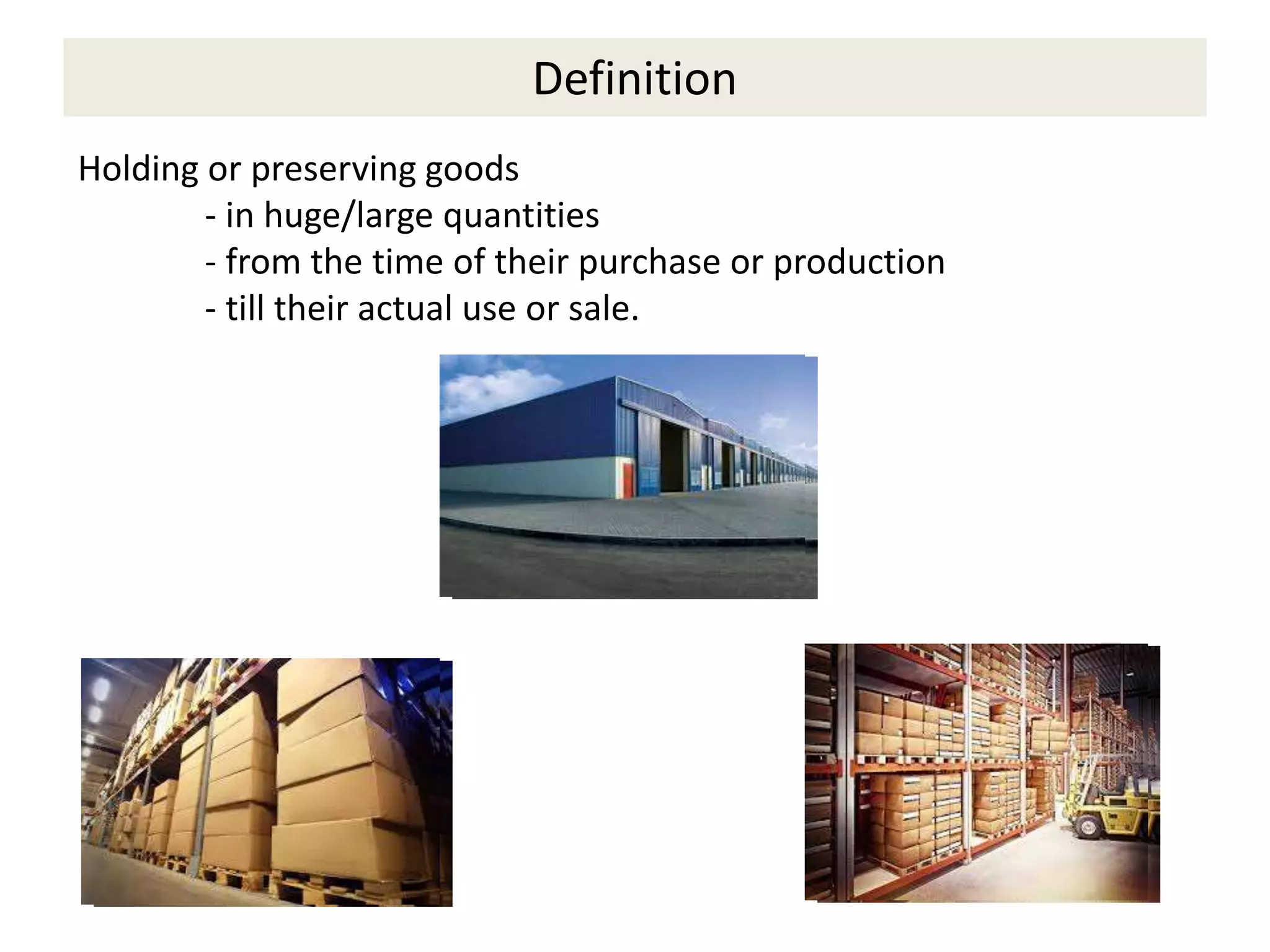
Holding or preserving goods
- in huge/large quantities
- from the time of their purchase or production
- till their actual use or sale.
The need for warehousing
a. Seasonal Production -
- Agricultural goods grow seasonally but are used the whole year.
- These kind of goods have to be stored till they are used.
- They can be supplied when needed.
b. Seasonal Demand -
- Goods like
woollen are
used seasonally
but made the
whole year
- These kind of
goods have to
be stored till
they are used.
- They can be
supplied when
needed.
c. Large Scale Production -
- Goods are made
in large scale
to meet
immediate demands
and
future demands.
- Large scale
production also
lowers cost of
production.
- These large quantities
of goods
have to be
stored till they are sold.
- d. Quick Supply -
- Goods are made in one place
but used all over.
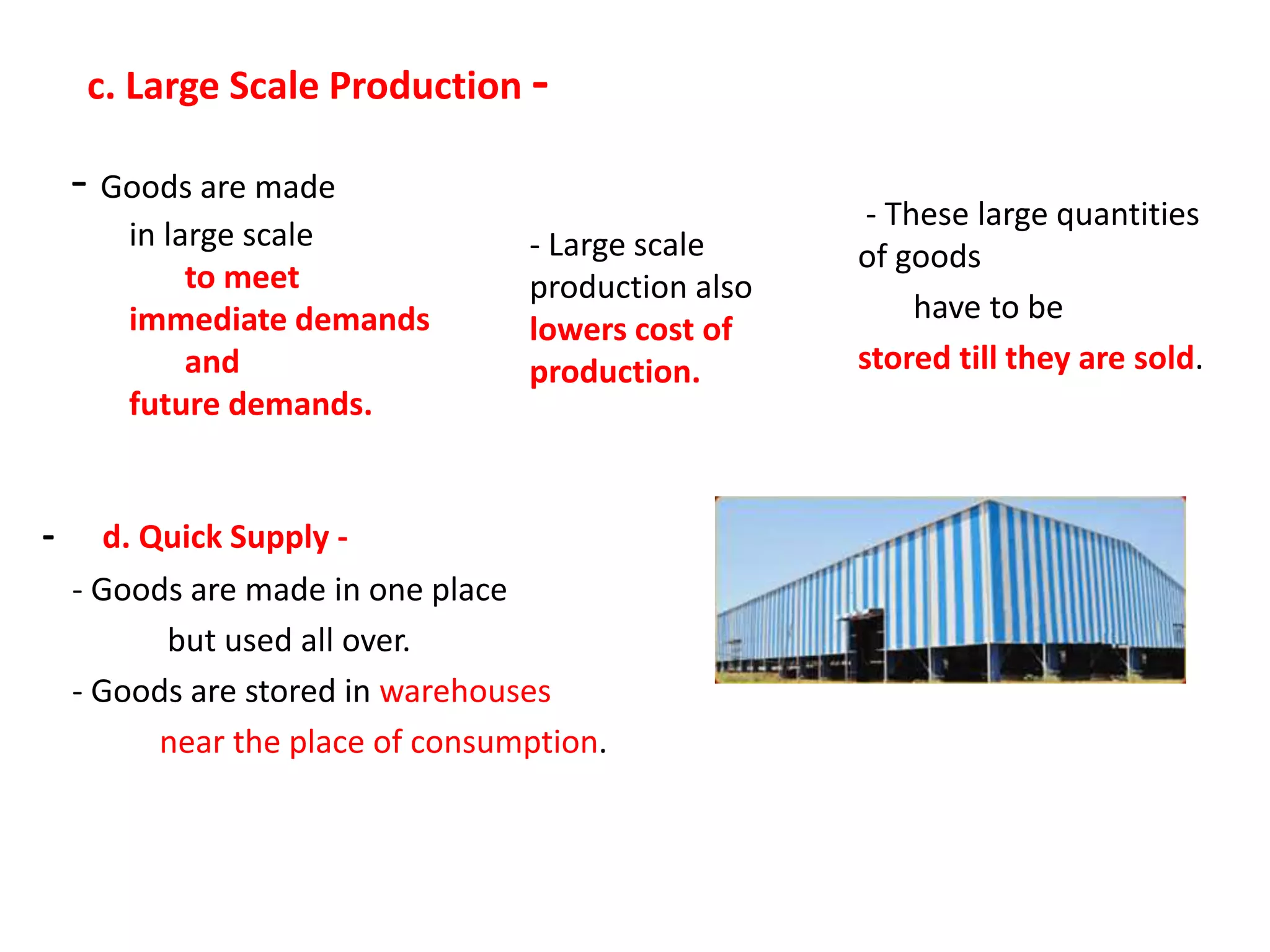
- Goods are stored in warehouses
near the place of consumption.
e. Continuous Production -
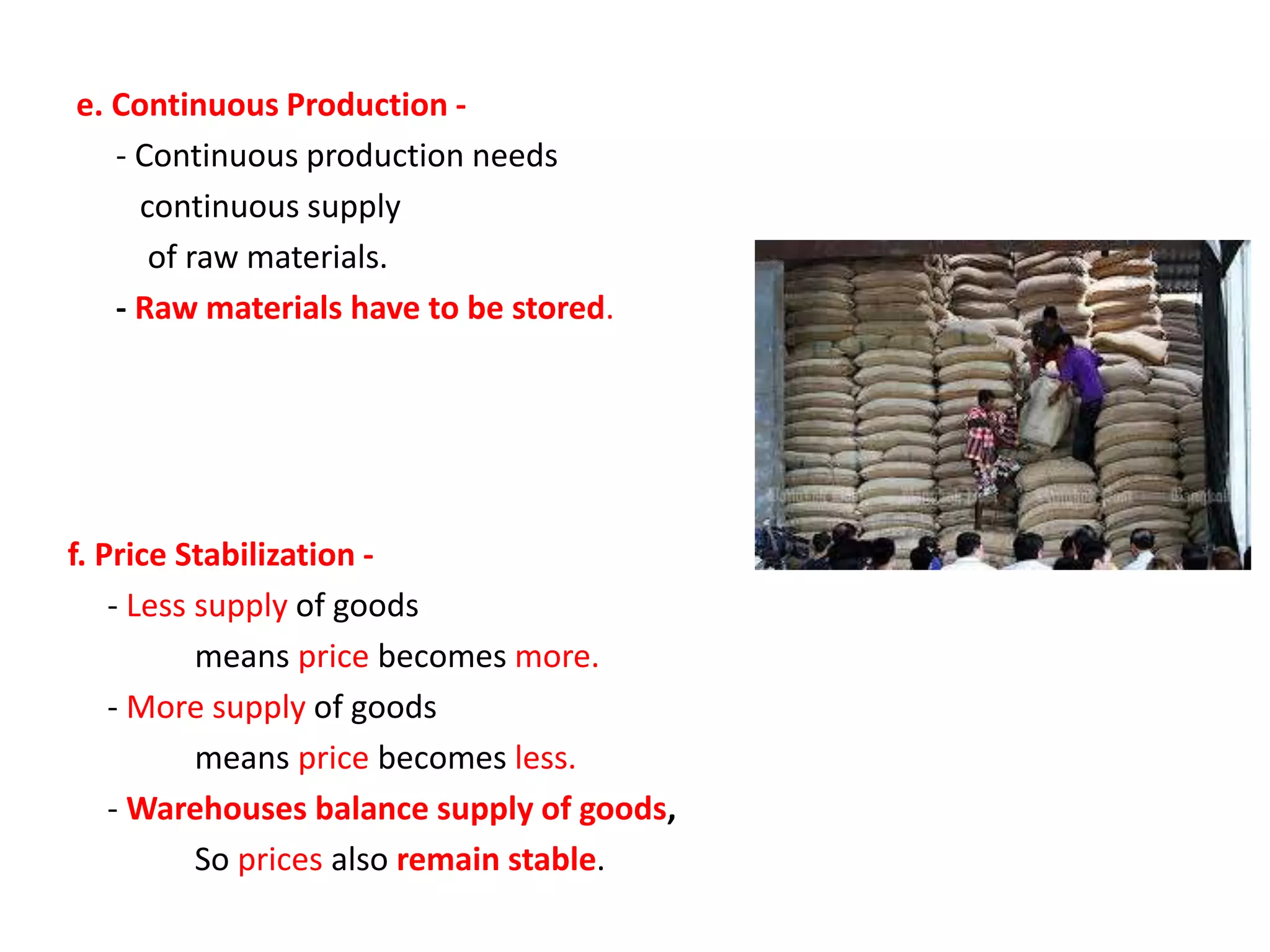
- Continuous production needs
continuous supply
of raw materials.
- Raw materials have to be stored.
f. Price Stabilization -
- Less supply of goods
means price becomes more.
- More supply of goods
means price becomes less.
- Warehouses balance supply of goods,
So prices also remain stable.
The need for warehousing arises
due to
i. Seasonal production of goods
ii. Seasonal Demand
iii. Large-scale Production
iv. Quick Supply
v. Continuous Production.
vi. Price Stabilization
Characteristics of an ideal warehouse.
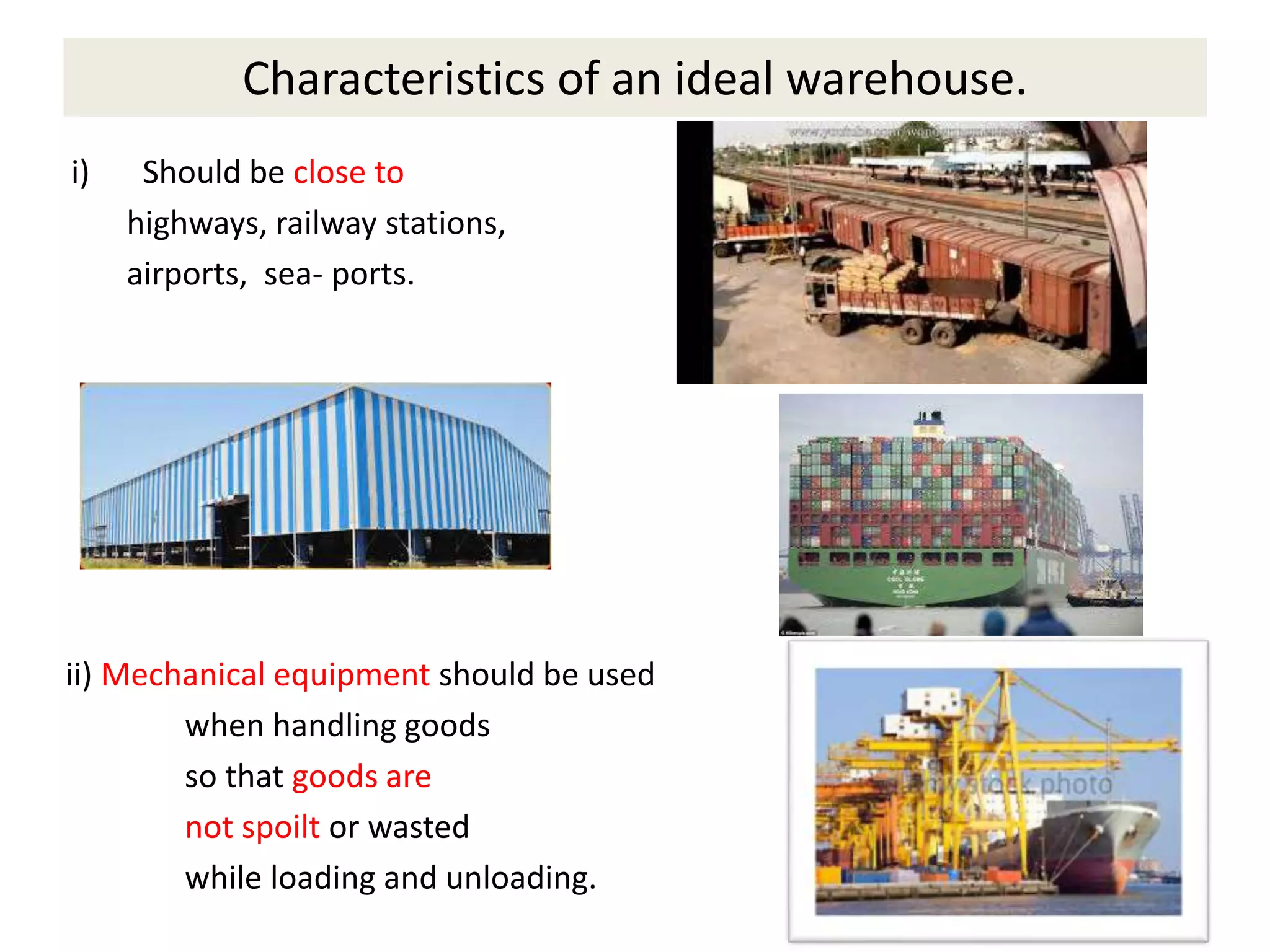
i) Should be close to
highways, railway stations,
airports, sea- ports.
ii) Mechanical equipment should be used
when handling goods
so that goods are
not spoilt or wasted
while loading and unloading.
iii) Warehouses for perishable
goods should have
cold storage facilities.
iv) Goods should be protected
from sun, rain, wind, moisture, dust, pest etc.
vi) There should be lots of parking space to load and unload goods.
v) There should be lots of space to store goods well.
viii) There should be fire fighting equipment
to protect goods from fire.
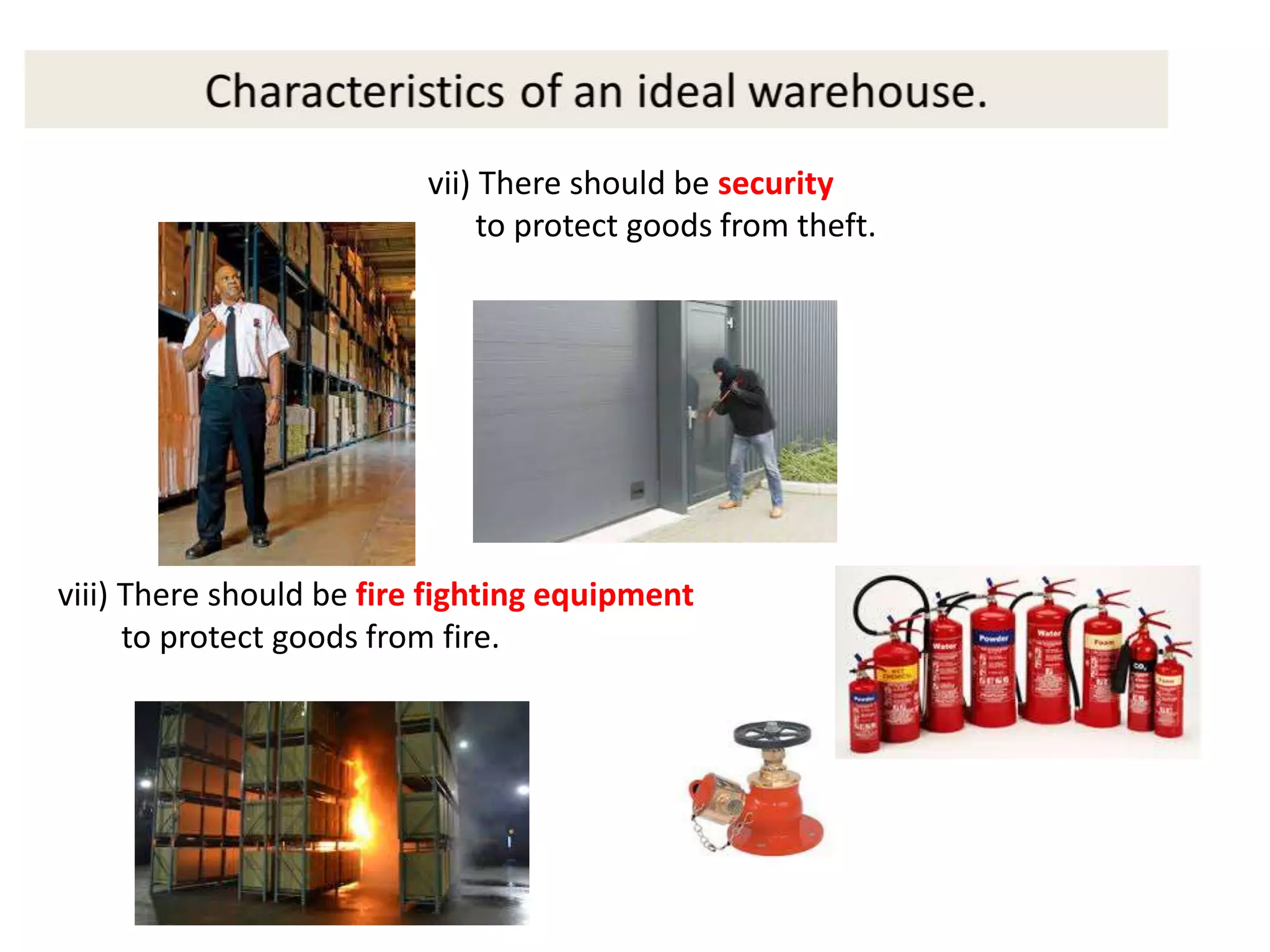
vii) There should be security
to protect goods from theft.
Characteristics of an ideal warehouse
i. Convenient location
ii. Use of mechanical devices for handling goods
iii. Adequate space for storage of goods
iv. Cold storage facility for perishable items
v. Protection of goods from sunlight, rain, wind, dust,
moisture and pests
vi. Sufficient parking space for vehicles
vii. Round the clock security
viii. Availability of fire fighting equipment's.
Types of warehouses
b. Public Warehouses -
- Maybe owned by a person, partnership firm or company.
- Controlled by the government.
- Used to store goods of the public.
- Rent has to be paid.
- Need license from government to start these warehouses.
a. Private Warehouses -
- Owned and managed by producers or traders.
- They use it to store their own stock of goods.
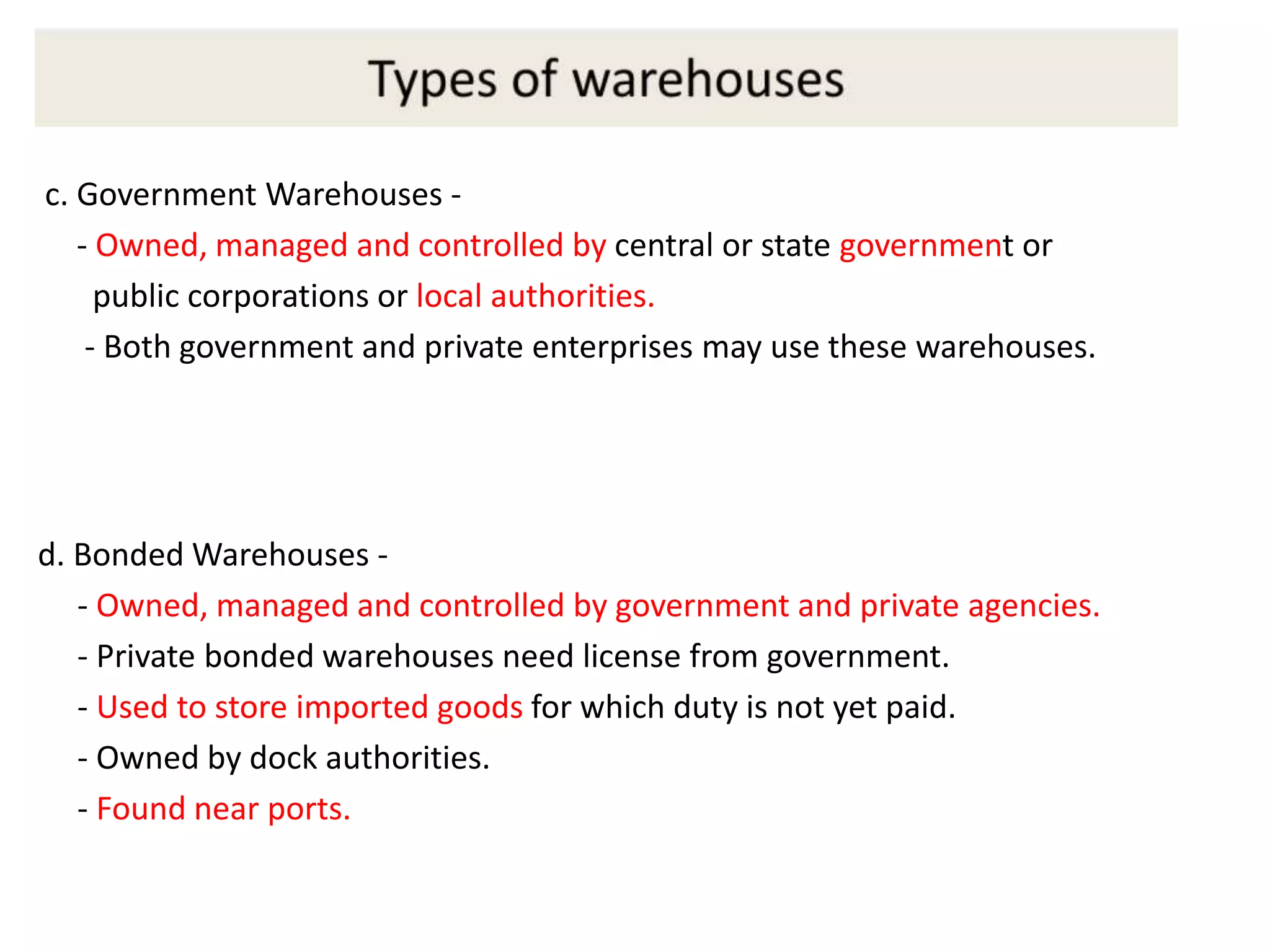
d. Bonded Warehouses -
- Owned, managed and controlled by government and private agencies.
- Private bonded warehouses need license from government.
- Used to store imported goods for which duty is not yet paid.
- Owned by dock authorities.
- Found near ports.
c. Government Warehouses -
- Owned, managed and controlled by central or state government or
public corporations or local authorities.
- Both government and private enterprises may use these warehouses.
e. Co-operative Warehouses
- Owned, managed and controlled by co-operative societies.
- These are used by the members of the society.
- They are the cheapest.
Types of Warehouses
Owned by Managed by
Controlled
by Used By
1. Private
Warehouse Producers or traders Producers or traders
Used to store own
s t o c k o f g o o d s
2. Public
Warehouse
Person, firm or
company
Governeme
nt
Store goods for
public
Rent has to be paid.
Need license from
government to start
w a r e h o u s e .
3. Government
warehouse
Central, state government or
public corporations or local
authorities
Government and
private may use
these warehouses
4. Bonded
Warehouse Government and private agencies
to store imported
goods for which
duty is not yet paid
Generally owned by
Dock authorities.
Found near ports
P r i v a t e
a g e n c i e s
need license
t o s t a r t
5. Co-operative
Warehouses Co-operative Socities
Members of the
society They are the cheapest.
Types of warehouses
i. Private warehouses,
ii. Public warehouses,
iii. Government warehouses,
iv. Bonded warehouses
v. Co-operative warehouses
Functions of warehouses
a. Storage of goods – Goods are stored
in large quantities from
the time of production
to the time of use.
b. Protection of goods – Protects goods
from loss due to heat,
dust, wind etc.
c. Risk bearing – Warehouse keeper is responsible for
any loss or damage to goods stored in
the warehouse.
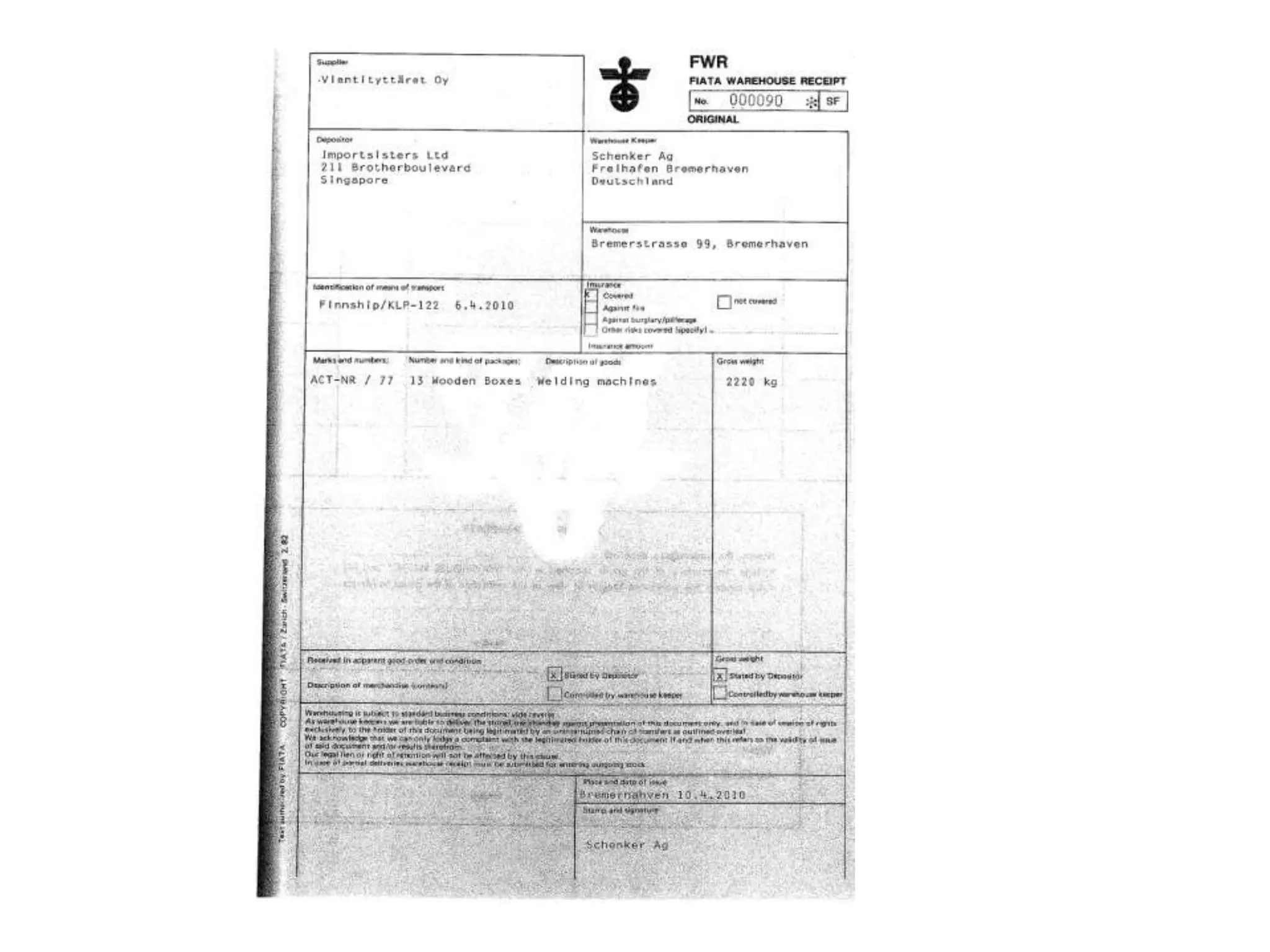
d. Financing – Receipt is given when
goods are stored.
- This is proof of storage
- Warehouse
keeper also issue’s a
document called the
warrant.
- This(warrant) is a
document of title
to the goods.
-The business man
can get a loan by
keeping this
warrant as security.
- Warehouses also give
advances for short term
keeping the goods as
security.
e. Processing – Goods are
processed in warehouses
to make them better.
E.g. – fruits are ripened.
f. Grading and Branding –
Done to help the producers.
Mixing, blending and
packaging is also done.
g. Transportation –
Goods are
transported from
place of production
to place of use.
Functions of warehouses
i. Storage of goods
ii. Protection of goods
iii. Risk bearing
iv. Financing
v. Processing
vi. Grading and branding
vii. Transportation
Advantages of warehouses to the businessmen
i) Protection :
Helps protect goods and prevent wastage.
ii) Storing seasonal goods:
Agricultural goods grow seasonally but are used the whole year.
- they can be stored for regular supply.
iii) Continuous Production :
To ensure continuous production, raw materials can be stored.
iv) Transport cost is less
as they are near highways, railway stations, airports and sea-ports.
v) Mechanical equipment used reduces wastage while handling
goods.
vi) Helps small businessmen who cannot afford their own
warehouses.
vii) Gives employment and raises standard of living.
viii) Helps sale of goods by doing grading, branding, packaging
etc.
ix) Ownership of goods can be easily transferred
- by transferring warehouse keeper’s warrant.
x) Warehouse warrant can be used to get loans.
- Warehouses also give advances for short term for goods
stored.
xi) Warehouses take steps to prevent theft, fire & spoiling of
perishable goods.
- Goods stored can be insured against loss.
Advantages of warehousing
i. Protection and preservation of goods
ii. Regular flow of goods
iii. Continuity in production
iv. Convenient location
v. Easy handling
vi. Useful for small businessmen
vii. Creation of employment
viii. Facilitates sale of goods
ix. Availability of finance
x. Reduces risk of loss
Fill in the blanks with suitable words given in brackets:
(i) Food Corporation of India maintains ___________ warehouses.
(Government, private, bonded)
(ii) Warehouses used exclusively by the traders to store there own goods
are known as ___________ warehouses. (Bonded, public, private)
(iii) License from the government is not required to start a ____________
warehouse. (Bonded, private, public).
(iv) Bonded warehouses are generally found near ____________________.
(industrial area, ports, commercial centers)
(v) Goods for which import duty is not paid are kept in ___________
warehouses. (Private, public, bonded)
II. Multiple Choice Questions
i. Which of the following is not a need for warehousing?
(a) Quick supply of Goods (b)Seasonal production goods
(c) Large-scale production (d) Small scale production
ii. Which of the following type of warehouses are situated at Airports and Seaports?
(a) Public warehouses (b) Government warehouses
(c) Bonded warehouses (d) Co-operative warehouses
iii. The warehouses owned and managed by the Manufacturers or Traders to Store exclusively their own
stock of goods are known as.
(a) Government warehouses (b) Private warehouses
(c) Public warehouses (d) Cooperative warehouses
iv. Which of the following is not a function of warehouses?
(a) Risk bearing (b) Financing
(c) Transport facility to every customer (d) Protection of good.
v. Which of the following is not an advantage of warehouses?
(a) Useful for small businessman (b) Available at convenient location
(c) Do not create employment (d) Make easier the Availability of Finance.
• Need for warehouse :
– i. Seasonal production of goods
– ii. Seasonal Demand
– iii. Large-scale Production
– iv. Quick Supply
– v. Continuous Production.
– vi. Price Stabilization
Advantages of Warehouse :
-i. Protection and preservation of
goods
ii. Regular flow of goods
iii. Continuity in production
iv. Convenient location
v. Easy handling
vi. Useful for small businessmen
vii. Creation of employment
viii. Facilitates sale of goods
ix. Availability of finance
x. Reduces risk of loss
Types of warehouses
i. Private warehouses,
ii. Public warehouses,
iii. Government warehouses,
iv. Bonded warehouses
v. Co-operative warehouses
Characteristics of an ideal warehouse
i. Convenient location
ii. Use of mechanical devices for handling
goods
iii. Adequate space for storage of goods
iv. Cold storage facility for perishable items
v. Protection of goods from sunlight, rain,
wind, dust, moisture and pests
vi. Sufficient parking space for vehicles
vii. Round the clock security
viii. Availability of fire fighting equipment's.
Functions of warehouses
i. Storage of goods
ii. Protection of goods
iii. Risk bearing
iv. Financing
v. Processing
vi. Grading and branding
vii. Transportation
nios std X business studies Ch 6 Warehousing

nios std X business studies Ch 6 Warehousing

  • 2.
    Definition Holding or preservinggoods - in huge/large quantities - from the time of their purchase or production - till their actual use or sale.
  • 3.
    The need forwarehousing a. Seasonal Production - - Agricultural goods grow seasonally but are used the whole year. - These kind of goods have to be stored till they are used. - They can be supplied when needed.
  • 4.
    b. Seasonal Demand- - Goods like woollen are used seasonally but made the whole year - These kind of goods have to be stored till they are used. - They can be supplied when needed.
  • 5.
    c. Large ScaleProduction - - Goods are made in large scale to meet immediate demands and future demands. - Large scale production also lowers cost of production. - These large quantities of goods have to be stored till they are sold. - d. Quick Supply - - Goods are made in one place but used all over. - Goods are stored in warehouses near the place of consumption.
  • 6.
    e. Continuous Production- - Continuous production needs continuous supply of raw materials. - Raw materials have to be stored. f. Price Stabilization - - Less supply of goods means price becomes more. - More supply of goods means price becomes less. - Warehouses balance supply of goods, So prices also remain stable.
  • 7.
    The need forwarehousing arises due to i. Seasonal production of goods ii. Seasonal Demand iii. Large-scale Production iv. Quick Supply v. Continuous Production. vi. Price Stabilization
  • 8.
    Characteristics of anideal warehouse. i) Should be close to highways, railway stations, airports, sea- ports. ii) Mechanical equipment should be used when handling goods so that goods are not spoilt or wasted while loading and unloading.
  • 9.
    iii) Warehouses forperishable goods should have cold storage facilities. iv) Goods should be protected from sun, rain, wind, moisture, dust, pest etc.
  • 10.
    vi) There shouldbe lots of parking space to load and unload goods. v) There should be lots of space to store goods well.
  • 11.
    viii) There shouldbe fire fighting equipment to protect goods from fire. vii) There should be security to protect goods from theft.
  • 12.
    Characteristics of anideal warehouse i. Convenient location ii. Use of mechanical devices for handling goods iii. Adequate space for storage of goods iv. Cold storage facility for perishable items v. Protection of goods from sunlight, rain, wind, dust, moisture and pests vi. Sufficient parking space for vehicles vii. Round the clock security viii. Availability of fire fighting equipment's.
  • 14.
    Types of warehouses b.Public Warehouses - - Maybe owned by a person, partnership firm or company. - Controlled by the government. - Used to store goods of the public. - Rent has to be paid. - Need license from government to start these warehouses. a. Private Warehouses - - Owned and managed by producers or traders. - They use it to store their own stock of goods.
  • 15.
    d. Bonded Warehouses- - Owned, managed and controlled by government and private agencies. - Private bonded warehouses need license from government. - Used to store imported goods for which duty is not yet paid. - Owned by dock authorities. - Found near ports. c. Government Warehouses - - Owned, managed and controlled by central or state government or public corporations or local authorities. - Both government and private enterprises may use these warehouses.
  • 16.
    e. Co-operative Warehouses -Owned, managed and controlled by co-operative societies. - These are used by the members of the society. - They are the cheapest.
  • 17.
    Types of Warehouses Ownedby Managed by Controlled by Used By 1. Private Warehouse Producers or traders Producers or traders Used to store own s t o c k o f g o o d s 2. Public Warehouse Person, firm or company Governeme nt Store goods for public Rent has to be paid. Need license from government to start w a r e h o u s e . 3. Government warehouse Central, state government or public corporations or local authorities Government and private may use these warehouses 4. Bonded Warehouse Government and private agencies to store imported goods for which duty is not yet paid Generally owned by Dock authorities. Found near ports P r i v a t e a g e n c i e s need license t o s t a r t 5. Co-operative Warehouses Co-operative Socities Members of the society They are the cheapest.
  • 18.
    Types of warehouses i.Private warehouses, ii. Public warehouses, iii. Government warehouses, iv. Bonded warehouses v. Co-operative warehouses
  • 19.
    Functions of warehouses a.Storage of goods – Goods are stored in large quantities from the time of production to the time of use. b. Protection of goods – Protects goods from loss due to heat, dust, wind etc. c. Risk bearing – Warehouse keeper is responsible for any loss or damage to goods stored in the warehouse.
  • 20.
    d. Financing –Receipt is given when goods are stored. - This is proof of storage - Warehouse keeper also issue’s a document called the warrant. - This(warrant) is a document of title to the goods. -The business man can get a loan by keeping this warrant as security. - Warehouses also give advances for short term keeping the goods as security.
  • 22.
    e. Processing –Goods are processed in warehouses to make them better. E.g. – fruits are ripened. f. Grading and Branding – Done to help the producers. Mixing, blending and packaging is also done. g. Transportation – Goods are transported from place of production to place of use.
  • 23.
    Functions of warehouses i.Storage of goods ii. Protection of goods iii. Risk bearing iv. Financing v. Processing vi. Grading and branding vii. Transportation
  • 24.
    Advantages of warehousesto the businessmen i) Protection : Helps protect goods and prevent wastage. ii) Storing seasonal goods: Agricultural goods grow seasonally but are used the whole year. - they can be stored for regular supply. iii) Continuous Production : To ensure continuous production, raw materials can be stored. iv) Transport cost is less as they are near highways, railway stations, airports and sea-ports.
  • 25.
    v) Mechanical equipmentused reduces wastage while handling goods. vi) Helps small businessmen who cannot afford their own warehouses. vii) Gives employment and raises standard of living. viii) Helps sale of goods by doing grading, branding, packaging etc.
  • 26.
    ix) Ownership ofgoods can be easily transferred - by transferring warehouse keeper’s warrant. x) Warehouse warrant can be used to get loans. - Warehouses also give advances for short term for goods stored. xi) Warehouses take steps to prevent theft, fire & spoiling of perishable goods. - Goods stored can be insured against loss.
  • 27.
    Advantages of warehousing i.Protection and preservation of goods ii. Regular flow of goods iii. Continuity in production iv. Convenient location v. Easy handling vi. Useful for small businessmen vii. Creation of employment viii. Facilitates sale of goods ix. Availability of finance x. Reduces risk of loss
  • 28.
    Fill in theblanks with suitable words given in brackets: (i) Food Corporation of India maintains ___________ warehouses. (Government, private, bonded) (ii) Warehouses used exclusively by the traders to store there own goods are known as ___________ warehouses. (Bonded, public, private) (iii) License from the government is not required to start a ____________ warehouse. (Bonded, private, public). (iv) Bonded warehouses are generally found near ____________________. (industrial area, ports, commercial centers) (v) Goods for which import duty is not paid are kept in ___________ warehouses. (Private, public, bonded)
  • 29.
    II. Multiple ChoiceQuestions i. Which of the following is not a need for warehousing? (a) Quick supply of Goods (b)Seasonal production goods (c) Large-scale production (d) Small scale production ii. Which of the following type of warehouses are situated at Airports and Seaports? (a) Public warehouses (b) Government warehouses (c) Bonded warehouses (d) Co-operative warehouses iii. The warehouses owned and managed by the Manufacturers or Traders to Store exclusively their own stock of goods are known as. (a) Government warehouses (b) Private warehouses (c) Public warehouses (d) Cooperative warehouses iv. Which of the following is not a function of warehouses? (a) Risk bearing (b) Financing (c) Transport facility to every customer (d) Protection of good. v. Which of the following is not an advantage of warehouses? (a) Useful for small businessman (b) Available at convenient location (c) Do not create employment (d) Make easier the Availability of Finance.
  • 30.
    • Need forwarehouse : – i. Seasonal production of goods – ii. Seasonal Demand – iii. Large-scale Production – iv. Quick Supply – v. Continuous Production. – vi. Price Stabilization Advantages of Warehouse : -i. Protection and preservation of goods ii. Regular flow of goods iii. Continuity in production iv. Convenient location v. Easy handling vi. Useful for small businessmen vii. Creation of employment viii. Facilitates sale of goods ix. Availability of finance x. Reduces risk of loss Types of warehouses i. Private warehouses, ii. Public warehouses, iii. Government warehouses, iv. Bonded warehouses v. Co-operative warehouses Characteristics of an ideal warehouse i. Convenient location ii. Use of mechanical devices for handling goods iii. Adequate space for storage of goods iv. Cold storage facility for perishable items v. Protection of goods from sunlight, rain, wind, dust, moisture and pests vi. Sufficient parking space for vehicles vii. Round the clock security viii. Availability of fire fighting equipment's. Functions of warehouses i. Storage of goods ii. Protection of goods iii. Risk bearing iv. Financing v. Processing vi. Grading and branding vii. Transportation