NASHVILLE STATE Community College
 Warehouse & Inventory Management
            LOGI 1030


     Warehouse Layout

       Space Planning

             Flow

                                    1
Warehouse Layout


The goal of layout is to maximize your warehouse functions to achieve the grea
efficiency and space utilization

  A warehouse is typically divided into the following areas to support its
  everyday processes:

           Receiving

           Reserve Storage

           Forward Pick

           Sorting and/or assembly

           Quality

           Shipping
                                                                             2
Warehouse Layout


The warehouse layout must satisfy these four primary functions:

                 Product storage

                 Inbound operations

                 Outbound operations

                 Value-added processes


Let’s look at each in some more detail….


                                                                  3
Warehouse Layout


 Product Storage
The first step is determining space requirements for the four
functions
just mentioned.
Determining space requirements for each of these is a complicated proces
which requires analysis of historical and projected volumes to include units
cube, and weight requirements.

A typical analysis looks back at one year’s worth of history and then projec
sales growth over the next three and five years.


                                                                      4
Warehouse Layout

 Product Storage

1. Begin by looking at current average inventory levels and growth projections by SKU


2. Consider variations amongst SKUs (date sensitive, refrigeration required,
           special handling requirements, weight/size limits?)

            Use this info to sort SKUs into separate product categories


3. Classify each product by the number of activities (ie: picks) that are involved
            over a span of time (month, year, etc…)

            Use this info to find ways to reduce travel time (store high vol SKUs together)


4. Determine where to locate product based on cube, velocity, and how often you want to
           replenish the forward pick locations

            Determine how much of each SKU to place in forward pick and reserve


                                                                                              5
Storage Space Planning


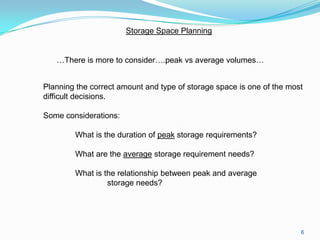
   …There is more to consider….peak vs average volumes…


Planning the correct amount and type of storage space is one of the most
difficult decisions.

Some considerations:

        What is the duration of peak storage requirements?

        What are the average storage requirement needs?

        What is the relationship between peak and average
                 storage needs?


                                                                       6
Storage Space Planning


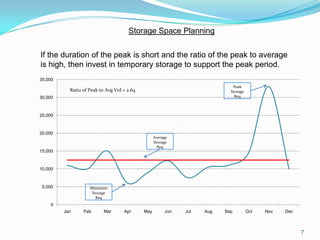
If the duration of the peak is short and the ratio of the peak to average
is high, then invest in temporary storage to support the peak period.
35,000
                                                                             Peak
           Ratio of Peak to Avg Vol = 2.64                                  Storage
30,000                                                                        Req


25,000


20,000
                                                   Average
                                                   Storage
                                                     Req
15,000


10,000


 5,000              Minimum
                     Storage
                       Req
    0
         Jan     Feb       Mar      Apr      May        Jun   Jul   Aug   Sep         Oct   Nov   Dec


                                                                                                        7
Storage Space Planning


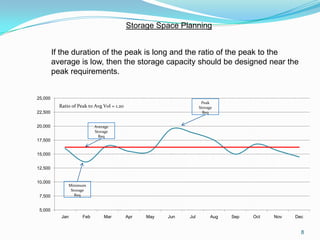
         If the duration of the peak is long and the ratio of the peak to the
         average is low, then the storage capacity should be designed near the
         peak requirements.


25,000
                                                                      Peak
           Ratio of Peak to Avg Vol = 1.20                           Storage
22,500                                                                 Req


20,000                      Average
                            Storage
                              Req
17,500


15,000


12,500


10,000
               Minimum
                Storage
 7,500            Req


 5,000
            Jan       Feb       Mar          Apr   May   Jun   Jul         Aug   Sep   Oct   Nov   Dec


                                                                                                     8
Storage Space Planning


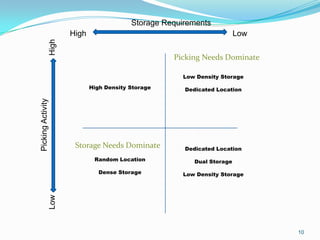
Another way to consider the type and extent of how much and which
type of storage is needed is by plotting the storage requirements vs
the picking activity on a 2x2 matrix.


                                                                       9
Storage Requirements
                          High                                               Low

                   High
                                                        Picking Needs Dominate

                                                          Low Density Storage

                                 High Density Storage      Dedicated Location
Picking Activity


                           Storage Needs Dominate          Dedicated Location

                                  Random Location             Dual Storage

                                    Dense Storage         Low Density Storage
                   Low


                                                                                   10
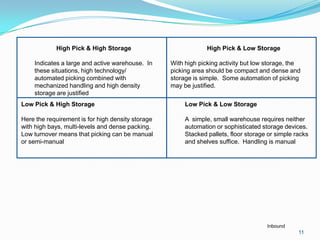
High Pick & High Storage                            High Pick & Low Storage

    Indicates a large and active warehouse. In     With high picking activity but low storage, the
    these situations, high technology/             picking area should be compact and dense and
    automated picking combined with                storage is simple. Some automation of picking
    mechanized handling and high density           may be justified.
    storage are justified
Low Pick & High Storage                                 Low Pick & Low Storage

Here the requirement is for high density storage        A simple, small warehouse requires neither
with high bays, multi-levels and dense packing.         automation or sophisticated storage devices.
Low turnover means that picking can be manual           Stacked pallets, floor storage or simple racks
or semi-manual                                          and shelves suffice. Handling is manual


                                                                                      Inbound
                                                                                                  11
Warehouse Layout


Inbound Operations: How much space does receiving require?


   Gather data to determine the typical receipt profile…

 Profiles should include:
           Average number of lines on a receipt
           Average quantity and cube of a receipt
           Average number of trucks received per day
           Unit of measure (pallets, cartons, pieces, etc…)

 Consider the overall receiving process


                                                              Outbound
                                                                   12
Warehouse Layout


Outbound Operations: How much space do picking and shipping require?


Consider:
            Are we picking eachs, cases, or pallets?

            Are we batch picking or picking orders straight through?

            Will we need to store pallets of product in shipping or direct load to trailer?

            Will we pick and hold orders for long periods of time?

            Will we perform QC audits in shipping?


                                                                                  Value Added
                                                                                         13
Warehouse Layout


Value Added Processes: How much space is required for value added services?


Consider:
            What type of value added service will be performed:
                     Price labeling
                     Re-labeling product
                     Kitting
                     Storing
                     Shipping

            Will the value added service be performed in a separate section or will it be
                       part of picking, packing, receiving, etc…?


                                                                                        14
                                                                             Material Flow
Material Flow Planning

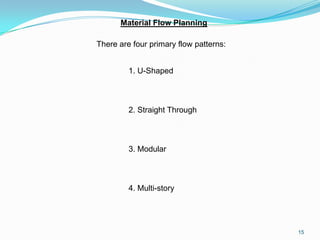
There are four primary flow patterns:


         1. U-Shaped


         2. Straight Through


         3. Modular


         4. Multi-story


                                        15
Material Flow Planning

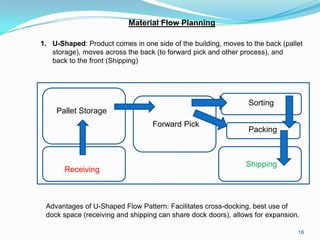
1. U-Shaped: Product comes in one side of the building, moves to the back (pallet
   storage), moves across the back (to forward pick and other process), and
   back to the front (Shipping)


                                                                Sorting
    Pallet Storage
                                  Forward Pick
                                                                Packing


                                                               Shipping
       Receiving


 Advantages of U-Shaped Flow Pattern: Facilitates cross-docking, best use of
 dock space (receiving and shipping can share dock doors), allows for expansion.

                                                                               16
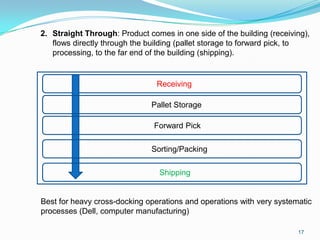
2. Straight Through: Product comes in one side of the building (receiving),
   flows directly through the building (pallet storage to forward pick, to
   processing, to the far end of the building (shipping).


                                Receiving

                              Pallet Storage

                               Forward Pick

                              Sorting/Packing

                                 Shipping


Best for heavy cross-docking operations and operations with very systematic
processes (Dell, computer manufacturing)

                                                                       17
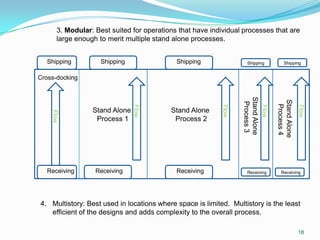
3. Modular: Best suited for operations that have individual processes that are
       large enough to merit multiple stand alone processes.


  Shipping           Shipping                Shipping                 Shipping               Shipping


Cross-docking


                                                                   Stand Alone


                                                                                        Stand Alone
                                                                    Process 3


                                                                                         Process 4
                                Flow


                                                            Flow


                                                                                 Flow


                                                                                                      Flow
                  Stand Alone              Stand Alone
    Flow


                   Process 1                Process 2


  Receiving        Receiving                 Receiving                Receiving            Receiving


4. Multistory: Best used in locations where space is limited. Multistory is the least
   efficient of the designs and adds complexity to the overall process.

                                                                                                      18

Warehouselayout

  • 1.
    NASHVILLE STATE CommunityCollege Warehouse & Inventory Management LOGI 1030 Warehouse Layout Space Planning Flow 1
  • 2.
    Warehouse Layout The goalof layout is to maximize your warehouse functions to achieve the grea efficiency and space utilization A warehouse is typically divided into the following areas to support its everyday processes: Receiving Reserve Storage Forward Pick Sorting and/or assembly Quality Shipping 2
  • 3.
    Warehouse Layout The warehouselayout must satisfy these four primary functions: Product storage Inbound operations Outbound operations Value-added processes Let’s look at each in some more detail…. 3
  • 4.
    Warehouse Layout ProductStorage The first step is determining space requirements for the four functions just mentioned. Determining space requirements for each of these is a complicated proces which requires analysis of historical and projected volumes to include units cube, and weight requirements. A typical analysis looks back at one year’s worth of history and then projec sales growth over the next three and five years. 4
  • 5.
    Warehouse Layout ProductStorage 1. Begin by looking at current average inventory levels and growth projections by SKU 2. Consider variations amongst SKUs (date sensitive, refrigeration required, special handling requirements, weight/size limits?) Use this info to sort SKUs into separate product categories 3. Classify each product by the number of activities (ie: picks) that are involved over a span of time (month, year, etc…) Use this info to find ways to reduce travel time (store high vol SKUs together) 4. Determine where to locate product based on cube, velocity, and how often you want to replenish the forward pick locations Determine how much of each SKU to place in forward pick and reserve 5
  • 6.
    Storage Space Planning …There is more to consider….peak vs average volumes… Planning the correct amount and type of storage space is one of the most difficult decisions. Some considerations: What is the duration of peak storage requirements? What are the average storage requirement needs? What is the relationship between peak and average storage needs? 6
  • 7.
    Storage Space Planning Ifthe duration of the peak is short and the ratio of the peak to average is high, then invest in temporary storage to support the peak period. 35,000 Peak Ratio of Peak to Avg Vol = 2.64 Storage 30,000 Req 25,000 20,000 Average Storage Req 15,000 10,000 5,000 Minimum Storage Req 0 Jan Feb Mar Apr May Jun Jul Aug Sep Oct Nov Dec 7
  • 8.
    Storage Space Planning If the duration of the peak is long and the ratio of the peak to the average is low, then the storage capacity should be designed near the peak requirements. 25,000 Peak Ratio of Peak to Avg Vol = 1.20 Storage 22,500 Req 20,000 Average Storage Req 17,500 15,000 12,500 10,000 Minimum Storage 7,500 Req 5,000 Jan Feb Mar Apr May Jun Jul Aug Sep Oct Nov Dec 8
  • 9.
    Storage Space Planning Anotherway to consider the type and extent of how much and which type of storage is needed is by plotting the storage requirements vs the picking activity on a 2x2 matrix. 9
  • 10.
    Storage Requirements High Low High Picking Needs Dominate Low Density Storage High Density Storage Dedicated Location Picking Activity Storage Needs Dominate Dedicated Location Random Location Dual Storage Dense Storage Low Density Storage Low 10
  • 11.
    High Pick &High Storage High Pick & Low Storage Indicates a large and active warehouse. In With high picking activity but low storage, the these situations, high technology/ picking area should be compact and dense and automated picking combined with storage is simple. Some automation of picking mechanized handling and high density may be justified. storage are justified Low Pick & High Storage Low Pick & Low Storage Here the requirement is for high density storage A simple, small warehouse requires neither with high bays, multi-levels and dense packing. automation or sophisticated storage devices. Low turnover means that picking can be manual Stacked pallets, floor storage or simple racks or semi-manual and shelves suffice. Handling is manual Inbound 11
  • 12.
    Warehouse Layout Inbound Operations:How much space does receiving require? Gather data to determine the typical receipt profile… Profiles should include: Average number of lines on a receipt Average quantity and cube of a receipt Average number of trucks received per day Unit of measure (pallets, cartons, pieces, etc…) Consider the overall receiving process Outbound 12
  • 13.
    Warehouse Layout Outbound Operations:How much space do picking and shipping require? Consider: Are we picking eachs, cases, or pallets? Are we batch picking or picking orders straight through? Will we need to store pallets of product in shipping or direct load to trailer? Will we pick and hold orders for long periods of time? Will we perform QC audits in shipping? Value Added 13
  • 14.
    Warehouse Layout Value AddedProcesses: How much space is required for value added services? Consider: What type of value added service will be performed: Price labeling Re-labeling product Kitting Storing Shipping Will the value added service be performed in a separate section or will it be part of picking, packing, receiving, etc…? 14 Material Flow
  • 15.
    Material Flow Planning Thereare four primary flow patterns: 1. U-Shaped 2. Straight Through 3. Modular 4. Multi-story 15
  • 16.
    Material Flow Planning 1.U-Shaped: Product comes in one side of the building, moves to the back (pallet storage), moves across the back (to forward pick and other process), and back to the front (Shipping) Sorting Pallet Storage Forward Pick Packing Shipping Receiving Advantages of U-Shaped Flow Pattern: Facilitates cross-docking, best use of dock space (receiving and shipping can share dock doors), allows for expansion. 16
  • 17.
    2. Straight Through:Product comes in one side of the building (receiving), flows directly through the building (pallet storage to forward pick, to processing, to the far end of the building (shipping). Receiving Pallet Storage Forward Pick Sorting/Packing Shipping Best for heavy cross-docking operations and operations with very systematic processes (Dell, computer manufacturing) 17
  • 18.
    3. Modular: Bestsuited for operations that have individual processes that are large enough to merit multiple stand alone processes. Shipping Shipping Shipping Shipping Shipping Cross-docking Stand Alone Stand Alone Process 3 Process 4 Flow Flow Flow Flow Stand Alone Stand Alone Flow Process 1 Process 2 Receiving Receiving Receiving Receiving Receiving 4. Multistory: Best used in locations where space is limited. Multistory is the least efficient of the designs and adds complexity to the overall process. 18