Product and
Service Design
Product and Service Design


Major factors in strategy






Cost
Quality
Time-to-market
Customer satisfaction
Competitive advantage


Increased emphasis on or attention to:


Customer satisfaction



Reducing time to introduce new product
or service



Reducing time to produce product


Increased emphasis on or attention to:


The organization’s capabilities to produce or
deliver the item



Environmental concerns



Designing products & services that are “user
friendly”



Designing products that use less material





Development time and cost
Product or service cost
Resulting product or service quality
Capability to produce or deliver a given
product or service









Translate customer wants and needs into
product and service requirements
Refine existing products and services
Develop new products and services
Formulate quality goals
Formulate cost targets
Construct and test prototypes
Document specifications








Economic reasons
Social and demographic Reasons
Political, Liability, or Legal
Life cycle
Competitive
Cost or availability
Technological


Legal





Ethical




Product liability
Uniform commercial code
Releasing products free of defects

Environmental


EPA


Product Liability - A manufacturer is
liable for any injuries or damages caused
by a faulty product.



Uniform Commercial Code - Products
carry an implication of merchantability
and fitness.
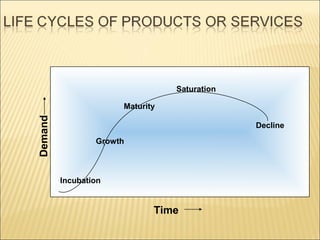
Saturation

Demand

Maturity
Decline
Growth

Incubation

Time


Modification



Expansion



Clone



New









Idea Generation
Feasibility Analysis
Product specification
Process specification
Prototype development
Design review
Market test
Product Introduction and follow-up


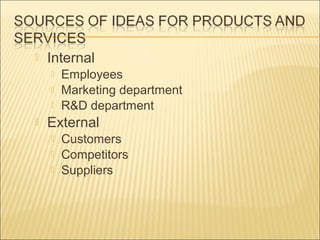
Internal






Employees
Marketing department
R&D department

External




Customers
Competitors
Suppliers


Fewer parts to deal with in inventory &
manufacturing



Reduced training costs and time



More routine purchasing, handling, and
inspection procedures


Orders fillable from inventory



Opportunities for long production runs
and automation



Need for fewer parts justifies increased
expenditures on perfecting designs and
improving quality control procedures.


Designs may be frozen with too many
imperfections remaining.



High cost of design changes increases
resistance to improvements.



Decreased variety results in less
consumer appeal.
Mass customization:





A strategy of producing standardized
goods or services, but incorporating some
degree degree of customization
Delayed differentiation
Modular design
Delayed differentiation is a
postponement tactic


Producing but not quite completing a
product or service until customer
preferences or specifications are known
Modular design is a form of standardization in
which component parts are subdivided into
modules that are easily replaced or
interchanged. It allows:


easier diagnosis and remedy of failures



easier repair and replacement



simplification of manufacturing and assembly







Design for manufacturing (DFM)
Design for assembly (DFA)
Design for recycling (DFR)
Remanufacturing
Design for disassembly (DFD)
Robust design
Beyond the overall objective to achieve
customer satisfaction while making a reasonable
profit is:
Design for Manufacturing(DFM)
The designers’ consideration of the
organization’s manufacturing capabilities when
designing a product.
The more general term design for operations
encompasses services as well as manufacturing
Reverse engineering is the
dismantling and inspecting
of a competitor’s product to
discover product
improvements.
Concurrent engineering
is the bringing together
of engineering design and
manufacturing personnel
early in the design phase.


Manufacturability is the ease of
fabrication and/or assembly
which is important for:


Cost



Productivity



Quality


Computer-Aided Design (CAD) is
product design using computer
graphics.


increases productivity of designers, 3 to 10
times



creates a database for manufacturing
information on product specifications



provides possibility of engineering and cost
analysis on proposed designs
Recycling




Recycling: recovering materials for
future use
Recycling reasons




Cost savings
Environment concerns
Environment regulations
Robust Design
Robust Design: Design that results in
products or services that can function
over a broad range of conditions
Differences Between Product
and Service Design








Tangible – intangible
Services created and delivered at the
same time
Services cannot be inventoried
Services highly visible to customers
Services have low barrier to entry
Location important to service

Product design