WAREHOUSING
Akash Deep Maurya
MT14IND002
M. Tech. (Industrial Engineering)
2014-2015
DEPARTMENT OF MECHANICAL
ENGINEERING
VNIT NAGPUR
What is warehouse?
A location with adequate facilities where
volume shipments are received from production
center, then broken-down , reassembled into
combinations representing a particular order &
shipped to customer.
A storage structure constructed for the
protection of the quality and quantity of the
stored produce.(GOI)
WAREHOUSING
2
WAREHOUSING
3
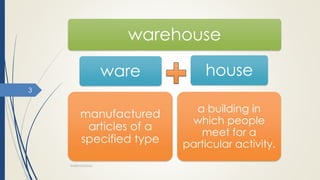
warehouse
ware
manufactured
articles of a
specified type
house
a building in
which people
meet for a
particular activity.
Warehouse is for-
For ensuring a continuous , uninterrupted supply
of goods in market areas.
To provide adjustment between the production &
use of product.
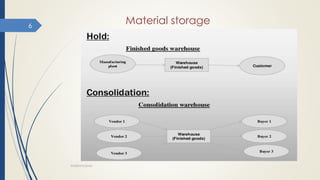
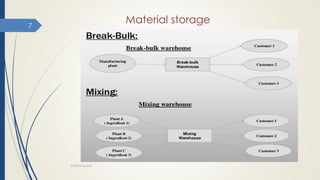
Transportation consolidation; Product mixing;
Docking; Service; Protection against contingencies
WAREHOUSING
4
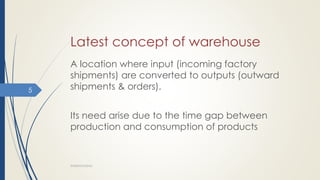
Latest concept of warehouse
A location where input (incoming factory
shipments) are converted to outputs (outward
shipments & orders).
Its need arise due to the time gap between
production and consumption of products
WAREHOUSING
5
Material storage
WAREHOUSING
6
WAREHOUSING
7
Material storage
What could be stored?
 Raw materials
 WIP (work in progress)
 Consumable stores
 Spare parts
 Ready made components
 Finished goods
WAREHOUSING
8
Need of warehouse
 Regular supply
 Quality of delivery
 Stock of trade
 Price stabilization
 Seasonal products
 Perishable goods
WAREHOUSING
9
 Continuous
production
 Large scale
production
 Quick supply
 Easy handling
 Protection &
preservation
Location of warehouse
• Service area.
• Transportation facility.
• Availability of power, water, gas, wastes etc.
• Labour supply & cost.
• Existing facilities of company.
• Climate & labour productivity.
• Real estate, excise & government taxes.
• Local residents & government.
• Potential for later expansion and operations.
• Cost of land & other costs.
WAREHOUSING
10
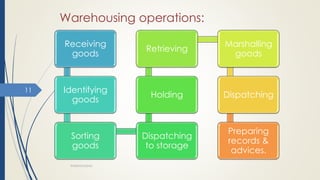
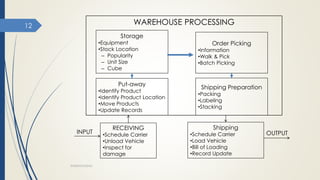
Warehousing operations:
WAREHOUSING
11
Receiving
goods
Identifying
goods
Sorting
goods
Dispatching
to storage
Holding
Retrieving
Marshalling
goods
Dispatching
Preparing
records &
advices.
Shipping
•Schedule Carrier
•Load Vehicle
•Bill of Loading
•Record Update
RECEIVING
•Schedule Carrier
•Unload Vehicle
•Inspect for
damage
INPUT
WAREHOUSE PROCESSING
Put-away
•Identify Product
•Identify Product Location
•Move Products
•Update Records
Storage
•Equipment
•Stock Location
– Popularity
– Unit Size
– Cube
Shipping Preparation
•Packing
•Labeling
•Stacking
Order Picking
•Information
•Walk & Pick
•Batch Picking
OUTPUT
WAREHOUSING
12
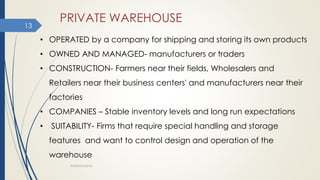
PRIVATE WAREHOUSE
WAREHOUSING
13
• OPERATED by a company for shipping and storing its own products
• OWNED AND MANAGED- manufacturers or traders
• CONSTRUCTION- Farmers near their fields, Wholesalers and
Retailers near their business centers' and manufacturers near their
factories
• COMPANIES – Stable inventory levels and long run expectations
• SUITABILITY- Firms that require special handling and storage
features and want to control design and operation of the
warehouse
PUBLIC WAREHOUSE
WAREHOUSING
14 • Provide storage and physical distribution services on rental basis
• Used by SMALL FIRMS and LARGE FIRMS
• Organizes to provide storage facilities to traders, manufacturers,
agriculturists in return for a storage charge
• Licensed by Govt. (Central Warehousing Corporation, State
Warehousing Corporation, FCI)
• SUITABILTY – seasonal production or low volume storage needs,
companies with inventories maintained in many locations, firms
entering new markets
• OWNER –stands as an agent of goods
Types of warehouses :
 Field warehouses
 Distribution warehouses
 Bonded warehouses
 Cold warehouses
 Agricultural warehouses
 Buffer warehouses
 Export & Import warehouses
WAREHOUSING
15
Characteristics of ideal warehouse:
 Convenient location
 Appliances to load & unload goods.
 Adequate space and proper utilization.
 Cold storage facilities for specific products.
 Proper arrangement for protection.
 Sufficient parking area.
 Round the clock security.
 Fire fighting equipments.
WAREHOUSING
16
Maximize productivity & minimize cost
Maximize use of space
space is the largest capital cost
Effective use of labor & equipment
labor is the largest operating cost
material handling equipment is the second
largest capital cost
WAREHOUSING
17
WAREHOUSING
18
Ideal Facility for Pure Supplier Consolidation
(Full Pallet Movement)
Warehouse Space General Layout
DESIGN CONSIDERATION
Services provided:
 Temporary storage
 Quick delivery
 Balance supply & demand
 Stock inventory for emergency
 Refrigeration
 Invoicing & collection
 Payment & distribution
 Protection against factory shutdown
 Sales promotion activities
WAREHOUSING
19
FACTORS INFLUENCING
EFFECTIVE USE OF WAREHOUSES
• Cube utilization and accessibility
• Stock location
• Order picking and assembly
• Physical Control & Security - Elements
WAREHOUSING
20
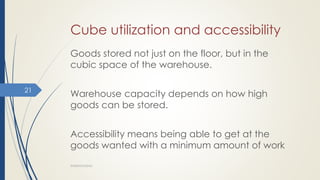
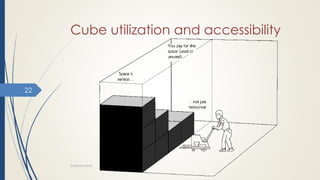
Cube utilization and accessibility
Goods stored not just on the floor, but in the
cubic space of the warehouse.
Warehouse capacity depends on how high
goods can be stored.
Accessibility means being able to get at the
goods wanted with a minimum amount of work
WAREHOUSING
21
Cube utilization and accessibility
WAREHOUSING
22
Stock Location
• Objectives
1. To provide the required customer service
2. To keep track of where items are stored
3. To minimize effort to receive, put away, and retrieve items
• Basic Stock Locating Systems
1. Group functionally related items together
2. Group fast-moving items together
3. Group physically similar items together
4. Locate working stock and reserve stock separately
WAREHOUSING
23
Stock Location
Fixed Location
assigns a permanent location & no other items are stored
there
poor cube utilization
Usually used in small warehouses
Floating (Random) Location
Goods stored wherever there is appropriate space
improved cube utilization
requires accurate and up-to-date information
Usually computer-based
WAREHOUSING
24
Order Picking and Assembly
When an order is received, items must be
obtained from the warehouse, grouped, &
prepared for shipment, systems used
• Area system
• Zone system
• Multi-order system
WAREHOUSING
25
PHYSICAL CONTROL & SECURITY - ELEMENTS
o Good part numbering system
o Simple, well-documented transaction system
1. Identify the item
2. Verify the quantity
3. Record the transaction
4. Physically execute the transaction
o Limited access
Inventory must be kept in a safe, secure
(locked) place with limited general access
o Well-trained workforce
WAREHOUSING
26
Benefits
 Maximum usage of available floor space and building height
 More storage capacity
 Less land and smaller building
 High productivity
 Operate faster -24 hours a day, 7-days a week
 Efficient flow of materials
 Provide buffer storage functions
 Need for drivers/operators eliminated
 Risk of injury minimized by safety fences
 Reduce stockholdings
 Inventory accurately tracked at all stages
 Ongoing operating costs eliminated
WAREHOUSING
27
Demerits
• Poor market coverage
• Distant market demand not met in short notice
• Transport cost maximum unless in bulk quantity
• Increased material handling cost
• Possibility of bottlenecks and resultant delays
• Greater danger of loss by fire
• Delay in customer service
• Huge investment in inventory
• Chances of stock-out situation is high
• Huge warehousing developments costs
WAREHOUSING
28
Modern Trends:
• Just In time
• RFID(Radio Frequency
IDentification)
• Warehouse type retail store
• Internet based stores
• Automated handling
WAREHOUSING
29
Soft wares :
• 3PLink
• Visual Logistics WMS
• LoMag
• RF Pathways
• SIMMS
• ATEC-WM
• Advantage Suite
• Autostore
• TECSYS
• SAP
• JDA software
• epicor
References:
1. http://business.gov.in/manage_business/warehousing.php
2. http://www.slideshare.net/omarof5/warehouse-operationslayout-design-by-
omar-youssef?related=1
3. http://www.slideshare.net/WelingkarDLP/chapter-5-warehouse-management
4. http://www.capterra.com/warehouse-management-software/
5. http://www.ey.com/IN/en/Services/Transactions/EY-Summarizing-the-key-
warehousing-segments-in-India
6. http://www.yourarticlelibrary.com/marketing/marketing-
management/warehousing-function-benefits-and-types-of-warehousing/27952/
7. http://www.inboundlogistics.com/cms/article/todays-warehouse-plays-a-new-
role/
WAREHOUSING
30
Questions:
 What is the latest concept regarding storage in
warehouses?
 List out difference in public and private warehouse.
 What are the factors influencing the effective use of
warehouses?
 What are different types of warehouse? Explain any
three.
 How the processing of inventory or goods occur in
warehouse? Explain in sequential manner.
WAREHOUSING
31

warehouse

  • 1.
    WAREHOUSING Akash Deep Maurya MT14IND002 M.Tech. (Industrial Engineering) 2014-2015 DEPARTMENT OF MECHANICAL ENGINEERING VNIT NAGPUR
  • 2.
    What is warehouse? Alocation with adequate facilities where volume shipments are received from production center, then broken-down , reassembled into combinations representing a particular order & shipped to customer. A storage structure constructed for the protection of the quality and quantity of the stored produce.(GOI) WAREHOUSING 2
  • 3.
    WAREHOUSING 3 warehouse ware manufactured articles of a specifiedtype house a building in which people meet for a particular activity.
  • 4.
    Warehouse is for- Forensuring a continuous , uninterrupted supply of goods in market areas. To provide adjustment between the production & use of product. Transportation consolidation; Product mixing; Docking; Service; Protection against contingencies WAREHOUSING 4
  • 5.
    Latest concept ofwarehouse A location where input (incoming factory shipments) are converted to outputs (outward shipments & orders). Its need arise due to the time gap between production and consumption of products WAREHOUSING 5
  • 6.
  • 7.
  • 8.
    What could bestored?  Raw materials  WIP (work in progress)  Consumable stores  Spare parts  Ready made components  Finished goods WAREHOUSING 8
  • 9.
    Need of warehouse Regular supply  Quality of delivery  Stock of trade  Price stabilization  Seasonal products  Perishable goods WAREHOUSING 9  Continuous production  Large scale production  Quick supply  Easy handling  Protection & preservation
  • 10.
    Location of warehouse •Service area. • Transportation facility. • Availability of power, water, gas, wastes etc. • Labour supply & cost. • Existing facilities of company. • Climate & labour productivity. • Real estate, excise & government taxes. • Local residents & government. • Potential for later expansion and operations. • Cost of land & other costs. WAREHOUSING 10
  • 11.
  • 12.
    Shipping •Schedule Carrier •Load Vehicle •Billof Loading •Record Update RECEIVING •Schedule Carrier •Unload Vehicle •Inspect for damage INPUT WAREHOUSE PROCESSING Put-away •Identify Product •Identify Product Location •Move Products •Update Records Storage •Equipment •Stock Location – Popularity – Unit Size – Cube Shipping Preparation •Packing •Labeling •Stacking Order Picking •Information •Walk & Pick •Batch Picking OUTPUT WAREHOUSING 12
  • 13.
    PRIVATE WAREHOUSE WAREHOUSING 13 • OPERATEDby a company for shipping and storing its own products • OWNED AND MANAGED- manufacturers or traders • CONSTRUCTION- Farmers near their fields, Wholesalers and Retailers near their business centers' and manufacturers near their factories • COMPANIES – Stable inventory levels and long run expectations • SUITABILITY- Firms that require special handling and storage features and want to control design and operation of the warehouse
  • 14.
    PUBLIC WAREHOUSE WAREHOUSING 14 •Provide storage and physical distribution services on rental basis • Used by SMALL FIRMS and LARGE FIRMS • Organizes to provide storage facilities to traders, manufacturers, agriculturists in return for a storage charge • Licensed by Govt. (Central Warehousing Corporation, State Warehousing Corporation, FCI) • SUITABILTY – seasonal production or low volume storage needs, companies with inventories maintained in many locations, firms entering new markets • OWNER –stands as an agent of goods
  • 15.
    Types of warehouses:  Field warehouses  Distribution warehouses  Bonded warehouses  Cold warehouses  Agricultural warehouses  Buffer warehouses  Export & Import warehouses WAREHOUSING 15
  • 16.
    Characteristics of idealwarehouse:  Convenient location  Appliances to load & unload goods.  Adequate space and proper utilization.  Cold storage facilities for specific products.  Proper arrangement for protection.  Sufficient parking area.  Round the clock security.  Fire fighting equipments. WAREHOUSING 16
  • 17.
    Maximize productivity &minimize cost Maximize use of space space is the largest capital cost Effective use of labor & equipment labor is the largest operating cost material handling equipment is the second largest capital cost WAREHOUSING 17
  • 18.
    WAREHOUSING 18 Ideal Facility forPure Supplier Consolidation (Full Pallet Movement) Warehouse Space General Layout DESIGN CONSIDERATION
  • 19.
    Services provided:  Temporarystorage  Quick delivery  Balance supply & demand  Stock inventory for emergency  Refrigeration  Invoicing & collection  Payment & distribution  Protection against factory shutdown  Sales promotion activities WAREHOUSING 19
  • 20.
    FACTORS INFLUENCING EFFECTIVE USEOF WAREHOUSES • Cube utilization and accessibility • Stock location • Order picking and assembly • Physical Control & Security - Elements WAREHOUSING 20
  • 21.
    Cube utilization andaccessibility Goods stored not just on the floor, but in the cubic space of the warehouse. Warehouse capacity depends on how high goods can be stored. Accessibility means being able to get at the goods wanted with a minimum amount of work WAREHOUSING 21
  • 22.
    Cube utilization andaccessibility WAREHOUSING 22
  • 23.
    Stock Location • Objectives 1.To provide the required customer service 2. To keep track of where items are stored 3. To minimize effort to receive, put away, and retrieve items • Basic Stock Locating Systems 1. Group functionally related items together 2. Group fast-moving items together 3. Group physically similar items together 4. Locate working stock and reserve stock separately WAREHOUSING 23
  • 24.
    Stock Location Fixed Location assignsa permanent location & no other items are stored there poor cube utilization Usually used in small warehouses Floating (Random) Location Goods stored wherever there is appropriate space improved cube utilization requires accurate and up-to-date information Usually computer-based WAREHOUSING 24
  • 25.
    Order Picking andAssembly When an order is received, items must be obtained from the warehouse, grouped, & prepared for shipment, systems used • Area system • Zone system • Multi-order system WAREHOUSING 25
  • 26.
    PHYSICAL CONTROL &SECURITY - ELEMENTS o Good part numbering system o Simple, well-documented transaction system 1. Identify the item 2. Verify the quantity 3. Record the transaction 4. Physically execute the transaction o Limited access Inventory must be kept in a safe, secure (locked) place with limited general access o Well-trained workforce WAREHOUSING 26
  • 27.
    Benefits  Maximum usageof available floor space and building height  More storage capacity  Less land and smaller building  High productivity  Operate faster -24 hours a day, 7-days a week  Efficient flow of materials  Provide buffer storage functions  Need for drivers/operators eliminated  Risk of injury minimized by safety fences  Reduce stockholdings  Inventory accurately tracked at all stages  Ongoing operating costs eliminated WAREHOUSING 27
  • 28.
    Demerits • Poor marketcoverage • Distant market demand not met in short notice • Transport cost maximum unless in bulk quantity • Increased material handling cost • Possibility of bottlenecks and resultant delays • Greater danger of loss by fire • Delay in customer service • Huge investment in inventory • Chances of stock-out situation is high • Huge warehousing developments costs WAREHOUSING 28
  • 29.
    Modern Trends: • JustIn time • RFID(Radio Frequency IDentification) • Warehouse type retail store • Internet based stores • Automated handling WAREHOUSING 29 Soft wares : • 3PLink • Visual Logistics WMS • LoMag • RF Pathways • SIMMS • ATEC-WM • Advantage Suite • Autostore • TECSYS • SAP • JDA software • epicor
  • 30.
    References: 1. http://business.gov.in/manage_business/warehousing.php 2. http://www.slideshare.net/omarof5/warehouse-operationslayout-design-by- omar-youssef?related=1 3.http://www.slideshare.net/WelingkarDLP/chapter-5-warehouse-management 4. http://www.capterra.com/warehouse-management-software/ 5. http://www.ey.com/IN/en/Services/Transactions/EY-Summarizing-the-key- warehousing-segments-in-India 6. http://www.yourarticlelibrary.com/marketing/marketing- management/warehousing-function-benefits-and-types-of-warehousing/27952/ 7. http://www.inboundlogistics.com/cms/article/todays-warehouse-plays-a-new- role/ WAREHOUSING 30
  • 31.
    Questions:  What isthe latest concept regarding storage in warehouses?  List out difference in public and private warehouse.  What are the factors influencing the effective use of warehouses?  What are different types of warehouse? Explain any three.  How the processing of inventory or goods occur in warehouse? Explain in sequential manner. WAREHOUSING 31