WAREHOUSING
waste
management
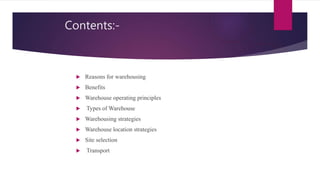
Contents:-
 Reasons for warehousing
 Benefits
 Warehouse operating principles
 Types of Warehouse
 Warehousing strategies
 Warehouse location strategies
 Site selection
 Transport
Reasons for warehousing:-
 To support the company’s customer policy.
 To maintain a source of supply without interruptions.
 To achieve transportation economies.
 To support changing market conditions and sudden changes in demand.
 To support any JIT programs.
 To provide customers with the right mix of products at all times and all
locations.
 To ensure least logistics cost for a desired level of customer service.
CONCEPTNeed for storage arises both for raw
material as well as finished products
STORAGE involves proper management
for preserving goods from the time of their
production or purchase till actual use.
When this storage is done on a large scale
and in a specified manner it is called
WAREHOUSING.
MEANING AND DEFINITION
Place where goods are kept is called
WAREHOUSE
The person in-charge of warehouse is
called WAREHOUSE-KEEPER
A commercial building for storage of
goods
Used by manufacturers, importers,
definition Warehousing refers to the activities involving storage of goods on a large-scale in a
systematic and orderly manner and making them available conveniently when needed.
 Means holding or preserving goods in huge quantities from the time of their purchase or
production till their actual use or sale.
 Creates time utility by bridging the time gap between production and consumption of
goods
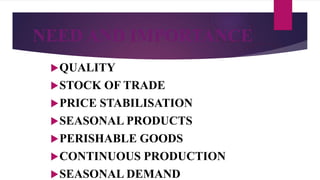
BASIC FUNCTIONS PERFORMED
Storage function
Performed by storing products in the
warehouse till delivery to ultimate consumer
Movement function
Receipt of
products from
manufacturing
plant
Transfer into
the warehouse
Placement at
designated
place
Regrouping
products
Transferring
on transport
vehicle
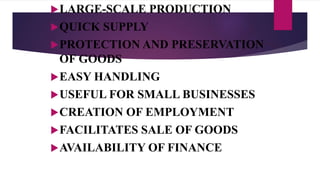
NEED AND IMPORTANCE
QUALITY
STOCK OF TRADE
PRICE STABILISATION
SEASONAL PRODUCTS
PERISHABLE GOODS
CONTINUOUS PRODUCTION
SEASONAL DEMAND
LARGE-SCALE PRODUCTION
QUICK SUPPLY
PROTECTION AND PRESERVATION
OF GOODS
EASY HANDLING
USEFUL FOR SMALL BUSINESSES
CREATION OF EMPLOYMENT
FACILITATES SALE OF GOODS
AVAILABILITY OF FINANCE
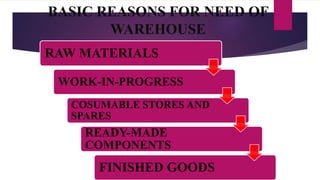
BASIC REASONS FOR NEED OF
WAREHOUSE
RAW MATERIALS
WORK-IN-PROGRESS
COSUMABLE STORES AND
SPARES
READY-MADE
COMPONENTS
FINISHED GOODS
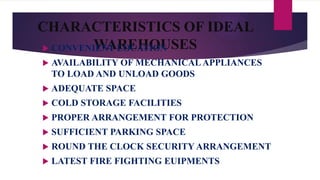
CHARACTERISTICS OF IDEAL
WAREHOUSES CONVENIENT LOCATION
 AVAILABILITY OF MECHANICAL APPLIANCES
TO LOAD AND UNLOAD GOODS
 ADEQUATE SPACE
 COLD STORAGE FACILITIES
 PROPER ARRANGEMENT FOR PROTECTION
 SUFFICIENT PARKING SPACE
 ROUND THE CLOCK SECURITY ARRANGEMENT
 LATEST FIRE FIGHTING EUIPMENTS
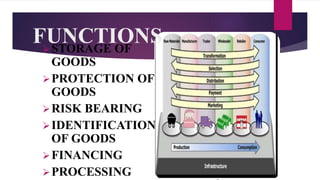
FUNCTIONSSTORAGE OF
GOODS
PROTECTION OF
GOODS
RISK BEARING
IDENTIFICATION
OF GOODS
FINANCING
PROCESSING
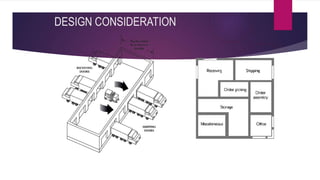
DESIGN CONSIDERATION
Ideal Facility for Pure Supplier
Consolidation
(Full Pallet Movement)
Warehouse Space
Requirements
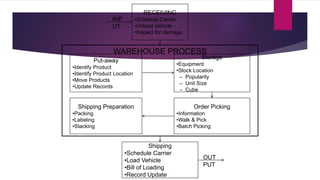
WAREHOUSE PROCESS
Put-away
•Identify Product
•Identify Product Location
•Move Products
•Update Records
Storage
•Equipment
•Stock Location
– Popularity
– Unit Size
– Cube
Shipping Preparation
•Packing
•Labeling
•Stacking
Order Picking
•Information
•Walk & Pick
•Batch Picking
Shipping
•Schedule Carrier
•Load Vehicle
•Bill of Loading
•Record Update
RECEIVING
•Schedule Carrier
•Unload Vehicle
•Inspect for damage
INP
UT
OUT
PUT
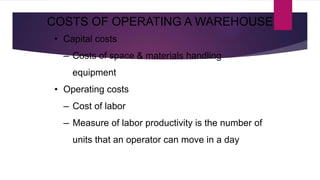
• Capital costs
— Costs of space & materials handling
equipment
• Operating costs
— Cost of labor
— Measure of labor productivity is the number of
units that an operator can move in a day
COSTS OF OPERATING A WAREHOUSE
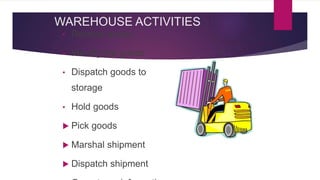
WAREHOUSE ACTIVITIES
• Receive goods
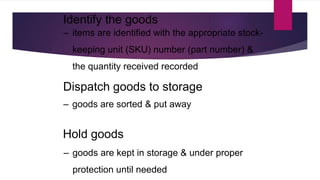
• Identify the goods
• Dispatch goods to
storage
• Hold goods
 Pick goods
 Marshal shipment
 Dispatch shipment
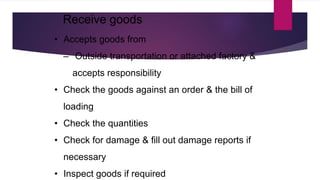
• Accepts goods from
‒ Outside transportation or attached factory &
accepts responsibility
• Check the goods against an order & the bill of
loading
• Check the quantities
• Check for damage & fill out damage reports if
necessary
• Inspect goods if required
Receive goods
‒ items are identified with the appropriate stock-
keeping unit (SKU) number (part number) &
the quantity received recorded
Identify the goods
Dispatch goods to storage
‒ goods are sorted & put away
Hold goods
‒ goods are kept in storage & under proper
protection until needed
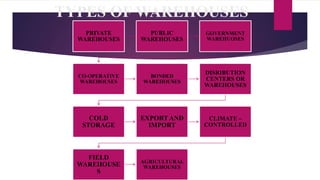
TYPES OF WAREHOUSES
PRIVATE
WAREHOUSES
PUBLIC
WAREHOUSES
GOVERNMENT
WAREHUOSES
CO-OPERATIVE
WAREHOUSES
BONDED
WAREHOUSES
DISRIBUTION
CENTERS OR
WAREHOUSES
COLD
STORAGE
EXPORT AND
IMPORT
CLIMATE –
CONTROLLED
FIELD
WAREHOUSE
S
AGRICULTURAL
WAREHOUSES
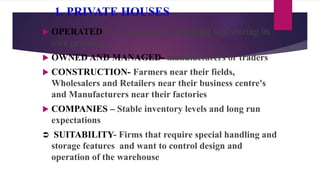
1. PRIVATE HOUSES
 OPERATED by a company for shipping and storing its
own products
 OWNED AND MANAGED- manufacturers or traders
 CONSTRUCTION- Farmers near their fields,
Wholesalers and Retailers near their business centre's
and Manufacturers near their factories
 COMPANIES – Stable inventory levels and long run
expectations
 SUITABILITY- Firms that require special handling and
storage features and want to control design and
operation of the warehouse
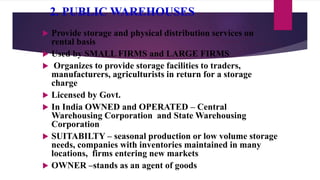
2. PUBLIC WAREHOUSES
 Provide storage and physical distribution services on
rental basis
 Used by SMALL FIRMS and LARGE FIRMS
 Organizes to provide storage facilities to traders,
manufacturers, agriculturists in return for a storage
charge
 Licensed by Govt.
 In India OWNED and OPERATED – Central
Warehousing Corporation and State Warehousing
Corporation
 SUITABILTY – seasonal production or low volume storage
needs, companies with inventories maintained in many
locations, firms entering new markets
 OWNER –stands as an agent of goods
3. GOVERNMENT WAREHOUSES
 OWNED, MANAGED AND CONTROLLED -Central or State Governments or public
corporations or local authorities
 EXAMPLES- Central Warehousing Corporation of India, State Warehousing
Corporation and Food Corporation of India
 If customer cannot pay rent within specified time authority can recover rent disposing
of goods
4. CO-OPERATIVE WAREHOUSES
• Owned, Managed and Controlled – Co-operative societies
• Facilities at most economical rates to members
• Located-Punjab, Karnataka, Maharashtra and Andhra
5. BONDED WAREHOUSES
 Licensed to accept imported goods for storage before payment of
customs duty
 Imported merchandise is stored and released only after payment
of appropriate taxes
 Cigarettes, Liquor, Other products are stored
 Owned and Operated – PORT TRUSTS
 Acts in two capacities viz LANDLORD and BAILEE OF GOODS
 As landlord provides storage facilities on rent
 As bailee of goods take reasonable care to handle and store goods
as it has lien on goods under care for charges of its services
 Owner can sell goods wholly or in part by endorsing a warrant
 Facilitate enterpot trade- importer need not pay the import duty
6. DISTRIBUTION CENTERS / WAREHOUSES
 Designed to move goods
 Large and highly automated
 Receive goods from various plants and suppliers, take orders, fill them efficiently deliver
to customers quickly
 Located near the market owned or leased by manufacturers
 Access to transport networks
7. COLD STORAGE
 Preserve perishability of goods against payment of a storage charge
 Temperature variation is controlled to degree necessary for certain sensitive items
8. EXPORT AND IMPORT WAREHOUSES
 LOCATION –near ports where international trade is undertaken
 Storage facilities for goods awaiting onward movements
 Facilities- packaging , inspection, marking etc
9. CLIMATE-CONTROLLED WAREHOUSE
 Handle storage of many products including need special handling conditions
 Freezers for frozen products, humidity controlled environment for delicate
products, produce or flowers, etc
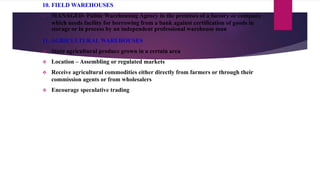
10. FIELD WAREHOUSES
 MANAGED- Public Warehousing Agency in the premises of a factory or company
which needs facility for borrowing from a bank against certification of goods in
storage or in process by an independent professional warehouse man.
11. AGRICULTURAL WAREHOUSES
 Store agricultural produce grown in a certain area
 Location – Assembling or regulated markets
 Receive agricultural commodities either directly from farmers or through their
commission agents or from wholesalers
 Encourage speculative trading
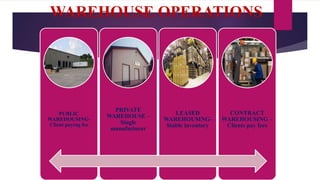
WAREHOUSE OPERATIONS
PUBLIC
WAREHOUSING-
Client paying fee
PRIVATE
WAREHOUSE –
Single
manufacturer
LEASED
WAREHOUSING-
Stable inventory
CONTRACT
WAREHOUSING –
Clients pay fees
Benefits of warehousing:-
 Consolidation.
 Break bulk warehouse.
 Processing / Postponement.
 Stockpiling.
Warehouse Operating Principles:-
Three Principles are:
1) Design criteria:
a) Number of stories in the facility,
b) Height utilization,
c) Product flow
Warehouse Operating Principles:-
2) Handling technology
a) Movement continuity,
b) Movement scale economies.
3) Storage plan
The Warehouse location strategies:-
1) Market positioned:
a) Order Cycle time
b) Transportation cost
c) Sensitivity of the product
d) Order sizes
2) Product positioned:
a) Perishability of the raw materials
b) Number of products in the product mix
c) Assortments ordered by the customers from the product mix
d) Transportation consolidation rates
3) Intermediately positioned:
Site Selection:-
 Location of the major markets.
 Nature of the products being distributed.
 Quality & Variety of carriers serving the proposed site.
 Quality & Quantity of labour available.
 Cost of industrial land.
Warehouse Layout:-
 Layout of a warehouse depends on the proposed material handling
system and requires development of a floor plan to facilitate
product flow.
 If pallets are to be utilized, the first step is to determine the pallet
size.
Pilferage Protection:-
 Protection against theft of merchandise has become a major factor
in warehouse operation
TRANSPORT
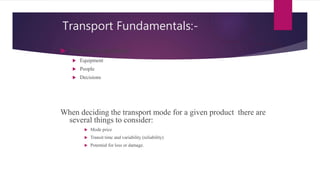
Transport Fundamentals:-
 Transport involves
 Equipment
 People
 Decisions
When deciding the transport mode for a given product there are
several things to consider:
 Mode price
 Transit time and variability (reliability)
 Potential for loss or damage.
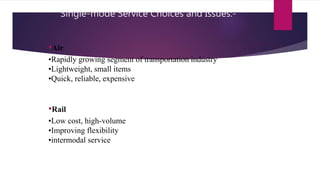
•Air
•Rapidly growing segment of transportation industry
•Lightweight, small items
•Quick, reliable, expensive
•Rail
•Low cost, high-volume
•Improving flexibility
•intermodal service
Single-mode Service Choices and Issues:-
Contd…
 Road :
• Company has flexibility of deciding the drop points .
• The operation can be 24 x 7
• The risk of Industrial action is minimized.
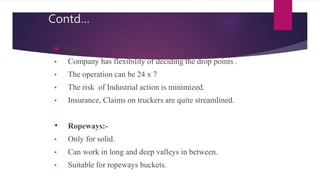
• Insurance, Claims on truckers are quite streamlined.
• Ropeways:-
• Only for solid.
• Can work in long and deep valleys in between.
• Suitable for ropeways buckets.
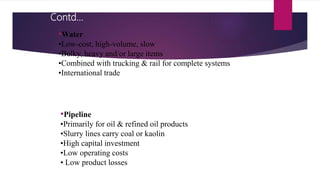
•Water
•Low-cost, high-volume, slow
•Bulky, heavy and/or large items
•Combined with trucking & rail for complete systems
•International trade
•Pipeline
•Primarily for oil & refined oil products
•Slurry lines carry coal or kaolin
•High capital investment
•Low operating costs
• Low product losses
Contd…
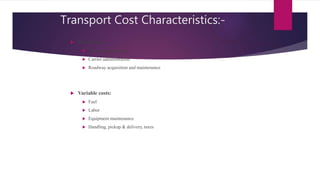
Transport Cost Characteristics:-
 Fixed costs:
 Transport equipment
 Carrier administration
 Roadway acquisition and maintenance
 Variable costs:
 Fuel
 Labor
 Equipment maintenance
 Handling, pickup & delivery, taxes
Solid Waste Management
Unit- V
What are Wastes?Waste (also known as rubbish, refuse, garbage, junk) is unwanted
or useless materials. In biology, waste is any of the many
unwanted substances expelled from living organisms, metabolic
waste; such as urea and sweat.
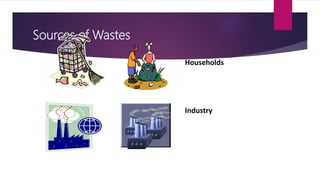
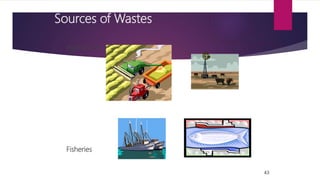
Sources of Wastes
Households
Industry
Sources of Wastes
Agriculture
Fisheries
43
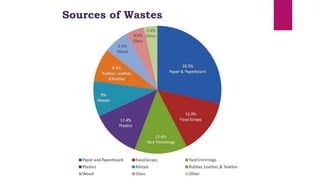
Sources of Wastes
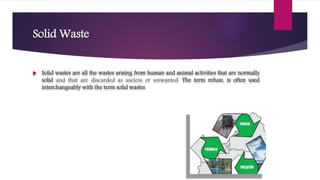
Solid Waste
 Solid wastes are all the wastes arising from human and animal activities that are normally
solid and that are discarded as useless or unwanted. The term refuse, is often used
interchangeably with the term solid wastes.
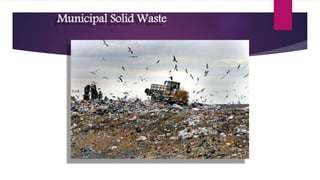
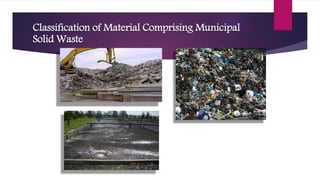
Municipal Solid Waste
Classification of Material Comprising Municipal
Solid Waste
Types of Solid Wastes
 Solid wastes are generally classified in three general categories
 Municipal Wastes
 Industrial Wastes
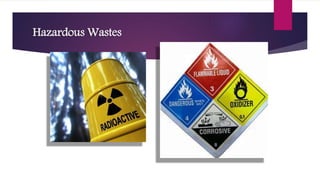
 Hazardous Wastes
Municipal Wastes
 Municipal Wastes Include waste from residential,
commercial, open areas such as parks, streets,
playgrounds etc. and treatment plant waste these include
wastes such as, garbage, rubbish, ashes, demolition and
construction wastes, special wastes, treatment plant
wastes, principally composed of residual sludges.
Industrial Wastes
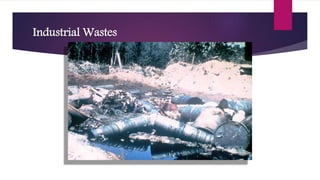
 Industrial wastes are those wastes arising from industrial activities and typically include
rubbish, ashes, demolition and construction wastes, special wastes and hazardous wastes.
Industrial Wastes
Hazardous Wastes
Solid Waste Management
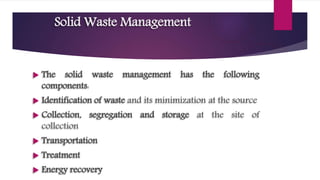
 The solid waste management has the following
components:
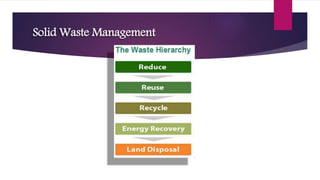
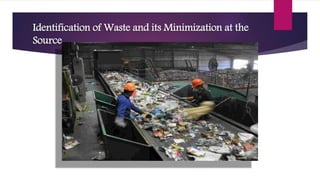
 Identification of waste and its minimization at the source
 Collection, segregation and storage at the site of
collection
 Transportation
 Treatment
 Energy recovery
Solid Waste Management
Identification of Waste and its Minimization at the
Source
Treatment of Solid Waste
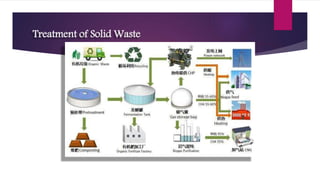
 The waste has to be treated before disposal for the protection of environment.
 In the treatment the biodegradable waste can be processed by composting, vermi-
composting, anaerobic digestion or any other appropriate biological processing for
stabilization of waste.
 In any case the solid waste should be reduced in quantity at the source, segregated, then
carefully transported and the economically treated before the final disposal.
Treatment of Solid Waste
Home, Swacch City then
Swacch Bharat
Cleanliness starts from YOU
'MISSION SWACCH BHARAT' (CLEAN
INDIA)
Solid Waste Management at Community Level
The program aims to make India a clean
country
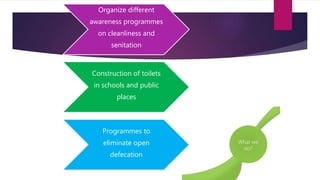
Organize different
awareness programmes
on cleanliness and
senitation
Construction of toilets
in schools and public
places
Programmes to
eliminate open
defecation
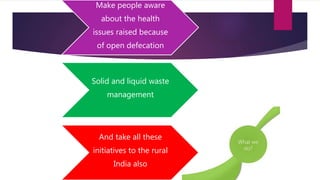
Make people aware
about the health
issues raised because
of open defecation
Solid and liquid waste
management
And take all these
initiatives to the rural
India also
Pledge with us to
make a stink free India
Warehousing waste management

Warehousing waste management

  • 1.
  • 2.
    Contents:-  Reasons forwarehousing  Benefits  Warehouse operating principles  Types of Warehouse  Warehousing strategies  Warehouse location strategies  Site selection  Transport
  • 3.
    Reasons for warehousing:- To support the company’s customer policy.  To maintain a source of supply without interruptions.  To achieve transportation economies.  To support changing market conditions and sudden changes in demand.  To support any JIT programs.  To provide customers with the right mix of products at all times and all locations.  To ensure least logistics cost for a desired level of customer service.
  • 4.
    CONCEPTNeed for storagearises both for raw material as well as finished products STORAGE involves proper management for preserving goods from the time of their production or purchase till actual use. When this storage is done on a large scale and in a specified manner it is called WAREHOUSING.
  • 5.
    MEANING AND DEFINITION Placewhere goods are kept is called WAREHOUSE The person in-charge of warehouse is called WAREHOUSE-KEEPER A commercial building for storage of goods Used by manufacturers, importers,
  • 6.
    definition Warehousing refersto the activities involving storage of goods on a large-scale in a systematic and orderly manner and making them available conveniently when needed.  Means holding or preserving goods in huge quantities from the time of their purchase or production till their actual use or sale.  Creates time utility by bridging the time gap between production and consumption of goods
  • 7.
    BASIC FUNCTIONS PERFORMED Storagefunction Performed by storing products in the warehouse till delivery to ultimate consumer Movement function Receipt of products from manufacturing plant Transfer into the warehouse Placement at designated place Regrouping products Transferring on transport vehicle
  • 8.
    NEED AND IMPORTANCE QUALITY STOCKOF TRADE PRICE STABILISATION SEASONAL PRODUCTS PERISHABLE GOODS CONTINUOUS PRODUCTION SEASONAL DEMAND
  • 9.
    LARGE-SCALE PRODUCTION QUICK SUPPLY PROTECTIONAND PRESERVATION OF GOODS EASY HANDLING USEFUL FOR SMALL BUSINESSES CREATION OF EMPLOYMENT FACILITATES SALE OF GOODS AVAILABILITY OF FINANCE
  • 10.
    BASIC REASONS FORNEED OF WAREHOUSE RAW MATERIALS WORK-IN-PROGRESS COSUMABLE STORES AND SPARES READY-MADE COMPONENTS FINISHED GOODS
  • 11.
    CHARACTERISTICS OF IDEAL WAREHOUSESCONVENIENT LOCATION  AVAILABILITY OF MECHANICAL APPLIANCES TO LOAD AND UNLOAD GOODS  ADEQUATE SPACE  COLD STORAGE FACILITIES  PROPER ARRANGEMENT FOR PROTECTION  SUFFICIENT PARKING SPACE  ROUND THE CLOCK SECURITY ARRANGEMENT  LATEST FIRE FIGHTING EUIPMENTS
  • 12.
    FUNCTIONSSTORAGE OF GOODS PROTECTION OF GOODS RISKBEARING IDENTIFICATION OF GOODS FINANCING PROCESSING
  • 13.
    DESIGN CONSIDERATION Ideal Facilityfor Pure Supplier Consolidation (Full Pallet Movement) Warehouse Space Requirements
  • 14.
    WAREHOUSE PROCESS Put-away •Identify Product •IdentifyProduct Location •Move Products •Update Records Storage •Equipment •Stock Location – Popularity – Unit Size – Cube Shipping Preparation •Packing •Labeling •Stacking Order Picking •Information •Walk & Pick •Batch Picking Shipping •Schedule Carrier •Load Vehicle •Bill of Loading •Record Update RECEIVING •Schedule Carrier •Unload Vehicle •Inspect for damage INP UT OUT PUT
  • 15.
    • Capital costs —Costs of space & materials handling equipment • Operating costs — Cost of labor — Measure of labor productivity is the number of units that an operator can move in a day COSTS OF OPERATING A WAREHOUSE
  • 16.
    WAREHOUSE ACTIVITIES • Receivegoods • Identify the goods • Dispatch goods to storage • Hold goods  Pick goods  Marshal shipment  Dispatch shipment
  • 17.
    • Accepts goodsfrom ‒ Outside transportation or attached factory & accepts responsibility • Check the goods against an order & the bill of loading • Check the quantities • Check for damage & fill out damage reports if necessary • Inspect goods if required Receive goods
  • 18.
    ‒ items areidentified with the appropriate stock- keeping unit (SKU) number (part number) & the quantity received recorded Identify the goods Dispatch goods to storage ‒ goods are sorted & put away Hold goods ‒ goods are kept in storage & under proper protection until needed
  • 19.
    TYPES OF WAREHOUSES PRIVATE WAREHOUSES PUBLIC WAREHOUSES GOVERNMENT WAREHUOSES CO-OPERATIVE WAREHOUSES BONDED WAREHOUSES DISRIBUTION CENTERSOR WAREHOUSES COLD STORAGE EXPORT AND IMPORT CLIMATE – CONTROLLED FIELD WAREHOUSE S AGRICULTURAL WAREHOUSES
  • 20.
    1. PRIVATE HOUSES OPERATED by a company for shipping and storing its own products  OWNED AND MANAGED- manufacturers or traders  CONSTRUCTION- Farmers near their fields, Wholesalers and Retailers near their business centre's and Manufacturers near their factories  COMPANIES – Stable inventory levels and long run expectations  SUITABILITY- Firms that require special handling and storage features and want to control design and operation of the warehouse
  • 21.
    2. PUBLIC WAREHOUSES Provide storage and physical distribution services on rental basis  Used by SMALL FIRMS and LARGE FIRMS  Organizes to provide storage facilities to traders, manufacturers, agriculturists in return for a storage charge  Licensed by Govt.  In India OWNED and OPERATED – Central Warehousing Corporation and State Warehousing Corporation  SUITABILTY – seasonal production or low volume storage needs, companies with inventories maintained in many locations, firms entering new markets  OWNER –stands as an agent of goods
  • 22.
    3. GOVERNMENT WAREHOUSES OWNED, MANAGED AND CONTROLLED -Central or State Governments or public corporations or local authorities  EXAMPLES- Central Warehousing Corporation of India, State Warehousing Corporation and Food Corporation of India  If customer cannot pay rent within specified time authority can recover rent disposing of goods 4. CO-OPERATIVE WAREHOUSES • Owned, Managed and Controlled – Co-operative societies • Facilities at most economical rates to members • Located-Punjab, Karnataka, Maharashtra and Andhra
  • 23.
    5. BONDED WAREHOUSES Licensed to accept imported goods for storage before payment of customs duty  Imported merchandise is stored and released only after payment of appropriate taxes  Cigarettes, Liquor, Other products are stored  Owned and Operated – PORT TRUSTS  Acts in two capacities viz LANDLORD and BAILEE OF GOODS  As landlord provides storage facilities on rent  As bailee of goods take reasonable care to handle and store goods as it has lien on goods under care for charges of its services  Owner can sell goods wholly or in part by endorsing a warrant  Facilitate enterpot trade- importer need not pay the import duty
  • 24.
    6. DISTRIBUTION CENTERS/ WAREHOUSES  Designed to move goods  Large and highly automated  Receive goods from various plants and suppliers, take orders, fill them efficiently deliver to customers quickly  Located near the market owned or leased by manufacturers  Access to transport networks 7. COLD STORAGE  Preserve perishability of goods against payment of a storage charge  Temperature variation is controlled to degree necessary for certain sensitive items
  • 25.
    8. EXPORT ANDIMPORT WAREHOUSES  LOCATION –near ports where international trade is undertaken  Storage facilities for goods awaiting onward movements  Facilities- packaging , inspection, marking etc 9. CLIMATE-CONTROLLED WAREHOUSE  Handle storage of many products including need special handling conditions  Freezers for frozen products, humidity controlled environment for delicate products, produce or flowers, etc
  • 26.
    10. FIELD WAREHOUSES MANAGED- Public Warehousing Agency in the premises of a factory or company which needs facility for borrowing from a bank against certification of goods in storage or in process by an independent professional warehouse man. 11. AGRICULTURAL WAREHOUSES  Store agricultural produce grown in a certain area  Location – Assembling or regulated markets  Receive agricultural commodities either directly from farmers or through their commission agents or from wholesalers  Encourage speculative trading
  • 27.
    WAREHOUSE OPERATIONS PUBLIC WAREHOUSING- Client payingfee PRIVATE WAREHOUSE – Single manufacturer LEASED WAREHOUSING- Stable inventory CONTRACT WAREHOUSING – Clients pay fees
  • 28.
    Benefits of warehousing:- Consolidation.  Break bulk warehouse.  Processing / Postponement.  Stockpiling.
  • 29.
    Warehouse Operating Principles:- ThreePrinciples are: 1) Design criteria: a) Number of stories in the facility, b) Height utilization, c) Product flow
  • 30.
    Warehouse Operating Principles:- 2)Handling technology a) Movement continuity, b) Movement scale economies. 3) Storage plan
  • 31.
    The Warehouse locationstrategies:- 1) Market positioned: a) Order Cycle time b) Transportation cost c) Sensitivity of the product d) Order sizes 2) Product positioned: a) Perishability of the raw materials b) Number of products in the product mix c) Assortments ordered by the customers from the product mix d) Transportation consolidation rates 3) Intermediately positioned:
  • 32.
    Site Selection:-  Locationof the major markets.  Nature of the products being distributed.  Quality & Variety of carriers serving the proposed site.  Quality & Quantity of labour available.  Cost of industrial land.
  • 33.
    Warehouse Layout:-  Layoutof a warehouse depends on the proposed material handling system and requires development of a floor plan to facilitate product flow.  If pallets are to be utilized, the first step is to determine the pallet size. Pilferage Protection:-  Protection against theft of merchandise has become a major factor in warehouse operation
  • 34.
  • 35.
    Transport Fundamentals:-  Transportinvolves  Equipment  People  Decisions When deciding the transport mode for a given product there are several things to consider:  Mode price  Transit time and variability (reliability)  Potential for loss or damage.
  • 36.
    •Air •Rapidly growing segmentof transportation industry •Lightweight, small items •Quick, reliable, expensive •Rail •Low cost, high-volume •Improving flexibility •intermodal service Single-mode Service Choices and Issues:-
  • 37.
    Contd…  Road : •Company has flexibility of deciding the drop points . • The operation can be 24 x 7 • The risk of Industrial action is minimized. • Insurance, Claims on truckers are quite streamlined. • Ropeways:- • Only for solid. • Can work in long and deep valleys in between. • Suitable for ropeways buckets.
  • 38.
    •Water •Low-cost, high-volume, slow •Bulky,heavy and/or large items •Combined with trucking & rail for complete systems •International trade •Pipeline •Primarily for oil & refined oil products •Slurry lines carry coal or kaolin •High capital investment •Low operating costs • Low product losses Contd…
  • 39.
    Transport Cost Characteristics:- Fixed costs:  Transport equipment  Carrier administration  Roadway acquisition and maintenance  Variable costs:  Fuel  Labor  Equipment maintenance  Handling, pickup & delivery, taxes
  • 40.
  • 41.
    What are Wastes?Waste(also known as rubbish, refuse, garbage, junk) is unwanted or useless materials. In biology, waste is any of the many unwanted substances expelled from living organisms, metabolic waste; such as urea and sweat.
  • 42.
  • 43.
  • 44.
  • 45.
    Solid Waste  Solidwastes are all the wastes arising from human and animal activities that are normally solid and that are discarded as useless or unwanted. The term refuse, is often used interchangeably with the term solid wastes.
  • 46.
  • 47.
    Classification of MaterialComprising Municipal Solid Waste
  • 48.
    Types of SolidWastes  Solid wastes are generally classified in three general categories  Municipal Wastes  Industrial Wastes  Hazardous Wastes
  • 49.
    Municipal Wastes  MunicipalWastes Include waste from residential, commercial, open areas such as parks, streets, playgrounds etc. and treatment plant waste these include wastes such as, garbage, rubbish, ashes, demolition and construction wastes, special wastes, treatment plant wastes, principally composed of residual sludges.
  • 50.
    Industrial Wastes  Industrialwastes are those wastes arising from industrial activities and typically include rubbish, ashes, demolition and construction wastes, special wastes and hazardous wastes.
  • 51.
  • 52.
  • 53.
    Solid Waste Management The solid waste management has the following components:  Identification of waste and its minimization at the source  Collection, segregation and storage at the site of collection  Transportation  Treatment  Energy recovery
  • 54.
  • 55.
    Identification of Wasteand its Minimization at the Source
  • 56.
    Treatment of SolidWaste  The waste has to be treated before disposal for the protection of environment.  In the treatment the biodegradable waste can be processed by composting, vermi- composting, anaerobic digestion or any other appropriate biological processing for stabilization of waste.  In any case the solid waste should be reduced in quantity at the source, segregated, then carefully transported and the economically treated before the final disposal.
  • 57.
  • 59.
    Home, Swacch Citythen Swacch Bharat Cleanliness starts from YOU 'MISSION SWACCH BHARAT' (CLEAN INDIA)
  • 60.
    Solid Waste Managementat Community Level
  • 61.
    The program aimsto make India a clean country
  • 63.
    Organize different awareness programmes oncleanliness and senitation Construction of toilets in schools and public places Programmes to eliminate open defecation
  • 64.
    Make people aware aboutthe health issues raised because of open defecation Solid and liquid waste management And take all these initiatives to the rural India also
  • 65.
    Pledge with usto make a stink free India