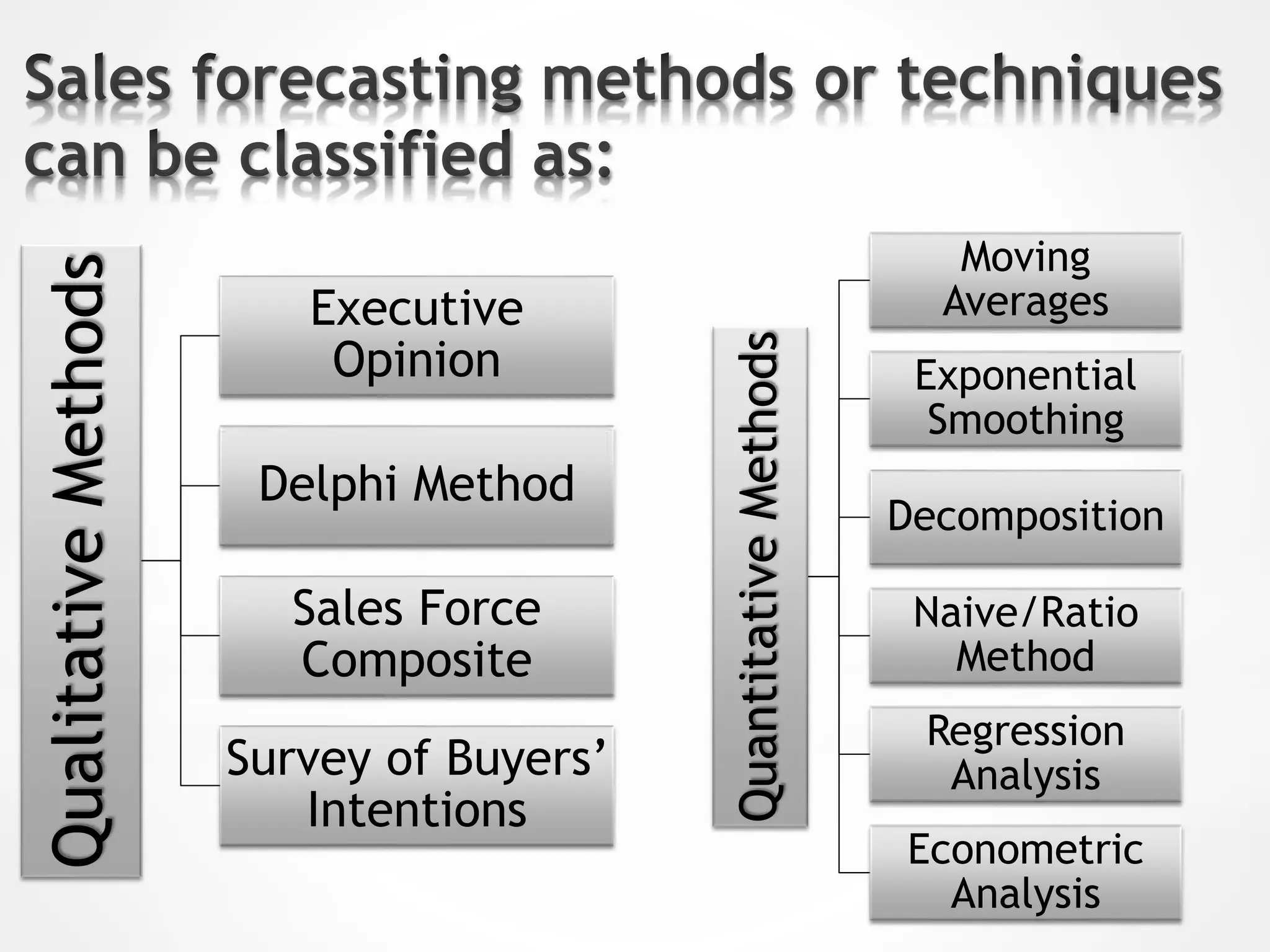
QualitativeMethods
Executive
Opinion
Delphi Method
Sales Force
Composite
Survey of Buyers’
Intentions
QuantitativeMethods
Moving
Averages
Exponential
Smoothing
Decomposition
Naive/Ratio
Method
Regression
Analysis
Econometric
Analysis
In this method of forecasting, the views of
senior executives of the company are
obtained for forecasting sales.
The oldest, simplest and the most widely
used method.
Advantages: Disadvantages
(i) Forecasting can be done
quickly and easily.
(i) unspecific
(ii) Less expensive than other
method.
(ii) subjective
(iii) Very popular (iii) Difficult to breakdown the
forecast into sub units
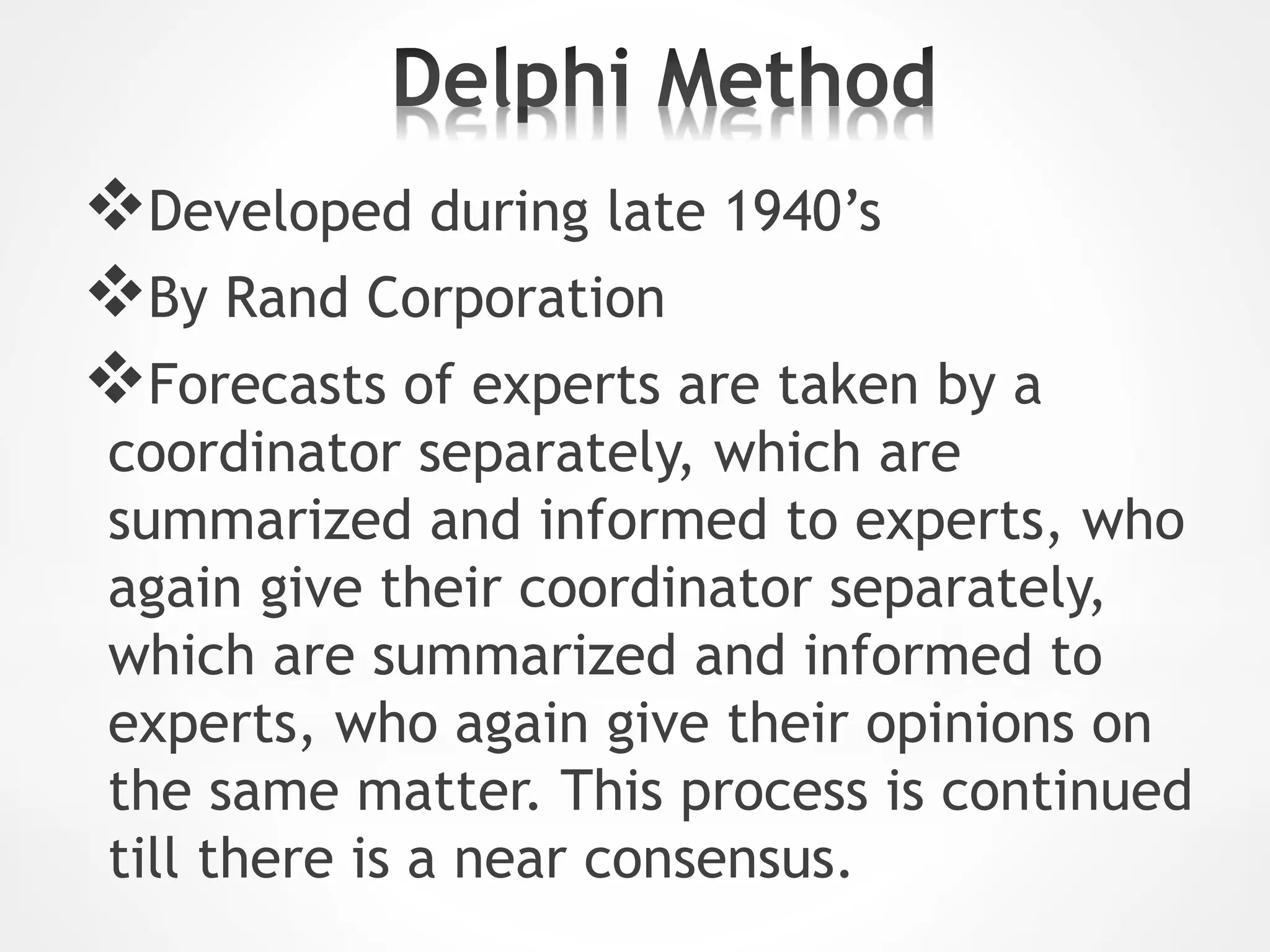
Developed during late 1940’s
By Rand Corporation
Forecasts of experts are taken by a
coordinator separately, which are
summarized and informed to experts, who
again give their coordinator separately,
which are summarized and informed to
experts, who again give their opinions on
the same matter. This process is continued
till there is a near consensus.
Advantages: Disadvantages
(i) Objective forecast is
accurate.
(i) Difficulty getting a
panel experts.
(ii) Useful foe
technology, new
product, and industry
sales forecast.
(ii) Longer time for
getting consensus.
(iii) Both long and short
term forecasting
possible.
(iii) Break-down of
forecast into products
or territories is not
possible.
 Each salesperson estimates how much
quantity or value each existing and
prospective consumer will buy of each of the
company’s product and services in his/her
territory.
Advantages: Disadvantages
(i) Forecasting is don by a
salespeople who are
closest to the market.
(i) Sales forecast are often
pessimistic or optimistic,
(ii)Detailed sales estimate
broke down by customer,
product and territory are
possible.
(ii) If sales forecast are used
to set sales quotas, which are
linked to incentive schemes,
salespeople may deliberately
under estimate the demand.
(iii) Involvement of
salespeople.
(iii) Many salespersons are
not interested in sales
forecasting, and prefer to
spend time in the field
meeting sustomers.
Also called “market research” or “market
survey”.
 In this method, existing and potential
costumers are asked about their likely
purchases of the company’s products and
services, during the forecast period.
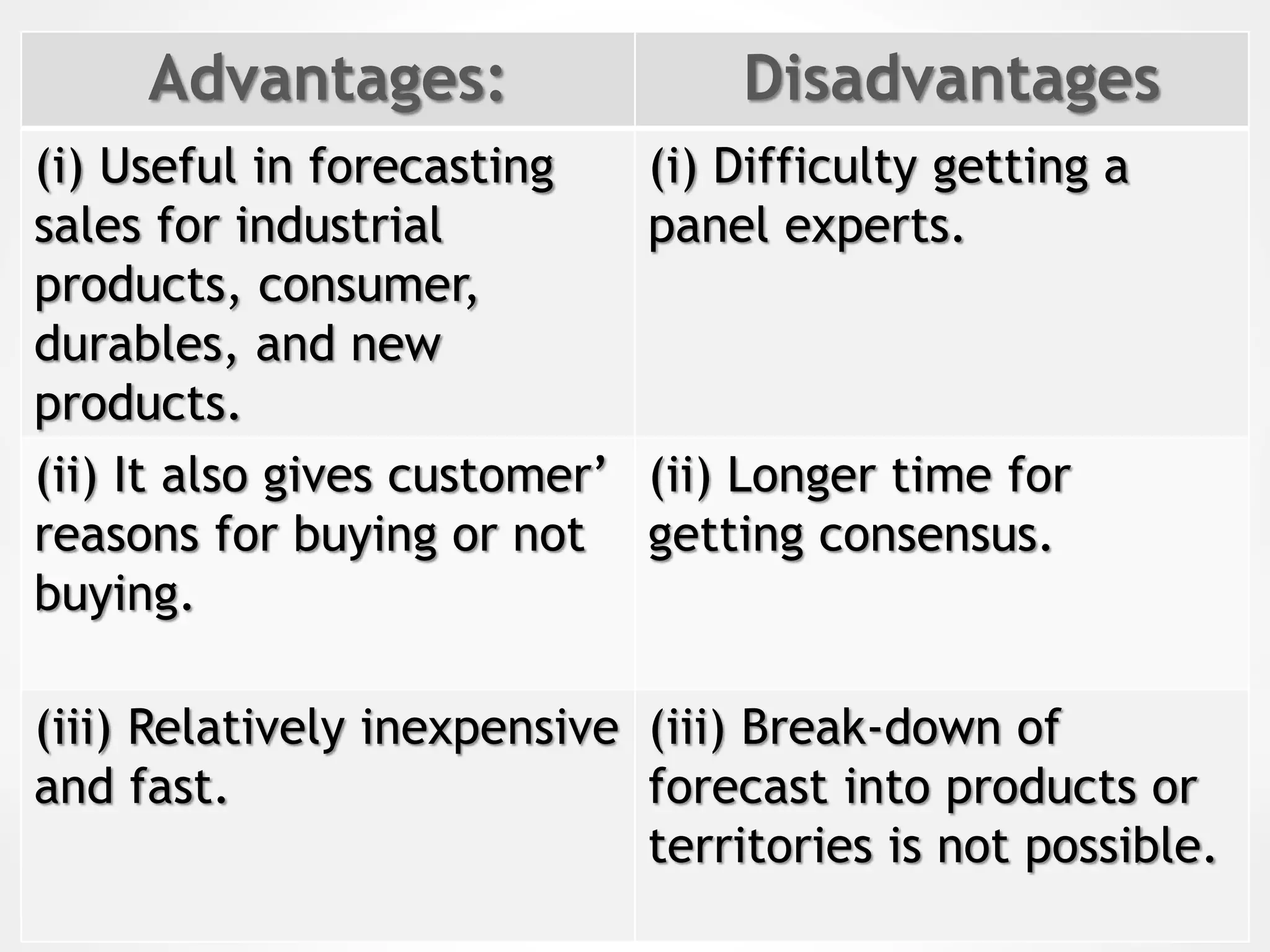
Advantages: Disadvantages
(i) Useful in forecasting
sales for industrial
products, consumer,
durables, and new
products.
(i) Difficulty getting a
panel experts.
(ii) It also gives customer’
reasons for buying or not
buying.
(ii) Longer time for
getting consensus.
(iii) Relatively inexpensive
and fast.
(iii) Break-down of
forecast into products or
territories is not possible.
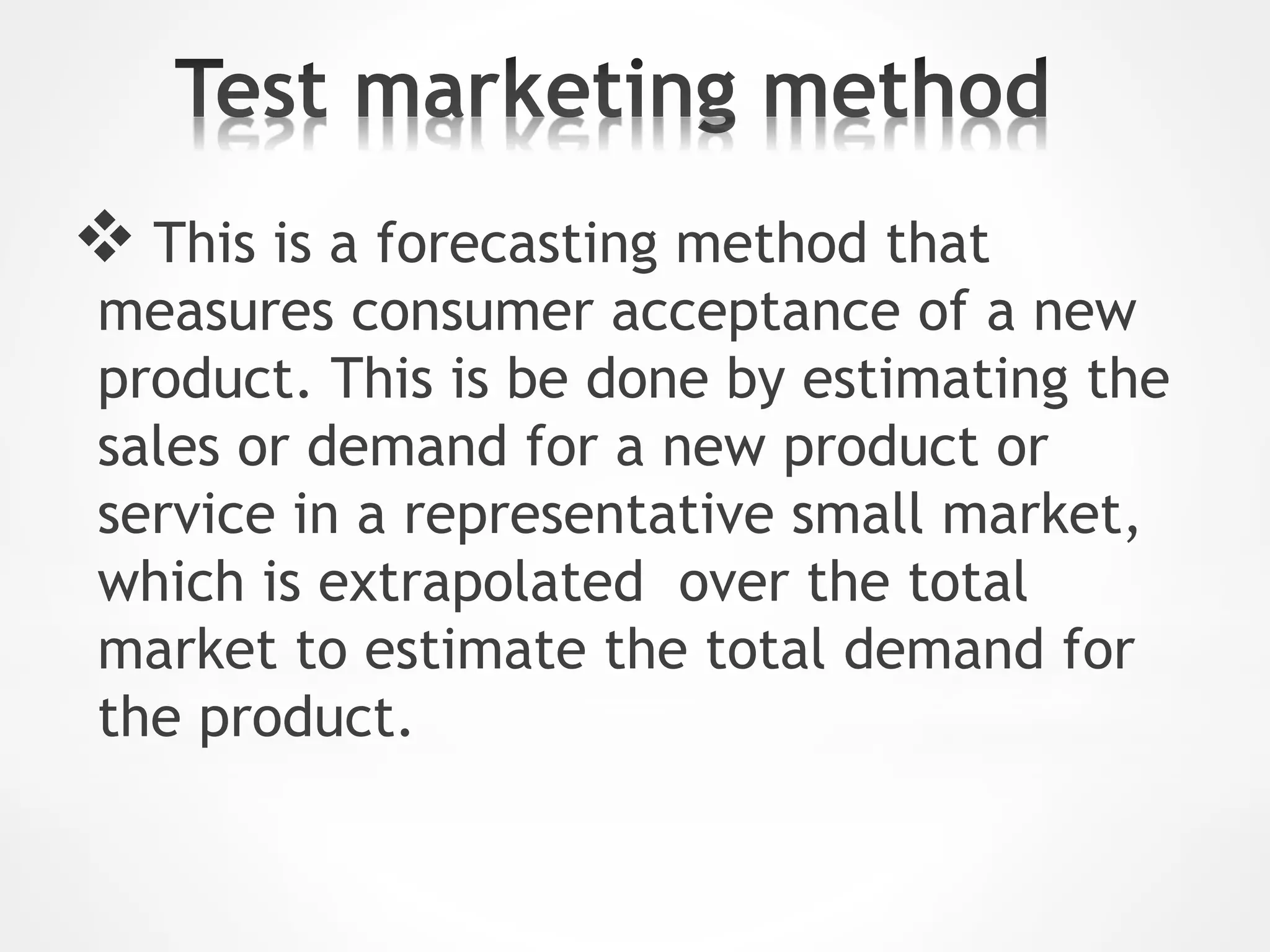
 This is a forecasting method that
measures consumer acceptance of a new
product. This is be done by estimating the
sales or demand for a new product or
service in a representative small market,
which is extrapolated over the total
market to estimate the total demand for
the product.
1.Full-blown test markets
2.Controlled test marketing
3.Simulated test marketing
Full-blown test markets
Buyer surveys are carried out to get information
about consumer attitude, usage and satisfaction
towards a new product.
Controlled test marketing
The company with a new products hires a
research firm and gets a panel of stores at specified
geographic locations.
Simulated test marketing
In this method, about 30-40 consumers are
selected, based on their brand familiarity and
preferences in a particular product category.
Advantages: Disadvantages
(i) Their usefulness for
forecasting the sales
of new or modified
product.
(i) Chances of spoilages.
(ii) In deciding whether
the company should go
ahead for a national
launch of a new product
without spending huge
amount.
(ii)It is difficult for the
company to wait to
measure test result.
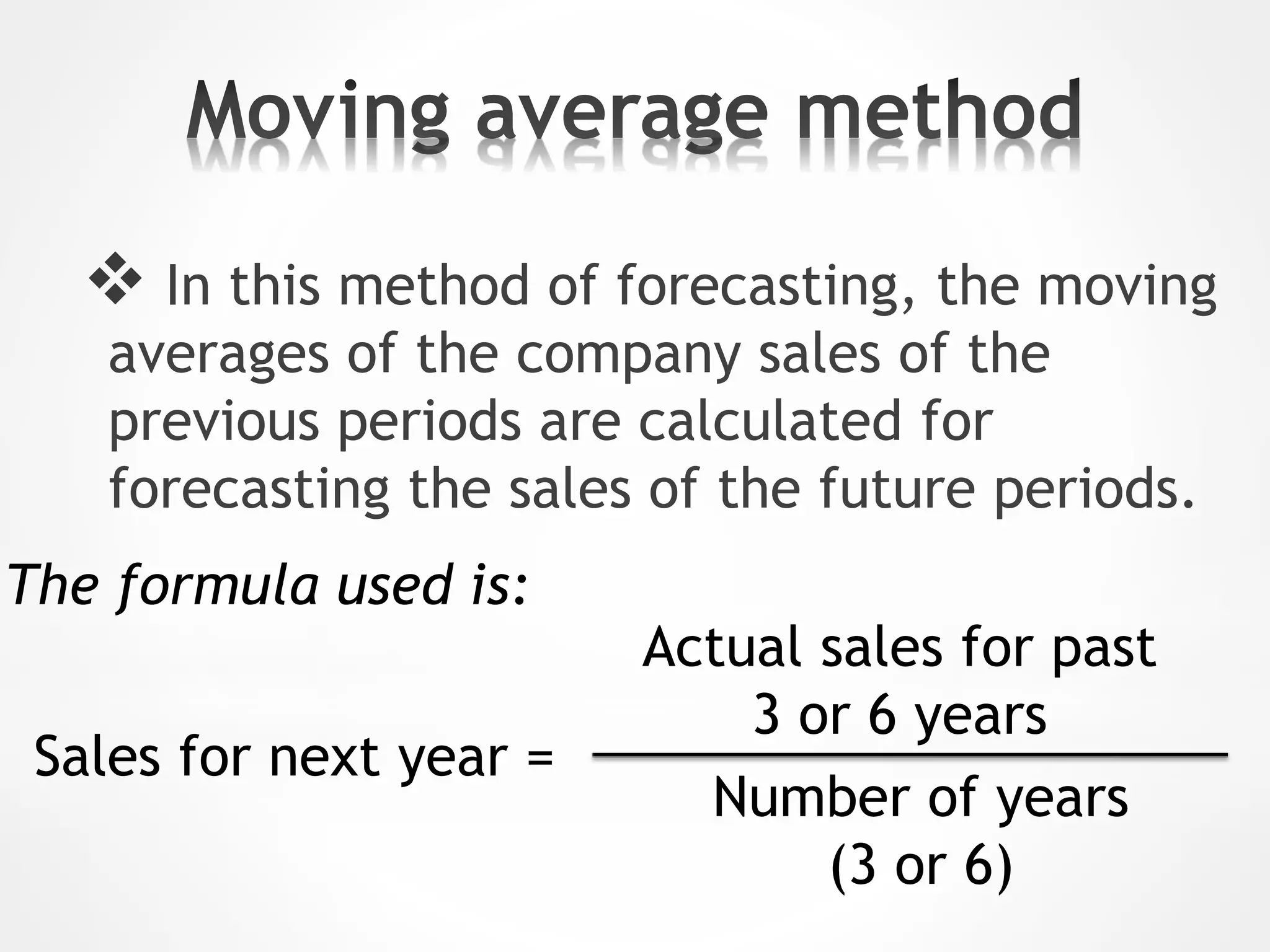
 In this method of forecasting, the moving
averages of the company sales of the
previous periods are calculated for
forecasting the sales of the future periods.
Sales for next year =
Actual sales for past
3 or 6 years
Number of years
(3 or 6)
The formula used is:
Advantages: Disadvantages
(i) Relatively simple
method.
(i) Unable to predict a
downturn or upturn in the
market.
(ii) Easy to calculate (ii) Cannot predict long-
term sales forecast
accurately
(iii) Widely used for short
term and medium term
sales forecasts.
(iii) Historical data is
needed.
 This is a forecasting method in which the
forecaster can allow sales in certain
periods to influence the sales forecast
more than the sales on other periods
By using a smoothing constant (L) in the
equation:
sales forecasts for next period =
(L) (actual sales this period) +
(1 – L) (this period’s sales forecast)
Advantages: Disadvantages
(i) Simple to operate. (i) Arbitrary
(ii) Forecasters knowledge or
intuition can be used in
forecasting.
(ii) Long term and new
product forecasting
are not possible.
(iii) Useful method when
sales date have a trend or a
seasonal pattern.
(iv) Immediate response to a
upturn or downturn in sales.
(v) Used by many firms.
 This is one of the methods of sales
forecasting in which the company’s periods
of sales data are broken down (or
decomposed) into major components, such
as trends, cycle, seasonal, and erratic
events.
These components are then recombined
to forecast the sales for the future period.
Advantages: Disadvantages
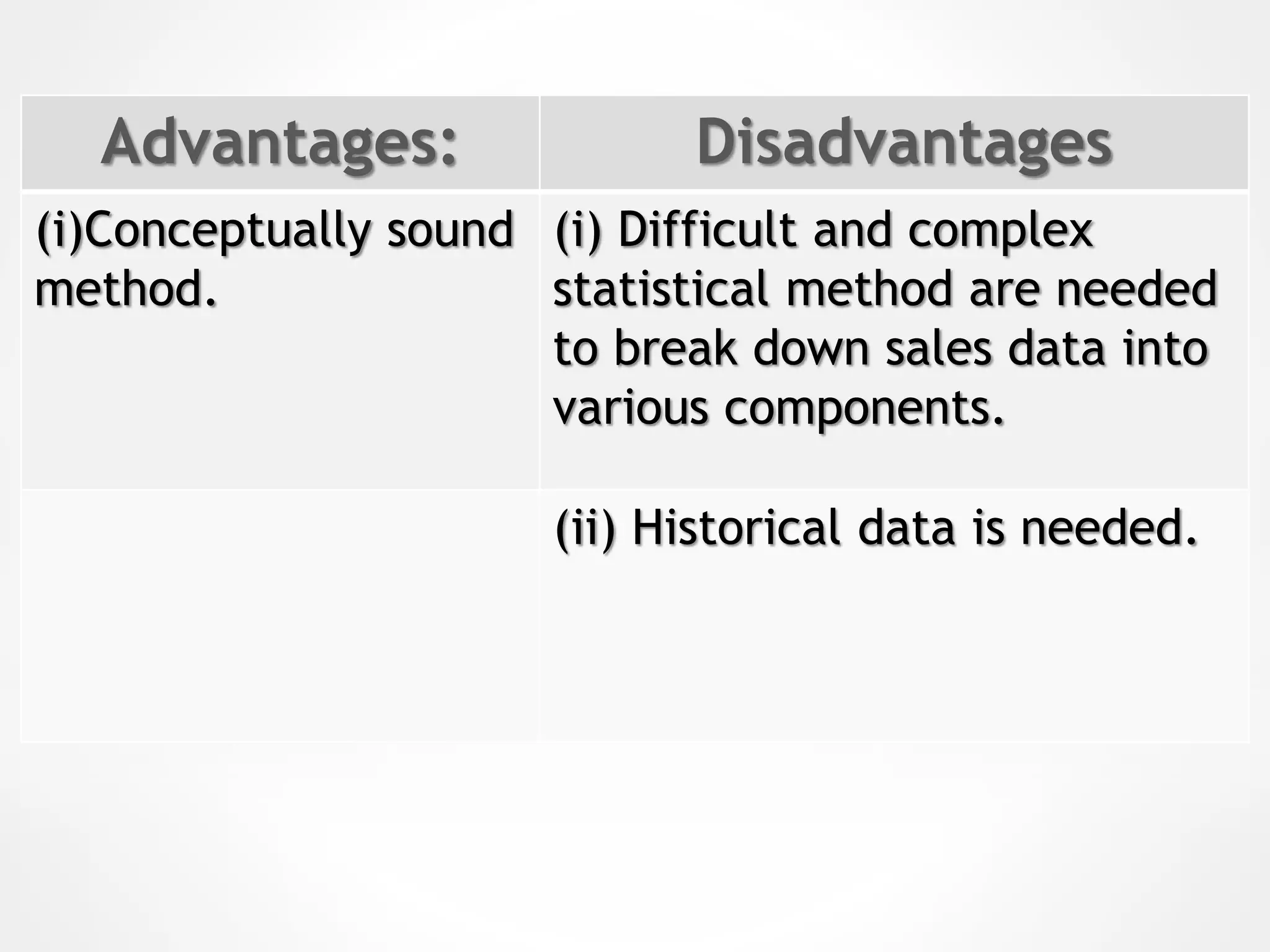
(i)Conceptually sound
method.
(i) Difficult and complex
statistical method are needed
to break down sales data into
various components.
(ii) Historical data is needed.
 it is a forecasting method, which is based on the
assumption that what happened in the immediate
past will continue to happen in the immediate
future.
Sales for next year =
The formula used is:
Actual sales for this year X
Actual sales for this year
Actual sales for last year
Advantages: Disadvantages
(i) Simple to calculate. (i) Cannot be used for
long-term and new
products.
(ii) Requires less data. (ii) Accuracy of sales
forecast would be less, if
past sales fluctuate
considerably.
(iii)Accuracy is good in
short-term forecast.
 It is a statistical method of sales
forecasting that derives an equation based on
relationship between the company sales
(dependent variable, x) and independent
variables, or factors (y1, y2) which influence
the sales.
 Simple regression analysis
 Multiple regression analysis
Advantages: Disadvantages
(i) High forecasting
accuracy
(i)Technically complex
(ii) Objective method (ii) Expensive and time
consuming.
(iii) Can predict turning
points of the company’s
sales.
(iii)Use of computer and
software packages
essential.
This is another method of forecasting in
which many regression equations are built
to forecast industry sales, general
economic conditions, or future events with
the help of computer hardware and
software.
Advantages Disadvantages
Accurate forecasts of
economic conditions and
industry sales are
possible.
Large volume of data is
required.
 Use Multiple Forecasting Methods
Identify Suitable Methods
Develop a Few Factors
Obtain a Range Factors
Use Computer Hardware and Software
 It is the estimate of expected sales
volume and selling expenses for the
company’s products and services, for the
budget period.
The sales manager is responsible for
preparing three detailed budgets.
(i)Sales volume budget
(ii)Selling expense budget
(iii) administrative budget of the sales
department
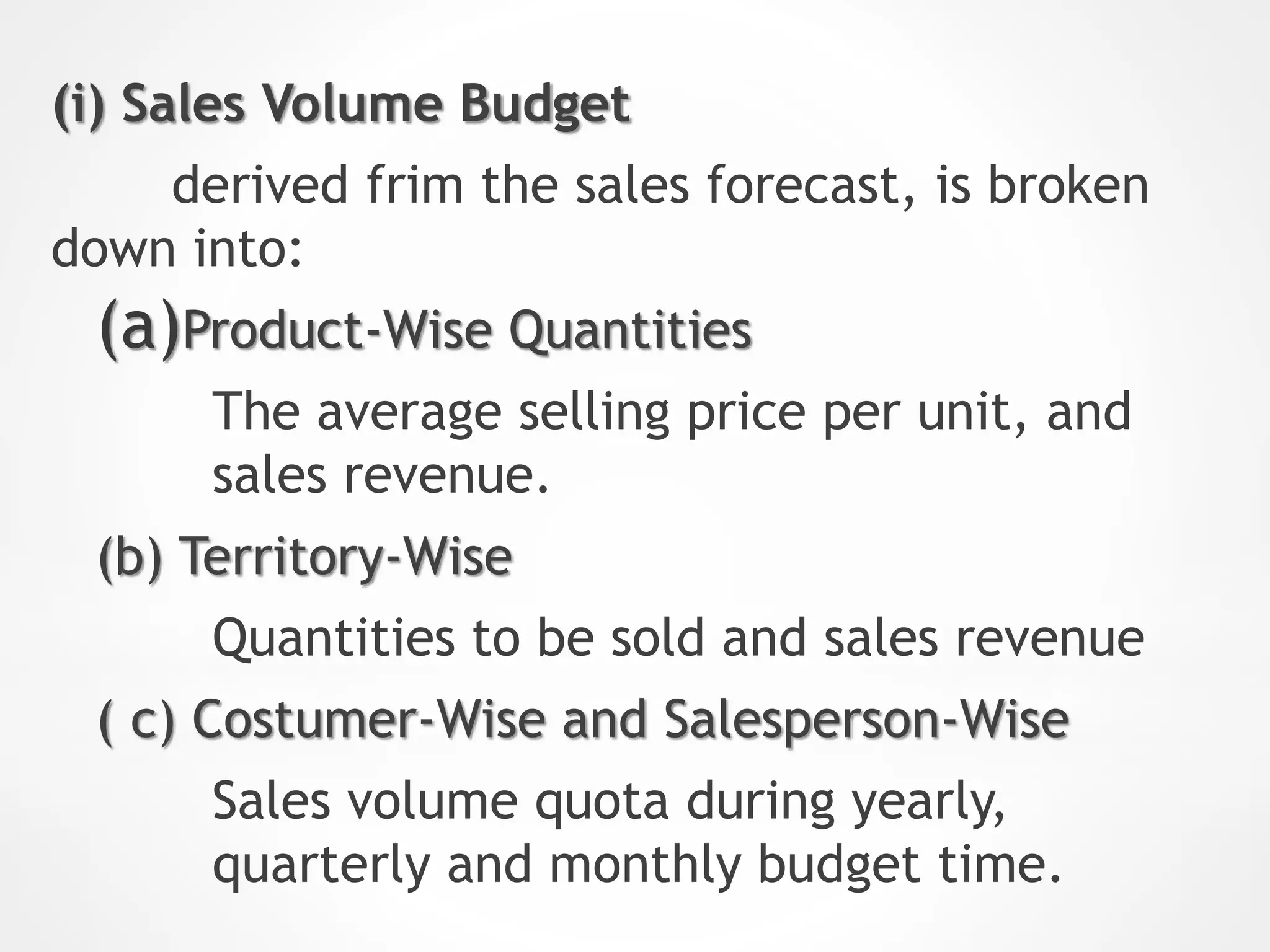
(i) Sales Volume Budget
derived frim the sales forecast, is broken
down into:
(a)Product-Wise Quantities
The average selling price per unit, and
sales revenue.
(b) Territory-Wise
Quantities to be sold and sales revenue
( c) Costumer-Wise and Salesperson-Wise
Sales volume quota during yearly,
quarterly and monthly budget time.
(ii) Selling expense budget
 includes expenditures for personal
selling activities.
(iii) Administrative budget of the sales
department
 the budget should be include
operating expenses.
 Planning
Coordination
Control
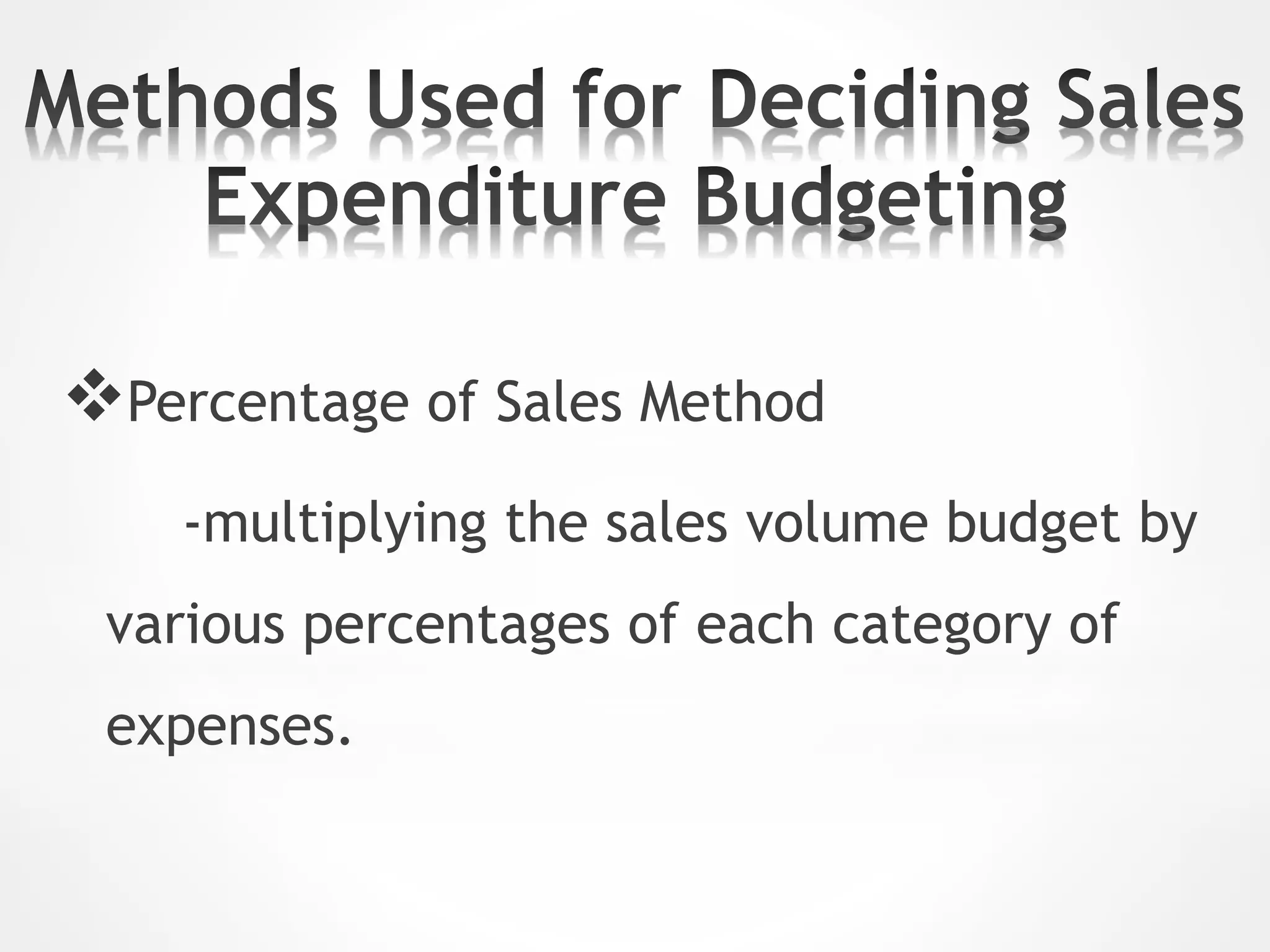
Percentage of Sales Method
-multiplying the sales volume budget by
various percentages of each category of
expenses.
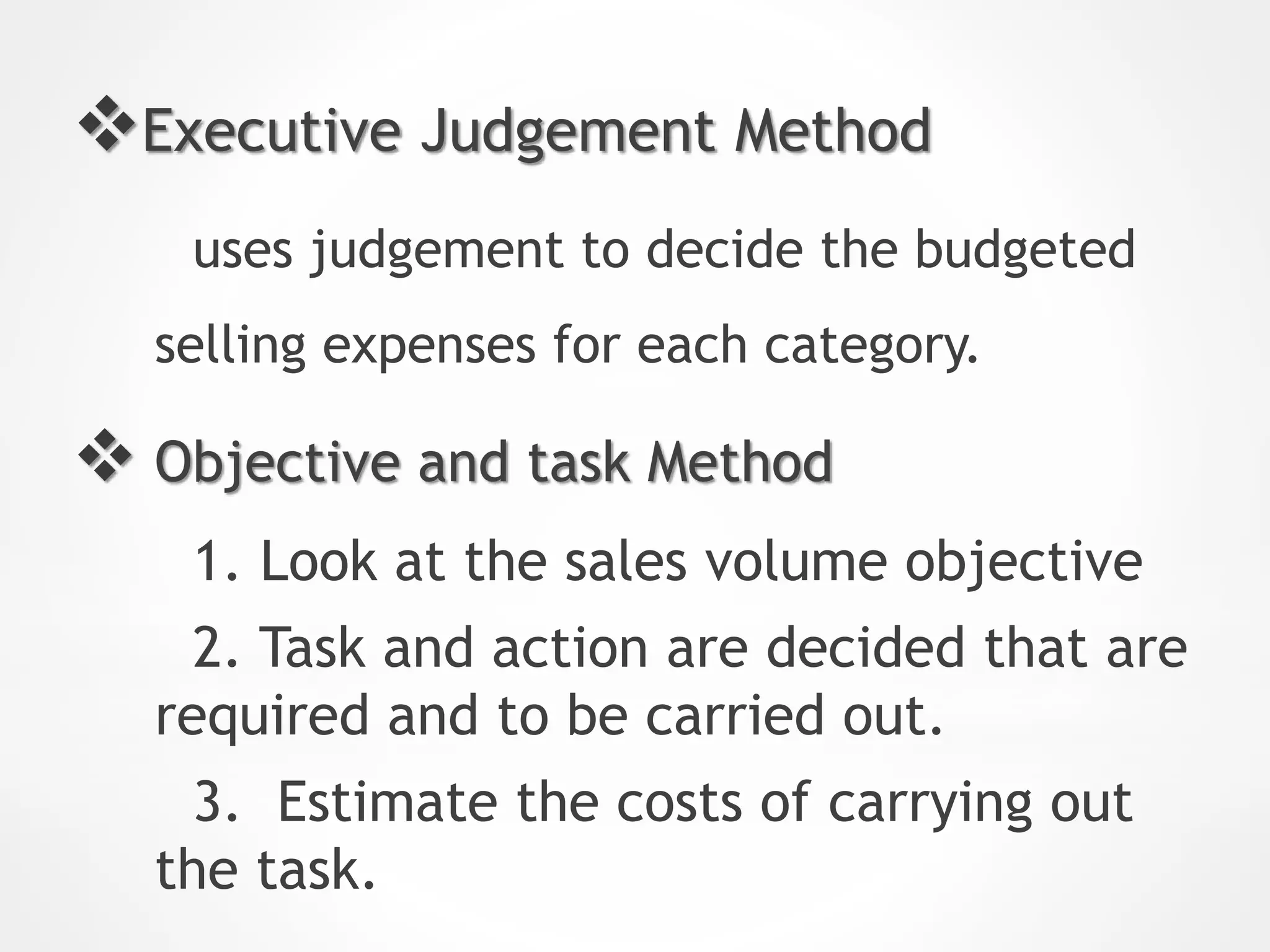
Executive Judgement Method
uses judgement to decide the budgeted
selling expenses for each category.
 Objective and task Method
1. Look at the sales volume objective
2. Task and action are decided that are
required and to be carried out.
3. Estimate the costs of carrying out
the task.
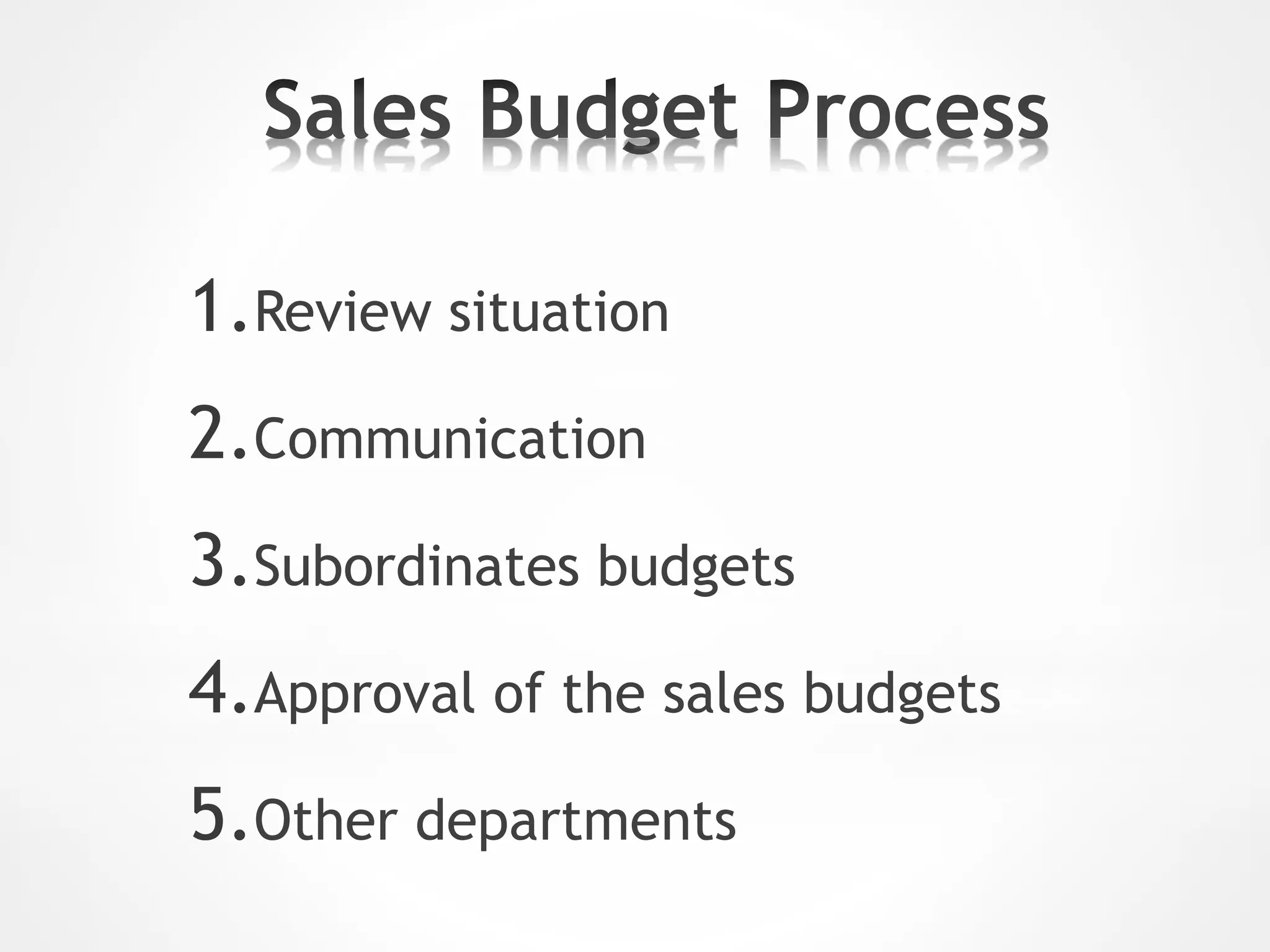
1.Review situation
2.Communication
3.Subordinates budgets
4.Approval of the sales budgets
5.Other departments
SALES FORECASTING METHOD

SALES FORECASTING METHOD

  • 2.
    QualitativeMethods Executive Opinion Delphi Method Sales Force Composite Surveyof Buyers’ Intentions QuantitativeMethods Moving Averages Exponential Smoothing Decomposition Naive/Ratio Method Regression Analysis Econometric Analysis
  • 3.
    In this methodof forecasting, the views of senior executives of the company are obtained for forecasting sales. The oldest, simplest and the most widely used method. Advantages: Disadvantages (i) Forecasting can be done quickly and easily. (i) unspecific (ii) Less expensive than other method. (ii) subjective (iii) Very popular (iii) Difficult to breakdown the forecast into sub units
  • 4.
    Developed during late1940’s By Rand Corporation Forecasts of experts are taken by a coordinator separately, which are summarized and informed to experts, who again give their coordinator separately, which are summarized and informed to experts, who again give their opinions on the same matter. This process is continued till there is a near consensus.
  • 5.
    Advantages: Disadvantages (i) Objectiveforecast is accurate. (i) Difficulty getting a panel experts. (ii) Useful foe technology, new product, and industry sales forecast. (ii) Longer time for getting consensus. (iii) Both long and short term forecasting possible. (iii) Break-down of forecast into products or territories is not possible.
  • 6.
     Each salespersonestimates how much quantity or value each existing and prospective consumer will buy of each of the company’s product and services in his/her territory.
  • 7.
    Advantages: Disadvantages (i) Forecastingis don by a salespeople who are closest to the market. (i) Sales forecast are often pessimistic or optimistic, (ii)Detailed sales estimate broke down by customer, product and territory are possible. (ii) If sales forecast are used to set sales quotas, which are linked to incentive schemes, salespeople may deliberately under estimate the demand. (iii) Involvement of salespeople. (iii) Many salespersons are not interested in sales forecasting, and prefer to spend time in the field meeting sustomers.
  • 8.
    Also called “marketresearch” or “market survey”.  In this method, existing and potential costumers are asked about their likely purchases of the company’s products and services, during the forecast period.
  • 9.
    Advantages: Disadvantages (i) Usefulin forecasting sales for industrial products, consumer, durables, and new products. (i) Difficulty getting a panel experts. (ii) It also gives customer’ reasons for buying or not buying. (ii) Longer time for getting consensus. (iii) Relatively inexpensive and fast. (iii) Break-down of forecast into products or territories is not possible.
  • 10.
     This isa forecasting method that measures consumer acceptance of a new product. This is be done by estimating the sales or demand for a new product or service in a representative small market, which is extrapolated over the total market to estimate the total demand for the product.
  • 11.
    1.Full-blown test markets 2.Controlledtest marketing 3.Simulated test marketing
  • 12.
    Full-blown test markets Buyersurveys are carried out to get information about consumer attitude, usage and satisfaction towards a new product. Controlled test marketing The company with a new products hires a research firm and gets a panel of stores at specified geographic locations. Simulated test marketing In this method, about 30-40 consumers are selected, based on their brand familiarity and preferences in a particular product category.
  • 13.
    Advantages: Disadvantages (i) Theirusefulness for forecasting the sales of new or modified product. (i) Chances of spoilages. (ii) In deciding whether the company should go ahead for a national launch of a new product without spending huge amount. (ii)It is difficult for the company to wait to measure test result.
  • 14.
     In thismethod of forecasting, the moving averages of the company sales of the previous periods are calculated for forecasting the sales of the future periods. Sales for next year = Actual sales for past 3 or 6 years Number of years (3 or 6) The formula used is:
  • 15.
    Advantages: Disadvantages (i) Relativelysimple method. (i) Unable to predict a downturn or upturn in the market. (ii) Easy to calculate (ii) Cannot predict long- term sales forecast accurately (iii) Widely used for short term and medium term sales forecasts. (iii) Historical data is needed.
  • 16.
     This isa forecasting method in which the forecaster can allow sales in certain periods to influence the sales forecast more than the sales on other periods By using a smoothing constant (L) in the equation: sales forecasts for next period = (L) (actual sales this period) + (1 – L) (this period’s sales forecast)
  • 17.
    Advantages: Disadvantages (i) Simpleto operate. (i) Arbitrary (ii) Forecasters knowledge or intuition can be used in forecasting. (ii) Long term and new product forecasting are not possible. (iii) Useful method when sales date have a trend or a seasonal pattern. (iv) Immediate response to a upturn or downturn in sales. (v) Used by many firms.
  • 18.
     This isone of the methods of sales forecasting in which the company’s periods of sales data are broken down (or decomposed) into major components, such as trends, cycle, seasonal, and erratic events. These components are then recombined to forecast the sales for the future period.
  • 19.
    Advantages: Disadvantages (i)Conceptually sound method. (i)Difficult and complex statistical method are needed to break down sales data into various components. (ii) Historical data is needed.
  • 20.
     it isa forecasting method, which is based on the assumption that what happened in the immediate past will continue to happen in the immediate future. Sales for next year = The formula used is: Actual sales for this year X Actual sales for this year Actual sales for last year
  • 21.
    Advantages: Disadvantages (i) Simpleto calculate. (i) Cannot be used for long-term and new products. (ii) Requires less data. (ii) Accuracy of sales forecast would be less, if past sales fluctuate considerably. (iii)Accuracy is good in short-term forecast.
  • 22.
     It isa statistical method of sales forecasting that derives an equation based on relationship between the company sales (dependent variable, x) and independent variables, or factors (y1, y2) which influence the sales.  Simple regression analysis  Multiple regression analysis
  • 23.
    Advantages: Disadvantages (i) Highforecasting accuracy (i)Technically complex (ii) Objective method (ii) Expensive and time consuming. (iii) Can predict turning points of the company’s sales. (iii)Use of computer and software packages essential.
  • 24.
    This is anothermethod of forecasting in which many regression equations are built to forecast industry sales, general economic conditions, or future events with the help of computer hardware and software. Advantages Disadvantages Accurate forecasts of economic conditions and industry sales are possible. Large volume of data is required.
  • 25.
     Use MultipleForecasting Methods Identify Suitable Methods Develop a Few Factors Obtain a Range Factors Use Computer Hardware and Software
  • 27.
     It isthe estimate of expected sales volume and selling expenses for the company’s products and services, for the budget period. The sales manager is responsible for preparing three detailed budgets. (i)Sales volume budget (ii)Selling expense budget (iii) administrative budget of the sales department
  • 28.
    (i) Sales VolumeBudget derived frim the sales forecast, is broken down into: (a)Product-Wise Quantities The average selling price per unit, and sales revenue. (b) Territory-Wise Quantities to be sold and sales revenue ( c) Costumer-Wise and Salesperson-Wise Sales volume quota during yearly, quarterly and monthly budget time.
  • 29.
    (ii) Selling expensebudget  includes expenditures for personal selling activities. (iii) Administrative budget of the sales department  the budget should be include operating expenses.
  • 30.
  • 31.
    Percentage of SalesMethod -multiplying the sales volume budget by various percentages of each category of expenses.
  • 32.
    Executive Judgement Method usesjudgement to decide the budgeted selling expenses for each category.  Objective and task Method 1. Look at the sales volume objective 2. Task and action are decided that are required and to be carried out. 3. Estimate the costs of carrying out the task.
  • 33.