WAREHOUSE
Athira Rajan​
Athirarajanmt@gmail.com
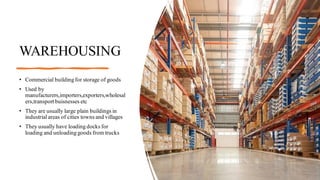
WAREHOUSING
• Commercial building for storage of goods
• Used by
manufacturers,importers,exporters,wholesal
ers,transport buisnesses etc
• They are usually large plain buildings in
industrial areas of cities towns and villages
• They usually have loading docks for
loading and unloading goods from trucks
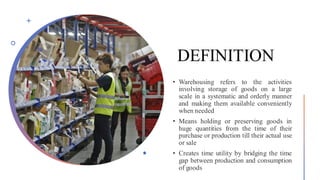
DEFINITION
OBJECTIVES
• The primary objective of warehouse is movement of goods
• Provide timely customer service
• Keep track of items so that they can be found readily and correctly
• Minimize the total physical effort and thus the cost of moving goods into and out of storage
• Provide communication links with customers
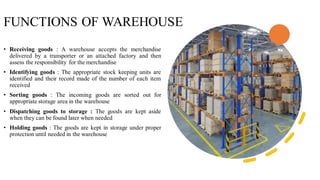
FUNCTIONS OF WAREHOUSE
• Receiving goods : A warehouse accepts the merchandise
delivered by a transporter or an attached factory and then
assess the responsibility for the merchandise
• Identifying goods : The appropriate stock keeping units are
identified and their record made of the number of each item
received
• Sorting goods : The incoming goods are sorted out for
appropriate storage area in the warehouse
• Dispatching goods to storage : The goods are kept aside
when they can be found later when needed
• Holding goods : The goods are kept in storage under proper
protection until needed in the warehouse
• Retrieving selecting or packing goods : Items ordered by customers are
taken out from storage and grouped in a manner useful for the next step
• Dispatching goods : The consolidated order is packaged suitably and directed
to the right transport vehicle. The necessary shipping and accounting
documentsare also prepared
• Preparing records and advices : The number of orders received ,the items
received and on hand etc.. are recorded for replenishment action and stock
control, and the demand and receive data are forwarded to a Control Center
located elsewhere.
MAJOR ACTIVITIES
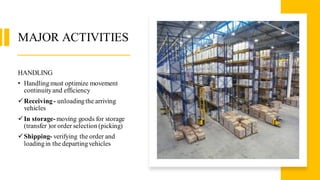
HANDLING
• Handling must optimize movement
continuityand efficiency
✓Receiving- unloadingthe arriving
vehicles
✓In storage-moving goods for storage
(transfer )or order selection (picking)
✓Shipping- verifying the order and
loadingin the departingvehicles
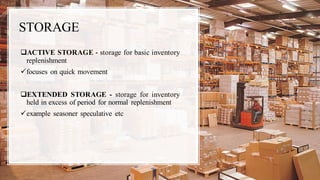
STORAGE
❑ACTIVE STORAGE - storage for basic inventory
replenishment
✓focuses on quick movement
❑EXTENDED STORAGE - storage for inventory
held in excess of period for normal replenishment
✓example seasoner speculative etc
TYPES OF WAREHOUSES
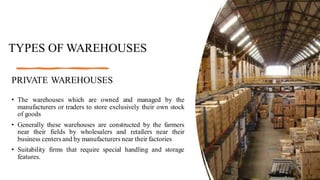
PRIVATE WAREHOUSES
• The warehouses which are owned and managed by the
manufacturers or traders to store exclusively their own stock
of goods
• Generally these warehouses are constructed by the farmers
near their fields by wholesalers and retailers near their
business centers and by manufacturers near their factories
• Suitability firms that require special handling and storage
features.
PUBLIC
WAREHOUSES
• To start such warehouses a license from the government is
required.
• The government also regulates the functions and operations
of these warehouses.
• Available to companies on hire
• As warehousing is their core business public warehouses offer
expertise in management
CONTRACT WAREHOUSING
• Contract warehouseoperatorstake over logistics responsibilityfrom manufacturing company
• Long term relationship and customized service
• Expertise of management
• Shared resources with several clients
GOVERNMENT WAREHOUSING
• These warehouses are owned, managed and controlled by central or state governments or public
corporationsor local authorities.
• Both government and private enterprises may use these warehouses to store their goods.
• Food Corporationare examples of agencies maintaining government warehouses
• Central WarehousingCorporation of India, State WarehousingCorporation and Food Corporation of
India are examples of agencies maintaining government warehouses
BONDED WAREHOUSES
• It is a building or other secured area in which goods may be stored manipulated or undergo manufacturing
operations without payment of duty.
• it is operated by a private company in their foreign country under the regulatory supervision of that
country's customs agency.
• Bonded warehouses let businesses store their goods closer to the foreign customers for faster delivery with
the advantage of pushing out the payment of customs duties until the goods are released from the bonded
warehouse
• They are used for imported or exported goods
CO-OPERATIVE WAREHOUSES
• These warehouses are owned, managed and controlled by co-operative societies.
• They provide warehousing facilities at the most economical rates to the members of their society.
• They are owned by different organisations and businesses
FIELD WAREHOUSES
• Field warehouses are those which is a building which has been rented and is being used by one company
where this building lies on the property owned by the owner of the building
• A leasing agreement is agreed upon between the two parties in this arrangement
AGRICULTURAL WAREHOUSES
• These warehouses are meant for storing agricultural produce grown in a certain area and are located in
assembling or regulated markets.
BUFFER STORAGE WAREHOUSES
• These warehouses are built at strategic locations with adequate transport and communication facilities.
• Supports fast and smooth production processes
• They store food grains or fertilizers etc
DISTRIBUTION WAREHOUSES
• These warehouses are located close to the manufacturing concerns or consuming areas and time taken for
transit
COLD STORAGE
• Cold storage facilities are provided for perishables against payment of a storage charge for the space
utilized by different parties.
WAREHOUSE MANAGEMENT SYSTEMS
• Warehouse management systems (WMS) integrate procedures and software support to standardize
storage and handling work procedures
• WMS is a key part of the supply chain and primarily aims to control the movement and storage of
materials within a warehouse and process the associated transactions, including shipping, receiving,
putaway and picking.
• Warehouse management systems often utilize ..... Auto ID Data Capture (AIDC) technology, such as
barcode scanners, mobile computers, wireless LANs and potentially Radio-frequency identification
(RFID) to efficiently monitor the flow of products.
• Once data has been collected, there is a real-time wireless transmission to a central database. The
database can then provide useful reports about the status of goods in the warehouse.
• The purpose of a WMS is to ensure that the materials and goods of a company are stored and moved
within the warehouse in an efficient manner to improve accessibility and visibility. Further, the system
helps businesses keep accurate records and move goods in and out of the facility accurately.
WAREHOUSE AUTOMATION
• AUTOMATED STORAGE RETRIEVAL SYSTEM (AS/RS)
• AUTOMATIC GUIDED VEHICLES (AGVS)
• CAROUSELS
• WAREHOUSE- STYLE RETAIL STORES
• INTERNET BASED STORES
• RADIO FREQUENCY IDENTIFICATION (RFID)
• TRANSPORTATION MANAGEMENT SYSTEMS
• PICK-TO-LIGHT TECHNOLOGY
• VOICE-ACTIVATED RECEIVING ANG PACKAGING
MERRITS
• Meet demand fluctuations at short notice
• no dangers of stockout
• Transport facilities optimally used
• bulk transportation is cheaper
• less warehousing costs
• maximum market coverage
• increased sales
• maximization of customer services
• moderate transportation costs
• better control
• maximum time utility
DEMERRITS
• transportcost maximum unless in bulk quantity
• increased material handlingcosts
• possibility of resultant delays
• greater danger of loss by fire
• delay in customer service
• chances of stockout situation is high
• huge warehousing development costs
• shortage
• goods at one warehouse from anotherrequire additional
transportation costs
WELL MANAGED WAREHOUSE
• Up to date software
• Up to date mechanical systems
• Up to date emergency and safety protocols
• Proper security
• Required storage space
• Proper temperature controls
• Positive customer service
THANK YOU

warehouse.pdf

  • 1.
  • 2.
    WAREHOUSING • Commercial buildingfor storage of goods • Used by manufacturers,importers,exporters,wholesal ers,transport buisnesses etc • They are usually large plain buildings in industrial areas of cities towns and villages • They usually have loading docks for loading and unloading goods from trucks
  • 3.
  • 4.
    OBJECTIVES • The primaryobjective of warehouse is movement of goods • Provide timely customer service • Keep track of items so that they can be found readily and correctly • Minimize the total physical effort and thus the cost of moving goods into and out of storage • Provide communication links with customers
  • 5.
    FUNCTIONS OF WAREHOUSE •Receiving goods : A warehouse accepts the merchandise delivered by a transporter or an attached factory and then assess the responsibility for the merchandise • Identifying goods : The appropriate stock keeping units are identified and their record made of the number of each item received • Sorting goods : The incoming goods are sorted out for appropriate storage area in the warehouse • Dispatching goods to storage : The goods are kept aside when they can be found later when needed • Holding goods : The goods are kept in storage under proper protection until needed in the warehouse
  • 6.
    • Retrieving selectingor packing goods : Items ordered by customers are taken out from storage and grouped in a manner useful for the next step • Dispatching goods : The consolidated order is packaged suitably and directed to the right transport vehicle. The necessary shipping and accounting documentsare also prepared • Preparing records and advices : The number of orders received ,the items received and on hand etc.. are recorded for replenishment action and stock control, and the demand and receive data are forwarded to a Control Center located elsewhere.
  • 7.
    MAJOR ACTIVITIES HANDLING • Handlingmust optimize movement continuityand efficiency ✓Receiving- unloadingthe arriving vehicles ✓In storage-moving goods for storage (transfer )or order selection (picking) ✓Shipping- verifying the order and loadingin the departingvehicles
  • 8.
    STORAGE ❑ACTIVE STORAGE -storage for basic inventory replenishment ✓focuses on quick movement ❑EXTENDED STORAGE - storage for inventory held in excess of period for normal replenishment ✓example seasoner speculative etc
  • 9.
    TYPES OF WAREHOUSES PRIVATEWAREHOUSES • The warehouses which are owned and managed by the manufacturers or traders to store exclusively their own stock of goods • Generally these warehouses are constructed by the farmers near their fields by wholesalers and retailers near their business centers and by manufacturers near their factories • Suitability firms that require special handling and storage features.
  • 10.
    PUBLIC WAREHOUSES • To startsuch warehouses a license from the government is required. • The government also regulates the functions and operations of these warehouses. • Available to companies on hire • As warehousing is their core business public warehouses offer expertise in management
  • 11.
    CONTRACT WAREHOUSING • Contractwarehouseoperatorstake over logistics responsibilityfrom manufacturing company • Long term relationship and customized service • Expertise of management • Shared resources with several clients GOVERNMENT WAREHOUSING • These warehouses are owned, managed and controlled by central or state governments or public corporationsor local authorities. • Both government and private enterprises may use these warehouses to store their goods. • Food Corporationare examples of agencies maintaining government warehouses • Central WarehousingCorporation of India, State WarehousingCorporation and Food Corporation of India are examples of agencies maintaining government warehouses
  • 12.
    BONDED WAREHOUSES • Itis a building or other secured area in which goods may be stored manipulated or undergo manufacturing operations without payment of duty. • it is operated by a private company in their foreign country under the regulatory supervision of that country's customs agency. • Bonded warehouses let businesses store their goods closer to the foreign customers for faster delivery with the advantage of pushing out the payment of customs duties until the goods are released from the bonded warehouse • They are used for imported or exported goods CO-OPERATIVE WAREHOUSES • These warehouses are owned, managed and controlled by co-operative societies. • They provide warehousing facilities at the most economical rates to the members of their society. • They are owned by different organisations and businesses
  • 13.
    FIELD WAREHOUSES • Fieldwarehouses are those which is a building which has been rented and is being used by one company where this building lies on the property owned by the owner of the building • A leasing agreement is agreed upon between the two parties in this arrangement AGRICULTURAL WAREHOUSES • These warehouses are meant for storing agricultural produce grown in a certain area and are located in assembling or regulated markets. BUFFER STORAGE WAREHOUSES • These warehouses are built at strategic locations with adequate transport and communication facilities. • Supports fast and smooth production processes • They store food grains or fertilizers etc
  • 14.
    DISTRIBUTION WAREHOUSES • Thesewarehouses are located close to the manufacturing concerns or consuming areas and time taken for transit COLD STORAGE • Cold storage facilities are provided for perishables against payment of a storage charge for the space utilized by different parties.
  • 15.
    WAREHOUSE MANAGEMENT SYSTEMS •Warehouse management systems (WMS) integrate procedures and software support to standardize storage and handling work procedures • WMS is a key part of the supply chain and primarily aims to control the movement and storage of materials within a warehouse and process the associated transactions, including shipping, receiving, putaway and picking. • Warehouse management systems often utilize ..... Auto ID Data Capture (AIDC) technology, such as barcode scanners, mobile computers, wireless LANs and potentially Radio-frequency identification (RFID) to efficiently monitor the flow of products. • Once data has been collected, there is a real-time wireless transmission to a central database. The database can then provide useful reports about the status of goods in the warehouse. • The purpose of a WMS is to ensure that the materials and goods of a company are stored and moved within the warehouse in an efficient manner to improve accessibility and visibility. Further, the system helps businesses keep accurate records and move goods in and out of the facility accurately.
  • 16.
    WAREHOUSE AUTOMATION • AUTOMATEDSTORAGE RETRIEVAL SYSTEM (AS/RS) • AUTOMATIC GUIDED VEHICLES (AGVS) • CAROUSELS • WAREHOUSE- STYLE RETAIL STORES • INTERNET BASED STORES • RADIO FREQUENCY IDENTIFICATION (RFID) • TRANSPORTATION MANAGEMENT SYSTEMS • PICK-TO-LIGHT TECHNOLOGY • VOICE-ACTIVATED RECEIVING ANG PACKAGING
  • 17.
    MERRITS • Meet demandfluctuations at short notice • no dangers of stockout • Transport facilities optimally used • bulk transportation is cheaper • less warehousing costs • maximum market coverage • increased sales • maximization of customer services • moderate transportation costs • better control • maximum time utility
  • 18.
    DEMERRITS • transportcost maximumunless in bulk quantity • increased material handlingcosts • possibility of resultant delays • greater danger of loss by fire • delay in customer service • chances of stockout situation is high • huge warehousing development costs • shortage • goods at one warehouse from anotherrequire additional transportation costs
  • 19.
    WELL MANAGED WAREHOUSE •Up to date software • Up to date mechanical systems • Up to date emergency and safety protocols • Proper security • Required storage space • Proper temperature controls • Positive customer service
  • 20.