LOGISTIC
MANAGEMENT
WHAT IS LOGISTICS?
Logistics is the . . . “process of planning, implementing, and
controlling the efficient, effective flow and storage of goods,
services, and related information from point of origin to point of
consumption for the purpose of conforming to customer
requirements.”
• The term Logistics Management is that part of Supply Chain
Management that plans, implements, and controls the efficient,
effective, forward, and reverse flow and storage of goods,
services, and related information between the point of origin and
the point of consumption in order to meet customers’
requirements
IS IT DIFFERENT FROM SCM?
Not really!
“Supply Chain Management deals with the management of
materials, information, and financial flows in a network consisting
of suppliers, manufacturers, distributors, and customers.”
So, Logistics and Supply Chain are equivalent terms.
LOGISTICS FUNCTIONS
• Purchasing / Procurement
• Inventory Control
• Warehousing
• Materials Handling
• Facility Location / Network Design
• Transportation
• Customer Service
• Order Processing
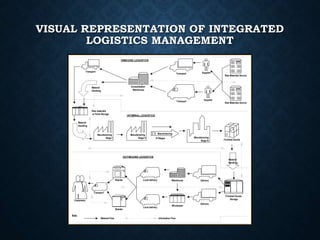
VISUAL REPRESENTATION OF INTEGRATED
LOGISTICS MANAGEMENT
Supplier
Supplier
Transport
Delivery
Consolidation
Warehouse
Manufacturing
Stage I Manufacturing
Stage N
Manufacturing
Stage II
Finished Goods
Local delivery
Finished Goods
Storage
Raw Materials Source
Wholesaler
Retailer
Retailer
Transport
Raw Materials Source
Local delivery
Material
Handling
Raw materials
or Parts Storage
N Stages
Customers
Warehouse
Manufcaturing
Material
Handling
Delivery
INBOUND LOGISTICS
INTERNAL LOGISTICS
OUTBOUND LOGISTICS
Material Flow Information Flow
Note:
Transport
Transport
Material
Handling
NATURE AND CONCEPTS
• Logistics is the management of the flow of goods, information and
other resources, including energy and people, between the point of
origin and the point of consumption in order to meet the
requirements of consumers (frequently, and originally, military
organizations).
• Logistics involves the integration of information, transportation,
inventory, warehousing, material-handling, and packaging, and
occasionally security. Logistics is a channel of the supply chain
which adds the value of time and place utility.
• Today the complexity of production logistics can be modeled,
analyzed, visualized and optimized by plant simulation software
TYPES OF LOGISTICS
A. Inbound Logistics
B. Outbound Logistics
C. Third Party Logistics
D. Fourth Party Logistics
E. Reverse Logistics
A. INBOUND LOGISTICS
• Inbound logistics refers to the transport, storage and delivery of
goods coming into a business. Outbound logistics refers to the
same for goods going out of a business.
• Sourcing and vendor selection for supply of raw materials and
manufacturing parts
• Inbound transportation and procurement planning
• Raw materials warehousing including consolidation warehousing
• Management of Inventory
• Information system for effective support strategic alliances with
the supplies and transporters
B. OUTBOUND LOGISTICS
• Outbound logistics refers to the same for goods going out of a
business. Inbound and outbound logistics combine within the
field of supply-chain management, as managers seek to
maximize the reliability and efficiency of distribution networks
while minimizing transport and storage costs.
• Outbound logistics system is concerned with the flow of finished products
from factory warehouse to the customers through a distribution network
comprising:
• The wholesalers
• Distributors
• Retailers
• Regional warehouses
• Transporters
• The inventory at all levels
• Sales order processing
• Sales return processing
• Accounts receivable realization and
• Counter flow of information from the customers to the factory
C. THIRD PARTY LOGISTICS
• A 3PL (third-party logistics) is a provider of outsourced logistics
services. Logistic services encompass anything that involves
management of the way resources are moved to the areas where
they are required. The term comes from the military.
D. FOURTH PARTY LOGISTICS
• This evolution in supply chain outsourcing is Fourth-party
Logistics or 4PL. A 4PL provider is a supply chain integrator. The
4PL assembles and manages all resources, capabilities and
technology of an organization's Supply Chain and its array of
providers.
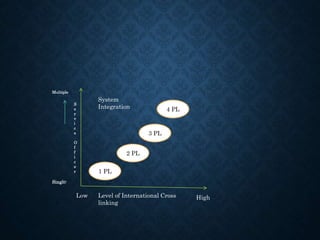
2 PL
3 PL
4 PL
1 PL
System
Integration
Multiple
Single
S
e
r
v
i
c
e
O
f
f
i
c
e
r
Low HighLevel of International Cross
linking
E. REVERSE LOGISTICS
• Reverse logistics is for all operations related to the reuse of
products and materials. It is "the process of moving goods from
their typical final destination for the purpose of capturing value, or
proper disposal.
MAJOR FEATURES OF FOR
LOGISTICS MANAGEMENT
• Smooth flow of all types of goods such as raw mareials, work-in-
process and finished goods
• Meeting customer expectations about product and related
information requirements
• Real time flow of information about products’ demand and
availability
• Delivery of quality product in required quantity without excessive
safety stock
• Best possible customer service at the least possible cost
• Integration of various managerial functions for optimization of
resources
• Movement and storage of goods in appropriate quantity
• Enhancement of productivity and profitability
CASE STUDY
• Ford Motor Company, one of the world’s largest
automotive manufacturers, has worked with
Penske as its lead logistics provider (LLP),
Penske’s quality team of associates are trained in
Six Sigma practices and work closely with Ford to
streamline operations and create and maintain a
more centralized logistics network
GETTING STARTED
• Ford conducted studies to determine the benefits of
transitioning the company's decentralized logistic
operations to a centralized approach.
• At the time, each of Ford's 20 North American
assembly plants managed its own logistics
operations. A decentralized approach provided total
control of logistics at the plant level, but presented
costly redundancies in materials handling and
transportation.
• Ford selected Penske as its North American LLP.
Under the contract, Penske would centralize and
manage all inbound materials handling for 19
assembly plants and seven stamping plants.

GETTING STARTED
CHALLENGES
• To develop, implement and operate a centralized
logistics network for Ford.
• To streamline supplier and carrier operations for
improved performance and accountability.
• To provide Ford with real time supply chain and
financial visibility.
SOLUTIONS
• Penske established 10 Origin Distribution Centres
(ODCs) and consolidated shipments to plants.
Approximately 1,200 trailers now ship to and from
Ford's ODCs per day, with most trucks at 95 percent
capacity. Penske has reduced plant inventory by 15
percent.
• Penske trained more than 1,500 suppliers on a uniform
set of procedures and logistics technologies. Precise
carrier requirements and a Carrier Rating System were
implemented to measure carrier performance.
• Penske implemented good accountability procedures
and advanced logistics management technologies to
gain real-time visibility of delivery status, routing
schedules and productivity.
• A new freight billing system was designed to
immediately capture logistics costs.
PENSKE AND FORD
• In approximately 18 months, Penske had completely
transitioned Ford's logistics operations to a centralized
network design.
• More than 700 inbound and 500 outbound trailers now
move to and from Ford's ODCs per day, with most loads
carrying at 95 percent capacity.
• Shipments are consolidated at the ODC and previously
unused cross-docking space is now in high demand.
• Fourteen million pounds of freight are cross-docked
each day, resulting in an inventory reduction of 15
percent.
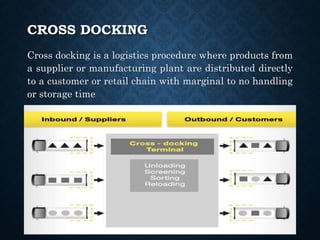
CROSS DOCKING
Cross docking is a logistics procedure where products from
a supplier or manufacturing plant are distributed directly
to a customer or retail chain with marginal to no handling
or storage time
RESULTS
• Savings in transportation of more than 25 million truck
kilometres
• A reduction of more than 10,000 tons of CO2 emissions each
year, based on an assumption of 750,000 shipments annually,
with further potential in the years ahead
• Significant operational cost reductions and scale efficiencies
• Greater overall flexibility for inbound and outbound
shipments
• Improved high service levels to automotive dealerships
within the network
INTEGRATED LOGISTICS MANAGEMENT
• Integrated Logistics is viewed as a method to create a
sustainable competitive advantage over the company's
competition
• Logistics strategy must be integrated with corporate strategy
because corporate strategy sets the basic requirement to the
Logistics system of a strategy
• The logics process is becoming more demanding and complex,
so is the business environment in which the logistics has to
operate
• Highlights seven critical factors including that are contributing to
the complexity of logistics system operations
• Escalating customer demand
• Cycle time reduction
• Globalization
• Restructuring
• Supply Chain Partnerships
• Productivity pressures and
• Environmental awareness
STRATEGIC LOGISTICS
PLANNING
• Strategic logistics planning is essentially concerned with the
deployment and management of logistics resources to met the
desired cost effective service performance of the system
• This may involve, number and location of warehouses, mode and
carrier selection, Inventory positioning, inventory planning, sub
contracting of services, sourcing, equipment and facilities
planning, order management and Information systems planning
etc.
• This is also includes such decisions as location and capacities of
company owned plants and warehouses, acquisition or long term
hiring of carriers like ships barges, trucks etc, acquisition of
martial handling system and facilities, balancing facilities to
maximize throughput and flexibility and introduction of system to
help, reductions in response time and in process inventory
• Choice of supply, transport mode, strategic alliance with both
suppliers and customers also form parts of these strategic
logistics planning process.
• The process of strategically managing the acquisition, movement
and storage of materials, parts, finished goods inventory, and
related information flows through the organization and its
marketing channel in such a way that current and future
profitability is maximized through the cost-effective fulfillment of
orders.
MAIN OBJECTIVES OF LOGISTICS
PLANNING ARE:
• Cost reduction: - This strategy is directed towards minimizing
the variable costs associated with the movement and storage.
The best strategy is to evaluate the alternative courses of
action and select the optimum one keeping profit
maximization as the prime goal in mind.
• Capital reduction: - This strategy is directed towards
minimizing the level of investment in the logistics system.
• Service improvements: - This strategy recognizes that the
revenue is a function of the logistics service provided and
develops an effective service strategy that is different from the
one provided by competitors
ISSUES FOR GLOBAL LOGISTICS
• Movement of product
• The flow of information
• Time / Service
• Cost competitiveness
• Integration
• Different culture
MAIN FEATURES OF LOGISTICS
• A fragmented logistics
• Optimization of physical operations
• Economical perspectives
• Skills & dimensions
THANK YOU…

Logistic management

  • 1.
  • 2.
    WHAT IS LOGISTICS? Logisticsis the . . . “process of planning, implementing, and controlling the efficient, effective flow and storage of goods, services, and related information from point of origin to point of consumption for the purpose of conforming to customer requirements.”
  • 3.
    • The termLogistics Management is that part of Supply Chain Management that plans, implements, and controls the efficient, effective, forward, and reverse flow and storage of goods, services, and related information between the point of origin and the point of consumption in order to meet customers’ requirements
  • 4.
    IS IT DIFFERENTFROM SCM? Not really! “Supply Chain Management deals with the management of materials, information, and financial flows in a network consisting of suppliers, manufacturers, distributors, and customers.” So, Logistics and Supply Chain are equivalent terms.
  • 5.
    LOGISTICS FUNCTIONS • Purchasing/ Procurement • Inventory Control • Warehousing • Materials Handling • Facility Location / Network Design • Transportation • Customer Service • Order Processing
  • 6.
    VISUAL REPRESENTATION OFINTEGRATED LOGISTICS MANAGEMENT Supplier Supplier Transport Delivery Consolidation Warehouse Manufacturing Stage I Manufacturing Stage N Manufacturing Stage II Finished Goods Local delivery Finished Goods Storage Raw Materials Source Wholesaler Retailer Retailer Transport Raw Materials Source Local delivery Material Handling Raw materials or Parts Storage N Stages Customers Warehouse Manufcaturing Material Handling Delivery INBOUND LOGISTICS INTERNAL LOGISTICS OUTBOUND LOGISTICS Material Flow Information Flow Note: Transport Transport Material Handling
  • 7.
    NATURE AND CONCEPTS •Logistics is the management of the flow of goods, information and other resources, including energy and people, between the point of origin and the point of consumption in order to meet the requirements of consumers (frequently, and originally, military organizations). • Logistics involves the integration of information, transportation, inventory, warehousing, material-handling, and packaging, and occasionally security. Logistics is a channel of the supply chain which adds the value of time and place utility. • Today the complexity of production logistics can be modeled, analyzed, visualized and optimized by plant simulation software
  • 8.
    TYPES OF LOGISTICS A.Inbound Logistics B. Outbound Logistics C. Third Party Logistics D. Fourth Party Logistics E. Reverse Logistics
  • 9.
    A. INBOUND LOGISTICS •Inbound logistics refers to the transport, storage and delivery of goods coming into a business. Outbound logistics refers to the same for goods going out of a business.
  • 10.
    • Sourcing andvendor selection for supply of raw materials and manufacturing parts • Inbound transportation and procurement planning • Raw materials warehousing including consolidation warehousing • Management of Inventory • Information system for effective support strategic alliances with the supplies and transporters
  • 11.
    B. OUTBOUND LOGISTICS •Outbound logistics refers to the same for goods going out of a business. Inbound and outbound logistics combine within the field of supply-chain management, as managers seek to maximize the reliability and efficiency of distribution networks while minimizing transport and storage costs.
  • 12.
    • Outbound logisticssystem is concerned with the flow of finished products from factory warehouse to the customers through a distribution network comprising: • The wholesalers • Distributors • Retailers • Regional warehouses • Transporters • The inventory at all levels • Sales order processing • Sales return processing • Accounts receivable realization and • Counter flow of information from the customers to the factory
  • 13.
    C. THIRD PARTYLOGISTICS • A 3PL (third-party logistics) is a provider of outsourced logistics services. Logistic services encompass anything that involves management of the way resources are moved to the areas where they are required. The term comes from the military.
  • 14.
    D. FOURTH PARTYLOGISTICS • This evolution in supply chain outsourcing is Fourth-party Logistics or 4PL. A 4PL provider is a supply chain integrator. The 4PL assembles and manages all resources, capabilities and technology of an organization's Supply Chain and its array of providers.
  • 15.
    2 PL 3 PL 4PL 1 PL System Integration Multiple Single S e r v i c e O f f i c e r Low HighLevel of International Cross linking
  • 16.
    E. REVERSE LOGISTICS •Reverse logistics is for all operations related to the reuse of products and materials. It is "the process of moving goods from their typical final destination for the purpose of capturing value, or proper disposal.
  • 17.
    MAJOR FEATURES OFFOR LOGISTICS MANAGEMENT • Smooth flow of all types of goods such as raw mareials, work-in- process and finished goods • Meeting customer expectations about product and related information requirements • Real time flow of information about products’ demand and availability • Delivery of quality product in required quantity without excessive safety stock • Best possible customer service at the least possible cost • Integration of various managerial functions for optimization of resources • Movement and storage of goods in appropriate quantity • Enhancement of productivity and profitability
  • 18.
    CASE STUDY • FordMotor Company, one of the world’s largest automotive manufacturers, has worked with Penske as its lead logistics provider (LLP), Penske’s quality team of associates are trained in Six Sigma practices and work closely with Ford to streamline operations and create and maintain a more centralized logistics network
  • 19.
    GETTING STARTED • Fordconducted studies to determine the benefits of transitioning the company's decentralized logistic operations to a centralized approach. • At the time, each of Ford's 20 North American assembly plants managed its own logistics operations. A decentralized approach provided total control of logistics at the plant level, but presented costly redundancies in materials handling and transportation.
  • 20.
    • Ford selectedPenske as its North American LLP. Under the contract, Penske would centralize and manage all inbound materials handling for 19 assembly plants and seven stamping plants. GETTING STARTED
  • 21.
    CHALLENGES • To develop,implement and operate a centralized logistics network for Ford. • To streamline supplier and carrier operations for improved performance and accountability. • To provide Ford with real time supply chain and financial visibility.
  • 22.
    SOLUTIONS • Penske established10 Origin Distribution Centres (ODCs) and consolidated shipments to plants. Approximately 1,200 trailers now ship to and from Ford's ODCs per day, with most trucks at 95 percent capacity. Penske has reduced plant inventory by 15 percent. • Penske trained more than 1,500 suppliers on a uniform set of procedures and logistics technologies. Precise carrier requirements and a Carrier Rating System were implemented to measure carrier performance.
  • 23.
    • Penske implementedgood accountability procedures and advanced logistics management technologies to gain real-time visibility of delivery status, routing schedules and productivity. • A new freight billing system was designed to immediately capture logistics costs.
  • 24.
    PENSKE AND FORD •In approximately 18 months, Penske had completely transitioned Ford's logistics operations to a centralized network design. • More than 700 inbound and 500 outbound trailers now move to and from Ford's ODCs per day, with most loads carrying at 95 percent capacity. • Shipments are consolidated at the ODC and previously unused cross-docking space is now in high demand. • Fourteen million pounds of freight are cross-docked each day, resulting in an inventory reduction of 15 percent.
  • 25.
    CROSS DOCKING Cross dockingis a logistics procedure where products from a supplier or manufacturing plant are distributed directly to a customer or retail chain with marginal to no handling or storage time
  • 26.
    RESULTS • Savings intransportation of more than 25 million truck kilometres • A reduction of more than 10,000 tons of CO2 emissions each year, based on an assumption of 750,000 shipments annually, with further potential in the years ahead • Significant operational cost reductions and scale efficiencies • Greater overall flexibility for inbound and outbound shipments • Improved high service levels to automotive dealerships within the network
  • 27.
    INTEGRATED LOGISTICS MANAGEMENT •Integrated Logistics is viewed as a method to create a sustainable competitive advantage over the company's competition • Logistics strategy must be integrated with corporate strategy because corporate strategy sets the basic requirement to the Logistics system of a strategy
  • 28.
    • The logicsprocess is becoming more demanding and complex, so is the business environment in which the logistics has to operate • Highlights seven critical factors including that are contributing to the complexity of logistics system operations • Escalating customer demand • Cycle time reduction • Globalization • Restructuring • Supply Chain Partnerships • Productivity pressures and • Environmental awareness
  • 29.
    STRATEGIC LOGISTICS PLANNING • Strategiclogistics planning is essentially concerned with the deployment and management of logistics resources to met the desired cost effective service performance of the system • This may involve, number and location of warehouses, mode and carrier selection, Inventory positioning, inventory planning, sub contracting of services, sourcing, equipment and facilities planning, order management and Information systems planning etc.
  • 30.
    • This isalso includes such decisions as location and capacities of company owned plants and warehouses, acquisition or long term hiring of carriers like ships barges, trucks etc, acquisition of martial handling system and facilities, balancing facilities to maximize throughput and flexibility and introduction of system to help, reductions in response time and in process inventory • Choice of supply, transport mode, strategic alliance with both suppliers and customers also form parts of these strategic logistics planning process.
  • 31.
    • The processof strategically managing the acquisition, movement and storage of materials, parts, finished goods inventory, and related information flows through the organization and its marketing channel in such a way that current and future profitability is maximized through the cost-effective fulfillment of orders.
  • 32.
    MAIN OBJECTIVES OFLOGISTICS PLANNING ARE: • Cost reduction: - This strategy is directed towards minimizing the variable costs associated with the movement and storage. The best strategy is to evaluate the alternative courses of action and select the optimum one keeping profit maximization as the prime goal in mind. • Capital reduction: - This strategy is directed towards minimizing the level of investment in the logistics system. • Service improvements: - This strategy recognizes that the revenue is a function of the logistics service provided and develops an effective service strategy that is different from the one provided by competitors
  • 33.
    ISSUES FOR GLOBALLOGISTICS • Movement of product • The flow of information • Time / Service • Cost competitiveness • Integration • Different culture
  • 34.
    MAIN FEATURES OFLOGISTICS • A fragmented logistics • Optimization of physical operations • Economical perspectives • Skills & dimensions
  • 35.

Editor's Notes

  • #24 A freight rate (historically and in ship chartering simply freight) is a price at which a certain cargo is delivered from one point to another