UNIT-4
Warehousing:
Concept and types,
Warehousing strategy,
Warehouse facility location & network design,
Reverse logistics,
Outsourcing- Nature and concept, Strategic decision to Outsourcing, Third
party logistics(3PL), Fourth party logistics(4PL).
Warehousing: Concept and Types
• A warehouse may be defined as a place used for the storage or accumulation
of goods. The function of storage can be carried out successful with the help
of warehouses used for storing the goods.
• Warehousing can also be defined as assumption of responsibility for the
storage of goods. By storing the goods throughout the year and releasing
them as and when they are needed, warehousing creates time utility.
Functions of Warehousing
A. Storage: This is the basic function of warehousing. Surplus commodities
which are not needed immediately can be stored in warehouses. They can
be supplied as and when needed by the customers.
B. Price Stabilization: Warehouses play an important role in the process of
price stabilization. It is achieved by the creation of time utility by
warehousing. Fall in the prices of goods when their supply is in abundance
and rise in their prices during the slack season are avoided.
C. Risk bearing:
 When the goods are stored in warehouses they are exposed to many
risks in the form of theft, deterioration, exploration, fire etc.
Warehouses are constructed in such a way as to minimise these risks.
Contract of bailment operates when the goods are stored in wave-
houses.
 The person keeping the goods in warehouses acts as boiler and
warehouse keeper acts as boiler. A warehouse keeper has to take the
reasonable care of the goods and safeguard them against various
risks. For any loss or damage sustained by goods, warehouse keeper
shall be liable to the owner of the goods.
D. Financing:
Loans can be raised from the warehouse keeper against the goods stored by the
owner. Goods act as security for the warehouse keeper. Similarly, banks and
other financial institutions also advance loans against warehouse receipts. In this
manner, warehousing acts as a source of finance for the businessmen for
meeting business operations.
E. Grading and Packing:
Warehouses nowadays provide the facilities of packing, processing and grading
of goods. Goods can be packed in convenient sizes as per the instructions of the
owner.
Importance of Warehousing In the Development of Trade and Commerce
• Warehousing or storage refers to the holding and preservation of goods until
they are dispatched to the consumers. Generally, there is a time gap between
the production and consumption of products. By bridging this gap, storage
creates time utility.
• There is need for storing the goods so as to make them available to buyers as
and when required. Some amount of goods is stored at every stage in the
marketing process. Proper and adequate arrangements to retail the goods in
perfect condition are essential for success in marketing. Storage enables a
firm to carry on production in anticipation of demand in future.
• A warehouse is a place used for the storage or accumulation of goods. It may
also be defined as an establishment that assumes responsibility for the safe
custody of goods. Warehouses enable the businessmen to carry on production
throughout the year and to sell their products, whenever there is adequate
demand.
• Need for warehouse arises also because some goods are produced only in a
particular season but are demanded throughout the year. Similarly certain
products are produced throughout the year but demanded only during a
particular season. Warehousing facilitates production and distribution on a
large scale.
1. Regular production: Raw materials need to be stored to enable mass production to
be carried on continuously. Sometimes, goods are stored in anticipation of a rise in
prices. Warehouses enable manufacturers to produce goods in anticipation of demand
in future
2. Time utility: A warehouse creates time utility by bringing the time gap between the
production and consumption of goods. It helps in making available the goods
whenever required or demanded by the customers.
3. Some goods are produced throughout the year but demanded only during particular
seasons, e.g., wool, raincoat, umbrella, heater, etc. on the other hand, some products
are demanded throughout the year but they are produced in certain region, e.g.,
wheat, rice, potatoes, etc. Goods like rice, tobacco, liquor an
4. Store of surplus goods: Basically, a warehouse acts as a store of surplus goods
which are not needed immediately. Goods are often produced in anticipation of
demand and need to be preserved properly until they are demanded by the customers.
Goods which are not required immediately can be stored in a warehouse to meet the
demand in future.
Benefits from Warehouses
5. Price stabilization:
Warehouses reduce violent fluctuations in prices by storing goods when their supply exceeds
demand and by releasing them when the demand is more than immediate productions. Warehouses
ensure a regular supply of goods in the market. This matching of supply with demand helps to
stabilize prices.
6. Minimization of risk:
Warehouses provide for the safe custody of goods. Perishable products can be preserved in cold
storage. By keeping their goods in warehouses, businessmen can minimize the loss from damage,
fire, theft etc. The goods kept in the warehouse are generally insured. In case of loss or damage to
the goods, the owner of goods can get full compensation from the insurance company.
7. Packing and grading:
Certain products have to be conditioned or processed to make them fit for human use, e.g., coffee,
tobacco, etc. A modern warehouse provides facilities for processing, packing, blending, grading
etc., of the goods for the purpose of sale. The prospective buyers can inspect the goods kept in a
warehouse.
8. Financing:
Warehouses provide a receipt to the owner of goods for the goods kept in the warehouse. The
owner can borrow money against the security of goods by making an endorsement on the
warehouse receipt. In some countries, warehouse authorities advance money against the goods
deposited in the warehouse. By keeping the imported goods in a bonded warehouse, a businessman
can pay customs duty in installments.
Benefits from Warehouses
Type of Warehouses
I. Private Warehouses: The private warehouses are owned and operated by big
manufacturers and merchants to fulfill their own storage needs. The goods
manufactured or purchased by the owner of the warehouses have a limited value
or utility as businessmen in general cannot make use of them because of the
heavy investment required in the construction of a warehouse, some big business
firms which need large storage capacity on a regular basis and who can afford
money, construct and maintain their private warehouses. A big manufacturer or
wholesaler may have a network of his own warehouses in different parts of the
country
II. Public Warehouses: A public warehouse is a specialized business establishment
that provides storage facilities to the general public for a certain charge. It may
be owned and operated by an individual or a cooperative society. It has to work
under a license from the government in accordance with the prescribed rules and
regulations.
 Public warehouses are very important in the marketing of agricultural
products and therefore the government is encouraging the establishment of
public warehouses in the cooperative sector. A public warehouse is also
known as duty-paid warehouse.
• Public warehouses are very useful to the business community. Most of the business
enterprises cannot afford to maintain their own warehouses due to huge capital
Investment. In many cases the storage facilities required by a business enterprise do
not warrant the maintenance of a private warehouse. Such enterprises can meet their
storage needs easily and economically by making use of the public warehouses,
without heavy investment.
• Public warehouses provide storage facilities to small manufacturers and traders at low
cost. These warehouses are well constructed and guarded round the clock to ensure
safe custody of goods. Public warehouses are generally located near the junctions of
railways, highways and waterways.
• They provide, therefore, excellent facilities for the easy receipt, despatch, loading and
unloading of goods. They also use mechanical devices for the handling of heavy and
bulky goods. A public warehouse enables a businessman to serve his customers
quickly and economically by carrying regional stocks near the important trading
centres or markets of two countries.
• Public warehouses provide facilities for the inspection of goods by prospective
buyers. They also permit packaging, grading and grading of goods. The public
warehouses receipts are good collateral securities for borrowings.
Bonded Warehouses
• Bonded warehouses are licensed by the government to accept imported goods for
storage until the payment of custom duty. They are located near the ports. These
warehouses are either operated by the government or work under the control of custom
authorities.
• The warehouse is required to give an undertaking or ‘Bond’ that it will not allow the
goods to be removed without the consent of the custom authorities. The goods are held
in bond and cannot be withdrawn without paying the custom duty. The goods stored in
bonded warehouses cannot be interfered by the owner without the permission of
customs authorities. Hence the name bonded warehouse.
• Bonded warehouses are very helpful to importers and exporters. If an importer is
unable or unwilling to pay customs duty immediately after the arrival of goods he can
store the goods in a bonded warehouse. He can withdraw the goods in installments by
paying the customs duty proportionately.
• In case he wishes to export the goods, he need not pay customs duty. Moreover, a
bonded warehouse provides all services which are provided by public warehouses.
Goods lying in a bonded warehouse can be packaged, graded and branded for the
purpose of sale.
Warehousing facility Location & Network Design
• LOGISTICS network design is concerned with the purpose of the number and
site of warehouses and manufacturing plants, allocation of customer demand,
distribution of warehouses to production plants. The best configuration must
be able to deliver the goods to the customers at the least cost (commonly
used objective) while satisfying the service level needs. In most logistics
network design models, the customer demand is exogenous and defined as a
consistent quantity for each product. Such a uniform demand value does not
take advantage of the possibility that different customers have different
sensitivity to delivery lead-time.
• Logistics network design is a vital strategic decision for Audi. It is very
important to allocate the customer demand points to warehouses, and allocate
products from warehouses to production plants. As Audi have become more
global, there has been a trend towards outsourcing the logistics function to
third-party logistics (3PL) firms, so that manufacturing companies can focus
their efforts on their core competencies. Thus, 3PL companies must have the
capability to design efficient and effective logistics network so as to add value
to their clients’ business. Audi is excellent in this.
• In Audi Company, we see three new models for logistics network design with
special focus on the perspective of 3PL companies. The chief objective of
these new models is to increase the effectiveness of the resulting network
design and the utilization of facilities in the network.
The three models encompass the following areas:
• Logistics network design with differentiated delivery lead time,
• Logistics network design with price discount, and
• Consolidated logistics network design using consolidation hubs.
A new perspective of Audi that incorporates into logistics network design are, two
factor namely delivery lead time and price discount that are usually not
considered. This shows that designing network with differentiated delivery lead
time can reduce the network cost, while the other shows that combining pricing
decision and demand management can result in a network design with higher net
profits, combines tactical decision for inventory replenishment policy with
strategic decision for consolidated network design. These shows by adding
consolidation hubs at suitable locations near to the suppliers, we can leverage on
concave Audi’s cost to reduce the overall network cost.
• Network design and inventory replenishment policy simultaneously our
findings provide managerial insights into how 3PL companies can and their
results to improve their business. Audi design more effective logistic networks
to support their clients and Audi is applicable to the order fulfilment business
process and managing suppliers for manufacturers. As every part is made by
Audi but work is divided into different department, for example tyre, machine
etc are produced in different plant.
• Audi is designing a network according to demand classes segmented
according to their sensitivity to delivery lead time. This shows that potential
network cost savings can be achieved by designing a network with segmented
customer demand as compared to a network without segmented demand. For
the segmented demand case, the short LT demand customers are served from
their local warehouse or a nearby warehouse which can satisfy the delivery
lead time requirement; while the long LT demand customers are served
directly from the hub which is located further away. In addition, the model
explored the multiple facilities grouping method which groups facilities which
can serve the same customer location within the short LT requirement. It was
shown that multiple facility grouping can reduce the network cost, especially
for networks with lower inventory holding cost and high fixed facility cost.
Network Design: Key Issues
• Pick the optimal number, location, and size of warehouses and/or plants
• Determine optimal sourcing strategy
• Which plant/vendor should produce which product?
• Determine best distribution channels
• Which warehouses should service which customers?
Data for Network Design
• A listing of all products
• Location of customers, stocking points and sources
• Demand for each product by customer location
• Transportation rates
• Warehousing costs
• Shipment sizes by product
• Order patterns by frequency, size, and season, content
• Order processing costs
• Customer service goals
Reverse Logistics: Application area and Activities involved
Reverse Logistics
Reverse logistics is for all operations related to the reuse of products and
materials. It is “the process of moving goods from their typical final destination for
the purpose of capturing value, or proper disposal. Remanufacturing and
refurbishing activities also may be included in the definition of reverse logistics.”
Growing green concerns and advancement of green supply chain management
concepts and practices make it all the more relevant. The number of publications
on the topic of reverse logistics have increased significantly over the past two
decades. The first use of the term “reverse logistics” in a publication was by
James R. Stock in a White Paper titled “Reverse Logistics,” published by the
Council of Logistics Management in 1992. The concept was further refined in
subsequent publications by Stock (1998) in another Council of Logistics
Management book, titled Development and Implementation of Reverse Logistics
Programs, and by Rogers and Tibben-Lembke (1999) in a book published by the
Reverse Logistics Association titled Going Backwards: Reverse Logistics Trends
and Practices. The reverse logistics process includes the management and the
sale of surplus as well as returned equipment and machines from the hardware
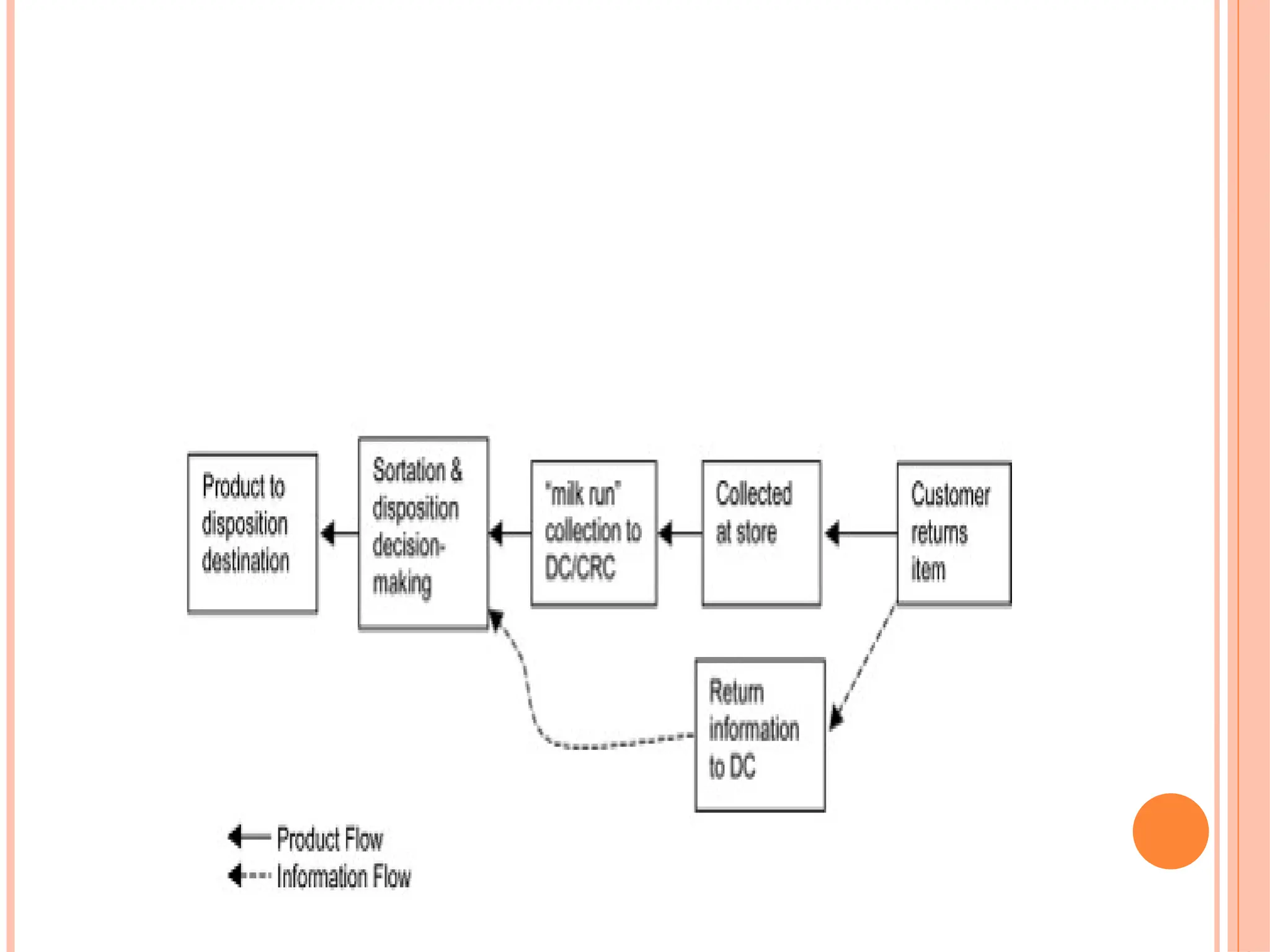
leasing business. Normally, logistics deal with events that bring the product
towards the customer. In the case of reverse logistics, the resource goes at least
one step back in the supply chain. For instance, goods move from the customer
to the distributor or to the manufacturer.
When a manufacturer’s product normally moves through the supply chain
network, it is to reach the distributor or customer. Any process or management
after the delivery of the product involves reverse logistics. If the product is
defective, the customer would return the product. The manufacturing firm would
then have to organise shipping of the defective product, testing the product,
dismantling, repairing, recycling or disposing the product. The product would
travel in reverse through the supply chain network in order to retain any use from
the defective product. The logistics for such matters is reverse logistics.
Benefits of an Efficient Reverse Logistics Systems
While many companies consider the return process to be a necessary evil that
shouldn’t be noticed, companies that implement an effective reverse logistics
workflow can reap several benefits.
Some of these benefits are:-
Reduced costs
By planning ahead for returns and making the return order right, you can
reduce related costs (administration, shipping, transportation, tech support, QA,
etc.)
Faster service
This refers to the original shipping of goods and the return / reimbursement of
goods. Quickly refunding or replacing goods can help restore a customer’s faith
in a brand.
Customer retention
Dealing with errors is just as important as making sales. If a customer had a
bad experience with your product, you have to make it right. Fulfilment blunders
can create educational opportunities. Learn how to keep your customers happy
and engaged with your company – even after you’ve made a mistake.
Reduced losses and unplanned profits
Recover the loss of investment in your failed product by fixing and restocking
the unit, scrapping it for parts, or repurposing it in a secondary market. With a
good reverse logistics program in place, you don’t have to leave money on the
table. Take a product that would otherwise just cost your company money and
turn it into an unforeseen asset.
Application area and Activities involved in Reverse Logistic
Reverse logistics has become one of the significant concepts for various
industries to practice to achieve sustainability objectives. Reverse logistic is
defined as “The movement of goods from a consumer towards a producer in a
channel of distribution”. A number of cases that implement successful reverse
logistics system have been found worldwide in specific industrial sectors such as
heavy machines, electronic sectors and plastic sector. Whereas, there is a limited
application of reverse logistics in other sectors. The main purpose of this study is
to explore and describe the applications of reverse logistics processes in
industrial sector. This leads the researcher to conduct a comparison using
qualitative approach between those applications to highlight strengths and
weaknesses in RL practices in Egyptian industrial companies. Finally, the
researcher proposes a number of corrective and preventive actions to improve
the application of RL. Based on the findings of the comparison, the researcher
recommends that the companies shall establish, implement and maintain
acquisition strategy and a manual to describe the inspection criteria and
guidelines for the inspection process to accelerate the process and avoid any
errors in deposition decision.
Outsourcing: Nature and Concept
• Outsourcing is the process of contracting a business function or any specific
business activity to specialized agencies. Mostly, the non-core areas such as
sanitation, security, household, pantry, etc are outsourced by the company.
The company makes a formal agreement with the agency.
• The agency then sends the manpower required to the company. The agency
charges the company for their services and in turn pays wages to their
employees. Global competition has given rise to outsourcing. With the help of
outsourcing, companies can focus on their core areas which leads to better
profits and increase the quality of their product.
Advantages of Outsourcing
Overall Cost Advantage: It eludes the need to hire individuals in house; hence
‐
recruitment and operational costs can be minimized to a great extent. It reduces
the cost and also saves time and efforting on training cost.
Stimulates Entrepreneurship, Employment, and Exports: Outsourcing
stimulates Entrepreneurship, Employment, and Exports in the country from where
outsourcing is done. Look at the example of India. After the initial success of call
centres, there was a sudden emergence of many small scales and medium scale
BPo and KPO companies.
Low Manpower Cost: The manpower cost is much lower than that of the host
country. This is exactly the case with India. We have a very large educated
workforce. And this causes the labour cost in our country to be much lower.
Access to Professional, Expert and High quality Services:
‐ Mostly, the tasks
are given to people who are skilled in that particular field. This provides us with a
better level of service and fewer chances of errors or misjudgment.
Emphasis on Core Process Rather than the Supporting Ones: With its help,
companies can focus on their core areas which lead to better profits and increase
the quality of their product. They simply outsource ancillary services.
Investment Requirements are Reduced: The organization can save on
investing in the latest technology, software, and infrastructure and let the
outsourcing partner handle the entire infrastructure.
Increased Efficiency and Productivity: There is an increased efficiency and
productivity in the non – core areas of an organization.
Knowledge Sharing: Outsourcing enables the organizations to share knowledge
and best practices with each
It helps develop both the companies and also boosts goodwill in the industry.
DISADVANTAGES OF OUTSOURCING
Lack of Customer Focus: An outsourced vendor may be catering to the needs
of multiple organizations at a time. In such situations, vendors may lack complete
focus on an individual organization’s tasks. And the reputation of the organization
may suffer as a result
A Threat to Security and Confidentiality: The inside news of the organization
may be leaked to the third party, so there are security issues. The leak of
sensitive information may result in losses to the company and also be an
advantage to competitors.
Dissatisfactory Services: Some of the common problem areas with outsourcing
include stretched delivery time and sub standard quality.
‐
Ethical Issues: The major ethical issue is taking away employment opportunities
from one’s own country. Instead of creating employment and wealth in the origin
country it gets outsourced to another country. In recent times this has been
viewed by many as unethical and even unpatriotic.
Other Disadvantages: Include misunderstanding of the contract, lack of
communication, poor quality and delayed
services amongst others.
Strategic Decision to Outsourcing
• Does strategic outsourcing actually benefit an organization? Or will it backfire
in the long run? Here’s how outsourcing has impacted organizations in India,
and how it can benefit you. by Soutiman Das Gupta
• What do companies like Hero Honda Motors, Bharti Tele-Ventures Limited, the
National Stock Exchange (NSE), HDFC Bank, Sony Entertainment Television,
Hyatt Services India Pvt. Ltd, and HPCL have in common?
• The common thread running through these large organizations is that all of
them have chosen outsourcing as a strategic business decision to garner
tangible and intangible benefits in the near and long run.
• Indeed, it’s difficult to find a successful and growing organization in India,
irrespective of size, that does not outsource a certain amount of its IT
infrastructure services or management.
HOW DOES IT WORK?
Does it make sense for an organization to outsource its IT needs? Most of the
CIOs and analysts we spoke to felt that strategic outsourcing helps an
organization to save on cost and speed up delivery while focusing on core
business needs.
To elaborate on the benefits, let’s look at Infrastructure Strategies (IS 2004),
the CIO annual survey conducted by Network Magazine to analyze technology
investment patterns in the Indian enterprise. The survey, conducted amongst
India’s top corporates, shows that nearly 54 per cent of the CIOs outsource “to
reduce costs”.
A similar view is echoed by Michele Caminos, Vice President, Team Manager,
IT Services, Asia/Pacific, Gartner. “The most compelling reason why
companies get into outsourcing engagements is to save costs,” she agrees.
According to Infrastructure Strategies, other impor-tant drivers for strategic IT
outsourcing are focus on core competencies, access to special expertise,
higher speed of delivery, and access to new technologies.
Focus on the core
• Given the pressures of a competitive market, organizations tend to focus on
their core activities — activities that link-up directly with the revenues and
hence the profitability. In such a scenario, companies tend to outsource their
non-core tasks to focus on business decision-making. And IT infrastructure
easily lends itself to outsourcing.
• Hero Honda Motors is a good example of an organization that uses strategic
outsourcing to focus on core competency. “We wanted to outsource all routine
(IT maintenance) tasks so that we could concentrate on the main business
issues. With the headache of dealing with routine complaints taken away, our
staff focuses on user requirements and is able to deliver services to users on
time,” explains SR Balasubramanian, Vice President – Information Systems,
Hero Honda Motors Limited.
• The IS 2004 survey reports that 46 per cent of the CIOs who outsource or
have plans to do so, consider “focus on core competencies” as the second
most important reason to outsource.
• “There are definite cost savings in terms of resource management and less
manpower costs. As an IT team we can focus more on providing new
infrastructure solutions to enable various requirements of our core media
business rather than get caught up with the daily maintenance requirements of
the existing set-up,” explains Aneeta Pankaj, Senior Manager, Information
Technology, Sony Entertainment Television (SET) India Private Limited.
• Outsourcing is best adopted after a careful look at business needs and
available options. It is essential that the outsourcing relationship provides
strategic business benefits in the future.
• “Outsourcing provides a competitive strategy benefit in a number of ways
to an organization. It allows ease of management, reduction in cost, lesser
manpower, and frees up internal resources,” says Pankaj.
• “Outsourcing can, and frequently does, provide both long- and short-term
benefits to companies that outsource, provided they have a strategic
objective for outsourcing. Medium and long-term gains are best realised by
selecting a vendor who brings value to your core business, rather than one
who can provide you with the lowest prices,” explains Sharad Sanghi,
Managing Director & CEO, Netmagic Solution Pvt. Ltd.
COMPETITIVE BUSINESS STRATEGY
Business-Related
• It’s important to understand that outsourcing is a business-related decision
and not simply an IT need. The ultimate goal of outsourcing is to bring benefits
to the business and subsequently the customer.
• Hero Honda’s Balasubramanian says, “We believe an outsourcing service
provider could better handle our day-to-day management needs than our own
team. We’ve not added numbers to our staffing in spite of increased business
activity. Since the outsourcing agency manages the data centre round the
clock, our staff has been relieved from working in shifts.”
• Bharti Tele-Ventures Limited has cut one of the largest outsourcing deals in
Asia on the IT infrastructure and network management areas. Dr Jai Menon,
Joint President, Enterprise Business, Bharti Tele-Ventures, says that the
outsourcing relationship has brought, “unparalleled value to the company for
our customers, employees and shareholders.”
• “For customers, it brings innovative and streamlined products and services like
billing, CRM and data warehousing. For employees, it brings enhanced
performance-critical applications like intranet, e-mail and online collaboration.
And at an overall level, the strategic alliance provides predictable IT spends,
and additional revenue streams to further enhance shareholder value,” he
adds
THE CHANGING LADSCAPE
• In the past, Indian companies were not very keen to outsource their IT
needs, primarily because their enterprise IT environments were relatively
less complex, easier to manage, and inexpensive to maintain. Besides, few
outsourcing service providers offered a number of outsourcing options under
one roof.
• But now, IT environments in companies have become more complex. There
has been growth in terms of volume of business, range of services, number
of employees, number of competitors, nationwide locations, and enterprise
applications. This calls for more attention to IT as a service to provide
strategic business benefits.
• To help organizations get optimum value out IT and use it as a strategic tool
to further the cause of business, many CIOs think it worth their while to
outsource IT infrastructure management.
Innovative options
• Indian enterprises today have a variety of outsourcing options from which they
can choose the right fit. Outsourcing solution providers offer services that
include desktop client management, server management, cable management,
firewall management, patch management, software license management, IT
audits, backbone and connectivity, website hosting, and IT infrastructure
management.
• Thus the available services are innovative, significantly more customised, and
better aligned with individual customer requirements. An enterprise can pick-
and-chose specific services and build a reliable mode of service delivery. A
company can outsource basic desktop management needs, or the
management of the entire nationwide IT infrastructure if needed.
• To introduce more flexibility, many service providers offer clients hire-purchase
schemes, infrastructure on-demand, and pay-as-you-use options.
• Hyatt Services India Pvt. Ltd has given a three-year contract to a service
provider to outsource network monitoring services. Says Harcharan Singh, the
company’s Director of Information Systems, “The service provider has to
upgrade and buy back the existing hardware as per the depreciation cost
agreed in the SLA. This clause protects us from technology obsolescence,
since technology changes rapidly.”
• IndusInd bank has entered into an infrastructure-on-demand agreement with
IBM India, which includes building an IT infrastructure, implementing server
consolidation, and setting up disaster recovery systems. The partnership
supports the bank’s goal to become totally customer-centric by providing more
secure, responsive and efficient service, in line with its renewed focus on retail
banking. It allows the bank to scale up operations and pursue aggressive
growth plans.
Before you outsource
• All things said, outsourcing is a strategic business decision that should be
made only if a company sees true business benefits accruing from it. Badly-
planned outsourcing could result in erosion of service value and cost
escalation, but a well-planned outsourcing decision can help you sleep better
at night, knowing that the responsibility of deliverables is in safe hands.
• Michele Caminos of Gartner highlights a few steps that can lead you to take a
proper decision in this context.
• What type of a service is it? Identify characteristics of service and the
respective type.
• What perspective is driving the effort? Identify decision rights (service owner)
and input rights (other stakeholders).
• How are other perspectives affected? Identify conflicts and work them out.
Check ‘killer’ factor. Improve solution.
• Check compliance with principles and fit with architecture.
• Who should carry it out? Evaluate different staffing possibilities. Select best
from combination.
• Who should participate in the decision? Submit service proposal to specific
decision process. Follow it up.
recommends the following:
• Understand different business perspectives and how they affect
sourcing decisions.
• Understand how perspectives must be harnessed to drive sourcing
decisions.
• Develop a structured sequence of steps to sourcing decisions.
• Develop evolving governance architecture to support sourcing
decisions.
• Develop internal sourcing decision roles.
Third Party Logistics (3PL)
 A 3PL (third-party logistics) provider offers outsourced logistics services, which
encompass anything that involves management of one or more “facets of
procurement”(a specific aspect or component within the broader process of
procurement) and fulfillment activities.
 In business, 3PL has a broad meaning that applies to any service contract that
involves storing or shipping items.
 A 3PL service may be a single provider, such as transportation or warehouse
storage, or it can be a systemwide bundle of services capable of handling
supply chain management.
How Third-Party Logistics work
 Here is an example of how 3PL arrangements operate:
 A book publisher hires writers, editors and graphic designers to produce
publications, but it may not want to handle the consumer ordering process or
transportation of book shipments. Instead, the book publisher uses a
fulfillment center to process its online orders and hires a trucking carrier to
haul its freight. The fulfillment center and carrier both act as 3PL providers.
It’s possible for a single 3PL provider to fulfill and ship book orders, too.
By contracting with a 3PL provider, the book company can use supply and
distribution services only when needed, thus controlling costs more
effectively while focusing on its core competency of producing books.
Aspects of 3PLs probably date back hundreds, if not thousands, of years. The Council of
Supply Chain Management Professionals traces the actual 3PL abbreviation to four
decades ago. “The term 3PL was first used in the early 1970s to identify intermodal
marketing companies … in transportation contracts,” the council wrote in a glossary. “Up
to that point, contracts for transportation had featured only two parties, the shipper and
the carrier.”
• The Motor Carrier Act of 1980 deregulated the trucking industry, which reduced
trucking rates and also increased the amount of competition, all of which fed into 3PL
concepts.
• The term 3PL got bandied about more by consultants and during conferences in the
1990s, likely tied to evolving technology, including the rise of the internet.
The growth of 3PLs
An overview of levels of Logistics Service
• Later, the Consumer Product Safety Improvement Act of 2008 legally defined
3PL: “The term third-party logistics provider means a person who solely
receives, holds or otherwise transports a consumer product in the ordinary
course of business but who does not take title to the product.”
• According to a frequently cited 2017 report from Armstrong & Associates, a
supply chain consultancy, 90% of domestic Fortune 500 companies rely on
3PL providers to handle logistics, compared to the 46% Armstrong reported in
2001.
• The growth in online sales and increasing consumer demand for faster delivery
and lower prices have spiked demand for 3PL services. 3PLs have also
bloomed thanks to tracking technology, such as radio frequency identification
(RFID) and global positioning system (GPS), both of which offer extended
supply chain visibility. Meanwhile, internet of things (IoT) technology has
improved tracking metrics for trucking and other carriers.
The Benefits of 3PL
 The primary benefit of using a 3PL service to handle logistics, such as
packaging, warehousing, fulfillment and distribution, is cost savings — for
example, not having to maintain a warehouse or the staff to monitor supply
chain operations.
 A 3PL service likely offers better performance on efforts such as shipping while
also enjoying an easier ability to scale its operations. If the publishing company
in the example above suddenly needs to ship more copies of a popular title, a
fulfillment center will have an easier time meeting that demand than if the
publisher itself had to ship additional copies of the book.
3PL vs. freight forwarding
 Freight forwarding and 3PL may come across as similar, but there are
noticeable differences.
A. Freight forwarders do not actually ship materials, and instead function as a
liaison between a client company and shipping firms.
B. The freight forwarder negotiates prices, determines the best modes of
transportation, establishes economical shipping routes and works on other
logistics concerns. As noted earlier, 3PL providers handle a broader range
of services compared to forwarders.
Fourth Party Logistics (4PL)
• While third-party logistics outsourcing is accepted business practice (though not
without risk), corporations are now looking to outsource to a single partner who
will assess, design, build, run and measure integrated comprehensive supply
chain solutions on their behalf. This evolution in supply chain outsourcing
is Fourth-party Logistics or 4PL.
• A 4PL provider is a supply chain integrator. The 4PL assembles and manages all
resources, capabilities and technology of an organisation's Supply Chain and its
array of providers.
• An experienced and reliable 4PL provider will bring value and a reengineered
approach to your organisation as it will manage the logistics process, regardless
of what carriers, forwarders or warehouses are used. As the centralised contact
with the client, 4PL has overall responsibility for logistics performance and the
ability to impact the entire supply chain and not just single elements. Consider
how many discrete discussions you need to have in your company to ensure your
product gets into consumers hands!
• Like Business Process Outsourcing, a 4PL solution aims to manage people, process
and technology. Importantly, 4PL outsourcing must not be seen as a pure cost
reduction issue and if it is considered as such then it is prone to failure. Adopting a
4PL approach brings a different perspective, knowledge, experience and technology
to the existing in-house function. Successful 4PL partnerships will see both parties
work side by side motivated by mutual success and reward.
• Some of the 4PL benefits include: access to a broader base of potential suppliers;
back-end system integration; increased market transparency for goods and services;
standardisation and automation of order placement; reduced procurement costs and
order cycle times. If your business and people are sufficiently mature you might
also integrate the 4PL into the S&OP process. Think how powerful that could be!
• Organisations are exploring this solution because it can improve their own bottom
line through increased and sustainable business efficiency. A word of warning; do
not go down this road unless your existing supply chain is already robust
AND people are sufficiently experienced to cope with a very different way of doing
business.
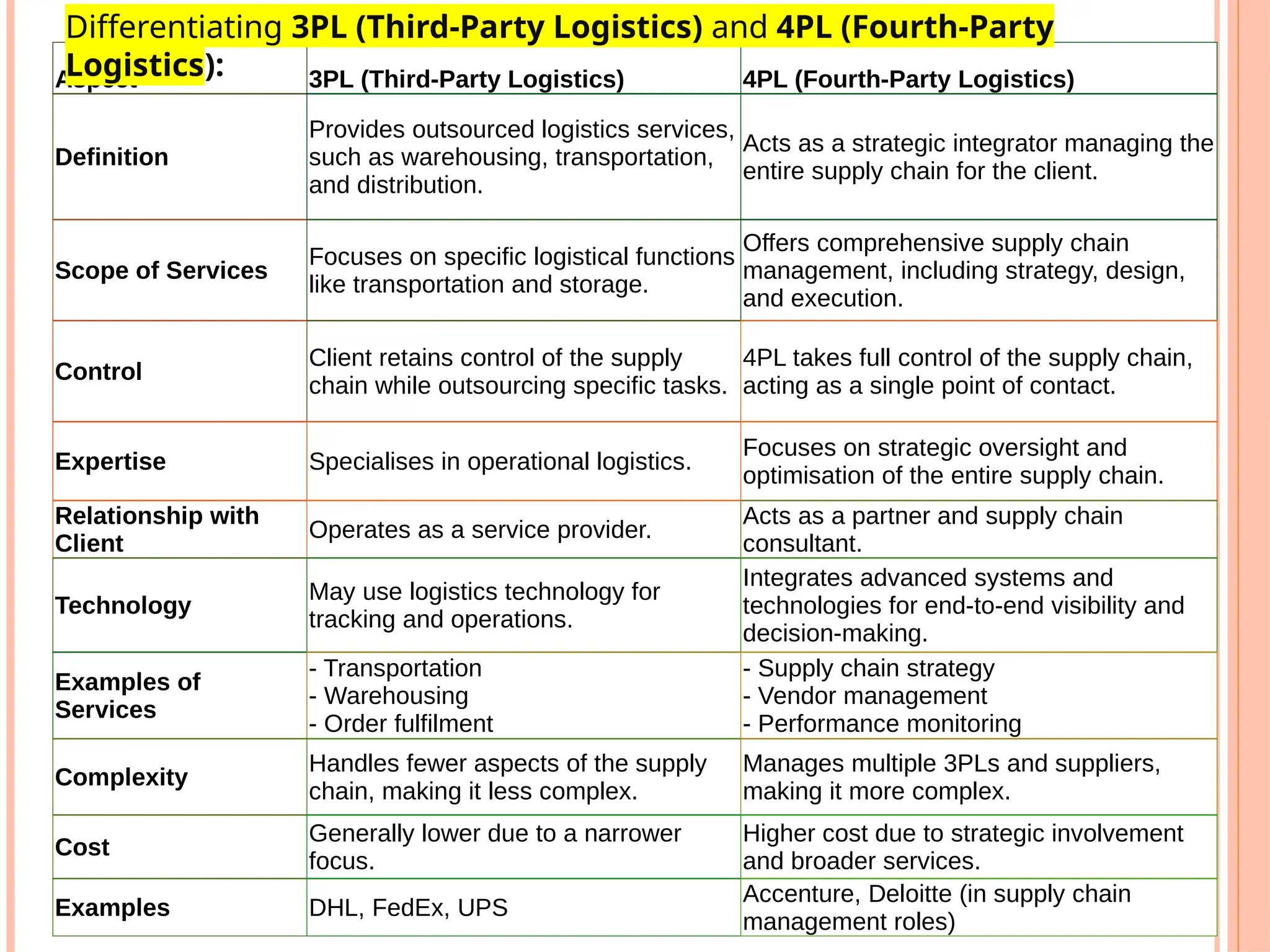
Aspect 3PL (Third-Party Logistics) 4PL (Fourth-Party Logistics)
Definition
Provides outsourced logistics services,
such as warehousing, transportation,
and distribution.
Acts as a strategic integrator managing the
entire supply chain for the client.
Scope of Services
Focuses on specific logistical functions
like transportation and storage.
Offers comprehensive supply chain
management, including strategy, design,
and execution.
Control
Client retains control of the supply
chain while outsourcing specific tasks.
4PL takes full control of the supply chain,
acting as a single point of contact.
Expertise Specialises in operational logistics.
Focuses on strategic oversight and
optimisation of the entire supply chain.
Relationship with
Client
Operates as a service provider.
Acts as a partner and supply chain
consultant.
Technology
May use logistics technology for
tracking and operations.
Integrates advanced systems and
technologies for end-to-end visibility and
decision-making.
Examples of
Services
- Transportation
- Warehousing
- Order fulfilment
- Supply chain strategy
- Vendor management
- Performance monitoring
Complexity
Handles fewer aspects of the supply
chain, making it less complex.
Manages multiple 3PLs and suppliers,
making it more complex.
Cost
Generally lower due to a narrower
focus.
Higher cost due to strategic involvement
and broader services.
Examples DHL, FedEx, UPS
Accenture, Deloitte (in supply chain
management roles)
Differentiating 3PL (Third-Party Logistics) and 4PL (Fourth-Party
Logistics):
Designing Supply Chain Network for each industry or business involves arriving at a
satisfactory design framework taking into all elements like product, market, process,
technology, costs, external environment and factors and their impact besides
evaluating alternate scenarios suiting your specific business requirements. No two
supply chain designs can be the same. The network design will vary depending
upon many factors including location and whether you are looking at national,
regional or global business models.
Supply Chain Network in Simple and basic Terms Involves determining
following process design:
Procurement
Where are your suppliers
How will you procure raw materials and components
Manufacturing
Where will you locate the factories for manufacturing/assembly
Manufacturing Methodology
Finished Good
Where will you hold inventories, Number of Warehouses, Location of warehouses
etc.
How will you distribute to markets – Transportation and Distribution logistics
All above decisions are influenced and driven by Key Driver which is the Customer
Fulfillment.
Factor that influences designing
Global Supply Chain Network
Reverse Logistics
Definition
Reverse logistics refers to the process of moving
goods from their final destination back to the
manufacturer, retailer, or another point in the
supply chain for the purposes of return, repair,
recycling, remanufacturing, or disposal.
Reverse logistics is no longer just a cost centre but a strategic asset. With rising
environmental awareness and customer expectations, companies are leveraging reverse
logistics to build a competitive advantage and contribute positively to society and the
environment. By adopting innovative practices and technologies, businesses can turn
returns and waste into valuable opportunities.
Reverse logistics plays a vital role in modern supply chains by ensuring sustainability,
improving customer satisfaction, and optimizing resource use, making it a cornerstone of
efficient and responsible business operations.
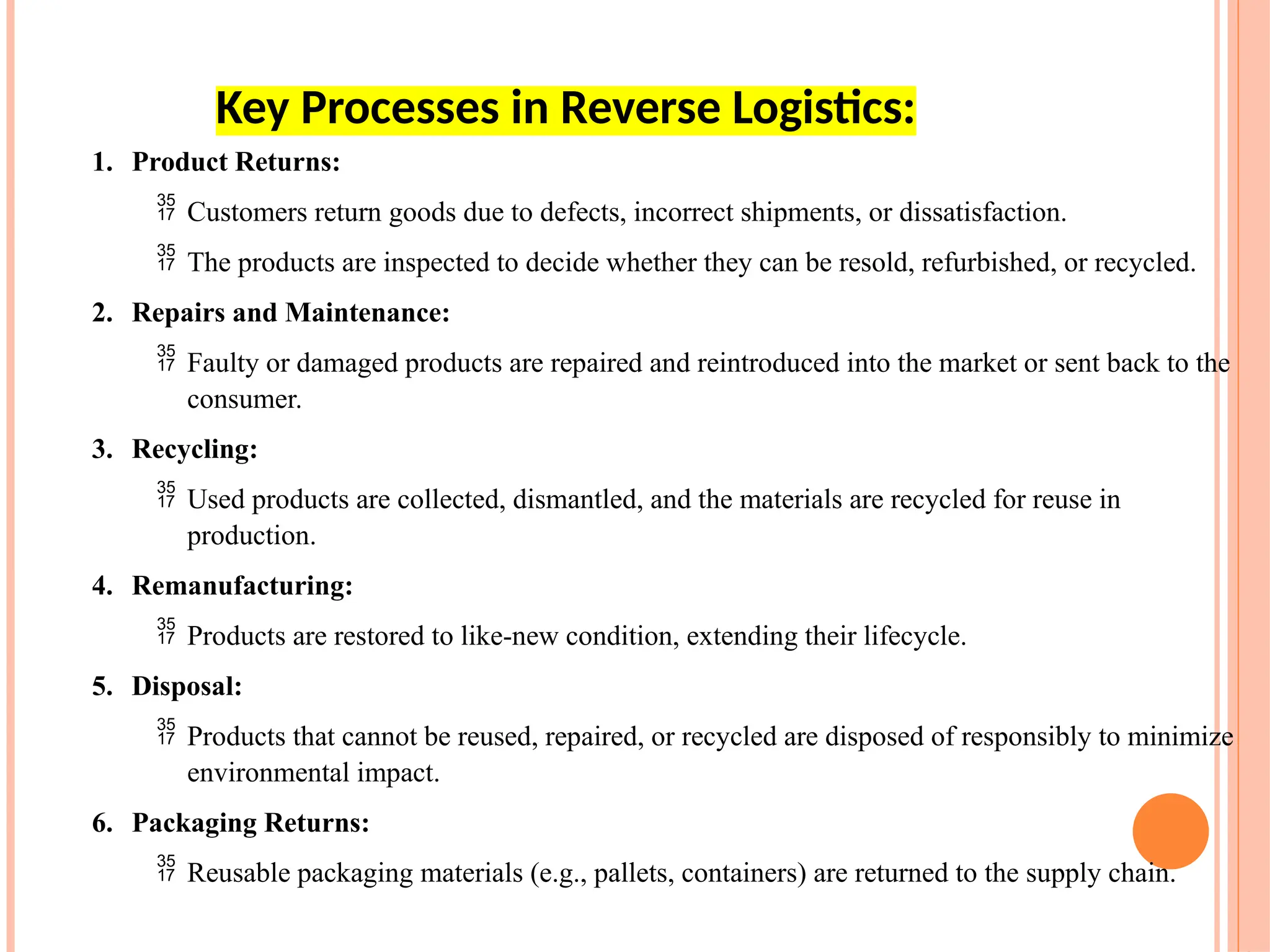
1. Product Returns:
 Customers return goods due to defects, incorrect shipments, or dissatisfaction.
 The products are inspected to decide whether they can be resold, refurbished, or recycled.
2. Repairs and Maintenance:
 Faulty or damaged products are repaired and reintroduced into the market or sent back to the
consumer.
3. Recycling:
 Used products are collected, dismantled, and the materials are recycled for reuse in
production.
4. Remanufacturing:
 Products are restored to like-new condition, extending their lifecycle.
5. Disposal:
 Products that cannot be reused, repaired, or recycled are disposed of responsibly to minimize
environmental impact.
6. Packaging Returns:
 Reusable packaging materials (e.g., pallets, containers) are returned to the supply chain.
Key Processes in Reverse Logistics:
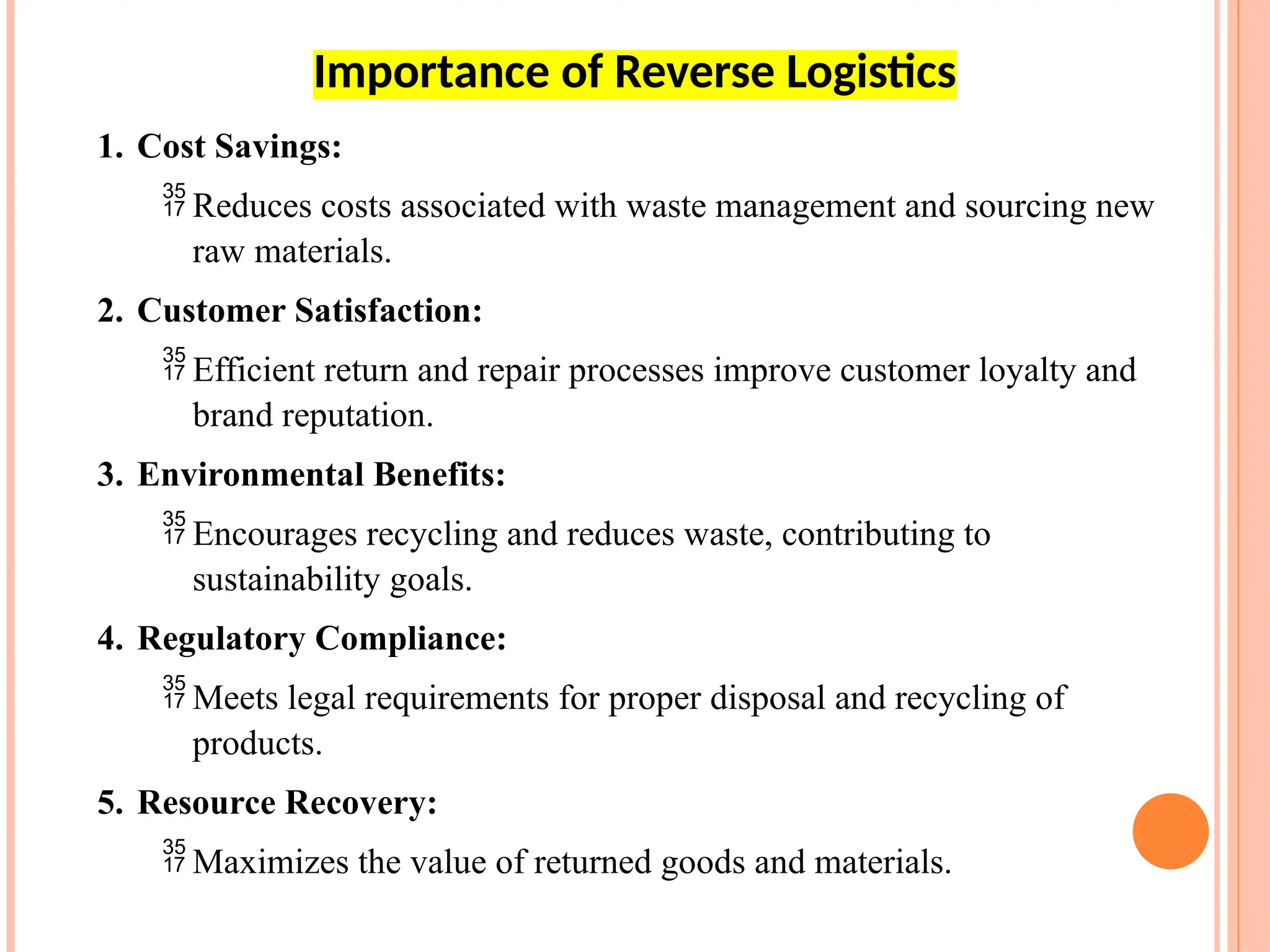
1. Cost Savings:
 Reduces costs associated with waste management and sourcing new
raw materials.
2. Customer Satisfaction:
 Efficient return and repair processes improve customer loyalty and
brand reputation.
3. Environmental Benefits:
 Encourages recycling and reduces waste, contributing to
sustainability goals.
4. Regulatory Compliance:
 Meets legal requirements for proper disposal and recycling of
products.
5. Resource Recovery:
 Maximizes the value of returned goods and materials.
Importance of Reverse Logistics
1. E-commerce:
Handles high volumes of returns due to online shopping.
2. Electronics:
Focuses on recycling e-waste and remanufacturing.
3. Automotive:
Reclaims and refurbishes parts like batteries, engines, and
tires.
4. Retail:
Manages customer returns and unsold inventory.
5. Pharmaceuticals:
Ensures the safe return and disposal of expired or recalled
medicines.
Industries Benefiting from Reverse Logistics
Challenges in Reverse Logistics
1. Complexity in Operations:
Managing diverse return channels and conditions.
2. High Costs:
Logistics, labour, and refurbishment costs can be
significant.
3. Uncertainty:
Unpredictable volume and timing of returns.
4. Inventory Management:
Balancing refurbished goods with new products.
5. Integration with Forward Logistics:
Aligning reverse logistics with the traditional supply chain
for efficiency.
Technological Solutions:
1. Tracking and Automation:
RFID and IoT for efficient monitoring and management of
returned goods.
2. Artificial Intelligence (AI):
Optimizes decision-making in repair or recycling
processes.
3. Blockchain:
Ensures transparency and traceability in the reverse supply
chain.
Technological Solutions
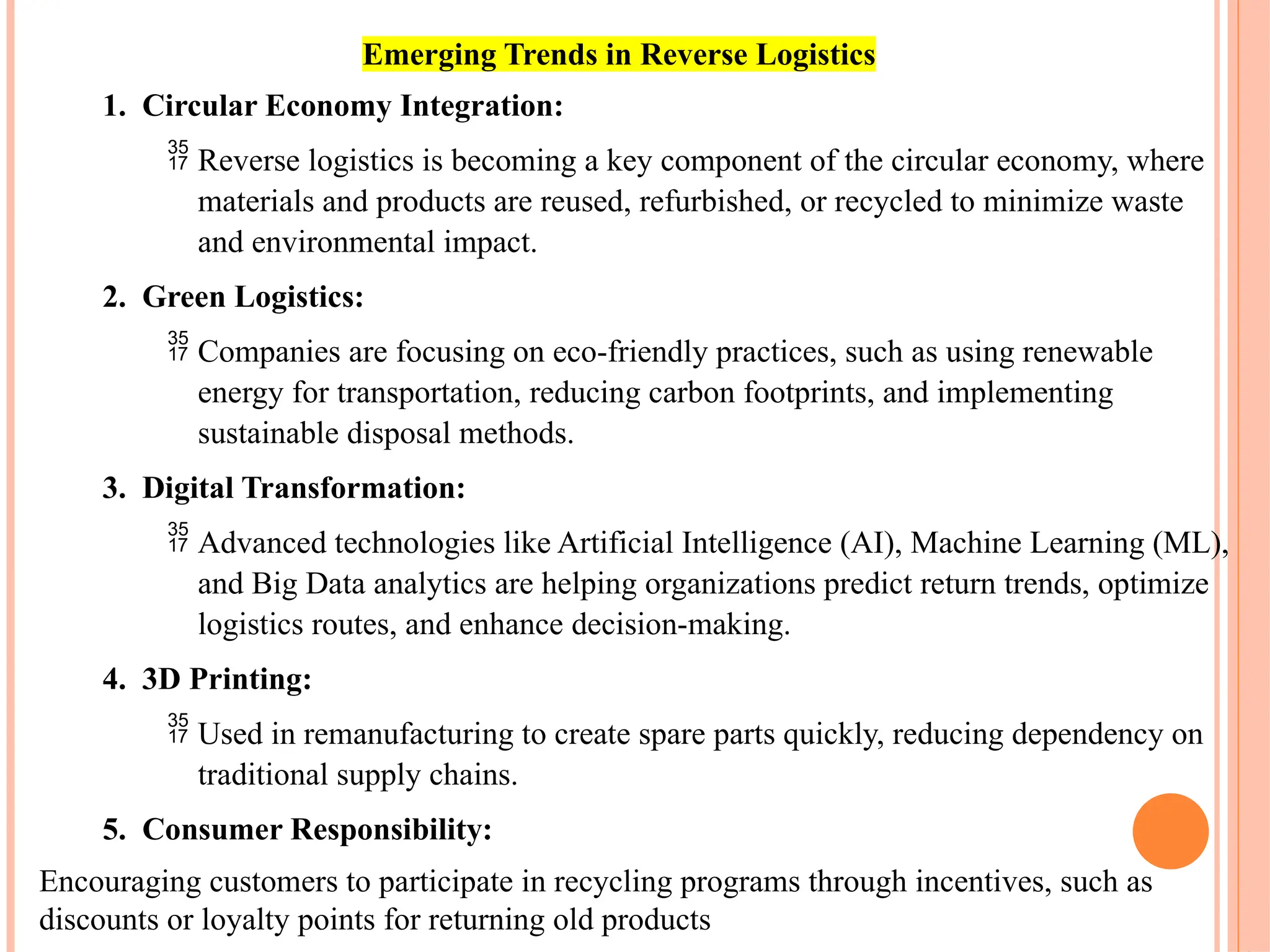
1. Circular Economy Integration:
 Reverse logistics is becoming a key component of the circular economy, where
materials and products are reused, refurbished, or recycled to minimize waste
and environmental impact.
2. Green Logistics:
 Companies are focusing on eco-friendly practices, such as using renewable
energy for transportation, reducing carbon footprints, and implementing
sustainable disposal methods.
3. Digital Transformation:
 Advanced technologies like Artificial Intelligence (AI), Machine Learning (ML),
and Big Data analytics are helping organizations predict return trends, optimize
logistics routes, and enhance decision-making.
4. 3D Printing:
 Used in remanufacturing to create spare parts quickly, reducing dependency on
traditional supply chains.
5. Consumer Responsibility:
Encouraging customers to participate in recycling programs through incentives, such as
discounts or loyalty points for returning old products
Emerging Trends in Reverse Logistics
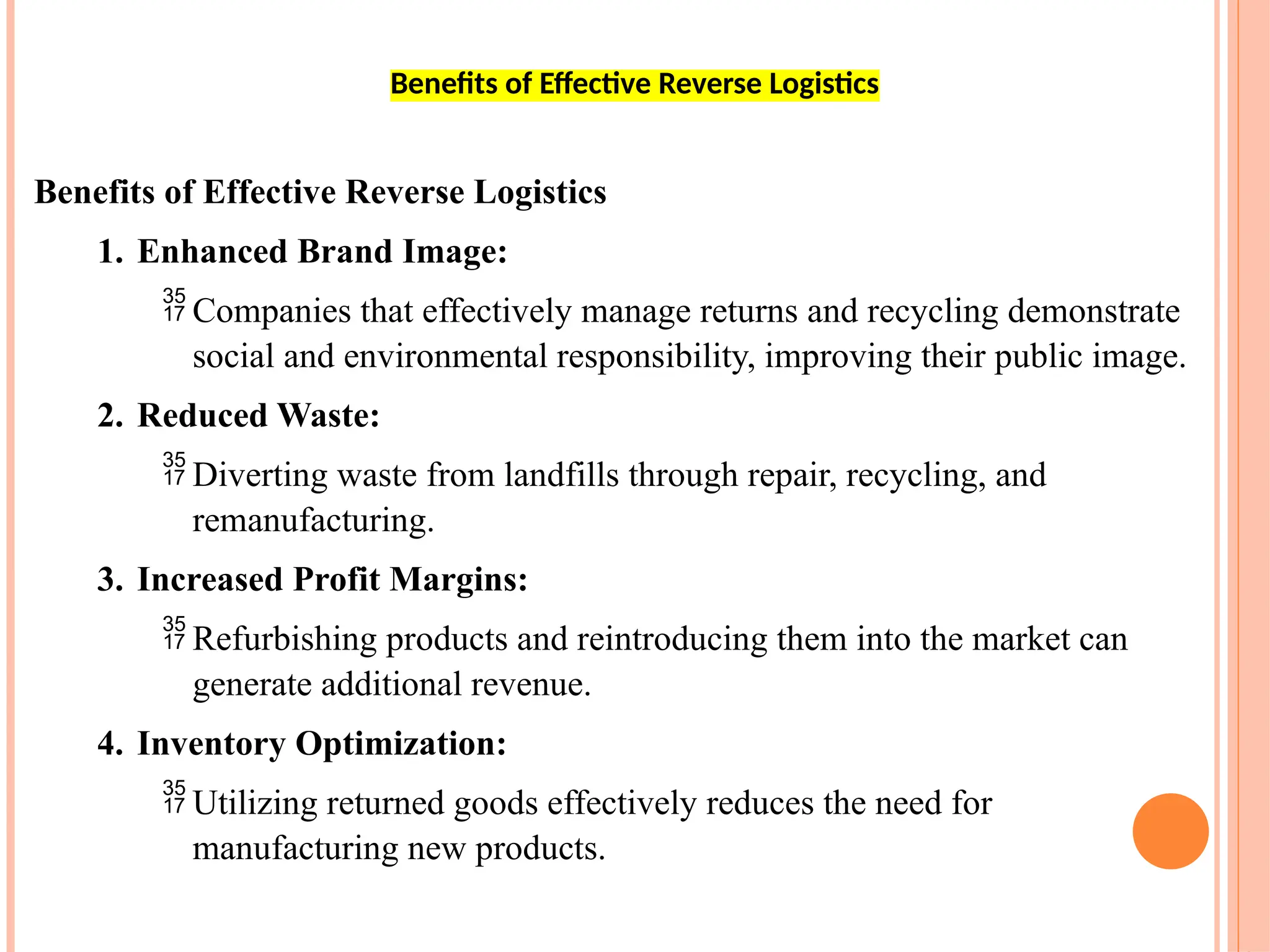
Benefits of Effective Reverse Logistics
1. Enhanced Brand Image:
 Companies that effectively manage returns and recycling demonstrate
social and environmental responsibility, improving their public image.
2. Reduced Waste:
 Diverting waste from landfills through repair, recycling, and
remanufacturing.
3. Increased Profit Margins:
 Refurbishing products and reintroducing them into the market can
generate additional revenue.
4. Inventory Optimization:
 Utilizing returned goods effectively reduces the need for
manufacturing new products.
Benefits of Effective Reverse Logistics
Strategies to Improve Reverse Logistics
1. Streamlined Return Policies:
 Clear and customer-friendly policies to simplify the return process.
2. Efficient Data Management:
 Real-time tracking and monitoring of returned goods through integrated IT
systems.
3. Collaboration with Partners:
 Working with third-party logistics providers (3PLs) for expertise and
infrastructure support.
4. Training and Awareness:
 Educating employees and customers about the importance of reverse
logistics and proper return handling.
5. Sustainability Goals Alignment:
 Aligning reverse logistics strategies with corporate sustainability objectives
to ensure long-term viability.
Strategies to Improve Reverse Logistics
Case Studies
1. Amazon:
 Amazon has a robust reverse logistics system that
enables customers to return items seamlessly. Returned
goods are inspected, refurbished, resold, or recycled to
minimize waste.
2. Dell:
 Dell operates a take-back program to recycle old
computers and components, promoting sustainability
and reducing e-waste.
3. H&M:
 The company encourages customers to return old
clothes, which are either resold, repurposed into new
garments, or recycled.
4. Apple:
 Apple’s “Trade-In” program allows customers to
return used devices for credit or recycling,
emphasizing product longevity and sustainability.
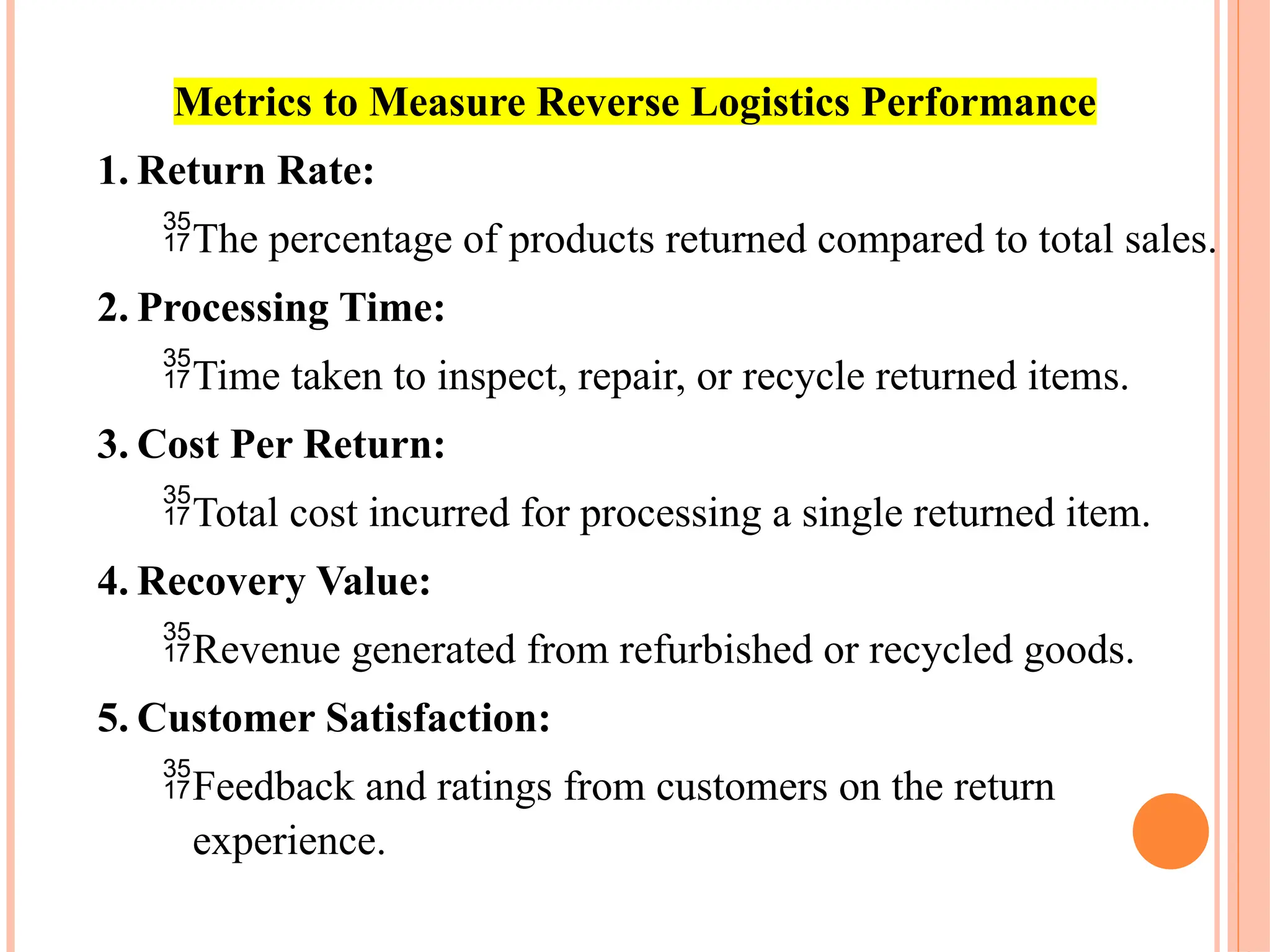
Metrics to Measure Reverse Logistics Performance
1. Return Rate:
The percentage of products returned compared to total sales.
2. Processing Time:
Time taken to inspect, repair, or recycle returned items.
3. Cost Per Return:
Total cost incurred for processing a single returned item.
4. Recovery Value:
Revenue generated from refurbished or recycled goods.
5. Customer Satisfaction:
Feedback and ratings from customers on the return
experience.
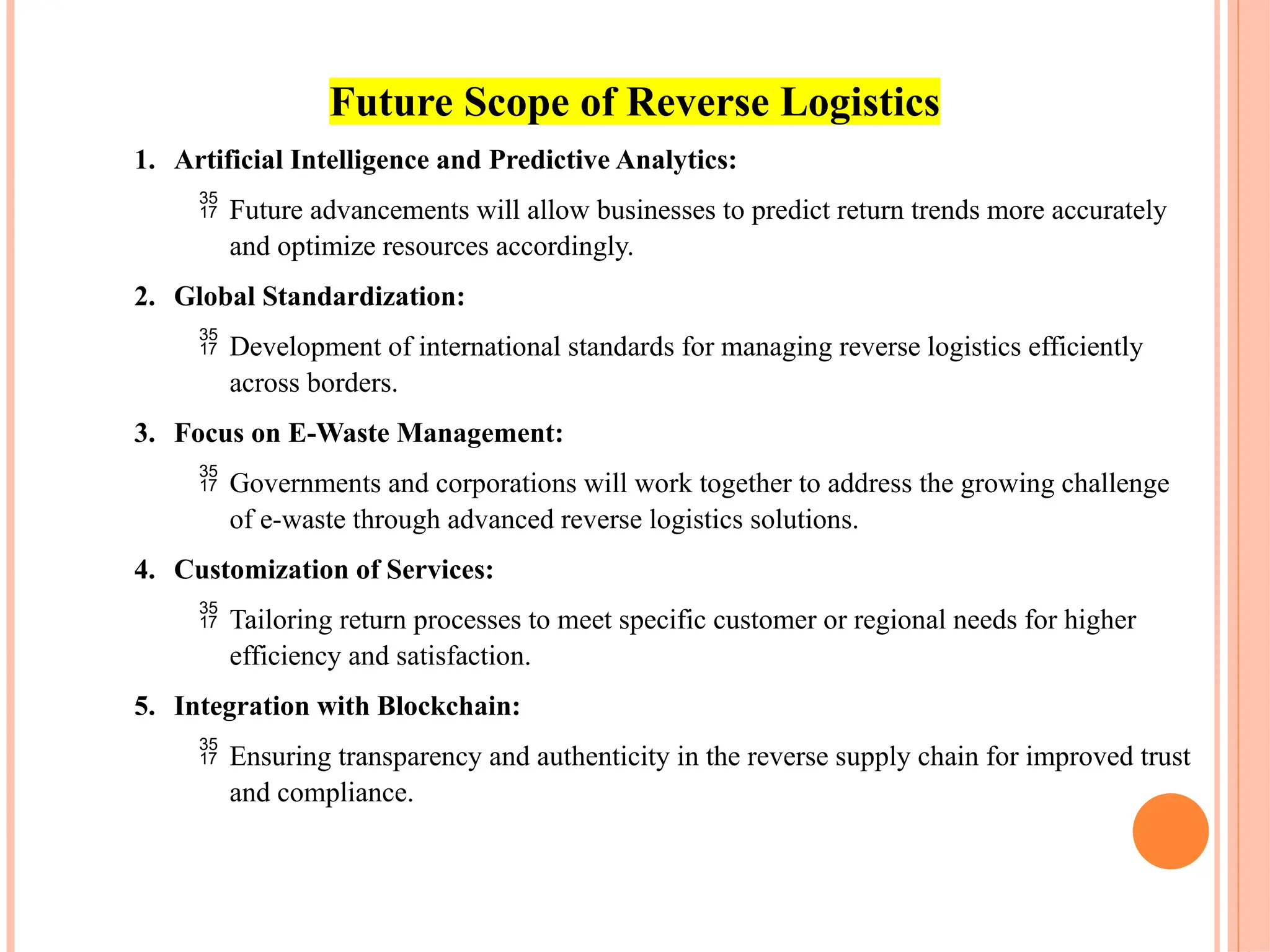
Future Scope of Reverse Logistics
1. Artificial Intelligence and Predictive Analytics:
 Future advancements will allow businesses to predict return trends more accurately
and optimize resources accordingly.
2. Global Standardization:
 Development of international standards for managing reverse logistics efficiently
across borders.
3. Focus on E-Waste Management:
 Governments and corporations will work together to address the growing challenge
of e-waste through advanced reverse logistics solutions.
4. Customization of Services:
 Tailoring return processes to meet specific customer or regional needs for higher
efficiency and satisfaction.
5. Integration with Blockchain:
 Ensuring transparency and authenticity in the reverse supply chain for improved trust
and compliance.

Supply chain lmUNIT 4.power point presentation

  • 1.
    UNIT-4 Warehousing: Concept and types, Warehousingstrategy, Warehouse facility location & network design, Reverse logistics, Outsourcing- Nature and concept, Strategic decision to Outsourcing, Third party logistics(3PL), Fourth party logistics(4PL).
  • 2.
    Warehousing: Concept andTypes • A warehouse may be defined as a place used for the storage or accumulation of goods. The function of storage can be carried out successful with the help of warehouses used for storing the goods. • Warehousing can also be defined as assumption of responsibility for the storage of goods. By storing the goods throughout the year and releasing them as and when they are needed, warehousing creates time utility.
  • 3.
    Functions of Warehousing A.Storage: This is the basic function of warehousing. Surplus commodities which are not needed immediately can be stored in warehouses. They can be supplied as and when needed by the customers. B. Price Stabilization: Warehouses play an important role in the process of price stabilization. It is achieved by the creation of time utility by warehousing. Fall in the prices of goods when their supply is in abundance and rise in their prices during the slack season are avoided. C. Risk bearing:  When the goods are stored in warehouses they are exposed to many risks in the form of theft, deterioration, exploration, fire etc. Warehouses are constructed in such a way as to minimise these risks. Contract of bailment operates when the goods are stored in wave- houses.  The person keeping the goods in warehouses acts as boiler and warehouse keeper acts as boiler. A warehouse keeper has to take the reasonable care of the goods and safeguard them against various risks. For any loss or damage sustained by goods, warehouse keeper shall be liable to the owner of the goods.
  • 4.
    D. Financing: Loans canbe raised from the warehouse keeper against the goods stored by the owner. Goods act as security for the warehouse keeper. Similarly, banks and other financial institutions also advance loans against warehouse receipts. In this manner, warehousing acts as a source of finance for the businessmen for meeting business operations. E. Grading and Packing: Warehouses nowadays provide the facilities of packing, processing and grading of goods. Goods can be packed in convenient sizes as per the instructions of the owner.
  • 5.
    Importance of WarehousingIn the Development of Trade and Commerce • Warehousing or storage refers to the holding and preservation of goods until they are dispatched to the consumers. Generally, there is a time gap between the production and consumption of products. By bridging this gap, storage creates time utility. • There is need for storing the goods so as to make them available to buyers as and when required. Some amount of goods is stored at every stage in the marketing process. Proper and adequate arrangements to retail the goods in perfect condition are essential for success in marketing. Storage enables a firm to carry on production in anticipation of demand in future. • A warehouse is a place used for the storage or accumulation of goods. It may also be defined as an establishment that assumes responsibility for the safe custody of goods. Warehouses enable the businessmen to carry on production throughout the year and to sell their products, whenever there is adequate demand. • Need for warehouse arises also because some goods are produced only in a particular season but are demanded throughout the year. Similarly certain products are produced throughout the year but demanded only during a particular season. Warehousing facilitates production and distribution on a large scale.
  • 6.
    1. Regular production:Raw materials need to be stored to enable mass production to be carried on continuously. Sometimes, goods are stored in anticipation of a rise in prices. Warehouses enable manufacturers to produce goods in anticipation of demand in future 2. Time utility: A warehouse creates time utility by bringing the time gap between the production and consumption of goods. It helps in making available the goods whenever required or demanded by the customers. 3. Some goods are produced throughout the year but demanded only during particular seasons, e.g., wool, raincoat, umbrella, heater, etc. on the other hand, some products are demanded throughout the year but they are produced in certain region, e.g., wheat, rice, potatoes, etc. Goods like rice, tobacco, liquor an 4. Store of surplus goods: Basically, a warehouse acts as a store of surplus goods which are not needed immediately. Goods are often produced in anticipation of demand and need to be preserved properly until they are demanded by the customers. Goods which are not required immediately can be stored in a warehouse to meet the demand in future. Benefits from Warehouses
  • 7.
    5. Price stabilization: Warehousesreduce violent fluctuations in prices by storing goods when their supply exceeds demand and by releasing them when the demand is more than immediate productions. Warehouses ensure a regular supply of goods in the market. This matching of supply with demand helps to stabilize prices. 6. Minimization of risk: Warehouses provide for the safe custody of goods. Perishable products can be preserved in cold storage. By keeping their goods in warehouses, businessmen can minimize the loss from damage, fire, theft etc. The goods kept in the warehouse are generally insured. In case of loss or damage to the goods, the owner of goods can get full compensation from the insurance company. 7. Packing and grading: Certain products have to be conditioned or processed to make them fit for human use, e.g., coffee, tobacco, etc. A modern warehouse provides facilities for processing, packing, blending, grading etc., of the goods for the purpose of sale. The prospective buyers can inspect the goods kept in a warehouse. 8. Financing: Warehouses provide a receipt to the owner of goods for the goods kept in the warehouse. The owner can borrow money against the security of goods by making an endorsement on the warehouse receipt. In some countries, warehouse authorities advance money against the goods deposited in the warehouse. By keeping the imported goods in a bonded warehouse, a businessman can pay customs duty in installments. Benefits from Warehouses
  • 8.
    Type of Warehouses I.Private Warehouses: The private warehouses are owned and operated by big manufacturers and merchants to fulfill their own storage needs. The goods manufactured or purchased by the owner of the warehouses have a limited value or utility as businessmen in general cannot make use of them because of the heavy investment required in the construction of a warehouse, some big business firms which need large storage capacity on a regular basis and who can afford money, construct and maintain their private warehouses. A big manufacturer or wholesaler may have a network of his own warehouses in different parts of the country II. Public Warehouses: A public warehouse is a specialized business establishment that provides storage facilities to the general public for a certain charge. It may be owned and operated by an individual or a cooperative society. It has to work under a license from the government in accordance with the prescribed rules and regulations.  Public warehouses are very important in the marketing of agricultural products and therefore the government is encouraging the establishment of public warehouses in the cooperative sector. A public warehouse is also known as duty-paid warehouse.
  • 9.
    • Public warehousesare very useful to the business community. Most of the business enterprises cannot afford to maintain their own warehouses due to huge capital Investment. In many cases the storage facilities required by a business enterprise do not warrant the maintenance of a private warehouse. Such enterprises can meet their storage needs easily and economically by making use of the public warehouses, without heavy investment. • Public warehouses provide storage facilities to small manufacturers and traders at low cost. These warehouses are well constructed and guarded round the clock to ensure safe custody of goods. Public warehouses are generally located near the junctions of railways, highways and waterways. • They provide, therefore, excellent facilities for the easy receipt, despatch, loading and unloading of goods. They also use mechanical devices for the handling of heavy and bulky goods. A public warehouse enables a businessman to serve his customers quickly and economically by carrying regional stocks near the important trading centres or markets of two countries. • Public warehouses provide facilities for the inspection of goods by prospective buyers. They also permit packaging, grading and grading of goods. The public warehouses receipts are good collateral securities for borrowings.
  • 10.
    Bonded Warehouses • Bondedwarehouses are licensed by the government to accept imported goods for storage until the payment of custom duty. They are located near the ports. These warehouses are either operated by the government or work under the control of custom authorities. • The warehouse is required to give an undertaking or ‘Bond’ that it will not allow the goods to be removed without the consent of the custom authorities. The goods are held in bond and cannot be withdrawn without paying the custom duty. The goods stored in bonded warehouses cannot be interfered by the owner without the permission of customs authorities. Hence the name bonded warehouse. • Bonded warehouses are very helpful to importers and exporters. If an importer is unable or unwilling to pay customs duty immediately after the arrival of goods he can store the goods in a bonded warehouse. He can withdraw the goods in installments by paying the customs duty proportionately. • In case he wishes to export the goods, he need not pay customs duty. Moreover, a bonded warehouse provides all services which are provided by public warehouses. Goods lying in a bonded warehouse can be packaged, graded and branded for the purpose of sale.
  • 11.
    Warehousing facility Location& Network Design • LOGISTICS network design is concerned with the purpose of the number and site of warehouses and manufacturing plants, allocation of customer demand, distribution of warehouses to production plants. The best configuration must be able to deliver the goods to the customers at the least cost (commonly used objective) while satisfying the service level needs. In most logistics network design models, the customer demand is exogenous and defined as a consistent quantity for each product. Such a uniform demand value does not take advantage of the possibility that different customers have different sensitivity to delivery lead-time. • Logistics network design is a vital strategic decision for Audi. It is very important to allocate the customer demand points to warehouses, and allocate products from warehouses to production plants. As Audi have become more global, there has been a trend towards outsourcing the logistics function to third-party logistics (3PL) firms, so that manufacturing companies can focus their efforts on their core competencies. Thus, 3PL companies must have the capability to design efficient and effective logistics network so as to add value to their clients’ business. Audi is excellent in this.
  • 12.
    • In AudiCompany, we see three new models for logistics network design with special focus on the perspective of 3PL companies. The chief objective of these new models is to increase the effectiveness of the resulting network design and the utilization of facilities in the network. The three models encompass the following areas: • Logistics network design with differentiated delivery lead time, • Logistics network design with price discount, and • Consolidated logistics network design using consolidation hubs. A new perspective of Audi that incorporates into logistics network design are, two factor namely delivery lead time and price discount that are usually not considered. This shows that designing network with differentiated delivery lead time can reduce the network cost, while the other shows that combining pricing decision and demand management can result in a network design with higher net profits, combines tactical decision for inventory replenishment policy with strategic decision for consolidated network design. These shows by adding consolidation hubs at suitable locations near to the suppliers, we can leverage on concave Audi’s cost to reduce the overall network cost.
  • 13.
    • Network designand inventory replenishment policy simultaneously our findings provide managerial insights into how 3PL companies can and their results to improve their business. Audi design more effective logistic networks to support their clients and Audi is applicable to the order fulfilment business process and managing suppliers for manufacturers. As every part is made by Audi but work is divided into different department, for example tyre, machine etc are produced in different plant. • Audi is designing a network according to demand classes segmented according to their sensitivity to delivery lead time. This shows that potential network cost savings can be achieved by designing a network with segmented customer demand as compared to a network without segmented demand. For the segmented demand case, the short LT demand customers are served from their local warehouse or a nearby warehouse which can satisfy the delivery lead time requirement; while the long LT demand customers are served directly from the hub which is located further away. In addition, the model explored the multiple facilities grouping method which groups facilities which can serve the same customer location within the short LT requirement. It was shown that multiple facility grouping can reduce the network cost, especially for networks with lower inventory holding cost and high fixed facility cost.
  • 14.
    Network Design: KeyIssues • Pick the optimal number, location, and size of warehouses and/or plants • Determine optimal sourcing strategy • Which plant/vendor should produce which product? • Determine best distribution channels • Which warehouses should service which customers? Data for Network Design • A listing of all products • Location of customers, stocking points and sources • Demand for each product by customer location • Transportation rates • Warehousing costs • Shipment sizes by product • Order patterns by frequency, size, and season, content • Order processing costs • Customer service goals
  • 15.
    Reverse Logistics: Applicationarea and Activities involved Reverse Logistics Reverse logistics is for all operations related to the reuse of products and materials. It is “the process of moving goods from their typical final destination for the purpose of capturing value, or proper disposal. Remanufacturing and refurbishing activities also may be included in the definition of reverse logistics.” Growing green concerns and advancement of green supply chain management concepts and practices make it all the more relevant. The number of publications on the topic of reverse logistics have increased significantly over the past two decades. The first use of the term “reverse logistics” in a publication was by James R. Stock in a White Paper titled “Reverse Logistics,” published by the Council of Logistics Management in 1992. The concept was further refined in subsequent publications by Stock (1998) in another Council of Logistics Management book, titled Development and Implementation of Reverse Logistics Programs, and by Rogers and Tibben-Lembke (1999) in a book published by the Reverse Logistics Association titled Going Backwards: Reverse Logistics Trends and Practices. The reverse logistics process includes the management and the sale of surplus as well as returned equipment and machines from the hardware leasing business. Normally, logistics deal with events that bring the product towards the customer. In the case of reverse logistics, the resource goes at least one step back in the supply chain. For instance, goods move from the customer to the distributor or to the manufacturer.
  • 16.
    When a manufacturer’sproduct normally moves through the supply chain network, it is to reach the distributor or customer. Any process or management after the delivery of the product involves reverse logistics. If the product is defective, the customer would return the product. The manufacturing firm would then have to organise shipping of the defective product, testing the product, dismantling, repairing, recycling or disposing the product. The product would travel in reverse through the supply chain network in order to retain any use from the defective product. The logistics for such matters is reverse logistics.
  • 18.
    Benefits of anEfficient Reverse Logistics Systems While many companies consider the return process to be a necessary evil that shouldn’t be noticed, companies that implement an effective reverse logistics workflow can reap several benefits. Some of these benefits are:- Reduced costs By planning ahead for returns and making the return order right, you can reduce related costs (administration, shipping, transportation, tech support, QA, etc.) Faster service This refers to the original shipping of goods and the return / reimbursement of goods. Quickly refunding or replacing goods can help restore a customer’s faith in a brand. Customer retention Dealing with errors is just as important as making sales. If a customer had a bad experience with your product, you have to make it right. Fulfilment blunders can create educational opportunities. Learn how to keep your customers happy and engaged with your company – even after you’ve made a mistake. Reduced losses and unplanned profits Recover the loss of investment in your failed product by fixing and restocking the unit, scrapping it for parts, or repurposing it in a secondary market. With a good reverse logistics program in place, you don’t have to leave money on the table. Take a product that would otherwise just cost your company money and turn it into an unforeseen asset.
  • 19.
    Application area andActivities involved in Reverse Logistic Reverse logistics has become one of the significant concepts for various industries to practice to achieve sustainability objectives. Reverse logistic is defined as “The movement of goods from a consumer towards a producer in a channel of distribution”. A number of cases that implement successful reverse logistics system have been found worldwide in specific industrial sectors such as heavy machines, electronic sectors and plastic sector. Whereas, there is a limited application of reverse logistics in other sectors. The main purpose of this study is to explore and describe the applications of reverse logistics processes in industrial sector. This leads the researcher to conduct a comparison using qualitative approach between those applications to highlight strengths and weaknesses in RL practices in Egyptian industrial companies. Finally, the researcher proposes a number of corrective and preventive actions to improve the application of RL. Based on the findings of the comparison, the researcher recommends that the companies shall establish, implement and maintain acquisition strategy and a manual to describe the inspection criteria and guidelines for the inspection process to accelerate the process and avoid any errors in deposition decision.
  • 20.
    Outsourcing: Nature andConcept • Outsourcing is the process of contracting a business function or any specific business activity to specialized agencies. Mostly, the non-core areas such as sanitation, security, household, pantry, etc are outsourced by the company. The company makes a formal agreement with the agency. • The agency then sends the manpower required to the company. The agency charges the company for their services and in turn pays wages to their employees. Global competition has given rise to outsourcing. With the help of outsourcing, companies can focus on their core areas which leads to better profits and increase the quality of their product. Advantages of Outsourcing Overall Cost Advantage: It eludes the need to hire individuals in house; hence ‐ recruitment and operational costs can be minimized to a great extent. It reduces the cost and also saves time and efforting on training cost. Stimulates Entrepreneurship, Employment, and Exports: Outsourcing stimulates Entrepreneurship, Employment, and Exports in the country from where outsourcing is done. Look at the example of India. After the initial success of call centres, there was a sudden emergence of many small scales and medium scale BPo and KPO companies.
  • 21.
    Low Manpower Cost:The manpower cost is much lower than that of the host country. This is exactly the case with India. We have a very large educated workforce. And this causes the labour cost in our country to be much lower. Access to Professional, Expert and High quality Services: ‐ Mostly, the tasks are given to people who are skilled in that particular field. This provides us with a better level of service and fewer chances of errors or misjudgment. Emphasis on Core Process Rather than the Supporting Ones: With its help, companies can focus on their core areas which lead to better profits and increase the quality of their product. They simply outsource ancillary services. Investment Requirements are Reduced: The organization can save on investing in the latest technology, software, and infrastructure and let the outsourcing partner handle the entire infrastructure. Increased Efficiency and Productivity: There is an increased efficiency and productivity in the non – core areas of an organization. Knowledge Sharing: Outsourcing enables the organizations to share knowledge and best practices with each It helps develop both the companies and also boosts goodwill in the industry.
  • 22.
    DISADVANTAGES OF OUTSOURCING Lackof Customer Focus: An outsourced vendor may be catering to the needs of multiple organizations at a time. In such situations, vendors may lack complete focus on an individual organization’s tasks. And the reputation of the organization may suffer as a result A Threat to Security and Confidentiality: The inside news of the organization may be leaked to the third party, so there are security issues. The leak of sensitive information may result in losses to the company and also be an advantage to competitors. Dissatisfactory Services: Some of the common problem areas with outsourcing include stretched delivery time and sub standard quality. ‐ Ethical Issues: The major ethical issue is taking away employment opportunities from one’s own country. Instead of creating employment and wealth in the origin country it gets outsourced to another country. In recent times this has been viewed by many as unethical and even unpatriotic. Other Disadvantages: Include misunderstanding of the contract, lack of communication, poor quality and delayed services amongst others.
  • 23.
    Strategic Decision toOutsourcing • Does strategic outsourcing actually benefit an organization? Or will it backfire in the long run? Here’s how outsourcing has impacted organizations in India, and how it can benefit you. by Soutiman Das Gupta • What do companies like Hero Honda Motors, Bharti Tele-Ventures Limited, the National Stock Exchange (NSE), HDFC Bank, Sony Entertainment Television, Hyatt Services India Pvt. Ltd, and HPCL have in common? • The common thread running through these large organizations is that all of them have chosen outsourcing as a strategic business decision to garner tangible and intangible benefits in the near and long run. • Indeed, it’s difficult to find a successful and growing organization in India, irrespective of size, that does not outsource a certain amount of its IT infrastructure services or management.
  • 24.
    HOW DOES ITWORK? Does it make sense for an organization to outsource its IT needs? Most of the CIOs and analysts we spoke to felt that strategic outsourcing helps an organization to save on cost and speed up delivery while focusing on core business needs. To elaborate on the benefits, let’s look at Infrastructure Strategies (IS 2004), the CIO annual survey conducted by Network Magazine to analyze technology investment patterns in the Indian enterprise. The survey, conducted amongst India’s top corporates, shows that nearly 54 per cent of the CIOs outsource “to reduce costs”. A similar view is echoed by Michele Caminos, Vice President, Team Manager, IT Services, Asia/Pacific, Gartner. “The most compelling reason why companies get into outsourcing engagements is to save costs,” she agrees. According to Infrastructure Strategies, other impor-tant drivers for strategic IT outsourcing are focus on core competencies, access to special expertise, higher speed of delivery, and access to new technologies.
  • 25.
    Focus on thecore • Given the pressures of a competitive market, organizations tend to focus on their core activities — activities that link-up directly with the revenues and hence the profitability. In such a scenario, companies tend to outsource their non-core tasks to focus on business decision-making. And IT infrastructure easily lends itself to outsourcing. • Hero Honda Motors is a good example of an organization that uses strategic outsourcing to focus on core competency. “We wanted to outsource all routine (IT maintenance) tasks so that we could concentrate on the main business issues. With the headache of dealing with routine complaints taken away, our staff focuses on user requirements and is able to deliver services to users on time,” explains SR Balasubramanian, Vice President – Information Systems, Hero Honda Motors Limited. • The IS 2004 survey reports that 46 per cent of the CIOs who outsource or have plans to do so, consider “focus on core competencies” as the second most important reason to outsource. • “There are definite cost savings in terms of resource management and less manpower costs. As an IT team we can focus more on providing new infrastructure solutions to enable various requirements of our core media business rather than get caught up with the daily maintenance requirements of the existing set-up,” explains Aneeta Pankaj, Senior Manager, Information Technology, Sony Entertainment Television (SET) India Private Limited.
  • 26.
    • Outsourcing isbest adopted after a careful look at business needs and available options. It is essential that the outsourcing relationship provides strategic business benefits in the future. • “Outsourcing provides a competitive strategy benefit in a number of ways to an organization. It allows ease of management, reduction in cost, lesser manpower, and frees up internal resources,” says Pankaj. • “Outsourcing can, and frequently does, provide both long- and short-term benefits to companies that outsource, provided they have a strategic objective for outsourcing. Medium and long-term gains are best realised by selecting a vendor who brings value to your core business, rather than one who can provide you with the lowest prices,” explains Sharad Sanghi, Managing Director & CEO, Netmagic Solution Pvt. Ltd. COMPETITIVE BUSINESS STRATEGY
  • 27.
    Business-Related • It’s importantto understand that outsourcing is a business-related decision and not simply an IT need. The ultimate goal of outsourcing is to bring benefits to the business and subsequently the customer. • Hero Honda’s Balasubramanian says, “We believe an outsourcing service provider could better handle our day-to-day management needs than our own team. We’ve not added numbers to our staffing in spite of increased business activity. Since the outsourcing agency manages the data centre round the clock, our staff has been relieved from working in shifts.” • Bharti Tele-Ventures Limited has cut one of the largest outsourcing deals in Asia on the IT infrastructure and network management areas. Dr Jai Menon, Joint President, Enterprise Business, Bharti Tele-Ventures, says that the outsourcing relationship has brought, “unparalleled value to the company for our customers, employees and shareholders.” • “For customers, it brings innovative and streamlined products and services like billing, CRM and data warehousing. For employees, it brings enhanced performance-critical applications like intranet, e-mail and online collaboration. And at an overall level, the strategic alliance provides predictable IT spends, and additional revenue streams to further enhance shareholder value,” he adds
  • 28.
    THE CHANGING LADSCAPE •In the past, Indian companies were not very keen to outsource their IT needs, primarily because their enterprise IT environments were relatively less complex, easier to manage, and inexpensive to maintain. Besides, few outsourcing service providers offered a number of outsourcing options under one roof. • But now, IT environments in companies have become more complex. There has been growth in terms of volume of business, range of services, number of employees, number of competitors, nationwide locations, and enterprise applications. This calls for more attention to IT as a service to provide strategic business benefits. • To help organizations get optimum value out IT and use it as a strategic tool to further the cause of business, many CIOs think it worth their while to outsource IT infrastructure management.
  • 29.
    Innovative options • Indianenterprises today have a variety of outsourcing options from which they can choose the right fit. Outsourcing solution providers offer services that include desktop client management, server management, cable management, firewall management, patch management, software license management, IT audits, backbone and connectivity, website hosting, and IT infrastructure management. • Thus the available services are innovative, significantly more customised, and better aligned with individual customer requirements. An enterprise can pick- and-chose specific services and build a reliable mode of service delivery. A company can outsource basic desktop management needs, or the management of the entire nationwide IT infrastructure if needed. • To introduce more flexibility, many service providers offer clients hire-purchase schemes, infrastructure on-demand, and pay-as-you-use options.
  • 30.
    • Hyatt ServicesIndia Pvt. Ltd has given a three-year contract to a service provider to outsource network monitoring services. Says Harcharan Singh, the company’s Director of Information Systems, “The service provider has to upgrade and buy back the existing hardware as per the depreciation cost agreed in the SLA. This clause protects us from technology obsolescence, since technology changes rapidly.” • IndusInd bank has entered into an infrastructure-on-demand agreement with IBM India, which includes building an IT infrastructure, implementing server consolidation, and setting up disaster recovery systems. The partnership supports the bank’s goal to become totally customer-centric by providing more secure, responsive and efficient service, in line with its renewed focus on retail banking. It allows the bank to scale up operations and pursue aggressive growth plans.
  • 31.
    Before you outsource •All things said, outsourcing is a strategic business decision that should be made only if a company sees true business benefits accruing from it. Badly- planned outsourcing could result in erosion of service value and cost escalation, but a well-planned outsourcing decision can help you sleep better at night, knowing that the responsibility of deliverables is in safe hands. • Michele Caminos of Gartner highlights a few steps that can lead you to take a proper decision in this context. • What type of a service is it? Identify characteristics of service and the respective type. • What perspective is driving the effort? Identify decision rights (service owner) and input rights (other stakeholders). • How are other perspectives affected? Identify conflicts and work them out. Check ‘killer’ factor. Improve solution. • Check compliance with principles and fit with architecture. • Who should carry it out? Evaluate different staffing possibilities. Select best from combination. • Who should participate in the decision? Submit service proposal to specific decision process. Follow it up.
  • 32.
    recommends the following: •Understand different business perspectives and how they affect sourcing decisions. • Understand how perspectives must be harnessed to drive sourcing decisions. • Develop a structured sequence of steps to sourcing decisions. • Develop evolving governance architecture to support sourcing decisions. • Develop internal sourcing decision roles.
  • 33.
    Third Party Logistics(3PL)  A 3PL (third-party logistics) provider offers outsourced logistics services, which encompass anything that involves management of one or more “facets of procurement”(a specific aspect or component within the broader process of procurement) and fulfillment activities.  In business, 3PL has a broad meaning that applies to any service contract that involves storing or shipping items.  A 3PL service may be a single provider, such as transportation or warehouse storage, or it can be a systemwide bundle of services capable of handling supply chain management.
  • 34.
    How Third-Party Logisticswork  Here is an example of how 3PL arrangements operate:  A book publisher hires writers, editors and graphic designers to produce publications, but it may not want to handle the consumer ordering process or transportation of book shipments. Instead, the book publisher uses a fulfillment center to process its online orders and hires a trucking carrier to haul its freight. The fulfillment center and carrier both act as 3PL providers. It’s possible for a single 3PL provider to fulfill and ship book orders, too. By contracting with a 3PL provider, the book company can use supply and distribution services only when needed, thus controlling costs more effectively while focusing on its core competency of producing books.
  • 35.
    Aspects of 3PLsprobably date back hundreds, if not thousands, of years. The Council of Supply Chain Management Professionals traces the actual 3PL abbreviation to four decades ago. “The term 3PL was first used in the early 1970s to identify intermodal marketing companies … in transportation contracts,” the council wrote in a glossary. “Up to that point, contracts for transportation had featured only two parties, the shipper and the carrier.” • The Motor Carrier Act of 1980 deregulated the trucking industry, which reduced trucking rates and also increased the amount of competition, all of which fed into 3PL concepts. • The term 3PL got bandied about more by consultants and during conferences in the 1990s, likely tied to evolving technology, including the rise of the internet. The growth of 3PLs
  • 36.
    An overview oflevels of Logistics Service • Later, the Consumer Product Safety Improvement Act of 2008 legally defined 3PL: “The term third-party logistics provider means a person who solely receives, holds or otherwise transports a consumer product in the ordinary course of business but who does not take title to the product.” • According to a frequently cited 2017 report from Armstrong & Associates, a supply chain consultancy, 90% of domestic Fortune 500 companies rely on 3PL providers to handle logistics, compared to the 46% Armstrong reported in 2001. • The growth in online sales and increasing consumer demand for faster delivery and lower prices have spiked demand for 3PL services. 3PLs have also bloomed thanks to tracking technology, such as radio frequency identification (RFID) and global positioning system (GPS), both of which offer extended supply chain visibility. Meanwhile, internet of things (IoT) technology has improved tracking metrics for trucking and other carriers.
  • 37.
    The Benefits of3PL  The primary benefit of using a 3PL service to handle logistics, such as packaging, warehousing, fulfillment and distribution, is cost savings — for example, not having to maintain a warehouse or the staff to monitor supply chain operations.  A 3PL service likely offers better performance on efforts such as shipping while also enjoying an easier ability to scale its operations. If the publishing company in the example above suddenly needs to ship more copies of a popular title, a fulfillment center will have an easier time meeting that demand than if the publisher itself had to ship additional copies of the book.
  • 38.
    3PL vs. freightforwarding  Freight forwarding and 3PL may come across as similar, but there are noticeable differences. A. Freight forwarders do not actually ship materials, and instead function as a liaison between a client company and shipping firms. B. The freight forwarder negotiates prices, determines the best modes of transportation, establishes economical shipping routes and works on other logistics concerns. As noted earlier, 3PL providers handle a broader range of services compared to forwarders.
  • 39.
    Fourth Party Logistics(4PL) • While third-party logistics outsourcing is accepted business practice (though not without risk), corporations are now looking to outsource to a single partner who will assess, design, build, run and measure integrated comprehensive supply chain solutions on their behalf. This evolution in supply chain outsourcing is Fourth-party Logistics or 4PL. • A 4PL provider is a supply chain integrator. The 4PL assembles and manages all resources, capabilities and technology of an organisation's Supply Chain and its array of providers. • An experienced and reliable 4PL provider will bring value and a reengineered approach to your organisation as it will manage the logistics process, regardless of what carriers, forwarders or warehouses are used. As the centralised contact with the client, 4PL has overall responsibility for logistics performance and the ability to impact the entire supply chain and not just single elements. Consider how many discrete discussions you need to have in your company to ensure your product gets into consumers hands!
  • 40.
    • Like BusinessProcess Outsourcing, a 4PL solution aims to manage people, process and technology. Importantly, 4PL outsourcing must not be seen as a pure cost reduction issue and if it is considered as such then it is prone to failure. Adopting a 4PL approach brings a different perspective, knowledge, experience and technology to the existing in-house function. Successful 4PL partnerships will see both parties work side by side motivated by mutual success and reward. • Some of the 4PL benefits include: access to a broader base of potential suppliers; back-end system integration; increased market transparency for goods and services; standardisation and automation of order placement; reduced procurement costs and order cycle times. If your business and people are sufficiently mature you might also integrate the 4PL into the S&OP process. Think how powerful that could be! • Organisations are exploring this solution because it can improve their own bottom line through increased and sustainable business efficiency. A word of warning; do not go down this road unless your existing supply chain is already robust AND people are sufficiently experienced to cope with a very different way of doing business.
  • 41.
    Aspect 3PL (Third-PartyLogistics) 4PL (Fourth-Party Logistics) Definition Provides outsourced logistics services, such as warehousing, transportation, and distribution. Acts as a strategic integrator managing the entire supply chain for the client. Scope of Services Focuses on specific logistical functions like transportation and storage. Offers comprehensive supply chain management, including strategy, design, and execution. Control Client retains control of the supply chain while outsourcing specific tasks. 4PL takes full control of the supply chain, acting as a single point of contact. Expertise Specialises in operational logistics. Focuses on strategic oversight and optimisation of the entire supply chain. Relationship with Client Operates as a service provider. Acts as a partner and supply chain consultant. Technology May use logistics technology for tracking and operations. Integrates advanced systems and technologies for end-to-end visibility and decision-making. Examples of Services - Transportation - Warehousing - Order fulfilment - Supply chain strategy - Vendor management - Performance monitoring Complexity Handles fewer aspects of the supply chain, making it less complex. Manages multiple 3PLs and suppliers, making it more complex. Cost Generally lower due to a narrower focus. Higher cost due to strategic involvement and broader services. Examples DHL, FedEx, UPS Accenture, Deloitte (in supply chain management roles) Differentiating 3PL (Third-Party Logistics) and 4PL (Fourth-Party Logistics):
  • 42.
    Designing Supply ChainNetwork for each industry or business involves arriving at a satisfactory design framework taking into all elements like product, market, process, technology, costs, external environment and factors and their impact besides evaluating alternate scenarios suiting your specific business requirements. No two supply chain designs can be the same. The network design will vary depending upon many factors including location and whether you are looking at national, regional or global business models. Supply Chain Network in Simple and basic Terms Involves determining following process design: Procurement Where are your suppliers How will you procure raw materials and components Manufacturing Where will you locate the factories for manufacturing/assembly Manufacturing Methodology Finished Good Where will you hold inventories, Number of Warehouses, Location of warehouses etc. How will you distribute to markets – Transportation and Distribution logistics All above decisions are influenced and driven by Key Driver which is the Customer Fulfillment. Factor that influences designing Global Supply Chain Network
  • 43.
  • 44.
    Definition Reverse logistics refersto the process of moving goods from their final destination back to the manufacturer, retailer, or another point in the supply chain for the purposes of return, repair, recycling, remanufacturing, or disposal.
  • 45.
    Reverse logistics isno longer just a cost centre but a strategic asset. With rising environmental awareness and customer expectations, companies are leveraging reverse logistics to build a competitive advantage and contribute positively to society and the environment. By adopting innovative practices and technologies, businesses can turn returns and waste into valuable opportunities. Reverse logistics plays a vital role in modern supply chains by ensuring sustainability, improving customer satisfaction, and optimizing resource use, making it a cornerstone of efficient and responsible business operations.
  • 46.
    1. Product Returns: Customers return goods due to defects, incorrect shipments, or dissatisfaction.  The products are inspected to decide whether they can be resold, refurbished, or recycled. 2. Repairs and Maintenance:  Faulty or damaged products are repaired and reintroduced into the market or sent back to the consumer. 3. Recycling:  Used products are collected, dismantled, and the materials are recycled for reuse in production. 4. Remanufacturing:  Products are restored to like-new condition, extending their lifecycle. 5. Disposal:  Products that cannot be reused, repaired, or recycled are disposed of responsibly to minimize environmental impact. 6. Packaging Returns:  Reusable packaging materials (e.g., pallets, containers) are returned to the supply chain. Key Processes in Reverse Logistics:
  • 47.
    1. Cost Savings: Reduces costs associated with waste management and sourcing new raw materials. 2. Customer Satisfaction:  Efficient return and repair processes improve customer loyalty and brand reputation. 3. Environmental Benefits:  Encourages recycling and reduces waste, contributing to sustainability goals. 4. Regulatory Compliance:  Meets legal requirements for proper disposal and recycling of products. 5. Resource Recovery:  Maximizes the value of returned goods and materials. Importance of Reverse Logistics
  • 48.
    1. E-commerce: Handles highvolumes of returns due to online shopping. 2. Electronics: Focuses on recycling e-waste and remanufacturing. 3. Automotive: Reclaims and refurbishes parts like batteries, engines, and tires. 4. Retail: Manages customer returns and unsold inventory. 5. Pharmaceuticals: Ensures the safe return and disposal of expired or recalled medicines. Industries Benefiting from Reverse Logistics
  • 49.
    Challenges in ReverseLogistics 1. Complexity in Operations: Managing diverse return channels and conditions. 2. High Costs: Logistics, labour, and refurbishment costs can be significant. 3. Uncertainty: Unpredictable volume and timing of returns. 4. Inventory Management: Balancing refurbished goods with new products. 5. Integration with Forward Logistics: Aligning reverse logistics with the traditional supply chain for efficiency.
  • 50.
    Technological Solutions: 1. Trackingand Automation: RFID and IoT for efficient monitoring and management of returned goods. 2. Artificial Intelligence (AI): Optimizes decision-making in repair or recycling processes. 3. Blockchain: Ensures transparency and traceability in the reverse supply chain. Technological Solutions
  • 51.
    1. Circular EconomyIntegration:  Reverse logistics is becoming a key component of the circular economy, where materials and products are reused, refurbished, or recycled to minimize waste and environmental impact. 2. Green Logistics:  Companies are focusing on eco-friendly practices, such as using renewable energy for transportation, reducing carbon footprints, and implementing sustainable disposal methods. 3. Digital Transformation:  Advanced technologies like Artificial Intelligence (AI), Machine Learning (ML), and Big Data analytics are helping organizations predict return trends, optimize logistics routes, and enhance decision-making. 4. 3D Printing:  Used in remanufacturing to create spare parts quickly, reducing dependency on traditional supply chains. 5. Consumer Responsibility: Encouraging customers to participate in recycling programs through incentives, such as discounts or loyalty points for returning old products Emerging Trends in Reverse Logistics
  • 52.
    Benefits of EffectiveReverse Logistics 1. Enhanced Brand Image:  Companies that effectively manage returns and recycling demonstrate social and environmental responsibility, improving their public image. 2. Reduced Waste:  Diverting waste from landfills through repair, recycling, and remanufacturing. 3. Increased Profit Margins:  Refurbishing products and reintroducing them into the market can generate additional revenue. 4. Inventory Optimization:  Utilizing returned goods effectively reduces the need for manufacturing new products. Benefits of Effective Reverse Logistics
  • 53.
    Strategies to ImproveReverse Logistics 1. Streamlined Return Policies:  Clear and customer-friendly policies to simplify the return process. 2. Efficient Data Management:  Real-time tracking and monitoring of returned goods through integrated IT systems. 3. Collaboration with Partners:  Working with third-party logistics providers (3PLs) for expertise and infrastructure support. 4. Training and Awareness:  Educating employees and customers about the importance of reverse logistics and proper return handling. 5. Sustainability Goals Alignment:  Aligning reverse logistics strategies with corporate sustainability objectives to ensure long-term viability. Strategies to Improve Reverse Logistics
  • 54.
    Case Studies 1. Amazon: Amazon has a robust reverse logistics system that enables customers to return items seamlessly. Returned goods are inspected, refurbished, resold, or recycled to minimize waste. 2. Dell:  Dell operates a take-back program to recycle old computers and components, promoting sustainability and reducing e-waste. 3. H&M:  The company encourages customers to return old clothes, which are either resold, repurposed into new garments, or recycled. 4. Apple:  Apple’s “Trade-In” program allows customers to return used devices for credit or recycling, emphasizing product longevity and sustainability.
  • 55.
    Metrics to MeasureReverse Logistics Performance 1. Return Rate: The percentage of products returned compared to total sales. 2. Processing Time: Time taken to inspect, repair, or recycle returned items. 3. Cost Per Return: Total cost incurred for processing a single returned item. 4. Recovery Value: Revenue generated from refurbished or recycled goods. 5. Customer Satisfaction: Feedback and ratings from customers on the return experience.
  • 56.
    Future Scope ofReverse Logistics 1. Artificial Intelligence and Predictive Analytics:  Future advancements will allow businesses to predict return trends more accurately and optimize resources accordingly. 2. Global Standardization:  Development of international standards for managing reverse logistics efficiently across borders. 3. Focus on E-Waste Management:  Governments and corporations will work together to address the growing challenge of e-waste through advanced reverse logistics solutions. 4. Customization of Services:  Tailoring return processes to meet specific customer or regional needs for higher efficiency and satisfaction. 5. Integration with Blockchain:  Ensuring transparency and authenticity in the reverse supply chain for improved trust and compliance.