WAREHOUSING
Presented by –
Mohd Kamran Yusuf (12mba41)
Syed Mohd Arbaz Ali (12mba40)
WAREHOUSE
 A commercial building for storage of goods
 Used by importers, exporters, wholesalers
 Situated in industrial areas of cities, towns and
villages
 Designed for loading and unloading of good
Historically a dominant part of urban
landscape
Used from the start of industrial revolution
Typically of four types
 Overseas warehouses
 Packaging warehouses
 Railways warehouses
 Canal warehouses
WAREHOUSING
 According to Robert Hughes“warehousing is the set of activities that are involved in
receiving and storing of goods and preparing them for
reshipment “

 Warehousing is not only concerned with storage facilities
but also involved in various other activities like –





Receiving,
identifying,
Holding
Assembling and preparing to meet the demand
KINDS OF WAREHOUSING
 Private warehousing•
•
•
•

Owned and leased by the firm
Complete control over activities
Used for special storage and handling needs
Used by firm to move product to large areas

 Public warehousing
•
•
•
•

Operated by professionals
Provides services to firm for a particular fees
No fixed investment involved
Used by firms keeping in views the locations and fright
rates
 Bonded warehousing
•
•
•
•

Licensed to accept imported goods before payment of custom duties
Importer gains some control without paying some duties
Goods under the strict supervision of custom officer
Permission is necessary before the owner can interfere with the goods

 Government warehousing
•
•
•
•

Mainly located at important seaport
Owned by the Dock Authorities
Available to general public on payment of fixed charges
Authority can recover the rent by disposing goods if customer can not
pay in time
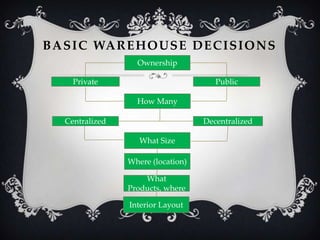
B A S I C WA R E H O U S E D E C I S I O N S
Ownership
Private

Public
How Many

Centralized

Decentralized
What Size
Where (location)
What
Products, where
Interior Layout
Public vs. Private Warehouse

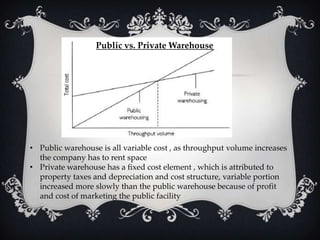
• Public warehouse is all variable cost , as throughput volume increases
the company has to rent space
• Private warehouse has a fixed cost element , which is attributed to
property taxes and depreciation and cost structure, variable portion
increased more slowly than the public warehouse because of profit
and cost of marketing the public facility
Public vs. Private Warehouse

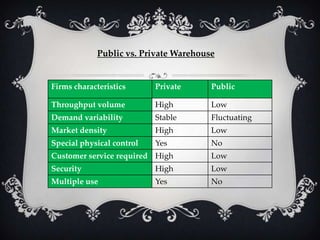
Firms characteristics

Private

Public

Throughput volume

High

Low

Demand variability

Stable

Fluctuating

Market density

High

Low

Special physical control

Yes

No

Customer service required High

Low

Security

High

Low

Multiple use

Yes

No
F U N C T I O N S O F WA R E H O U S I N G
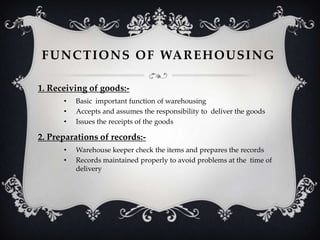
1. Receiving of goods:•
•
•

Basic important function of warehousing
Accepts and assumes the responsibility to deliver the goods
Issues the receipts of the goods

2. Preparations of records:•
•

Warehouse keeper check the items and prepares the records
Records maintained properly to avoid problems at the time of
delivery
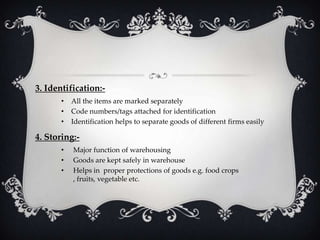
3. Identification:•
•
•

All the items are marked separately
Code numbers/tags attached for identification
Identification helps to separate goods of different firms easily

4. Storing:•
•
•

Major function of warehousing
Goods are kept safely in warehouse
Helps in proper protections of goods e.g. food crops
, fruits, vegetable etc.
5. Packing:•
•

Provided by the warehouse keeper if owner requires
such facilities
Packaging is done in a reasonable way according to size
and quantity of goods

6. Information about receipts:•

Warehouse keeper checks and informs about the goods
to the concerned department
7. Breaking of bulks:•
•

Generally goods delivered in bulk
If owner wants in small quantity, keepers packs according to
the requirements of customer

8. Search the goods:•

Warehouse keeper searches efficiently and provides the
goods to the owner, whenever he demands

9. Delivery of goods:•
•

Documents are checked and prepared and
Goods are loaded over transport
Factors to be Considered

It is desirable to maximize the following factors1.

Space utilization

2.

Equipment utilization

3.

Labour utilization

4.

Accessibility of all materials

5.

Protection of all materials
Benefits of Warehousing

Warehousing reduces the cost in four ways1.

Consolidation of materials

2.

Breaking the bulk materials

3.

Processing

4.

Storing
Thank You

Warehousing

  • 1.
    WAREHOUSING Presented by – MohdKamran Yusuf (12mba41) Syed Mohd Arbaz Ali (12mba40)
  • 2.
    WAREHOUSE  A commercialbuilding for storage of goods  Used by importers, exporters, wholesalers  Situated in industrial areas of cities, towns and villages  Designed for loading and unloading of good
  • 3.
    Historically a dominantpart of urban landscape Used from the start of industrial revolution Typically of four types  Overseas warehouses  Packaging warehouses  Railways warehouses  Canal warehouses
  • 4.
    WAREHOUSING  According toRobert Hughes“warehousing is the set of activities that are involved in receiving and storing of goods and preparing them for reshipment “  Warehousing is not only concerned with storage facilities but also involved in various other activities like –     Receiving, identifying, Holding Assembling and preparing to meet the demand
  • 5.
    KINDS OF WAREHOUSING Private warehousing• • • • Owned and leased by the firm Complete control over activities Used for special storage and handling needs Used by firm to move product to large areas  Public warehousing • • • • Operated by professionals Provides services to firm for a particular fees No fixed investment involved Used by firms keeping in views the locations and fright rates
  • 6.
     Bonded warehousing • • • • Licensedto accept imported goods before payment of custom duties Importer gains some control without paying some duties Goods under the strict supervision of custom officer Permission is necessary before the owner can interfere with the goods  Government warehousing • • • • Mainly located at important seaport Owned by the Dock Authorities Available to general public on payment of fixed charges Authority can recover the rent by disposing goods if customer can not pay in time
  • 7.
    B A SI C WA R E H O U S E D E C I S I O N S Ownership Private Public How Many Centralized Decentralized What Size Where (location) What Products, where Interior Layout
  • 8.
    Public vs. PrivateWarehouse • Public warehouse is all variable cost , as throughput volume increases the company has to rent space • Private warehouse has a fixed cost element , which is attributed to property taxes and depreciation and cost structure, variable portion increased more slowly than the public warehouse because of profit and cost of marketing the public facility
  • 9.
    Public vs. PrivateWarehouse Firms characteristics Private Public Throughput volume High Low Demand variability Stable Fluctuating Market density High Low Special physical control Yes No Customer service required High Low Security High Low Multiple use Yes No
  • 10.
    F U NC T I O N S O F WA R E H O U S I N G 1. Receiving of goods:• • • Basic important function of warehousing Accepts and assumes the responsibility to deliver the goods Issues the receipts of the goods 2. Preparations of records:• • Warehouse keeper check the items and prepares the records Records maintained properly to avoid problems at the time of delivery
  • 11.
    3. Identification:• • • All theitems are marked separately Code numbers/tags attached for identification Identification helps to separate goods of different firms easily 4. Storing:• • • Major function of warehousing Goods are kept safely in warehouse Helps in proper protections of goods e.g. food crops , fruits, vegetable etc.
  • 12.
    5. Packing:• • Provided bythe warehouse keeper if owner requires such facilities Packaging is done in a reasonable way according to size and quantity of goods 6. Information about receipts:• Warehouse keeper checks and informs about the goods to the concerned department
  • 13.
    7. Breaking ofbulks:• • Generally goods delivered in bulk If owner wants in small quantity, keepers packs according to the requirements of customer 8. Search the goods:• Warehouse keeper searches efficiently and provides the goods to the owner, whenever he demands 9. Delivery of goods:• • Documents are checked and prepared and Goods are loaded over transport
  • 14.
    Factors to beConsidered It is desirable to maximize the following factors1. Space utilization 2. Equipment utilization 3. Labour utilization 4. Accessibility of all materials 5. Protection of all materials
  • 15.
    Benefits of Warehousing Warehousingreduces the cost in four ways1. Consolidation of materials 2. Breaking the bulk materials 3. Processing 4. Storing
  • 16.

Editor's Notes

  • #15 Storing goods in adequate space with the proper equipment by well trained personnel in a properly planned layout results in maximum protection of items