Welingkar’s Distance Learning Division

CHAPTER-5

Warehouse Management

We Learn – A Continuous Learning Forum
Warehouse Management
• Organizations choose their warehouses
locations normally as near as possible to the
points of consumption
• Similarly they locate their factories (Normally)
as near as possible to the source of raw
materials

Warehouse Management
In case of manufacturing , the selection of
site may be dictated by
•
•
•
•
•
•
•

Existing facility of the organization
Availability of resources e.g. labour
Tax advantages, concessions
Scope for further expansion
Overall cost of set up
Industrial climate
Records of other industries etc.
Warehouse Management
In case of warehouses , the selection of
site may be dictated by
• How close it is to the area to be serviced
• Apart from the cost of transportation, locating
the depot nearer to the point of consumption
imparts the edge of being able to reduce the
response time substantially
• Outside town limits, so that octroi is not paid

Warehouse Management
Warehouse
• Combination of two words ”ware” and
“House” which means that it is a place to
house or store/keep wares i.e. items/articles
for sales

Warehouse Management
A functional warehouse should ensure that
wares stored therein are
•
•
•
•

In the best condition
Easily available
Properly accounted for
Rotated so that the older ones are moves out
first
• secured /protected from losses and damages
• Separately segregated between good and bad

Warehouse Management
Functions of warehouse
•
•
•
•
•

Receipts of items
Storing the same properly
Dispatching products as per requirements
Preparing related documents
Maintaining records of transactions

Warehouse Management
Receipt of items
• The warehouse must check the materials
received are as per the indent
• Condition of the materials must be checked
for any damages, shortage
• Recording receipt should be prompts, and
accurate
• Stock rotation can be properly enforced
Warehouse Management
Storage
• Materials to be stored properly, securely, and
in a fashion that the operational efficiencies
are maintained at a very high level.
• Stocks are liquid assets
• Proper maintenance of quality in storage has
also to be taken care of

Warehouse Management
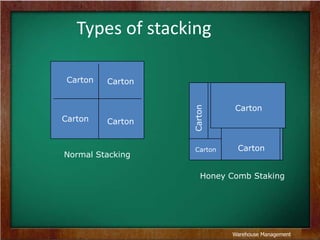
Types of stacking

Carton

Carton

Carton

Normal Stacking

Carton

Carton

Carton

Carton

Carton

Honey Comb Staking

Warehouse Management
Honey Comb Stacking
• Cartons are stacked in a fashion whereby the
arrangement ensures an open shaft like space
is kept till the top of the stack that allow air
circulation through the height of the stack
enhancing the quality of storage
• Separate lots ensure that the movements are
made form distinct lots so that FIFO is
maintained
Warehouse Management
FIFO and OPFO
• FIFO
– First In First Out
– Material which is received earlier will be
dispatched first

• OPFO
– Oldest Pack First Out
– Material which is having earlier date of
manufacturing will be dispatched first (Old Pack)

Warehouse Management
Pallet
• Palletisation is an option which can also be
extended to utilization of stacks.
• The pallets made of 2 layers of wood has open
space in between, which can enable forklift to
lift pallet loads easily and move around

Warehouse Management
Designing a Warehouse
• Elements of warehouse are interdependent
and comprise
– Land & building
– Management and staff
– Equipment
– Computer and software
– Operating methods & procedures

Warehouse Management
Constraints in designing a warehouse
•
•
•
•
•
•

Existing land
Existing buildings
Existing equipments that may have to be used
Existing system software
Staff or union objections on automation
Government regulations on street access,
space restrictions, environment requirements

Warehouse Management
Data needs for warehouse
•
•
•
•

How the goods are received , in what volume
How they are put away and stored
The physical characteristics of each SKU
What volume of stock needs to be stored in
each subgroup
• What are typical order profile

Warehouse Management
Data needs for warehouse
• Must orders be checked and repacked
• What will be the work content and physical volume
per tasks
• Must goods be so arranged & physical volume per
tasks
• What types of vehicles have to be accommodated
• What effects do certain day of the week/month or
any other seasonal factor have on the pressures, and
inventory levels

Warehouse Management
Data Collections & Analysis
• Product Quantity Analysis
– Show the number of pallets, or units which have
to be stored in each line. It will show how dense
or selective the storage system can be

• Product Movement Analysis
– Show the rate at which each product line moves
through the warehouse with indications of
whether they move out in cartoons or pallets

Warehouse Management
Split Case and Full Case Items
• Product can exist in several pack types. e.g.
there may be large shippers, which contain a
number of cartons, each of which may contain
units in certain numbers. Thus within large
cartons there can be small inner cartons.
When such is the case it is important to
identify the pack sizes and types in which the
goods are sold.

Warehouse Management
Pareto’s Analysis
C
A
S
E
S
M
O
V
E
D

Top 10-20% SKU account for
70-90% movement

Last 50% SKU account for
Less than 5% movement

Last 25 % SKU account for 1% of
movement

SKU s BY MOVEMENT
Warehouse Management
Perpetual Inventory Audit
• System involves continuos checking of
inventory on an on going basis as against an
annual stock checking at the year end
• Organization also conduct a packed stock
reconciliation across the several storing points
starting from the factory to check that all the
goods brought into system have been
accounted for
Warehouse Management
Dispatches
• Dispatching efficiency can be assessed on the
basis of the period of time in which the
customer orders are executed, like what
percentage executed on same day etc.
• Reasons for non-execution can be
– Non-availability of stock
– Non-availability of credit limit
– No-availability of blank cheques

Warehouse Management
Warehousing activities at different stages
• At procurement stage
– Take care of inputs into the manufacturing operation

• Factory stage
– Involves raw material, packing material, work in progress,
as well as finished goods.

• Multiple manufacturing points
– Often resort to a central warehouse

• Distribution centers are the final lot of sink in the
supply chain

Warehouse Management
Activities of C & F A
•
•
•
•
•

Timeliness of order execution
Quality of items sent
Information back up
Secondary transportation efficiency
Adherence to procedures such as cheque
deposits

Warehouse Management
Selection procedure for C & FA
• Performance assessment of C&FAs operating
in the market
• Through advertisements
• Even trying out absolutely new ones on the
bases of track records
• Trying out employees separating from the
organization on superannuation

Warehouse Management
Resources required by C & FA
•
•
•
•
•
•

Storage space of requisite specification
Special receiving facilities
Staff for the several functions
Handling arrangement
Communication facilities
Secondary transportation facilities

Warehouse Management
Remuneration package for C & FA
• A per unit remuneration
• Percentage of sales
• Fixed expenses at actual as per amounts
agreed

Warehouse Management
Layouts
• Layout should be such that activities are and
can be carried out without any delay
• In order to facilitate FIFO or OPFO the layout
should facilitate storage in separate easily
identifiable lots, from which the stores in
charge can pick properly
• Physical removal of goods should be possible

Warehouse Management
Summary
• Organizations choose their warehouses locations
normally as near as possible to the points of
consumption
• Combination of two words ”ware” and “House”
which means that it is a place to house or store/keep
wares i.e. items/articles for sales
• There are two types of stacking 1. normal 2. honey
comb stacking.

Warehouse Management
Summary
• FIFO represents First In First Out method of
inventory management and OPFO Oldest Pack
First Out.
• C & FA plays major role in warehousing
function.

Warehouse Management

Warehouse Management

  • 1.
    Welingkar’s Distance LearningDivision CHAPTER-5 Warehouse Management We Learn – A Continuous Learning Forum
  • 2.
    Warehouse Management • Organizationschoose their warehouses locations normally as near as possible to the points of consumption • Similarly they locate their factories (Normally) as near as possible to the source of raw materials Warehouse Management
  • 3.
    In case ofmanufacturing , the selection of site may be dictated by • • • • • • • Existing facility of the organization Availability of resources e.g. labour Tax advantages, concessions Scope for further expansion Overall cost of set up Industrial climate Records of other industries etc. Warehouse Management
  • 4.
    In case ofwarehouses , the selection of site may be dictated by • How close it is to the area to be serviced • Apart from the cost of transportation, locating the depot nearer to the point of consumption imparts the edge of being able to reduce the response time substantially • Outside town limits, so that octroi is not paid Warehouse Management
  • 5.
    Warehouse • Combination oftwo words ”ware” and “House” which means that it is a place to house or store/keep wares i.e. items/articles for sales Warehouse Management
  • 6.
    A functional warehouseshould ensure that wares stored therein are • • • • In the best condition Easily available Properly accounted for Rotated so that the older ones are moves out first • secured /protected from losses and damages • Separately segregated between good and bad Warehouse Management
  • 7.
    Functions of warehouse • • • • • Receiptsof items Storing the same properly Dispatching products as per requirements Preparing related documents Maintaining records of transactions Warehouse Management
  • 8.
    Receipt of items •The warehouse must check the materials received are as per the indent • Condition of the materials must be checked for any damages, shortage • Recording receipt should be prompts, and accurate • Stock rotation can be properly enforced Warehouse Management
  • 9.
    Storage • Materials tobe stored properly, securely, and in a fashion that the operational efficiencies are maintained at a very high level. • Stocks are liquid assets • Proper maintenance of quality in storage has also to be taken care of Warehouse Management
  • 10.
    Types of stacking Carton Carton Carton NormalStacking Carton Carton Carton Carton Carton Honey Comb Staking Warehouse Management
  • 11.
    Honey Comb Stacking •Cartons are stacked in a fashion whereby the arrangement ensures an open shaft like space is kept till the top of the stack that allow air circulation through the height of the stack enhancing the quality of storage • Separate lots ensure that the movements are made form distinct lots so that FIFO is maintained Warehouse Management
  • 12.
    FIFO and OPFO •FIFO – First In First Out – Material which is received earlier will be dispatched first • OPFO – Oldest Pack First Out – Material which is having earlier date of manufacturing will be dispatched first (Old Pack) Warehouse Management
  • 13.
    Pallet • Palletisation isan option which can also be extended to utilization of stacks. • The pallets made of 2 layers of wood has open space in between, which can enable forklift to lift pallet loads easily and move around Warehouse Management
  • 14.
    Designing a Warehouse •Elements of warehouse are interdependent and comprise – Land & building – Management and staff – Equipment – Computer and software – Operating methods & procedures Warehouse Management
  • 15.
    Constraints in designinga warehouse • • • • • • Existing land Existing buildings Existing equipments that may have to be used Existing system software Staff or union objections on automation Government regulations on street access, space restrictions, environment requirements Warehouse Management
  • 16.
    Data needs forwarehouse • • • • How the goods are received , in what volume How they are put away and stored The physical characteristics of each SKU What volume of stock needs to be stored in each subgroup • What are typical order profile Warehouse Management
  • 17.
    Data needs forwarehouse • Must orders be checked and repacked • What will be the work content and physical volume per tasks • Must goods be so arranged & physical volume per tasks • What types of vehicles have to be accommodated • What effects do certain day of the week/month or any other seasonal factor have on the pressures, and inventory levels Warehouse Management
  • 18.
    Data Collections &Analysis • Product Quantity Analysis – Show the number of pallets, or units which have to be stored in each line. It will show how dense or selective the storage system can be • Product Movement Analysis – Show the rate at which each product line moves through the warehouse with indications of whether they move out in cartoons or pallets Warehouse Management
  • 19.
    Split Case andFull Case Items • Product can exist in several pack types. e.g. there may be large shippers, which contain a number of cartons, each of which may contain units in certain numbers. Thus within large cartons there can be small inner cartons. When such is the case it is important to identify the pack sizes and types in which the goods are sold. Warehouse Management
  • 20.
    Pareto’s Analysis C A S E S M O V E D Top 10-20%SKU account for 70-90% movement Last 50% SKU account for Less than 5% movement Last 25 % SKU account for 1% of movement SKU s BY MOVEMENT Warehouse Management
  • 21.
    Perpetual Inventory Audit •System involves continuos checking of inventory on an on going basis as against an annual stock checking at the year end • Organization also conduct a packed stock reconciliation across the several storing points starting from the factory to check that all the goods brought into system have been accounted for Warehouse Management
  • 22.
    Dispatches • Dispatching efficiencycan be assessed on the basis of the period of time in which the customer orders are executed, like what percentage executed on same day etc. • Reasons for non-execution can be – Non-availability of stock – Non-availability of credit limit – No-availability of blank cheques Warehouse Management
  • 23.
    Warehousing activities atdifferent stages • At procurement stage – Take care of inputs into the manufacturing operation • Factory stage – Involves raw material, packing material, work in progress, as well as finished goods. • Multiple manufacturing points – Often resort to a central warehouse • Distribution centers are the final lot of sink in the supply chain Warehouse Management
  • 24.
    Activities of C& F A • • • • • Timeliness of order execution Quality of items sent Information back up Secondary transportation efficiency Adherence to procedures such as cheque deposits Warehouse Management
  • 25.
    Selection procedure forC & FA • Performance assessment of C&FAs operating in the market • Through advertisements • Even trying out absolutely new ones on the bases of track records • Trying out employees separating from the organization on superannuation Warehouse Management
  • 26.
    Resources required byC & FA • • • • • • Storage space of requisite specification Special receiving facilities Staff for the several functions Handling arrangement Communication facilities Secondary transportation facilities Warehouse Management
  • 27.
    Remuneration package forC & FA • A per unit remuneration • Percentage of sales • Fixed expenses at actual as per amounts agreed Warehouse Management
  • 28.
    Layouts • Layout shouldbe such that activities are and can be carried out without any delay • In order to facilitate FIFO or OPFO the layout should facilitate storage in separate easily identifiable lots, from which the stores in charge can pick properly • Physical removal of goods should be possible Warehouse Management
  • 29.
    Summary • Organizations choosetheir warehouses locations normally as near as possible to the points of consumption • Combination of two words ”ware” and “House” which means that it is a place to house or store/keep wares i.e. items/articles for sales • There are two types of stacking 1. normal 2. honey comb stacking. Warehouse Management
  • 30.
    Summary • FIFO representsFirst In First Out method of inventory management and OPFO Oldest Pack First Out. • C & FA plays major role in warehousing function. Warehouse Management