Warehousing and Distribution
Custody and preparation of the inventory of a number
of articles
Planned recumbency of articles in material flow
Spatial bridge between the locations of production
and disposal
Warehouse - Definition
Is it only a storage facility?
• A warehouse is typically viewed as a place to store inventory.
• However, in many logistical system designs, the role of the
warehouse is more properly viewed as a switching facility as
contrasted to a storage facility.
Objectives of Warehousing
Maximize User Service
Minimize Costs
Guarantee Safety
What is Warehousing?
• A warehouse is a commercial building, specifically used for goods
storage. Warehousing is, therefore, the act of storing goods at a paid-
for location, with the intent to sell or distribute them at a later date.
• Small businesses don’t necessarily pay for warehousing services
because the owners use space in their garages, basement or spare
rooms in their homes for storage. Large businesses, on the other hand,
rely on renting space in buildings to store their goods.
• While a business owner might distribute items from a warehouse, this
doesn’t mean that a warehouse doubles up as a distribution centre. A
warehouse strictly offers storage solutions while a distribution centre
fulfils orders in addition to storing goods.
Why Warehousing is important?
•An IBISWorld UK Market Research Report in 2017
revealed that the popularity of online shopping has
supported the demand for warehousing, boosting
revenue for the warehousing and storage industry.
•Experts estimate a strong compound annual growth rate
of 11.3% over the next 5 years, through 2017-2018,
ultimately making it a £21.3 billion industry.
•So, why the growth and reported importance of
warehousing?
•Supply chains have become increasingly complex and
consumers are forging new demands.
Effective Space Utilization
Ready Access to All Items
Quick Receiving of Materials
Complete Inspection
Coordination with Other Divisions
Efficient Material Handling
Maximum Protection of Materials
Good Housekeeping
Objectives
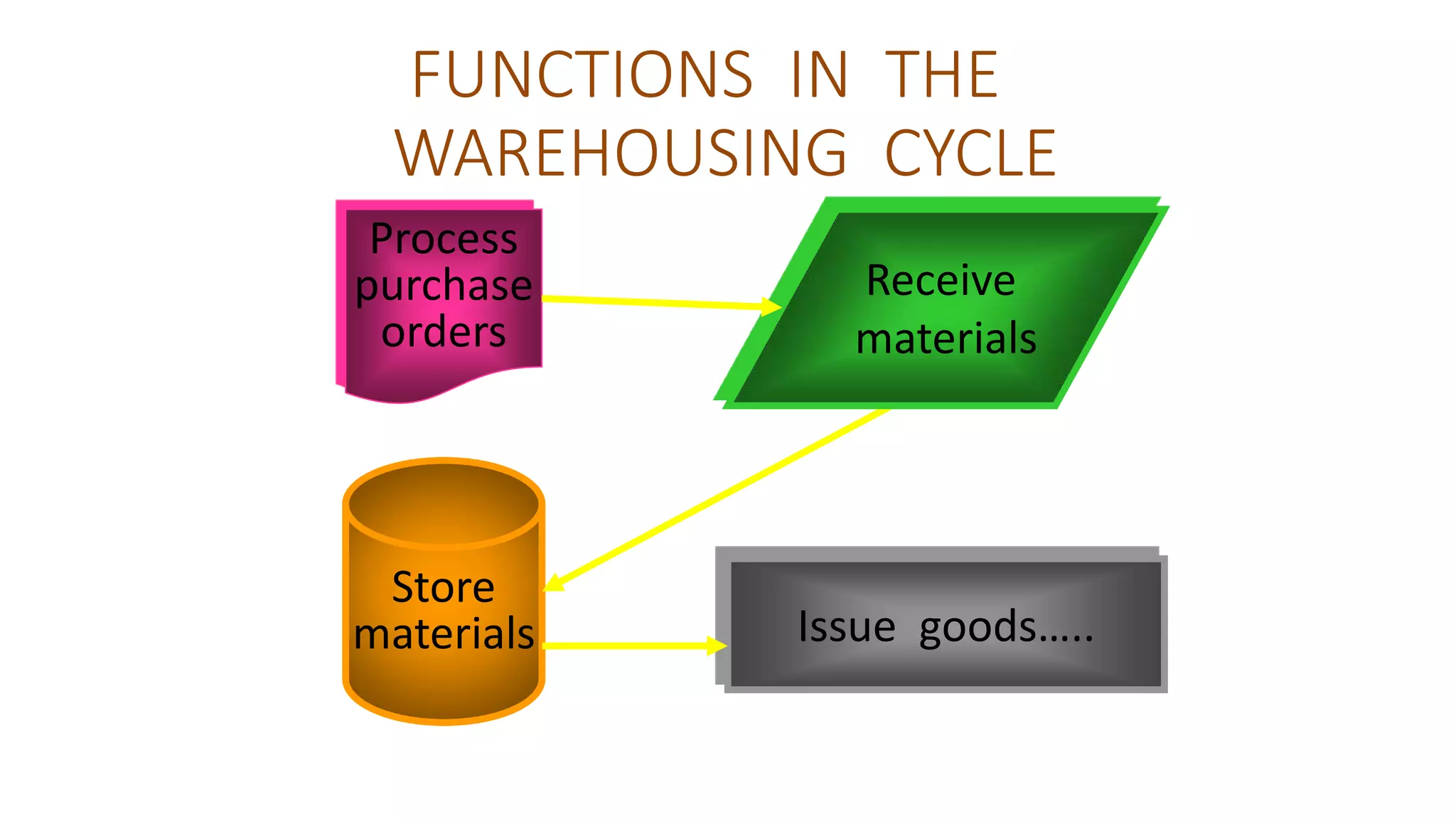
FUNCTIONS IN THE
WAREHOUSING CYCLE
Process
purchase
orders
Store
materials Issue goods…..
Receive
materials
Benefits of Warehousing
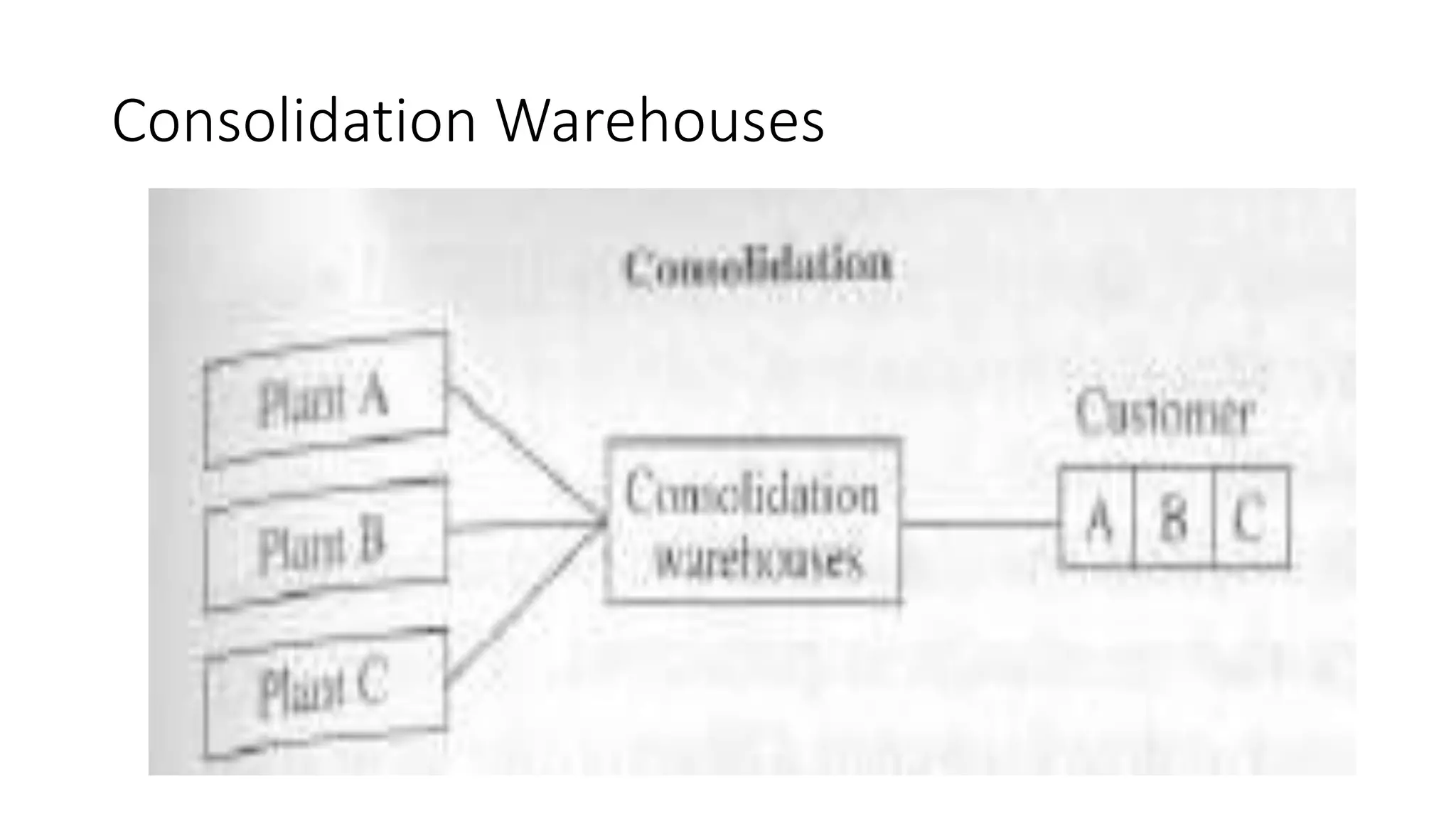
Consolidation
• Shipment consolidation is an economic benefit of warehousing.
• With this arrangement, the consolidating warehouse receives and
consolidates materials from a number of manufacturing plants
destined to a specific customer on a single transportation shipment.
• The benefits are the realization of the lowest possible transportation
rate and reduced congestion at a customer's receiving dock.
Warehousing - benefits
• Opportunity to expand -Finding enough storage in your
manufacturing facility can stifle productivity especially when stored
goods get in the way of work, reducing efficiency. Warehousing gets
rid of manufactured products, creating enough space and conducive
environment to efficiently produce.
• Production support -Black Friday, Cyber Monday and Christmas
holidays are a manufacturer’s biggest sales days annually. This
means more sales, increased production and an immense need for
production support. A warehouse ensures timely, consistent
production support which can significantly reduce production lead
times.
• Product packing and processing– An efficient warehouse also
offers product picking, packing and shipping services.
Warehousing - benefits
• Price control– The market is all about demand-supply. To balance your books properly, a
warehouse offers a business an opportunity to directly influence demand-supply. Goods are
stored when supply exceeds demand and released once demand exceeds supply.
• Financing– Looking for trade finance? A warehouse offers a solution by using the goods
stored as collateral to a lender.
• Reduced business risk– Did you know that goods stored in a warehouse are insured against
the warehouse owner’s risk? This means you don’t have to worry about inventory loss by
fire, theft or damage. You will be compensated anyway.
• Spot stocking– Certain holiday-specific products such as Halloween costumes, Easter and
Christmas-themed goods are seasonal, yet, a manufacturer ought to produce in large
quantities to meet the demand when the time comes. Spot stocking is important for such
businesses, offering simultaneous access to warehouses in different locations, close to target
markets, reducing transport time and meeting customer needs everywhere within the short
period. It is also a great option for agricultural products.
Consolidation Warehouses
Consolidation - Benefits
• The primary benefit of consolidation is that it
combines the logistical flow of several small shipments
to a specific market area.
• Consolidation warehousing may be used by a single
firm, or a number of firms may join together and use a
for-hire consolidation service.
• Through the use of such a program, each individual
manufacturer or shipper can enjoy lower total
distribution cost than could be realized on a direct
shipment basis individually.
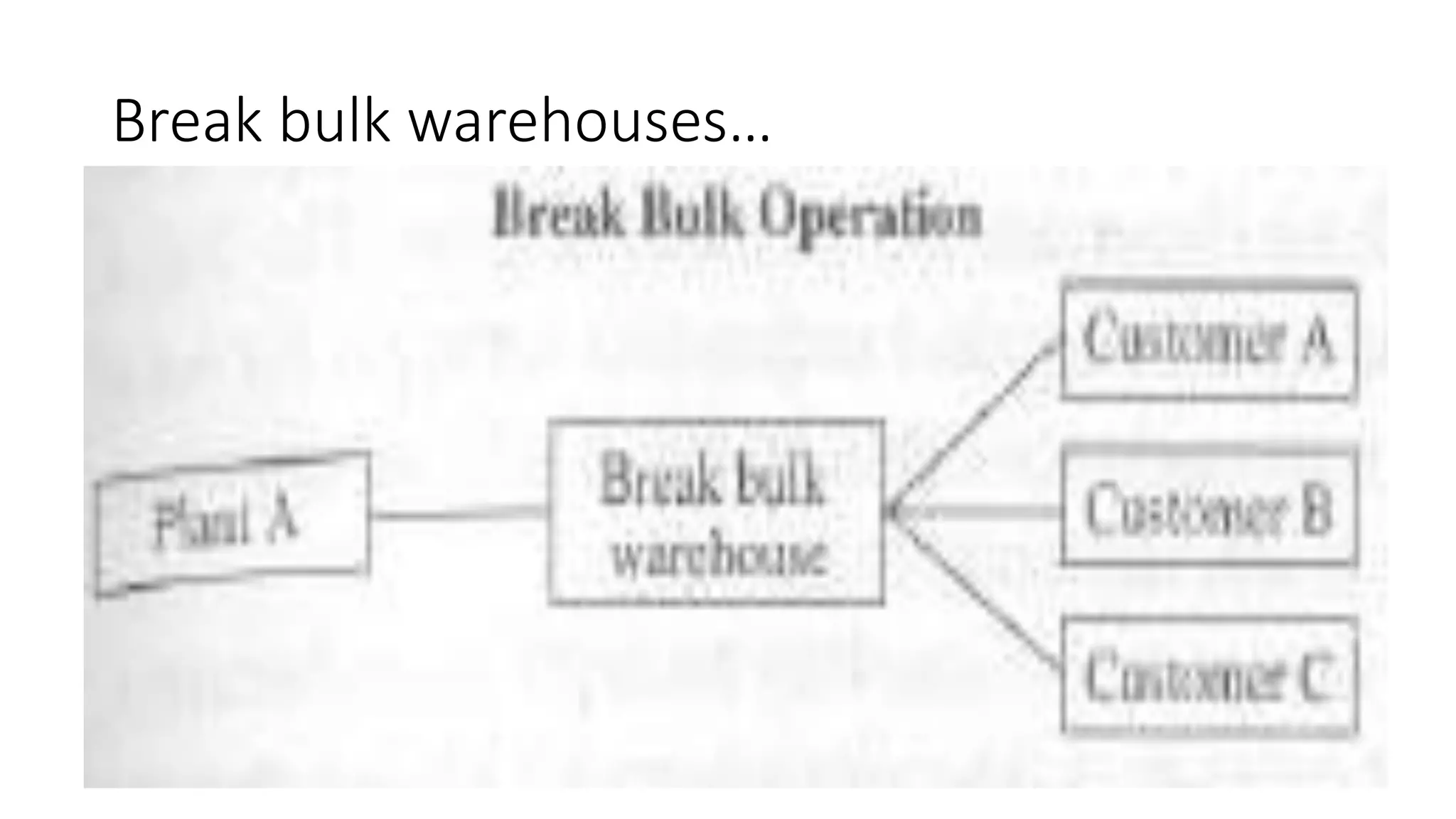
Break bulk warehouses…
Break bulk warehouses
• Break bulk warehouse operations are similar to
consolidation except that no storage is performed.
• A break bulk operation receives combined customer
orders from manufacturers and ships them to
individual customers.
• The break bulk warehouse sorts or splits individual
orders and arranges for local delivery.
• Because the long-distance transportation movement is
a large shipment, transport costs are lower and there
is less difficulty in tracking.
Private Warehouses
• A private warehouse is operated by the firm owning the product.
• The actual facility, however, may be owned or leased.
• The decision as to which strategy best fits an individual firm is
essentially financial.
• Often it is not possible to find a warehouse for lease that fits the exact
requirements of a firm.
Private Warehouses
• Private warehouses are owned by individual manufacturers or
producers, for storing their own goods, for example, cold storage for
perishable goods such as fruits and vegetables. The authorised
warehouse keeper must not necessarily own the goods but must be
the depositor.
• There are 3 types of private warehouses-
• Type C, premises-based;
• Type D, premises-based where a trader has authority to release
products for free circulation according to the Local Clearance
Procedure (LCP);
• Type E where authorisation for release is stricter than types C and D.
Instead of the premises, the record-keeping system is authorised.
Public Warehouses…
• Public warehouses are operated by a warehouse keeper, for storing
goods placed under the customs warehouse procedure by other
traders, who are also known as depositors.
• A public warehouse charges clients a basic fee for handling and storage.
• In the case of handling, the charge is based on the number of cases or pounds
handled.
• For storage, the charge is assessed on the number of cases or weight in
storage during the month.
• Such charges normally exceed the cost of private warehousing if adequate
private facility volume exists.
• However, when economies of scale are not possible in a private facility, public
warehousing may be a low-cost alternative.
Contract Warehouses
• Contract warehousing combines the best characteristics of
both private and public operations.
• The long-term relationship and shared risk result in lower
cost than typical public warehouse arrangements.
• Contract warehouse operations can provide benefits of
expertise, flexibility, and economies of scale by sharing
management, labor, equipment, and information
resources across a number of clients.
Bonded Warehouses
Bonded warehouses are licensed by the government to accept
imported goods for storage, and goods are released only when
customs duties have been paid. They are usually at sea or dry
ports in big cities and could either be privately owned or
owned by dock authorities. The name comes from the process
that the warehouse should give an undertaking, otherwise
known as ‘bond’ that it will not allow the removal of goods
until customs authorities give their consent.
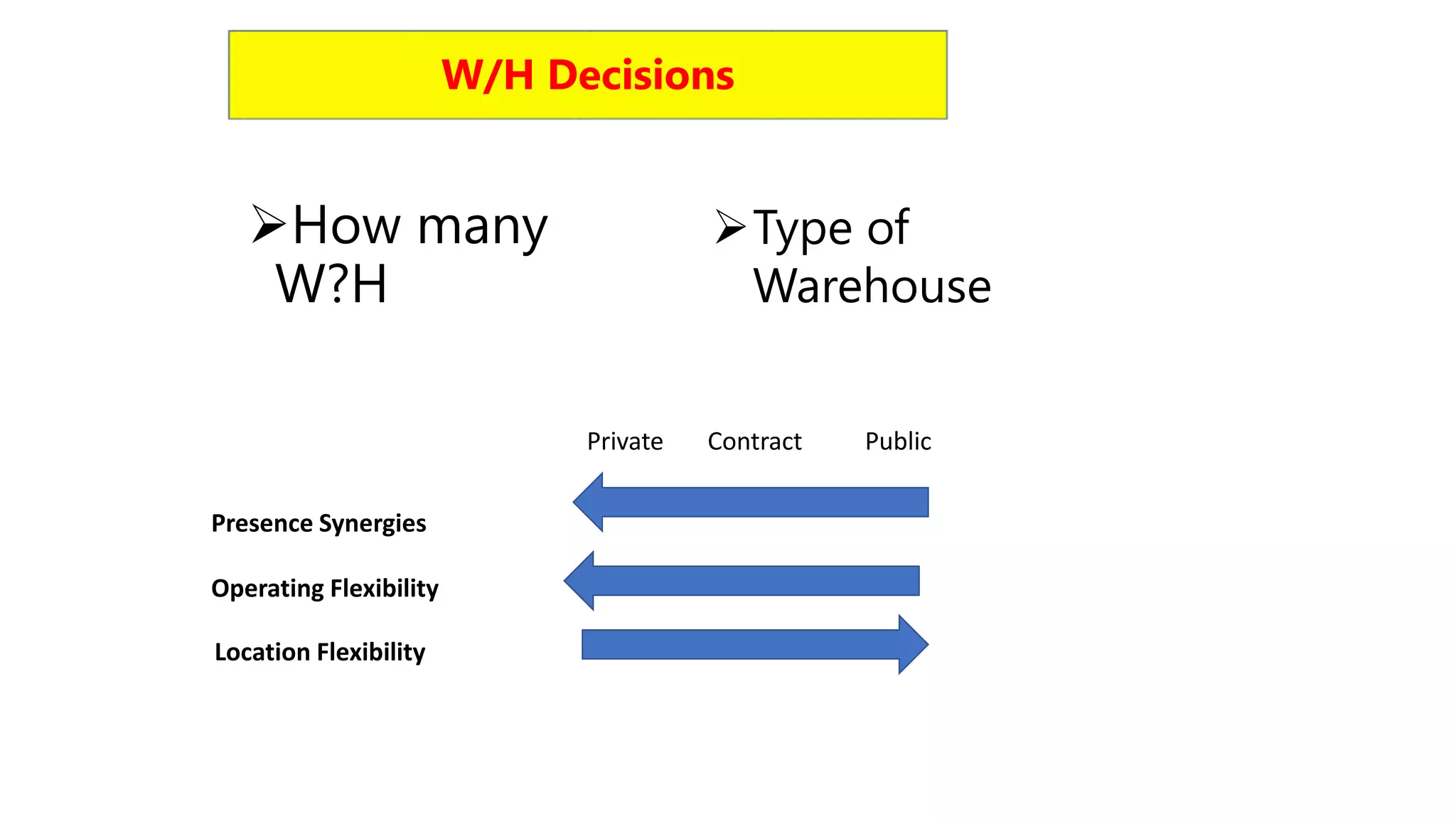
How many
W?H
W/H Decisions
Type of
Warehouse
Private Contract Public
Presence Synergies
Operating Flexibility
Location Flexibility
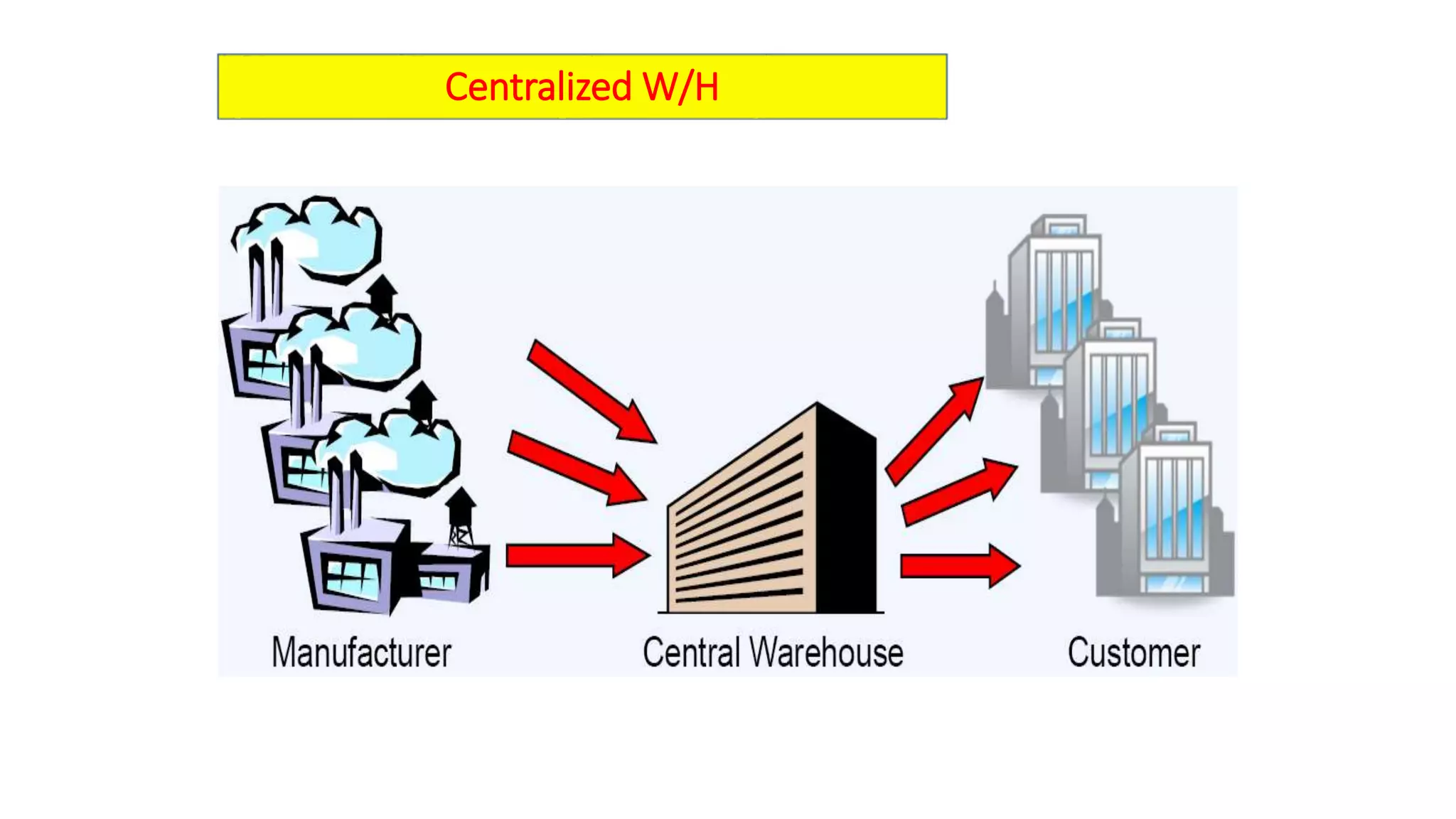
Centralized W/H
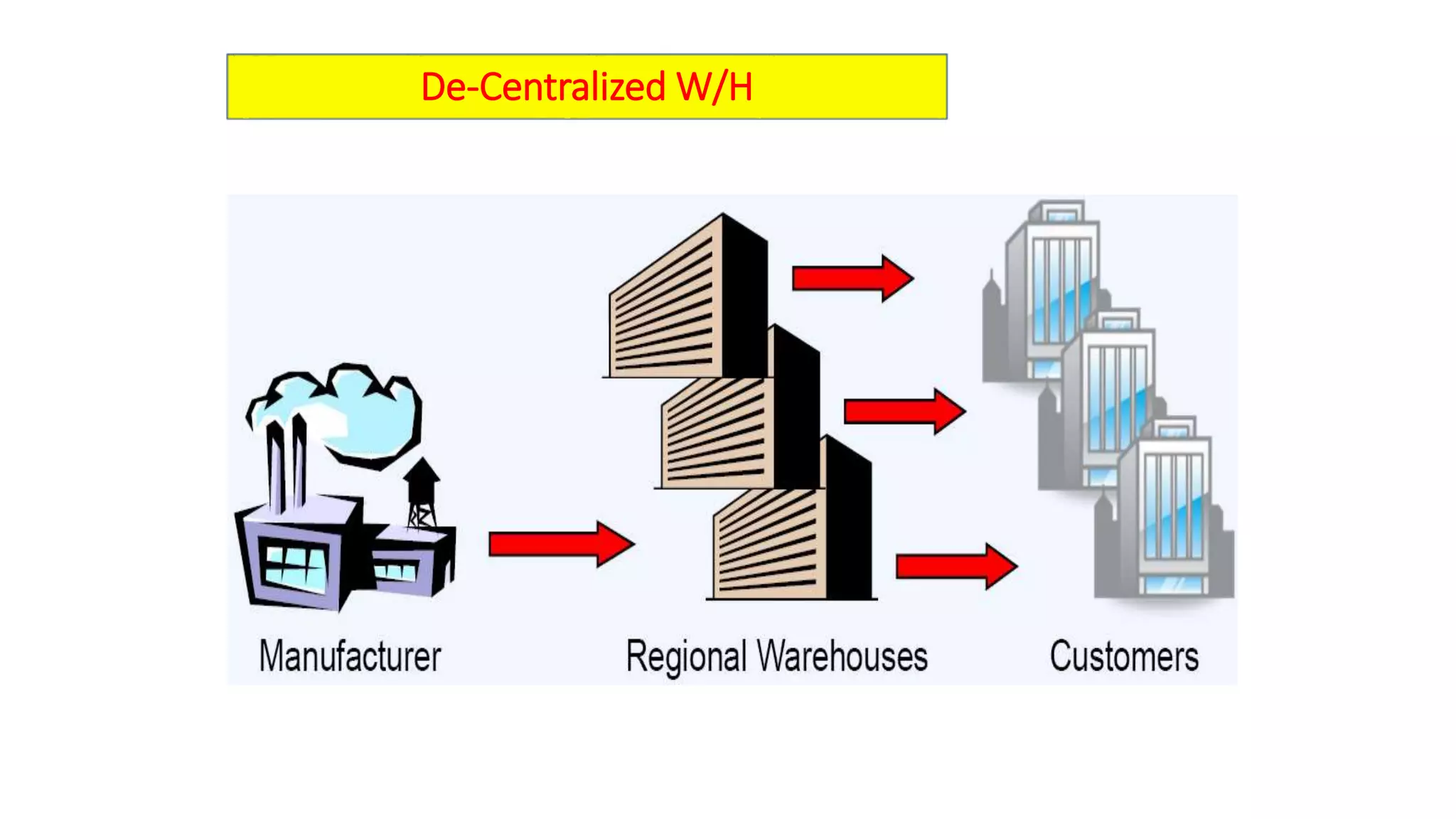
De-Centralized W/H
Warehousing
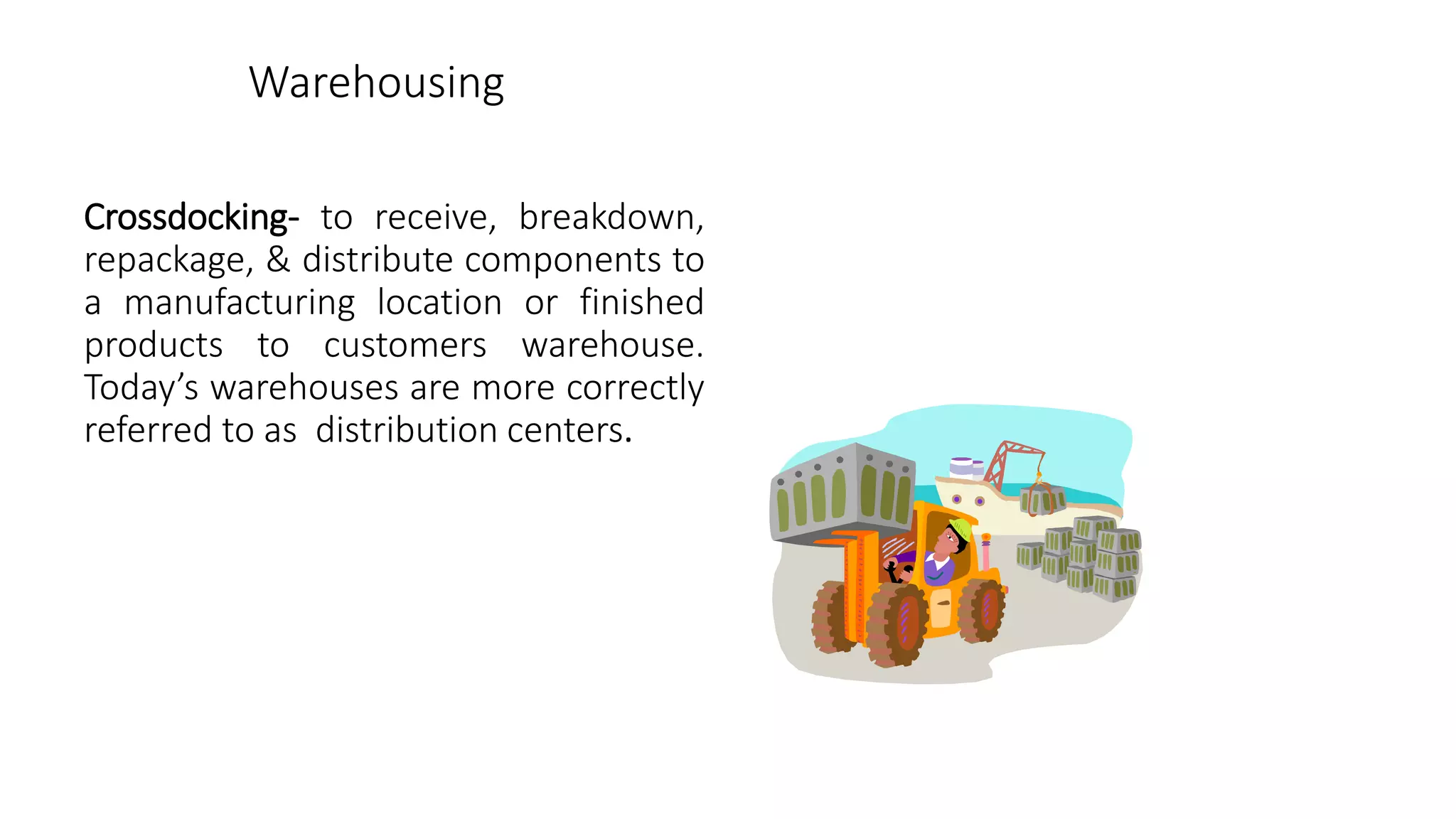
Crossdocking- to receive, breakdown,
repackage, & distribute components to
a manufacturing location or finished
products to customers warehouse.
Today’s warehouses are more correctly
referred to as distribution centers.
How to find / access Warehousing?
• Finding a warehouse that satisfies a business’ unique needs is a
complicated process, which luckily, only needs consideration of certain
crucial factors.
• Location– Assess location at both regional and national basis. Cheaper
location is not necessarily the cheaper option. Also, consider
transportation costs.
• Type of building– New buildings are a new catch, but are the facilities
satisfactory? Is there sufficient power, adequate temperature control or
clear height to allow for new ductwork when you need it?
• Gross rent– Most landlords will reduce their operational costs by
passing on operation expenses to the depositor, adding to the net rent.
Responsibilities on additional expenses such as real estate taxes,
maintenance and repair charges and management cost should be well
Contd.,
• Dedicated Facility, Flex Space or Multi-Client– Depending on
the option offered, there will be considerable difference in rent
cost. Just make sure that the option picked doesn’t compromise on
the security, safety or quality of your products.
• Opportunity for unanticipated value-added services– A
warehouse only stores goods. What if you want extra services like
special packaging, labelling or repairs? Is the service provider
flexible?
• Only pay for service used– Labour is a warehouse’s biggest
expense, and businesses need to decide whether they need cross-
trained staff or temporary labour. Cross-trained staff can be
borrowed when one account is slow to prevent hiring temporary
labour. Temporary labour is an efficient way of handling activity
spikes on a short period.
Warehousing Location
Warehouse Location Strategies proposed by Edgar
Hoover
• Market-positioned strategy- warehouses close to customers
to maximize distribution svcs & improve transp. economies of
scale.
• Product positioned strategy- warehouses close to the sources
of supply to enable the firm to collect goods & consolidate
these.
• Intermediately positioned strategy- warehouses midway
between the sources of supply & the customers when
distribution requirements are high & product assortments
come from various locations.
Warehousing Location
Just-in-Time Warehousing
Emphasis on warehousing to support JIT operations:
• A commitment to customers & service quality
• Reduced lot sizes & shipping quantities
• Greater emphasis on cross docking
• Increased automation
• Increased assembly operations

Warehousing and Distribution.pptx

  • 1.
  • 3.
    Custody and preparationof the inventory of a number of articles Planned recumbency of articles in material flow Spatial bridge between the locations of production and disposal Warehouse - Definition
  • 4.
    Is it onlya storage facility? • A warehouse is typically viewed as a place to store inventory. • However, in many logistical system designs, the role of the warehouse is more properly viewed as a switching facility as contrasted to a storage facility.
  • 5.
    Objectives of Warehousing MaximizeUser Service Minimize Costs Guarantee Safety
  • 6.
    What is Warehousing? •A warehouse is a commercial building, specifically used for goods storage. Warehousing is, therefore, the act of storing goods at a paid- for location, with the intent to sell or distribute them at a later date. • Small businesses don’t necessarily pay for warehousing services because the owners use space in their garages, basement or spare rooms in their homes for storage. Large businesses, on the other hand, rely on renting space in buildings to store their goods. • While a business owner might distribute items from a warehouse, this doesn’t mean that a warehouse doubles up as a distribution centre. A warehouse strictly offers storage solutions while a distribution centre fulfils orders in addition to storing goods.
  • 7.
    Why Warehousing isimportant? •An IBISWorld UK Market Research Report in 2017 revealed that the popularity of online shopping has supported the demand for warehousing, boosting revenue for the warehousing and storage industry. •Experts estimate a strong compound annual growth rate of 11.3% over the next 5 years, through 2017-2018, ultimately making it a £21.3 billion industry. •So, why the growth and reported importance of warehousing? •Supply chains have become increasingly complex and consumers are forging new demands.
  • 8.
    Effective Space Utilization ReadyAccess to All Items Quick Receiving of Materials Complete Inspection Coordination with Other Divisions Efficient Material Handling Maximum Protection of Materials Good Housekeeping Objectives
  • 9.
    FUNCTIONS IN THE WAREHOUSINGCYCLE Process purchase orders Store materials Issue goods….. Receive materials
  • 10.
    Benefits of Warehousing Consolidation •Shipment consolidation is an economic benefit of warehousing. • With this arrangement, the consolidating warehouse receives and consolidates materials from a number of manufacturing plants destined to a specific customer on a single transportation shipment. • The benefits are the realization of the lowest possible transportation rate and reduced congestion at a customer's receiving dock.
  • 11.
    Warehousing - benefits •Opportunity to expand -Finding enough storage in your manufacturing facility can stifle productivity especially when stored goods get in the way of work, reducing efficiency. Warehousing gets rid of manufactured products, creating enough space and conducive environment to efficiently produce. • Production support -Black Friday, Cyber Monday and Christmas holidays are a manufacturer’s biggest sales days annually. This means more sales, increased production and an immense need for production support. A warehouse ensures timely, consistent production support which can significantly reduce production lead times. • Product packing and processing– An efficient warehouse also offers product picking, packing and shipping services.
  • 12.
    Warehousing - benefits •Price control– The market is all about demand-supply. To balance your books properly, a warehouse offers a business an opportunity to directly influence demand-supply. Goods are stored when supply exceeds demand and released once demand exceeds supply. • Financing– Looking for trade finance? A warehouse offers a solution by using the goods stored as collateral to a lender. • Reduced business risk– Did you know that goods stored in a warehouse are insured against the warehouse owner’s risk? This means you don’t have to worry about inventory loss by fire, theft or damage. You will be compensated anyway. • Spot stocking– Certain holiday-specific products such as Halloween costumes, Easter and Christmas-themed goods are seasonal, yet, a manufacturer ought to produce in large quantities to meet the demand when the time comes. Spot stocking is important for such businesses, offering simultaneous access to warehouses in different locations, close to target markets, reducing transport time and meeting customer needs everywhere within the short period. It is also a great option for agricultural products.
  • 13.
  • 14.
    Consolidation - Benefits •The primary benefit of consolidation is that it combines the logistical flow of several small shipments to a specific market area. • Consolidation warehousing may be used by a single firm, or a number of firms may join together and use a for-hire consolidation service. • Through the use of such a program, each individual manufacturer or shipper can enjoy lower total distribution cost than could be realized on a direct shipment basis individually.
  • 15.
  • 16.
    Break bulk warehouses •Break bulk warehouse operations are similar to consolidation except that no storage is performed. • A break bulk operation receives combined customer orders from manufacturers and ships them to individual customers. • The break bulk warehouse sorts or splits individual orders and arranges for local delivery. • Because the long-distance transportation movement is a large shipment, transport costs are lower and there is less difficulty in tracking.
  • 17.
    Private Warehouses • Aprivate warehouse is operated by the firm owning the product. • The actual facility, however, may be owned or leased. • The decision as to which strategy best fits an individual firm is essentially financial. • Often it is not possible to find a warehouse for lease that fits the exact requirements of a firm.
  • 18.
    Private Warehouses • Privatewarehouses are owned by individual manufacturers or producers, for storing their own goods, for example, cold storage for perishable goods such as fruits and vegetables. The authorised warehouse keeper must not necessarily own the goods but must be the depositor. • There are 3 types of private warehouses- • Type C, premises-based; • Type D, premises-based where a trader has authority to release products for free circulation according to the Local Clearance Procedure (LCP); • Type E where authorisation for release is stricter than types C and D. Instead of the premises, the record-keeping system is authorised.
  • 19.
    Public Warehouses… • Publicwarehouses are operated by a warehouse keeper, for storing goods placed under the customs warehouse procedure by other traders, who are also known as depositors. • A public warehouse charges clients a basic fee for handling and storage. • In the case of handling, the charge is based on the number of cases or pounds handled. • For storage, the charge is assessed on the number of cases or weight in storage during the month. • Such charges normally exceed the cost of private warehousing if adequate private facility volume exists. • However, when economies of scale are not possible in a private facility, public warehousing may be a low-cost alternative.
  • 20.
    Contract Warehouses • Contractwarehousing combines the best characteristics of both private and public operations. • The long-term relationship and shared risk result in lower cost than typical public warehouse arrangements. • Contract warehouse operations can provide benefits of expertise, flexibility, and economies of scale by sharing management, labor, equipment, and information resources across a number of clients.
  • 21.
    Bonded Warehouses Bonded warehousesare licensed by the government to accept imported goods for storage, and goods are released only when customs duties have been paid. They are usually at sea or dry ports in big cities and could either be privately owned or owned by dock authorities. The name comes from the process that the warehouse should give an undertaking, otherwise known as ‘bond’ that it will not allow the removal of goods until customs authorities give their consent.
  • 22.
    How many W?H W/H Decisions Typeof Warehouse Private Contract Public Presence Synergies Operating Flexibility Location Flexibility
  • 23.
  • 24.
  • 25.
    Warehousing Crossdocking- to receive,breakdown, repackage, & distribute components to a manufacturing location or finished products to customers warehouse. Today’s warehouses are more correctly referred to as distribution centers.
  • 26.
    How to find/ access Warehousing? • Finding a warehouse that satisfies a business’ unique needs is a complicated process, which luckily, only needs consideration of certain crucial factors. • Location– Assess location at both regional and national basis. Cheaper location is not necessarily the cheaper option. Also, consider transportation costs. • Type of building– New buildings are a new catch, but are the facilities satisfactory? Is there sufficient power, adequate temperature control or clear height to allow for new ductwork when you need it? • Gross rent– Most landlords will reduce their operational costs by passing on operation expenses to the depositor, adding to the net rent. Responsibilities on additional expenses such as real estate taxes, maintenance and repair charges and management cost should be well
  • 27.
    Contd., • Dedicated Facility,Flex Space or Multi-Client– Depending on the option offered, there will be considerable difference in rent cost. Just make sure that the option picked doesn’t compromise on the security, safety or quality of your products. • Opportunity for unanticipated value-added services– A warehouse only stores goods. What if you want extra services like special packaging, labelling or repairs? Is the service provider flexible? • Only pay for service used– Labour is a warehouse’s biggest expense, and businesses need to decide whether they need cross- trained staff or temporary labour. Cross-trained staff can be borrowed when one account is slow to prevent hiring temporary labour. Temporary labour is an efficient way of handling activity spikes on a short period.
  • 28.
    Warehousing Location Warehouse LocationStrategies proposed by Edgar Hoover • Market-positioned strategy- warehouses close to customers to maximize distribution svcs & improve transp. economies of scale. • Product positioned strategy- warehouses close to the sources of supply to enable the firm to collect goods & consolidate these. • Intermediately positioned strategy- warehouses midway between the sources of supply & the customers when distribution requirements are high & product assortments come from various locations.
  • 29.
    Warehousing Location Just-in-Time Warehousing Emphasison warehousing to support JIT operations: • A commitment to customers & service quality • Reduced lot sizes & shipping quantities • Greater emphasis on cross docking • Increased automation • Increased assembly operations