Mechanical Ventilation
Graphics
Dr.s.vijay anand
 Allow users to interpret, evaluate, and
troubleshoot the ventilator and the patient’s
response to the ventilator.
 Monitor the patient’s disease status (C and
Raw).
 Assess the patient’s response to therapy.
 Monitor proper ventilator function
 Allow fine tuning of ventilator to decrease
WOB, optimize ventilation, and maximize
patient comfort
Mechanical Ventilation
Graphics
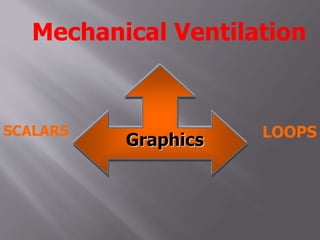
SCALARS LOOPS
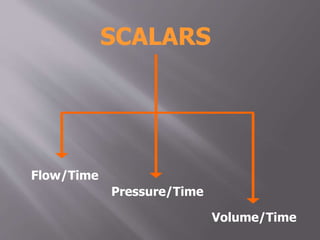
SCALARS
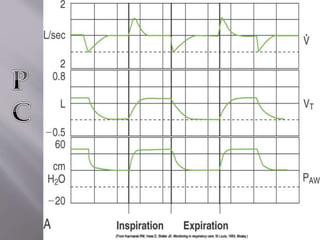
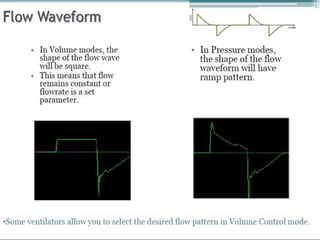
Flow/Time
Pressure/Time
Volume/Time
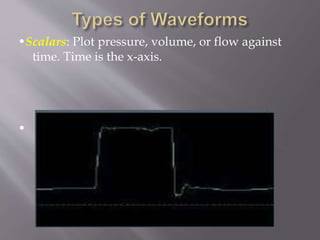
•Scalars: Plot pressure, volume, or flow against
time. Time is the x-axis.
•
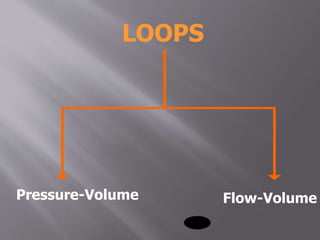
Pressure-Volume Flow-Volume
LOOPS
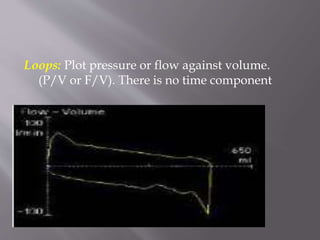
Loops: Plot pressure or flow against volume.
(P/V or F/V). There is no time component
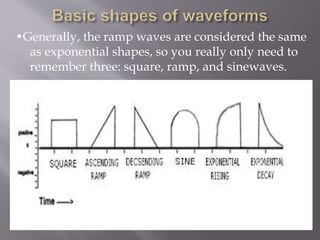
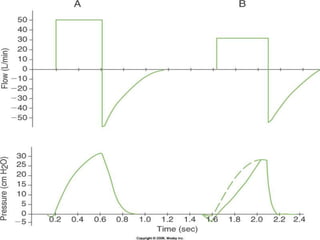
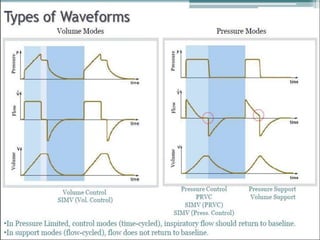
•Generally, the ramp waves are considered the same
as exponential shapes, so you really only need to
remember three: square, ramp, and sinewaves.
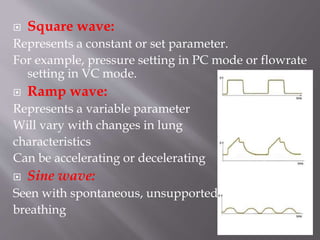
 Square wave:
Represents a constant or set parameter.
For example, pressure setting in PC mode or flowrate
setting in VC mode.
 Ramp wave:
Represents a variable parameter
Will vary with changes in lung
characteristics
Can be accelerating or decelerating
 Sine wave:
Seen with spontaneous, unsupported
breathing
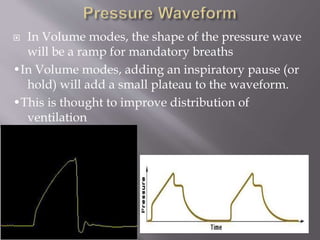
 In Volume modes, the shape of the pressure wave
will be a ramp for mandatory breaths
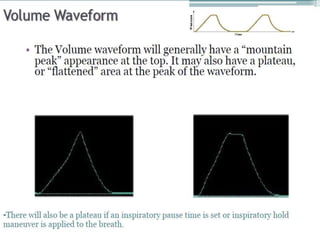
•In Volume modes, adding an inspiratory pause (or
hold) will add a small plateau to the waveform.
•This is thought to improve distribution of
ventilation
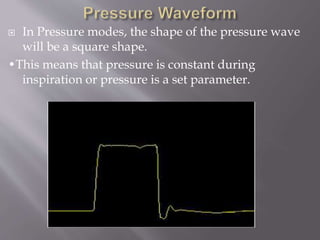
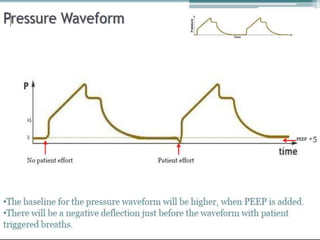
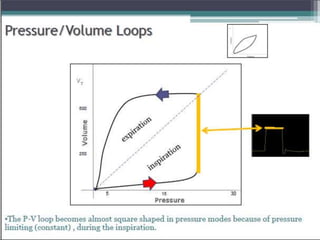
 In Pressure modes, the shape of the pressure wave
will be a square shape.
•This means that pressure is constant during
inspiration or pressure is a set parameter.
 Distinguishing breath type
 Trigger Sensitivity
 Plateau pressure
 Rate & I:E
 Peak Flow [VC]
 PS characteristics
 Lung mechanics
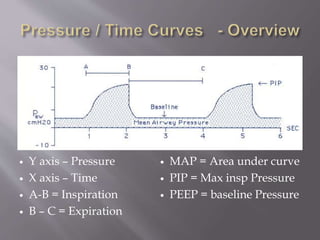
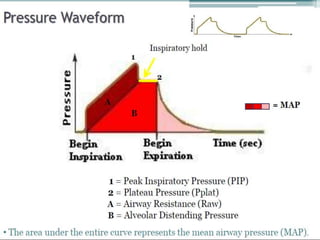
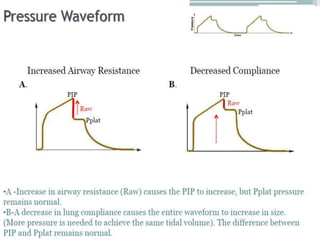
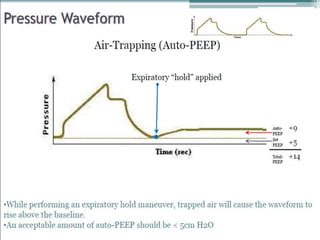
 Y axis – Pressure
 X axis – Time
 A-B = Inspiration
 B – C = Expiration
 MAP = Area under curve
 PIP = Max insp Pressure
 PEEP = baseline Pressure
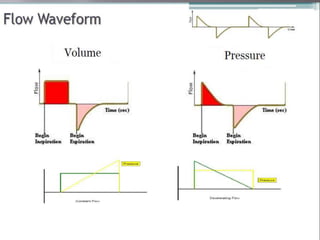
 Press wave is square [constant]
 P wave is not affected by lung mechanics or pt flow
demand
 Flow rate is according to lung mechanics, set P, & Insp
effort by pt
 Flow wave rises rapidly to meet set P, then decreases
to a point necessary to maintain set P. [ expo decay or
continuously variable decelerating pattern]
 Note the P & V plateaus in regard to the Flow which
ends before Ti is over
 This condition provides the greatest volume
possible for that set P
 Indicates the lung has met equilibrium [Plateau]
 This condix has a much shorter Ti [not allowing for
Plateau] but for a longer Te
 Delivered volume is slightly decreased
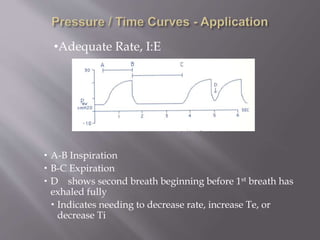
 A-B Inspiration
 B-C Expiration
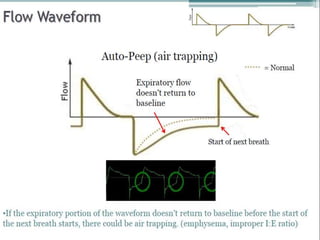
 D shows second breath beginning before 1st breath has
exhaled fully
 Indicates needing to decrease rate, increase Te, or
decrease Ti
•Adequate Rate, I:E
•Breath type
Mechanical breath [volume]
•Note at point A – there is no negative deflex
•Consistent Ti & Volume delivery
•Pressure continues to rise until set V is
reached, then breath cycles
•Breath type
•Mechanical Breath [ Pressure]
Consistent Ti & Pressure delivery
•P reaches limit early in I and holds
for Ti
•No Trigger
•Breath type
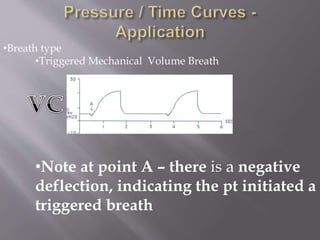
•Triggered Mechanical Volume Breath
•Note at point A – there is a negative
deflection, indicating the pt initiated a
triggered breath
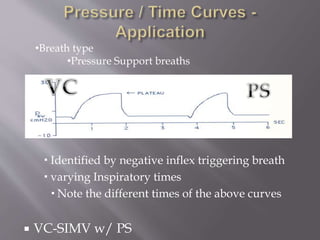
 Identified by negative inflex triggering breath
 varying Inspiratory times
 Note the different times of the above curves
 VC-SIMV w/ PS
•Breath type
•Pressure Support breaths
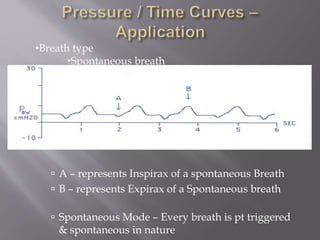
 A – represents Inspirax of a spontaneous Breath
 B – represents Expirax of a Spontaneous breath
 Spontaneous Mode – Every breath is pt triggered
& spontaneous in nature
•Breath type
•Spontaneous breath
 A – scooped out waveform b/c
inadequate flow for pt demand
 B – bulging indicates too much flow
•Adjusting Peak Flow [ VC]
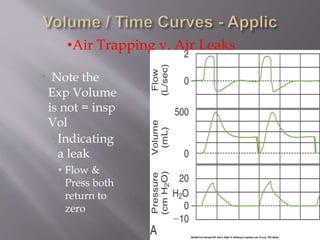
 Note the
Exp Volume
is not = insp
Vol
 Indicating
a leak
 Flow &
Press both
return to
zero
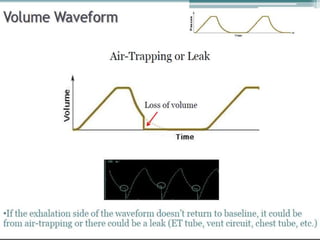
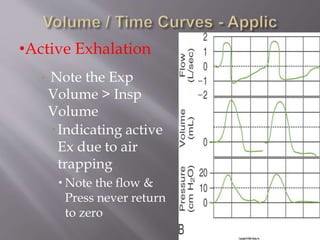
•Air Trapping v. Air Leaks
 Note the Exp
Volume > Insp
Volume
Indicating active
Ex due to air
trapping
 Note the flow &
Press never return
to zero
•Active Exhalation
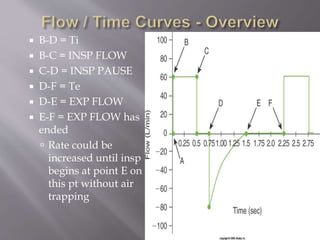
 Y axis = flow
 X axis = Time
 A-B = inspiration
 Above x axis
 B-C = Expirax
 Below X axis
 D- Peak Inspiratory
Flow
 E = Peak Expiratory
Flow [ PEFR]
 B-D = Ti
 B-C = INSP FLOW
 C-D = INSP PAUSE
 D-F = Te
 D-E = EXP FLOW
 E-F = EXP FLOW has
ended
 Rate could be
increased until insp
begins at point E on
this pt without air
trapping
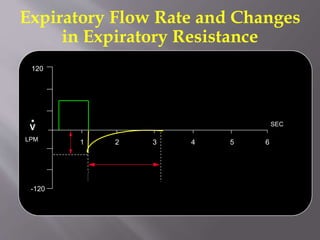
1 2 3 4 5 6
SEC
120
-120
V
.
LPM
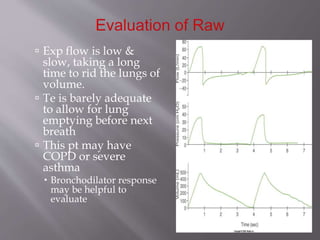
Expiratory Flow Rate and Changes
in Expiratory Resistance
 Exp flow is low &
slow, taking a long
time to rid the lungs of
volume.
 Te is barely adequate
to allow for lung
emptying before next
breath
 This pt may have
COPD or severe
asthma
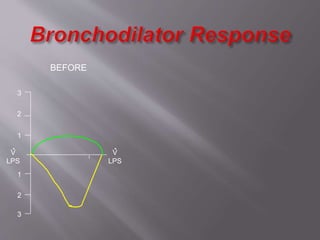
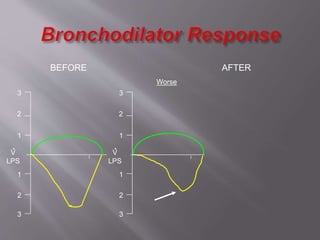
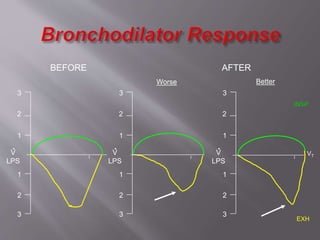
 Bronchodilator response
may be helpful to
evaluate
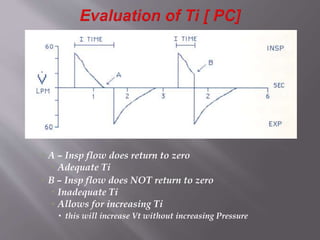
 A – Insp flow does return to zero
 Adequate Ti
 B – Insp flow does NOT return to zero
 Inadequate Ti
 Allows for increasing Ti
 this will increase Vt without increasing Pressure
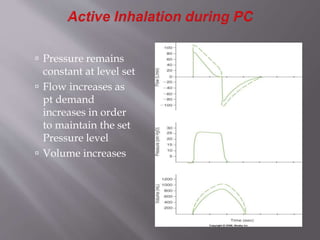
 Pressure remains
constant at level set
 Flow increases as
pt demand
increases in order
to maintain the set
Pressure level
 Volume increases
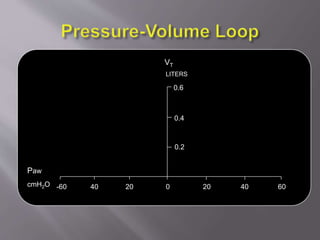
 Pressure-Volume Loops
 Flow-Volume Loops
0 20 40 602040-60
0.2
LITERS
0.4
0.6
Paw
cmH2O
VT
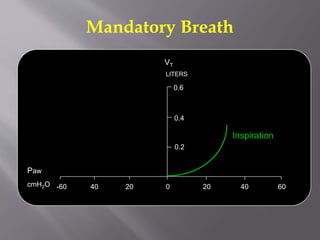
Mandatory Breath
Inspiration
0 20 40 602040-60
0.2
LITERS
0.4
0.6
Paw
cmH2O
VT
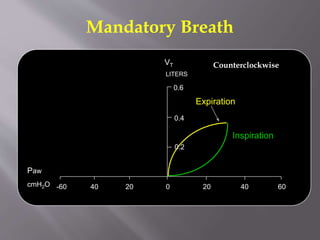
Mandatory Breath
Expiration
0 20 40 602040-60
0.2
LITERS
0.4
0.6
Paw
cmH2O
Inspiration
VT Counterclockwise
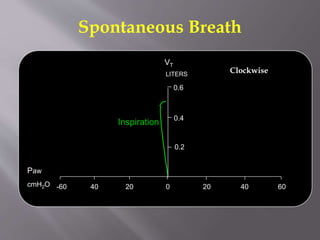
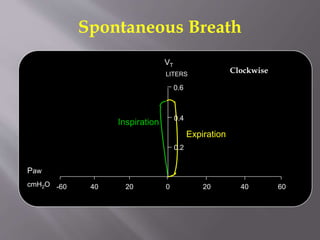
Spontaneous Breath
Inspiration
0 20 40 602040-60
0.2
LITERS
0.4
0.6
Paw
cmH2O
VT
Clockwise
Spontaneous Breath
Inspiration
Expiration
0 20 40 602040-60
0.2
LITERS
0.4
0.6
Paw
cmH2O
VT
Clockwise
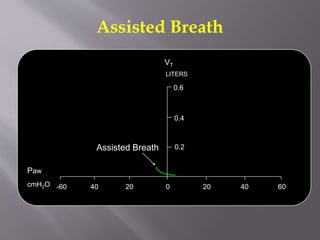
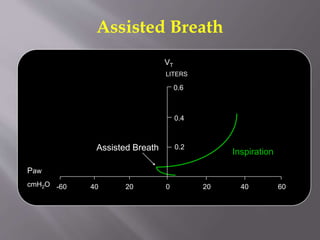
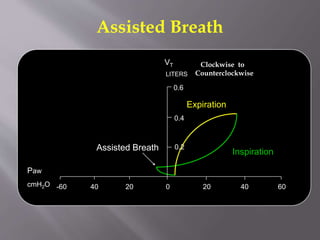
Assisted Breath
0 20 40 602040-60
0.2
LITERS
0.4
0.6
Paw
cmH2O
Assisted Breath
VT
Assisted Breath
Inspiration
0 20 40 602040-60
0.2
LITERS
0.4
0.6
Paw
cmH2O
Assisted Breath
VT
Assisted Breath
Inspiration
Expiration
0 20 40 602040-60
0.2
LITERS
0.4
0.6
Paw
cmH2O
Assisted Breath
VT Clockwise to
Counterclockwise
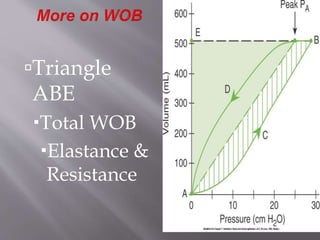
 Dashed line plotted
based on the Static
Compliance calculation
drawn from zero to
peak PA
Peak PA – Pstatic or
Pplat
 Note that the point
at which Peak PA is
also the point
where the volume
plateaus
PTA = xairway
pressure
 [difference b/w the
airway
opening(Pawo) and
the Alveoli (PA)]
 Triangle APAE
 Represents the amount of
mechanical work to
overcome the compliance
[elastic forces] of the chest
 Area ACBPA represents
amount of work to
overcome Raw during
Insp
 Triangle APAD represents
amount of work to
overcome Raw during
Exp
 The insp area [area w/in
the hysteresis] represents
total WOB due to Raw
PTA = xairway pressure
 [difference b/w the
airway
opening(Pawo) and
the Alveoli (PA)]
 Represents the
amount of pressure
needed to overcome
resistance of the
lung
 If Raw increases
this distance will
increase
 If flow [turbulence]
increases, so does
this distance
Triangle
ABE
Total WOB
Elastance &
Resistance
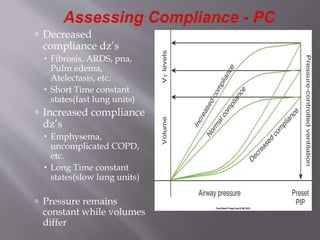
 Slope = line drawn
from zero through the
Pplat
 As slope increases [
Pplat decreases]
compliance increases
for a set volume
 As slope decreases [
Pplat increase]
compliance decreases
for a set volume
 Decreased
compliance dz’s
 Fibrosis, ARDS, pna,
Pulm edema,
Atelectasis, etc.
 Short Time constant
states(fast lung units)
 Increased compliance
dz’s
 Emphysema,
uncomplicated COPD,
etc.
 Long Time constant
states(slow lung units)
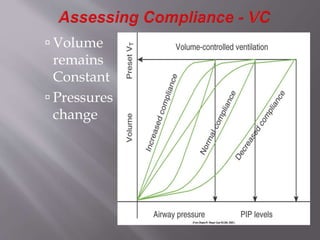
 Pressure remains
constant while volumes
differ
 Volume
remains
Constant
 Pressures
change
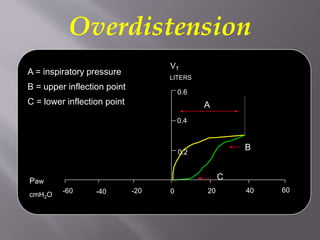
Overdistension
B
A
0 20 40 60-20-40-60
0.2
0.4
0.6
LITERS
Paw
cmH2O
C
A = inspiratory pressure
B = upper inflection point
C = lower inflection point
VT
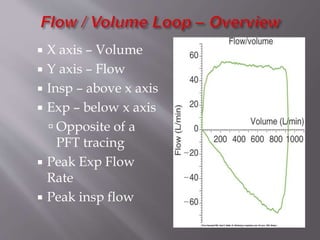
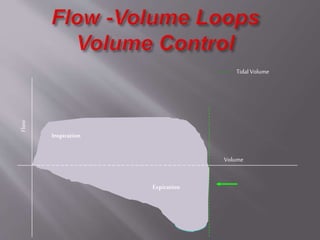
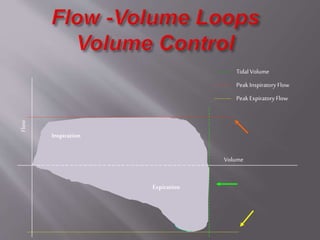
 X axis – Volume
 Y axis – Flow
 Insp – above x axis
 Exp – below x axis
 Opposite of a
PFT tracing
 Peak Exp Flow
Rate
 Peak insp flow
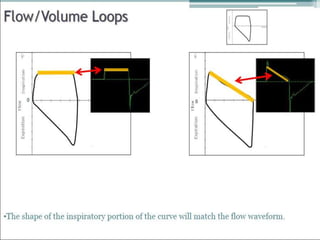
 •The shape of the inspiratory
portion of the curve will match the
flow waveform.
 •The shape of the exp flow curve
represents passive exhalation.
 •Can be used to determine the PIF,
PEF, and Vt
 •Looks circular with spontaneous
breaths
 •Air trapping
 •Airway Obstruction
 •Airway Resistance
 •Bronchodilator Response
 •Insp/Exp Flow
 •Flow Starvation
 •Leaks
 •Water or Secretion accumulation
 •Asynchrony
Volume
Tidal Volume
Inspiration
Expiration
Volume
Peak Expiratory Flow
Peak Inspiratory Flow
Tidal Volume
Inspiration
Expiration
 A – normal Raw & exp
flow
 B – increased Raw &
reduced exp flow
 C – markedly
increased Raw &
reduced exp flow
 Insp flow is unaffected
by Raw b/c the vent is
delivering a constant
flow [square
waveform]
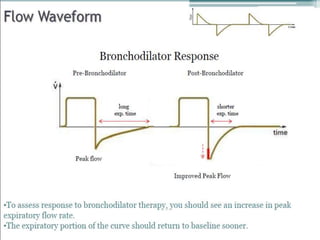
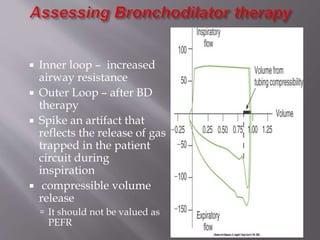
 Inner loop – increased
airway resistance
 Outer Loop – after BD
therapy
 Spike an artifact that
reflects the release of gas
trapped in the patient
circuit during
inspiration
 compressible volume
release
 It should not be valued as
PEFR
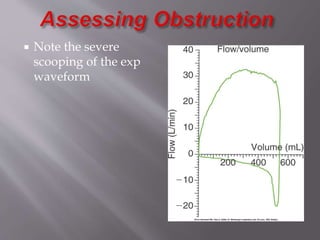
 Note the severe
scooping of the exp
waveform
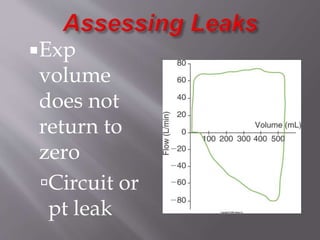
Exp
volume
does not
return to
zero
Circuit or
pt leak
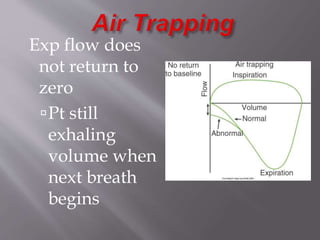
Exp flow does
not return to
zero
Pt still
exhaling
volume when
next breath
begins
2
1
1
2
3
3
V
LPS
.
BEFORE
V
LPS
.
2
1
1
2
3
3
V
LPS
.
BEFORE AFTER
Worse
2
1
1
2
3
3
V
LPS
.
2
1
1
2
3
3
V
LPS
.
VT
INSP
EXH
BEFORE AFTER
Worse Better
2
1
1
2
3
3
V
LPS
.
2
1
1
2
3
3
V
LPS
.
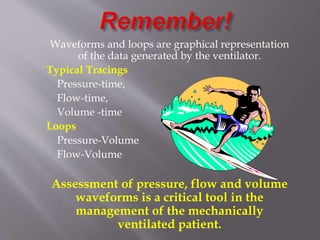
Waveforms and loops are graphical representation
of the data generated by the ventilator.
Typical Tracings
Pressure-time,
Flow-time,
Volume -time
Loops
Pressure-Volume
Flow-Volume
Assessment of pressure, flow and volume
waveforms is a critical tool in the
management of the mechanically
ventilated patient.
 Susan philbeam textbook of mechanical
ventilation

Ventilator graphics

  • 1.
  • 2.
     Allow usersto interpret, evaluate, and troubleshoot the ventilator and the patient’s response to the ventilator.  Monitor the patient’s disease status (C and Raw).  Assess the patient’s response to therapy.  Monitor proper ventilator function  Allow fine tuning of ventilator to decrease WOB, optimize ventilation, and maximize patient comfort
  • 3.
  • 4.
  • 5.
    •Scalars: Plot pressure,volume, or flow against time. Time is the x-axis. •
  • 6.
  • 7.
    Loops: Plot pressureor flow against volume. (P/V or F/V). There is no time component
  • 8.
    •Generally, the rampwaves are considered the same as exponential shapes, so you really only need to remember three: square, ramp, and sinewaves.
  • 9.
     Square wave: Representsa constant or set parameter. For example, pressure setting in PC mode or flowrate setting in VC mode.  Ramp wave: Represents a variable parameter Will vary with changes in lung characteristics Can be accelerating or decelerating  Sine wave: Seen with spontaneous, unsupported breathing
  • 10.
     In Volumemodes, the shape of the pressure wave will be a ramp for mandatory breaths •In Volume modes, adding an inspiratory pause (or hold) will add a small plateau to the waveform. •This is thought to improve distribution of ventilation
  • 11.
     In Pressuremodes, the shape of the pressure wave will be a square shape. •This means that pressure is constant during inspiration or pressure is a set parameter.
  • 12.
     Distinguishing breathtype  Trigger Sensitivity  Plateau pressure  Rate & I:E  Peak Flow [VC]  PS characteristics  Lung mechanics
  • 13.
     Y axis– Pressure  X axis – Time  A-B = Inspiration  B – C = Expiration  MAP = Area under curve  PIP = Max insp Pressure  PEEP = baseline Pressure
  • 14.
     Press waveis square [constant]  P wave is not affected by lung mechanics or pt flow demand  Flow rate is according to lung mechanics, set P, & Insp effort by pt  Flow wave rises rapidly to meet set P, then decreases to a point necessary to maintain set P. [ expo decay or continuously variable decelerating pattern]  Note the P & V plateaus in regard to the Flow which ends before Ti is over  This condition provides the greatest volume possible for that set P  Indicates the lung has met equilibrium [Plateau]
  • 16.
     This condixhas a much shorter Ti [not allowing for Plateau] but for a longer Te  Delivered volume is slightly decreased
  • 17.
     A-B Inspiration B-C Expiration  D shows second breath beginning before 1st breath has exhaled fully  Indicates needing to decrease rate, increase Te, or decrease Ti •Adequate Rate, I:E
  • 22.
    •Breath type Mechanical breath[volume] •Note at point A – there is no negative deflex •Consistent Ti & Volume delivery •Pressure continues to rise until set V is reached, then breath cycles
  • 23.
    •Breath type •Mechanical Breath[ Pressure] Consistent Ti & Pressure delivery •P reaches limit early in I and holds for Ti •No Trigger
  • 24.
    •Breath type •Triggered MechanicalVolume Breath •Note at point A – there is a negative deflection, indicating the pt initiated a triggered breath
  • 25.
     Identified bynegative inflex triggering breath  varying Inspiratory times  Note the different times of the above curves  VC-SIMV w/ PS •Breath type •Pressure Support breaths
  • 26.
     A –represents Inspirax of a spontaneous Breath  B – represents Expirax of a Spontaneous breath  Spontaneous Mode – Every breath is pt triggered & spontaneous in nature •Breath type •Spontaneous breath
  • 28.
     A –scooped out waveform b/c inadequate flow for pt demand  B – bulging indicates too much flow •Adjusting Peak Flow [ VC]
  • 33.
     Note the ExpVolume is not = insp Vol  Indicating a leak  Flow & Press both return to zero •Air Trapping v. Air Leaks
  • 34.
     Note theExp Volume > Insp Volume Indicating active Ex due to air trapping  Note the flow & Press never return to zero •Active Exhalation
  • 37.
     Y axis= flow  X axis = Time  A-B = inspiration  Above x axis  B-C = Expirax  Below X axis  D- Peak Inspiratory Flow  E = Peak Expiratory Flow [ PEFR]
  • 38.
     B-D =Ti  B-C = INSP FLOW  C-D = INSP PAUSE  D-F = Te  D-E = EXP FLOW  E-F = EXP FLOW has ended  Rate could be increased until insp begins at point E on this pt without air trapping
  • 41.
    1 2 34 5 6 SEC 120 -120 V . LPM Expiratory Flow Rate and Changes in Expiratory Resistance
  • 43.
     Exp flowis low & slow, taking a long time to rid the lungs of volume.  Te is barely adequate to allow for lung emptying before next breath  This pt may have COPD or severe asthma  Bronchodilator response may be helpful to evaluate
  • 44.
     A –Insp flow does return to zero  Adequate Ti  B – Insp flow does NOT return to zero  Inadequate Ti  Allows for increasing Ti  this will increase Vt without increasing Pressure
  • 45.
     Pressure remains constantat level set  Flow increases as pt demand increases in order to maintain the set Pressure level  Volume increases
  • 47.
  • 48.
    0 20 40602040-60 0.2 LITERS 0.4 0.6 Paw cmH2O VT
  • 49.
    Mandatory Breath Inspiration 0 2040 602040-60 0.2 LITERS 0.4 0.6 Paw cmH2O VT
  • 50.
    Mandatory Breath Expiration 0 2040 602040-60 0.2 LITERS 0.4 0.6 Paw cmH2O Inspiration VT Counterclockwise
  • 51.
    Spontaneous Breath Inspiration 0 2040 602040-60 0.2 LITERS 0.4 0.6 Paw cmH2O VT Clockwise
  • 52.
    Spontaneous Breath Inspiration Expiration 0 2040 602040-60 0.2 LITERS 0.4 0.6 Paw cmH2O VT Clockwise
  • 53.
    Assisted Breath 0 2040 602040-60 0.2 LITERS 0.4 0.6 Paw cmH2O Assisted Breath VT
  • 54.
    Assisted Breath Inspiration 0 2040 602040-60 0.2 LITERS 0.4 0.6 Paw cmH2O Assisted Breath VT
  • 55.
    Assisted Breath Inspiration Expiration 0 2040 602040-60 0.2 LITERS 0.4 0.6 Paw cmH2O Assisted Breath VT Clockwise to Counterclockwise
  • 56.
     Dashed lineplotted based on the Static Compliance calculation drawn from zero to peak PA Peak PA – Pstatic or Pplat  Note that the point at which Peak PA is also the point where the volume plateaus PTA = xairway pressure  [difference b/w the airway opening(Pawo) and the Alveoli (PA)]
  • 58.
     Triangle APAE Represents the amount of mechanical work to overcome the compliance [elastic forces] of the chest  Area ACBPA represents amount of work to overcome Raw during Insp  Triangle APAD represents amount of work to overcome Raw during Exp  The insp area [area w/in the hysteresis] represents total WOB due to Raw
  • 59.
    PTA = xairwaypressure  [difference b/w the airway opening(Pawo) and the Alveoli (PA)]  Represents the amount of pressure needed to overcome resistance of the lung  If Raw increases this distance will increase  If flow [turbulence] increases, so does this distance
  • 60.
  • 61.
     Slope =line drawn from zero through the Pplat  As slope increases [ Pplat decreases] compliance increases for a set volume  As slope decreases [ Pplat increase] compliance decreases for a set volume
  • 62.
     Decreased compliance dz’s Fibrosis, ARDS, pna, Pulm edema, Atelectasis, etc.  Short Time constant states(fast lung units)  Increased compliance dz’s  Emphysema, uncomplicated COPD, etc.  Long Time constant states(slow lung units)  Pressure remains constant while volumes differ
  • 63.
  • 64.
    Overdistension B A 0 20 4060-20-40-60 0.2 0.4 0.6 LITERS Paw cmH2O C A = inspiratory pressure B = upper inflection point C = lower inflection point VT
  • 65.
     X axis– Volume  Y axis – Flow  Insp – above x axis  Exp – below x axis  Opposite of a PFT tracing  Peak Exp Flow Rate  Peak insp flow
  • 66.
     •The shapeof the inspiratory portion of the curve will match the flow waveform.  •The shape of the exp flow curve represents passive exhalation.  •Can be used to determine the PIF, PEF, and Vt  •Looks circular with spontaneous breaths
  • 67.
     •Air trapping •Airway Obstruction  •Airway Resistance  •Bronchodilator Response  •Insp/Exp Flow  •Flow Starvation  •Leaks  •Water or Secretion accumulation  •Asynchrony
  • 69.
  • 70.
    Volume Peak Expiratory Flow PeakInspiratory Flow Tidal Volume Inspiration Expiration
  • 71.
     A –normal Raw & exp flow  B – increased Raw & reduced exp flow  C – markedly increased Raw & reduced exp flow  Insp flow is unaffected by Raw b/c the vent is delivering a constant flow [square waveform]
  • 72.
     Inner loop– increased airway resistance  Outer Loop – after BD therapy  Spike an artifact that reflects the release of gas trapped in the patient circuit during inspiration  compressible volume release  It should not be valued as PEFR
  • 73.
     Note thesevere scooping of the exp waveform
  • 74.
  • 75.
    Exp flow does notreturn to zero Pt still exhaling volume when next breath begins
  • 76.
  • 77.
  • 78.
  • 79.
    Waveforms and loopsare graphical representation of the data generated by the ventilator. Typical Tracings Pressure-time, Flow-time, Volume -time Loops Pressure-Volume Flow-Volume Assessment of pressure, flow and volume waveforms is a critical tool in the management of the mechanically ventilated patient.
  • 80.
     Susan philbeamtextbook of mechanical ventilation