VENTILATOR WAVEFORM
ANALYSIS
ANALYSIS
By
Dr M V Nagarjuna
1
Dr. M.V. Nagarjuna
Seminar Overview
1. BasicTerminology (Types of
variables, Breaths, modes of
, ,
ventilation)
2. Ideal ventilator waveforms (Scalars)
( )
3. Diagnosing altered physiological
states
4. Ventilator PatientAsynchrony and its
management.
5. Loops (Pressure volume and Flow
volume)
2
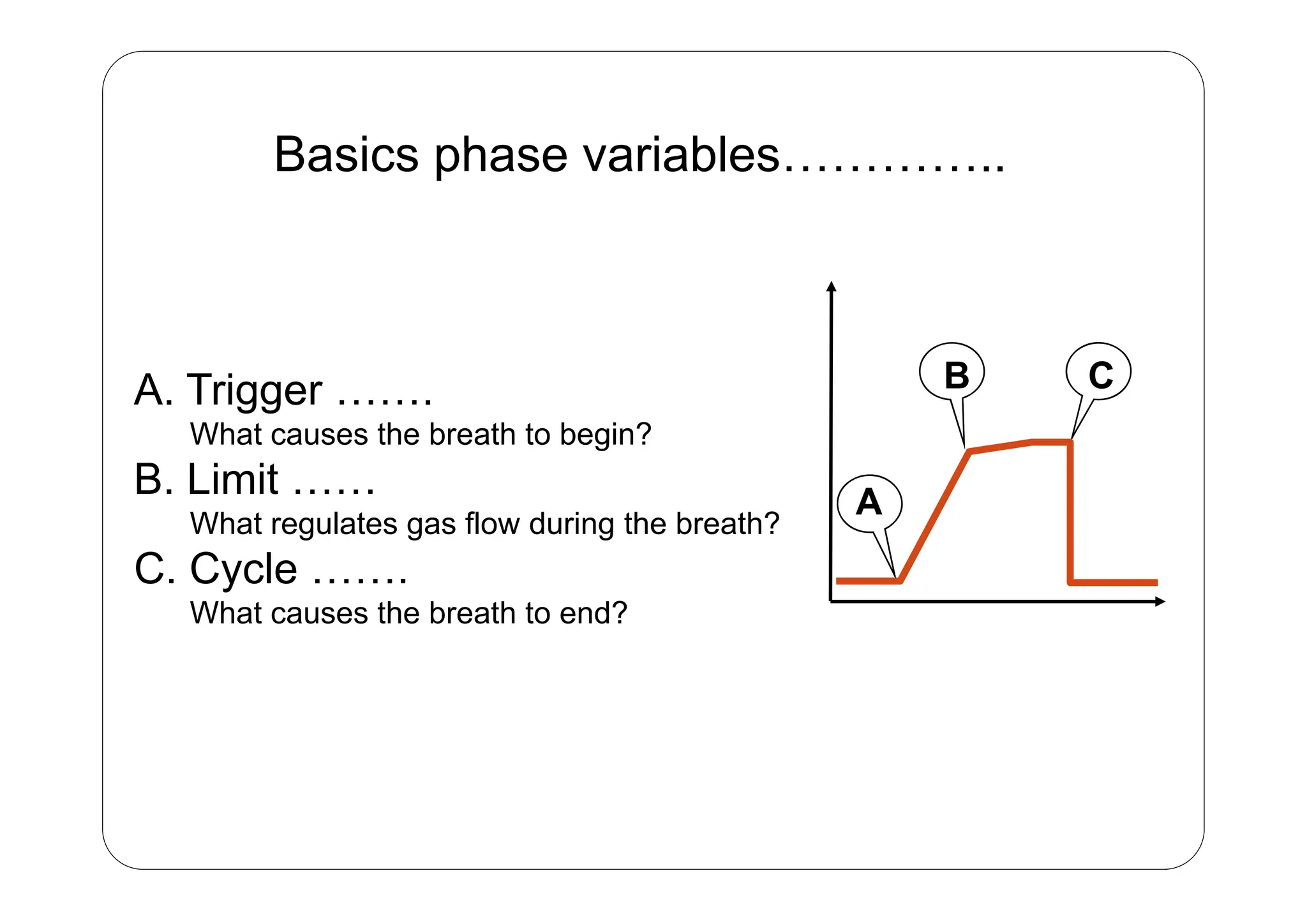
Basics phase variables
Basics phase variables…………..
A. Trigger …….
What causes the breath to begin?
B C
B. Limit ……
What regulates gas flow during the breath?
C Cycle
A
C. Cycle …….
What causes the breath to end?
VARIABLES
VARIABLES
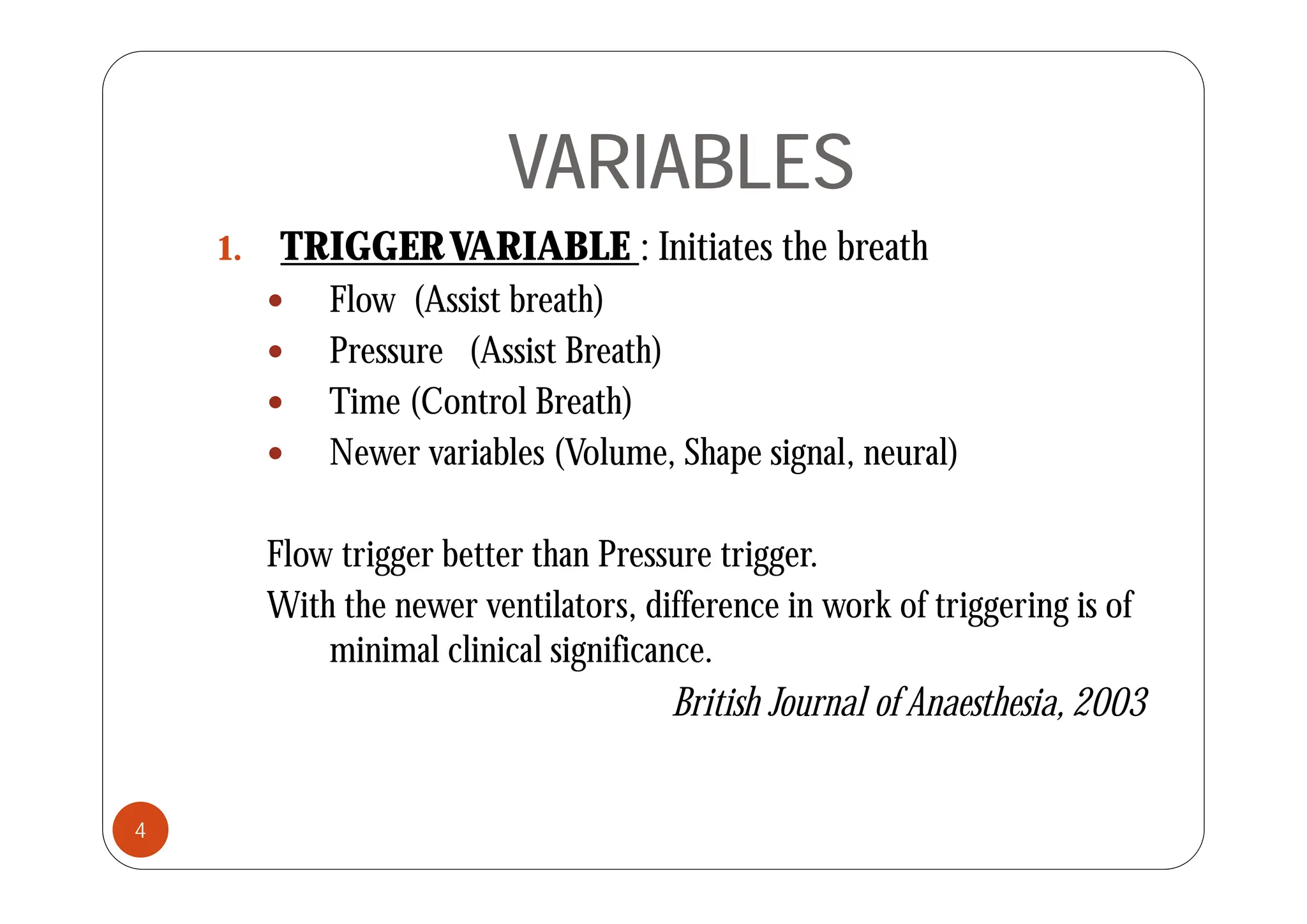
1 TRIGGERVARIABLE : Initiates the breath
1. TRIGGERVARIABLE : Initiates the breath
 Flow (Assist breath)
 Pressure (Assist Breath)
 Time (Control Breath)
 Newer variables (Volume Shape signal neural)
Newer variables (Volume, Shape signal, neural)
Flow trigger better than Pressure trigger.
ow t gge ette t a essu e t gge .
With the newer ventilators, difference in work of triggering is of
minimal clinical significance.
g
British Journal of Anaesthesia,2003
4
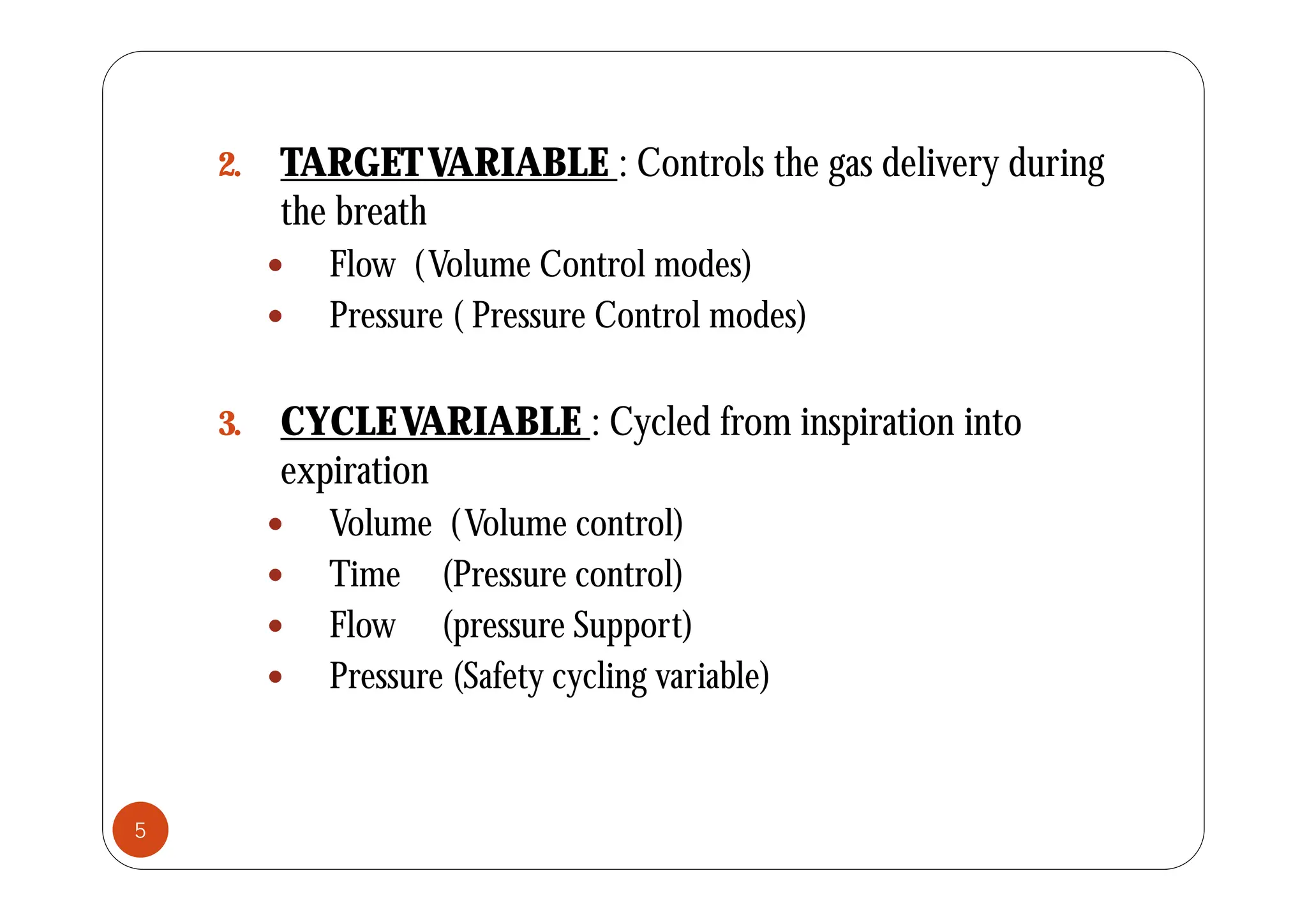
2. TARGETVARIABLE : Controls the gas delivery during
the breath
 Flow (Volume Control modes)
 Pressure ( Pressure Control modes)
3. CYCLEVARIABLE : Cycled from inspiration into
i i
expiration
 Volume (Volume control)
Ti (P l)
 Time (Pressure control)
 Flow (pressure Support)
 P (S f t li i bl )
 Pressure (Safety cycling variable)
5
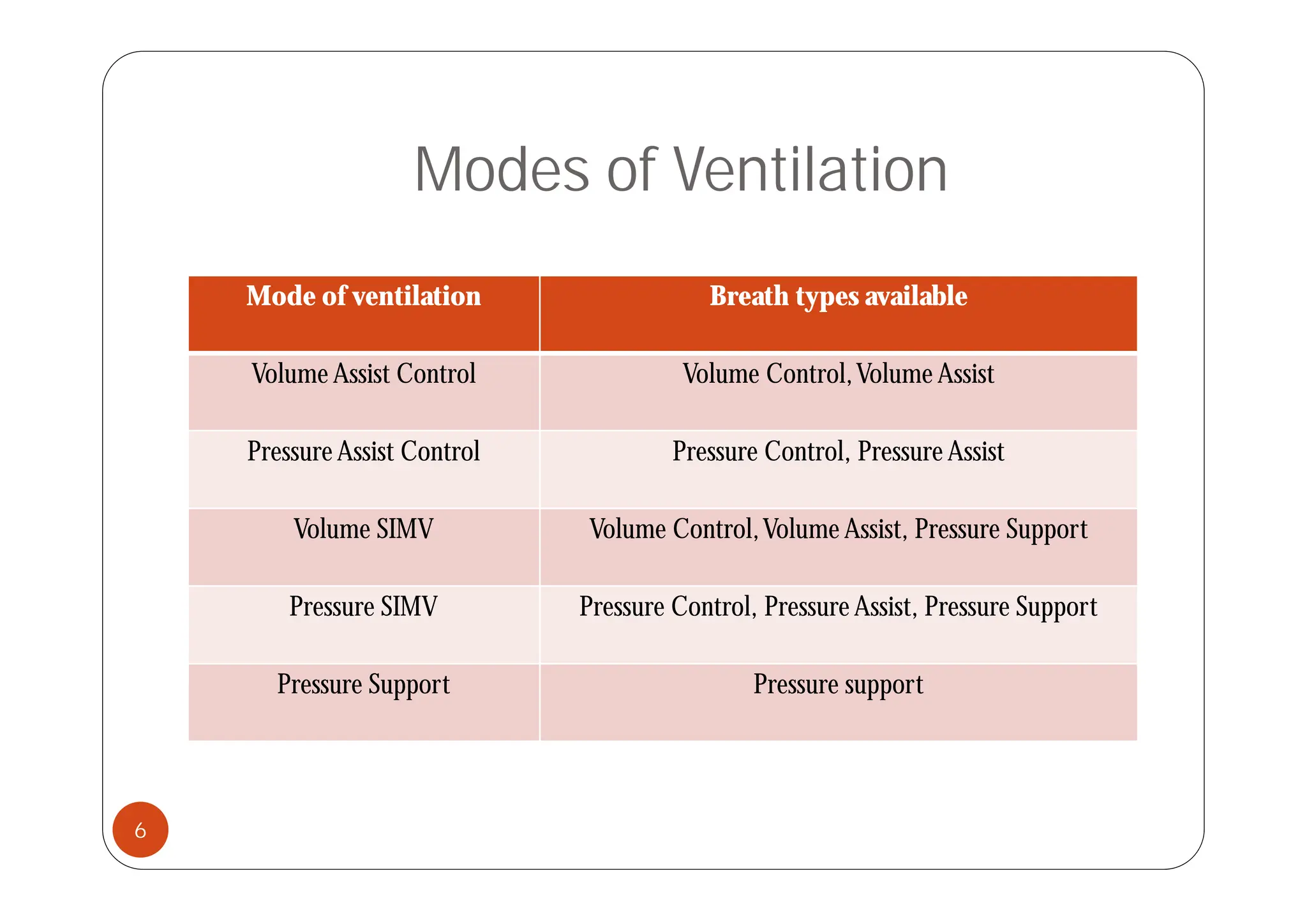
Modes of Ventilation
Mode of ventilation Breath types available
Volume Assist Control Volume Control,Volume Assist
PressureAssist Control Pressure Control, PressureAssist
,
Volume SIMV Volume Control,Volume Assist, Pressure Support
Pressure SIMV Pressure Control, PressureAssist, Pressure Support
Pressure Support Pressure support
6
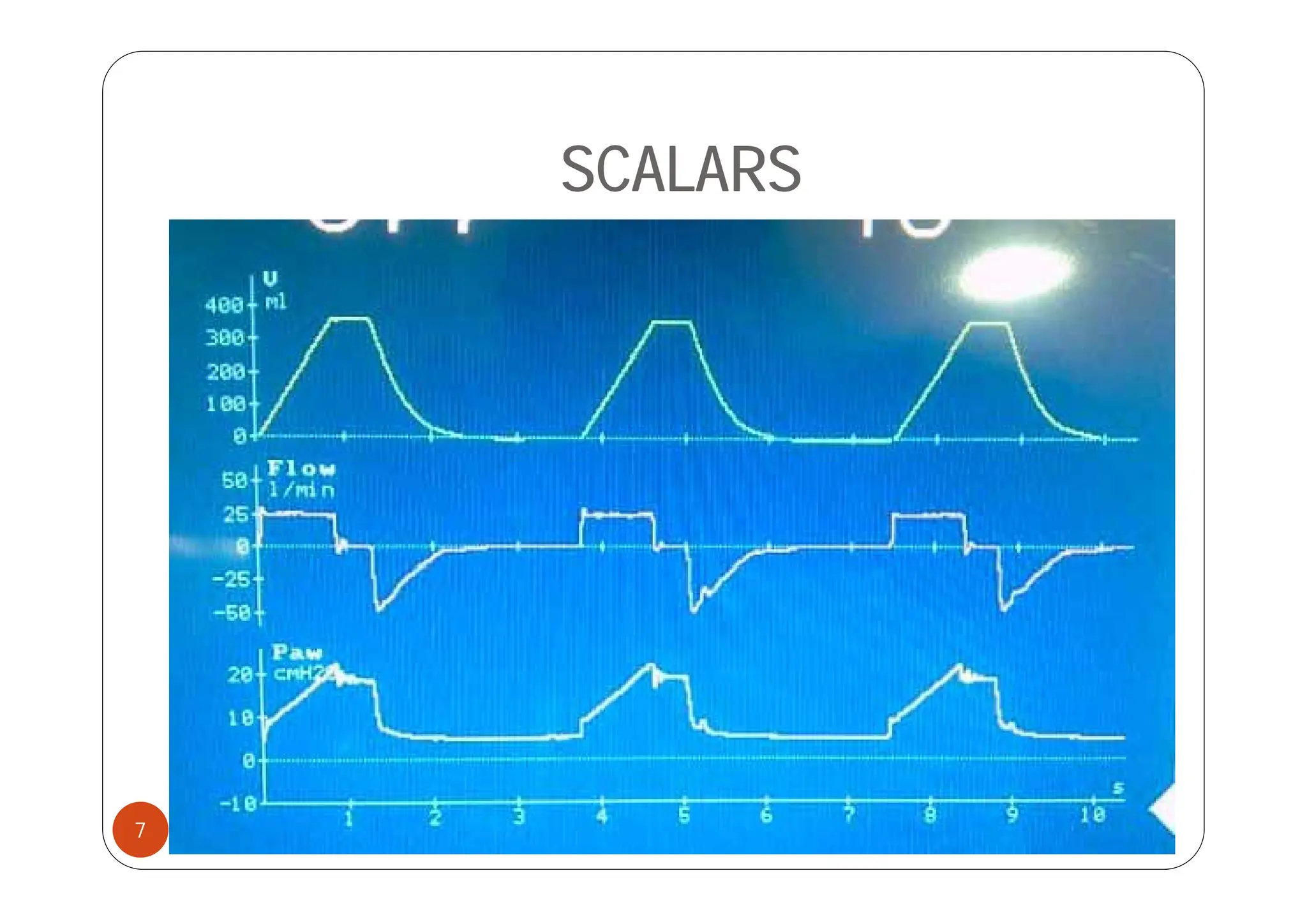
SCALARS
7
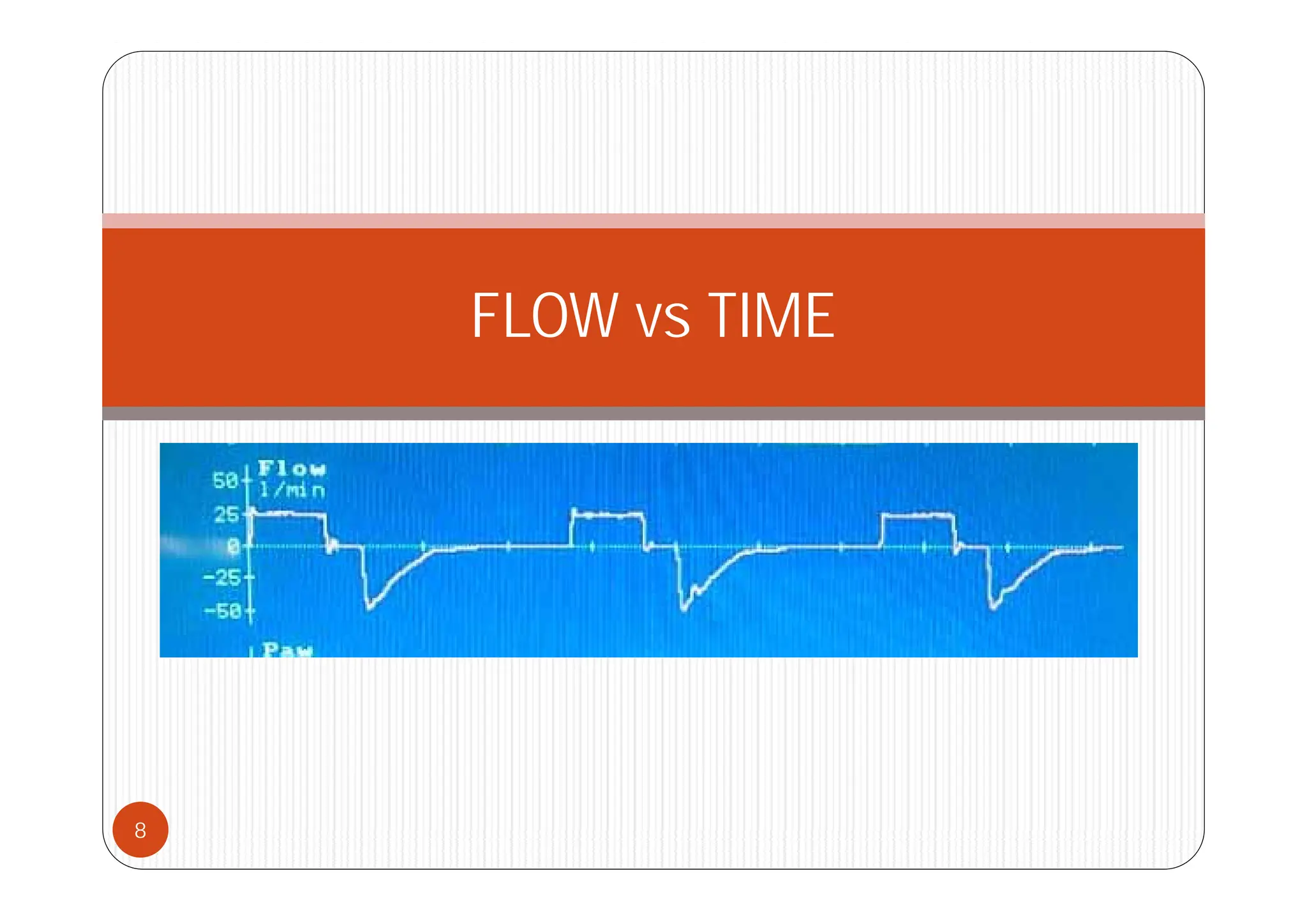
FLOW vs TIME
8
Flow versus time
Never forget to look at the expiratory limb of the flow waveform
The expiratory flow is determined by the elastic recoil of the
respiratory system and resistance of intubated airways
9
Types of Inspiratory flow waveforms
a Square wave flow
a. Square wave flow
b. Ascending ramp flow
c Descending ramp flow
c. Descending ramp flow
d. Sinusoidal flow
e Decay flow
e. Decay flow
10
Which form to use??
 P t l d Al D l ti d fl
 Pressure control mode :Always Decelerating or decay flow.
Cannot be changed.
 Volume control mode : Flow waveform can be changed
d di h il i
depending on the ventilator options.
11
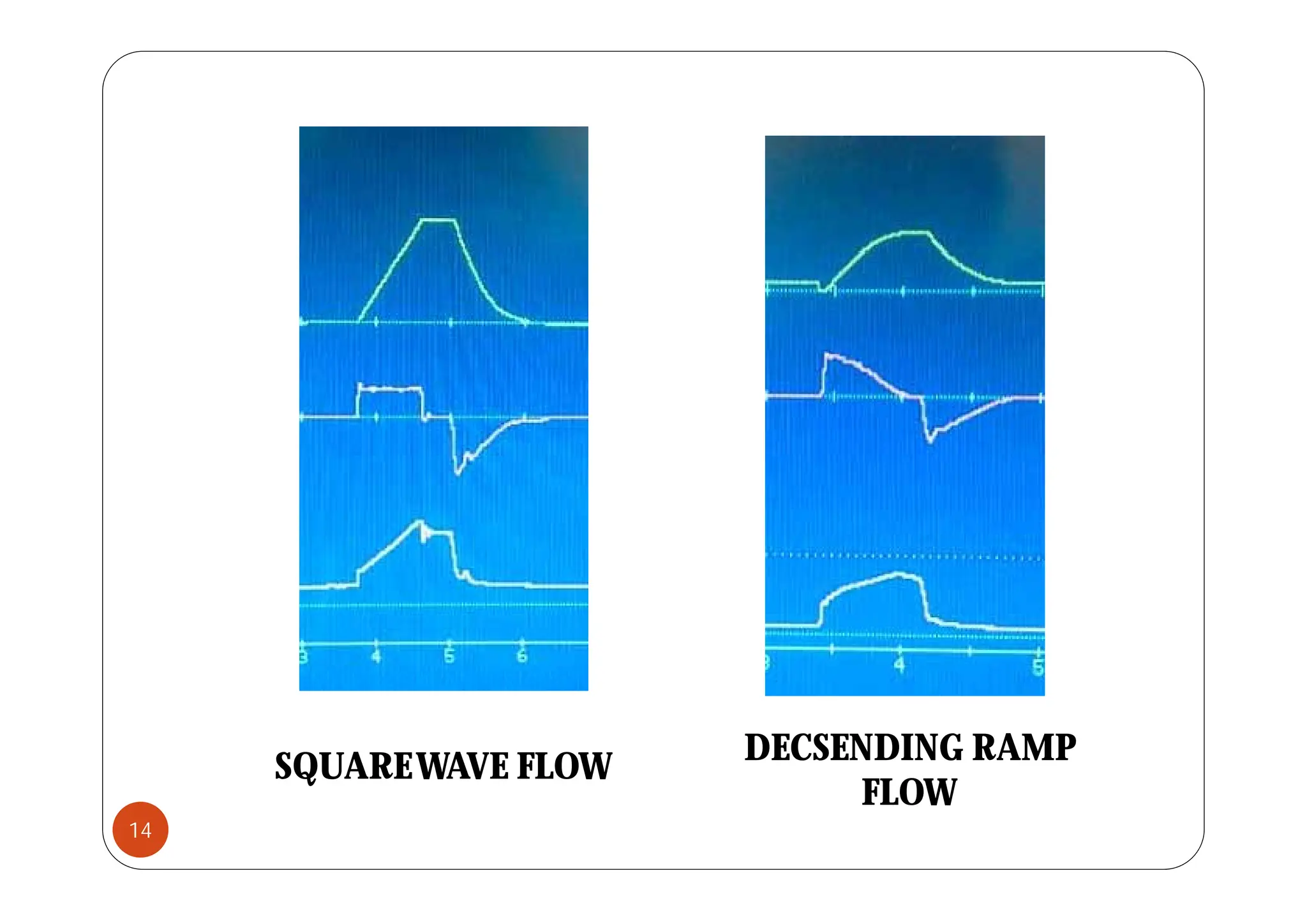
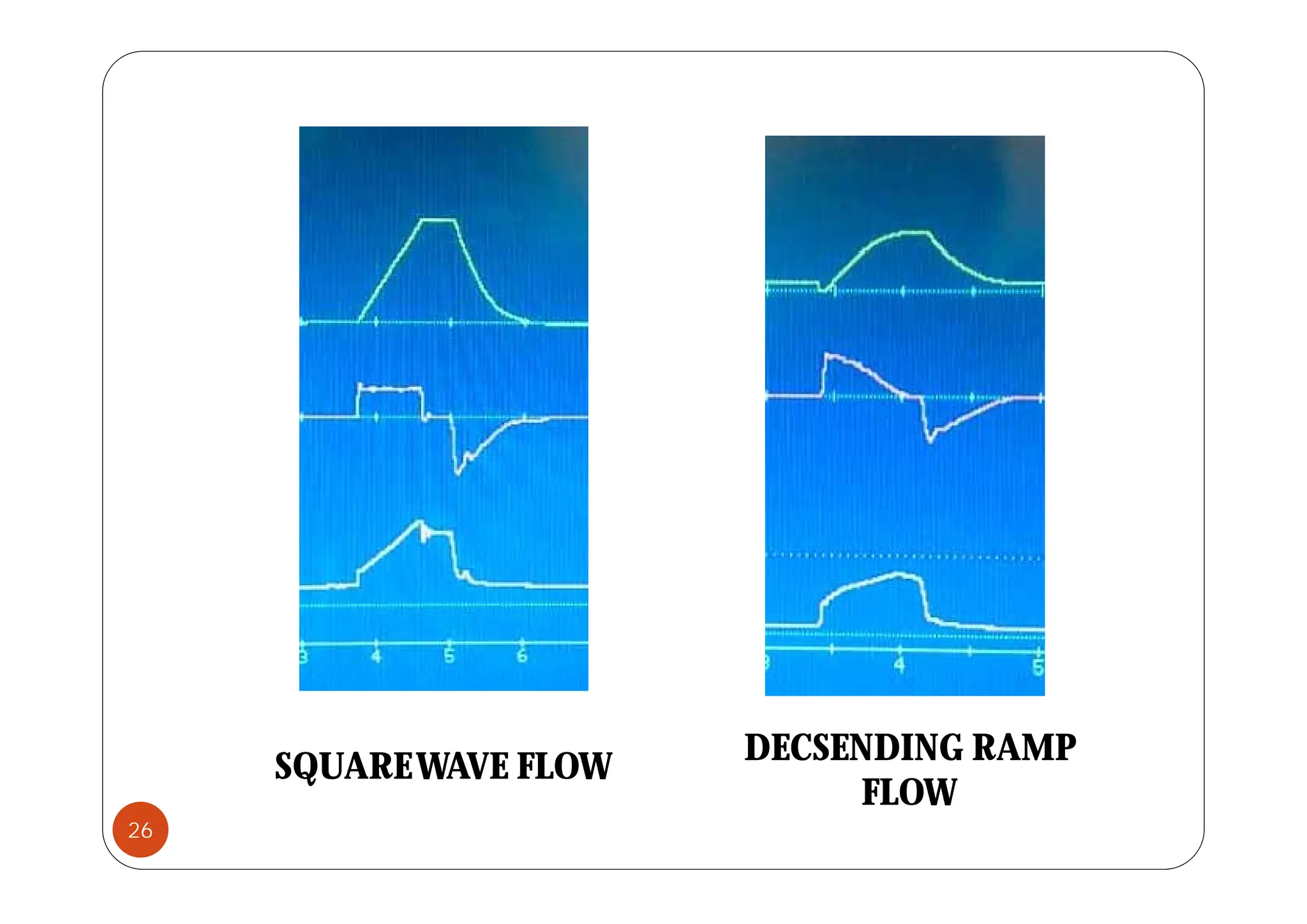
SQUARE FLOWWAVEFORM :
• Inspiratory time is shortest for
Inspiratory time is shortest for
Square wave flow form.
• Highest Peak Inspiratory pressures
•Low Mean Inspiratory pressure
•Low Mean Inspiratory pressure,,
thus better venous return and cardiac
output
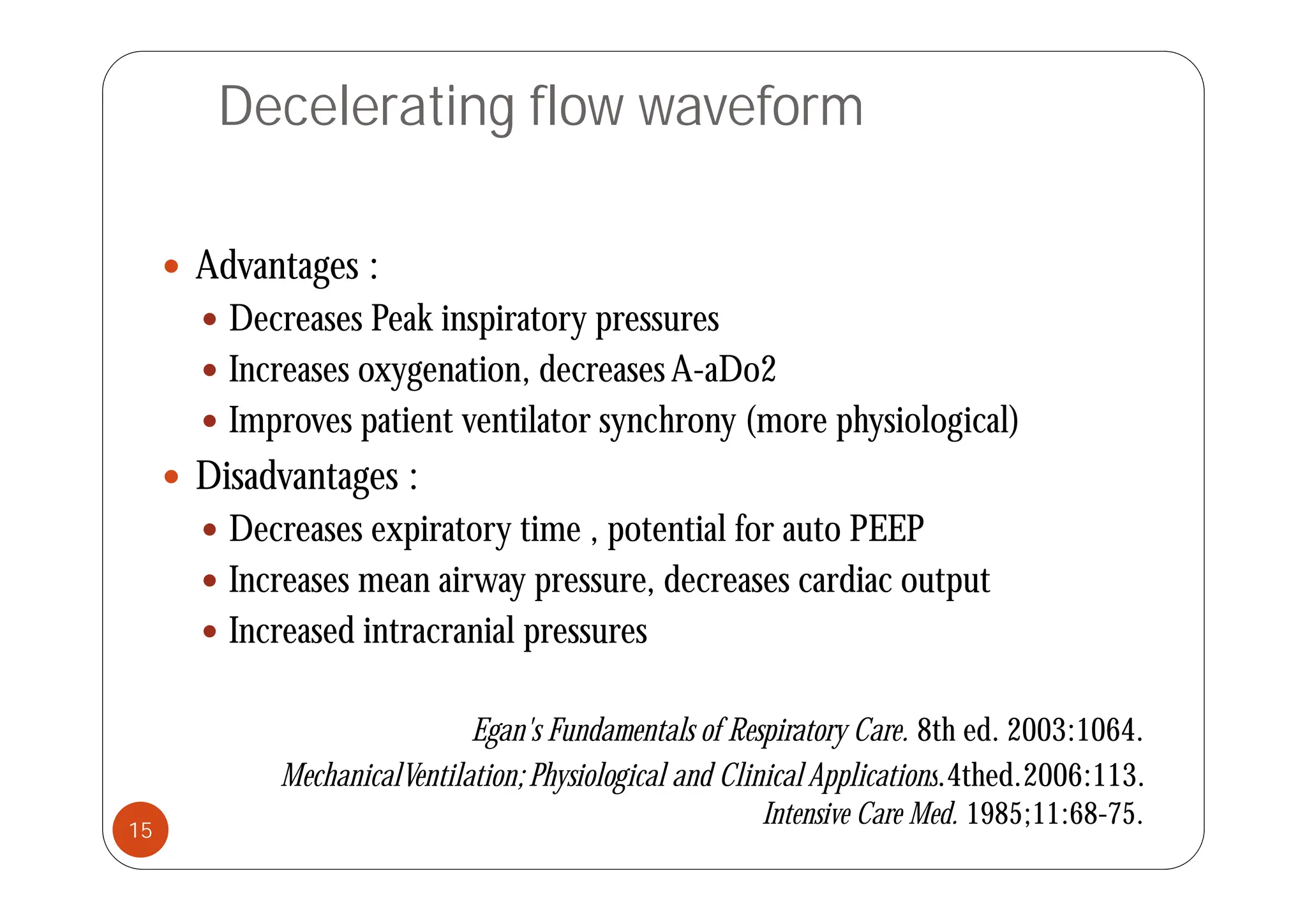
DESCENDING RAMP FLOW :
• Increases inspiratory time (if not
fixed) or peak inspiratory flow rate (if
inspiratory time is fixed)
p y
•Least Peak inspiratory pressures
(19% decrease).
•High mean airway pressure, helps
g y p , p
lung inflation and oxygenation.
12
Sinusoidal and ascending ramp flow :
 Initial flow rates are slow and hence cause dyssynchrony –
FLOW STARVATION
FLOW STARVATION.
 Should not be used in assist modes.
Descending ramp and Square wave flow :
 Usually preferred as the initial flow rate meets the flow
demand of the patient. Decreases air hunger.
13
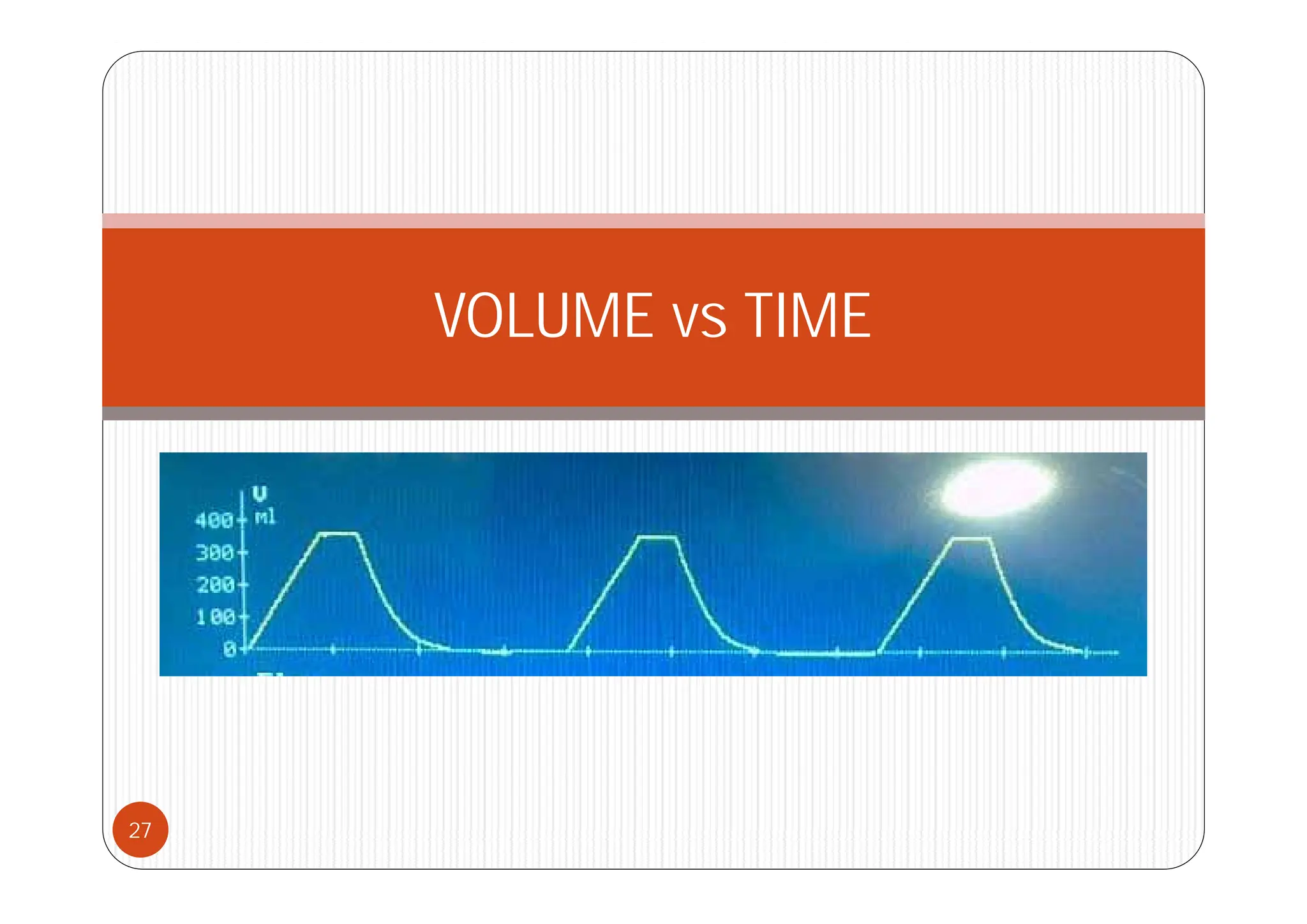
SQUAREWAVE FLOW
DECSENDING RAMP
14
SQUAREWAVE FLOW
FLOW
Decelerating flow waveform
 Advantages :
 Decreases Peak inspiratory pressures
 Increases oxygenation, decreases A-aDo2
 Improves patient ventilator synchrony (more physiological)
 Disadvantages :
 Decreases expiratory time , potential for auto PEEP
 Increases mean airway pressure, decreases cardiac output
 Increased intracranial pressures
Egan's Fundamentals of Respiratory Care. 8th ed. 2003:1064.
MechanicalVentilation;Physiological and Clinical Applications 4thed 2006:113
MechanicalVentilation;Physiological and Clinical Applications.4thed.2006:113.
Intensive Care Med. 1985;11:68-75.
15
Expiratory flow waveform
 Passive and determined by compliance of the lung and
resistance of the airways
resistance of the airways.
F i b b d
 Four points to be observed :
1. Peak Expiratory Flow
2 Sl f h i li b
2. Slope of the expiratory limb
3. Expiratory time
4 D th f h th b li ?
4. Does the waveform reach the baseline?
16
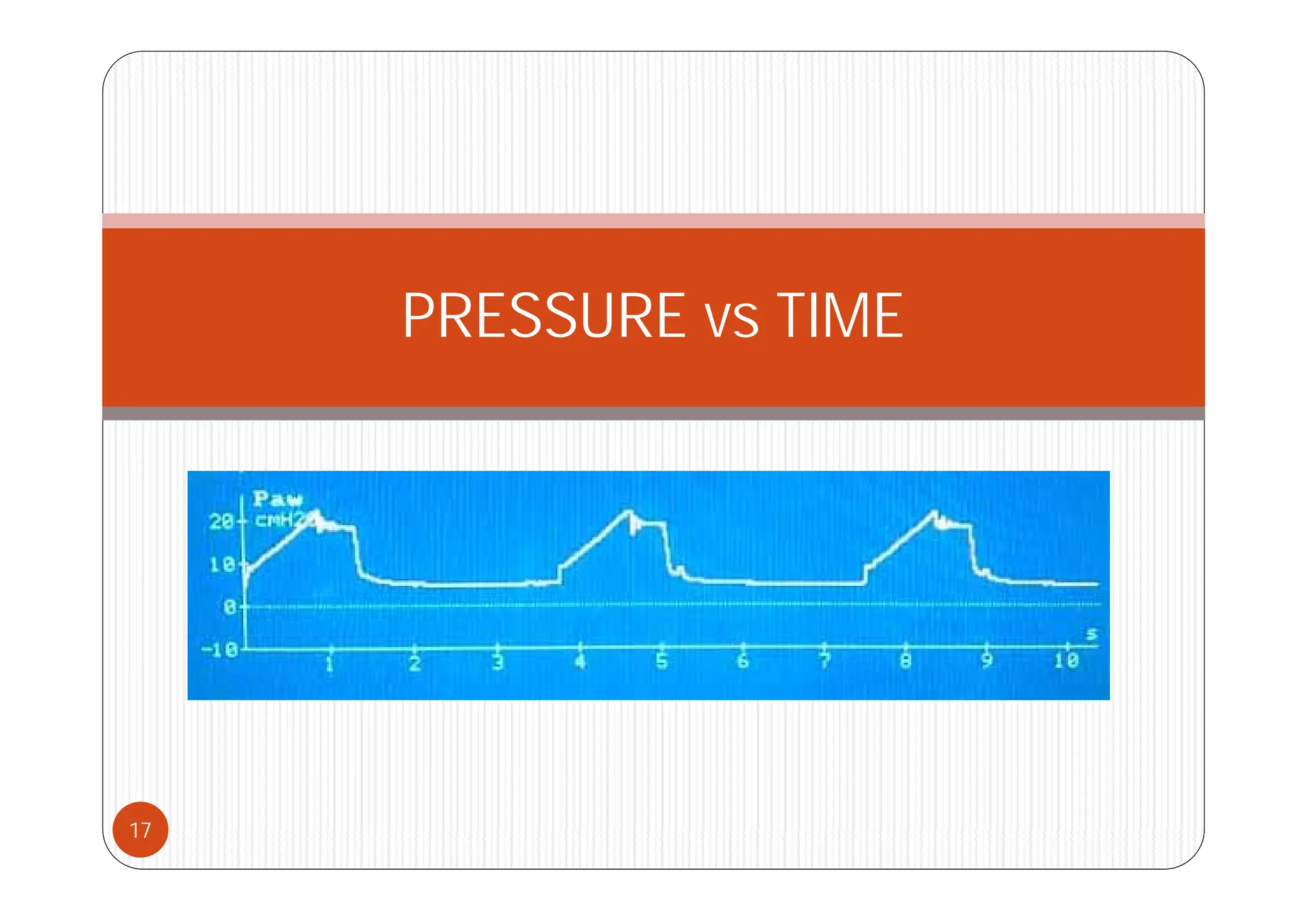
PRESSURE vs TIME
17
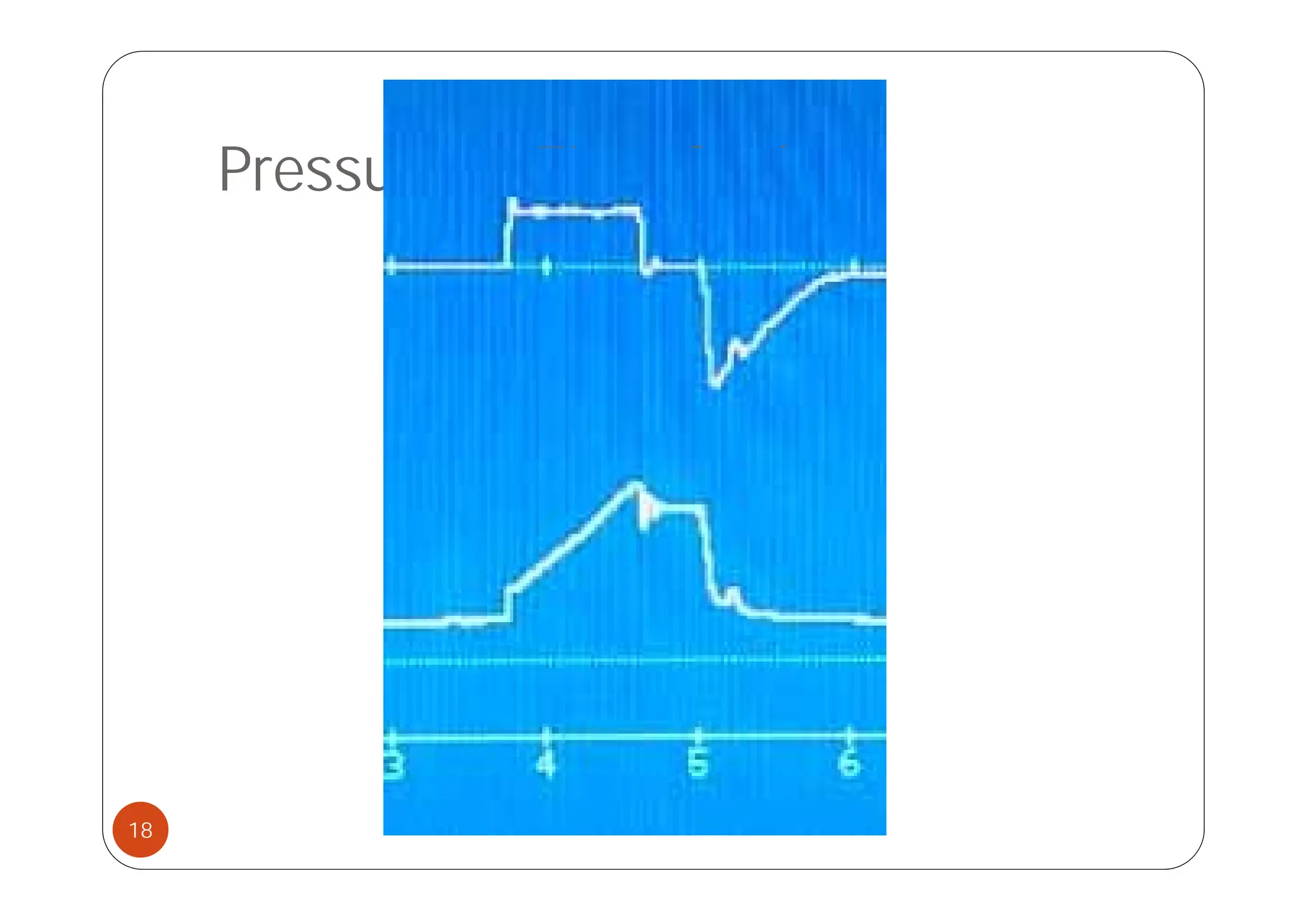
Pressure vs Time Scalar
18
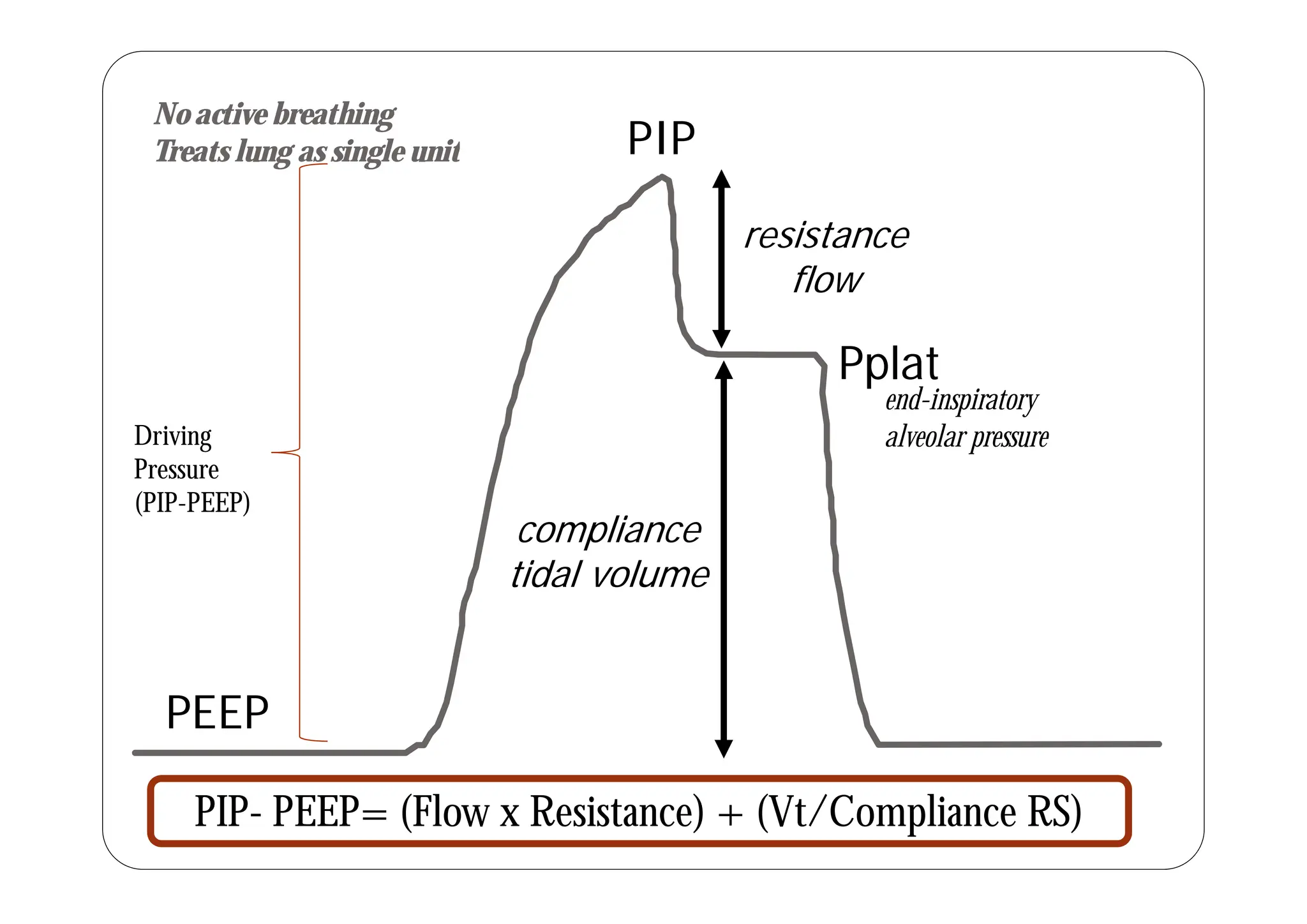
PIP
No active breathing
T t l i l it PIP
resistance
Treats lung as single unit
Pplat
flow
Pplat
end-inspiratory
alveolar pressure
Driving
compliance
tidal volume
Pressure
(PIP-PEEP)
tidal volume
PEEP
PIP- PEEP= (Flow x Resistance) + (Vt/Compliance RS)
tidal volume
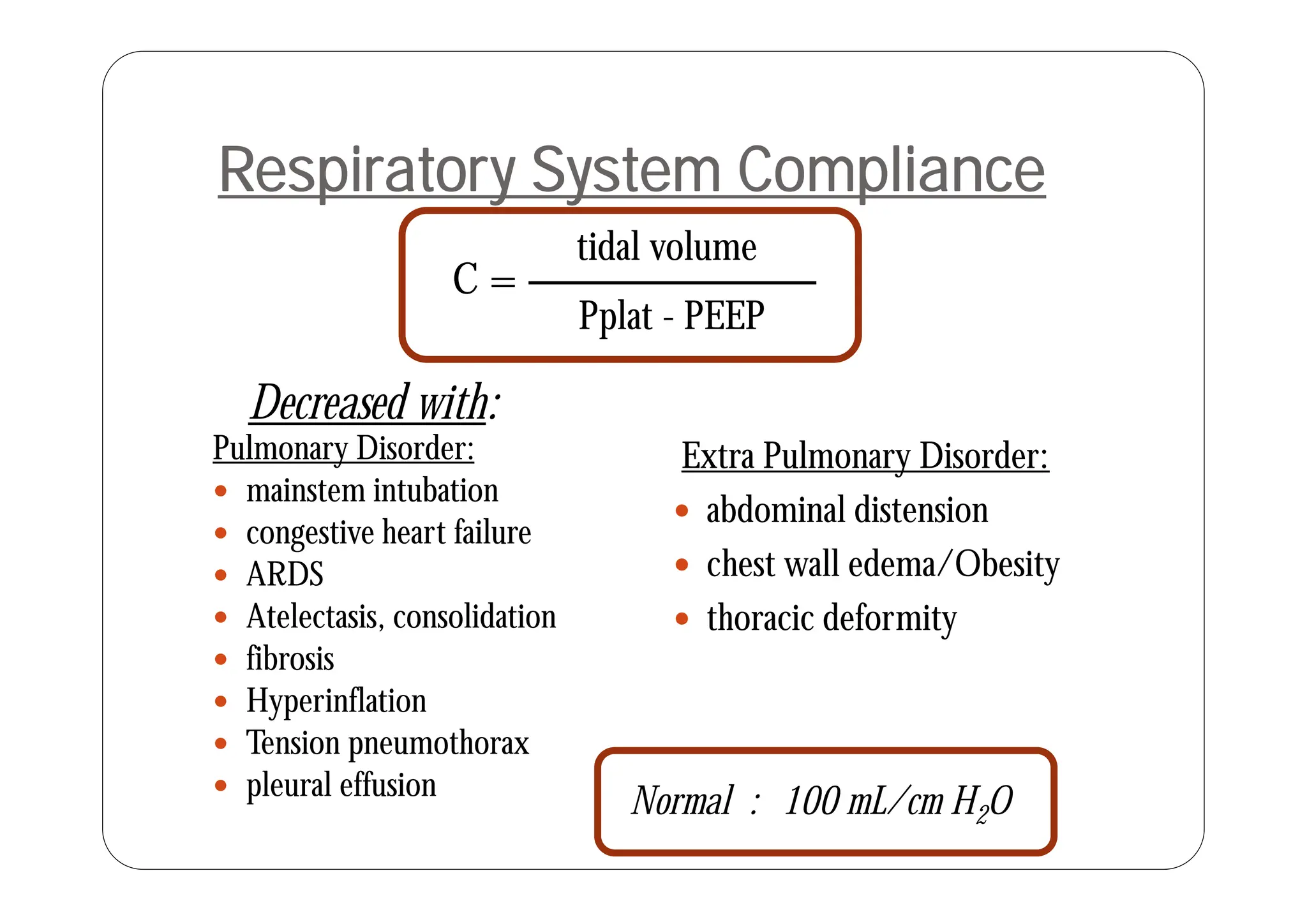
Respiratory System Compliance
C =
Pplat - PEEP
tidal volume
Pulmonary Disorder: Extra Pulmonary Disorder:
Decreased with:
y
 mainstem intubation
 congestive heart failure
ARDS
Extra Pulmonary Disorder:
 abdominal distension
 chest wall edema/Obesity
 ARDS
 Atelectasis, consolidation
 fibrosis
 chest wall edema/Obesity
 thoracic deformity
 Hyperinflation
 Tension pneumothorax
l l ff
Normal : 100 mL/cm H2O
 pleural effusion
P l t PEEP =Vt/ C li
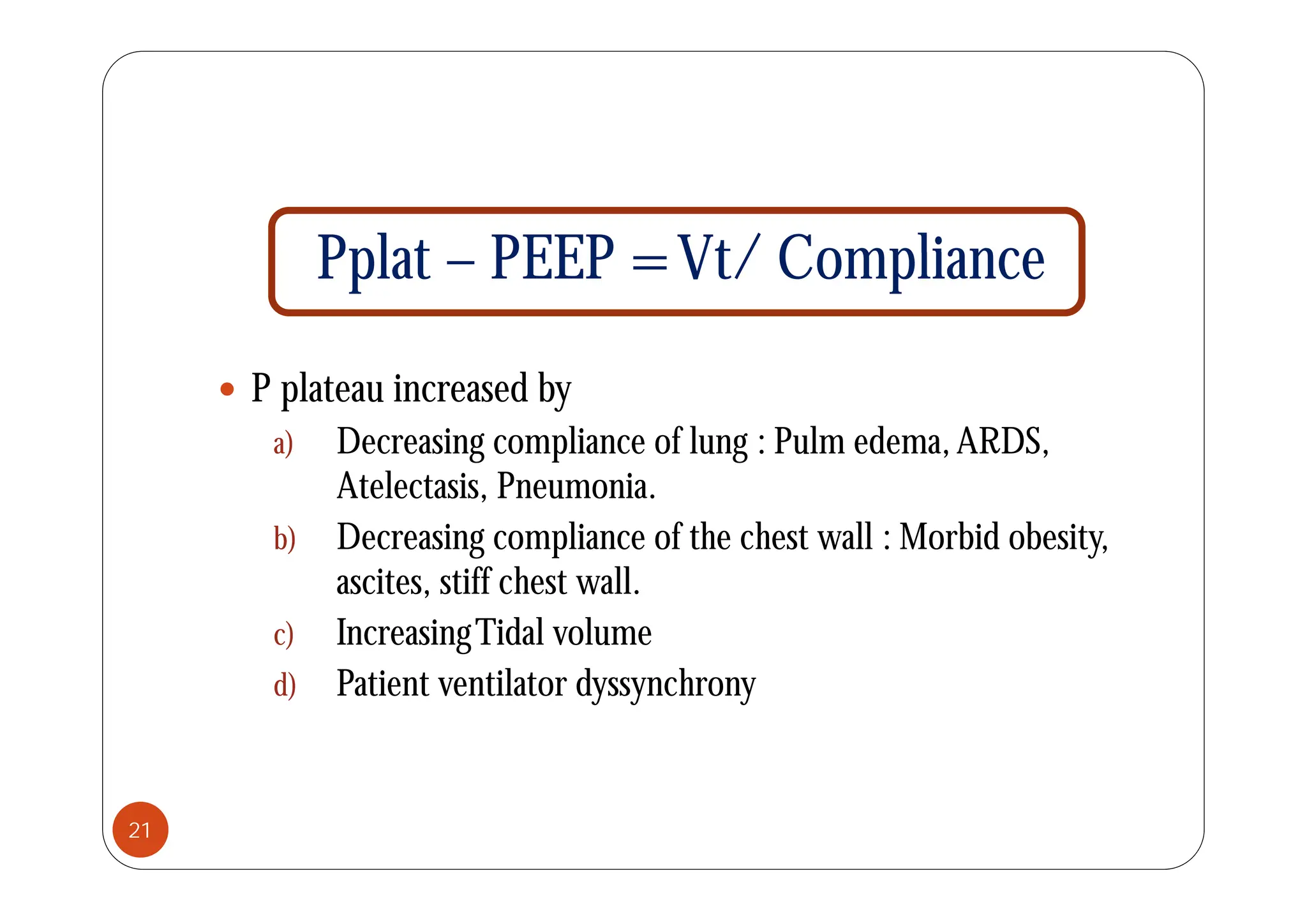
Pplat – PEEP =Vt/ Compliance
 P plateau increased by
a) Decreasing compliance of lung : Pulm edema,ARDS,
g p g
Atelectasis, Pneumonia.
b) Decreasing compliance of the chest wall : Morbid obesity,
ascites, stiff chest wall.
c) IncreasingTidal volume
d) Patient ventilator dyssynchrony
21
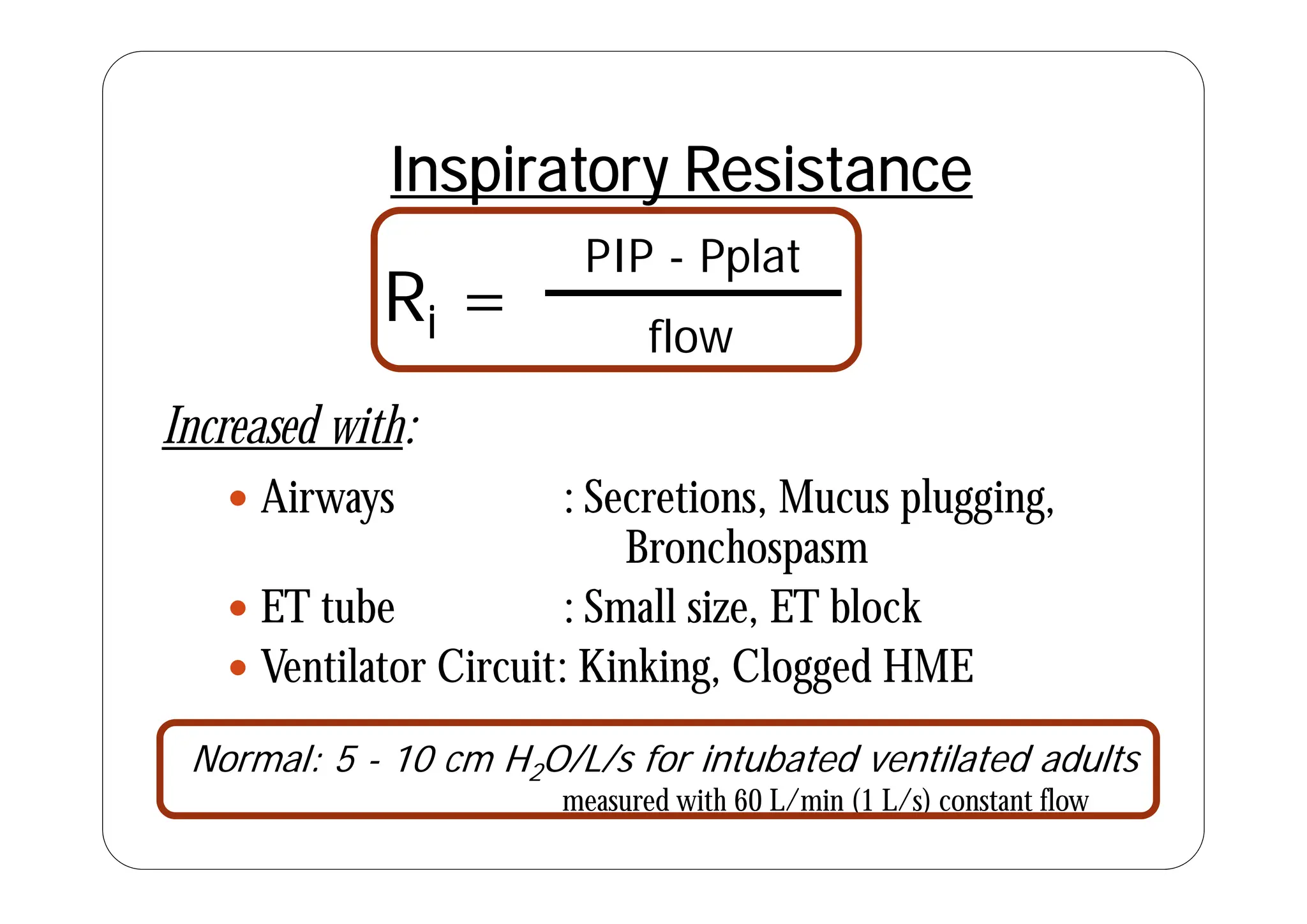
PIP Pplat
Inspiratory Resistance
Ri =
PIP - Pplat
flow
Increased with:
 Airways : Secretions, Mucus plugging,
Bronchospasm
p
 ET tube : Small size, ET block
 Ventilator Circuit: Kinking Clogged HME
 Ventilator Circuit: Kinking, Clogged HME
Normal: 5 - 10 cm H2O/L/s for intubated ventilated adults
2 / /
measured with 60 L/min (1 L/s) constant flow
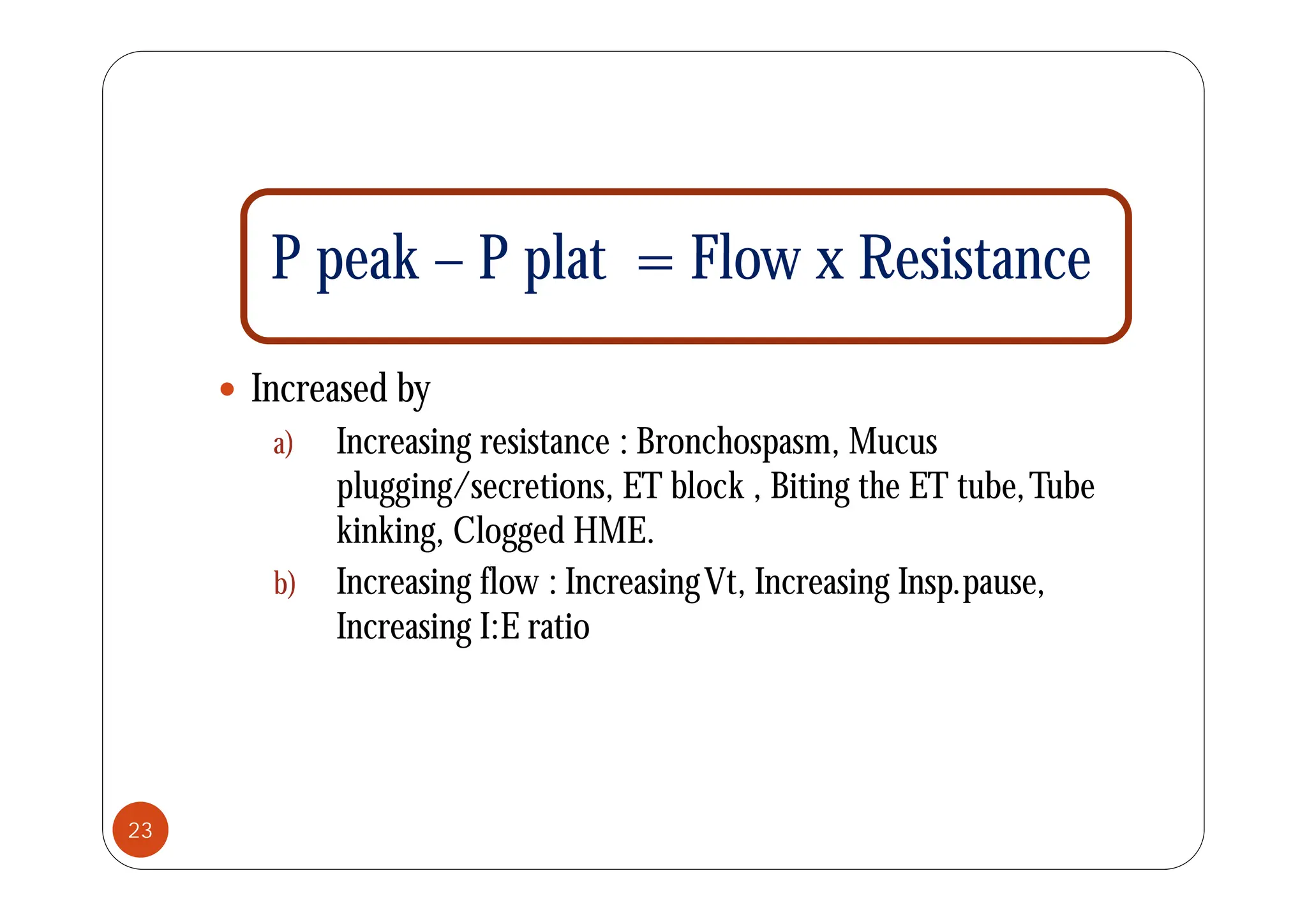
P k P l t = Fl R i t
P peak – P plat = Flow x Resistance
 Increased by
a) Increasing resistance : Bronchospasm, Mucus
g p
plugging/secretions, ET block , Biting the ET tube,Tube
kinking, Clogged HME.
b) Increasing flow : IncreasingVt, Increasing Insp.pause,
Increasing I:E ratio
23
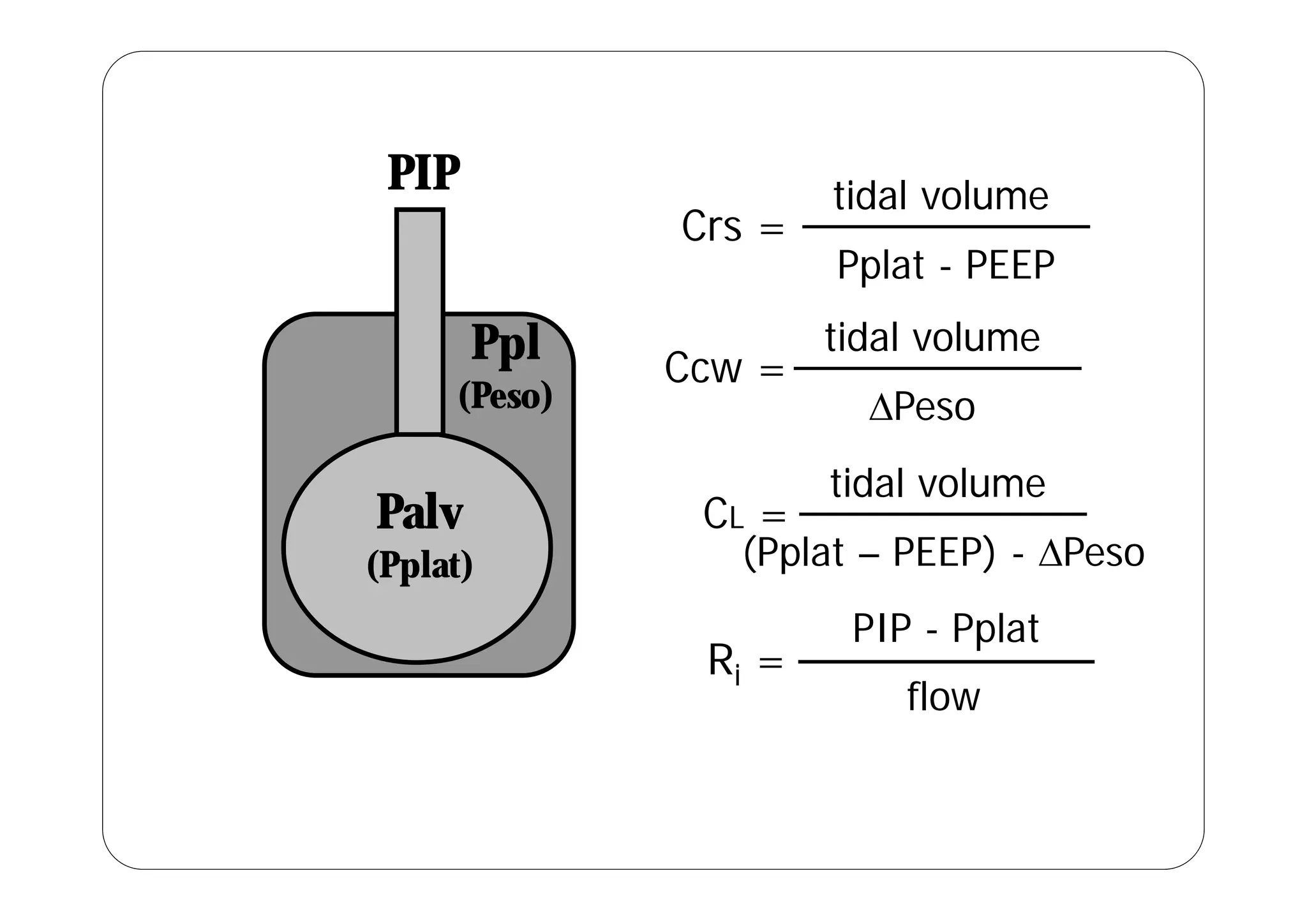
PIP
Crs =
P l t PEEP
tidal volume
Ppl
Pplat - PEEP
C
tidal volume
Ppl
(Peso)
Ccw =
Peso
Palv
(Pplat)
CL =
(Pplat – PEEP) - Peso
tidal volume
(Pplat) ( p )
Ri =
PIP - Pplat
Ri
flow
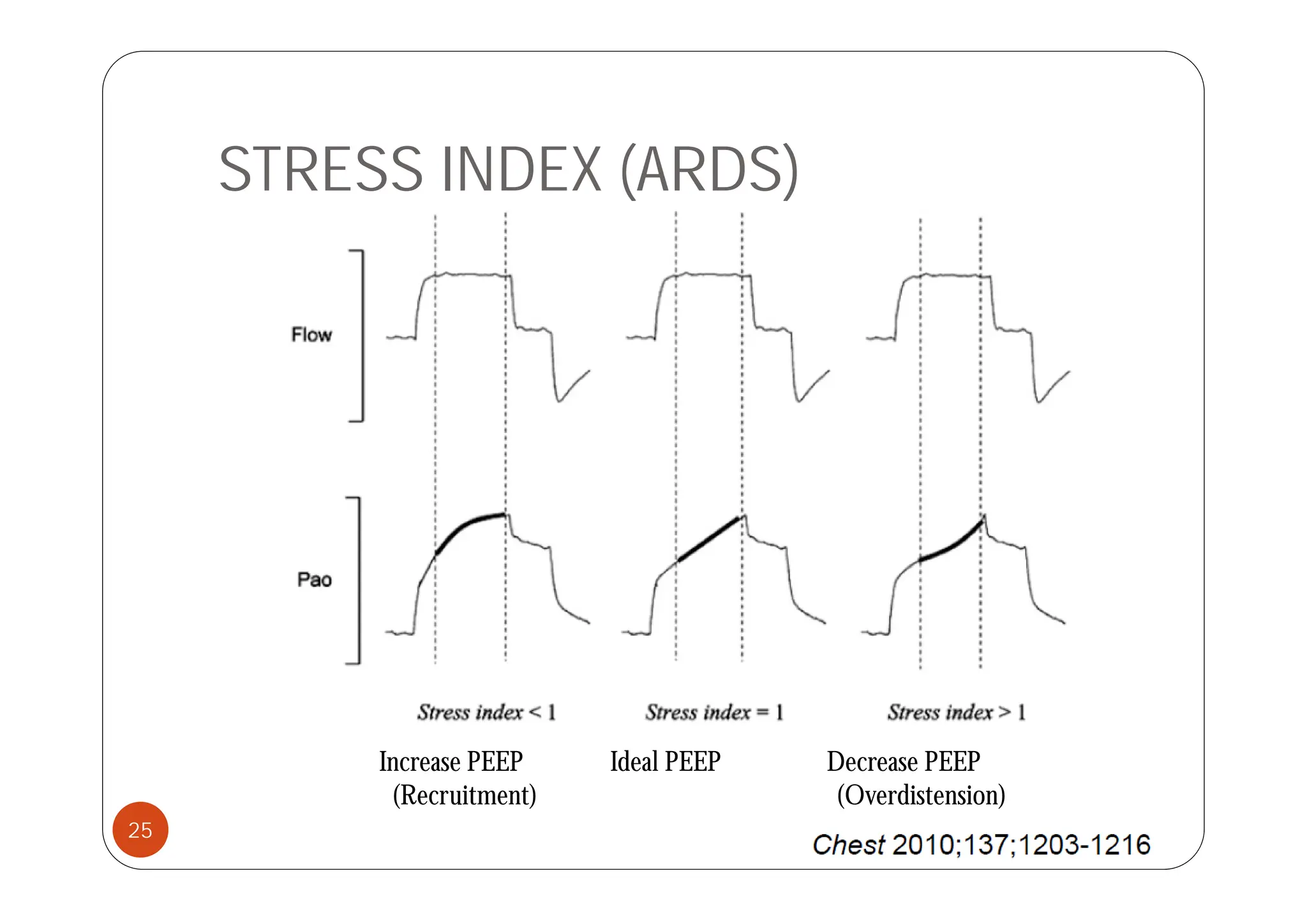
STRESS INDEX (ARDS)
Increase PEEP Ideal PEEP Decrease PEEP
(Recruitment) (Overdistension)
25
SQUAREWAVE FLOW
DECSENDING RAMP
26
SQUAREWAVE FLOW
FLOW
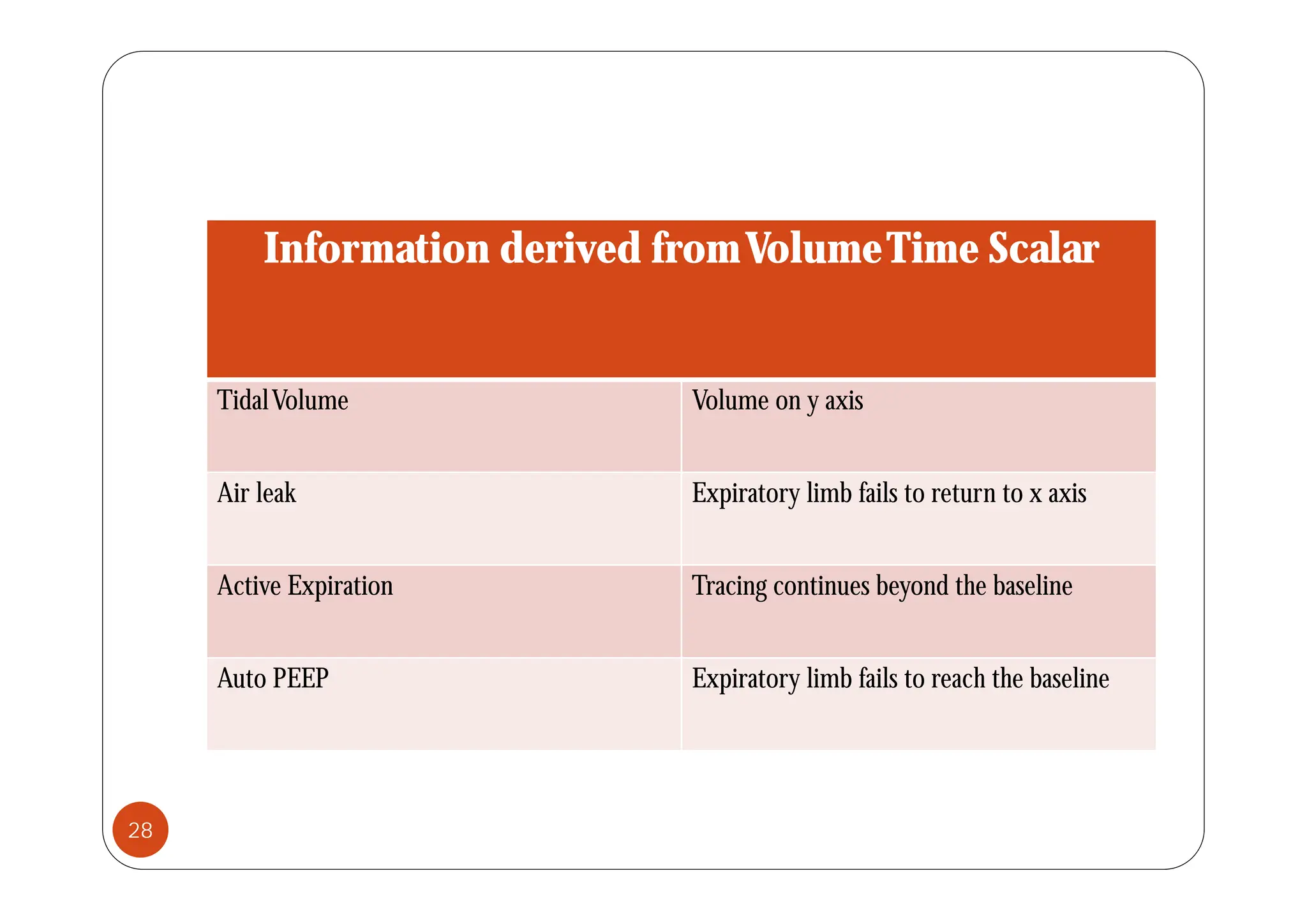
VOLUME vs TIME
27
Information derived fromVolumeTime Scalar
TidalVolume Volume on y axis
Air leak Expiratory limb fails to return to x axis
Active Expiration Tracing continues beyond the baseline
A l b f l h h b l
Auto PEEP Expiratory limb fails to reach the baseline
28
HOWTO USETHE
HOWTO USETHE
GRAPHS FOR
GRAPHS FOR
DIAGNOSIS OF DISEASE
STATES ?
STATES ?
29
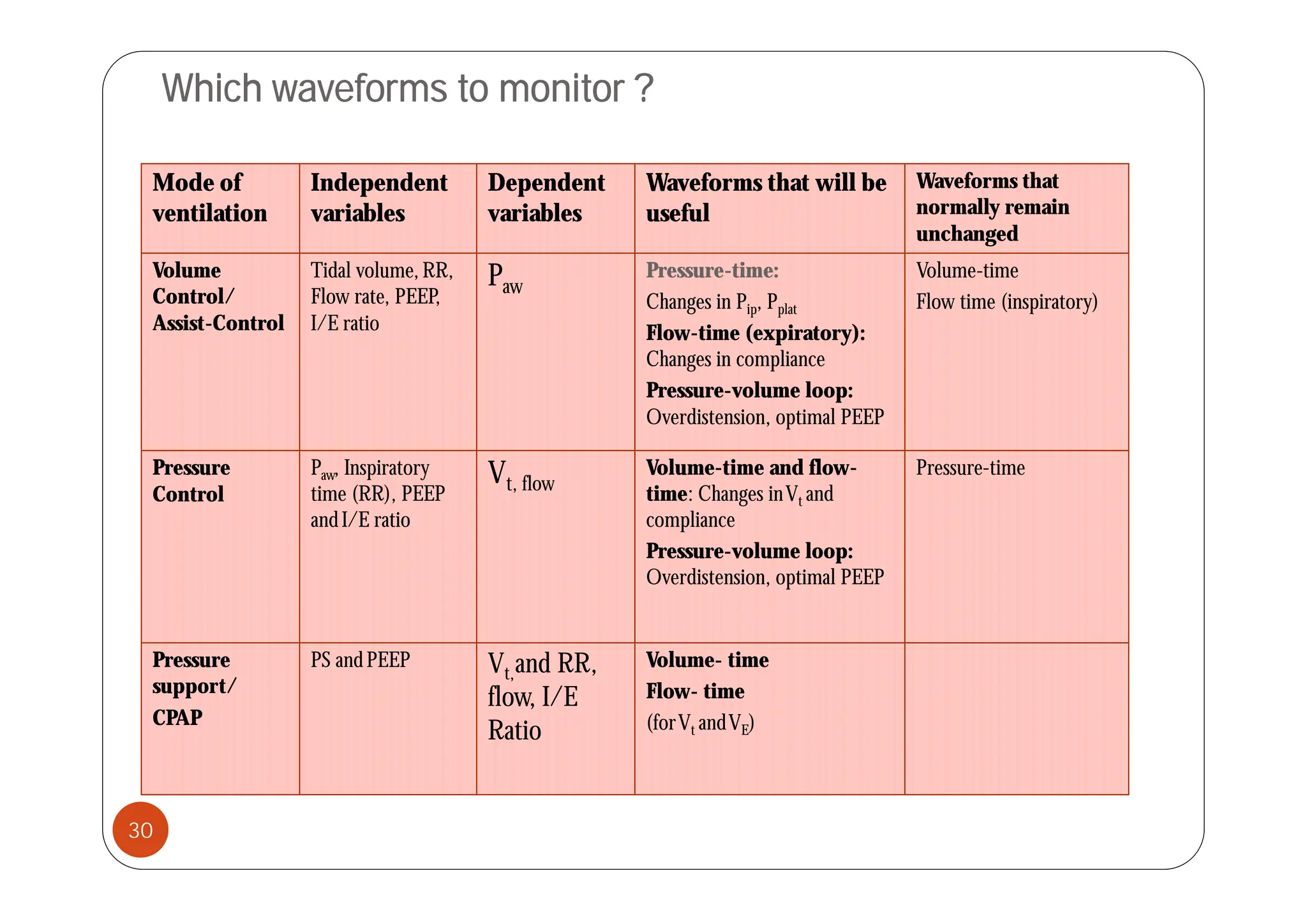
Which waveforms to monitor ?
Mode of
ventilation
Independent
variables
Dependent
variables
Waveforms that will be
useful
Waveforms that
normally remain
unchanged
Volume
Control/
Assist-Control
Tidal volume,RR,
Flow rate, PEEP,
I/E ratio
Paw
Pressure-time:
Changes in Pip, Pplat
Flow-time (expiratory):
Ch i li
Volume-time
Flow time (inspiratory)
Changes in compliance
Pressure-volume loop:
Overdistension, optimal PEEP
l i d fl
Pressure
Control
Paw, Inspiratory
time (RR), PEEP
andI/E ratio
Vt, flow
Volume-time and flow-
time: Changes inVt and
compliance
Pressure-volume loop:
Pressure-time
Overdistension, optimal PEEP
Pressure PS andPEEP Vt and RR, Volume- time
support/
CPAP
Vt,and RR,
flow, I/E
Ratio
Flow- time
(forVt andVE)
30
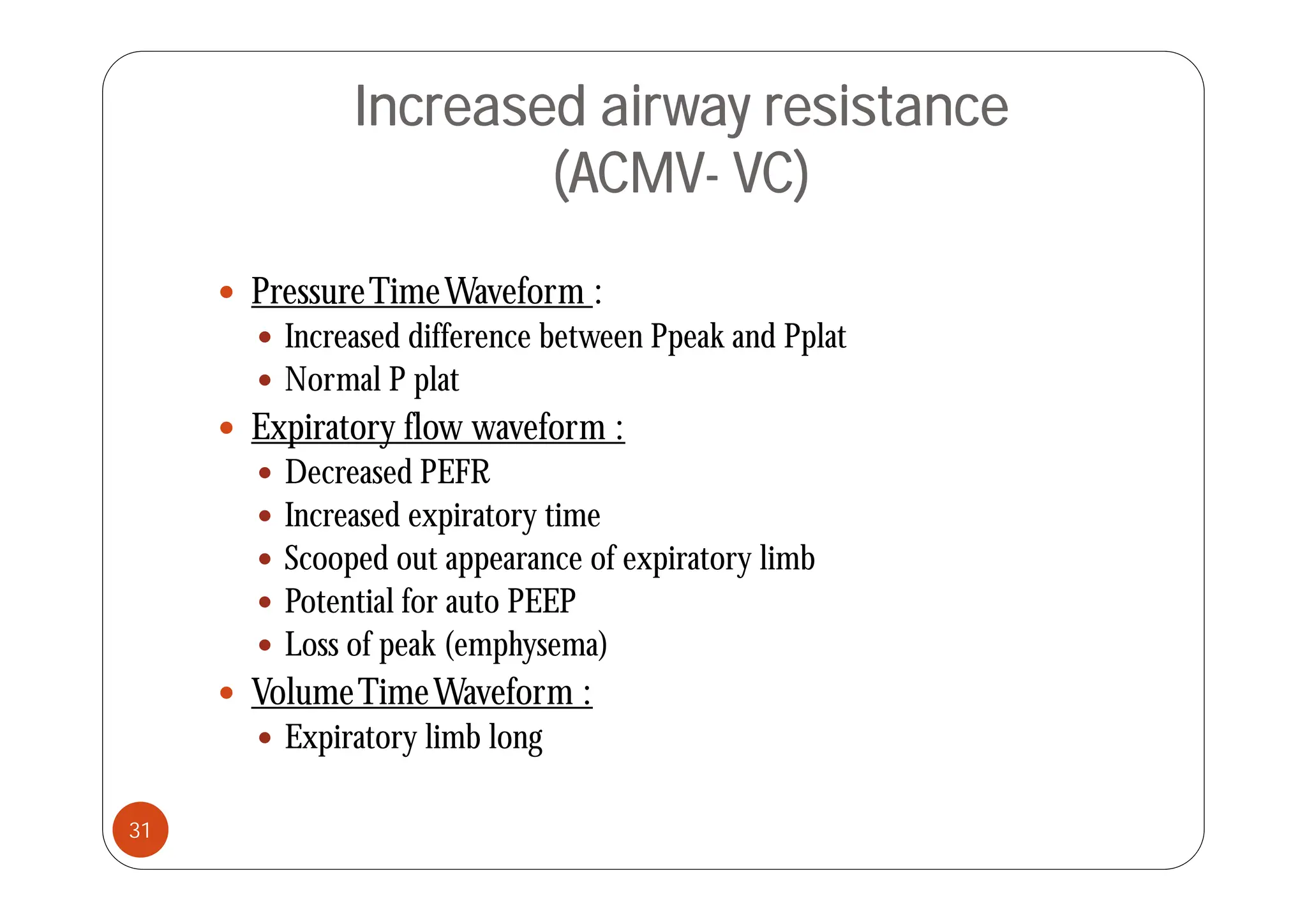
Increased airway resistance
(ACMV- VC)
 PressureTimeWaveform :
 Increased difference between Ppeak and Pplat
 Normal P plat
 Expiratory flow waveform :
d
 Decreased PEFR
 Increased expiratory time
 Scooped out appearance of expiratory limb
Scooped out appearance of expiratory limb
 Potential for auto PEEP
 Loss of peak (emphysema)
 VolumeTimeWaveform :
 Expiratory limb long
31
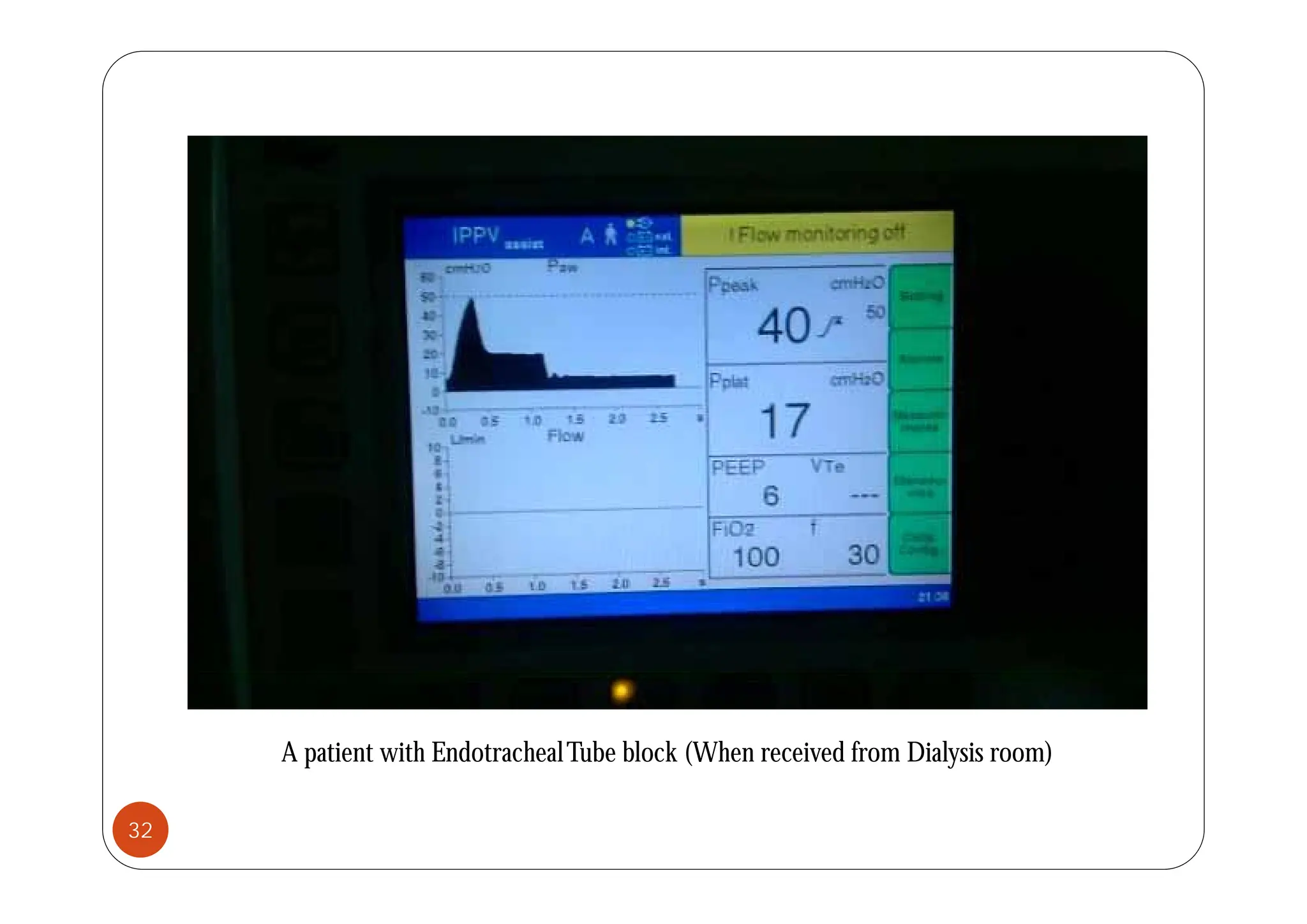
A patient with EndotrachealTube block (When received from Dialysis room)
32
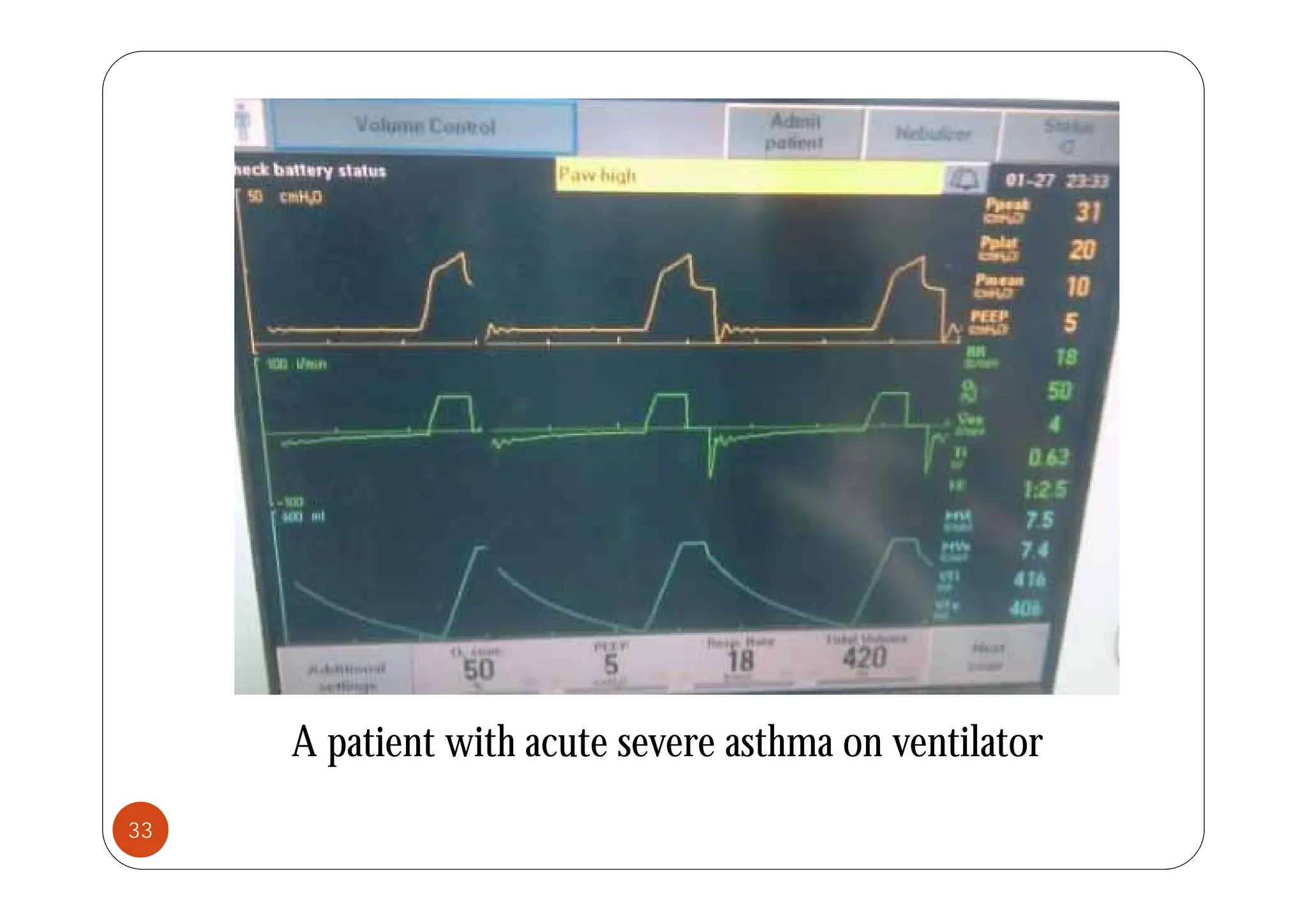
A patient with acute severe asthma on ventilator
33
Decreased Compliance of Respiratory
System
 PressureTimeWaveform :
 Increased P plat and Ppeak
 Increased P plat and Ppeak.
 Normal P peak – Pplat
 FlowTimeWaveform :
 Increased PEFR
 Increased PEFR
 Shortened expiratory time
34
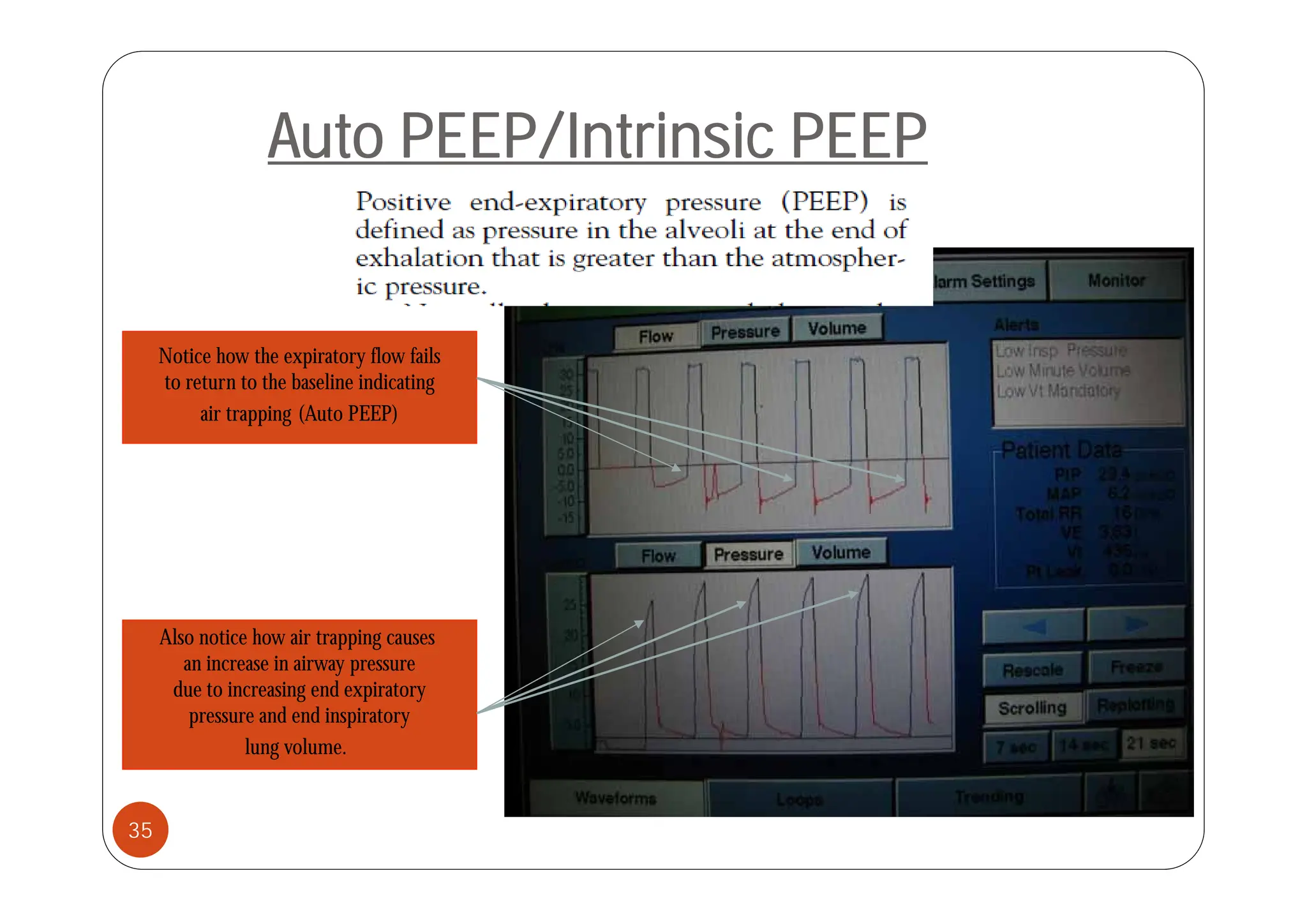
Auto PEEP/Intrinsic PEEP
Notice how the expiratory flow fails
to return to the baseline indicating
air trapping (Auto PEEP)
Also notice how air trapping causes
an increase in airway pressure
y p
due to increasing end expiratory
pressure and end inspiratory
lung volume.
35
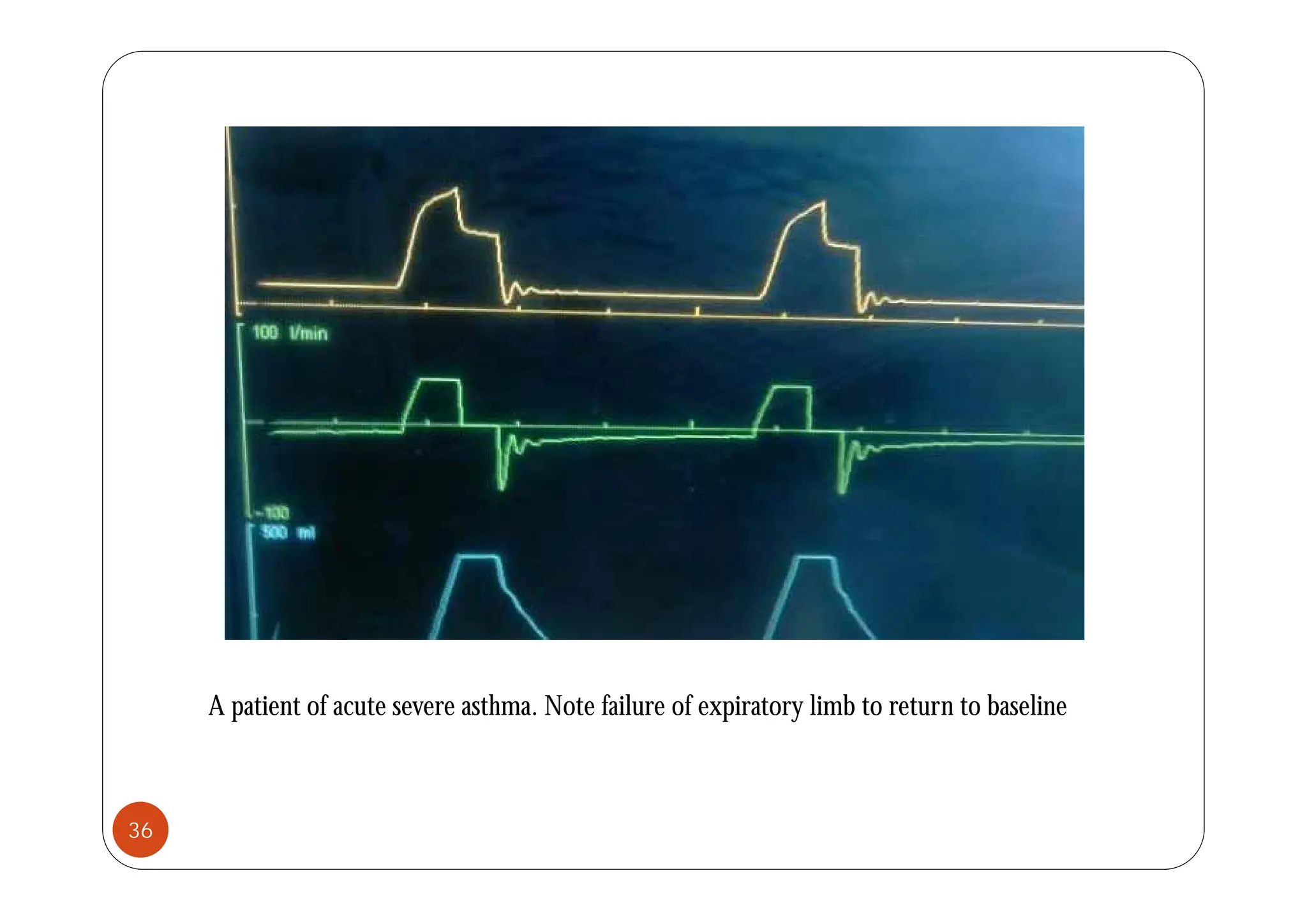
A patient of acute severe asthma. Note failure of expiratory limb to return to baseline
36
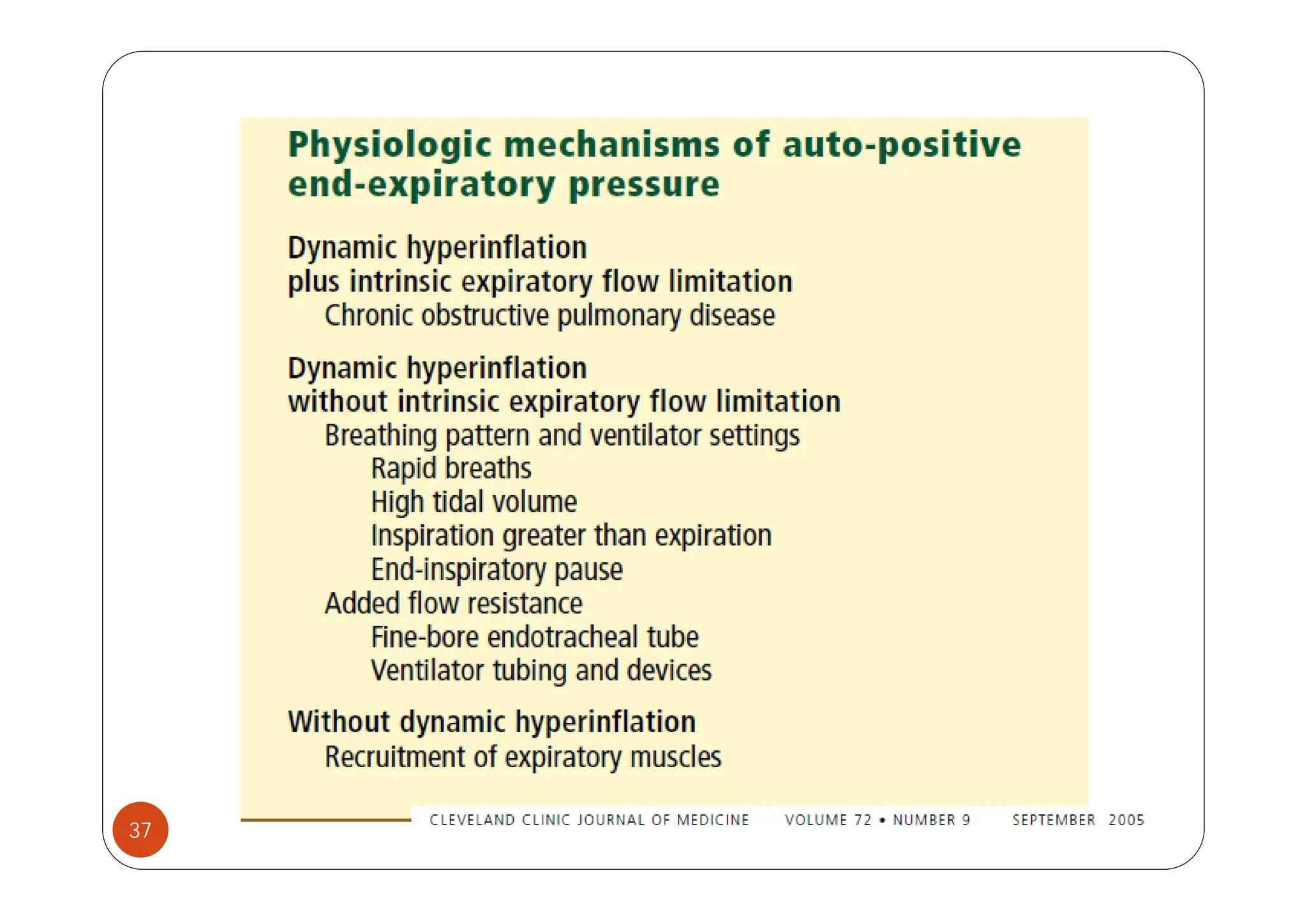
37
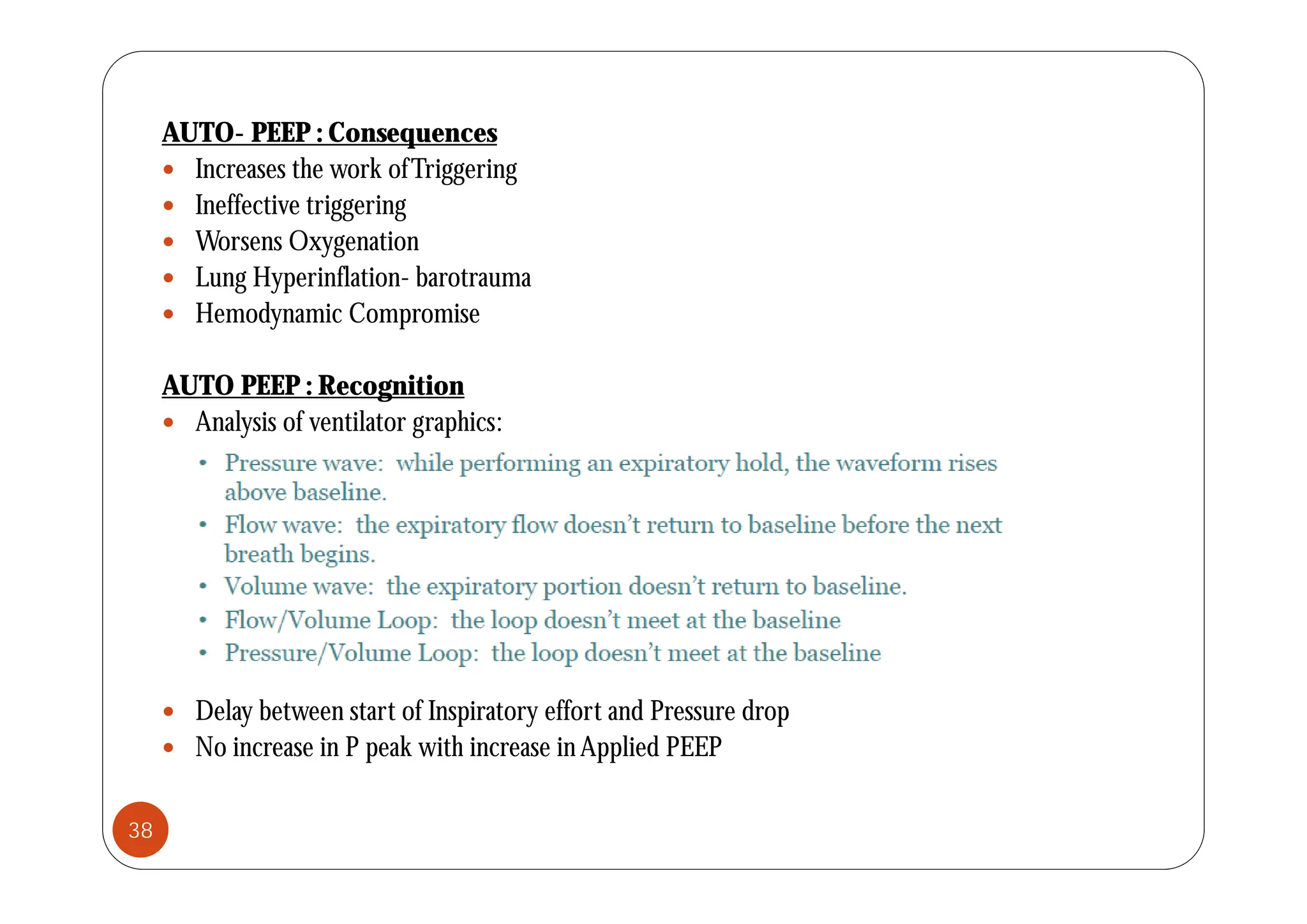
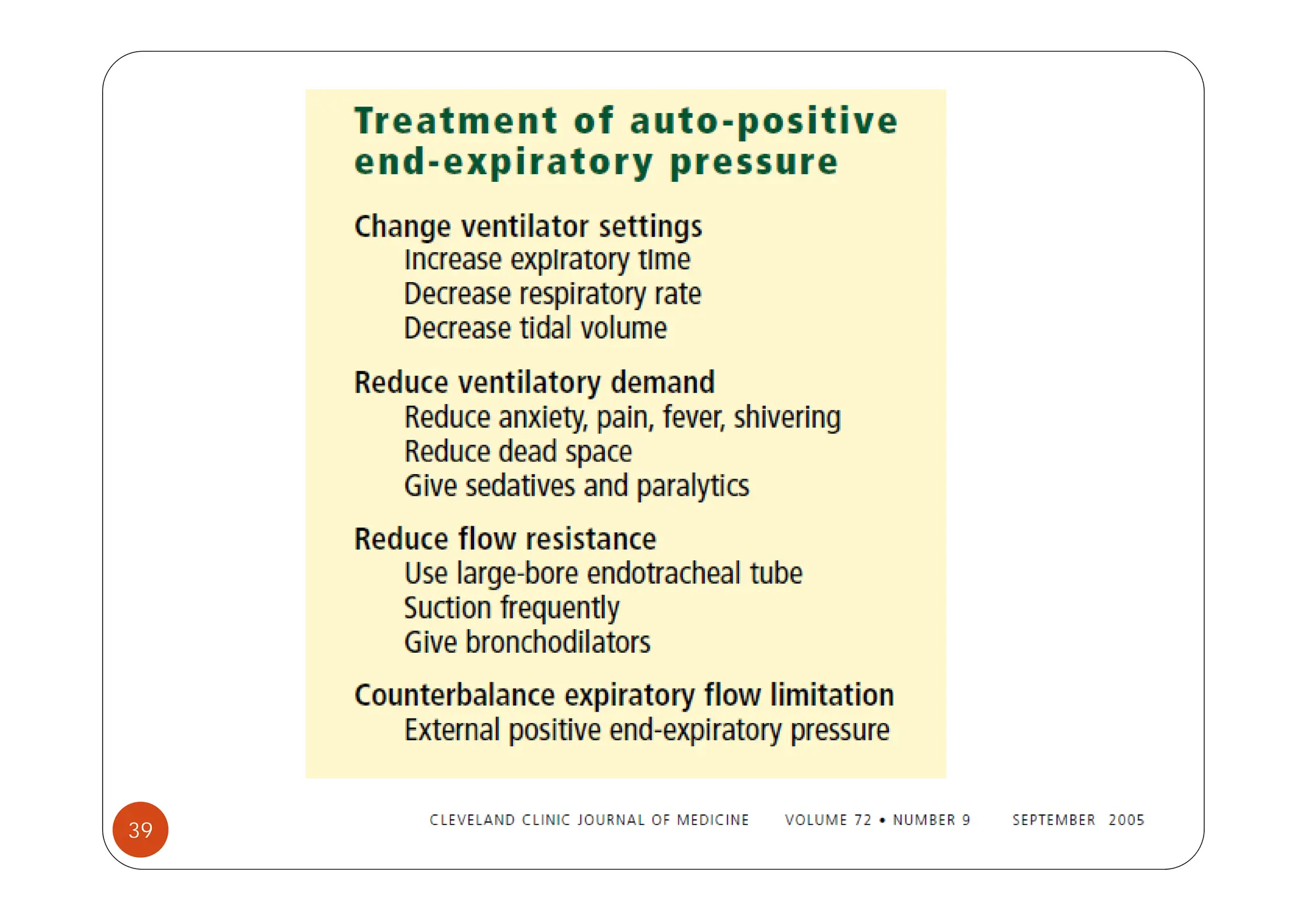
AUTO- PEEP : Consequences
q
 Increases the work ofTriggering
 Ineffective triggering
 Worsens Oxygenation
yg
 Lung Hyperinflation- barotrauma
 Hemodynamic Compromise
AUTO PEEP : Recognition
 Analysis of ventilator graphics:
 Delay between start of Inspiratory effort and Pressure drop
 No increase in P peak with increase inApplied PEEP
38
39
VENTILATOR PATIENT
VENTILATOR PATIENT
SYNCHRONY
SYNCHRONY
VS
VS
DYS-SYNCHRONY
S S C O
40
Wh t i V til t P ti t S h ?
What isVentilator Patient Synchrony?
The ventilator should start inspiration at
p
the time of onset of patients inspiration.
Th fl id d b th til t h ld
The flow provided by the ventilator should
meet the flow demand of the patient.
p
TheVentilator Inspiratory time should
t h ith th ti t i i t ti
match with the patients inspiratory time.
41
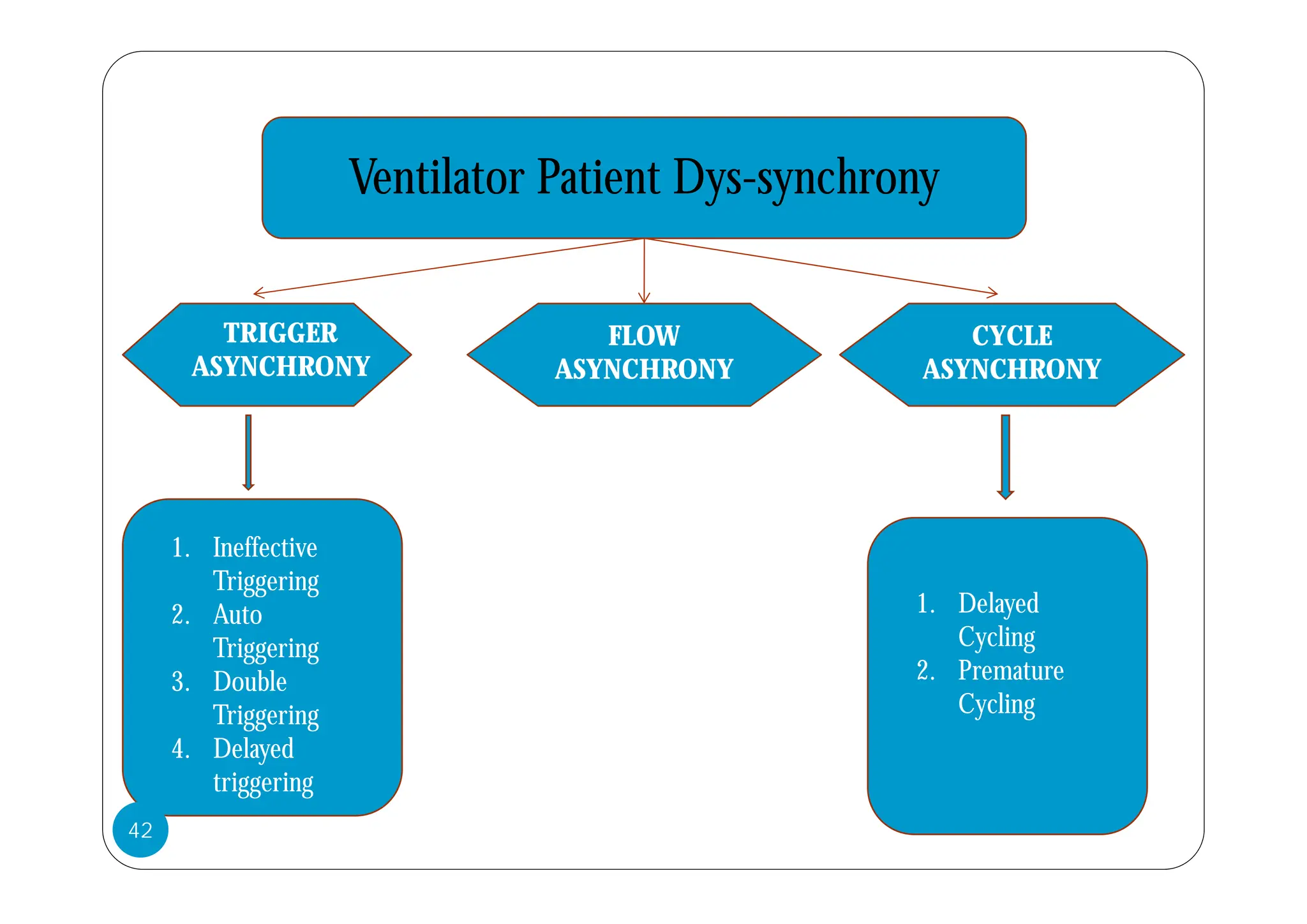
Ventilator Patient Dys-synchrony
FLOW CYCLE
TRIGGER
ASYNCHRONY ASYNCHRONY
ASYNCHRONY
1. Ineffective
Triggering
2. Auto
Triggering
1. Delayed
Cycling
2 Premature
3. Double
Triggering
4. Delayed
i i
2. Premature
Cycling
triggering
42
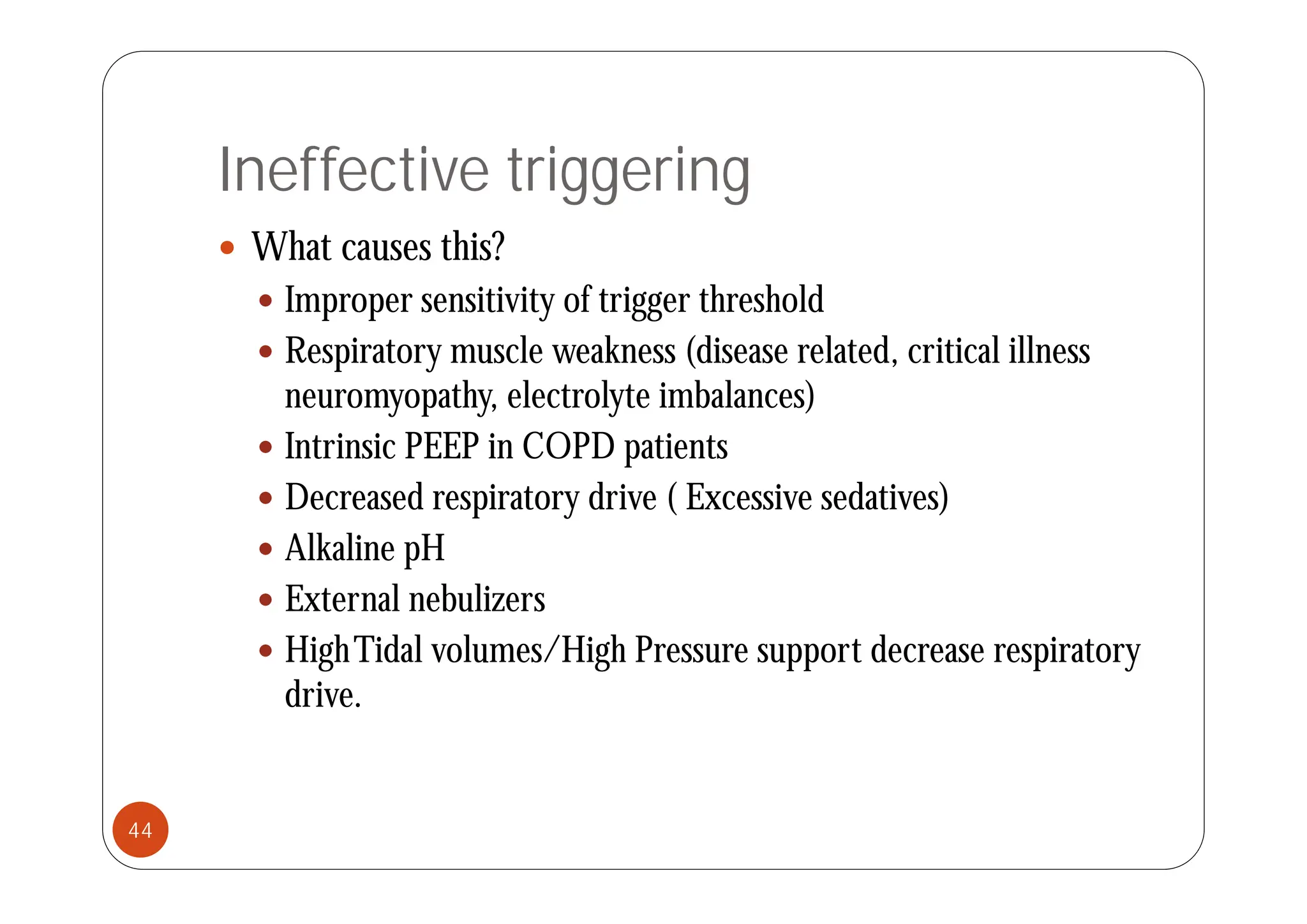
INEFFECTIVE TRIGGGERING
 One of the most common asynchronies
 Failure of the patients inspiratory effort to initiate a
ventilator breath
ventilator breath.
 Identified by
 Vi l i ti f ti t di th i l b t
 Visual inspection of patients expanding thoracic volume but
without delivery of ventilator breath.
 Ventilator graphics which show a decrease in airway pressure
Ventilator graphics which show a decrease in airway pressure
with an increase in flow but no initiation of breath.
43
Ineffective triggering
 What causes this?
 What causes this?
 Improper sensitivity of trigger threshold
 Respiratory muscle weakness (disease related critical illness
 Respiratory muscle weakness (disease related, critical illness
neuromyopathy, electrolyte imbalances)
 Intrinsic PEEP in COPD patients
p
 Decreased respiratory drive ( Excessive sedatives)
 Alkaline pH
p
 External nebulizers
 HighTidal volumes/High Pressure support decrease respiratory
g g pp p y
drive.
44
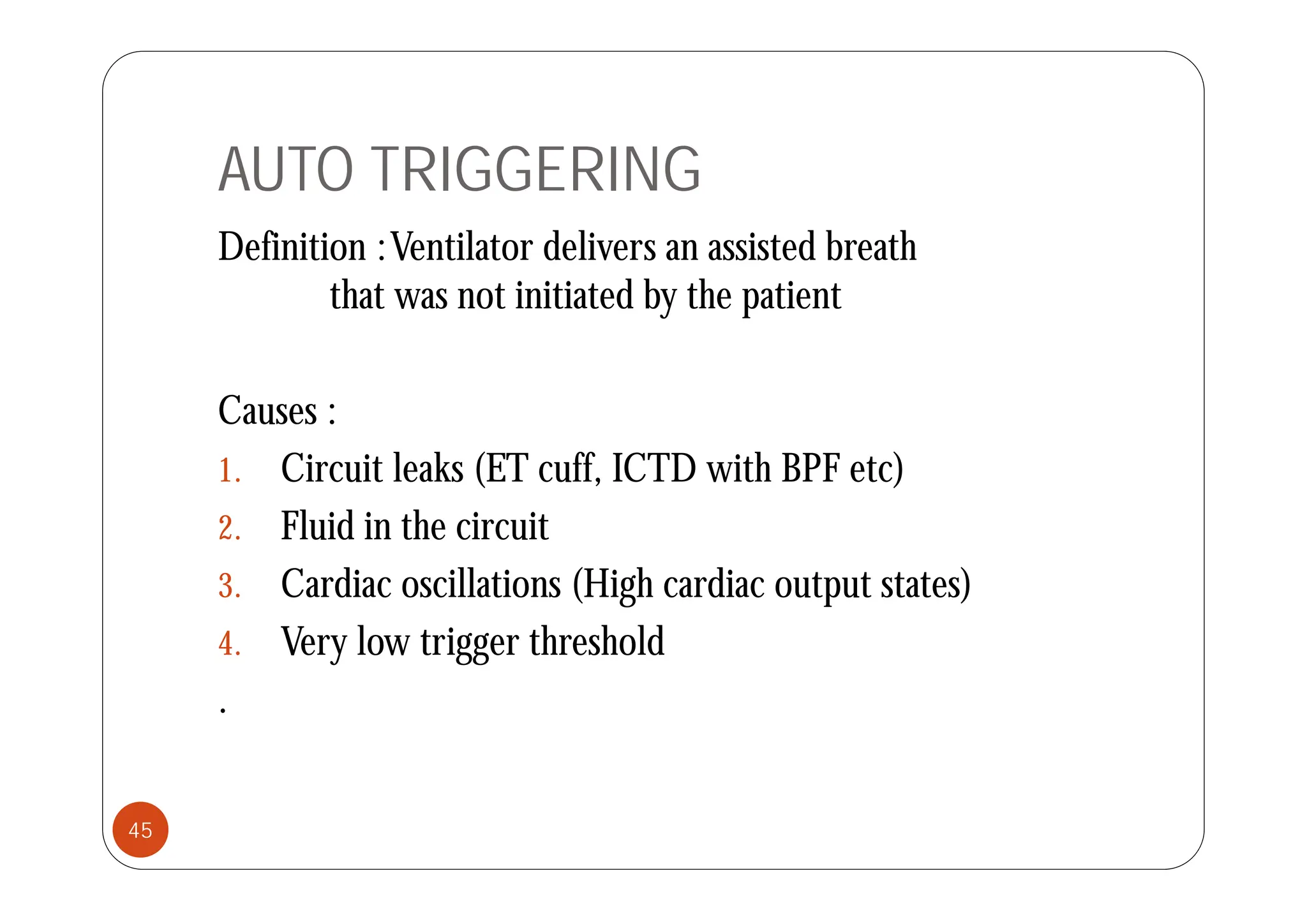
AUTO TRIGGERING
Definition :Ventilator delivers an assisted breath
that was not initiated by the patient
Causes :
1 Ci i l k (ET ff ICTD i h BPF )
1. Circuit leaks (ET cuff, ICTD with BPF etc)
2. Fluid in the circuit
3. Cardiac oscillations (High cardiac output states)
4. Very low trigger threshold
.
45
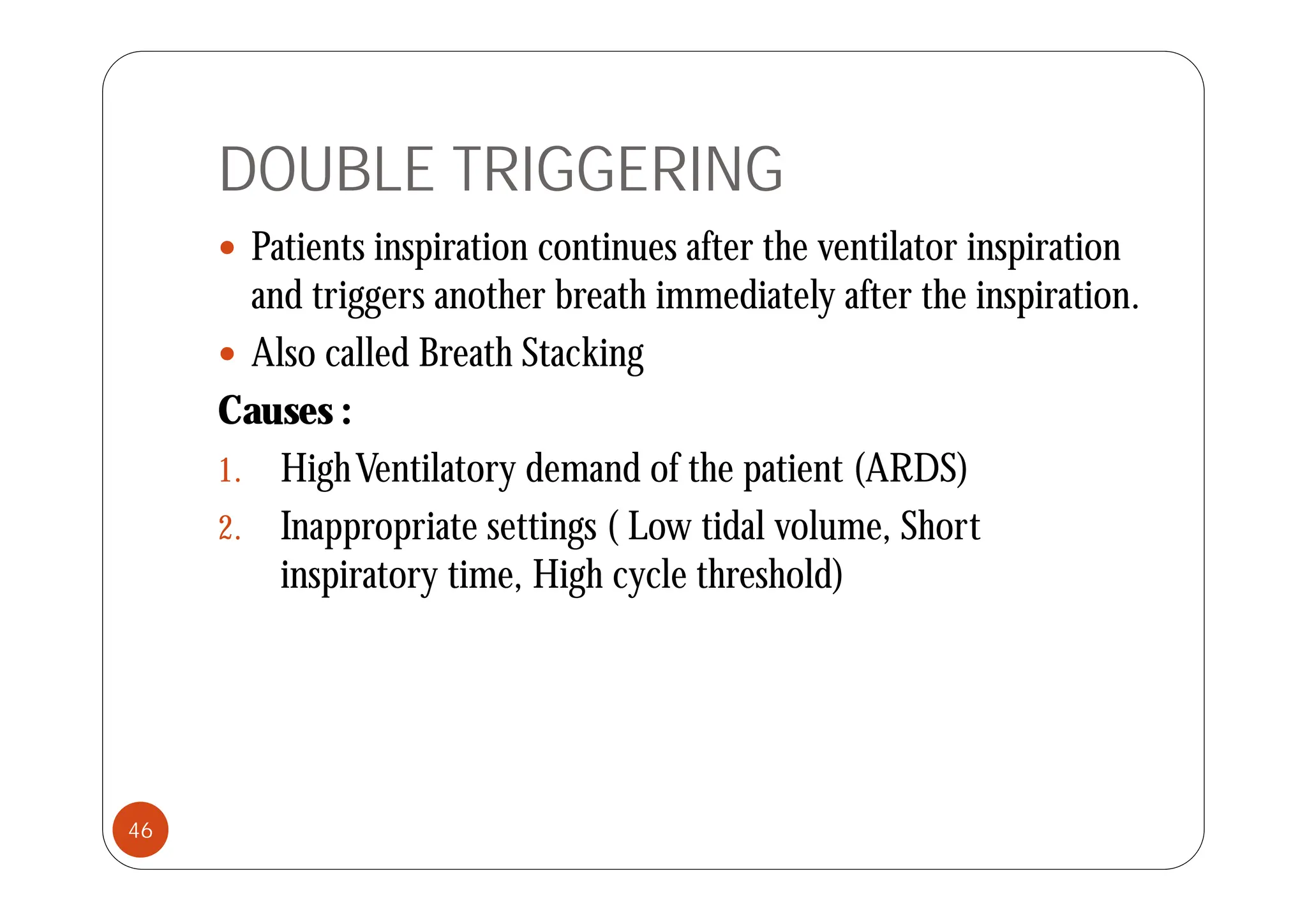
DOUBLE TRIGGERING
 Patients inspiration continues after the ventilator inspiration
and triggers another breath immediately after the inspiration.
 Also called Breath Stacking
Causes :
1 Hi hV il d d f h i (ARDS)
1. HighVentilatory demand of the patient (ARDS)
2. Inappropriate settings ( Low tidal volume, Short
i i i Hi h l h h ld)
inspiratory time, High cycle threshold)
46
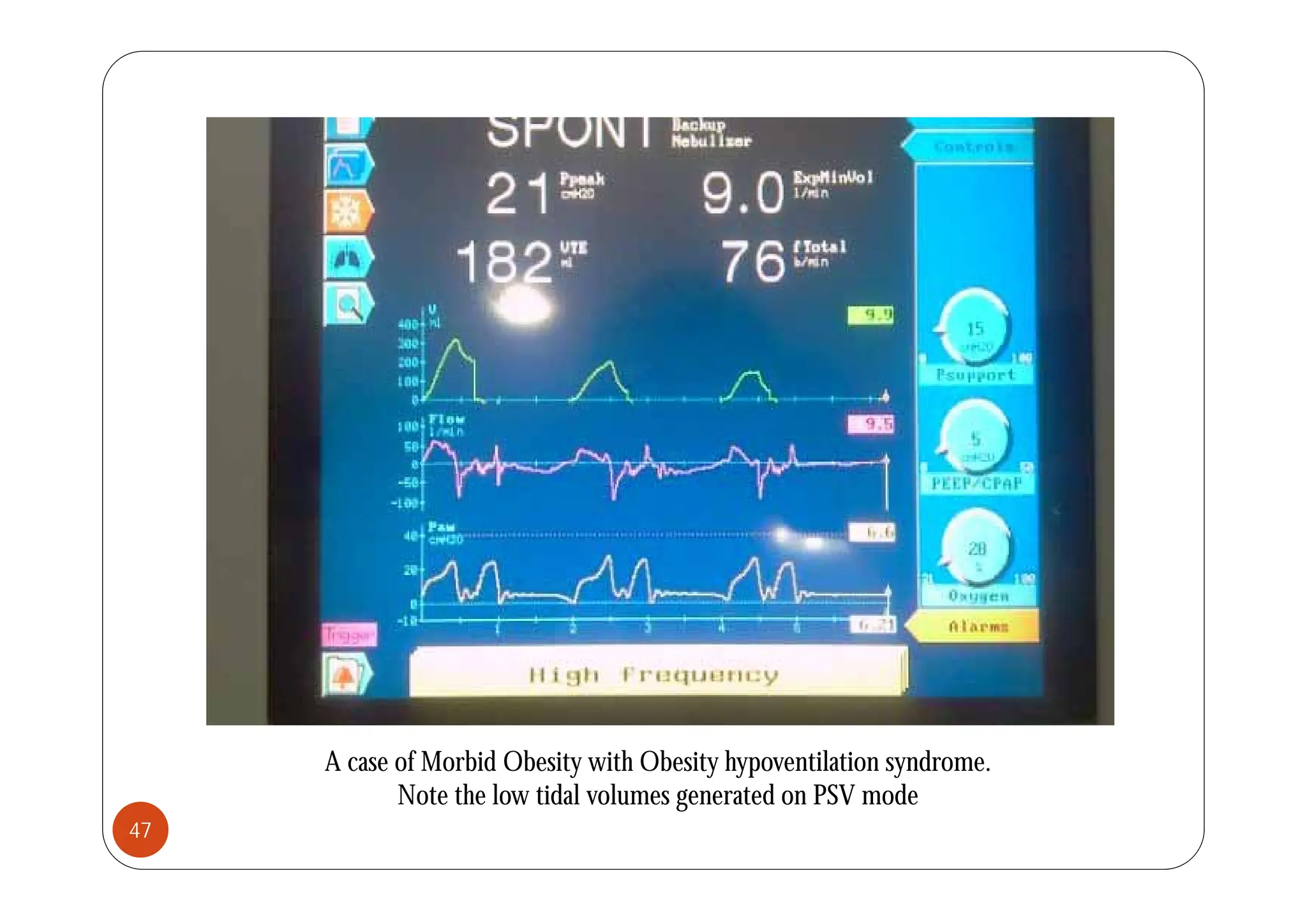
A case of Morbid Obesity with Obesity hypoventilation syndrome.
y y yp y
Note the low tidal volumes generated on PSV mode
47
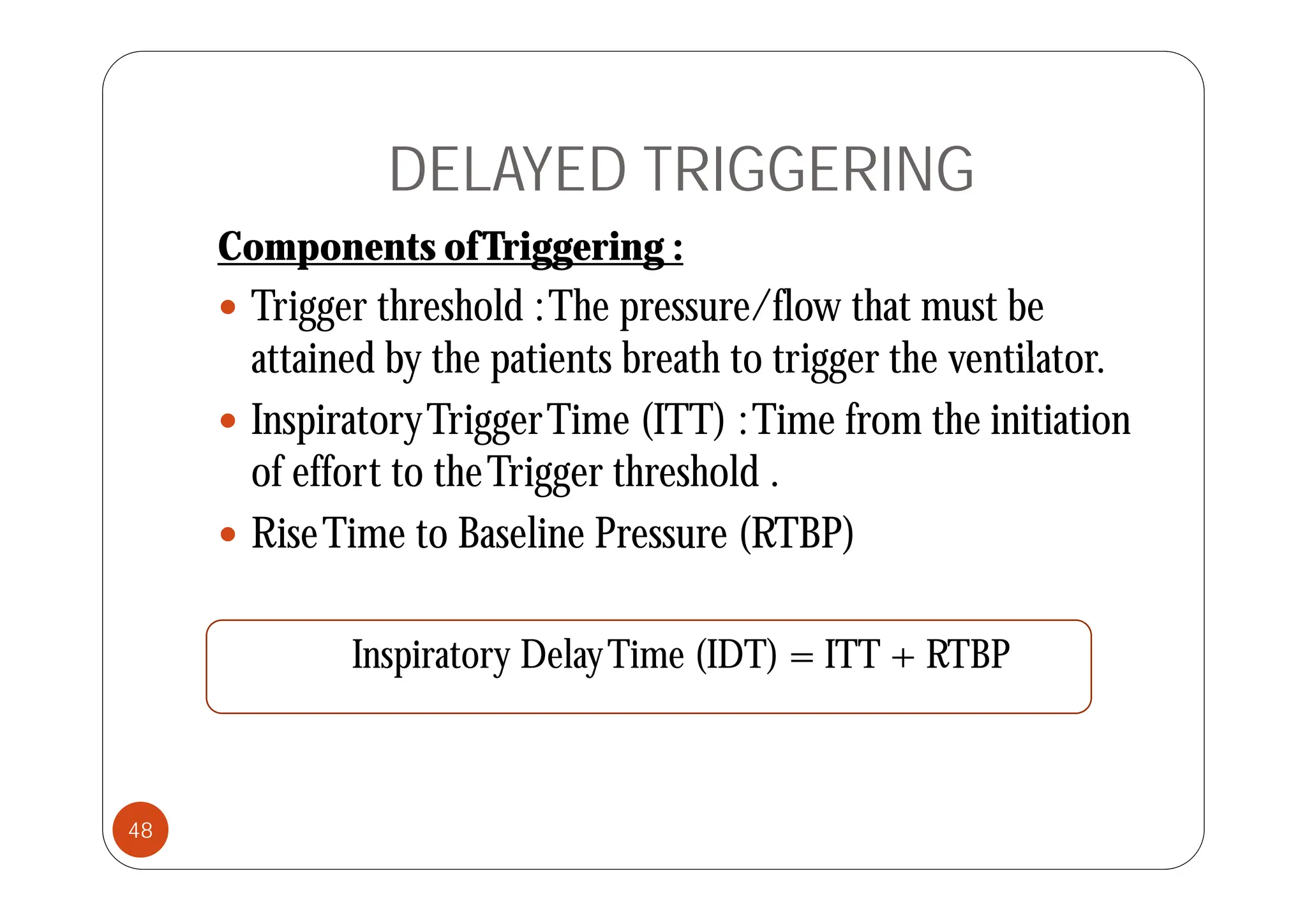
DELAYED TRIGGERING
Components ofTriggering :
 Trigger threshold :The pressure/flow that must be
attained b the patients breath to trigger the entilator
attained by the patients breath to trigger the ventilator.
 InspiratoryTriggerTime (ITT) :Time from the initiation
f ff h T h h ld
of effort to theTrigger threshold .
 RiseTime to Baseline Pressure (RTBP)
Inspiratory DelayTime (IDT) = ITT + RTBP
p y y ( )
48
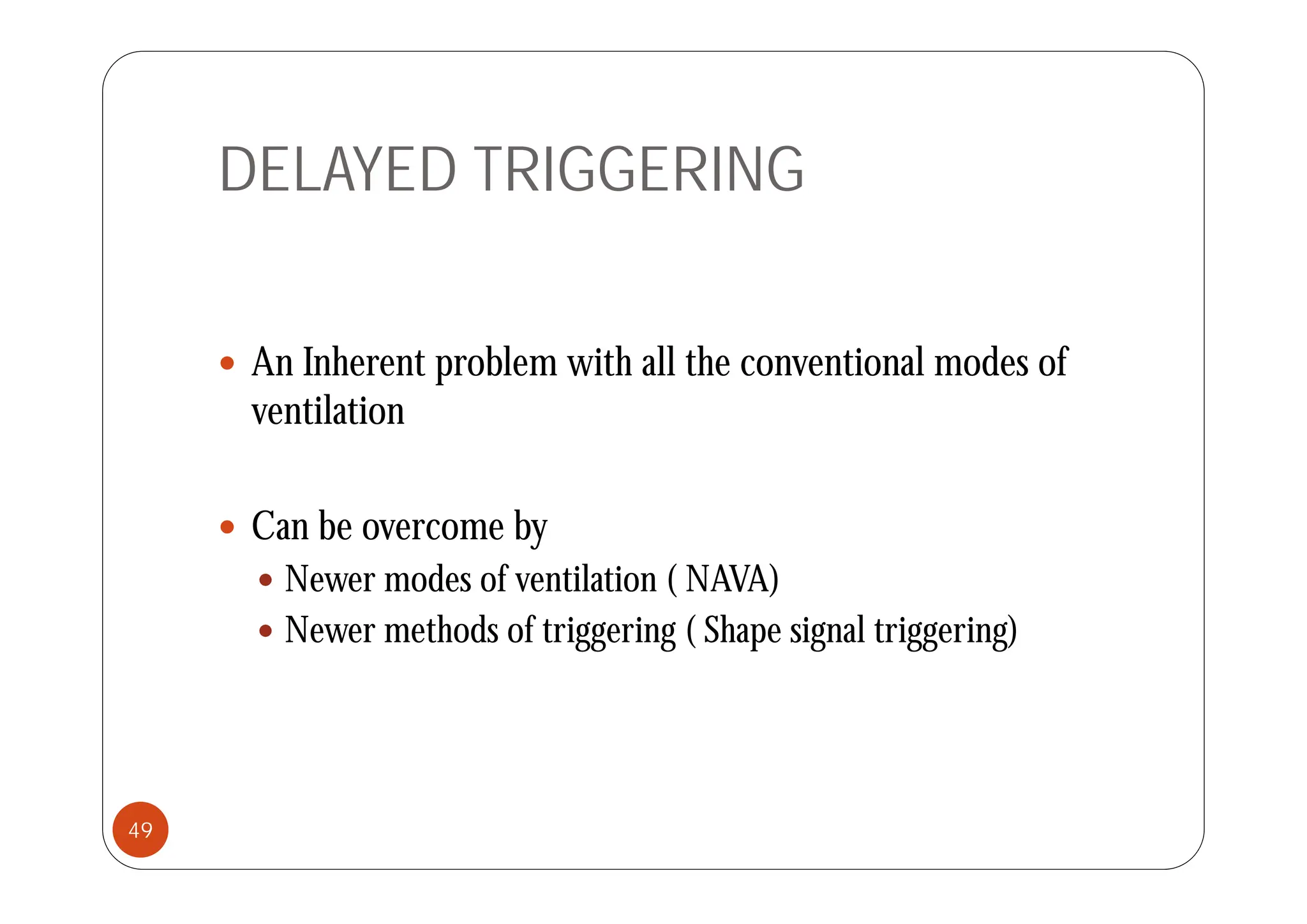
DELAYED TRIGGERING
 A I h t bl ith ll th ti l d f
 An Inherent problem with all the conventional modes of
ventilation
 Can be overcome by
 Newer modes of ventilation ( NAVA)
 Newer methods of triggering ( Shape signal triggering)
49
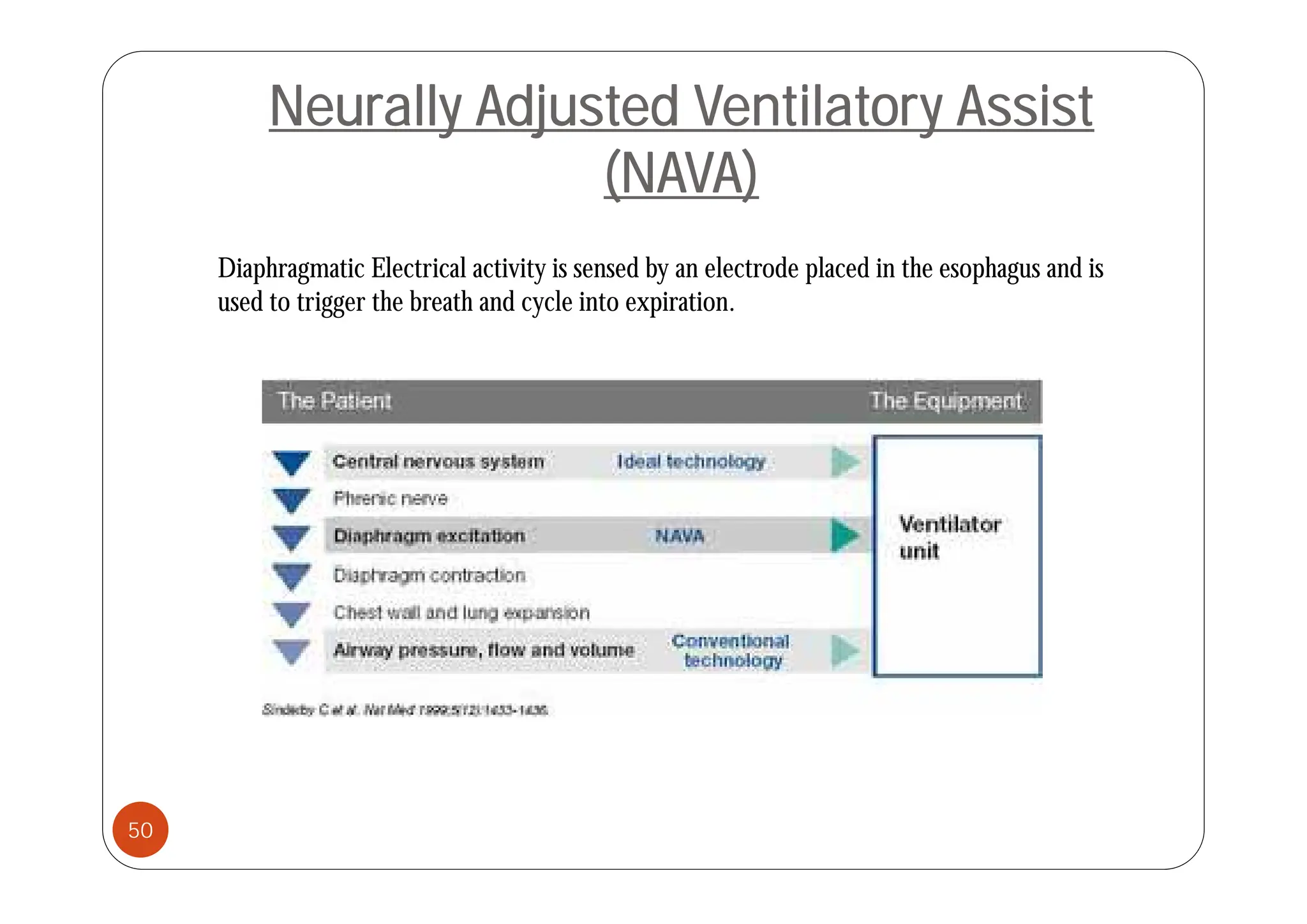
Neurally Adjusted Ventilatory Assist
(NAVA)
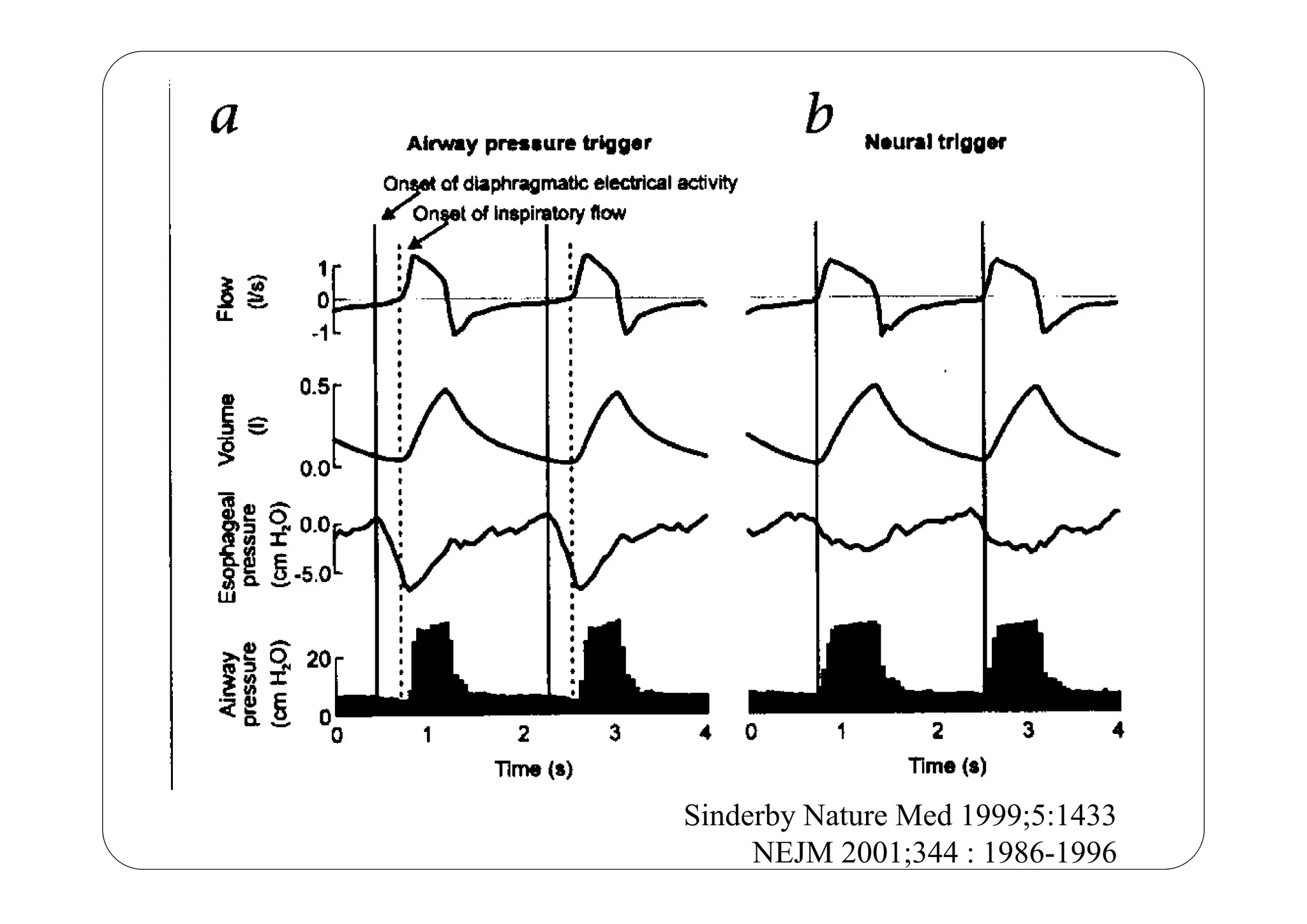
Diaphragmatic Electrical activity is sensed by an electrode placed in the esophagus and is
used to trigger the breath and cycle into expiration.
50
Sinderby Nature Med 1999;5:1433
NEJM 2001;344 : 1986-1996
FLOW ASYNCHRONY
Causes :
Causes :
 HighVentilatory demand (ALI/ARDS)
 Low ventilatory settings ( Flow rate Tidal volume Pramp)
Low ventilatory settings ( Flow rate,Tidal volume, Pramp)
What to do :
 Treat reversible causes of air hunger (fever acidosis)
 Treat reversible causes of air hunger (fever, acidosis)
 Increase the tidal volume ( if feasible)
 Increase the flow rate ( directly or by decreasing inspiratory
 Increase the flow rate ( directly, or by decreasing inspiratory
time, increasing pause)
 Change to pressure control mode with variable flow
g p
 Sedate /Paralyze the patient (last resort)
52
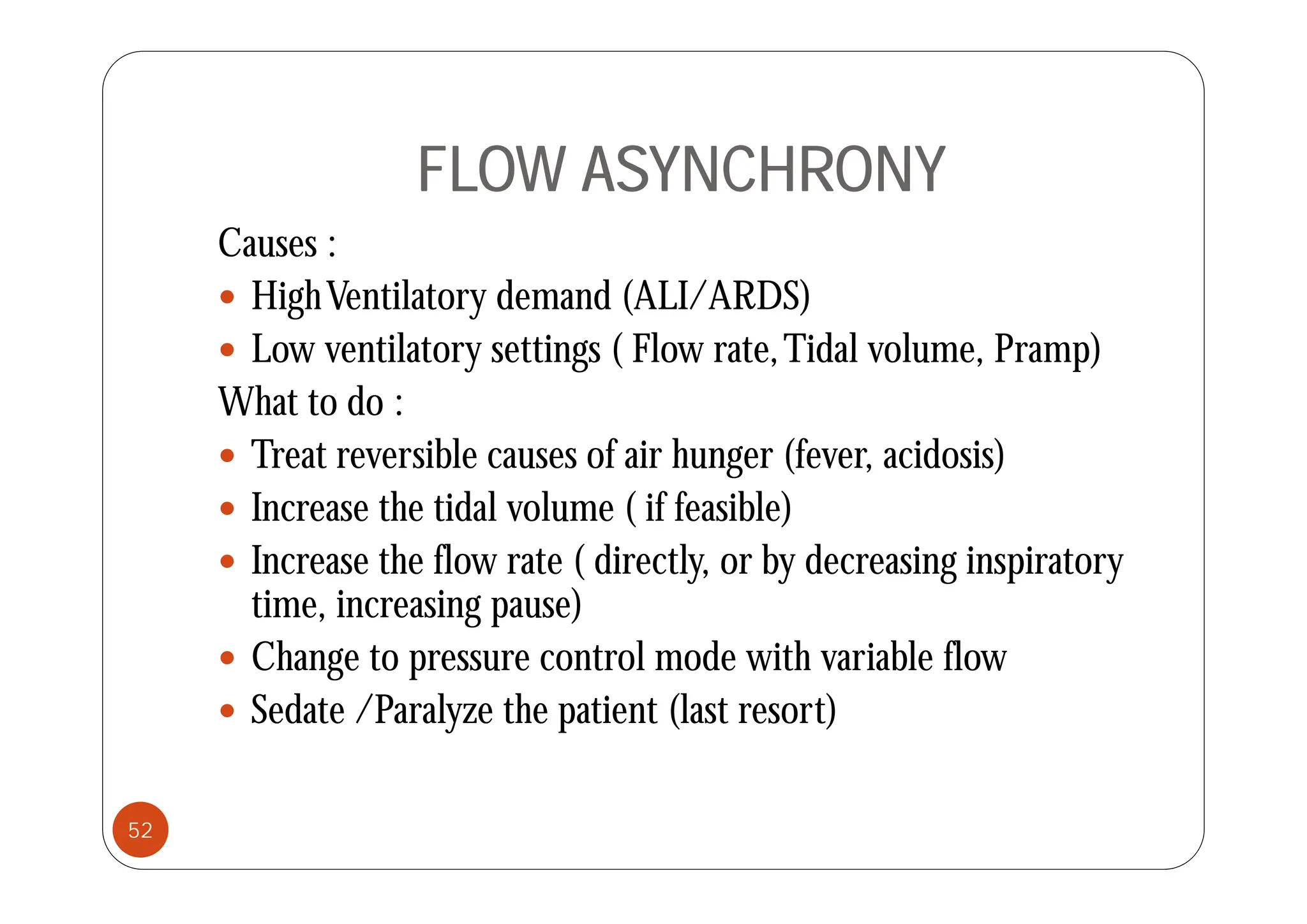
Patient ofARDS being ventilated usingARDS Network strategy
(Tidal volume = 6 ml/kg, Body weight = 66 kg)
53
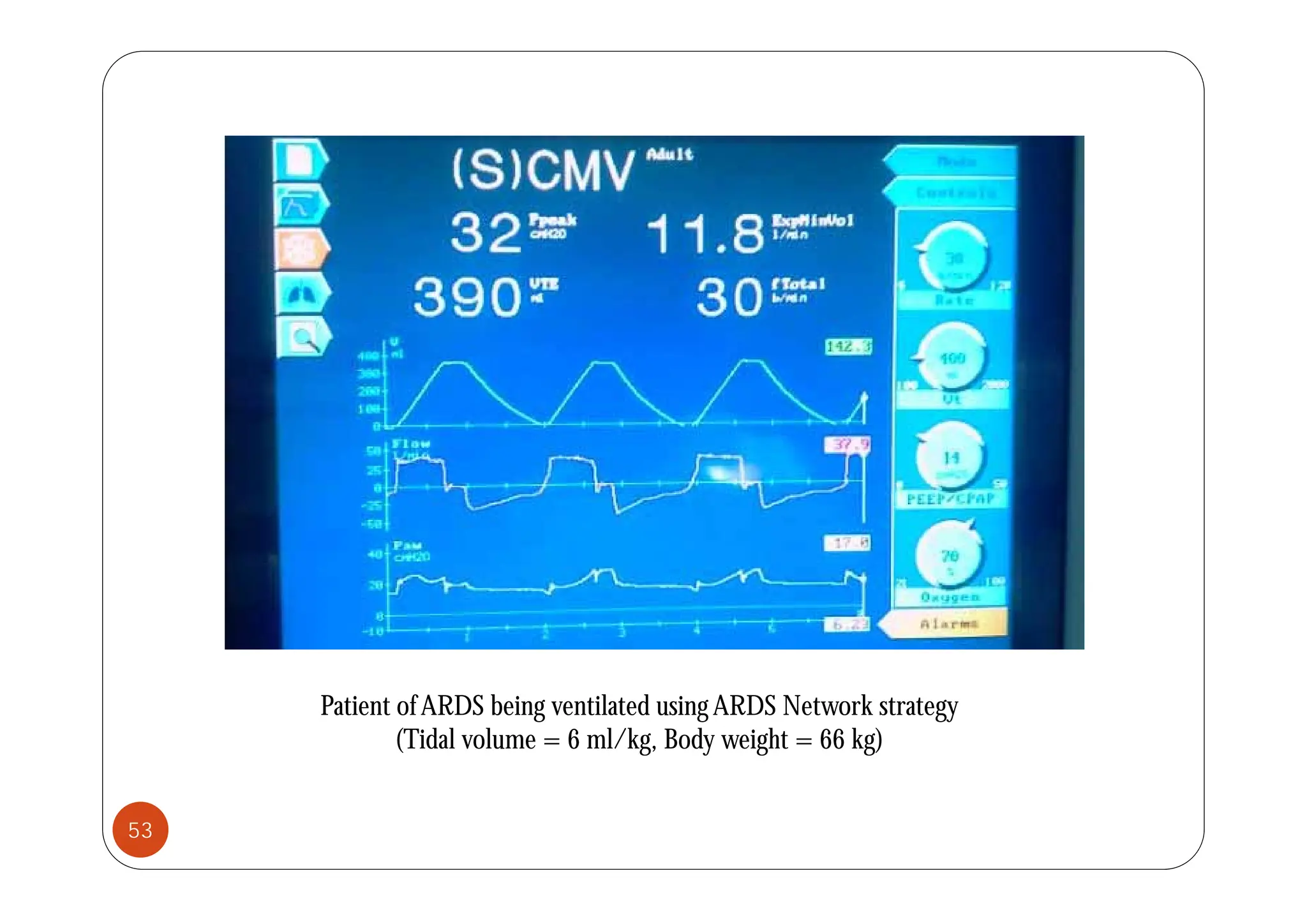
Tidal volume increased to 440 ml from 400 ml to improve the flow synchrony
54
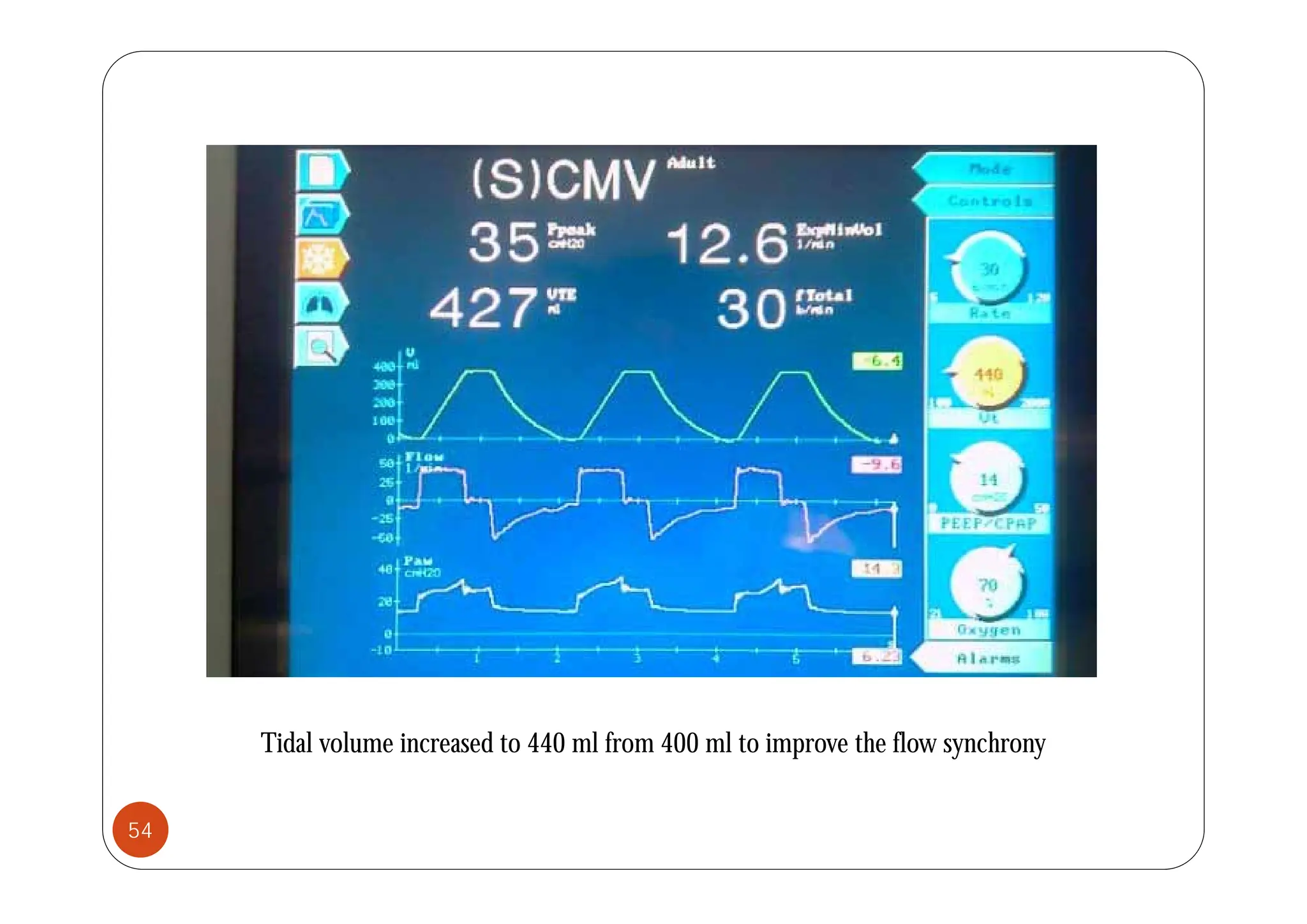
Same patient during a spike of fever 39.2 C showing severe flow dyssynchrony
55
CYCLING ASYNCHRONY
 Delayed Cycling :VentilatorTi > PatientTi
V til t ti I i ti h t ll i ti h
Ventilator continues Inspiration when actually expiration has
started.
 Premature Cycling :VentilatorTi < PatientTi
Patients inspiratory effort continue into the expiratory
phase of ventilator breath.
56
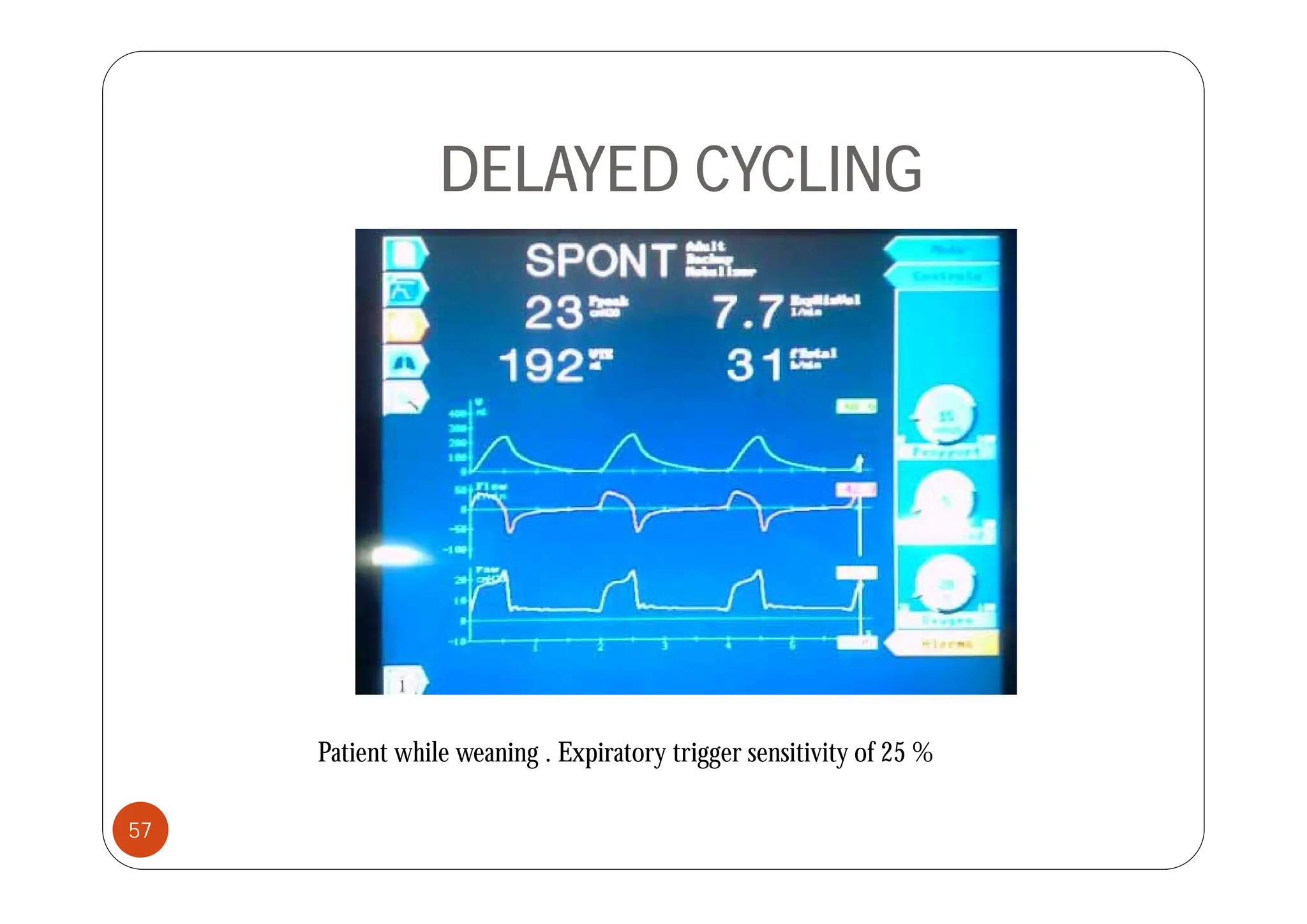
DELAYED CYCLING
Patient while weaning . Expiratory trigger sensitivity of 25 %
57
How to Manage :
How to Manage :
 D I i t ti
 Decrease Inspiratory time
 DecreaseTidal volume ( SCMV mode)
 Increase ExpiratoryTrigger Sensitivity ( PSV mode)
58
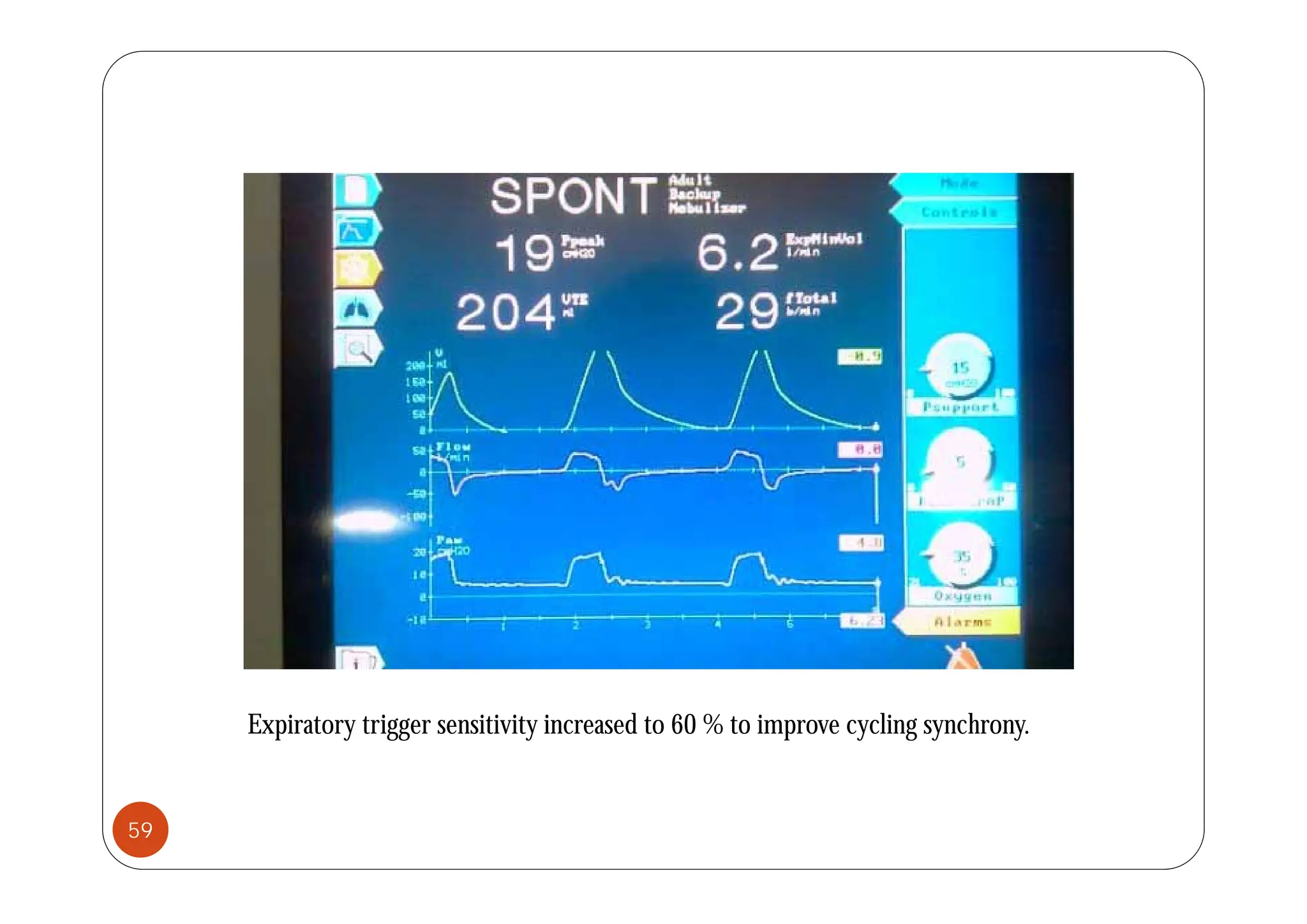
Expiratory trigger sensitivity increased to 60 % to improve cycling synchrony.
59
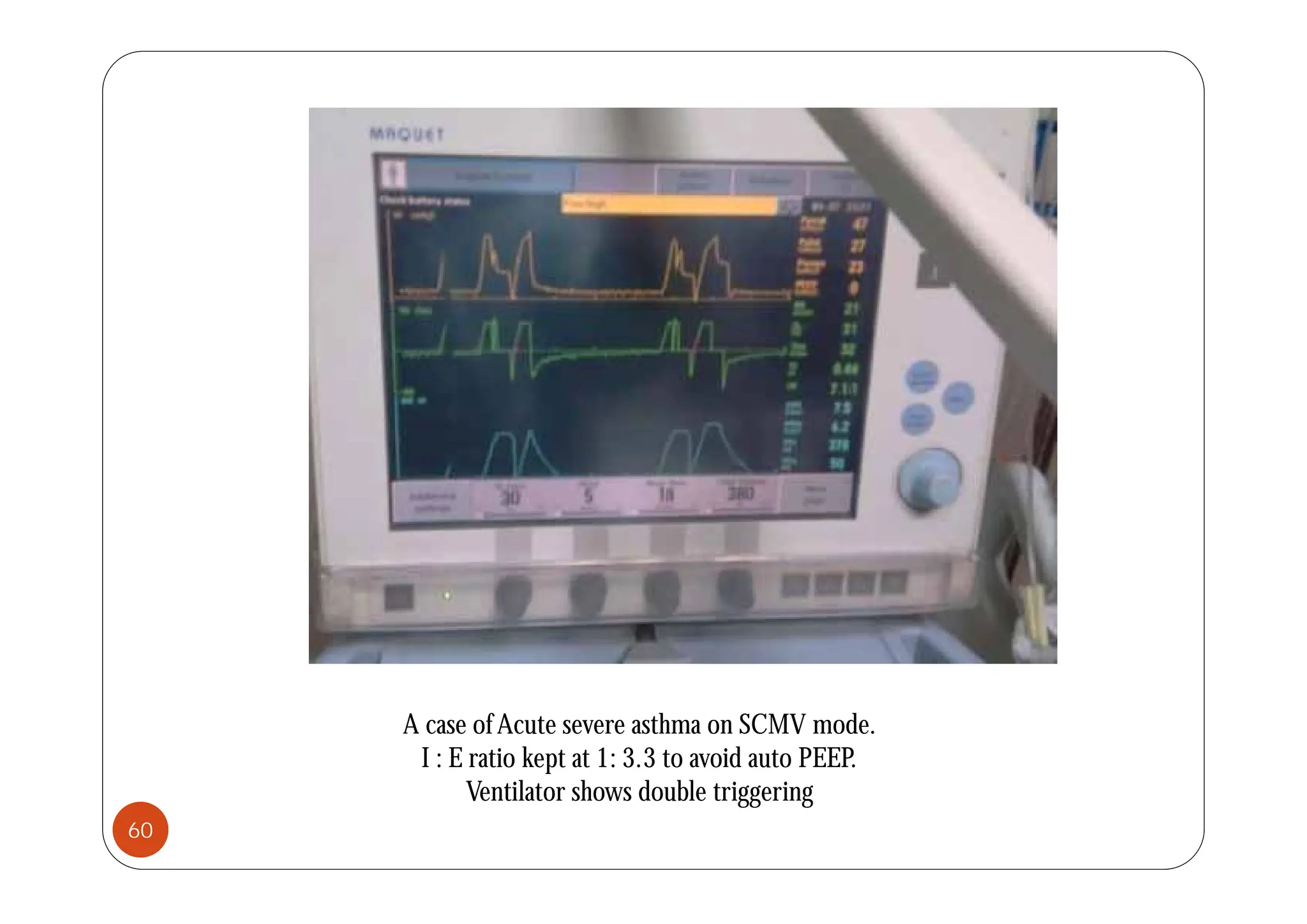
A case ofAcute severe asthma on SCMV mode.
I : E ratio kept at 1: 3.3 to avoid auto PEEP.
Ventilator shows double triggering
60
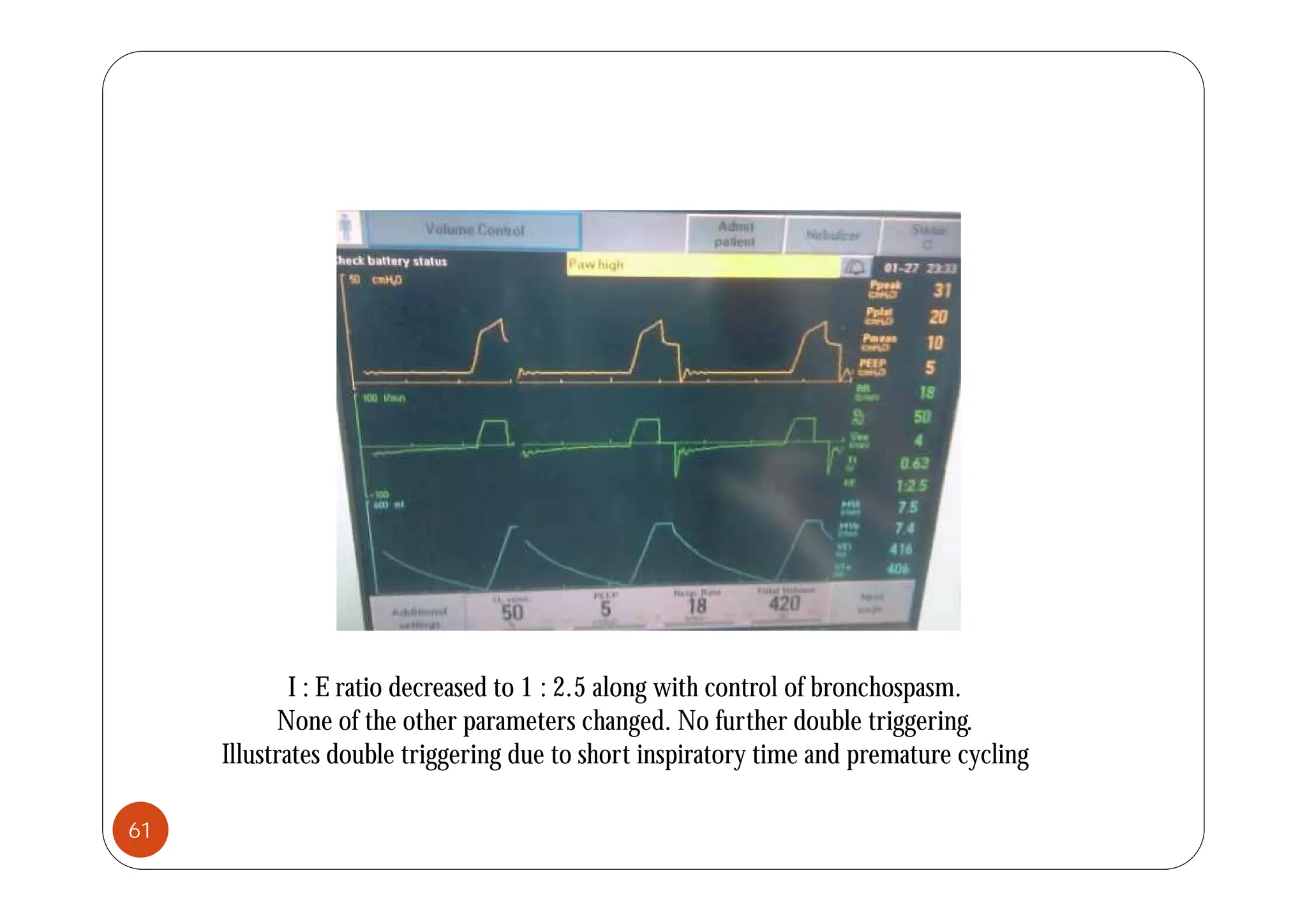
I : E ratio decreased to 1 : 2.5 along with control of bronchospasm.
None of the other parameters changed. No further double triggering.
Illustrates double triggering due to short inspiratory time and premature cycling
61
PATIENT VENTILATOR DYS-SYNCHRONY
CLINICAL SIGNIFICANCE ??
 Increases Work Of Breathing
Increases Work Of Breathing
 Causes Ultra structural damage to the respiratory muscles.
 Worsens Respiratory mechanics ( Auto PEEP)
Worsens Respiratory mechanics ( Auto PEEP)
 Alters gas exchange ( Auto, double triggering – lower CO2)
 Increased need for sedation
 Longer duration of mechanical ventilation
 Difficulty in weaning
 Confounds lung protective ventilation ( Double breaths)
 Sleep Fragmentation
 Inability to tolerate NIV
62
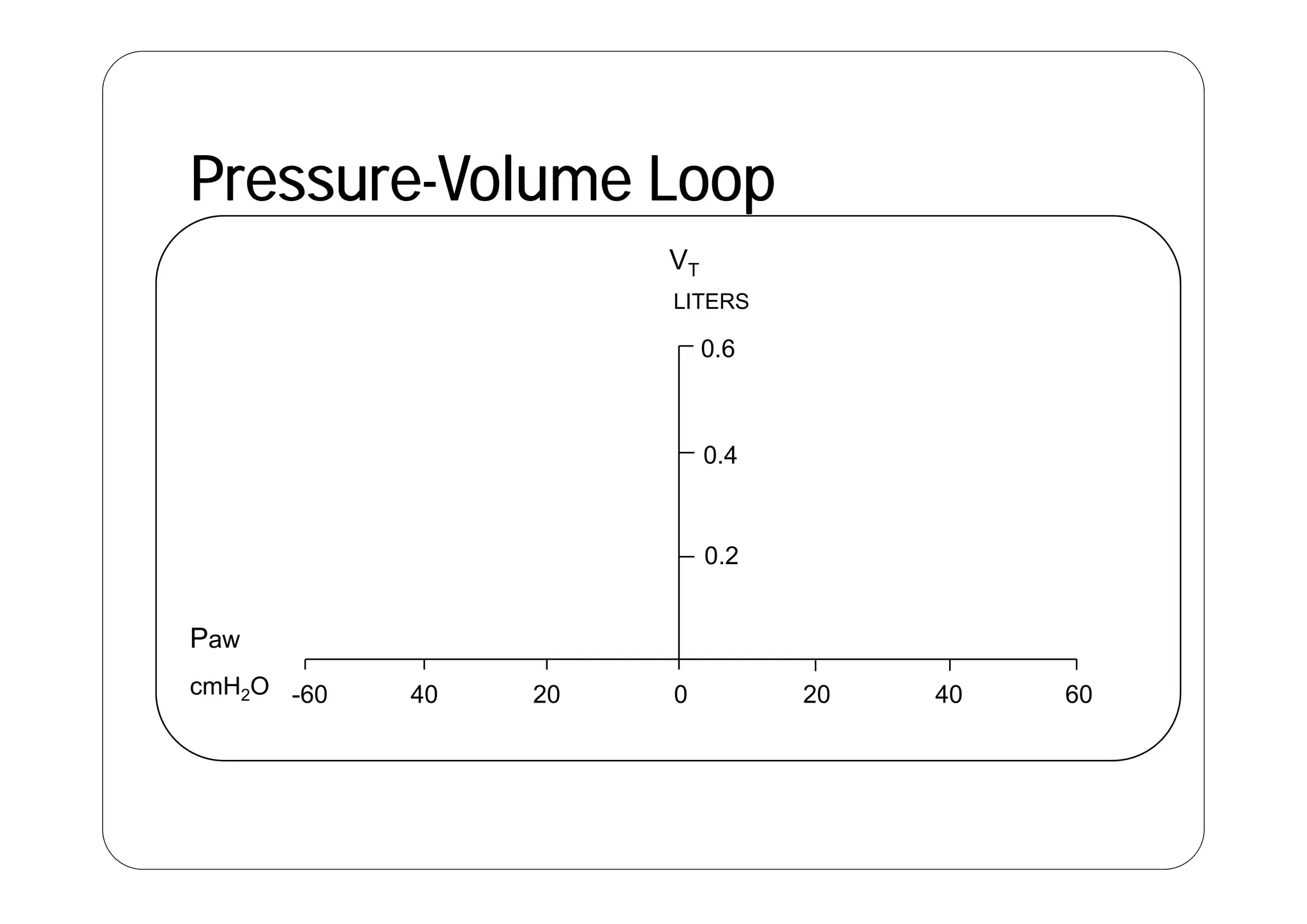
Loops
 Pressure-Volume Loops
 Flow-Volume Loops
p
Pressure-Volume Loop
V
LITERS
0.6
VT
0.4
0.6
0.2
0.4
Paw
0 20 40 60
20
40
-60
cmH2O
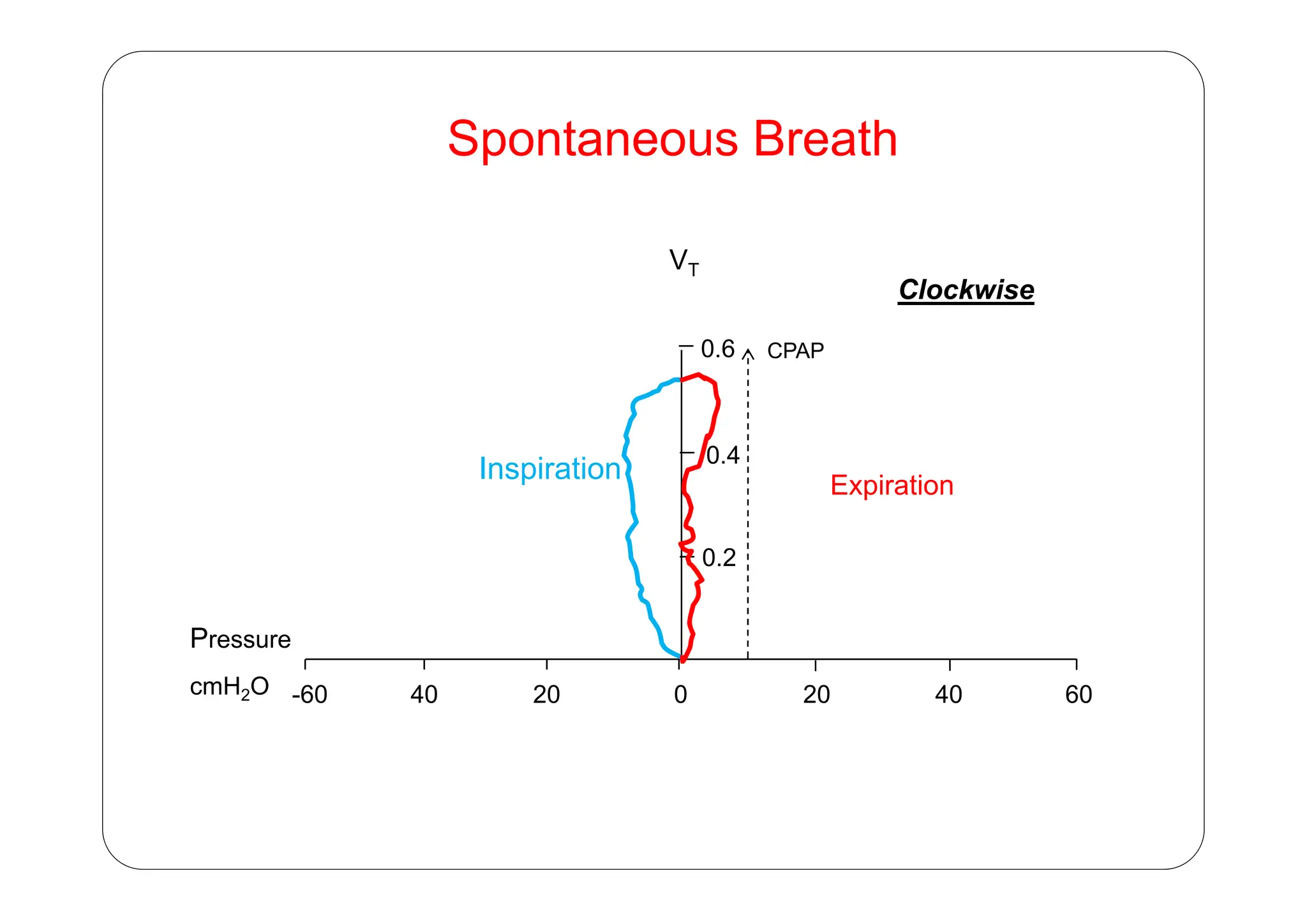
Spontaneous Breath
Spontaneous Breath
V
0.6
VT
Clockwise
CPAP
I i ti 0.4
0.6 CPAP
Inspiration
Expiration
0.2
0.4
Pressure
0 20 40 60
20
40
-60
cmH2O
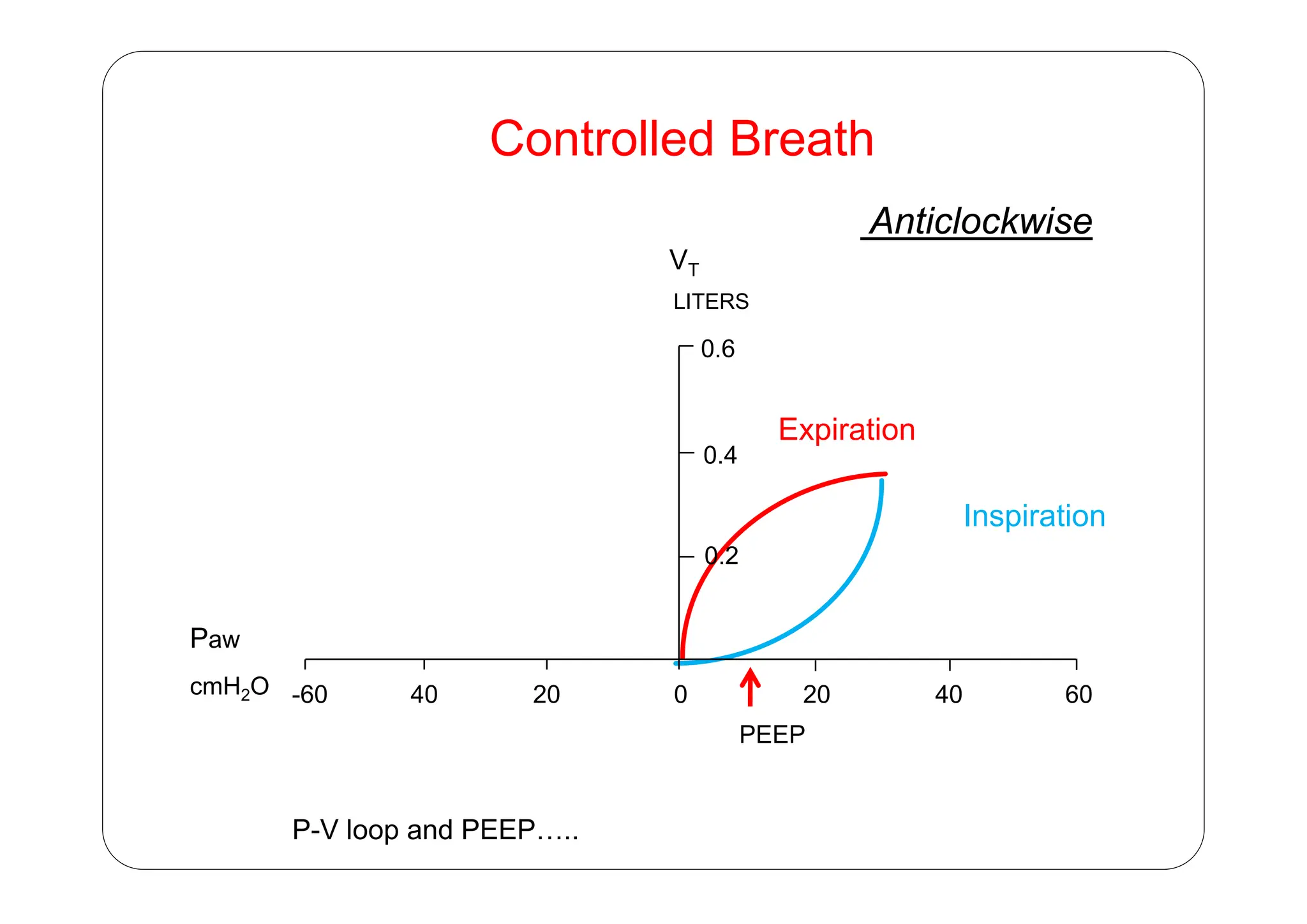
Controlled Breath
Controlled Breath
V
Anticlockwise
LITERS
0.6
VT
Expiration
0.4
0.6
0.2
0.4
Inspiration
Paw
0 20 40 60
20
40
-60
cmH2O
PEEP
P-V loop and PEEP…..
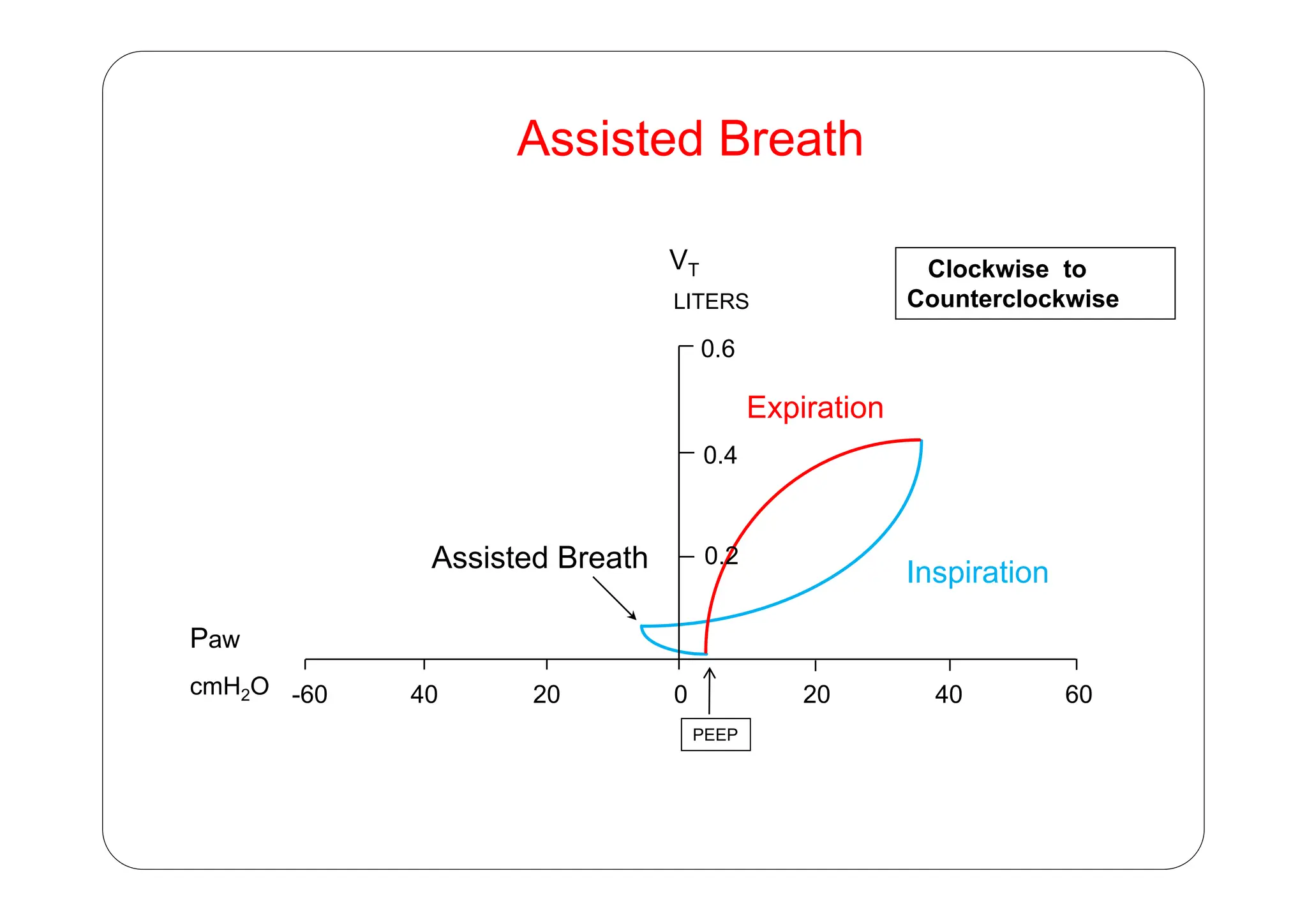
Assisted Breath
Assisted Breath
V
LITERS
0.6
VT Clockwise to
Counterclockwise
Expiration
0.4
0.6
Inspiration
0.2
0.4
Assisted Breath Inspiration
Paw
Assisted Breath
0 20 40 60
20
40
-60
cmH2O
PEEP
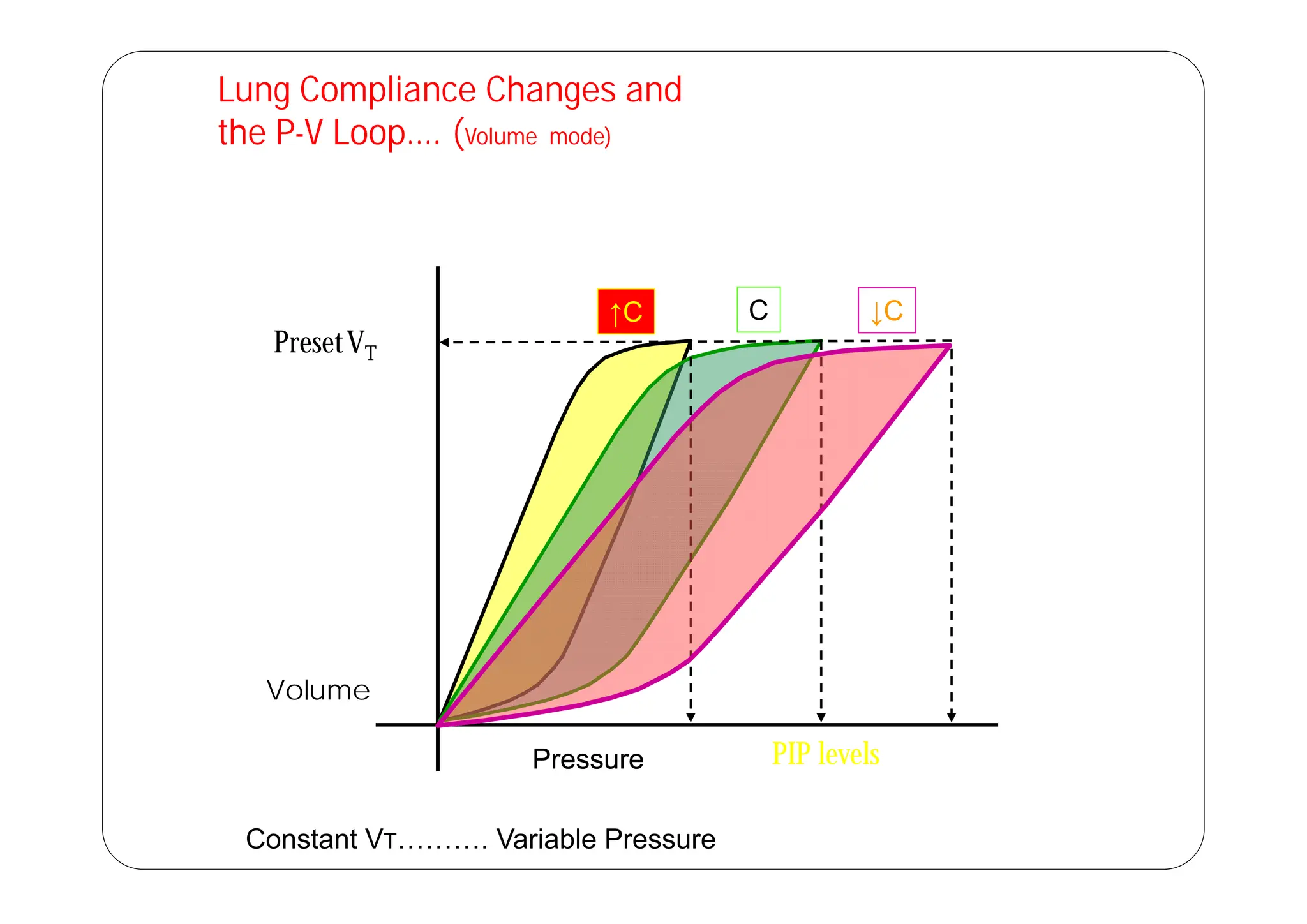
Lung Compliance Changes and
the P-V Loop…. (Volume mode)
Lung Compliance Changes and
the P-V Loop…. (Volume mode)
p ( )
p ( )
PresetVT
↑C C ↓C
T
Volume
PIP levels
Pressure
Pressure
Constant VT………. Variable Pressure
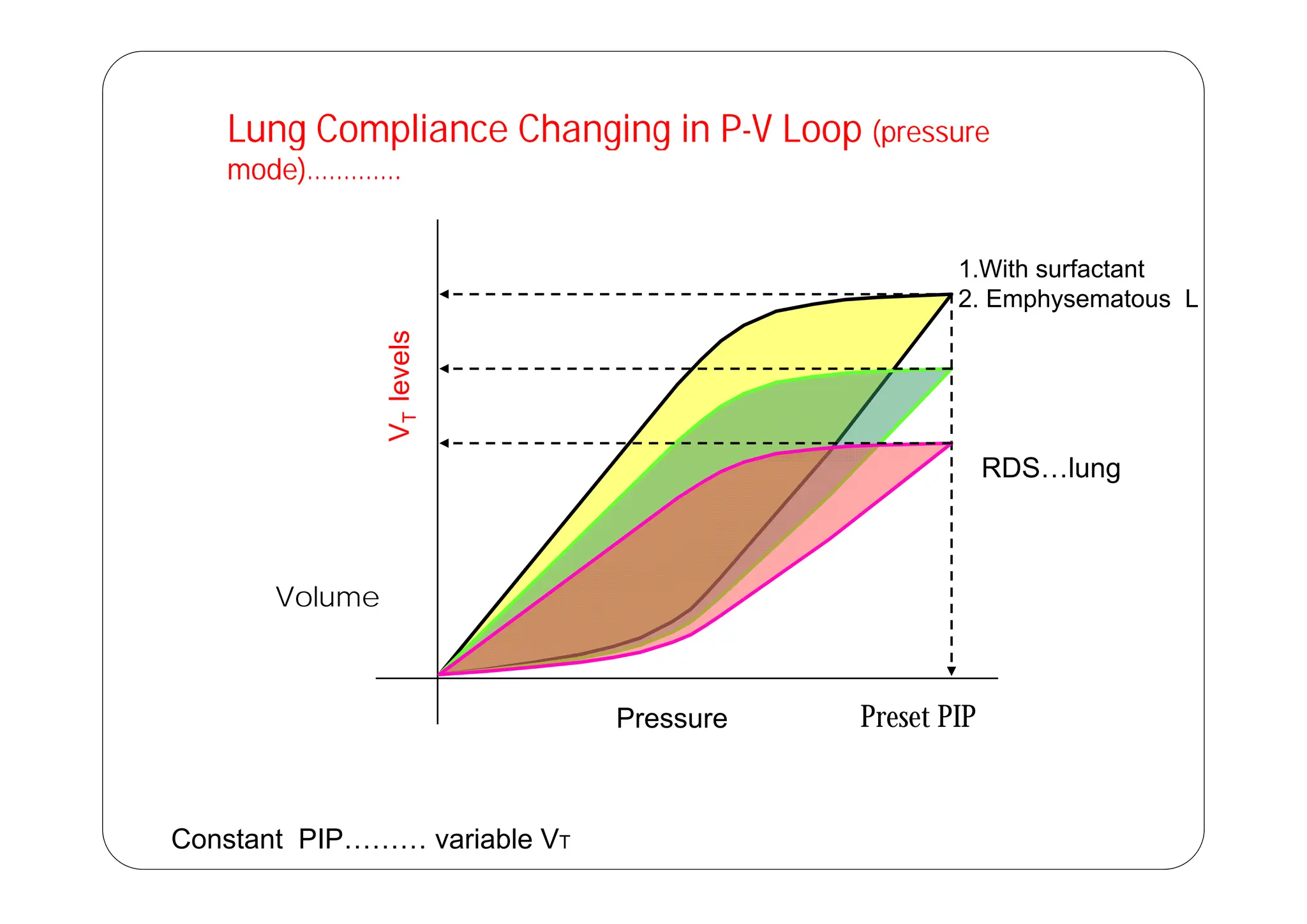
Lung Compliance Changing in P-V Loop (pressure
g p g g p
mode)………….
g p g g p
mode)………….
els
1.With surfactant
2. Emphysematous L
V
T
leve
RDS l
RDS…lung
Volume
Preset PIP
Pressure
Constant PIP……… variable VT
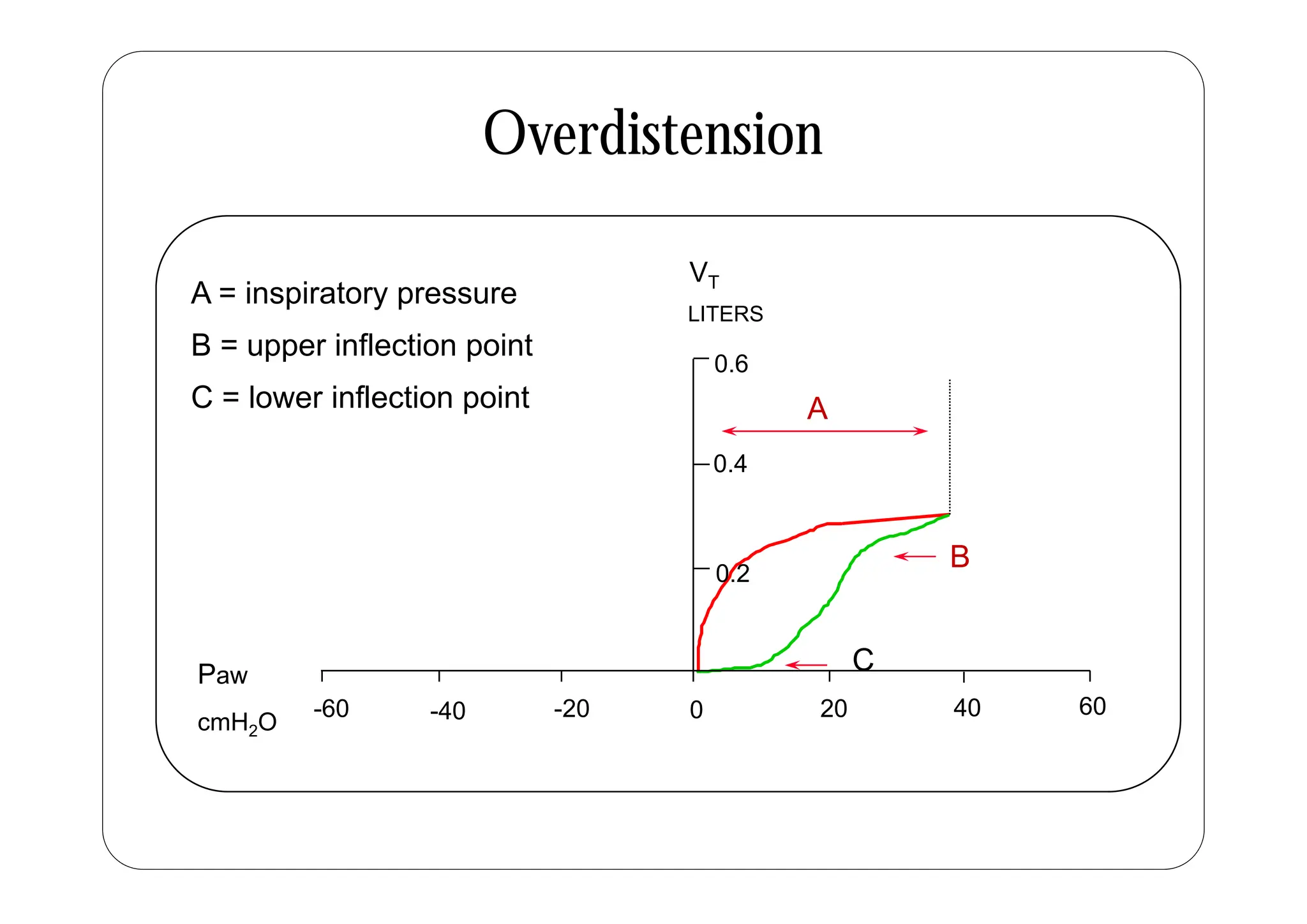
Overdistension
Overdistension
0 6
LITERS
A = inspiratory pressure
B = upper inflection point
VT
A
0 4
0.6
pp p
C = lower inflection point
B
0 2
0.4
B
0.2
Paw
C
0 20 40 60
-20
-40
-60
Paw
cmH2O
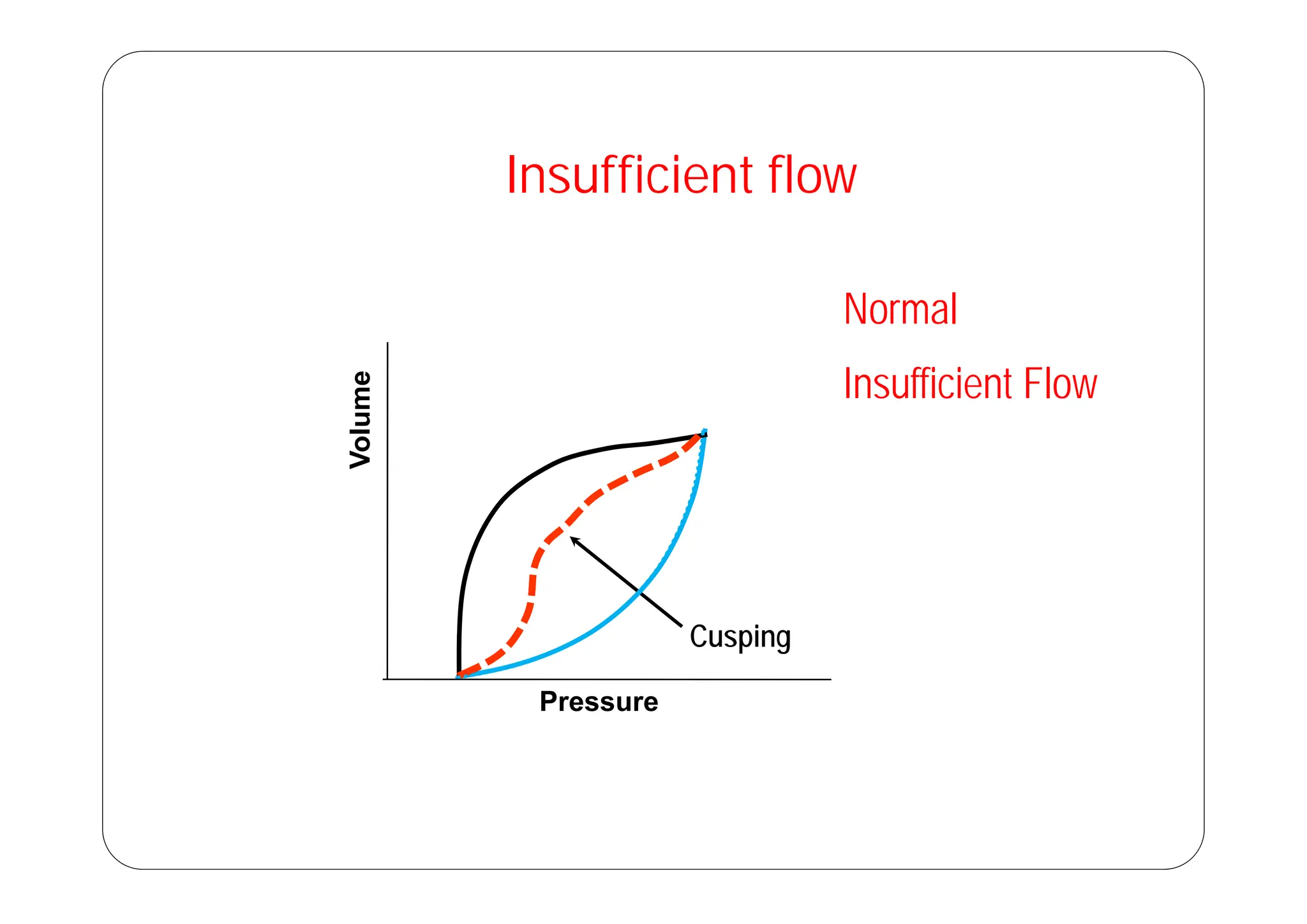
Insufficient flow
Normal
Volume
Insufficient Flow
V
Cusping
Pressure
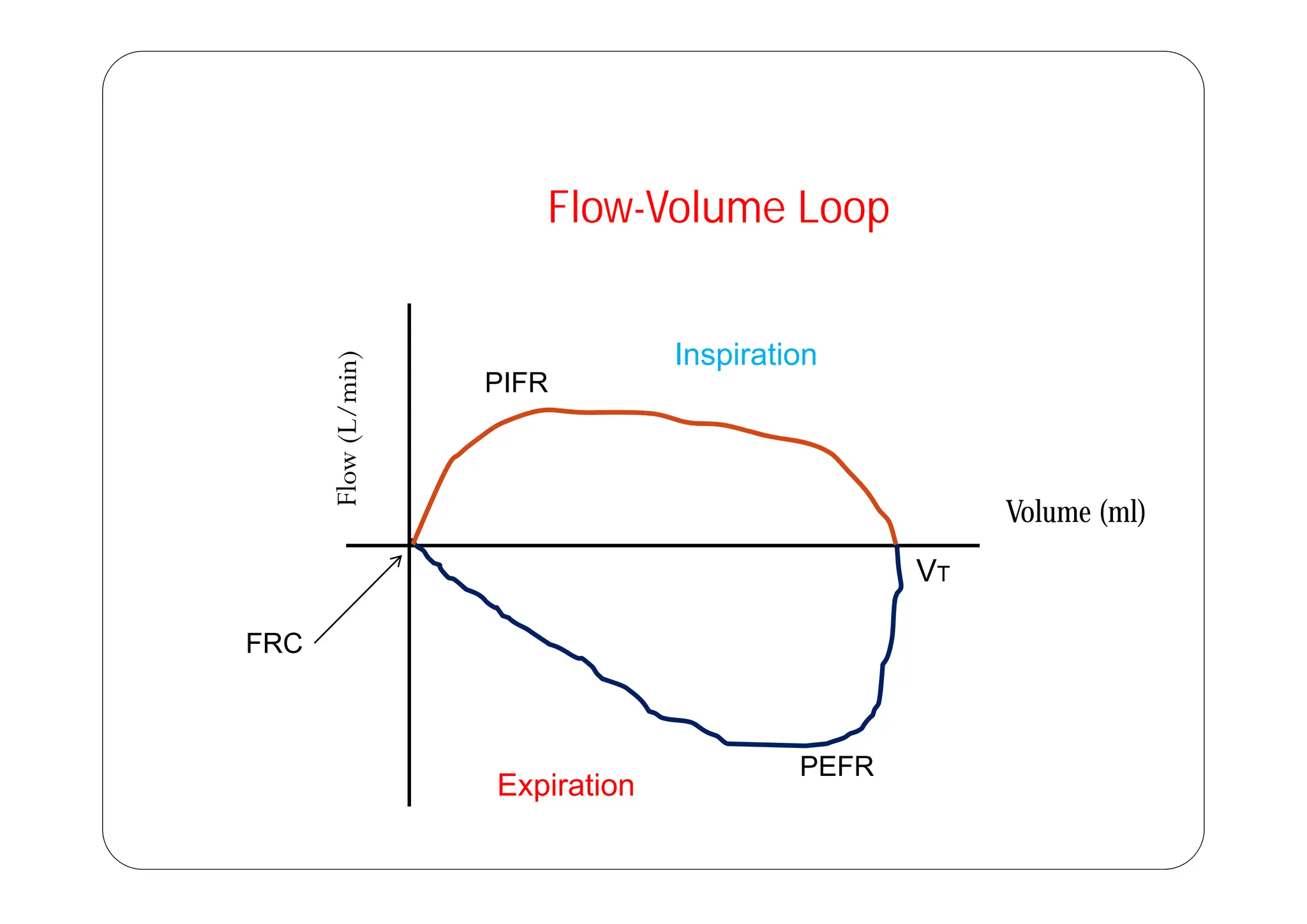
Flow-Volume Loop
Flow-Volume Loop
Inspiration
Inspiration
PIFR
Volume (ml)
VT
FRC
VT
E i ti
PEFR
Expiration
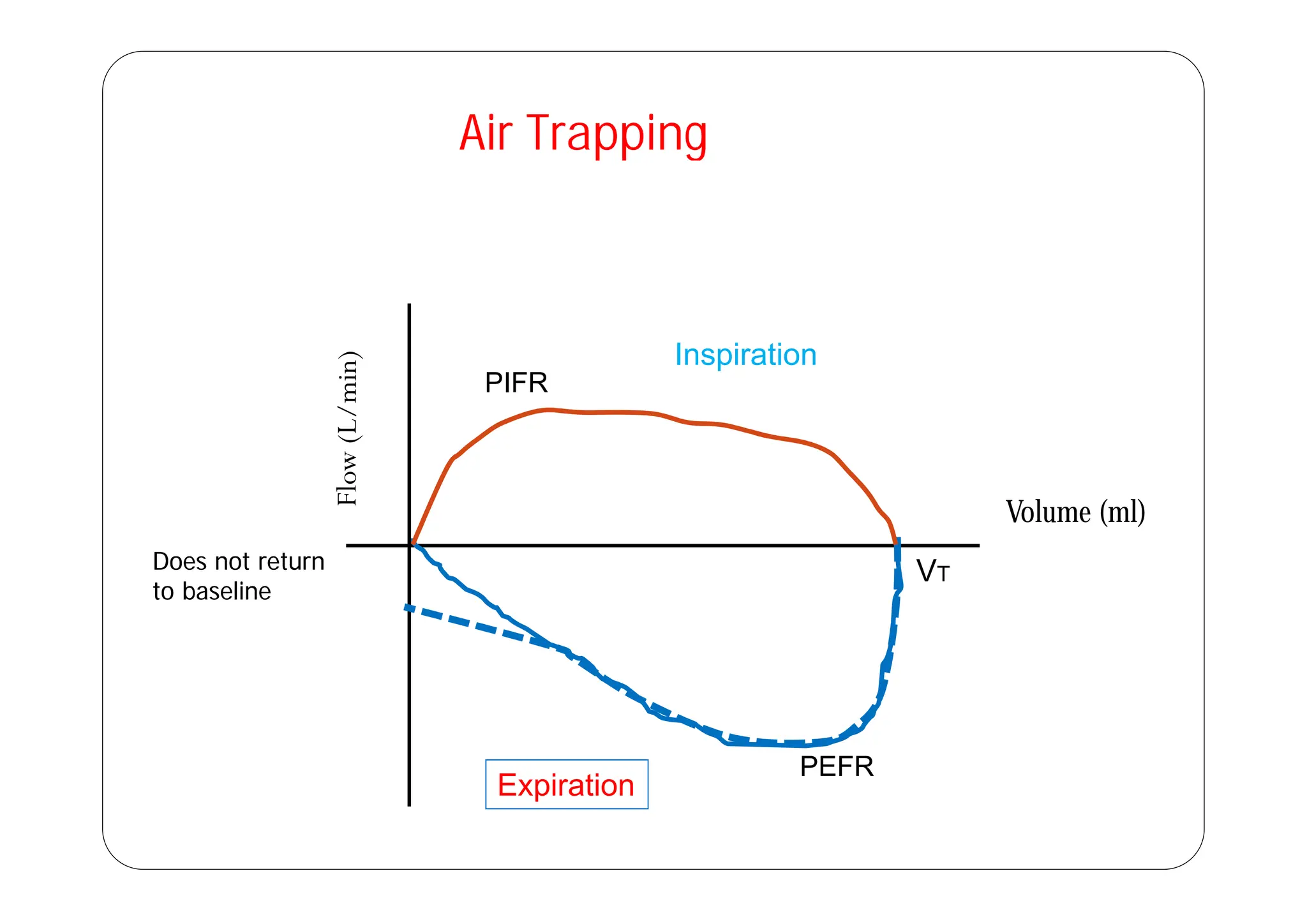
Air Trapping
Air Trapping
Air Trapping
Air Trapping
Inspiration
Inspiration
PIFR
Volume (ml)
VT
Does not return
Does not return VT
Does not return
Does not return
to baseline
to baseline
E i ti
PEFR
Expiration
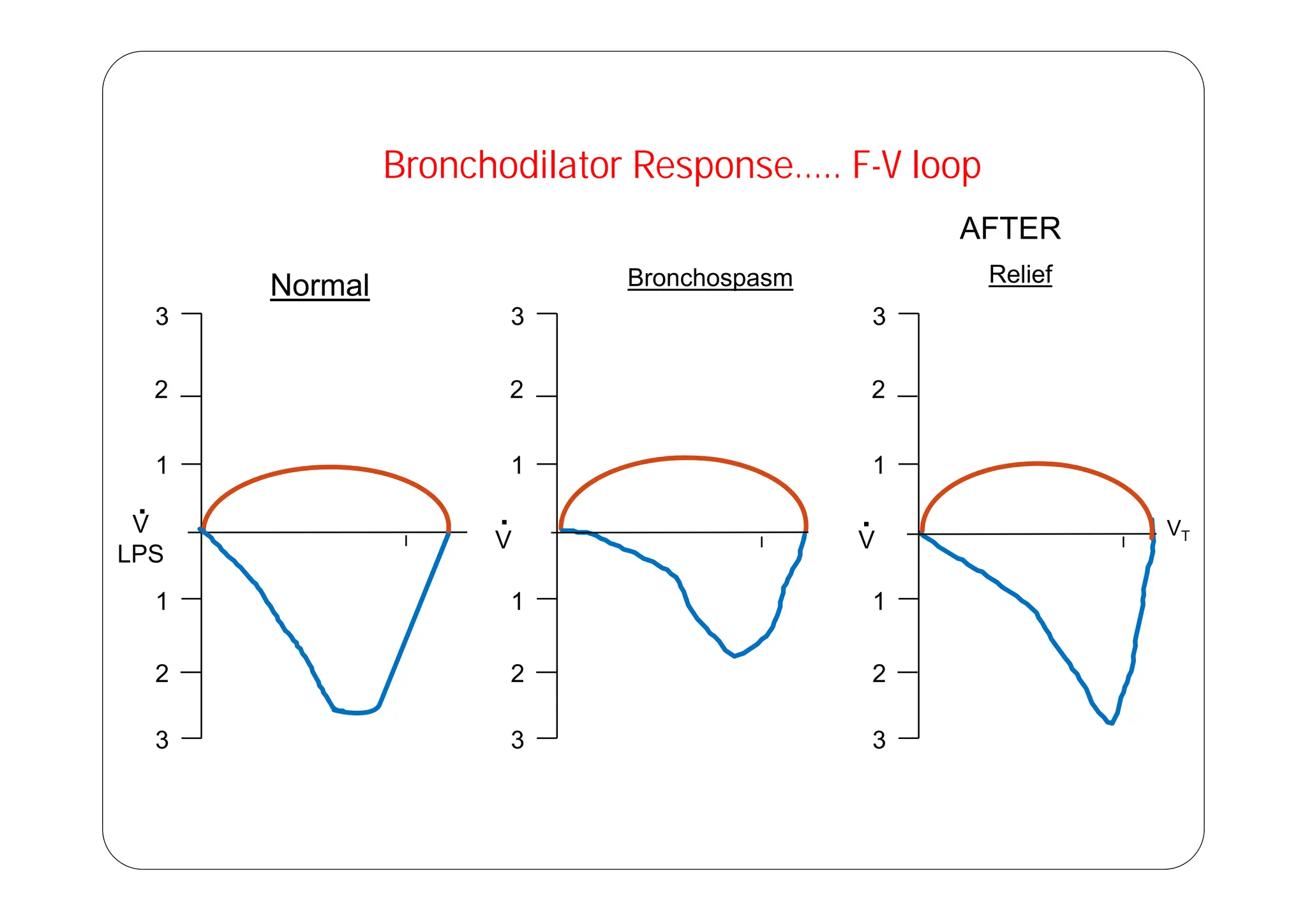
Bronchodilator Response….. F-V loop
AFTER
3
Normal Bronchospasm Relief
3 3
2
1
2
1
2
1
1
V
LPS
.
VT
1
V
.
1
V
.
1
2
1
2
1
2
2
3
2
3
2
3
SUMMARY
 Identify the correct waveforms to monitor
 S d ti t th b d id
 Spend more time at the bedside
 Never Ignore any ventilator alarm
 Monitor P peak, P plat and expiratory limb of flow volume
loop to diagnose changes in lung resistance or compliance.
 Identify Dys synchrony early and correct the cause.
76
Ventilator-waveform-analysis_nagarjuna_2012.pdf

  • 1.
    VENTILATOR WAVEFORM ANALYSIS ANALYSIS By Dr MV Nagarjuna 1 Dr. M.V. Nagarjuna
  • 2.
    Seminar Overview 1. BasicTerminology(Types of variables, Breaths, modes of , , ventilation) 2. Ideal ventilator waveforms (Scalars) ( ) 3. Diagnosing altered physiological states 4. Ventilator PatientAsynchrony and its management. 5. Loops (Pressure volume and Flow volume) 2
  • 3.
    Basics phase variables Basicsphase variables………….. A. Trigger ……. What causes the breath to begin? B C B. Limit …… What regulates gas flow during the breath? C Cycle A C. Cycle ……. What causes the breath to end?
  • 4.
    VARIABLES VARIABLES 1 TRIGGERVARIABLE :Initiates the breath 1. TRIGGERVARIABLE : Initiates the breath  Flow (Assist breath)  Pressure (Assist Breath)  Pressure (Assist Breath)  Time (Control Breath)  Newer variables (Volume Shape signal neural) Newer variables (Volume, Shape signal, neural) Flow trigger better than Pressure trigger. ow t gge ette t a essu e t gge . With the newer ventilators, difference in work of triggering is of minimal clinical significance. g British Journal of Anaesthesia,2003 4
  • 5.
    2. TARGETVARIABLE :Controls the gas delivery during the breath  Flow (Volume Control modes)  Pressure ( Pressure Control modes) 3. CYCLEVARIABLE : Cycled from inspiration into i i expiration  Volume (Volume control) Ti (P l)  Time (Pressure control)  Flow (pressure Support)  P (S f t li i bl )  Pressure (Safety cycling variable) 5
  • 6.
    Modes of Ventilation Modeof ventilation Breath types available Volume Assist Control Volume Control,Volume Assist PressureAssist Control Pressure Control, PressureAssist , Volume SIMV Volume Control,Volume Assist, Pressure Support Pressure SIMV Pressure Control, PressureAssist, Pressure Support Pressure Support Pressure support 6
  • 7.
  • 8.
  • 9.
    Flow versus time Neverforget to look at the expiratory limb of the flow waveform The expiratory flow is determined by the elastic recoil of the respiratory system and resistance of intubated airways respiratory system and resistance of intubated airways 9
  • 10.
    Types of Inspiratoryflow waveforms a Square wave flow a. Square wave flow b. Ascending ramp flow c Descending ramp flow c. Descending ramp flow d. Sinusoidal flow e Decay flow e. Decay flow 10
  • 11.
    Which form touse??  P t l d Al D l ti d fl  Pressure control mode :Always Decelerating or decay flow. Cannot be changed.  Volume control mode : Flow waveform can be changed d di h il i depending on the ventilator options. 11
  • 12.
    SQUARE FLOWWAVEFORM : •Inspiratory time is shortest for Inspiratory time is shortest for Square wave flow form. • Highest Peak Inspiratory pressures •Low Mean Inspiratory pressure •Low Mean Inspiratory pressure,, thus better venous return and cardiac output DESCENDING RAMP FLOW : • Increases inspiratory time (if not fixed) or peak inspiratory flow rate (if inspiratory time is fixed) p y •Least Peak inspiratory pressures (19% decrease). •High mean airway pressure, helps g y p , p lung inflation and oxygenation. 12
  • 13.
    Sinusoidal and ascendingramp flow : Sinusoidal and ascending ramp flow :  Initial flow rates are slow and hence cause dyssynchrony – FLOW STARVATION FLOW STARVATION.  Should not be used in assist modes. Descending ramp and Square wave flow :  Usually preferred as the initial flow rate meets the flow demand of the patient. Decreases air hunger. 13
  • 14.
  • 15.
    Decelerating flow waveform Advantages :  Decreases Peak inspiratory pressures  Increases oxygenation, decreases A-aDo2  Improves patient ventilator synchrony (more physiological)  Disadvantages :  Decreases expiratory time , potential for auto PEEP  Increases mean airway pressure, decreases cardiac output  Increased intracranial pressures Egan's Fundamentals of Respiratory Care. 8th ed. 2003:1064. MechanicalVentilation;Physiological and Clinical Applications 4thed 2006:113 MechanicalVentilation;Physiological and Clinical Applications.4thed.2006:113. Intensive Care Med. 1985;11:68-75. 15
  • 16.
    Expiratory flow waveform Passive and determined by compliance of the lung and resistance of the airways resistance of the airways. F i b b d  Four points to be observed : 1. Peak Expiratory Flow 2 Sl f h i li b 2. Slope of the expiratory limb 3. Expiratory time 4 D th f h th b li ? 4. Does the waveform reach the baseline? 16
  • 17.
  • 18.
  • 19.
    PIP No active breathing Tt l i l it PIP resistance Treats lung as single unit Pplat flow Pplat end-inspiratory alveolar pressure Driving compliance tidal volume Pressure (PIP-PEEP) tidal volume PEEP PIP- PEEP= (Flow x Resistance) + (Vt/Compliance RS)
  • 20.
    tidal volume Respiratory SystemCompliance C = Pplat - PEEP tidal volume Pulmonary Disorder: Extra Pulmonary Disorder: Decreased with: y  mainstem intubation  congestive heart failure ARDS Extra Pulmonary Disorder:  abdominal distension  chest wall edema/Obesity  ARDS  Atelectasis, consolidation  fibrosis  chest wall edema/Obesity  thoracic deformity  Hyperinflation  Tension pneumothorax l l ff Normal : 100 mL/cm H2O  pleural effusion
  • 21.
    P l tPEEP =Vt/ C li Pplat – PEEP =Vt/ Compliance  P plateau increased by a) Decreasing compliance of lung : Pulm edema,ARDS, g p g Atelectasis, Pneumonia. b) Decreasing compliance of the chest wall : Morbid obesity, ascites, stiff chest wall. c) IncreasingTidal volume d) Patient ventilator dyssynchrony 21
  • 22.
    PIP Pplat Inspiratory Resistance Ri= PIP - Pplat flow Increased with:  Airways : Secretions, Mucus plugging, Bronchospasm p  ET tube : Small size, ET block  Ventilator Circuit: Kinking Clogged HME  Ventilator Circuit: Kinking, Clogged HME Normal: 5 - 10 cm H2O/L/s for intubated ventilated adults 2 / / measured with 60 L/min (1 L/s) constant flow
  • 23.
    P k Pl t = Fl R i t P peak – P plat = Flow x Resistance  Increased by a) Increasing resistance : Bronchospasm, Mucus g p plugging/secretions, ET block , Biting the ET tube,Tube kinking, Clogged HME. b) Increasing flow : IncreasingVt, Increasing Insp.pause, Increasing I:E ratio 23
  • 24.
    PIP Crs = P lt PEEP tidal volume Ppl Pplat - PEEP C tidal volume Ppl (Peso) Ccw = Peso Palv (Pplat) CL = (Pplat – PEEP) - Peso tidal volume (Pplat) ( p ) Ri = PIP - Pplat Ri flow
  • 25.
    STRESS INDEX (ARDS) IncreasePEEP Ideal PEEP Decrease PEEP (Recruitment) (Overdistension) 25
  • 26.
  • 27.
  • 28.
    Information derived fromVolumeTimeScalar Information derived fromVolumeTime Scalar TidalVolume Volume on y axis Air leak Expiratory limb fails to return to x axis Active Expiration Tracing continues beyond the baseline A l b f l h h b l Auto PEEP Expiratory limb fails to reach the baseline 28
  • 29.
    HOWTO USETHE HOWTO USETHE GRAPHSFOR GRAPHS FOR DIAGNOSIS OF DISEASE DIAGNOSIS OF DISEASE STATES ? STATES ? 29
  • 30.
    Which waveforms tomonitor ? Mode of ventilation Independent variables Dependent variables Waveforms that will be useful Waveforms that normally remain unchanged Volume Control/ Assist-Control Tidal volume,RR, Flow rate, PEEP, I/E ratio Paw Pressure-time: Changes in Pip, Pplat Flow-time (expiratory): Ch i li Volume-time Flow time (inspiratory) Changes in compliance Pressure-volume loop: Overdistension, optimal PEEP l i d fl Pressure Control Paw, Inspiratory time (RR), PEEP andI/E ratio Vt, flow Volume-time and flow- time: Changes inVt and compliance Pressure-volume loop: Pressure-time Overdistension, optimal PEEP Pressure PS andPEEP Vt and RR, Volume- time support/ CPAP Vt,and RR, flow, I/E Ratio Flow- time (forVt andVE) 30
  • 31.
    Increased airway resistance (ACMV-VC)  PressureTimeWaveform :  Increased difference between Ppeak and Pplat  Normal P plat  Expiratory flow waveform : d  Decreased PEFR  Increased expiratory time  Scooped out appearance of expiratory limb Scooped out appearance of expiratory limb  Potential for auto PEEP  Loss of peak (emphysema)  VolumeTimeWaveform :  Expiratory limb long 31
  • 32.
    A patient withEndotrachealTube block (When received from Dialysis room) 32
  • 33.
    A patient withacute severe asthma on ventilator 33
  • 34.
    Decreased Compliance ofRespiratory System  PressureTimeWaveform :  Increased P plat and Ppeak  Increased P plat and Ppeak.  Normal P peak – Pplat  FlowTimeWaveform :  Increased PEFR  Increased PEFR  Shortened expiratory time 34
  • 35.
    Auto PEEP/Intrinsic PEEP AutoPEEP/Intrinsic PEEP Notice how the expiratory flow fails Notice how the expiratory flow fails to return to the baseline indicating air trapping (Auto PEEP) Also notice how air trapping causes an increase in airway pressure y p due to increasing end expiratory pressure and end inspiratory lung volume. 35
  • 36.
    A patient ofacute severe asthma. Note failure of expiratory limb to return to baseline 36
  • 37.
  • 38.
    AUTO- PEEP :Consequences q  Increases the work ofTriggering  Ineffective triggering  Worsens Oxygenation yg  Lung Hyperinflation- barotrauma  Hemodynamic Compromise AUTO PEEP : Recognition  Analysis of ventilator graphics:  Delay between start of Inspiratory effort and Pressure drop  No increase in P peak with increase inApplied PEEP 38
  • 39.
  • 40.
  • 41.
    Wh t iV til t P ti t S h ? What isVentilator Patient Synchrony? The ventilator should start inspiration at p the time of onset of patients inspiration. Th fl id d b th til t h ld The flow provided by the ventilator should meet the flow demand of the patient. p TheVentilator Inspiratory time should t h ith th ti t i i t ti match with the patients inspiratory time. 41
  • 42.
    Ventilator Patient Dys-synchrony FLOWCYCLE TRIGGER ASYNCHRONY ASYNCHRONY ASYNCHRONY 1. Ineffective Triggering 2. Auto Triggering 1. Delayed Cycling 2 Premature 3. Double Triggering 4. Delayed i i 2. Premature Cycling triggering 42
  • 43.
    INEFFECTIVE TRIGGGERING  Oneof the most common asynchronies  One of the most common asynchronies  Failure of the patients inspiratory effort to initiate a ventilator breath ventilator breath.  Identified by  Vi l i ti f ti t di th i l b t  Visual inspection of patients expanding thoracic volume but without delivery of ventilator breath.  Ventilator graphics which show a decrease in airway pressure Ventilator graphics which show a decrease in airway pressure with an increase in flow but no initiation of breath. 43
  • 44.
    Ineffective triggering  Whatcauses this?  What causes this?  Improper sensitivity of trigger threshold  Respiratory muscle weakness (disease related critical illness  Respiratory muscle weakness (disease related, critical illness neuromyopathy, electrolyte imbalances)  Intrinsic PEEP in COPD patients p  Decreased respiratory drive ( Excessive sedatives)  Alkaline pH p  External nebulizers  HighTidal volumes/High Pressure support decrease respiratory g g pp p y drive. 44
  • 45.
    AUTO TRIGGERING Definition :Ventilatordelivers an assisted breath Definition :Ventilator delivers an assisted breath that was not initiated by the patient Causes : 1 Ci i l k (ET ff ICTD i h BPF ) 1. Circuit leaks (ET cuff, ICTD with BPF etc) 2. Fluid in the circuit 3. Cardiac oscillations (High cardiac output states) 4. Very low trigger threshold . 45
  • 46.
    DOUBLE TRIGGERING  Patientsinspiration continues after the ventilator inspiration  Patients inspiration continues after the ventilator inspiration and triggers another breath immediately after the inspiration.  Also called Breath Stacking  Also called Breath Stacking Causes : 1 Hi hV il d d f h i (ARDS) 1. HighVentilatory demand of the patient (ARDS) 2. Inappropriate settings ( Low tidal volume, Short i i i Hi h l h h ld) inspiratory time, High cycle threshold) 46
  • 47.
    A case ofMorbid Obesity with Obesity hypoventilation syndrome. y y yp y Note the low tidal volumes generated on PSV mode 47
  • 48.
    DELAYED TRIGGERING Components ofTriggering: Components ofTriggering :  Trigger threshold :The pressure/flow that must be attained b the patients breath to trigger the entilator attained by the patients breath to trigger the ventilator.  InspiratoryTriggerTime (ITT) :Time from the initiation f ff h T h h ld of effort to theTrigger threshold .  RiseTime to Baseline Pressure (RTBP) Inspiratory DelayTime (IDT) = ITT + RTBP p y y ( ) 48
  • 49.
    DELAYED TRIGGERING  AI h t bl ith ll th ti l d f  An Inherent problem with all the conventional modes of ventilation  Can be overcome by  Newer modes of ventilation ( NAVA)  Newer methods of triggering ( Shape signal triggering) 49
  • 50.
    Neurally Adjusted VentilatoryAssist (NAVA) Diaphragmatic Electrical activity is sensed by an electrode placed in the esophagus and is used to trigger the breath and cycle into expiration. 50
  • 51.
    Sinderby Nature Med1999;5:1433 NEJM 2001;344 : 1986-1996
  • 52.
    FLOW ASYNCHRONY Causes : Causes:  HighVentilatory demand (ALI/ARDS)  Low ventilatory settings ( Flow rate Tidal volume Pramp) Low ventilatory settings ( Flow rate,Tidal volume, Pramp) What to do :  Treat reversible causes of air hunger (fever acidosis)  Treat reversible causes of air hunger (fever, acidosis)  Increase the tidal volume ( if feasible)  Increase the flow rate ( directly or by decreasing inspiratory  Increase the flow rate ( directly, or by decreasing inspiratory time, increasing pause)  Change to pressure control mode with variable flow g p  Sedate /Paralyze the patient (last resort) 52
  • 53.
    Patient ofARDS beingventilated usingARDS Network strategy (Tidal volume = 6 ml/kg, Body weight = 66 kg) 53
  • 54.
    Tidal volume increasedto 440 ml from 400 ml to improve the flow synchrony 54
  • 55.
    Same patient duringa spike of fever 39.2 C showing severe flow dyssynchrony 55
  • 56.
    CYCLING ASYNCHRONY  DelayedCycling :VentilatorTi > PatientTi V til t ti I i ti h t ll i ti h Ventilator continues Inspiration when actually expiration has started.  Premature Cycling :VentilatorTi < PatientTi Patients inspiratory effort continue into the expiratory phase of ventilator breath. 56
  • 57.
    DELAYED CYCLING Patient whileweaning . Expiratory trigger sensitivity of 25 % 57
  • 58.
    How to Manage: How to Manage :  D I i t ti  Decrease Inspiratory time  DecreaseTidal volume ( SCMV mode)  Increase ExpiratoryTrigger Sensitivity ( PSV mode) 58
  • 59.
    Expiratory trigger sensitivityincreased to 60 % to improve cycling synchrony. 59
  • 60.
    A case ofAcutesevere asthma on SCMV mode. I : E ratio kept at 1: 3.3 to avoid auto PEEP. Ventilator shows double triggering 60
  • 61.
    I : Eratio decreased to 1 : 2.5 along with control of bronchospasm. None of the other parameters changed. No further double triggering. Illustrates double triggering due to short inspiratory time and premature cycling 61
  • 62.
    PATIENT VENTILATOR DYS-SYNCHRONY CLINICALSIGNIFICANCE ??  Increases Work Of Breathing Increases Work Of Breathing  Causes Ultra structural damage to the respiratory muscles.  Worsens Respiratory mechanics ( Auto PEEP) Worsens Respiratory mechanics ( Auto PEEP)  Alters gas exchange ( Auto, double triggering – lower CO2)  Increased need for sedation  Increased need for sedation  Longer duration of mechanical ventilation  Difficulty in weaning  Difficulty in weaning  Confounds lung protective ventilation ( Double breaths)  Sleep Fragmentation  Sleep Fragmentation  Inability to tolerate NIV 62
  • 63.
  • 64.
  • 65.
    Spontaneous Breath Spontaneous Breath V 0.6 VT Clockwise CPAP Ii ti 0.4 0.6 CPAP Inspiration Expiration 0.2 0.4 Pressure 0 20 40 60 20 40 -60 cmH2O
  • 66.
  • 67.
    Assisted Breath Assisted Breath V LITERS 0.6 VTClockwise to Counterclockwise Expiration 0.4 0.6 Inspiration 0.2 0.4 Assisted Breath Inspiration Paw Assisted Breath 0 20 40 60 20 40 -60 cmH2O PEEP
  • 68.
    Lung Compliance Changesand the P-V Loop…. (Volume mode) Lung Compliance Changes and the P-V Loop…. (Volume mode) p ( ) p ( ) PresetVT ↑C C ↓C T Volume PIP levels Pressure Pressure Constant VT………. Variable Pressure
  • 69.
    Lung Compliance Changingin P-V Loop (pressure Lung Compliance Changing in P-V Loop (pressure g p g g p mode)…………. g p g g p mode)…………. els 1.With surfactant 2. Emphysematous L V T leve RDS l RDS…lung Volume Preset PIP Pressure Constant PIP……… variable VT
  • 70.
    Overdistension Overdistension 0 6 LITERS A =inspiratory pressure B = upper inflection point VT A 0 4 0.6 pp p C = lower inflection point B 0 2 0.4 B 0.2 Paw C 0 20 40 60 -20 -40 -60 Paw cmH2O
  • 71.
  • 73.
  • 74.
    Air Trapping Air Trapping AirTrapping Air Trapping Inspiration Inspiration PIFR Volume (ml) VT Does not return Does not return VT Does not return Does not return to baseline to baseline E i ti PEFR Expiration
  • 75.
    Bronchodilator Response….. F-Vloop AFTER 3 Normal Bronchospasm Relief 3 3 2 1 2 1 2 1 1 V LPS . VT 1 V . 1 V . 1 2 1 2 1 2 2 3 2 3 2 3
  • 76.
    SUMMARY  Identify thecorrect waveforms to monitor  S d ti t th b d id  Spend more time at the bedside  Never Ignore any ventilator alarm  Monitor P peak, P plat and expiratory limb of flow volume loop to diagnose changes in lung resistance or compliance.  Identify Dys synchrony early and correct the cause. 76