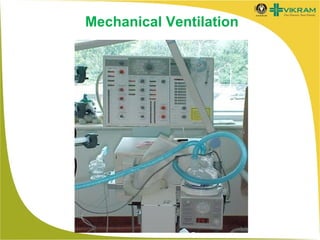
Mechanical Ventilation
Contents
 Anatomy and Physiology Of Respiratory System
 Introduction About Mechanical Ventilation
 History
 Meaning of Mechanical Ventilation
 Indications for use
 Types or Forms Of Mechanical Ventilation
 Settings of Mechanical Ventilation
 Modes of Mechanical Ventilation
 Complications associated with Mechanical Ventilation
 Nursing Management of ventilator patients
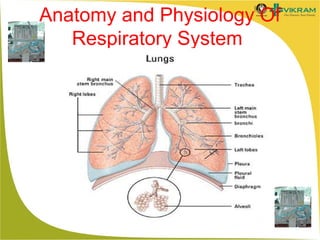
Anatomy and Physiology Of
Respiratory System
Introduction About Mechanical
Ventilation
Mechanical ventilation is typically used after an
invasive intubation, a procedure wherein an
endotracheal or tracheostomy tube is inserted into
the airway. It is used in acute settings such as in
the ICU for a short period of time during a serious
illness. It may be used at home or in a nursing or
rehabilitation institution if patients have chronic
illnesses that require long-term ventilation
assistance.
History
The roman physician Galen may have been the
first to describe mechanical ventilation: "If you take
a dead animal and blow air through its larynx
[through a reed], you will fill its bronchi and watch
its lungs attain the greatest distention.” Vesalius
too describes ventilation by inserting a reed or
cane into the trachea of animals. In 1908 George
Poe demonstrated his mechanical respirator by
asphyxiating dogs and seemingly bringing them
back to life.
Meaning of Mechanical
Ventilation
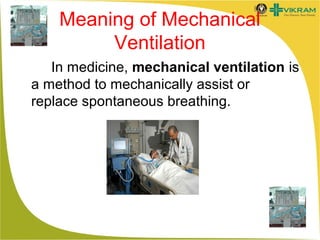
In medicine, mechanical ventilation is
a method to mechanically assist or
replace spontaneous breathing.
Indications for use
•
•
•
•
•

•
•
•
•

Common medical indications for use include:
Acute lung injury (including ARDS, trauma)
Apnea with respiratory arrest, including cases from intoxication
Chronic obstructive pulmonary disease (COPD)
Acute respiratory acidosis with partial pressure of carbon dioxide
(pCO2) > 50 mmHg and pH < 7.25, which may be due to paralysis of
the diaphragm due to Guillain-Barré syndrome, Myasthenia Gravis,
spinal cord injury, or the effect of anaesthetic and muscle relaxant
drugs
Increased work of breathing as evidenced by significant tachypnea,
retractions, and other physical signs of respiratory distress
Hypoxemia with arterial partial pressure of oxygen (PaO2) with
supplemental fraction of inspired oxygen (FiO2) < 55 mm Hg
Hypotension including sepsis, shock, congestive heart failure
Neurological diseases such as Muscular Dystrophy Amyotrophic
Lateral Sclerosis
Types or Forms Of Mechanical
Ventilation
The two major types of Mechanical Ventilation are
Negative pressure and positive Pressure
ventilation
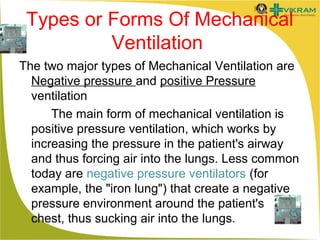
The main form of mechanical ventilation is
positive pressure ventilation, which works by
increasing the pressure in the patient's airway
and thus forcing air into the lungs. Less common
today are negative pressure ventilators (for
example, the "iron lung") that create a negative
pressure environment around the patient's
chest, thus sucking air into the lungs.
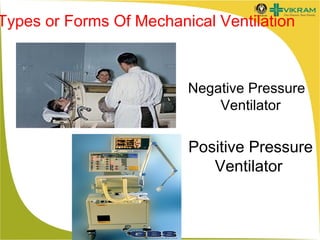
Types or Forms Of Mechanical Ventilation

Negative Pressure
Ventilator

Positive Pressure
Ventilator
Settings of Mechanical
Ventilation
• Mechanical Ventilator Settings
regulates the rate, depth and
other characteristics of ventilation.
Settings are based on the
patient’s status (ABGs, Body
weight, level of consciousness
and muscle strength)
PARAMETERS OF MECHANICAL
VENTILATION ARE
 Respiratory Rate (f) :-Normally 10-20b/m
 Tidal Volume (VT) :-5-15ml/kg
 Oxygen Concentration(FIO2):-b/w 21-90%

I:E Ratio:-1:2
Flow Rate:-40-100L/min
Sensitivity/Trigger:- 0.5-1.5 cm H2O
Pressure Limit:-10-25cm H2O
 PEEP :- Usually, 5-10 cmH2O
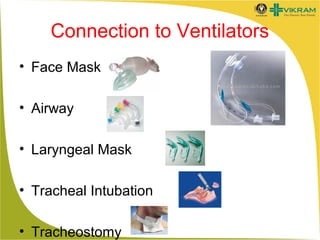
Connection to Ventilators
• Face Mask
• Airway
• Laryngeal Mask
• Tracheal Intubation
• Tracheostomy
Modes of Mechanical
Ventilation
• Controlled Mandatory Ventilation (CMV)
• Asst-Control Mandatory Ventilation (ACV)
• Synchronized Intermittent Mandatory
Ventilation(SIMV)
• Positive Expiratory End Pressure(PEEP)
• Continuous Positive Airway Pressure
(CPAP)
• Pressure Support Ventilation (PSV)
Modes of Mechanical Ventilation
Controlled Mandatory
Ventilation (CMV)
• Controlled Mechanical Ventilation (CMV).
In this mode the ventilator provides a
mechanical breath on a preset timing.
Patient respiratory efforts are ignored.
This is generally uncomfortable for
children and adults who are conscious
and is usually only used in an
unconscious patient. It may also be used
in infants who often quickly adapt their
breathing pattern to the ventilator timing
Asst-Control Mandatory
Ventilation (ACV)
•

Assist Control (AC). In this mode the ventilator provides a
mechanical breath with either a pre-set tidal volume or peak
pressure every time the patient initiates a breath. Traditional assistcontrol used only a pre-set tidal volume--when a preset peak
pressure is used this is also sometimes termed Intermittent Positive
Pressure Ventilation or IPPV. However, the initiation timing is the
same--both provide a ventilator breath with every patient effort. In
most ventilators a back-up minimum breath rate can be set in the
event that the patient becomes apnoeic. Although a maximum rate
is not usually set, an alarm can be set if the ventilator cycles too
frequently. This can alert that the patient is tachypneic or that the
ventilator may be auto-cycling (a problem that results when the
ventilator interprets fluctuations in the circuit due to the last breath
termination as a new breath initiation attempt)
Synchronized Intermittent
Mandatory Ventilation(SIMV)
•

Synchronized Intermittent Mandatory Ventilation (SIMV). In this
mode the ventilator provides a pre-set mechanical breath (pressure
or volume limited) every specified number of seconds (determined
by dividing the respiratory rate into 60 - thus a respiratory rate of 12
results in a 5 second cycle time). Within that cycle time the ventilator
waits for the patient to initiate a breath using either a pressure or
flow sensor. When the ventilator senses the first patient breathing
attempt within the cycle, it delivers the preset ventilator breath. If the
patient fails to initiate a breath, the ventilator delivers a mechanical
breath at the end of the breath cycle. Additional spontaneous
breaths after the first one within the breath cycle do not trigger
another SIMV breath. However, SIMV may be combined with
pressure support (see below). SIMV is frequently employed as a
method of decreasing ventilatory support (weaning) by turning down
the rate, which requires the patient to take additional breaths
beyond the SIMV triggered breath.
.
Positive End Expiratory
Pressure(PEEP)
• PEEP) is functionally the same as CPAP, but refers to
the use of an elevated pressure during the expiratory
phase of the ventilatory cycle. After delivery of the set
amount of breath by the ventilator, the patient then
exhales passively. The volume of gas remaining in the
lung after a normal expiration is termed the functional
residual capacity (FRC). The FRC is primarily
determined by the elastic qualities of the lung and the
chest wall. In many lung diseases, the FRC is reduced
due to collapse of the unstable alveoli, leading to a
decreased surface area for gas exchange and
intrapulmonary shunting (see above), with wasted
oxygen inspired. Adding PEEP can reduce the work of
breathing (at low levels) and help preserve FRC.
Continuous Positive Airway
Pressure (CPAP)
• (CPAP). A continuous level of elevated pressure
is provided through the patient circuit to maintain
adequate oxygenation, decrease the work of
breathing, and decrease the work of the heart
(such as in left-sided heart failure — CHF). Note
that no cycling of ventilator pressures occurs
and the patient must initiate all breaths. In
addition, no additional pressure above the CPAP
pressure is provided during those breaths.
CPAP may be used invasively through an
endotracheal tube or tracheostomy or noninvasively with a face mask or nasal prongs.
Pressure Support Ventilation
• Pressure Support Ventilation (PSV). When a
patient attempts to breath spontaneously
through an endotracheal tube, the narrowed
diameter of the airway results in higher
resistance to airflow, and thus a higher work of
breathing. PSV was developed as a method to
decrease the work of breathing in-between
ventilator mandated breaths by providing an
elevated pressure triggered by spontaneous
breathing that "supports" ventilation during
inspiration
Complication
•
•
•
•
•
•
•
•
•
•

Hypotension
Pneumothorax
Decreased Cardiac Output
Nosocomial Pneumonia
Positive Water Balance
Increased Intracranial Pressure (ICP)
Alarms turned off or nonfunctional
Sinusitis and nasal injury
Mucosal lesions
Aspiration, GI bleeding, Inappropriate ventilation (respiratory
acidosis or alkalosis, Thick secretions, Patient discomfort due to
pulling or jarring of ETT or tracheostomy, High PaO2, Low
PaO2, Anxiety and fear, Dysrhythmias or vagal reactions during
or after suctioning, Incorrect PEEP setting, Inability to tolerate
ventilator mode.
Terminologies Used in
Mechanical Ventilation
• APRV Airway pressure release ventilation
• ASB Assisted spontaneous breathing—also ASV = assisted
spontaneous ventilation
• ASV Adaptive support ventilation—a patented technology—
closed-loop mechanical respiration, a further development of
MMV. Can also stand for assisted spontaneous ventilation.
• ATC Automatic tube compensation
• BIPAP Biphasic positive airway pressure
• CMV Continuous mandatory ventilation
• CPAP Continuous positive airway pressure
• CPPV Continuous positive pressure ventilation
• EPAP Expiratory positive airway pressure
Conti…….
•

HFV High frequency ventilation
–
–
–
–

•
•
•
•
•
•
•

HFFI High frequency flow interruption
HFJV High frequency jet ventilation
HFOV High frequency oscillatory ventilation
HFPPV High frequency positive pressure ventilation

ILV Independent lung ventilation—separate sides positive pressure
ventilation.
IPAP Inspiratory positive airway pressure
IPPV Intermittent positive pressure ventilation
IRV Inversed ratio ventilation— mechanical ventilation with switched
respiration phases/time rate.
LFPPV Low frequency positive pressure ventilation
MMV Mandatory minute volume
NAVA Neurally adjusted ventilatory assist
Nursing Management
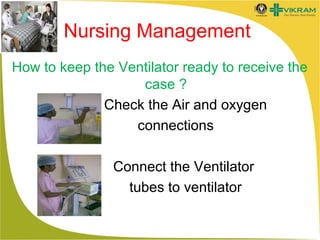
How to keep the Ventilator ready to receive the
case ?
Check the Air and oxygen
connections
Connect the Ventilator
tubes to ventilator
How to keep the Ventilator ready to
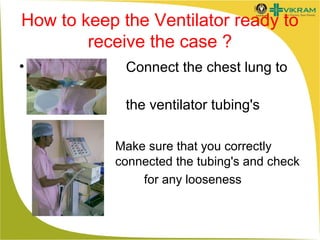
receive the case ?
•

Connect the chest lung to
the ventilator tubing's
Make sure that you correctly
connected the tubing's and check
for any looseness
How to keep the Ventilator
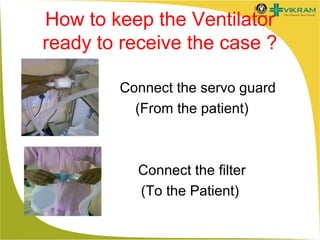
ready to receive the case ?
Connect the servo guard
(From the patient)

Connect the filter
(To the Patient)
How to keep the Ventilator
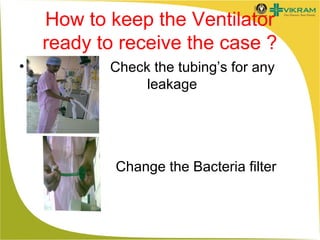
ready to receive the case ?
•

Check the tubing’s for any
leakage

»

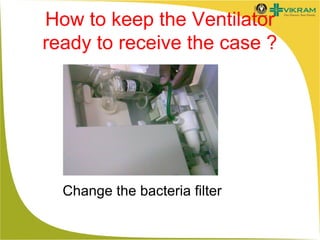
Change the Bacteria filter
How to keep the Ventilator
ready to receive the case ?

Change the bacteria filter
PLAN OF CARE FOR THE
VENTILATED PATIENT
Patient Goals:
• Patient will have effective breathing pattern.
• Patient will have adequate gas exchange.
• Patient’s nutritional status will be maintained to
meet body needs.
• Patient will not develop a pulmonary infection.
• Patient will not develop problems related to
immobility.
• Patient and/or family will indicate understanding
of the purpose for mechanical ventilation.
Nursing Interventions
• Observe changes in respiratory rate and
depth; observe for the use of accessory
muscles.
• Observe for tube misplacement- note and
post cm. Marking at lip/teeth after x-ray
confirmation
• Prevent accidental extubation by taping
tube securely, checking q.2h.;
restraining/sedating as needed.
Nursing Interventions
• Inspect thorax for symmetry of movement.
Determines adequacy of breathing
pattern; asymmetry may indicate
hemothorax or pneumothorax. . Measure
tidal volume and vital capacity.
• Asses for pain
• Monitor chest x-rays
• Maintain ventilator settings as ordered.
Nursing Interventions
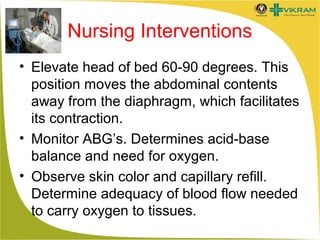
• Elevate head of bed 60-90 degrees. This
position moves the abdominal contents
away from the diaphragm, which facilitates
its contraction.
• Monitor ABG’s. Determines acid-base
balance and need for oxygen.
• Observe skin color and capillary refill.
Determine adequacy of blood flow needed
to carry oxygen to tissues.
Nursing Interventions
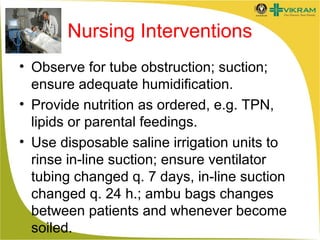
• Observe for tube obstruction; suction;
ensure adequate humidification.
• Provide nutrition as ordered, e.g. TPN,
lipids or parental feedings.
• Use disposable saline irrigation units to
rinse in-line suction; ensure ventilator
tubing changed q. 7 days, in-line suction
changed q. 24 h.; ambu bags changes
between patients and whenever become
soiled.
Nursing Interventions
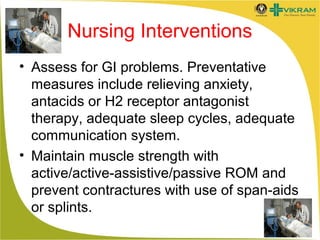
• Assess for GI problems. Preventative
measures include relieving anxiety,
antacids or H2 receptor antagonist
therapy, adequate sleep cycles, adequate
communication system.
• Maintain muscle strength with
active/active-assistive/passive ROM and
prevent contractures with use of span-aids
or splints.
Nursing Interventions
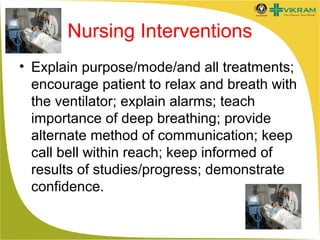
• Explain purpose/mode/and all treatments;
encourage patient to relax and breath with
the ventilator; explain alarms; teach
importance of deep breathing; provide
alternate method of communication; keep
call bell within reach; keep informed of
results of studies/progress; demonstrate
confidence.
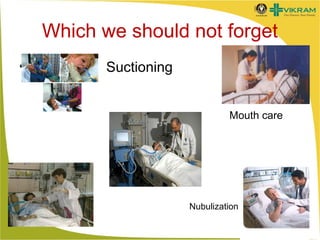
Which we should not forget
•

Suctioning
•
•
•

Mouth care

»

Nubulization
Thank You

(Save the life Safely)

Mechanical ventilation

  • 1.
  • 2.
    Contents  Anatomy andPhysiology Of Respiratory System  Introduction About Mechanical Ventilation  History  Meaning of Mechanical Ventilation  Indications for use  Types or Forms Of Mechanical Ventilation  Settings of Mechanical Ventilation  Modes of Mechanical Ventilation  Complications associated with Mechanical Ventilation  Nursing Management of ventilator patients
  • 3.
    Anatomy and PhysiologyOf Respiratory System
  • 4.
    Introduction About Mechanical Ventilation Mechanicalventilation is typically used after an invasive intubation, a procedure wherein an endotracheal or tracheostomy tube is inserted into the airway. It is used in acute settings such as in the ICU for a short period of time during a serious illness. It may be used at home or in a nursing or rehabilitation institution if patients have chronic illnesses that require long-term ventilation assistance.
  • 5.
    History The roman physicianGalen may have been the first to describe mechanical ventilation: "If you take a dead animal and blow air through its larynx [through a reed], you will fill its bronchi and watch its lungs attain the greatest distention.” Vesalius too describes ventilation by inserting a reed or cane into the trachea of animals. In 1908 George Poe demonstrated his mechanical respirator by asphyxiating dogs and seemingly bringing them back to life.
  • 6.
    Meaning of Mechanical Ventilation Inmedicine, mechanical ventilation is a method to mechanically assist or replace spontaneous breathing.
  • 7.
    Indications for use • • • • • • • • • Commonmedical indications for use include: Acute lung injury (including ARDS, trauma) Apnea with respiratory arrest, including cases from intoxication Chronic obstructive pulmonary disease (COPD) Acute respiratory acidosis with partial pressure of carbon dioxide (pCO2) > 50 mmHg and pH < 7.25, which may be due to paralysis of the diaphragm due to Guillain-Barré syndrome, Myasthenia Gravis, spinal cord injury, or the effect of anaesthetic and muscle relaxant drugs Increased work of breathing as evidenced by significant tachypnea, retractions, and other physical signs of respiratory distress Hypoxemia with arterial partial pressure of oxygen (PaO2) with supplemental fraction of inspired oxygen (FiO2) < 55 mm Hg Hypotension including sepsis, shock, congestive heart failure Neurological diseases such as Muscular Dystrophy Amyotrophic Lateral Sclerosis
  • 8.
    Types or FormsOf Mechanical Ventilation The two major types of Mechanical Ventilation are Negative pressure and positive Pressure ventilation The main form of mechanical ventilation is positive pressure ventilation, which works by increasing the pressure in the patient's airway and thus forcing air into the lungs. Less common today are negative pressure ventilators (for example, the "iron lung") that create a negative pressure environment around the patient's chest, thus sucking air into the lungs.
  • 9.
    Types or FormsOf Mechanical Ventilation Negative Pressure Ventilator Positive Pressure Ventilator
  • 10.
    Settings of Mechanical Ventilation •Mechanical Ventilator Settings regulates the rate, depth and other characteristics of ventilation. Settings are based on the patient’s status (ABGs, Body weight, level of consciousness and muscle strength)
  • 11.
    PARAMETERS OF MECHANICAL VENTILATIONARE  Respiratory Rate (f) :-Normally 10-20b/m  Tidal Volume (VT) :-5-15ml/kg  Oxygen Concentration(FIO2):-b/w 21-90% I:E Ratio:-1:2 Flow Rate:-40-100L/min Sensitivity/Trigger:- 0.5-1.5 cm H2O Pressure Limit:-10-25cm H2O  PEEP :- Usually, 5-10 cmH2O
  • 12.
    Connection to Ventilators •Face Mask • Airway • Laryngeal Mask • Tracheal Intubation • Tracheostomy
  • 13.
    Modes of Mechanical Ventilation •Controlled Mandatory Ventilation (CMV) • Asst-Control Mandatory Ventilation (ACV) • Synchronized Intermittent Mandatory Ventilation(SIMV) • Positive Expiratory End Pressure(PEEP) • Continuous Positive Airway Pressure (CPAP) • Pressure Support Ventilation (PSV)
  • 14.
  • 15.
    Controlled Mandatory Ventilation (CMV) •Controlled Mechanical Ventilation (CMV). In this mode the ventilator provides a mechanical breath on a preset timing. Patient respiratory efforts are ignored. This is generally uncomfortable for children and adults who are conscious and is usually only used in an unconscious patient. It may also be used in infants who often quickly adapt their breathing pattern to the ventilator timing
  • 16.
    Asst-Control Mandatory Ventilation (ACV) • AssistControl (AC). In this mode the ventilator provides a mechanical breath with either a pre-set tidal volume or peak pressure every time the patient initiates a breath. Traditional assistcontrol used only a pre-set tidal volume--when a preset peak pressure is used this is also sometimes termed Intermittent Positive Pressure Ventilation or IPPV. However, the initiation timing is the same--both provide a ventilator breath with every patient effort. In most ventilators a back-up minimum breath rate can be set in the event that the patient becomes apnoeic. Although a maximum rate is not usually set, an alarm can be set if the ventilator cycles too frequently. This can alert that the patient is tachypneic or that the ventilator may be auto-cycling (a problem that results when the ventilator interprets fluctuations in the circuit due to the last breath termination as a new breath initiation attempt)
  • 17.
    Synchronized Intermittent Mandatory Ventilation(SIMV) • SynchronizedIntermittent Mandatory Ventilation (SIMV). In this mode the ventilator provides a pre-set mechanical breath (pressure or volume limited) every specified number of seconds (determined by dividing the respiratory rate into 60 - thus a respiratory rate of 12 results in a 5 second cycle time). Within that cycle time the ventilator waits for the patient to initiate a breath using either a pressure or flow sensor. When the ventilator senses the first patient breathing attempt within the cycle, it delivers the preset ventilator breath. If the patient fails to initiate a breath, the ventilator delivers a mechanical breath at the end of the breath cycle. Additional spontaneous breaths after the first one within the breath cycle do not trigger another SIMV breath. However, SIMV may be combined with pressure support (see below). SIMV is frequently employed as a method of decreasing ventilatory support (weaning) by turning down the rate, which requires the patient to take additional breaths beyond the SIMV triggered breath.
  • 18.
    . Positive End Expiratory Pressure(PEEP) •PEEP) is functionally the same as CPAP, but refers to the use of an elevated pressure during the expiratory phase of the ventilatory cycle. After delivery of the set amount of breath by the ventilator, the patient then exhales passively. The volume of gas remaining in the lung after a normal expiration is termed the functional residual capacity (FRC). The FRC is primarily determined by the elastic qualities of the lung and the chest wall. In many lung diseases, the FRC is reduced due to collapse of the unstable alveoli, leading to a decreased surface area for gas exchange and intrapulmonary shunting (see above), with wasted oxygen inspired. Adding PEEP can reduce the work of breathing (at low levels) and help preserve FRC.
  • 19.
    Continuous Positive Airway Pressure(CPAP) • (CPAP). A continuous level of elevated pressure is provided through the patient circuit to maintain adequate oxygenation, decrease the work of breathing, and decrease the work of the heart (such as in left-sided heart failure — CHF). Note that no cycling of ventilator pressures occurs and the patient must initiate all breaths. In addition, no additional pressure above the CPAP pressure is provided during those breaths. CPAP may be used invasively through an endotracheal tube or tracheostomy or noninvasively with a face mask or nasal prongs.
  • 20.
    Pressure Support Ventilation •Pressure Support Ventilation (PSV). When a patient attempts to breath spontaneously through an endotracheal tube, the narrowed diameter of the airway results in higher resistance to airflow, and thus a higher work of breathing. PSV was developed as a method to decrease the work of breathing in-between ventilator mandated breaths by providing an elevated pressure triggered by spontaneous breathing that "supports" ventilation during inspiration
  • 21.
    Complication • • • • • • • • • • Hypotension Pneumothorax Decreased Cardiac Output NosocomialPneumonia Positive Water Balance Increased Intracranial Pressure (ICP) Alarms turned off or nonfunctional Sinusitis and nasal injury Mucosal lesions Aspiration, GI bleeding, Inappropriate ventilation (respiratory acidosis or alkalosis, Thick secretions, Patient discomfort due to pulling or jarring of ETT or tracheostomy, High PaO2, Low PaO2, Anxiety and fear, Dysrhythmias or vagal reactions during or after suctioning, Incorrect PEEP setting, Inability to tolerate ventilator mode.
  • 22.
    Terminologies Used in MechanicalVentilation • APRV Airway pressure release ventilation • ASB Assisted spontaneous breathing—also ASV = assisted spontaneous ventilation • ASV Adaptive support ventilation—a patented technology— closed-loop mechanical respiration, a further development of MMV. Can also stand for assisted spontaneous ventilation. • ATC Automatic tube compensation • BIPAP Biphasic positive airway pressure • CMV Continuous mandatory ventilation • CPAP Continuous positive airway pressure • CPPV Continuous positive pressure ventilation • EPAP Expiratory positive airway pressure
  • 23.
    Conti……. • HFV High frequencyventilation – – – – • • • • • • • HFFI High frequency flow interruption HFJV High frequency jet ventilation HFOV High frequency oscillatory ventilation HFPPV High frequency positive pressure ventilation ILV Independent lung ventilation—separate sides positive pressure ventilation. IPAP Inspiratory positive airway pressure IPPV Intermittent positive pressure ventilation IRV Inversed ratio ventilation— mechanical ventilation with switched respiration phases/time rate. LFPPV Low frequency positive pressure ventilation MMV Mandatory minute volume NAVA Neurally adjusted ventilatory assist
  • 24.
    Nursing Management How tokeep the Ventilator ready to receive the case ? Check the Air and oxygen connections Connect the Ventilator tubes to ventilator
  • 25.
    How to keepthe Ventilator ready to receive the case ? • Connect the chest lung to the ventilator tubing's Make sure that you correctly connected the tubing's and check for any looseness
  • 26.
    How to keepthe Ventilator ready to receive the case ? Connect the servo guard (From the patient) Connect the filter (To the Patient)
  • 27.
    How to keepthe Ventilator ready to receive the case ? • Check the tubing’s for any leakage » Change the Bacteria filter
  • 28.
    How to keepthe Ventilator ready to receive the case ? Change the bacteria filter
  • 29.
    PLAN OF CAREFOR THE VENTILATED PATIENT Patient Goals: • Patient will have effective breathing pattern. • Patient will have adequate gas exchange. • Patient’s nutritional status will be maintained to meet body needs. • Patient will not develop a pulmonary infection. • Patient will not develop problems related to immobility. • Patient and/or family will indicate understanding of the purpose for mechanical ventilation.
  • 30.
    Nursing Interventions • Observechanges in respiratory rate and depth; observe for the use of accessory muscles. • Observe for tube misplacement- note and post cm. Marking at lip/teeth after x-ray confirmation • Prevent accidental extubation by taping tube securely, checking q.2h.; restraining/sedating as needed.
  • 31.
    Nursing Interventions • Inspectthorax for symmetry of movement. Determines adequacy of breathing pattern; asymmetry may indicate hemothorax or pneumothorax. . Measure tidal volume and vital capacity. • Asses for pain • Monitor chest x-rays • Maintain ventilator settings as ordered.
  • 32.
    Nursing Interventions • Elevatehead of bed 60-90 degrees. This position moves the abdominal contents away from the diaphragm, which facilitates its contraction. • Monitor ABG’s. Determines acid-base balance and need for oxygen. • Observe skin color and capillary refill. Determine adequacy of blood flow needed to carry oxygen to tissues.
  • 33.
    Nursing Interventions • Observefor tube obstruction; suction; ensure adequate humidification. • Provide nutrition as ordered, e.g. TPN, lipids or parental feedings. • Use disposable saline irrigation units to rinse in-line suction; ensure ventilator tubing changed q. 7 days, in-line suction changed q. 24 h.; ambu bags changes between patients and whenever become soiled.
  • 34.
    Nursing Interventions • Assessfor GI problems. Preventative measures include relieving anxiety, antacids or H2 receptor antagonist therapy, adequate sleep cycles, adequate communication system. • Maintain muscle strength with active/active-assistive/passive ROM and prevent contractures with use of span-aids or splints.
  • 35.
    Nursing Interventions • Explainpurpose/mode/and all treatments; encourage patient to relax and breath with the ventilator; explain alarms; teach importance of deep breathing; provide alternate method of communication; keep call bell within reach; keep informed of results of studies/progress; demonstrate confidence.
  • 36.
    Which we shouldnot forget • Suctioning • • • Mouth care » Nubulization
  • 37.
    Thank You (Save thelife Safely)