ADVANCED MODES OF
MECHANICAL VENTILATION
Mazen Kherallah, MD, FCCP
POINTS OF DISCUSSION
 Triggered Modes of Ventilation
 Volume Support (VS)
 Proportional Assist Ventilation (PAV or PPS)
 Hybrid Modes of Ventilation
 Volume Assured Pressure Support
 Pressure Regulated Volume Control (PRVC)
 Auto mode: VS and PRVC
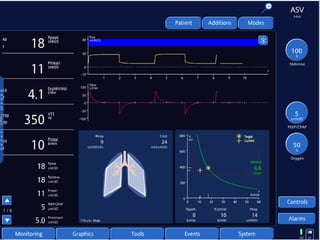
 Adaptive Support Ventilation: ASV
 Bi-level Ventilation (APRV and Bi-vent)
 Mandatory Minute Ventilation (MMV)
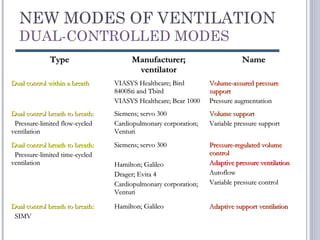
NEW MODES OF VENTILATION
DUAL-CONTROLLED MODES
TypeType Manufacturer;Manufacturer;
ventilatorventilator
NameName
Dual control within a breathDual control within a breath VIASYS Healthcare; BirdVIASYS Healthcare; Bird
8400Sti and Tbird8400Sti and Tbird
VIASYS Healthcare; Bear 1000VIASYS Healthcare; Bear 1000
Volume-assured pressureVolume-assured pressure
supportsupport
Pressure augmentationPressure augmentation
Dual control breath to breath:Dual control breath to breath:
Pressure-limited flow-cycledPressure-limited flow-cycled
ventilationventilation
Siemens; servo 300Siemens; servo 300
Cardiopulmonary corporation;Cardiopulmonary corporation;
VenturiVenturi
Volume supportVolume support
Variable pressure supportVariable pressure support
Dual control breath to breath:Dual control breath to breath:
Pressure-limited time-cycledPressure-limited time-cycled
ventilationventilation
Siemens; servo 300Siemens; servo 300
Hamilton; GalileoHamilton; Galileo
Drager; Evita 4Drager; Evita 4
Cardiopulmonary corporation;Cardiopulmonary corporation;
VenturiVenturi
Pressure-regulated volumePressure-regulated volume
controlcontrol
Adaptive pressure ventilationAdaptive pressure ventilation
AutoflowAutoflow
Variable pressure controlVariable pressure control
Dual control breath to breath:Dual control breath to breath:
SIMVSIMV
Hamilton; GalileoHamilton; Galileo Adaptive support ventilationAdaptive support ventilation
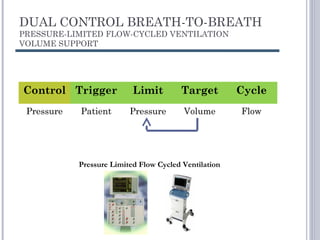
DUAL CONTROL BREATH-TO-BREATH
PRESSURE-LIMITED FLOW-CYCLED VENTILATION
VOLUME SUPPORT
Control Trigger Limit Target Cycle
Pressure Patient Pressure Volume Flow
Pressure Limited Flow Cycled Ventilation
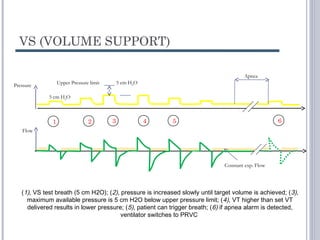
VS (VOLUME SUPPORT)
(1), VS test breath (5 cm H2O); (2), pressure is increased slowly until target volume is achieved; (3),
maximum available pressure is 5 cm H2O below upper pressure limit; (4), VT higher than set VT
delivered results in lower pressure; (5), patient can trigger breath; (6) if apnea alarm is detected,
ventilator switches to PRVC
1 2 3 4 5 6
Pressure
Upper Pressure limit
5 cm H2O
Flow
Apnea
5 cm H2O
Constant exp. Flow
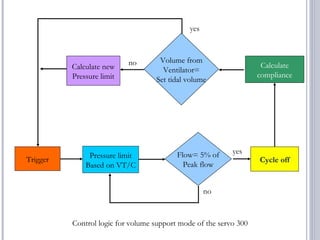
Volume from
Ventilator=
Set tidal volume
Pressure limit
Based on VT/C
Cycle off
Calculate
compliance
Calculate new
Pressure limit
no
yes
yes
no
Control logic for volume support mode of the servo 300
Trigger
Flow= 5% of
Peak flow
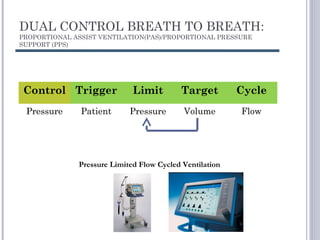
DUAL CONTROL BREATH TO BREATH:
PROPORTIONAL ASSIST VENTILATION(PAS)/PROPORTIONAL PRESSURE
SUPPORT (PPS)
Control Trigger Limit Target Cycle
Pressure Patient Pressure Volume Flow
Pressure Limited Flow Cycled Ventilation
PROPORTIONAL ASSIST
VENTILATION (PAV)
Pressure
Flow
Time
Time
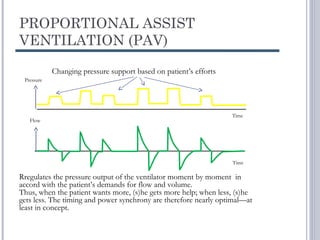
Rregulates the pressure output of the ventilator moment by moment in
accord with the patient’s demands for flow and volume.
Thus, when the patient wants more, (s)he gets more help; when less, (s)he
gets less. The timing and power synchrony are therefore nearly optimal—at
least in concept.
Changing pressure support based on patient’s efforts
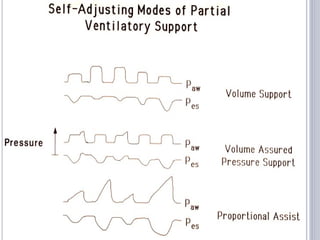
PROPORTIONAL ASSIST
AMPLIFIES MUSCULAR EFFORT
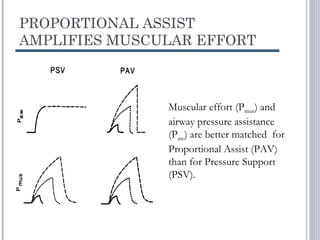
Muscular effort (Pmus) and
airway pressure assistance
(Paw) are better matched for
Proportional Assist (PAV)
than for Pressure Support
(PSV).
PAV (PROPORTIONAL ASSIST
VENTILATION)
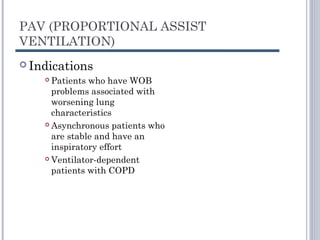
 Indications
 Patients who have WOB
problems associated with
worsening lung
characteristics
 Asynchronous patients who
are stable and have an
inspiratory effort
 Ventilator-dependent
patients with COPD
PAV (PROPORTIONAL ASSIST
VENTILATION)
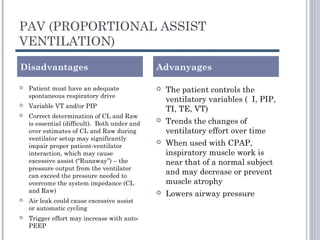
 Patient must have an adequate
spontaneous respiratory drive
 Variable VT and/or PIP
 Correct determination of CL and Raw
is essential (difficult). Both under and
over estimates of CL and Raw during
ventilator setup may significantly
impair proper patient-ventilator
interaction, which may cause
excessive assist (“Runaway”) – the
pressure output from the ventilator
can exceed the pressure needed to
overcome the system impedance (CL
and Raw)
 Air leak could cause excessive assist
or automatic cycling
 Trigger effort may increase with auto-
PEEP
 The patient controls the
ventilatory variables ( I, PIP,
TI, TE, VT)
 Trends the changes of
ventilatory effort over time
 When used with CPAP,
inspiratory muscle work is
near that of a normal subject
and may decrease or prevent
muscle atrophy
 Lowers airway pressure
Disadvantages Advanyages
DUAL CONTROL WITHIN A
BREATH
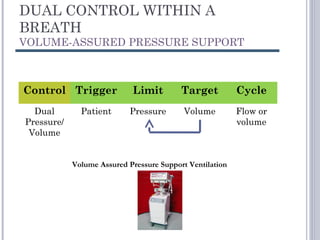
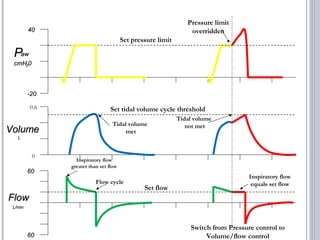
VOLUME-ASSURED PRESSURE SUPPORT
Control Trigger Limit Target Cycle
Dual
Pressure/
Volume
Patient Pressure Volume Flow or
volume
Volume Assured Pressure Support Ventilation
PPawaw
cmHcmH2200
6060
-20-20
6060
FlowFlow
L/minL/min
VolumeVolume
Set flow
Set tidal volume cycle threshold
Set pressure limit
Tidal volume
met
Tidal volume
not met
Switch from Pressure control to
Volume/flow control
Inspiratory flow
greater than set flow
Flow cycle
Inspiratory flow
equals set flow
Pressure limit
overridden
LL
0
0.6
4040
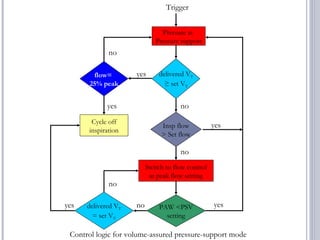
Pressure at
Pressure support
delivered VT
≥ set VT
flow=
25% peak
Cycle off
inspiration
Insp flow
> Set flow
PAW <PSV
setting
delivered VT
= set VT
Switch to flow control
at peak flow setting
Trigger
yes
no
no
no
no
no
yes
yes
yes
Control logic for volume-assured pressure-support mode
yes
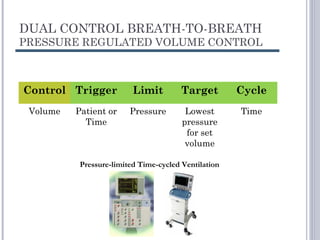
DUAL CONTROL BREATH-TO-BREATH
PRESSURE REGULATED VOLUME CONTROL
Control Trigger Limit Target Cycle
Volume Patient or
Time
Pressure Lowest
pressure
for set
volume
Time
Pressure-limited Time-cycled Ventilation
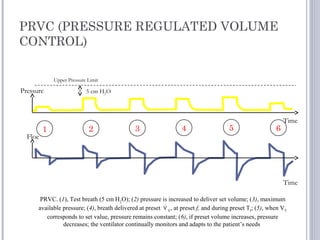
PRVC (PRESSURE REGULATED VOLUME
CONTROL)
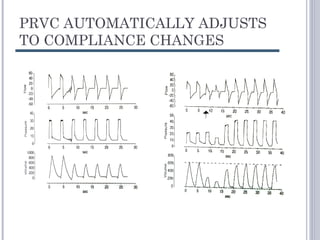
PRVC. (1), Test breath (5 cm H2
O); (2) pressure is increased to deliver set volume; (3), maximum
available pressure; (4), breath delivered at preset E
, at preset f, and during preset TI
; (5), when VT
corresponds to set value, pressure remains constant; (6), if preset volume increases, pressure
decreases; the ventilator continually monitors and adapts to the patient’s needs
1 2 3 4 5 6
Upper Pressure Limit
5 cm H2OPressure
Floe
Time
Time
PRVC AUTOMATICALLY ADJUSTS
TO COMPLIANCE CHANGES
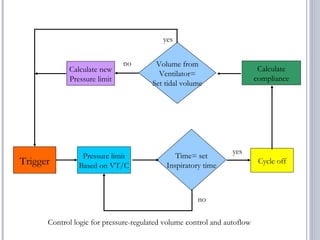
Volume from
Ventilator=
Set tidal volume
Time= set
Inspiratory time
Pressure limit
Based on VT/CTrigger Cycle off
Calculate
compliance
Calculate new
Pressure limit
no
yes
yes
no
Control logic for pressure-regulated volume control and autoflow
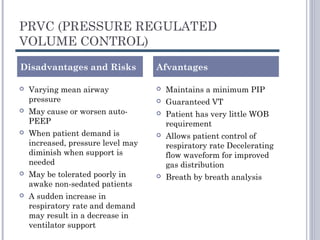
PRVC (PRESSURE REGULATED
VOLUME CONTROL)
 Varying mean airway
pressure
 May cause or worsen auto-
PEEP
 When patient demand is
increased, pressure level may
diminish when support is
needed
 May be tolerated poorly in
awake non-sedated patients
 A sudden increase in
respiratory rate and demand
may result in a decrease in
ventilator support
 Maintains a minimum PIP
 Guaranteed VT
 Patient has very little WOB
requirement
 Allows patient control of
respiratory rate Decelerating
flow waveform for improved
gas distribution
 Breath by breath analysis
Disadvantages and Risks Afvantages
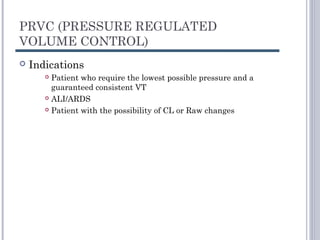
PRVC (PRESSURE REGULATED
VOLUME CONTROL)
 Indications
 Patient who require the lowest possible pressure and a
guaranteed consistent VT
 ALI/ARDS
 Patient with the possibility of CL or Raw changes
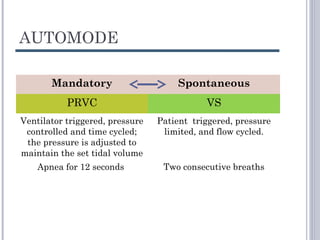
AUTOMODE
Mandatory Spontaneous
PRVC VS
Ventilator triggered, pressure
controlled and time cycled;
the pressure is adjusted to
maintain the set tidal volume
Patient triggered, pressure
limited, and flow cycled.
Apnea for 12 seconds Two consecutive breaths
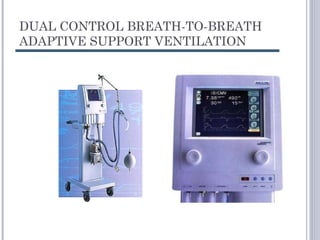
DUAL CONTROL BREATH-TO-BREATH
ADAPTIVE SUPPORT VENTILATION
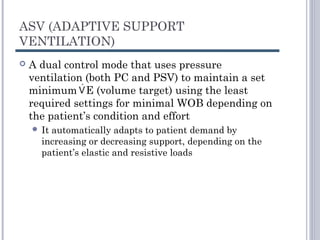
ASV (ADAPTIVE SUPPORT
VENTILATION)
 A dual control mode that uses pressure
ventilation (both PC and PSV) to maintain a set
minimum E (volume target) using the least
required settings for minimal WOB depending on
the patient’s condition and effort
 It automatically adapts to patient demand by
increasing or decreasing support, depending on the
patient’s elastic and resistive loads
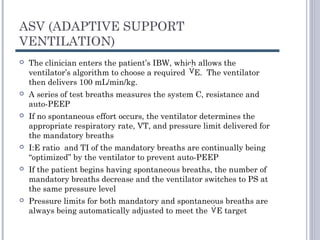
ASV (ADAPTIVE SUPPORT
VENTILATION)
 The clinician enters the patient’s IBW, which allows the
ventilator’s algorithm to choose a required E. The ventilator
then delivers 100 mL/min/kg.
 A series of test breaths measures the system C, resistance and
auto-PEEP
 If no spontaneous effort occurs, the ventilator determines the
appropriate respiratory rate, VT, and pressure limit delivered for
the mandatory breaths
 I:E ratio and TI of the mandatory breaths are continually being
“optimized” by the ventilator to prevent auto-PEEP
 If the patient begins having spontaneous breaths, the number of
mandatory breaths decrease and the ventilator switches to PS at
the same pressure level
 Pressure limits for both mandatory and spontaneous breaths are
always being automatically adjusted to meet the E target
ASV (ADAPTIVE SUPPORT
VENTILATION)
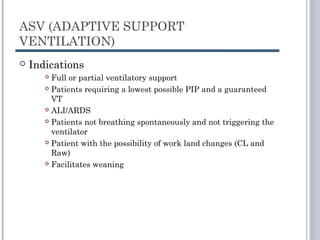
 Indications
 Full or partial ventilatory support
 Patients requiring a lowest possible PIP and a guaranteed
VT
 ALI/ARDS
 Patients not breathing spontaneously and not triggering the
ventilator
 Patient with the possibility of work land changes (CL and
Raw)
 Facilitates weaning
ASV (ADAPTIVE SUPPORT
VENTILATION)
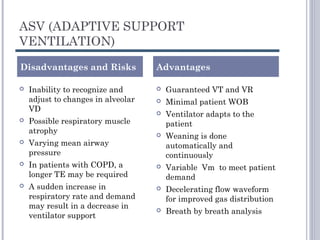
 Inability to recognize and
adjust to changes in alveolar
VD
 Possible respiratory muscle
atrophy
 Varying mean airway
pressure
 In patients with COPD, a
longer TE may be required
 A sudden increase in
respiratory rate and demand
may result in a decrease in
ventilator support
 Guaranteed VT and VR
 Minimal patient WOB
 Ventilator adapts to the
patient
 Weaning is done
automatically and
continuously
 Variable Vm to meet patient
demand
 Decelerating flow waveform
for improved gas distribution
 Breath by breath analysis
Disadvantages and Risks Advantages
MMV (MANDATORY MINUTE
VENTILATION)
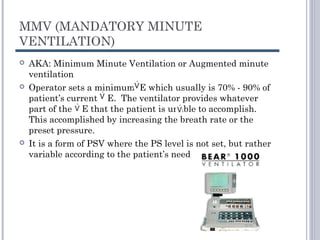
 AKA: Minimum Minute Ventilation or Augmented minute
ventilation
 Operator sets a minimum E which usually is 70% - 90% of
patient’s current E. The ventilator provides whatever
part of the E that the patient is unable to accomplish.
This accomplished by increasing the breath rate or the
preset pressure.
 It is a form of PSV where the PS level is not set, but rather
variable according to the patient’s need
MMV (MANDATORY MINUTE
VENTILATION)
 Indications
 Any patient who is spontaneously and is deemed ready to
wean
 Patients with unstable ventilatory drive
MMV (MANDATORY MINUTE
VENTILATION)
 An adequate E may not equal
sufficient A (e.g., rapid shallow
breathing)
 The high rate alarm must be set
low enough to alert clinician of
rapid shallow breathing
 Variable mean airway pressure
 An inadequate set E
(>spontaneous E) can lead to
inadequate support and patient
fatigue
 An excessive set E
(>spontaneous E) with no
spontaneous breathing can lead
to total support
 Full to partial ventilatory
support
 Allows spontaneous
ventilation with safety net
 Patient’s E remains stable
 Prevents hypoventilation
Disadvantages Advantages
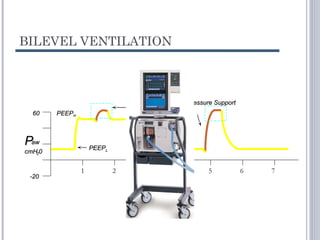
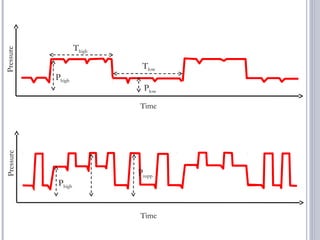
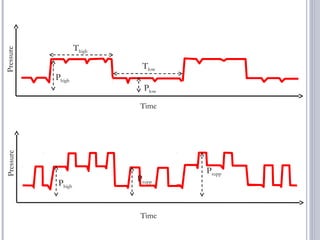
BILEVEL VENTILATION
PEEPPEEPHH
PEEPPEEPLL
Pressure SupportPressure Support
PEEPPEEPHighHigh + PS+ PS
PPawaw
cmHcmH2200
6060
-20-20
1 2 3 4 5 6 7
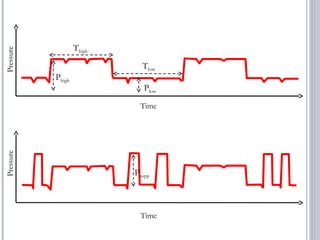
Thigh
Tlow
Plow
Phigh
Time
Time
PressurePressure
Psupp
Thigh
Tlow
Plow
Phigh
Time
Time
PressurePressure
Phigh
Psupp
Thigh
Tlow
Plow
Phigh
Time
Time
PressurePressure
Phigh
Psupp
Psupp
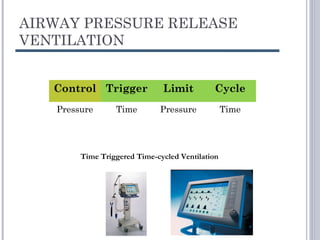
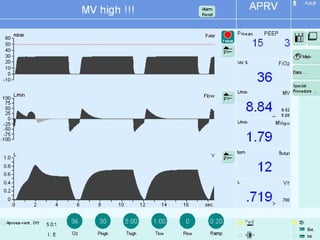
AIRWAY PRESSURE RELEASE
VENTILATION
Control Trigger Limit Cycle
Pressure Time Pressure Time
Time Triggered Time-cycled Ventilation
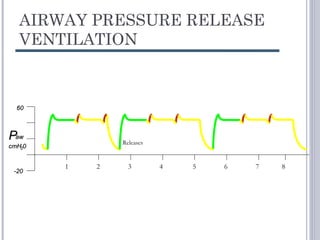
AIRWAY PRESSURE RELEASE
VENTILATION
PPawaw
cmHcmH2200
6060
-20-20
1 2 3 4 5 6 7 8
Spontaneous Breaths
Releases
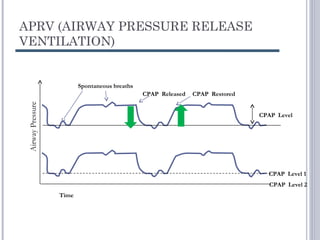
APRV (AIRWAY PRESSURE RELEASE
VENTILATION)
Spontaneous breaths
CPAP Level
CPAP Level 2
CPAP Level 1
CPAP Released CPAP Restored
Time
AirwayPressure
APRV (AIRWAY PRESSURE
RELEASE VENTILATION)
 Indications
 Partial to full ventilatory support
 Patients with ALI/ARDS
 Patients with refractory hypoxemia
due to collapsed alveoli
 Patients with massive atelectasis
 May use with mild or no lung disease
APRV (AIRWAY PRESSURE RELEASE
VENTILATION)
 Variable VT
 Could be harmful to patients
with high expiratory
resistance (i.e., COPD or
asthma)
 Auto-PEEP is usually present
 Caution should be used with
hemodynamically unstable
patients
 Asynchrony can occur is
spontaneous breaths are out
of sync with release time
 Requires the presence of an
“active exhalation valve”
 Allows inverse ratio ventilation
(IRV) with or without
spontaneous breathing (less need
for sedation or paralysis)
 Improves patient-ventilator
synchrony if spontaneous
breathing is present
 Improves mean airway pressure
 Improves oxygenation by
stabilizing collapsed alveoli
 Allows patients to breath
spontaneously while continuing
lung recruitment
 Lowers PIP
 May decrease physiologic
deadspace
Disadvantages and Risks Advantages
QUESTIONS

Advanced ventilatory modes

  • 1.
    ADVANCED MODES OF MECHANICALVENTILATION Mazen Kherallah, MD, FCCP
  • 2.
    POINTS OF DISCUSSION Triggered Modes of Ventilation  Volume Support (VS)  Proportional Assist Ventilation (PAV or PPS)  Hybrid Modes of Ventilation  Volume Assured Pressure Support  Pressure Regulated Volume Control (PRVC)  Auto mode: VS and PRVC  Adaptive Support Ventilation: ASV  Bi-level Ventilation (APRV and Bi-vent)  Mandatory Minute Ventilation (MMV)
  • 3.
    NEW MODES OFVENTILATION DUAL-CONTROLLED MODES TypeType Manufacturer;Manufacturer; ventilatorventilator NameName Dual control within a breathDual control within a breath VIASYS Healthcare; BirdVIASYS Healthcare; Bird 8400Sti and Tbird8400Sti and Tbird VIASYS Healthcare; Bear 1000VIASYS Healthcare; Bear 1000 Volume-assured pressureVolume-assured pressure supportsupport Pressure augmentationPressure augmentation Dual control breath to breath:Dual control breath to breath: Pressure-limited flow-cycledPressure-limited flow-cycled ventilationventilation Siemens; servo 300Siemens; servo 300 Cardiopulmonary corporation;Cardiopulmonary corporation; VenturiVenturi Volume supportVolume support Variable pressure supportVariable pressure support Dual control breath to breath:Dual control breath to breath: Pressure-limited time-cycledPressure-limited time-cycled ventilationventilation Siemens; servo 300Siemens; servo 300 Hamilton; GalileoHamilton; Galileo Drager; Evita 4Drager; Evita 4 Cardiopulmonary corporation;Cardiopulmonary corporation; VenturiVenturi Pressure-regulated volumePressure-regulated volume controlcontrol Adaptive pressure ventilationAdaptive pressure ventilation AutoflowAutoflow Variable pressure controlVariable pressure control Dual control breath to breath:Dual control breath to breath: SIMVSIMV Hamilton; GalileoHamilton; Galileo Adaptive support ventilationAdaptive support ventilation
  • 4.
    DUAL CONTROL BREATH-TO-BREATH PRESSURE-LIMITEDFLOW-CYCLED VENTILATION VOLUME SUPPORT Control Trigger Limit Target Cycle Pressure Patient Pressure Volume Flow Pressure Limited Flow Cycled Ventilation
  • 5.
    VS (VOLUME SUPPORT) (1),VS test breath (5 cm H2O); (2), pressure is increased slowly until target volume is achieved; (3), maximum available pressure is 5 cm H2O below upper pressure limit; (4), VT higher than set VT delivered results in lower pressure; (5), patient can trigger breath; (6) if apnea alarm is detected, ventilator switches to PRVC 1 2 3 4 5 6 Pressure Upper Pressure limit 5 cm H2O Flow Apnea 5 cm H2O Constant exp. Flow
  • 6.
    Volume from Ventilator= Set tidalvolume Pressure limit Based on VT/C Cycle off Calculate compliance Calculate new Pressure limit no yes yes no Control logic for volume support mode of the servo 300 Trigger Flow= 5% of Peak flow
  • 7.
    DUAL CONTROL BREATHTO BREATH: PROPORTIONAL ASSIST VENTILATION(PAS)/PROPORTIONAL PRESSURE SUPPORT (PPS) Control Trigger Limit Target Cycle Pressure Patient Pressure Volume Flow Pressure Limited Flow Cycled Ventilation
  • 8.
    PROPORTIONAL ASSIST VENTILATION (PAV) Pressure Flow Time Time Rregulatesthe pressure output of the ventilator moment by moment in accord with the patient’s demands for flow and volume. Thus, when the patient wants more, (s)he gets more help; when less, (s)he gets less. The timing and power synchrony are therefore nearly optimal—at least in concept. Changing pressure support based on patient’s efforts
  • 9.
    PROPORTIONAL ASSIST AMPLIFIES MUSCULAREFFORT Muscular effort (Pmus) and airway pressure assistance (Paw) are better matched for Proportional Assist (PAV) than for Pressure Support (PSV).
  • 11.
    PAV (PROPORTIONAL ASSIST VENTILATION) Indications  Patients who have WOB problems associated with worsening lung characteristics  Asynchronous patients who are stable and have an inspiratory effort  Ventilator-dependent patients with COPD
  • 12.
    PAV (PROPORTIONAL ASSIST VENTILATION) Patient must have an adequate spontaneous respiratory drive  Variable VT and/or PIP  Correct determination of CL and Raw is essential (difficult). Both under and over estimates of CL and Raw during ventilator setup may significantly impair proper patient-ventilator interaction, which may cause excessive assist (“Runaway”) – the pressure output from the ventilator can exceed the pressure needed to overcome the system impedance (CL and Raw)  Air leak could cause excessive assist or automatic cycling  Trigger effort may increase with auto- PEEP  The patient controls the ventilatory variables ( I, PIP, TI, TE, VT)  Trends the changes of ventilatory effort over time  When used with CPAP, inspiratory muscle work is near that of a normal subject and may decrease or prevent muscle atrophy  Lowers airway pressure Disadvantages Advanyages
  • 13.
    DUAL CONTROL WITHINA BREATH VOLUME-ASSURED PRESSURE SUPPORT Control Trigger Limit Target Cycle Dual Pressure/ Volume Patient Pressure Volume Flow or volume Volume Assured Pressure Support Ventilation
  • 14.
    PPawaw cmHcmH2200 6060 -20-20 6060 FlowFlow L/minL/min VolumeVolume Set flow Set tidalvolume cycle threshold Set pressure limit Tidal volume met Tidal volume not met Switch from Pressure control to Volume/flow control Inspiratory flow greater than set flow Flow cycle Inspiratory flow equals set flow Pressure limit overridden LL 0 0.6 4040
  • 15.
    Pressure at Pressure support deliveredVT ≥ set VT flow= 25% peak Cycle off inspiration Insp flow > Set flow PAW <PSV setting delivered VT = set VT Switch to flow control at peak flow setting Trigger yes no no no no no yes yes yes Control logic for volume-assured pressure-support mode yes
  • 16.
    DUAL CONTROL BREATH-TO-BREATH PRESSUREREGULATED VOLUME CONTROL Control Trigger Limit Target Cycle Volume Patient or Time Pressure Lowest pressure for set volume Time Pressure-limited Time-cycled Ventilation
  • 17.
    PRVC (PRESSURE REGULATEDVOLUME CONTROL) PRVC. (1), Test breath (5 cm H2 O); (2) pressure is increased to deliver set volume; (3), maximum available pressure; (4), breath delivered at preset E , at preset f, and during preset TI ; (5), when VT corresponds to set value, pressure remains constant; (6), if preset volume increases, pressure decreases; the ventilator continually monitors and adapts to the patient’s needs 1 2 3 4 5 6 Upper Pressure Limit 5 cm H2OPressure Floe Time Time
  • 18.
  • 19.
    Volume from Ventilator= Set tidalvolume Time= set Inspiratory time Pressure limit Based on VT/CTrigger Cycle off Calculate compliance Calculate new Pressure limit no yes yes no Control logic for pressure-regulated volume control and autoflow
  • 20.
    PRVC (PRESSURE REGULATED VOLUMECONTROL)  Varying mean airway pressure  May cause or worsen auto- PEEP  When patient demand is increased, pressure level may diminish when support is needed  May be tolerated poorly in awake non-sedated patients  A sudden increase in respiratory rate and demand may result in a decrease in ventilator support  Maintains a minimum PIP  Guaranteed VT  Patient has very little WOB requirement  Allows patient control of respiratory rate Decelerating flow waveform for improved gas distribution  Breath by breath analysis Disadvantages and Risks Afvantages
  • 21.
    PRVC (PRESSURE REGULATED VOLUMECONTROL)  Indications  Patient who require the lowest possible pressure and a guaranteed consistent VT  ALI/ARDS  Patient with the possibility of CL or Raw changes
  • 22.
    AUTOMODE Mandatory Spontaneous PRVC VS Ventilatortriggered, pressure controlled and time cycled; the pressure is adjusted to maintain the set tidal volume Patient triggered, pressure limited, and flow cycled. Apnea for 12 seconds Two consecutive breaths
  • 23.
  • 24.
    ASV (ADAPTIVE SUPPORT VENTILATION) A dual control mode that uses pressure ventilation (both PC and PSV) to maintain a set minimum E (volume target) using the least required settings for minimal WOB depending on the patient’s condition and effort  It automatically adapts to patient demand by increasing or decreasing support, depending on the patient’s elastic and resistive loads
  • 25.
    ASV (ADAPTIVE SUPPORT VENTILATION) The clinician enters the patient’s IBW, which allows the ventilator’s algorithm to choose a required E. The ventilator then delivers 100 mL/min/kg.  A series of test breaths measures the system C, resistance and auto-PEEP  If no spontaneous effort occurs, the ventilator determines the appropriate respiratory rate, VT, and pressure limit delivered for the mandatory breaths  I:E ratio and TI of the mandatory breaths are continually being “optimized” by the ventilator to prevent auto-PEEP  If the patient begins having spontaneous breaths, the number of mandatory breaths decrease and the ventilator switches to PS at the same pressure level  Pressure limits for both mandatory and spontaneous breaths are always being automatically adjusted to meet the E target
  • 27.
    ASV (ADAPTIVE SUPPORT VENTILATION) Indications  Full or partial ventilatory support  Patients requiring a lowest possible PIP and a guaranteed VT  ALI/ARDS  Patients not breathing spontaneously and not triggering the ventilator  Patient with the possibility of work land changes (CL and Raw)  Facilitates weaning
  • 28.
    ASV (ADAPTIVE SUPPORT VENTILATION) Inability to recognize and adjust to changes in alveolar VD  Possible respiratory muscle atrophy  Varying mean airway pressure  In patients with COPD, a longer TE may be required  A sudden increase in respiratory rate and demand may result in a decrease in ventilator support  Guaranteed VT and VR  Minimal patient WOB  Ventilator adapts to the patient  Weaning is done automatically and continuously  Variable Vm to meet patient demand  Decelerating flow waveform for improved gas distribution  Breath by breath analysis Disadvantages and Risks Advantages
  • 29.
    MMV (MANDATORY MINUTE VENTILATION) AKA: Minimum Minute Ventilation or Augmented minute ventilation  Operator sets a minimum E which usually is 70% - 90% of patient’s current E. The ventilator provides whatever part of the E that the patient is unable to accomplish. This accomplished by increasing the breath rate or the preset pressure.  It is a form of PSV where the PS level is not set, but rather variable according to the patient’s need
  • 30.
    MMV (MANDATORY MINUTE VENTILATION) Indications  Any patient who is spontaneously and is deemed ready to wean  Patients with unstable ventilatory drive
  • 31.
    MMV (MANDATORY MINUTE VENTILATION) An adequate E may not equal sufficient A (e.g., rapid shallow breathing)  The high rate alarm must be set low enough to alert clinician of rapid shallow breathing  Variable mean airway pressure  An inadequate set E (>spontaneous E) can lead to inadequate support and patient fatigue  An excessive set E (>spontaneous E) with no spontaneous breathing can lead to total support  Full to partial ventilatory support  Allows spontaneous ventilation with safety net  Patient’s E remains stable  Prevents hypoventilation Disadvantages Advantages
  • 32.
    BILEVEL VENTILATION PEEPPEEPHH PEEPPEEPLL Pressure SupportPressureSupport PEEPPEEPHighHigh + PS+ PS PPawaw cmHcmH2200 6060 -20-20 1 2 3 4 5 6 7
  • 33.
  • 34.
  • 35.
  • 36.
    AIRWAY PRESSURE RELEASE VENTILATION ControlTrigger Limit Cycle Pressure Time Pressure Time Time Triggered Time-cycled Ventilation
  • 37.
  • 38.
    APRV (AIRWAY PRESSURERELEASE VENTILATION) Spontaneous breaths CPAP Level CPAP Level 2 CPAP Level 1 CPAP Released CPAP Restored Time AirwayPressure
  • 40.
    APRV (AIRWAY PRESSURE RELEASEVENTILATION)  Indications  Partial to full ventilatory support  Patients with ALI/ARDS  Patients with refractory hypoxemia due to collapsed alveoli  Patients with massive atelectasis  May use with mild or no lung disease
  • 41.
    APRV (AIRWAY PRESSURERELEASE VENTILATION)  Variable VT  Could be harmful to patients with high expiratory resistance (i.e., COPD or asthma)  Auto-PEEP is usually present  Caution should be used with hemodynamically unstable patients  Asynchrony can occur is spontaneous breaths are out of sync with release time  Requires the presence of an “active exhalation valve”  Allows inverse ratio ventilation (IRV) with or without spontaneous breathing (less need for sedation or paralysis)  Improves patient-ventilator synchrony if spontaneous breathing is present  Improves mean airway pressure  Improves oxygenation by stabilizing collapsed alveoli  Allows patients to breath spontaneously while continuing lung recruitment  Lowers PIP  May decrease physiologic deadspace Disadvantages and Risks Advantages
  • 42.