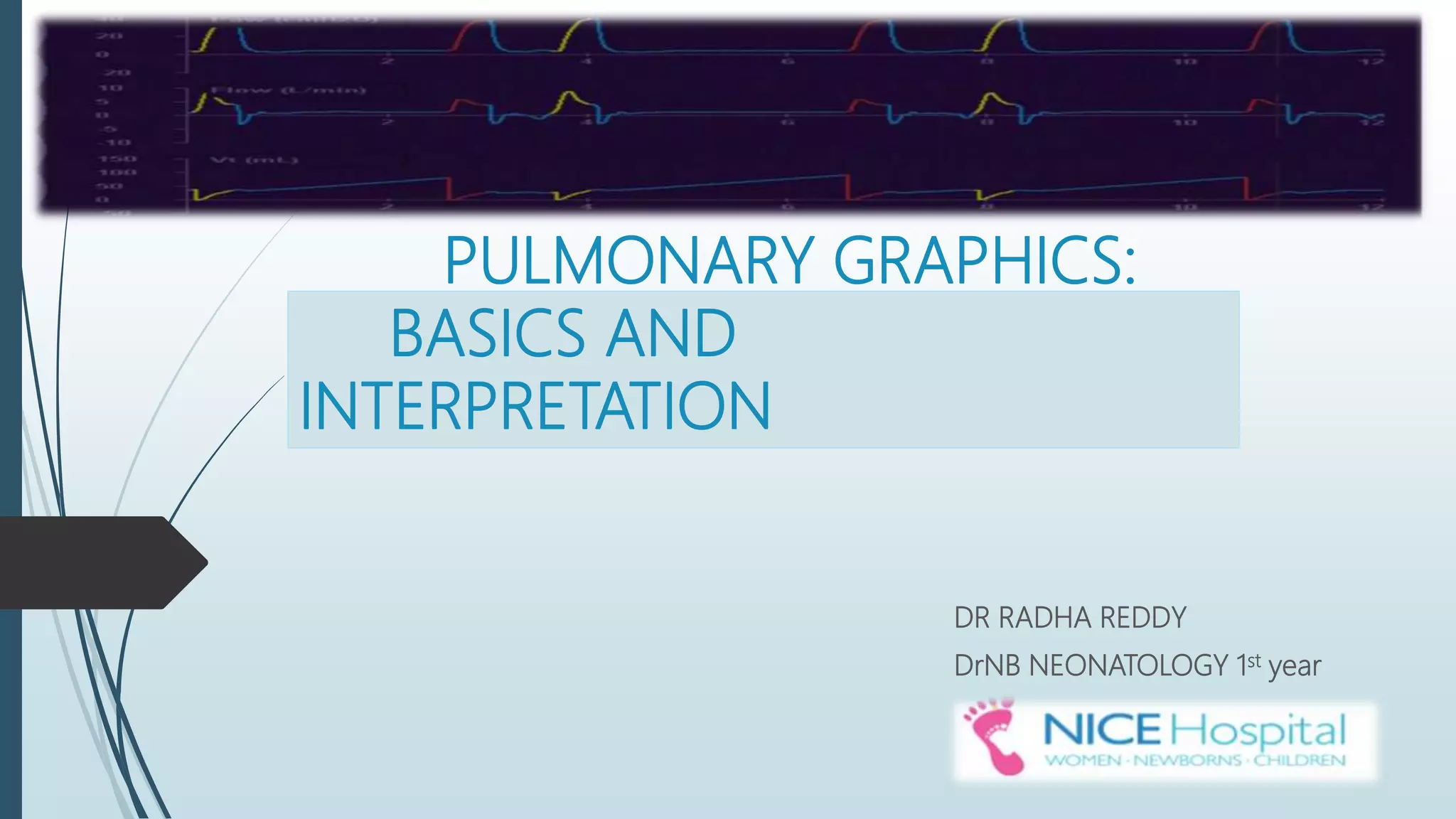
PULMONARY GRAPHICS:
BASICS AND
INTERPRETATION
DR RADHA REDDY
DrNB NEONATOLOGY 1st year
INTRODUCTION
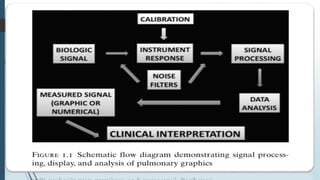
 Pulmonary graphic monitoring systems are composed of multiple units
that work together to create a visual or numerical display.
 Ventilator waveforms are the graphical depictions of patient ventilator
interactions.
 Monitoring and analysis of graphic display of curves and loops is a
critical tool in the management of the mechanically ventilated patient.
VENTILATOR GRAPHICS
 Allow users to interpret, evaluate, and troubleshoot the
ventilator and the patient’s response to the ventilator.
 Monitor the patient’s disease status (C and Raw).
 Allow fine tuning of ventilator to decrease WOB, optimize
ventilation, and maximize patient comfort.
 A skilled practitioner can use ventilator graphics to assess the
status of the patient’s lungs in the same way a cardiologist
uses an EKG to view the condition of the heart.
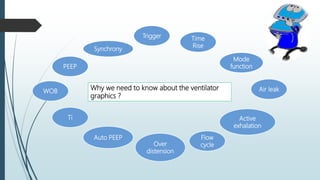
Why we need to know about the ventilator
graphics ?
PEEP
Auto PEEP
Over
distension
Synchrony
WOB
Trigger
Mode
function
Active
exhalation
Time
Rise
Flow
cycle
Ti
Air leak
Clinical applications of ventilator waveform analysis
Useful in many different situations including:
Diagnosing a ventilator that is ‘alarming’
Detecting obstructive flow patterns on the ventilator
Detecting air trapping and dynamic hyperinflation
Detecting lung overdistention
Gives objective evaluation of treatment
Optimize ventilator settings
Picks tube leakage, secretions
Facilitates weaning process
Detecting patient-ventilator interactions
Dysynchrony
Double triggering
Wasted efforts
Flow starvation
BASIC PRINCIPLES
 Oxygenation is proportional to Mean Airway Pressure (PIP
,
PEEP
, Ti, Rate)
 Ventilation is proportional to the product of frequency and
Vt (amplitude, or PIP – PEEP)
In CMV, CO2
removal = f x Vt
In HFV, CO2
removal = f x (Vt)2
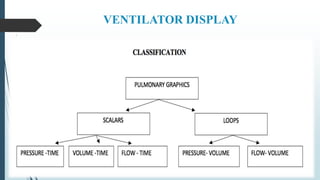
VENTILATOR DISPLAY
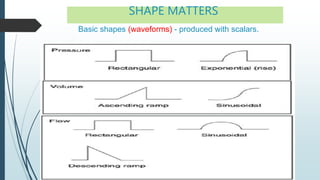
Basic shapes (waveforms) - produced with scalars.
SHAPE MATTERS
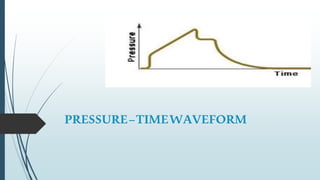
PRESSURE–TIMEWAVEFORM
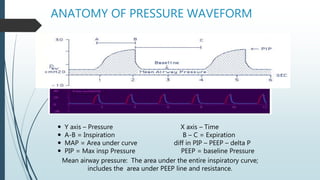
ANATOMY OF PRESSURE WAVEFORM
 Y axis – Pressure X axis – Time
 A-B = Inspiration B – C = Expiration
 MAP = Area under curve diff in PIP – PEEP – delta P
 PIP = Max insp Pressure PEEP = baseline Pressure
Mean airway pressure: The area under the entire inspiratory curve;
includes the area under PEEP line and resistance.
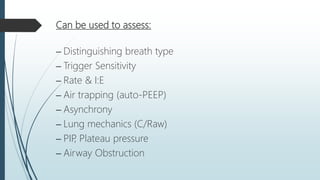
Can be used to assess:
– Distinguishing breath type
– Trigger Sensitivity
– Rate & I:E
– Air trapping (auto-PEEP)
– Asynchrony
– Lung mechanics (C/Raw)
– PIP
, Plateau pressure
– Airway Obstruction
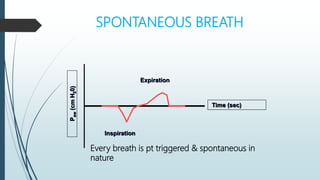
SPONTANEOUS BREATH
P
aw
(cm
H
2
0)
Time (sec)
Inspiration
Expiration
Every breath is pt triggered & spontaneous in
nature
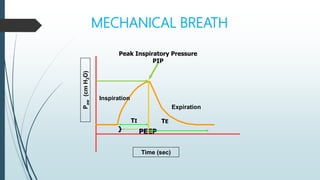
MECHANICAL BREATH
Inspiration
Expiration
P
aw
(cm
H
2
O)
Time (sec)
}
TI
Peak Inspiratory Pressure
PIP
PEEP
TE
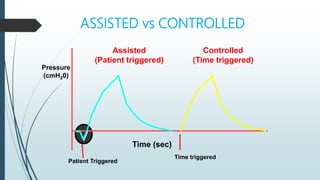
ASSISTED vs CONTROLLED
Time (sec)
Assisted
(Patient triggered)
Controlled
(Time triggered)
Pressure
(cmH20)
Patient Triggered
Time triggered
MECHANICAL BREATH [PRESSURE CONTROL]
Consistent Ti & Pressure delivery
•P reaches limit early in I and holds for Ti
(square)
•No Trigger
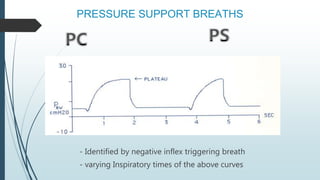
PRESSURE SUPPORT BREATHS
- Identified by negative inflex triggering breath
- varying Inspiratory times of the above curves
MECHANICAL BREATH [VOLUME CONTROL]
At point A – there is no negative deflection
•Consistent Ti & Volume delivery
•Pressure continues to rise until set V is reached, then breath cycles
•classically a “shark-fin” appearance, where an initially rapid rise in pressure is
followed by a gradual attainment of a peak inspiratory pressure (PIP).
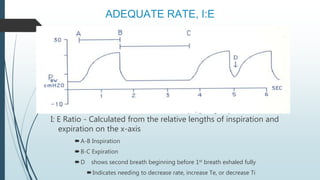
ADEQUATE RATE, I:E
I: E Ratio - Calculated from the relative lengths of inspiration and
expiration on the x-axis
A-B Inspiration
B-C Expiration
D shows second breath beginning before 1st breath exhaled fully
Indicates needing to decrease rate, increase Te, or decrease Ti
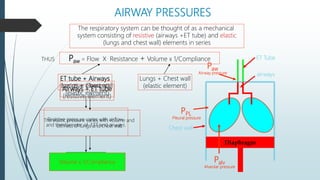
AIRWAY PRESSURES
The respiratory system can be thought of as a mechanical
system consisting of resistive (airways +ET tube) and elastic
(lungs and chest wall) elements in series
Diaphragm
ET Tube
airways
Chest wall
PPL
Pleural pressure
Paw
Airway pressure
Palv
Alveolar pressure
ET tube + Airways
(resistive element)
Resistive pressure varies with airflow
and the diameter of ETT and airways.
Flow resistance
The elastic pressure varies with volume and
stiffness of lungs and chest wall.
Volume x 1/Compliance
Paw = Flow X Resistance + Volume x 1/Compliance
THUS
Lungs + Chest wall
(elastic element)
Airways + ET tube
(resistive element)
Lungs + Chest wall
(elastic element)
Let us now understand how the respiratory systems’
inherent elastance and resistance to airflow
determines the pressures generated within a
mechanically ventilated system.
Ventilator
Diaphragm
RET tube
Rairways
Raw
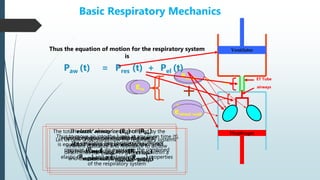
Basic Respiratory Mechanics
The total ‘airway’ resistance (Raw)
in the mechanically ventilated patient
is equal to the sum of the resistances offered
by the endotracheal tube (R ET tube)
and the patient’s airways ( R airways)
The total ‘elastic’ resistance (Ers) offered by the
respiratory system is equal to the sum of
elastic resistances offered by the
Lung E lungs and the
chest wall E chest wall
Elungs
Echest wall
Thus to move air into the lungs at any given time (t),
the ventilator has to generate sufficient
pressure (Paw(t)) to overcome the combined
elastic (Pel (t)) and resistance (Pres(t)) properties
of the respiratory system
Ers
ET Tube
airways
Thus the equation of motion for the respiratory system
is
Paw (t) = Pres (t) + Pel (t)
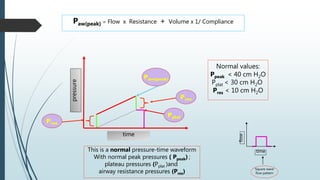
This is a normal pressure-time waveform
With normal peak pressures ( Ppeak) ;
plateau pressures (Pplat )and
airway resistance pressures (Pres)
time
pressure
Pres
Pplat
Pres
Paw(peak) = Flow x Resistance + Volume x 1/ Compliance
time
flow
‘Square wave’
flow pattern
Paw(peak)
Normal values:
Ppeak < 40 cm H2O
Pplat < 30 cm H2O
Pres < 10 cm H2O
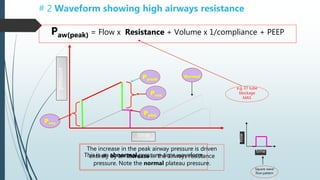
# 2 Waveform showing high airways resistance
This is an abnormal pressure-time waveform
time
pressure
Ppeak
Pres
Pplat
Pres
The increase in the peak airway pressure is driven
entirely by an increase in the airways resistance
pressure. Note the normal plateau pressure.
e.g. ET tube
blockage
MAS
Paw(peak) = Flow x Resistance + Volume x 1/compliance + PEEP
time
flow
‘Square wave’
flow pattern
Normal
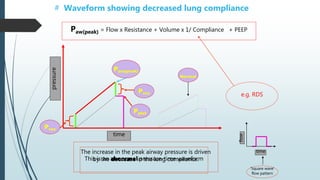
# Waveform showing decreased lung compliance
This is an abnormal pressure-time waveform
time
pressure
Pres
Pplat
Pres
The increase in the peak airway pressure is driven
by the decrease in the lung compliance.
e.g. RDS
Normal
time
flow
‘Square wave’
flow pattern
Paw(peak)
Paw(peak) = Flow x Resistance + Volume x 1/ Compliance + PEEP
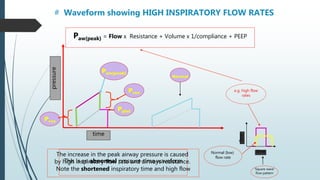
# Waveform showing HIGH INSPIRATORY FLOW RATES
This is an abnormal pressure-time waveform
time
pressure
Paw(peak)
Pres
Pplat
Pres
The increase in the peak airway pressure is caused
by high inspiratory flow rate and airways resistance.
Note the shortened inspiratory time and high flow
e.g. high flow
rates
Paw(peak) = Flow x Resistance + Volume x 1/compliance + PEEP
time
flow
‘Square wave’
flow pattern
Normal
Normal (low)
flow rate
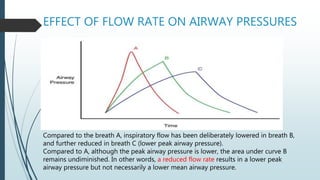
EFFECT OF FLOW RATE ON AIRWAY PRESSURES
Compared to the breath A, inspiratory flow has been deliberately lowered in breath B,
and further reduced in breath C (lower peak airway pressure).
Compared to A, although the peak airway pressure is lower, the area under curve B
remains undiminished. In other words, a reduced flow rate results in a lower peak
airway pressure but not necessarily a lower mean airway pressure.
Pressure
Time
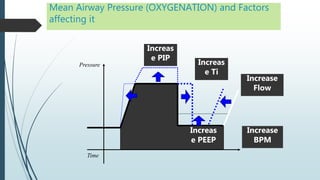
Mean Airway Pressure (OXYGENATION) and Factors
affecting it
 PIP
 Base
Line
Increas
e PEEP
Increas
e PIP
Increas
e Ti
Increase
Flow
Increase
BPM
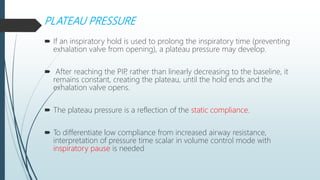
PLATEAU PRESSURE
 If an inspiratory hold is used to prolong the inspiratory time (preventing
exhalation valve from opening), a plateau pressure may develop.
 After reaching the PIP
, rather than linearly decreasing to the baseline, it
remains constant, creating the plateau, until the hold ends and the
exhalation valve opens.
 The plateau pressure is a reflection of the static compliance.
 To differentiate low compliance from increased airway resistance,
interpretation of pressure time scalar in volume control mode with
inspiratory pause is needed
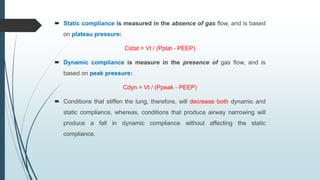
 Static compliance is measured in the absence of gas flow, and is based
on plateau pressure:
Cstat = Vt / (Pplat - PEEP)
 Dynamic compliance is measure in the presence of gas flow, and is
based on peak pressure:
Cdyn = Vt / (Ppeak - PEEP)
 Conditions that stiffen the lung, therefore, will decrease both dynamic and
static compliance, whereas, conditions that produce airway narrowing will
produce a fall in dynamic compliance without affecting the static
compliance.
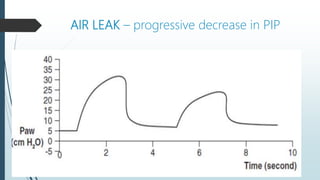
AIR LEAK – progressive decrease in PIP
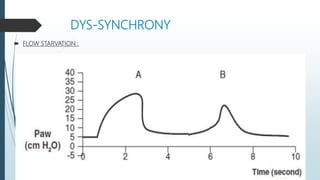
DYS‐SYNCHRONY
 FLOW STARVATION :
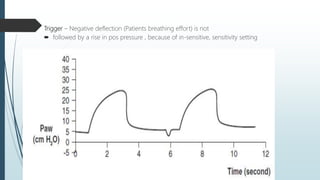
Trigger – Negative deflection (Patients breathing effort) is not
 followed by a rise in pos pressure , because of in-sensitive, sensitivity setting
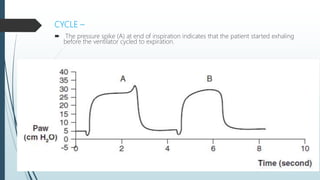
CYCLE –
 The pressure spike (A) at end of inspiration indicates that the patient started exhaling
before the ventilator cycled to expiration.
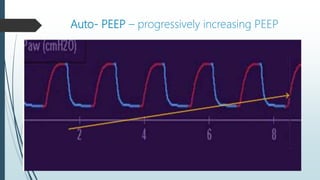
Auto‐ PEEP – progressively increasing PEEP
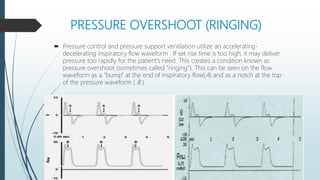
PRESSURE OVERSHOOT (RINGING)
 Pressure control and pressure support ventilation utilize an accelerating-
decelerating inspiratory flow waveform . If set rise time is too high, it may deliver
pressure too rapidly for the patient’s need. This creates a condition known as
pressure overshoot (sometimes called “ringing”). This can be seen on the flow
waveform as a “bump” at the end of inspiratory flow(A) and as a notch at the top
of the pressure waveform ( B ).
VOLUME-TIME
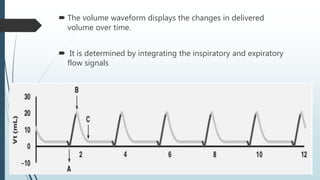
 The volume waveform displays the changes in delivered
volume over time.
 It is determined by integrating the inspiratory and expiratory
flow signals
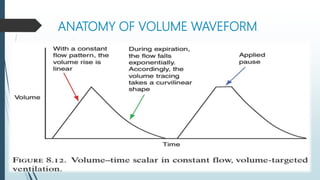
ANATOMY OF VOLUME WAVEFORM
 Can be used to assess:
Air trapping (auto-PEEP)
Leaks
Tidal Volume
Active Exhalation
Asynchrony
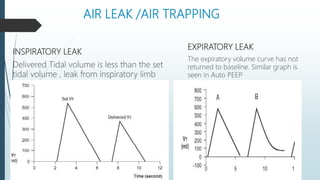
AIR LEAK /AIR TRAPPING
INSPIRATORY LEAK
Delivered Tidal volume is less than the set
tidal volume , leak from inspiratory limb
EXPIRATORY LEAK
The expiratory volume curve has not
returned to baseline. Similar graph is
seen in Auto PEEP
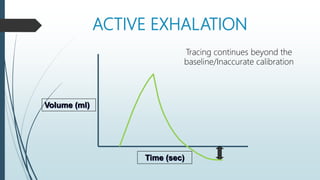
ACTIVE EXHALATION
Volume (ml)
Time (sec)
Tracing continues beyond the
baseline/Inaccurate calibration
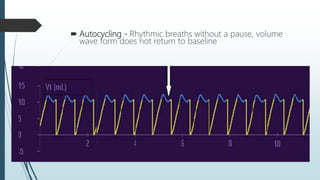
 Autocycling - Rhythmic breaths without a pause, volume
wave form does not return to baseline
FLOW-TIME
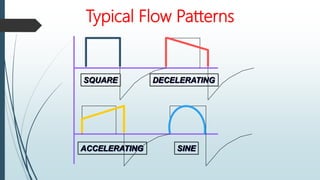
Typical Flow Patterns
ACCELERATING
DECELERATING
SINE
SQUARE
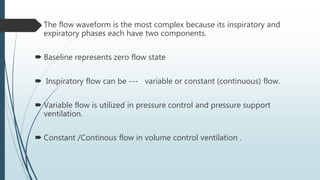
 The flow waveform is the most complex because its inspiratory and
expiratory phases each have two components.
 Baseline represents zero flow state
 Inspiratory flow can be --- variable or constant (continuous) flow.
 Variable flow is utilized in pressure control and pressure support
ventilation.
 Constant /Continous flow in volume control ventilation .
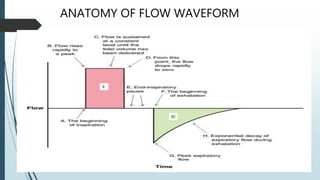
ANATOMY OF FLOW WAVEFORM
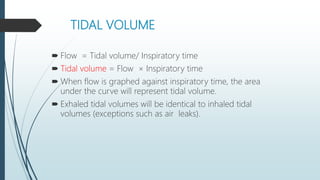
TIDAL VOLUME
 Flow = Tidal volume/ Inspiratory time
 Tidal volume = Flow × Inspiratory time
 When flow is graphed against inspiratory time, the area
under the curve will represent tidal volume.
 Exhaled tidal volumes will be identical to inhaled tidal
volumes (exceptions such as air leaks).
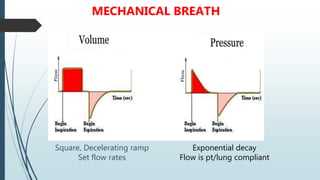
Square, Decelerating ramp
Set flow rates
Exponential decay
Flow is pt/lung compliant
MECHANICAL BREATH
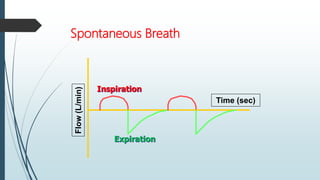
Spontaneous Breath
Time (sec)
Flow
(L/min)
Inspiration
Expiration
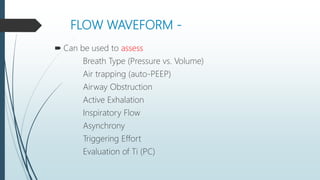
FLOW WAVEFORM -
 Can be used to assess
Breath Type (Pressure vs. Volume)
Air trapping (auto-PEEP)
Airway Obstruction
Active Exhalation
Inspiratory Flow
Asynchrony
Triggering Effort
Evaluation of Ti (PC)
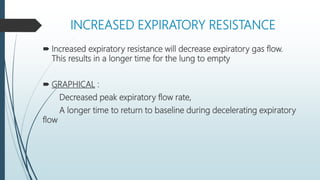
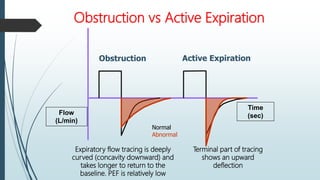
INCREASED EXPIRATORY RESISTANCE
 Increased expiratory resistance will decrease expiratory gas flow.
This results in a longer time for the lung to empty
 GRAPHICAL :
Decreased peak expiratory flow rate,
A longer time to return to baseline during decelerating expiratory
flow
Obstruction vs Active Expiration
Obstruction Active Expiration
Time
(sec)
Normal
Abnormal
Flow
(L/min)
Expiratory flow tracing is deeply
curved (concavity downward) and
takes longer to return to the
baseline. PEF is relatively low
Terminal part of tracing
shows an upward
deflection
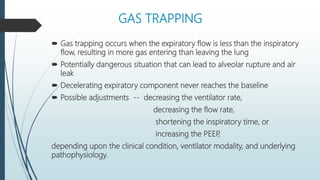
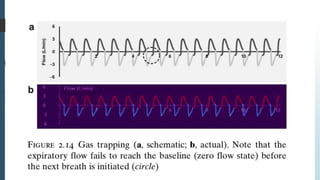
GAS TRAPPING
 Gas trapping occurs when the expiratory flow is less than the inspiratory
flow, resulting in more gas entering than leaving the lung
 Potentially dangerous situation that can lead to alveolar rupture and air
leak
 Decelerating expiratory component never reaches the baseline
 Possible adjustments -- decreasing the ventilator rate,
decreasing the flow rate,
shortening the inspiratory time, or
increasing the PEEP
,
depending upon the clinical condition, ventilator modality, and underlying
pathophysiology.
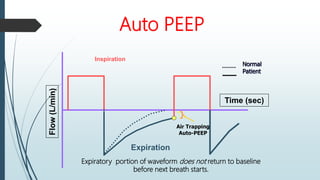
Auto PEEP
Inspiration
Expiration
Normal
Patient
Time (sec)
Flow
(L/min)
Air Trapping
Auto-PEEP
}
Expiratory portion of waveform does not return to baseline
before next breath starts.
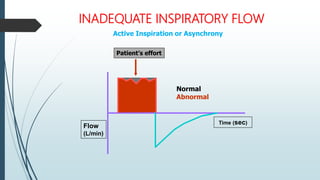
INADEQUATE INSPIRATORY FLOW
Flow
(L/min)
Time (sec)
Normal
Abnormal
Active Inspiration or Asynchrony
Patient’s effort
ENDOTRACHEAL TUBE LEAKS
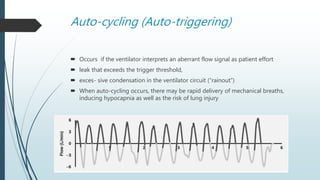
Auto-cycling (Auto-triggering)
 Occurs if the ventilator interprets an aberrant flow signal as patient effort
 leak that exceeds the trigger threshold,
 exces- sive condensation in the ventilator circuit (“rainout”)
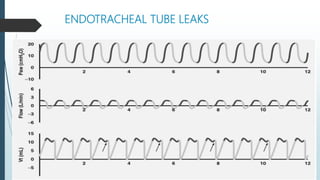
 When auto-cycling occurs, there may be rapid delivery of mechanical breaths,
inducing hypocapnia as well as the risk of lung injury
LOOPS
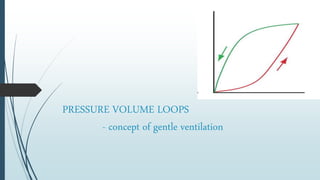
PRESSURE VOLUME LOOPS
- concept of gentle ventilation
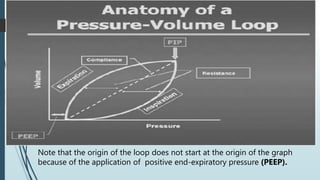
PRESSURE – VOLUME LOOPS
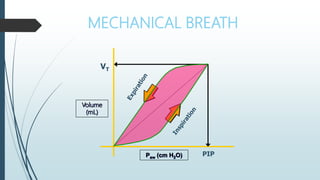
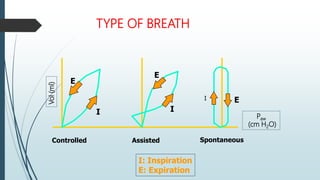
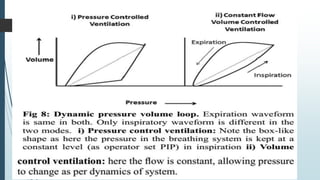
 Volume is plotted on the Y-axis, Pressure on the X-axis.
 Inspiratory curve is upward, Expiratory curve is downward.
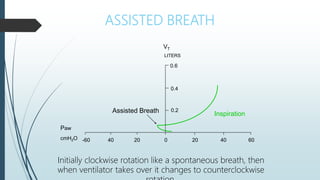
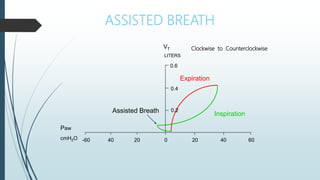
 Spontaneous breaths go clockwise and positive pressure breaths go
counterclockwise.
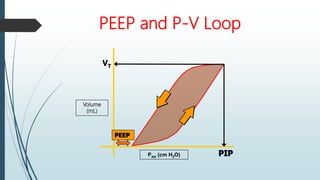
 The bottom of the loop will be at the set PEEP level. It will be at 0 if
there’s no PEEP set.
 If an imaginary line is drawn down the middle of the loop, the area to
the right represents inspiratory resistance and the area to the left
represents expiratory resistance.
Note that the origin of the loop does not start at the origin of the graph
because of the application of positive end-expiratory pressure (PEEP).
MECHANICAL BREATH
Volume
(mL)
PIP
VT
Paw (cm H2O)
ASSISTED BREATH
Inspiration
0 20 40 60
20
40
-60
0.2
LITERS
0.4
0.6
Paw
cmH2O
Assisted Breath
VT
Initially clockwise rotation like a spontaneous breath, then
when ventilator takes over it changes to counterclockwise
ASSISTED BREATH
Inspiration
Expiration
0 20 40 60
20
40
-60
0.2
LITERS
0.4
0.6
Paw
cmH2O
Assisted Breath
VT Clockwise to Counterclockwise
TYPE OF BREATH
Controlled Assisted Spontaneous
Vol
(ml)
Paw
(cm H2O)
I: Inspiration
E: Expiration
I
E
E
E
I
I
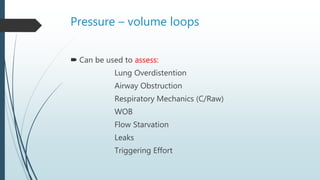
Pressure – volume loops
 Can be used to assess:
Lung Overdistention
Airway Obstruction
Respiratory Mechanics (C/Raw)
WOB
Flow Starvation
Leaks
Triggering Effort
PEEP and P-V Loop
Volume
(mL)
VT
PIP
Paw (cm H2O)
PEEP
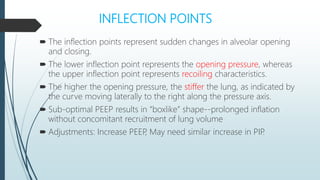
INFLECTION POINTS
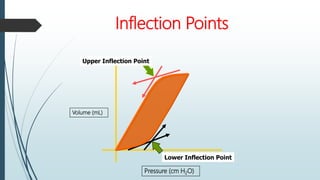
 The inflection points represent sudden changes in alveolar opening
and closing.
 The lower inflection point represents the opening pressure, whereas
the upper inflection point represents recoiling characteristics.
 The higher the opening pressure, the stiffer the lung, as indicated by
the curve moving laterally to the right along the pressure axis.
 Sub-optimal PEEP results in “boxlike” shape--prolonged inflation
without concomitant recruitment of lung volume
 Adjustments: Increase PEEP
, May need similar increase in PIP
.
Inflection Points
Pressure (cm H2O)
Volume (mL)
Upper Inflection Point
Lower Inflection Point
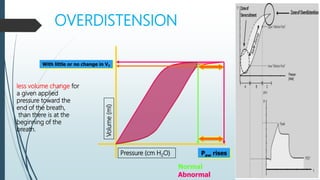
OVERDISTENSION
Volume
(ml)
Pressure (cm H2O)
With little or no change in VT
Paw rises
Normal
Abnormal
less volume change for
a given applied
pressure toward the
end of the breath,
than there is at the
beginning of the
breath.
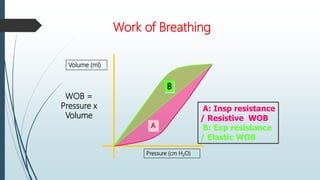
Work of Breathing
A: Insp resistance
/ Resistive WOB
B: Exp resistance
/ Elastic WOB
Pressure (cm H2O)
Volume (ml)
B
A
WOB =
Pressure x
Volume
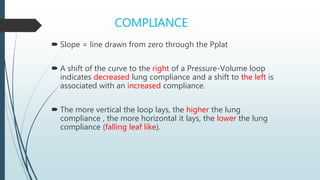
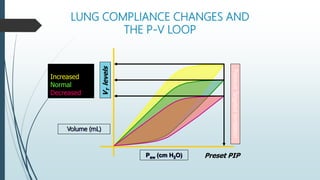
COMPLIANCE
 Slope = line drawn from zero through the Pplat
 A shift of the curve to the right of a Pressure-Volume loop
indicates decreased lung compliance and a shift to the left is
associated with an increased compliance.
 The more vertical the loop lays, the higher the lung
compliance , the more horizontal it lays, the lower the lung
compliance (falling leaf like).
LUNG COMPLIANCE CHANGES AND
THE P-V LOOP
Volume (mL)
Preset PIP
V
T
levels
Paw (cm H2O)
COMPLIANCE
Increased
Normal
Decreased
Pressure
Targeted
Ventilation
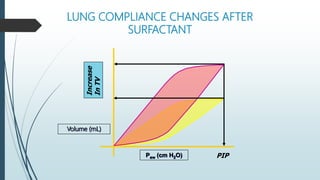
LUNG COMPLIANCE CHANGES AFTER
SURFACTANT
Volume (mL)
PIP
Increase
In
TV
Paw (cm H2O)
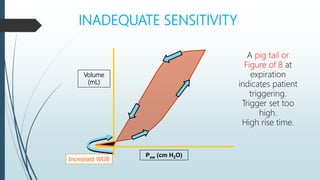
INADEQUATE SENSITIVITY
Volume
(mL)
Paw (cm H2O)
Increased WOB
A pig tail or
Figure of 8 at
expiration
indicates patient
triggering.
Trigger set too
high.
High rise time.
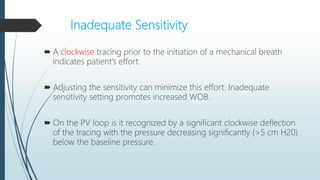
Inadequate Sensitivity
 A clockwise tracing prior to the initiation of a mechanical breath
indicates patient’s effort.
 Adjusting the sensitivity can minimize this effort. Inadequate
sensitivity setting promotes increased WOB.
 On the PV loop is it recognized by a significant clockwise deflection
of the tracing with the pressure decreasing significantly (>5 cm H20)
below the baseline pressure.
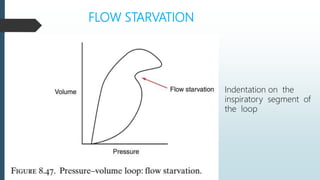
FLOW STARVATION
Indentation on the
inspiratory segment of
the loop
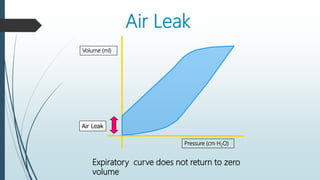
Air Leak
Volume (ml)
Pressure (cm H2O)
Air Leak
Expiratory curve does not return to zero
volume
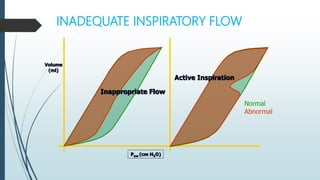
INADEQUATE INSPIRATORY FLOW
Paw (cm H2O)
Volume
(ml)
Normal
Abnormal
Active Inspiration
Inappropriate Flow
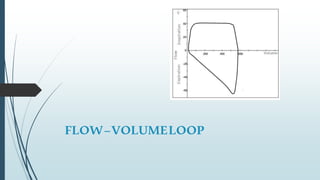
FLOW–VOLUMELOOP
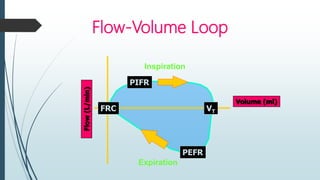
Flow-Volume Loop
Volume (ml)
PEFR
FRC
Inspiration
Expiration
PIFR
VT
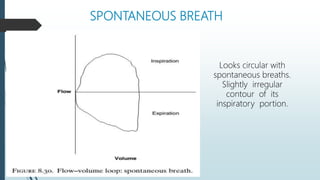
SPONTANEOUS BREATH
Looks circular with
spontaneous breaths.
Slightly irregular
contour of its
inspiratory portion.
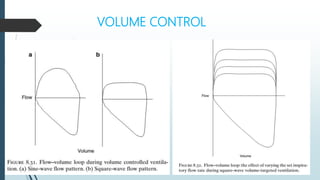
VOLUME CONTROL
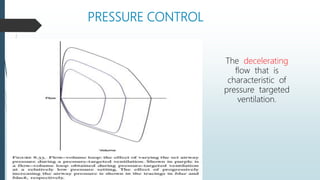
PRESSURE CONTROL
The decelerating
flow that is
characteristic of
pressure targeted
ventilation.
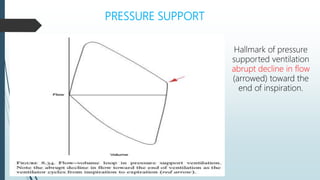
PRESSURE SUPPORT
Hallmark of pressure
supported ventilation
abrupt decline in flow
(arrowed) toward the
end of inspiration.
FLOW VOLUME LOOP
 Can be used to assess:
Air trapping
Airway Obstruction
Airway Resistance
Insp/Exp Flow
Flow Starvation
Leaks
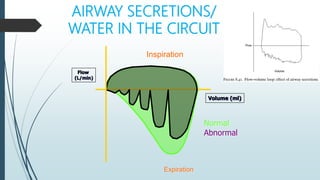
Water or Secretion accumulation
Asynchrony
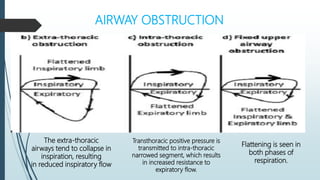
AIRWAY OBSTRUCTION
The extra-thoracic
airways tend to collapse in
inspiration, resulting
in reduced inspiratory flow
Transthoracic positive pressure is
transmitted to intra-thoracic
narrowed segment, which results
in increased resistance to
expiratory flow.
Flattening is seen in
both phases of
respiration.
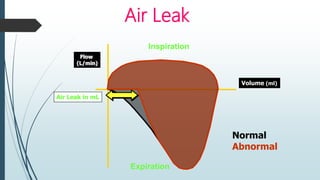
Air Leak
Inspiration
Expiration
Volume (ml)
Flow
(L/min)
Air Leak in mL
Normal
Abnormal
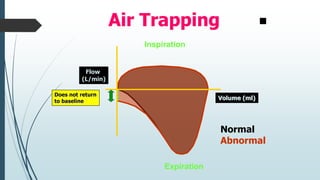
Air Trapping
Inspiration
Expiration
Volume (ml)
Flow
(L/min)
Does not return
to baseline
Normal
Abnormal
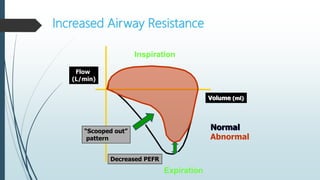
Increased Airway Resistance
Inspiration
Expiration
Volume (ml)
Flow
(L/min)
Decreased PEFR
Normal
Abnormal
“Scooped out”
pattern
AIRWAY SECRETIONS/
WATER IN THE CIRCUIT
Inspiration
Expiration
Volume (ml)
Flow
(L/min)
Normal
Abnormal
RECOGNITIONOFDIFFERENT
MODESOFVENTILATION
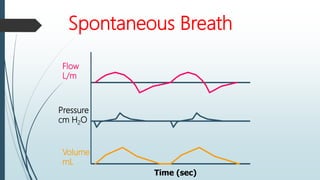
Spontaneous Breath
Time (sec)
Flow
L/m
Pressure
cm H2O
Volume
mL
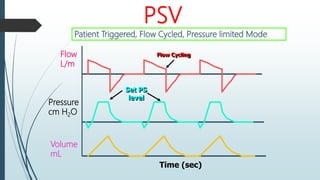
PSV
Time (sec)
Flow
L/m
Pressure
cm H2O
Volume
mL
Flow Cycling
Set PS
level
Patient Triggered, Flow Cycled, Pressure limited Mode
WAVEFORMS TO OBSERVE DURING
VOLUME ASSIST/CONTROL VENTILATION
 Pressure-time waveform:
Is ‘dynamic’ and is affected by patient effort and changes in
respiratory system compliance and resistance.
 Flow-time waveform:
The inspiratory arm of the flow time waveform is ‘static’ and
reflects what you set for flows.
But the expiratory flow-time waveform is ‘dynamic’ and reflects
the elastic recoil pressure of respiratory system and patient
effort.
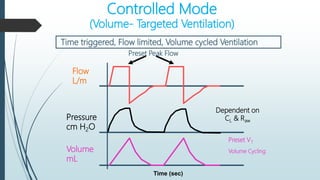
Controlled Mode
(Volume- Targeted Ventilation)
Preset VT
Volume Cycling
Dependent on
CL & Raw
Time (sec)
Flow
L/m
Pressure
cm H2O
Volume
mL
Preset Peak Flow
Time triggered, Flow limited, Volume cycled Ventilation
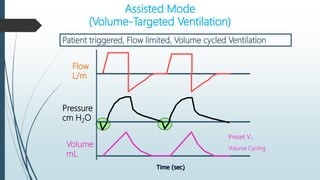
Assisted Mode
(Volume-Targeted Ventilation)
Time (sec)
Flow
L/m
Pressure
cm H2O
Volume
mL
Preset VT
Volume Cycling
Patient triggered, Flow limited, Volume cycled Ventilation
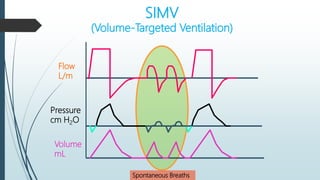
SIMV
(Volume-Targeted Ventilation)
Spontaneous Breaths
Flow
L/m
Pressure
cm H2O
Volume
mL
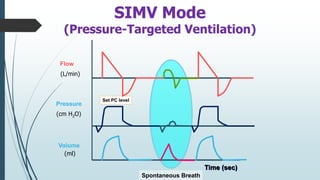
Pressure
Flow
Volume
(L/min)
(cm H2O)
(ml)
Set PC level
Time (sec)
SIMV Mode
(Pressure-Targeted Ventilation)
Spontaneous Breath
Pressure
Flow
Volume
(L/min)
(cm H2O)
(ml)
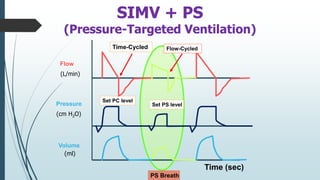
SIMV + PS
(Pressure-Targeted Ventilation)
PS Breath
Set PS level
Set PC level
Time (sec)
Time-Cycled Flow-Cycled
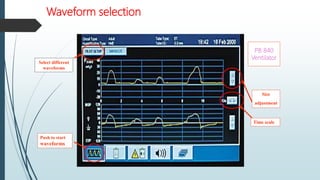
Waveform selection
Push to start
waveforms
Time scale
Size
adjustment
Select different
waveforms
PB 840
Ventilator
Effect of cycling
 Time
 Flow
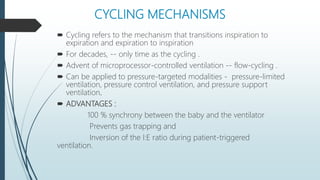
CYCLING MECHANISMS
 Cycling refers to the mechanism that transitions inspiration to
expiration and expiration to inspiration
 For decades, -- only time as the cycling .
 Advent of microprocessor-controlled ventilation -- flow-cycling .
 Can be applied to pressure-targeted modalities - pressure-limited
ventilation, pressure control ventilation, and pressure support
ventilation.
 ADVANTAGES :
100 % synchrony between the baby and the ventilator
Prevents gas trapping and
Inversion of the I:E ratio during patient-triggered
ventilation.
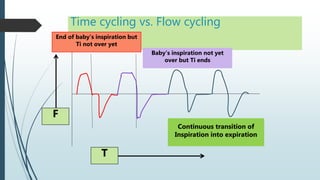
Time cycling vs. Flow cycling
T
F
Continuous transition of
Inspiration into expiration
End of baby’s inspiration but
Ti not over yet
Baby’s inspiration not yet
over but Ti ends
LIMITATIONS OF PULMONARY GRAPHICS
 A major drawback is that the equipment required to measure and display
pulmonary mechanics and graphics has not been standardized.
 Interpretation of pulmonary graphics requires pattern recognition.
Unfortunately, this can be distorted by improper scaling of axes, and even
the direction of flow volume loops can be either clockwise or
counterclockwise.
 Some reference values are still lacking.
 Significant inter- and intra-patient variability has been reported.
 Clinicians need to be mindful that what is being measured is the mechanical
properties of the lungs and airways (pulmonary mechanics), and not true
gas exchange (pulmonary function).
 Finally, we must be cognizant that the use of uncuffed endotracheal tubes
will result in some degree of leak, and this can have an important impact on
how the system functions
Take home points
 Ventilator waveform analysis is an integral component in the management of a
mechanically ventilated patient.
 Caution: Look at the baby too !!!
 ‘Observation’ and not just ‘Watching’
 For every bit of information given by pulmonary graphics there are clinical
methods
 ‘Complement’ and not Supplant clinical parameters
THANK YOU

Pulmonary graphics radha

  • 1.
    PULMONARY GRAPHICS: BASICS AND INTERPRETATION DRRADHA REDDY DrNB NEONATOLOGY 1st year
  • 2.
    INTRODUCTION  Pulmonary graphicmonitoring systems are composed of multiple units that work together to create a visual or numerical display.  Ventilator waveforms are the graphical depictions of patient ventilator interactions.  Monitoring and analysis of graphic display of curves and loops is a critical tool in the management of the mechanically ventilated patient.
  • 4.
    VENTILATOR GRAPHICS  Allowusers to interpret, evaluate, and troubleshoot the ventilator and the patient’s response to the ventilator.  Monitor the patient’s disease status (C and Raw).  Allow fine tuning of ventilator to decrease WOB, optimize ventilation, and maximize patient comfort.  A skilled practitioner can use ventilator graphics to assess the status of the patient’s lungs in the same way a cardiologist uses an EKG to view the condition of the heart.
  • 5.
    Why we needto know about the ventilator graphics ? PEEP Auto PEEP Over distension Synchrony WOB Trigger Mode function Active exhalation Time Rise Flow cycle Ti Air leak
  • 6.
    Clinical applications ofventilator waveform analysis Useful in many different situations including: Diagnosing a ventilator that is ‘alarming’ Detecting obstructive flow patterns on the ventilator Detecting air trapping and dynamic hyperinflation Detecting lung overdistention Gives objective evaluation of treatment
  • 7.
    Optimize ventilator settings Pickstube leakage, secretions Facilitates weaning process Detecting patient-ventilator interactions Dysynchrony Double triggering Wasted efforts Flow starvation
  • 8.
    BASIC PRINCIPLES  Oxygenationis proportional to Mean Airway Pressure (PIP , PEEP , Ti, Rate)  Ventilation is proportional to the product of frequency and Vt (amplitude, or PIP – PEEP) In CMV, CO2 removal = f x Vt In HFV, CO2 removal = f x (Vt)2
  • 9.
  • 10.
    Basic shapes (waveforms)- produced with scalars. SHAPE MATTERS
  • 11.
  • 12.
    ANATOMY OF PRESSUREWAVEFORM  Y axis – Pressure X axis – Time  A-B = Inspiration B – C = Expiration  MAP = Area under curve diff in PIP – PEEP – delta P  PIP = Max insp Pressure PEEP = baseline Pressure Mean airway pressure: The area under the entire inspiratory curve; includes the area under PEEP line and resistance.
  • 13.
    Can be usedto assess: – Distinguishing breath type – Trigger Sensitivity – Rate & I:E – Air trapping (auto-PEEP) – Asynchrony – Lung mechanics (C/Raw) – PIP , Plateau pressure – Airway Obstruction
  • 14.
  • 15.
  • 16.
    ASSISTED vs CONTROLLED Time(sec) Assisted (Patient triggered) Controlled (Time triggered) Pressure (cmH20) Patient Triggered Time triggered
  • 17.
    MECHANICAL BREATH [PRESSURECONTROL] Consistent Ti & Pressure delivery •P reaches limit early in I and holds for Ti (square) •No Trigger
  • 18.
    PRESSURE SUPPORT BREATHS -Identified by negative inflex triggering breath - varying Inspiratory times of the above curves
  • 19.
    MECHANICAL BREATH [VOLUMECONTROL] At point A – there is no negative deflection •Consistent Ti & Volume delivery •Pressure continues to rise until set V is reached, then breath cycles •classically a “shark-fin” appearance, where an initially rapid rise in pressure is followed by a gradual attainment of a peak inspiratory pressure (PIP).
  • 20.
    ADEQUATE RATE, I:E I:E Ratio - Calculated from the relative lengths of inspiration and expiration on the x-axis A-B Inspiration B-C Expiration D shows second breath beginning before 1st breath exhaled fully Indicates needing to decrease rate, increase Te, or decrease Ti
  • 21.
    AIRWAY PRESSURES The respiratorysystem can be thought of as a mechanical system consisting of resistive (airways +ET tube) and elastic (lungs and chest wall) elements in series Diaphragm ET Tube airways Chest wall PPL Pleural pressure Paw Airway pressure Palv Alveolar pressure ET tube + Airways (resistive element) Resistive pressure varies with airflow and the diameter of ETT and airways. Flow resistance The elastic pressure varies with volume and stiffness of lungs and chest wall. Volume x 1/Compliance Paw = Flow X Resistance + Volume x 1/Compliance THUS Lungs + Chest wall (elastic element) Airways + ET tube (resistive element) Lungs + Chest wall (elastic element)
  • 22.
    Let us nowunderstand how the respiratory systems’ inherent elastance and resistance to airflow determines the pressures generated within a mechanically ventilated system. Ventilator Diaphragm RET tube Rairways Raw Basic Respiratory Mechanics The total ‘airway’ resistance (Raw) in the mechanically ventilated patient is equal to the sum of the resistances offered by the endotracheal tube (R ET tube) and the patient’s airways ( R airways) The total ‘elastic’ resistance (Ers) offered by the respiratory system is equal to the sum of elastic resistances offered by the Lung E lungs and the chest wall E chest wall Elungs Echest wall Thus to move air into the lungs at any given time (t), the ventilator has to generate sufficient pressure (Paw(t)) to overcome the combined elastic (Pel (t)) and resistance (Pres(t)) properties of the respiratory system Ers ET Tube airways Thus the equation of motion for the respiratory system is Paw (t) = Pres (t) + Pel (t)
  • 23.
    This is anormal pressure-time waveform With normal peak pressures ( Ppeak) ; plateau pressures (Pplat )and airway resistance pressures (Pres) time pressure Pres Pplat Pres Paw(peak) = Flow x Resistance + Volume x 1/ Compliance time flow ‘Square wave’ flow pattern Paw(peak) Normal values: Ppeak < 40 cm H2O Pplat < 30 cm H2O Pres < 10 cm H2O
  • 24.
    # 2 Waveformshowing high airways resistance This is an abnormal pressure-time waveform time pressure Ppeak Pres Pplat Pres The increase in the peak airway pressure is driven entirely by an increase in the airways resistance pressure. Note the normal plateau pressure. e.g. ET tube blockage MAS Paw(peak) = Flow x Resistance + Volume x 1/compliance + PEEP time flow ‘Square wave’ flow pattern Normal
  • 25.
    # Waveform showingdecreased lung compliance This is an abnormal pressure-time waveform time pressure Pres Pplat Pres The increase in the peak airway pressure is driven by the decrease in the lung compliance. e.g. RDS Normal time flow ‘Square wave’ flow pattern Paw(peak) Paw(peak) = Flow x Resistance + Volume x 1/ Compliance + PEEP
  • 26.
    # Waveform showingHIGH INSPIRATORY FLOW RATES This is an abnormal pressure-time waveform time pressure Paw(peak) Pres Pplat Pres The increase in the peak airway pressure is caused by high inspiratory flow rate and airways resistance. Note the shortened inspiratory time and high flow e.g. high flow rates Paw(peak) = Flow x Resistance + Volume x 1/compliance + PEEP time flow ‘Square wave’ flow pattern Normal Normal (low) flow rate
  • 27.
    EFFECT OF FLOWRATE ON AIRWAY PRESSURES Compared to the breath A, inspiratory flow has been deliberately lowered in breath B, and further reduced in breath C (lower peak airway pressure). Compared to A, although the peak airway pressure is lower, the area under curve B remains undiminished. In other words, a reduced flow rate results in a lower peak airway pressure but not necessarily a lower mean airway pressure.
  • 28.
    Pressure Time Mean Airway Pressure(OXYGENATION) and Factors affecting it  PIP  Base Line Increas e PEEP Increas e PIP Increas e Ti Increase Flow Increase BPM
  • 29.
    PLATEAU PRESSURE  Ifan inspiratory hold is used to prolong the inspiratory time (preventing exhalation valve from opening), a plateau pressure may develop.  After reaching the PIP , rather than linearly decreasing to the baseline, it remains constant, creating the plateau, until the hold ends and the exhalation valve opens.  The plateau pressure is a reflection of the static compliance.  To differentiate low compliance from increased airway resistance, interpretation of pressure time scalar in volume control mode with inspiratory pause is needed
  • 30.
     Static complianceis measured in the absence of gas flow, and is based on plateau pressure: Cstat = Vt / (Pplat - PEEP)  Dynamic compliance is measure in the presence of gas flow, and is based on peak pressure: Cdyn = Vt / (Ppeak - PEEP)  Conditions that stiffen the lung, therefore, will decrease both dynamic and static compliance, whereas, conditions that produce airway narrowing will produce a fall in dynamic compliance without affecting the static compliance.
  • 31.
    AIR LEAK –progressive decrease in PIP
  • 32.
  • 33.
    Trigger – Negativedeflection (Patients breathing effort) is not  followed by a rise in pos pressure , because of in-sensitive, sensitivity setting
  • 34.
    CYCLE –  Thepressure spike (A) at end of inspiration indicates that the patient started exhaling before the ventilator cycled to expiration.
  • 35.
    Auto‐ PEEP –progressively increasing PEEP
  • 36.
    PRESSURE OVERSHOOT (RINGING) Pressure control and pressure support ventilation utilize an accelerating- decelerating inspiratory flow waveform . If set rise time is too high, it may deliver pressure too rapidly for the patient’s need. This creates a condition known as pressure overshoot (sometimes called “ringing”). This can be seen on the flow waveform as a “bump” at the end of inspiratory flow(A) and as a notch at the top of the pressure waveform ( B ).
  • 37.
  • 38.
     The volumewaveform displays the changes in delivered volume over time.  It is determined by integrating the inspiratory and expiratory flow signals
  • 39.
  • 40.
     Can beused to assess: Air trapping (auto-PEEP) Leaks Tidal Volume Active Exhalation Asynchrony
  • 41.
    AIR LEAK /AIRTRAPPING INSPIRATORY LEAK Delivered Tidal volume is less than the set tidal volume , leak from inspiratory limb EXPIRATORY LEAK The expiratory volume curve has not returned to baseline. Similar graph is seen in Auto PEEP
  • 42.
    ACTIVE EXHALATION Volume (ml) Time(sec) Tracing continues beyond the baseline/Inaccurate calibration
  • 43.
     Autocycling -Rhythmic breaths without a pause, volume wave form does not return to baseline
  • 44.
  • 45.
  • 46.
     The flowwaveform is the most complex because its inspiratory and expiratory phases each have two components.  Baseline represents zero flow state  Inspiratory flow can be --- variable or constant (continuous) flow.  Variable flow is utilized in pressure control and pressure support ventilation.  Constant /Continous flow in volume control ventilation .
  • 47.
  • 48.
    TIDAL VOLUME  Flow= Tidal volume/ Inspiratory time  Tidal volume = Flow × Inspiratory time  When flow is graphed against inspiratory time, the area under the curve will represent tidal volume.  Exhaled tidal volumes will be identical to inhaled tidal volumes (exceptions such as air leaks).
  • 49.
    Square, Decelerating ramp Setflow rates Exponential decay Flow is pt/lung compliant MECHANICAL BREATH
  • 50.
  • 51.
    FLOW WAVEFORM - Can be used to assess Breath Type (Pressure vs. Volume) Air trapping (auto-PEEP) Airway Obstruction Active Exhalation Inspiratory Flow Asynchrony Triggering Effort Evaluation of Ti (PC)
  • 52.
    INCREASED EXPIRATORY RESISTANCE Increased expiratory resistance will decrease expiratory gas flow. This results in a longer time for the lung to empty  GRAPHICAL : Decreased peak expiratory flow rate, A longer time to return to baseline during decelerating expiratory flow
  • 53.
    Obstruction vs ActiveExpiration Obstruction Active Expiration Time (sec) Normal Abnormal Flow (L/min) Expiratory flow tracing is deeply curved (concavity downward) and takes longer to return to the baseline. PEF is relatively low Terminal part of tracing shows an upward deflection
  • 54.
    GAS TRAPPING  Gastrapping occurs when the expiratory flow is less than the inspiratory flow, resulting in more gas entering than leaving the lung  Potentially dangerous situation that can lead to alveolar rupture and air leak  Decelerating expiratory component never reaches the baseline  Possible adjustments -- decreasing the ventilator rate, decreasing the flow rate, shortening the inspiratory time, or increasing the PEEP , depending upon the clinical condition, ventilator modality, and underlying pathophysiology.
  • 56.
    Auto PEEP Inspiration Expiration Normal Patient Time (sec) Flow (L/min) AirTrapping Auto-PEEP } Expiratory portion of waveform does not return to baseline before next breath starts.
  • 57.
    INADEQUATE INSPIRATORY FLOW Flow (L/min) Time(sec) Normal Abnormal Active Inspiration or Asynchrony Patient’s effort
  • 58.
  • 59.
    Auto-cycling (Auto-triggering)  Occursif the ventilator interprets an aberrant flow signal as patient effort  leak that exceeds the trigger threshold,  exces- sive condensation in the ventilator circuit (“rainout”)  When auto-cycling occurs, there may be rapid delivery of mechanical breaths, inducing hypocapnia as well as the risk of lung injury
  • 60.
  • 61.
    PRESSURE VOLUME LOOPS -concept of gentle ventilation
  • 62.
    PRESSURE – VOLUMELOOPS  Volume is plotted on the Y-axis, Pressure on the X-axis.  Inspiratory curve is upward, Expiratory curve is downward.  Spontaneous breaths go clockwise and positive pressure breaths go counterclockwise.  The bottom of the loop will be at the set PEEP level. It will be at 0 if there’s no PEEP set.  If an imaginary line is drawn down the middle of the loop, the area to the right represents inspiratory resistance and the area to the left represents expiratory resistance.
  • 63.
    Note that theorigin of the loop does not start at the origin of the graph because of the application of positive end-expiratory pressure (PEEP).
  • 64.
  • 65.
    ASSISTED BREATH Inspiration 0 2040 60 20 40 -60 0.2 LITERS 0.4 0.6 Paw cmH2O Assisted Breath VT Initially clockwise rotation like a spontaneous breath, then when ventilator takes over it changes to counterclockwise
  • 66.
    ASSISTED BREATH Inspiration Expiration 0 2040 60 20 40 -60 0.2 LITERS 0.4 0.6 Paw cmH2O Assisted Breath VT Clockwise to Counterclockwise
  • 67.
    TYPE OF BREATH ControlledAssisted Spontaneous Vol (ml) Paw (cm H2O) I: Inspiration E: Expiration I E E E I I
  • 69.
    Pressure – volumeloops  Can be used to assess: Lung Overdistention Airway Obstruction Respiratory Mechanics (C/Raw) WOB Flow Starvation Leaks Triggering Effort
  • 70.
    PEEP and P-VLoop Volume (mL) VT PIP Paw (cm H2O) PEEP
  • 71.
    INFLECTION POINTS  Theinflection points represent sudden changes in alveolar opening and closing.  The lower inflection point represents the opening pressure, whereas the upper inflection point represents recoiling characteristics.  The higher the opening pressure, the stiffer the lung, as indicated by the curve moving laterally to the right along the pressure axis.  Sub-optimal PEEP results in “boxlike” shape--prolonged inflation without concomitant recruitment of lung volume  Adjustments: Increase PEEP , May need similar increase in PIP .
  • 72.
    Inflection Points Pressure (cmH2O) Volume (mL) Upper Inflection Point Lower Inflection Point
  • 73.
    OVERDISTENSION Volume (ml) Pressure (cm H2O) Withlittle or no change in VT Paw rises Normal Abnormal less volume change for a given applied pressure toward the end of the breath, than there is at the beginning of the breath.
  • 74.
    Work of Breathing A:Insp resistance / Resistive WOB B: Exp resistance / Elastic WOB Pressure (cm H2O) Volume (ml) B A WOB = Pressure x Volume
  • 75.
    COMPLIANCE  Slope =line drawn from zero through the Pplat  A shift of the curve to the right of a Pressure-Volume loop indicates decreased lung compliance and a shift to the left is associated with an increased compliance.  The more vertical the loop lays, the higher the lung compliance , the more horizontal it lays, the lower the lung compliance (falling leaf like).
  • 76.
    LUNG COMPLIANCE CHANGESAND THE P-V LOOP Volume (mL) Preset PIP V T levels Paw (cm H2O) COMPLIANCE Increased Normal Decreased Pressure Targeted Ventilation
  • 77.
    LUNG COMPLIANCE CHANGESAFTER SURFACTANT Volume (mL) PIP Increase In TV Paw (cm H2O)
  • 79.
    INADEQUATE SENSITIVITY Volume (mL) Paw (cmH2O) Increased WOB A pig tail or Figure of 8 at expiration indicates patient triggering. Trigger set too high. High rise time.
  • 80.
    Inadequate Sensitivity  Aclockwise tracing prior to the initiation of a mechanical breath indicates patient’s effort.  Adjusting the sensitivity can minimize this effort. Inadequate sensitivity setting promotes increased WOB.  On the PV loop is it recognized by a significant clockwise deflection of the tracing with the pressure decreasing significantly (>5 cm H20) below the baseline pressure.
  • 81.
    FLOW STARVATION Indentation onthe inspiratory segment of the loop
  • 82.
    Air Leak Volume (ml) Pressure(cm H2O) Air Leak Expiratory curve does not return to zero volume
  • 83.
    INADEQUATE INSPIRATORY FLOW Paw(cm H2O) Volume (ml) Normal Abnormal Active Inspiration Inappropriate Flow
  • 84.
  • 85.
  • 86.
    SPONTANEOUS BREATH Looks circularwith spontaneous breaths. Slightly irregular contour of its inspiratory portion.
  • 87.
  • 88.
    PRESSURE CONTROL The decelerating flowthat is characteristic of pressure targeted ventilation.
  • 89.
    PRESSURE SUPPORT Hallmark ofpressure supported ventilation abrupt decline in flow (arrowed) toward the end of inspiration.
  • 90.
    FLOW VOLUME LOOP Can be used to assess: Air trapping Airway Obstruction Airway Resistance Insp/Exp Flow Flow Starvation Leaks Water or Secretion accumulation Asynchrony
  • 91.
    AIRWAY OBSTRUCTION The extra-thoracic airwaystend to collapse in inspiration, resulting in reduced inspiratory flow Transthoracic positive pressure is transmitted to intra-thoracic narrowed segment, which results in increased resistance to expiratory flow. Flattening is seen in both phases of respiration.
  • 92.
  • 93.
  • 94.
    Increased Airway Resistance Inspiration Expiration Volume(ml) Flow (L/min) Decreased PEFR Normal Abnormal “Scooped out” pattern
  • 95.
    AIRWAY SECRETIONS/ WATER INTHE CIRCUIT Inspiration Expiration Volume (ml) Flow (L/min) Normal Abnormal
  • 96.
  • 97.
  • 98.
    PSV Time (sec) Flow L/m Pressure cm H2O Volume mL FlowCycling Set PS level Patient Triggered, Flow Cycled, Pressure limited Mode
  • 99.
    WAVEFORMS TO OBSERVEDURING VOLUME ASSIST/CONTROL VENTILATION  Pressure-time waveform: Is ‘dynamic’ and is affected by patient effort and changes in respiratory system compliance and resistance.  Flow-time waveform: The inspiratory arm of the flow time waveform is ‘static’ and reflects what you set for flows. But the expiratory flow-time waveform is ‘dynamic’ and reflects the elastic recoil pressure of respiratory system and patient effort.
  • 100.
    Controlled Mode (Volume- TargetedVentilation) Preset VT Volume Cycling Dependent on CL & Raw Time (sec) Flow L/m Pressure cm H2O Volume mL Preset Peak Flow Time triggered, Flow limited, Volume cycled Ventilation
  • 101.
    Assisted Mode (Volume-Targeted Ventilation) Time(sec) Flow L/m Pressure cm H2O Volume mL Preset VT Volume Cycling Patient triggered, Flow limited, Volume cycled Ventilation
  • 102.
  • 103.
    Pressure Flow Volume (L/min) (cm H2O) (ml) Set PClevel Time (sec) SIMV Mode (Pressure-Targeted Ventilation) Spontaneous Breath
  • 104.
    Pressure Flow Volume (L/min) (cm H2O) (ml) SIMV +PS (Pressure-Targeted Ventilation) PS Breath Set PS level Set PC level Time (sec) Time-Cycled Flow-Cycled
  • 106.
    Waveform selection Push tostart waveforms Time scale Size adjustment Select different waveforms PB 840 Ventilator
  • 107.
    Effect of cycling Time  Flow
  • 108.
    CYCLING MECHANISMS  Cyclingrefers to the mechanism that transitions inspiration to expiration and expiration to inspiration  For decades, -- only time as the cycling .  Advent of microprocessor-controlled ventilation -- flow-cycling .  Can be applied to pressure-targeted modalities - pressure-limited ventilation, pressure control ventilation, and pressure support ventilation.  ADVANTAGES : 100 % synchrony between the baby and the ventilator Prevents gas trapping and Inversion of the I:E ratio during patient-triggered ventilation.
  • 109.
    Time cycling vs.Flow cycling T F Continuous transition of Inspiration into expiration End of baby’s inspiration but Ti not over yet Baby’s inspiration not yet over but Ti ends
  • 110.
    LIMITATIONS OF PULMONARYGRAPHICS  A major drawback is that the equipment required to measure and display pulmonary mechanics and graphics has not been standardized.  Interpretation of pulmonary graphics requires pattern recognition. Unfortunately, this can be distorted by improper scaling of axes, and even the direction of flow volume loops can be either clockwise or counterclockwise.  Some reference values are still lacking.  Significant inter- and intra-patient variability has been reported.  Clinicians need to be mindful that what is being measured is the mechanical properties of the lungs and airways (pulmonary mechanics), and not true gas exchange (pulmonary function).  Finally, we must be cognizant that the use of uncuffed endotracheal tubes will result in some degree of leak, and this can have an important impact on how the system functions
  • 111.
    Take home points Ventilator waveform analysis is an integral component in the management of a mechanically ventilated patient.  Caution: Look at the baby too !!!  ‘Observation’ and not just ‘Watching’  For every bit of information given by pulmonary graphics there are clinical methods  ‘Complement’ and not Supplant clinical parameters
  • 112.